Luteolin — Benefits Deep Dive
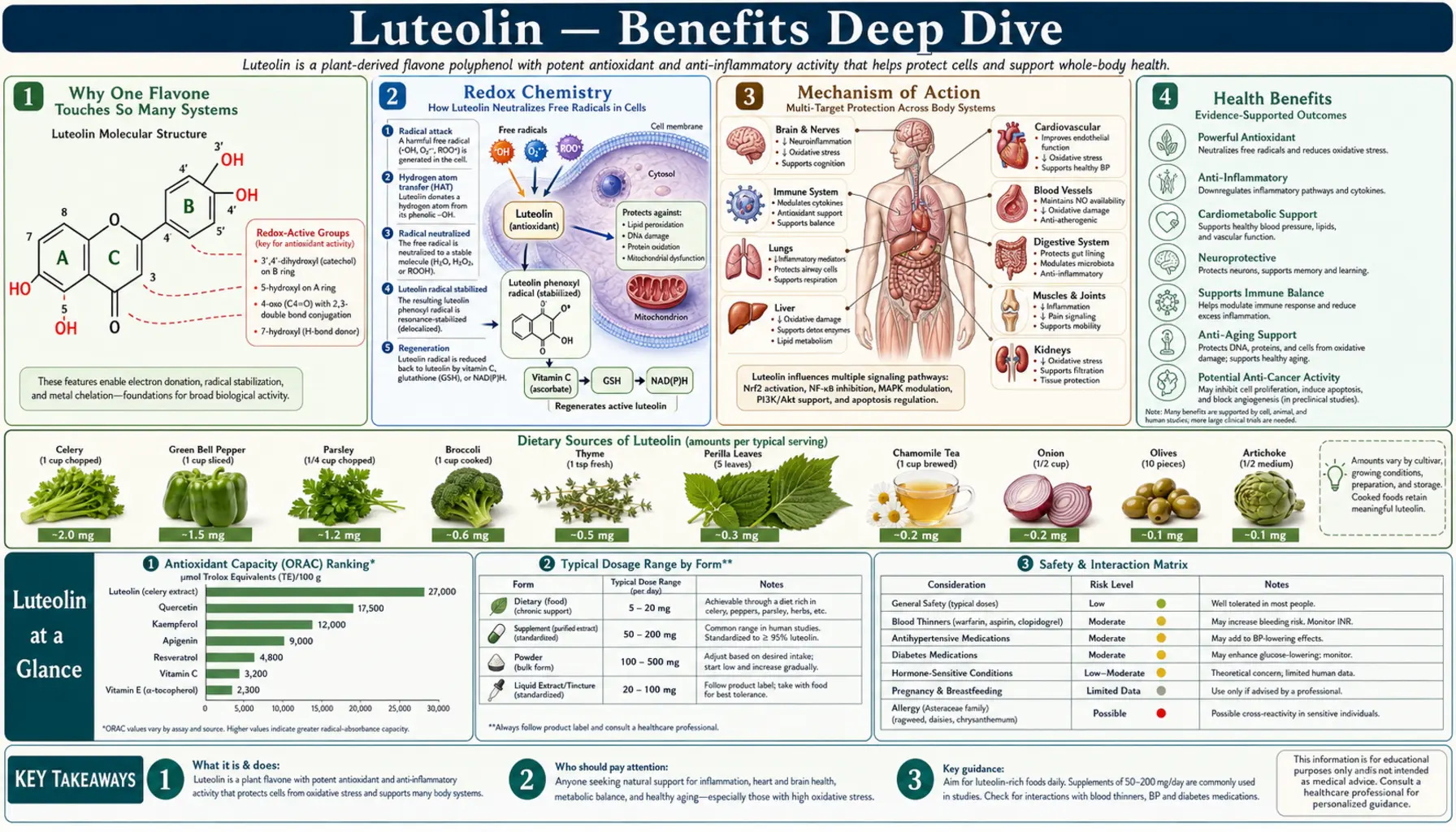
Luteolin is a plant flavone — chemically 3',4',5,7-tetrahydroxyflavone — that gives celery, parsley, thyme, sweet peppers, and chamomile part of their color and much of their pharmacology. In the laboratory it is one of the most reliably anti-inflammatory and mast-cell-calming molecules in the plant kingdom, and it has become a focus of research into brain inflammation, allergy, and immune balance. It is important to be honest about where the evidence stands: luteolin's antioxidant and anti-inflammatory mechanisms are well characterized in cells and animals, its allergy and mast-cell effects are strong in preclinical models, but the human clinical trials are still small and preliminary — especially for the brain. The four pages below walk through what is genuinely known, what is promising but unproven, and how to get luteolin from ordinary food.
Deep-Dive Articles
Brain & Neuroinflammation
The most talked-about — and most preliminary — research area. How luteolin quiets activated microglia and mast cells in the brain, the small open-label autism pilot, senescent-mouse memory studies, and the honest limits of the “brain fog” conversation. Mostly cell and animal work plus a handful of tiny human pilots.
Antioxidant & Anti-Inflammatory
The mechanistic core. Direct free-radical scavenging by the catechol B-ring, activation of the Nrf2/HO-1 antioxidant defense system, and suppression of the NF-κB inflammatory switch that turns down TNF-α, IL-6, iNOS, and COX-2. This is the best-established part of luteolin's biology.
Allergy & Mast Cells
Why luteolin is studied as a natural mast-cell stabilizer. It blunts FcεRI-triggered degranulation and histamine, tryptase, and prostaglandin release — in one human-cell study more potently than the drug cromolyn. Strong in the lab and in allergy-model animals; human trials remain limited.
Dietary Sources
Where luteolin actually comes from: celery and celery seed, fresh and dried parsley, thyme and other Mediterranean herbs, sweet peppers, chamomile tea, artichoke, and oregano. Realistic food amounts, why dried herbs concentrate it, and why luteolin is poorly absorbed — the bioavailability problem.
Table of Contents
- Deep-Dive Articles
- Why One Flavone Touches So Many Systems
- Research Papers: Brain & Neuroinflammation
- Research Papers: Antioxidant & Anti-Inflammatory
- Research Papers: Allergy & Mast Cells
- Research Papers: Dietary Sources & Bioavailability
- Research Papers: Cross-Cutting (Reviews & Pharmacology)
- External Authoritative Resources
- Connections
- Featured Videos
Why One Flavone Touches So Many Systems
At first glance it seems too convenient that a single molecule from parsley could be relevant to allergy, brain inflammation, and antioxidant defense all at once. The explanation is not that luteolin is a cure-all — it is that these seemingly different problems share a small number of upstream control points, and luteolin happens to touch those control points.
- The NF-κB inflammatory switch. NF-κB is a master transcription factor that turns on the genes for inflammatory messengers — TNF-α, IL-6, IL-1β, iNOS, COX-2. Luteolin interferes with the kinase cascade that activates NF-κB, so it turns the volume down on inflammation wherever that switch is running hot: in a macrophage, in a brain microglial cell, or in the lining of an inflamed airway. This is the single mechanism that most unifies its effects and is explored on the Antioxidant & Anti-Inflammatory page.
- The Nrf2 antioxidant defense system. Rather than only scavenging free radicals directly, luteolin activates Nrf2, the transcription factor that switches on the cell's own protective enzymes (heme oxygenase-1, glutathione-synthesizing enzymes). This gives a longer-lasting, self-renewing antioxidant effect than a molecule that is simply consumed when it neutralizes a radical.
- Mast-cell and microglial stabilization. Mast cells (in tissues) and microglia (in the brain) are the two “first-responder” cells that release inflammatory mediators fastest. Luteolin dampens both — blocking the calcium influx and FcεRI signaling that make a mast cell degranulate, and shifting microglia from an inflammatory to a quiescent state. This links the allergy story and the brain story, which are really the same cell biology in two different tissues.
The honest caveat that runs through all four pages is bioavailability. Luteolin is poorly water-soluble and heavily metabolized after you eat it, so the striking concentrations that produce these effects in a cell-culture dish are much higher than what circulates after a normal meal. That does not erase the food-level benefit — population studies do associate higher luteolin intake with better outcomes — but it is the reason to be skeptical of dramatic claims and to treat luteolin as one helpful component of a plant-rich diet rather than a standalone treatment. The Sources page covers this directly.
Research Papers: Brain & Neuroinflammation
- Theoharides TC et al. (2009). Luteolin as a therapeutic option for multiple sclerosis. Journal of Neuroinflammation. — PubMed 19825165
- Jang S et al. (2008). Luteolin reduces IL-6 production in microglia by inhibiting JNK phosphorylation and activation of AP-1. PNAS. — PubMed 18490655
- Dirscherl K et al. (2010). Luteolin triggers global changes in the microglial transcriptome leading to a unique anti-inflammatory and neuroprotective phenotype. Journal of Neuroinflammation. — PubMed 20074346
- Burton MD et al. (2016). Dietary Luteolin Reduces Proinflammatory Microglia in the Brain of Senescent Mice. Rejuvenation Research. — PubMed 26918466
- Taliou A et al. (2013). An open-label pilot study of a formulation containing the anti-inflammatory flavonoid luteolin and its effects on behavior in children with autism spectrum disorders. Clinical Therapeutics. — PubMed 23688534
Research Papers: Antioxidant & Anti-Inflammatory
- Xagorari A et al. (2001). Luteolin inhibits an endotoxin-stimulated phosphorylation cascade and proinflammatory cytokine production in macrophages. Journal of Pharmacology and Experimental Therapeutics. — PubMed 11123379
- Aziz N et al. (2018). Anti-inflammatory effects of luteolin: A review of in vitro, in vivo, and in silico studies. Journal of Ethnopharmacology. — PubMed 29801717
- Seelinger G et al. (2008). Anti-oxidant, anti-inflammatory and anti-allergic activities of luteolin. Planta Medica. — PubMed 18937165
- Lin Y et al. (2008). Luteolin, a flavonoid with potential for cancer prevention and therapy. Current Cancer Drug Targets. — PubMed 18991571
- Tan X et al. (2019). Luteolin Exerts Neuroprotection via Modulation of the p62/Keap1/Nrf2 Pathway. Frontiers in Pharmacology. — PubMed 32038239
Research Papers: Allergy & Mast Cells
- Tsilioni I et al. (2024). Luteolin Is More Potent than Cromolyn in Their Ability to Inhibit Mediator Release from Cultured Human Mast Cells. International Archives of Allergy and Immunology. — PubMed 38588651
- Kritas SK et al. (2013). Luteolin inhibits mast cell-mediated allergic inflammation. Journal of Biological Regulators and Homeostatic Agents. — PubMed 24382176
- Kimata M et al. (2000). Effects of luteolin, quercetin and baicalein on immunoglobulin E-mediated mediator release from human cultured mast cells. Clinical & Experimental Allergy. — PubMed 10718847
- Hao Y et al. (2022). Luteolin inhibits FcεRI- and MRGPRX2-mediated mast cell activation by regulating calcium signaling. Phytotherapy Research. — PubMed 35315143
- Kim SH et al. (2018). Luteolin attenuates airway inflammation by inducing the transition of CD4+CD25- to CD4+CD25+ regulatory T cells. European Journal of Pharmacology. — PubMed 29225189
Research Papers: Dietary Sources & Bioavailability
- Miean KH, Mohamed S (2001). Flavonoid (myricetin, quercetin, kaempferol, luteolin, and apigenin) content of edible tropical plants. Journal of Agricultural and Food Chemistry. — PubMed 11410016
- Shimoi K et al. (1998). Intestinal absorption of luteolin and luteolin 7-O-beta-glucoside in rats and humans. FEBS Letters. — PubMed 9827549
- López-Lázaro M (2009). Distribution and biological activities of the flavonoid luteolin. Mini-Reviews in Medicinal Chemistry. — PubMed 19149659
- Somerset SM, Johannot L (2008). Dietary flavonoid sources in Australian adults. Nutrition and Cancer. — PubMed 18584477
- Yao X et al. (2024). Dietary intake of luteolin is negatively associated with all-cause and cardiovascular mortality. BMC Public Health. — PubMed 39080632
Research Papers: Cross-Cutting (Reviews & Pharmacology)
- Nabavi SF et al. (2015). Luteolin as an anti-inflammatory and neuroprotective agent: A brief review. Brain Research Bulletin. — PubMed 26361743
- Theoharides TC et al. (2019). Recent advances in our understanding of mast cell activation. Expert Review of Clinical Immunology. — PubMed 30884251
- Shi M et al. (2024). Luteolin, a flavone ingredient: Anticancer mechanisms, combined medication strategy, pharmacokinetics. Phytotherapy Research. — PubMed 38088265
- Mahto K et al. (2025). Therapeutic potential of luteolin in neurodegenerative disorders: targeting Nrf2, NF-κB. Inflammopharmacology. — PubMed 40694206
- Theoharides TC et al. (2018). Tetramethoxyluteolin for the Treatment of Neurodegenerative Diseases. Current Topics in Medicinal Chemistry. — PubMed 30451113
External Authoritative Resources
- PubChem — Luteolin (CID 5280445) — structure, properties, and a curated bioactivity index
- USDA FoodData Central — food composition database (search foods for flavone content)
- NIH Office of Dietary Supplements — Fact Sheets (flavonoids and dietary bioactives)
- Linus Pauling Institute — Flavonoids — authoritative overview of dietary flavonoids including flavones
- PubMed — All research on luteolin (thousands of papers)
Connections
- Luteolin (Main Page)
- Luteolin for Brain & Neuroinflammation
- Luteolin: Antioxidant & Anti-Inflammatory
- Luteolin for Allergy & Mast Cells
- Dietary Sources of Luteolin
- Apigenin (Sister Flavone)
- Quercetin
- Fisetin
- All Antioxidants
- Mast Cell Activation Syndrome
- Allergic Rhinitis
- Asthma
- Celery
- Thyme
- Chamomile