Glutathione: History and Discovery
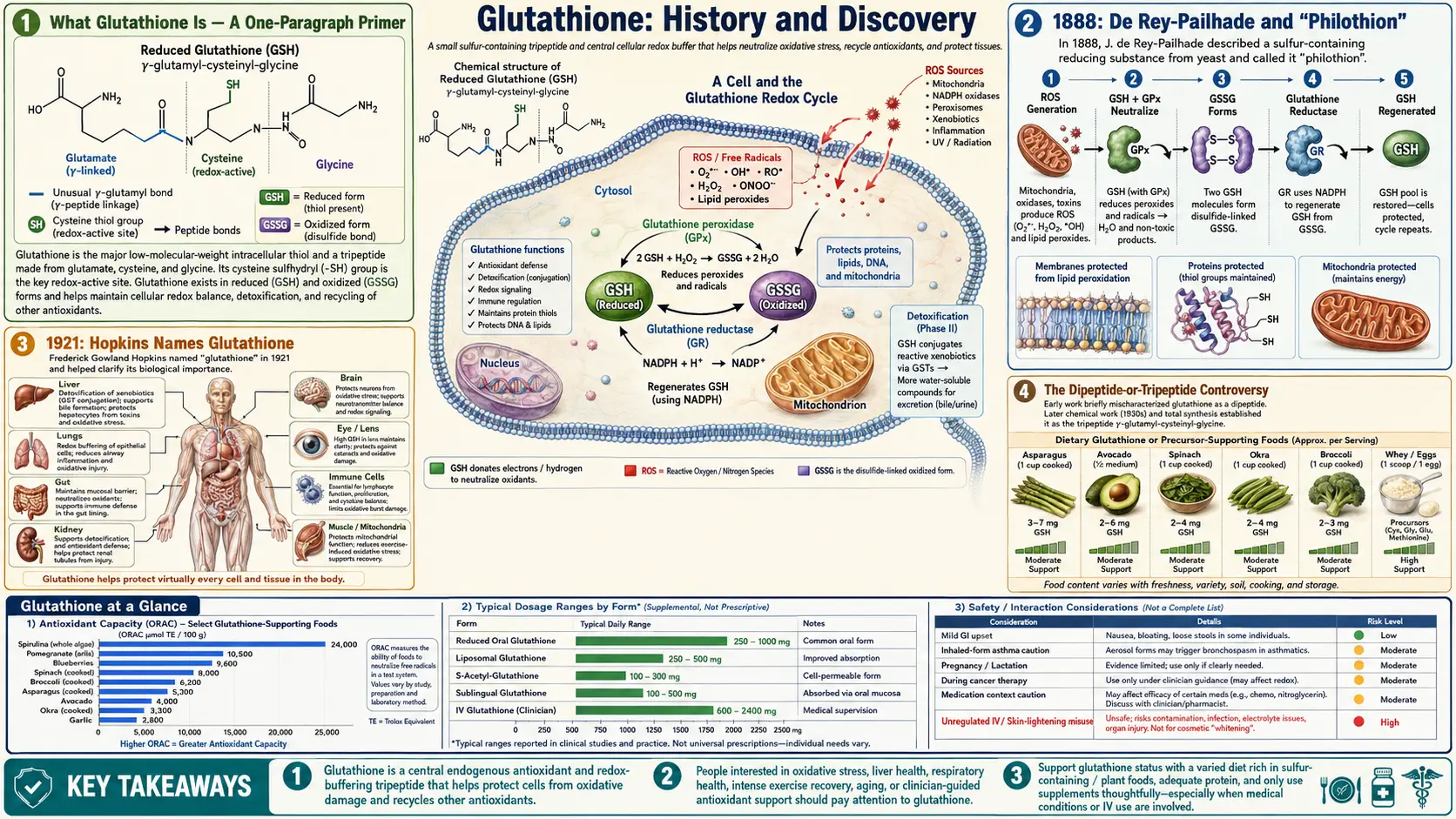
Glutathione is now described as the body's "master antioxidant," but for most of human history nobody knew it existed. Its story is almost entirely a scientific one, unfolding across roughly fifty years and several countries. It begins in 1888, when a French medical student noticed that yeast cells could pull sulfur out of solution and named the responsible substance for its love of sulfur. It runs through a famous and bad-tempered scientific dispute in the 1920s over whether the molecule had two amino acids or three, settled only when chemists built it from scratch in the 1930s. And it continues into the modern era, when researchers worked out how the body recycles glutathione, why it needs the trace mineral selenium to do its job, and how much of it sits in everyday foods. This page traces what the documented record actually supports, names the real researchers where the history is firm, and flags the places where credit is shared or the picture is still being filled in.
Interactive Visualization Free Radicals & Your Antioxidant Network Follow one superoxide radical down the whole relay — SOD, catalase, glutathione, vitamin E, vitamin C, NADPH — then release free iron and watch a membrane tear itself apart. Launch →
Table of Contents
- What Glutathione Is — A One-Paragraph Primer
- 1888: De Rey-Pailhade and "Philothion"
- 1921: Hopkins Names Glutathione
- The Dipeptide-or-Tripeptide Controversy
- 1935: The Structure Settled by Synthesis
- 1957–1973: The Enzyme and the Selenium Surprise
- The γ-Glutamyl Cycle and the Modern Era
- Glutathione in Food: Dietary and Cultural Context
- Research Papers and References
- Connections
- Featured Videos
What Glutathione Is — A One-Paragraph Primer
Before the history makes sense, it helps to know what was being discovered. Glutathione is a small molecule built from three amino acids — glutamate, cysteine, and glycine — strung together in a chain. Because it is made of three amino acid building blocks, chemists call it a tripeptide. Its working part is a single sulfur atom carried on the cysteine, and that sulfur is what lets glutathione mop up reactive molecules, hand off electrons, and help the body neutralise toxins. Almost every cell makes its own glutathione and keeps it at high concentrations. None of this was understood in 1888; the people in this story were working it out one careful, often contested, step at a time. For the full modern biochemistry and clinical uses, see the main Glutathione page; this article is about how it came to be known.
1888: De Rey-Pailhade and "Philothion"
The earliest documented sighting of glutathione belongs to Joseph de Rey-Pailhade, a French researcher working in Toulouse, in 1888. Studying extracts of brewer's yeast, he found that the living cells contained a substance that reacted spontaneously with elemental sulfur to release hydrogen sulfide — the rotten-egg gas. He went on to detect the same activity widely across animal tissues, in samples such as skeletal muscle and liver, and concluded he had found a real, broadly distributed cellular constituent rather than a quirk of yeast.
Because the substance seemed so eager to combine with sulfur, de Rey-Pailhade named it philothion, from the Greek roots meaning "love" (philos) and "sulfur" (theion) — literally, the sulfur-loving thing. He did not isolate it in pure form or work out its chemical structure; the tools of the day could not do that. What he established was the essential first fact: that cells contain a reactive, sulfur-bearing compound found throughout the living world. For more than thirty years that observation sat largely unexploited, and the substance kept its evocative but pre-modern name.
1921: Hopkins Names Glutathione
The molecule re-entered science through one of the most important British biochemists of the twentieth century. Frederick Gowland Hopkins, working at the University of Cambridge, published a landmark paper in 1921 in the Biochemical Journal, titled "On an autoxidisable constituent of the cell." In it he reported isolating from muscle, liver, and yeast a compound that readily took up oxygen, and he proposed the name we still use: glutathione — coined to flag that the molecule contained glutamic acid and a sulfur-bearing component (a thiol). Hopkins is the person who gave the substance its modern identity, lifting it out of the curiosity stage and into mainstream biochemistry.
Hopkins is a towering figure for a separate reason: he was a founder of the idea that the diet must supply "accessory food factors" — what we now call vitamins — and he shared the 1929 Nobel Prize in Physiology or Medicine for that vitamin work (not, it should be said, for glutathione). That standing matters to the story, because when Hopkins made a claim about glutathione's composition, the field took it as close to settled. His first proposal was that glutathione was a dipeptide — a chain of just two amino acids, glutamate and cysteine. That specific claim turned out to be wrong, and the correcting of it became one of the more instructive episodes in early protein chemistry.
The Dipeptide-or-Tripeptide Controversy
For several years after 1921, glutathione was taught as a two-amino-acid molecule on Hopkins's authority. The trouble surfaced in 1927, when the researchers Hunter and Eagles, using essentially the same preparation method Hopkins had described, obtained material that contained noticeably less sulfur per unit mass than a glutamate–cysteine dipeptide should. Their finding pointed toward a larger molecule — one with a third amino acid diluting the sulfur content — and implied that the accepted two-part structure could not be right. This was an awkward, openly debated challenge to a celebrated scientist's published result.
To his credit, Hopkins took the challenge seriously and went back to the bench with improved purification methods. In 1929 he reversed his own earlier position and concluded that glutathione was in fact a tripeptide — glutamate, cysteine, and glycine. The revised picture matched independent work in the United States by Edward Calvin Kendall and colleagues at the Mayo Clinic, who first prepared glutathione in crystalline form and studied its chemistry (their crystallisation-and-identification paper, with Bernard McKenzie and Harold Mason, appeared in the Journal of Biological Chemistry in 1929, followed by further structural studies in 1930). Kendall is better remembered today for later isolating thyroxine and the adrenal hormones, work for which he shared a Nobel Prize, but his glutathione crystallography was an important corroborating thread. The episode is a clean example of science self-correcting: a famous result was questioned on hard chemical evidence, retested, and revised — with the original author himself publishing the correction.
1935: The Structure Settled by Synthesis
Agreeing that glutathione had three amino acids was not the same as proving exactly how they were joined. The decisive confirmation came in 1935, when Charles Robert Harington and Thomas Hobson Mead, working in London, reported the chemical synthesis of glutathione in a paper titled "Synthesis of glutathione" in the Biochemical Journal. By building the molecule from known starting materials in the laboratory and showing the synthetic product matched the natural one, they fixed its structure beyond reasonable doubt: a tripeptide in which glutamate is attached to cysteine, which is attached to glycine.
The synthesis also pinned down an unusual structural detail that turns out to matter a great deal. The glutamate is linked to cysteine not through its ordinary "head" carboxyl group, the way amino acids normally connect, but through a side carboxyl — the so-called γ-glutamyl bond. This odd linkage is the reason ordinary protein-digesting enzymes cannot easily chop glutathione apart, which is part of why cells can stockpile it. (Charles Harington, like Kendall, is also remembered for thyroxine work, having earlier helped determine that hormone's structure.) With the 1935 synthesis, the roughly fifty-year arc from de Rey-Pailhade's sulfur-loving extract to a fully defined chemical structure was essentially complete. What remained was to learn what glutathione actually does.
1957–1973: The Enzyme and the Selenium Surprise
Knowing glutathione's structure did not explain its purpose. A pivotal advance came in 1957, when Gordon C. Mills described an enzyme he called glutathione peroxidase in a paper in the Journal of Biological Chemistry on the breakdown of haemoglobin. Mills showed that this enzyme used glutathione to destroy hydrogen peroxide inside red blood cells, protecting haemoglobin from oxidative damage. This was a turning point: it gave glutathione a concrete antioxidant job, one enzyme-catalysed reaction at a time, rather than a vague reputation as an "autoxidisable" cell component.
The deeper surprise arrived in 1973. Two groups, working independently, discovered that glutathione peroxidase depends on the trace mineral selenium to function. In the United States, John T. Rotruck and colleagues published "Selenium: biochemical role as a component of glutathione peroxidase" in Science, showing that the enzyme from selenium-deficient animals had almost no activity and that the enzyme contained selenium. In Germany, Leopold Flohé and colleagues reported the same essential finding the same year. This explained a long-standing puzzle — why selenium is an essential nutrient at all — and tied two strands of nutrition together: glutathione cannot do much of its antioxidant work without selenium, a connection explored further on the Selenium page. Later work in 1978 established that the selenium sits in the enzyme as a special amino acid, selenocysteine.
The γ-Glutamyl Cycle and the Modern Era
As the antioxidant story took shape, other researchers asked how the body manages glutathione — how it is built, broken down, and recycled. The central figure here is the American biochemist Alton Meister, who through the 1970s and 1980s mapped out the metabolism of glutathione in detail. With Marian Orlowski, Meister proposed the γ-glutamyl cycle in a 1970 paper in the Proceedings of the National Academy of Sciences — a scheme describing how glutathione is synthesised, used, and salvaged, and how its unusual γ-glutamyl bond ties into the transport of amino acids across cell membranes. Meister's laboratory also clarified the two ATP-dependent enzymes that assemble glutathione and explored what happens when synthesis fails.
That last point gave glutathione a place in clinical genetics. Rare inherited deficiencies of the glutathione-making enzymes were recognised as causes of severe disease appearing in infancy, demonstrating in the starkest possible way that glutathione is not optional. Through the second half of the twentieth century the molecule moved steadily from biochemical curiosity to a recognised pillar of cellular defence and detoxification — the foundation on which today's research into ageing, neurodegeneration, lung disease, and metabolic health is built. Those modern clinical threads, including the precursor strategies and the GlyNAC trials, are covered on the main Glutathione page and in the Glutathione Benefits articles.
Glutathione in Food: Dietary and Cultural Context
Unlike a vitamin, glutathione was never the subject of a famous deficiency disease that reshaped a culture's diet, because the body manufactures its own supply from amino acids. But it is genuinely present in food, and researchers have measured how much. The most-cited survey is the 1992 study by Dean Jones and colleagues, published in Nutrition and Cancer, which catalogued the glutathione content of common foods. Its broad findings are consistent and easy to summarise: fresh fruits and vegetables and freshly prepared (uncooked or lightly cooked) meats are relatively rich in glutathione, while grains, breads, cereals, and pasteurised dairy products contain little or none.
Two practical patterns stand out from that work and the dietary research around it. First, freshness and gentle handling matter: cooking at high heat and prolonged storage degrade much of the glutathione in food, whereas freezing tends to preserve it — so a fresh or frozen vegetable generally carries more than a heavily processed one. Second, dietary glutathione is partly broken down during digestion, which is one reason researchers have spent so much effort on whether eating it, versus supplying its amino acid building blocks, is the better way to support the body's own production — a question taken up in detail on the main page. The honest cultural footnote is that glutathione has no "French Paradox" or single famous food legend attached to it; its place in the diet is simply that of a real but fragile compound, most abundant in fresh produce and fresh meat, that the body can also make for itself.
Research Papers and References
The list below gives the key historical primary sources in glutathione's discovery, followed by curated PubMed topic-search links. Author names, titles, and journals are given as plain text; only the stable DOI, PMID, or archive link is hyperlinked, and each opens in a new tab. De Rey-Pailhade's 1888 reports and the 1927 work of Hunter and Eagles are named in the article as historical sources.
- Hopkins FG. On an autoxidisable constituent of the cell. Biochemical Journal. 1921;15(2):286-305. — doi:10.1042/bj0150286 · PMID: 16742989
- Harington CR, Mead TH. Synthesis of glutathione. Biochemical Journal. 1935;29(7):1602-1611. — PMID: 16745829
- Mills GC. Hemoglobin catabolism. I. Glutathione peroxidase, an erythrocyte enzyme which protects hemoglobin from oxidative breakdown. Journal of Biological Chemistry. 1957;229(1):189-197. — PMID: 13491573
- Rotruck JT, Pope AL, Ganther HE, Swanson AB, Hafeman DG, Hoekstra WG. Selenium: biochemical role as a component of glutathione peroxidase. Science. 1973;179(4073):588-590. — doi:10.1126/science.179.4073.588 Search PubMed
- Orlowski M, Meister A. The γ-glutamyl cycle: a possible transport system for amino acids. Proceedings of the National Academy of Sciences USA. 1970;67(3):1248-1255. — doi:10.1073/pnas.67.3.1248
- Jones DP, Coates RJ, Flagg EW, et al. Glutathione in foods listed in the National Cancer Institute's Health Habits and History Food Frequency Questionnaire. Nutrition and Cancer. 1992;17(1):57-75. — PMID: 1574445
- History and discovery of glutathione PubMed: glutathione discovery history
- Glutathione metabolism and the γ-glutamyl cycle (Meister) PubMed: glutathione metabolism and the γ-glutamyl cycle
External Authoritative Resources
- Linus Pauling Institute — Glutathione
- NCCIH — Antioxidants: In Depth
- MedlinePlus — Glutathione
- PubMed — All research on glutathione
Connections
- Free Radicals & Your Antioxidant Network — interactive animation
- Glutathione
- Glutathione Benefits
- All Antioxidants
- NAC (Primary Precursor)
- Alpha Lipoic Acid
- CoQ10
- Selenium
- Cysteine
- Glycine