EGCG for Metabolism and Weight
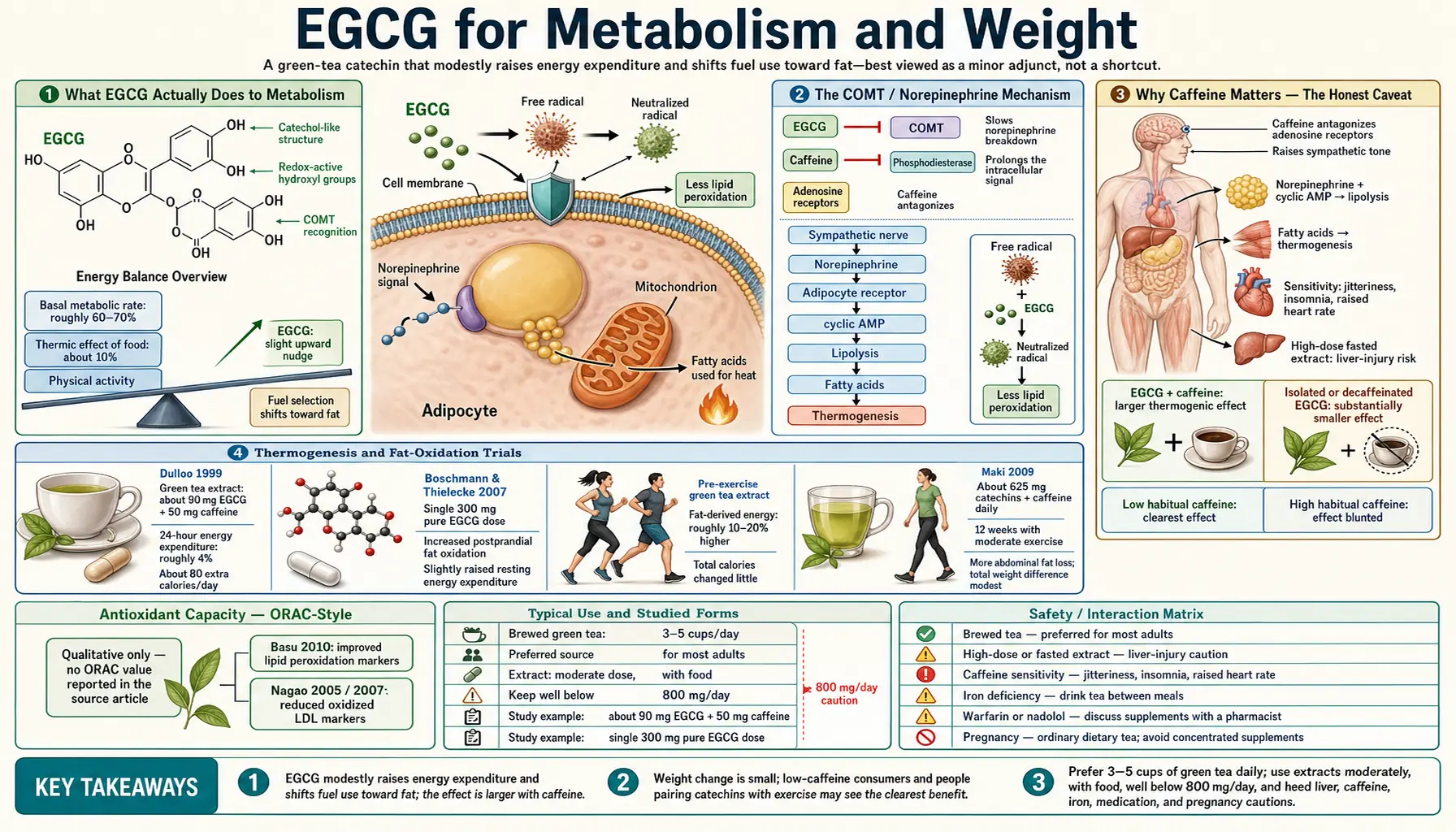
EGCG is a common ingredient in weight-loss supplements, and in short metabolic studies green tea catechins modestly raise energy expenditure and shift the body toward burning fat. The longer trials are less impressive. The effect on weight appears to depend largely on the caffeine that comes with the catechins, and a 2012 Cochrane review found that green tea preparations produced a small, statistically non-significant weight loss in overweight or obese adults that was not likely to be clinically important. This page sets out the proposed biochemistry, what the trials showed, why results vary, and what that adds up to.
Table of Contents
- What EGCG Actually Does to Metabolism
- The COMT / Norepinephrine Mechanism
- Why Caffeine Matters — The Honest Caveat
- Thermogenesis and Fat-Oxidation Trials
- Weight-Loss Trials and Meta-Analyses
- Abdominal Fat and the Exercise Synergy
- Metabolic Syndrome, Insulin, and Blood Sugar
- Why Individual Results Vary So Much
- What the Trials Add Up To
- Safety Findings and Dose Limits
- Key Research Papers
- Connections
- Featured Videos
What EGCG Actually Does to Metabolism
Body weight is governed by energy balance: calories in versus calories out. EGCG is not known as an appetite suppressant, so the proposed effects on weight come from the "calories out" side — total energy expenditure — or from a shift in which fuel the body burns.
Total daily energy expenditure has three parts: basal metabolic rate (the energy the body spends at rest), the thermic effect of food, and physical activity. Green tea catechins appear to nudge energy expenditure upward slightly and to shift fuel selection toward fat oxidation. In a 1999 respiratory-chamber study of 10 healthy men (Dulloo and colleagues), a green tea extract containing 50 mg of caffeine and 90 mg of EGCG, taken at breakfast, lunch and dinner, raised 24-hour energy expenditure by 4% compared with placebo and lowered the respiratory quotient (a sign of more fat being burned). Caffeine alone, in the same amount, had no effect on energy expenditure, which is the origin of the idea that the catechins contribute something caffeine alone does not.
A 4% rise in energy expenditure is small, and effects that small are easily swamped by day-to-day variation in what people eat and do. That gap between a measurable metabolic signal and a meaningful change on the scale is the central story of EGCG and weight.
The COMT / Norepinephrine Mechanism
The most-cited mechanism for EGCG's metabolic effect involves an enzyme called catechol-O-methyltransferase (COMT). When the sympathetic ("fight or flight") nervous system fires, nerve endings release norepinephrine, a signal that tells fat cells to break down stored triglycerides (lipolysis) and tells tissues to burn the released fatty acids for heat (thermogenesis). COMT is one of the enzymes that degrades norepinephrine, ending the signal.
In laboratory studies EGCG inhibits COMT. The proposed effect is that slowing the breakdown of norepinephrine lets the fat-mobilizing signal linger a little longer, modestly increasing lipolysis and thermogenesis. The mechanism is chemically plausible because EGCG's catechol-like structure is the kind of molecule COMT acts on. In the Dulloo study, 24-hour urinary norepinephrine was 40% higher with the green tea extract than with placebo.
Caffeine works on a complementary lever: it blocks phosphodiesterase (the enzyme that breaks down the intracellular "go" signal cyclic AMP) and antagonizes adenosine receptors, both of which also raise sympathetic tone and prolong the fat-burning cascade downstream of norepinephrine. Because EGCG acts at one point in the pathway (slowing norepinephrine removal) and caffeine acts at another (amplifying the downstream signal), the two are thought to be synergistic — each makes the other's effect larger. That proposed synergy fits the trial pattern in which catechins plus caffeine show larger effects than catechins alone.
Why Caffeine Matters — The Honest Caveat
Much of the "EGCG burns fat" reputation reflects the combination of catechins and caffeine found in green tea, not EGCG alone. In a 2010 meta-analysis of 15 trials (Phung and colleagues), catechins taken with caffeine lowered body weight by 1.38 kg compared with caffeine alone, while studies of catechins without caffeine showed no benefit on any body measurement. In a 2009 meta-analysis of 11 studies (Hursel and colleagues), the effect looked smaller in people with high habitual caffeine intake (above 300 mg a day: −0.27 kg, against −1.60 kg with low intake), but that difference did not reach statistical significance (P = 0.09); the combination of ethnicity and caffeine intake was a significant moderator.
Two findings follow from these analyses:
- Trials of catechins without caffeine showed no benefit on body measurements in the Phung meta-analysis, so decaffeinated extracts may not reproduce the effects seen with the combination. In the Minnesota Green Tea Trial, a decaffeinated extract (843 mg EGCG a day for 12 months) did not change BMI, total fat mass or percentage body fat in 121 overweight or obese postmenopausal women (Dostal and colleagues, 2016).
- The Hursel analysis raised the possibility that people with high habitual caffeine intake gain less, though that trend was not statistically significant.
None of this means EGCG contributes nothing. The Dulloo study included a caffeine-only comparison and still found an effect beyond the caffeine content. But the trials do not support isolated EGCG as a stand-alone "fat burner".
Thermogenesis and Fat-Oxidation Trials
The short-term metabolic-chamber studies are the strongest part of the EGCG-metabolism story because they measure energy expenditure directly rather than relying on the scale:
- Dulloo 1999 — green tea extract raised 24-hour energy expenditure by about 4% and increased fat oxidation, beyond what the caffeine content alone explained.
- Boschmann & Thielecke 2007 — in a crossover pilot study, six overweight men took 300 mg of EGCG a day for 2 days. Resting energy expenditure did not differ from placebo, but the respiratory quotient was lower in the first monitoring phase after a meal, suggesting more fat was burned, with EGCG given without caffeine.
- Venables 2008 — in 12 healthy men, green tea extract (366 mg EGCG in total, taken in the 24 hours before) raised average fat oxidation during 30 minutes of moderate cycling by 17% compared with placebo.
The pattern across these small, short trials is a modest shift toward fat as fuel, with a small rise in energy expenditure when caffeine is present. Whether it accumulates into meaningful weight change over weeks is a separate question — and that is where the longer trials come in.
Weight-Loss Trials and Meta-Analyses
When the longer randomized weight-loss trials are pooled, the effect is small:
- Hursel 2009 meta-analysis (International Journal of Obesity) pooled 11 studies and found that catechins significantly decreased body weight and helped maintain it after weight loss (−1.31 kg). The authors described the effect as small and suggested habitual caffeine intake and ethnicity may be moderators (the effect looked smaller in Caucasian than in Asian participants).
- Phung 2010 meta-analysis (American Journal of Clinical Nutrition) pooled 15 trials (1,243 participants): catechins with caffeine lowered body weight by 1.38 kg compared with caffeine alone and by 0.44 kg compared with a caffeine-free control; the authors judged the clinical significance "modest at best".
- Jurgens 2012 Cochrane review included trials of at least 12 weeks. Six trials conducted outside Japan, pooled, showed a mean weight difference of −0.04 kg (not significant); eight trials conducted in Japan were too dissimilar to pool and ranged from −0.2 to −3.5 kg. The authors concluded that green tea preparations appear to induce a small, statistically non-significant weight loss that is not likely to be clinically important, and had no significant effect on maintaining weight loss.
- Basu 2010 randomized 35 people with obesity and metabolic syndrome to water, green tea (4 cups a day) or green tea extract for eight weeks; both green tea groups had significantly greater decreases in body weight and BMI than controls, and the beverage lowered markers of lipid peroxidation. The trial was small.
Why a measurable thermogenic effect yields so little weight change has not been settled. Proposed explanations include compensation through appetite or activity, tolerance to caffeine, and the small size of the effect relative to ordinary weight fluctuation.
The wider evidence on weight is covered on the Obesity and Metabolic Syndrome pages.
Abdominal Fat and the Exercise Synergy
Some trials suggest catechins may affect abdominal fat, particularly when combined with exercise.
In Maki and colleagues' 2009 trial (Journal of Nutrition; 132 randomized, 107 completed), overweight and obese adults on a program of at least 180 minutes a week of moderate exercise drank either a beverage with about 625 mg of catechins and 39 mg of caffeine or a control beverage with the same caffeine and no catechins, for 12 weeks. Loss of body weight showed only a trend toward being greater with catechins (P = 0.079), and fat mass did not differ, but total abdominal fat area (−7.7% vs −0.3%), subcutaneous abdominal fat area and fasting triglycerides fell more in the catechin group.
Nagao's Japanese studies pointed the same direction. In 2005, healthy Japanese men drinking tea with 690 mg of catechins a day for 12 weeks (17 men) had lower body weight, waist circumference and body fat mass than those drinking tea with 22 mg (18 men), and changes in oxidized (malondialdehyde-modified) LDL tracked changes in body fat. In 2007, 240 adults with visceral-fat-type obesity drinking 583 mg of catechins a day for 12 weeks had greater decreases in body weight, waist circumference, visceral and subcutaneous fat area and LDL cholesterol than those drinking 96 mg. These trials tested catechins alongside diet or exercise, not in place of them.
Metabolic Syndrome, Insulin, and Blood Sugar
Beyond weight itself, green tea catechins have been studied for the cluster of problems — high blood sugar, high triglycerides, high blood pressure, central obesity — that make up metabolic syndrome. In cell and animal models, EGCG improves insulin sensitivity, inhibits the starch-digesting enzyme alpha-amylase, and reduces intestinal glucose uptake.
In humans the effect on blood sugar is small. A 2013 meta-analysis of 17 randomized trials (1,133 participants; Liu and colleagues) found that green tea lowered fasting glucose by 0.09 mmol/L and hemoglobin A1c by 0.30 percentage points; fasting insulin fell only in the subgroup of higher-quality trials. Individual trials vary, and some find no significant change. These markers are measured by tests such as Fasting Insulin and Hemoglobin A1C.
These effects are far smaller than those of the interventions with strong outcome data in type 2 diabetes — weight loss, exercise, and proven medications — and green tea catechins are not a diabetes treatment.
Why Individual Results Vary So Much
Responses to the same catechin dose differ between people. Factors studied include:
- COMT genotype — people carry different variants of the COMT gene, which affect how fast the enzyme works, and genotype has been proposed to change the response to catechins. In the Minnesota Green Tea Trial substudy, COMT genotype did not modify the effect of the extract on body composition (Dostal and colleagues, 2016).
- Habitual caffeine intake — in the Hursel meta-analysis the effect looked smaller in people with high habitual caffeine intake, though the difference was not statistically significant.
- Ethnicity and study setting — trials in Japan showed larger effects than trials elsewhere in the Cochrane review, and Hursel found a smaller effect in Caucasian than in Asian participants.
- Low and variable bioavailability — oral EGCG is poorly absorbed, and absorption varies with dose and food: peak plasma free EGCG was more than 3.5-fold higher after an overnight fast than with a light breakfast (Chow and colleagues, 2005). USP and EFSA connect that same fasted condition with a higher risk of liver injury from concentrated extracts, as the safety page explains.
What the Trials Add Up To
A summary of what the studies on this page report:
- Brewed green tea supplies the catechin-plus-caffeine combination that most of the positive trials used. The European Food Safety Authority (EFSA) considers catechins from traditionally brewed green tea in general safe at the intakes reported in Europe, though EFSA and the NIH LiverTox database both report rare cases of liver injury after drinking green tea.
- The weight effect is small. Meta-analyses report about 1.3–1.4 kg with catechins plus caffeine, and the Cochrane review judged the effect not likely to be clinically important.
- Exercise trials — the abdominal-fat findings come from trials that combined catechins with an exercise program.
- Higher, fasted doses raise EGCG exposure, and EFSA found a statistically significant rise in liver enzymes in trials at 800 mg of EGCG a day or more taken as a supplement, with no supplement intake identified as free of concern.
Safety Findings and Dose Limits
- Brewed green tea — EFSA estimated mean EGCG intake from green tea infusions at 90–300 mg a day in European adults (up to about 866 mg in high consumers) and considers it in general safe at those intakes, while noting rare, probably idiosyncratic cases of liver injury.
- Concentrated extracts — EFSA found a statistically significant rise in serum transaminases in trials of 800 mg of EGCG a day or more taken as a supplement, and could not identify a supplement intake that does not give rise to concern. In the Minnesota Green Tea Trial (843 mg EGCG a day for a year), ALT elevations occurred in 6.7% of the extract group versus 0.7% on placebo. EU Regulation 2022/2340 requires a daily portion of a food to contain less than 800 mg of EGCG from green tea extracts and a label warning against consumption on an empty stomach. Full detail on the Safety & Liver page.
- Caffeine — many weight-loss products combine green tea extract with added caffeine; caffeine's known effects include jitteriness, insomnia and a raised heart rate.
- Iron absorption — tea polyphenols reduce absorption of non-heme (plant) iron, which the research raises as a concern mainly for people prone to iron deficiency.
- Medications — a case report described a fall in warfarin's effect (INR) in a man drinking one-half to one gallon of green tea a day, attributed by the authors to its vitamin K (Taylor and Wilt, 1999); green tea lowered blood levels of the beta-blocker nadolol by about 85% in healthy volunteers (Misaka and colleagues, 2014). Decisions about supplements and medicines belong with a clinician.
- Pregnancy — EFSA noted that none of the intervention studies included pregnant or lactating women, and the EU regulation requires a label warning that green tea extracts should not be consumed by pregnant or lactating women or children under 18.
Key Research Papers
- Dulloo AG et al. (1999). Efficacy of a green tea extract rich in catechin polyphenols and caffeine in increasing 24-h energy expenditure and fat oxidation in humans. Am J Clin Nutr — PubMed PMID: 10584049
- Boschmann M, Thielecke F (2007). The effects of epigallocatechin-3-gallate on thermogenesis and fat oxidation in obese men: a pilot study. J Am Coll Nutr — PubMed PMID: 17906192
- Hursel R, Viechtbauer W, Westerterp-Plantenga MS (2009). The effects of green tea on weight loss and weight maintenance: a meta-analysis. Int J Obes (Lond) — PubMed PMID: 19597519
- Jurgens TM et al. (2012). Green tea for weight loss and weight maintenance in overweight or obese adults. Cochrane Database Syst Rev — PubMed PMID: 23235664
- Maki KC et al. (2009). Green tea catechin consumption enhances exercise-induced abdominal fat loss in overweight and obese adults. J Nutr — PubMed PMID: 19074207
- Nagao T et al. (2005). Ingestion of a tea rich in catechins leads to a reduction in body fat and malondialdehyde-modified LDL in men. Am J Clin Nutr — PubMed PMID: 15640470
- Nagao T et al. (2007). A green tea extract high in catechins reduces body fat and cardiovascular risks in humans. Obesity (Silver Spring) — PubMed PMID: 17557985
- Basu A et al. (2010). Green tea supplementation affects body weight, lipids, and lipid peroxidation in obese subjects with metabolic syndrome. J Am Coll Nutr — PubMed PMID: 20595643
- Phung OJ, Baker WL, Matthews LJ, Lanosa M, Thorne A, Coleman CI (2010). Effect of green tea catechins with or without caffeine on anthropometric measures: a systematic review and meta-analysis. Am J Clin Nutr 91(1):73–81 — PubMed PMID: 19906797
- Venables MC, Hulston CJ, Cox HR, Jeukendrup AE (2008). Green tea extract ingestion, fat oxidation, and glucose tolerance in healthy humans. Am J Clin Nutr 87(3):778–784 — PubMed PMID: 18326618
- Liu K et al. (2013). Effect of green tea on glucose control and insulin sensitivity: a meta-analysis of 17 randomized controlled trials. Am J Clin Nutr 98(2):340–348 — PubMed PMID: 23803878
- Dostal AM, Arikawa A, Espejo L, Kurzer MS (2016). Long-term supplementation of green tea extract does not modify adiposity or bone mineral density in a randomized trial of overweight and obese postmenopausal women. J Nutr 146(2):256–264 — PubMed PMID: 26701796
- Chow HH et al. (2005). Effects of dosing condition on the oral bioavailability of green tea catechins after single-dose administration of Polyphenon E in healthy individuals. Clin Cancer Res 11(12):4627–4633 — PubMed PMID: 15958649
- EFSA Panel on Food Additives and Nutrient Sources added to Food (ANS), Younes M et al. (2018). Scientific opinion on the safety of green tea catechins. EFSA J 16(4):e05239 — PubMed PMID: 32625874
- Dostal AM et al. (2015). The safety of green tea extract supplementation in postmenopausal women at risk for breast cancer: results of the Minnesota Green Tea Trial. Food Chem Toxicol 83:26–35 — PubMed PMID: 26051348
- Taylor JR, Wilt VM (1999). Probable antagonism of warfarin by green tea. Ann Pharmacother 33(4):426–428 — PubMed PMID: 10332534
- Misaka S et al. (2014). Green tea ingestion greatly reduces plasma concentrations of nadolol in healthy subjects. Clin Pharmacol Ther 95(4):432–438 — PubMed PMID: 24419562