EGCG Safety and Liver Health
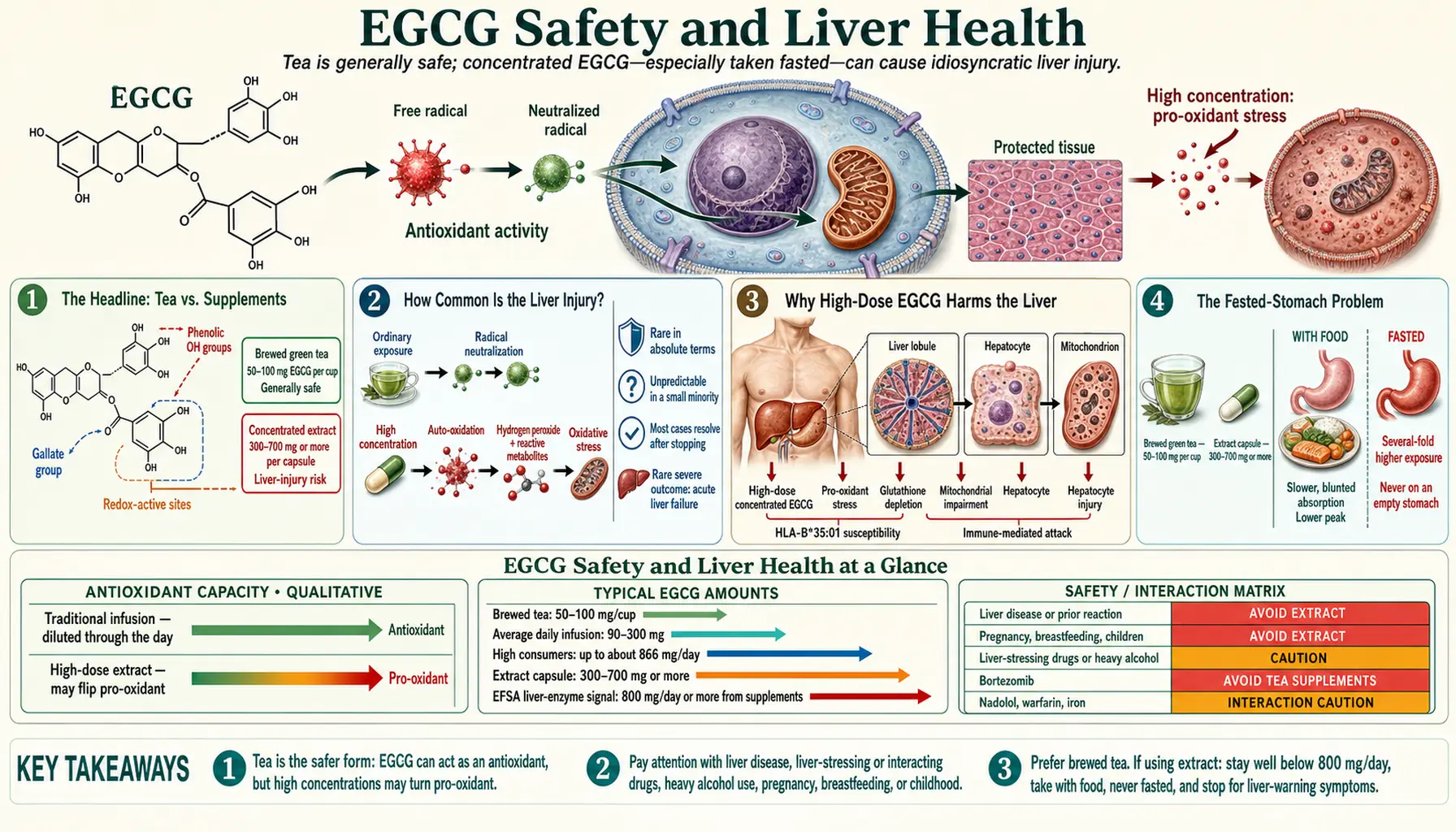
The safety record of EGCG splits in two. The European Food Safety Authority (EFSA) concluded in 2018 that catechins from traditionally brewed green tea are in general considered safe at the intakes reported in Europe, while clinical trials of food supplements supplying 800 mg or more of EGCG a day showed a statistically significant rise in serum transaminases, a sign of liver injury. Concentrated green tea extracts have been linked to liver injury ranging from raised liver enzymes to, in rare cases, acute liver failure, liver transplantation or death. The U.S. Pharmacopeia (USP), EFSA, the NIH LiverTox database and the U.S. Drug-Induced Liver Injury Network have all documented the problem, and since 2022 the European Union restricts EGCG from green tea extracts in foods. This page sets out what those bodies and studies report: how often the injury occurs, the role of dose and of an empty stomach, an inherited immune trait linked to it, and the warnings regulators require.
Table of Contents
- The Headline: Tea vs. Supplements
- How Common Is the Liver Injury?
- Why High-Dose EGCG Harms the Liver
- The Fasted-Stomach Problem
- EFSA 2018 and the EU 2022 Restriction
- USP and LiverTox: Cautionary Labeling
- Symptoms Named in Label Warnings
- Who the Research Raises Concerns For
- What Studies and Regulators Report About Dose and Timing
- Other Safety Considerations
- Key Research Papers
- External Resources
- Connections
- Featured Videos
The Headline: Tea vs. Supplements
The central distinction in EGCG safety is brewed green tea versus concentrated green tea extract (GTE) taken as a supplement.
- Brewed green tea. EFSA concluded that catechins from green tea infusions prepared in the traditional way, and reconstituted drinks of equivalent composition, are in general considered safe, provided intake corresponds to the amounts reported in European countries. EFSA also noted that rare cases of liver injury have been reported after drinking green tea infusions, most probably as an idiosyncratic reaction, and LiverTox likewise describes rare cases after ingestion of large amounts of green tea.
- Concentrated extracts. A 2018 systematic review of 159 human intervention studies (Hu and colleagues) found that hepatic adverse events occurred with a limited range of concentrated, catechin-rich preparations, in a dose-dependent manner, when they were taken as large bolus doses, but not when green tea was consumed as brewed tea or as extracts in beverages or food.
The difference is largely one of dose and delivery. EFSA estimated mean EGCG intake from green tea infusions at 90–300 mg per day in European adults, with high consumers reaching up to about 866 mg per day, while food supplements containing green tea catechins supplied 5–1,000 mg of EGCG per day.
How Common Is the Liver Injury?
Green tea extract liver injury is generally described as idiosyncratic — it affects a small minority of users unpredictably rather than everyone above a given dose.
- U.S. Drug-Induced Liver Injury Network (DILIN). A 2017 research-symposium review in Hepatology (Navarro and colleagues) reported that herbal and dietary supplements account for 20% of hepatotoxicity cases in the United States based on research data, and named green tea extract among the major implicated agents, alongside anabolic steroids and multi-ingredient nutritional supplements. Among 1,414 DILIN patients who underwent formal causality assessment, 40 cases (3%) were attributed to green tea (Hoofnagle and colleagues, 2021).
- The 2009 case review. Mazzanti and colleagues found 34 published cases of hepatitis linked to green tea between 1999 and October 2008. Liver biopsies showed inflammatory reactions, cholestasis, occasional steatosis and necrosis. The injury resolved after the product was stopped (positive dechallenge) in 29 cases, recurred on re-exposure (positive rechallenge) in seven (20%), and one death was reported. The authors concluded that the case reports suggest a causal association.
- Severity in the DILIN series. Of the 40 green tea cases, the injury was hepatocellular in 95%, 83% of patients were jaundiced and 88% had symptoms. The course was judged severe in 14 (35%), 3 (8%) needed a liver transplant, and chronic injury was rare (3%). Symptoms began 15–448 days (median 72) after starting the product.
An inherited immune trait. In the same DILIN analysis, the immune-system gene variant HLA-B*35:01 was found in 72% of green tea cases, compared with 15% of liver-injury cases caused by other supplements, 12% of cases caused by conventional drugs, and 11% of population controls. The authors concluded that green tea-related liver injury is idiosyncratic and immune mediated, which helps explain why it occurs in some users and not in others taking similar amounts.
Why High-Dose EGCG Harms the Liver
The mechanism is not settled. Most of the direct evidence comes from mouse studies given very large bolus doses by stomach tube, and from the human genetic association above:
- Oxidative stress at high concentration (animal studies). As described on the Antioxidant & Cellular Health page, EGCG can act as a pro-oxidant at high concentrations. In mice, a single 1,500 mg/kg dose raised plasma ALT 138-fold and reduced survival by 85%, with hepatic necrosis and markers of oxidative stress such as a 5-fold rise in liver lipid peroxidation (Lambert and colleagues, 2010).
- Glutathione depletion and mitochondrial injury (animal studies). In mice given 750 mg/kg once daily for 3 days, reduced liver glutathione fell by 59% (James and colleagues, 2015). A 2018 mouse study linked bolus-dose EGCG liver injury to lower antioxidant enzyme levels and fewer liver mitochondria, and its authors proposed the mitochondria as a target.
- An immune (idiosyncratic) reaction in people. The HLA-B*35:01 association in DILIN patients points to an immune-mediated mechanism in susceptible individuals.
These strands do not behave the same way. EFSA described dose-dependent hepatotoxicity of EGCG from supplements, but also stated that the rare cases after green tea infusions are probably idiosyncratic, with no clear relation to dose, route or duration. Hu and colleagues identified internal dose of catechins — how much reaches the blood and liver, which depends on the dose and on whether it is taken with food — as a key determinant of whether liver injury occurs and how severe it is.
The Fasted-Stomach Problem
Taking concentrated EGCG on an empty stomach raises how much reaches the bloodstream. In a crossover trial of 30 healthy volunteers given a single dose of a decaffeinated green tea catechin mixture (400, 800 or 1,200 mg of EGCG), the average maximum plasma concentration of free EGCG was more than 3.5-fold higher when the dose was taken after an overnight fast than when it was taken with a light breakfast (Chow and colleagues, 2005). Mild, transient nausea was seen most often at the 1,200 mg dose and in the fasting condition. In an earlier 4-week trial, the area under the plasma EGCG curve rose by more than 60% when 800 mg was taken once daily, but not when 400 mg was taken twice daily (Chow and colleagues, 2003).
The 2005 study authors concluded that the fasting condition was expected to optimize the biological effects of tea catechins — the same reasoning behind taking extracts before eating to maximize absorption. Safety bodies have since connected that same condition with toxicity:
- USP's 2008 review stated that clinical pharmacokinetic and animal toxicology information indicated that taking concentrated green tea extracts on an empty stomach is more likely to lead to adverse effects than taking them with food.
- USP's 2020 review reported that animal and human data show repeated bolus doses of green tea extract during fasting significantly increase the bioavailability of catechins, specifically EGCG.
- EFSA noted that taking green tea extracts fasted and as a single bolus significantly increases EGCG exposure compared with taking them with food and in split doses, and that fasting has been shown to increase the toxicity of green tea catechins in experimental animals.
Both the USP label statement and the EU regulation described below include a warning against taking green tea extract on an empty stomach.
EFSA 2018 and the EU 2022 Restriction
In 2018 EFSA's Panel on Food Additives and Nutrient Sources added to Food published a scientific opinion on the safety of green tea catechins. Its main findings:
- Catechins from traditional green tea infusions, and reconstituted drinks of equivalent composition, are in general considered safe at the intakes reported in EU member states.
- Interventional clinical trials showed that EGCG doses equal to or above 800 mg per day taken as a food supplement induced a statistically significant increase in serum transaminases compared with controls.
- EFSA could not identify a dietary intake of green tea catechins that does not give rise to concerns about harmful effects, citing uncertainties including limited dose–response data, variable extract composition, and the unknown effects of long-term use. Below 800 mg per day, therefore, no dose was declared safe.
- Mean intake from green tea infusions was estimated at 90–300 mg of EGCG per day, with high consumers reaching up to about 866 mg per day.
EU Regulation 2022/2340. Acting on that opinion, the European Commission adopted Regulation (EU) 2022/2340 on 30 November 2022. It places green tea extracts containing EGCG in Part B of Annex III to Regulation (EC) No 1925/2006 (restricted substances): a daily portion of a food must contain less than 800 mg of EGCG. The label must state the EGCG content per portion and the maximum number of portions per day, warn against consuming 800 mg or more a day, and carry three warnings, quoted from the regulation: “Should not be consumed if you are consuming other products containing green tea on the same day”, “Should not be consumed by pregnant or lactating women and children below 18 years old”, and “Should not be consumed on an empty stomach”. Because a harmful effect below 800 mg could not be ruled out, the extracts were also placed under Union scrutiny (Part C), with a decision on a further prohibition or restriction due within four years. Aqueous extracts that, once made into a drink, resemble traditional green tea infusions are excluded, as is a highly purified EGCG (at least 90%) authorised separately as a novel food.
Bars are drawn to scale from the figures stated on this page; the case-report bar ends at about 1,000 mg, as USP reported.
USP and LiverTox: Cautionary Labeling
The United States Pharmacopeia (USP), which sets quality standards for supplements, has reviewed green tea extract safety twice:
- Sarma and colleagues (2008, Drug Safety) reported USP's first systematic review. It analysed 216 case reports on green tea products, 34 of them concerning liver damage; 27 of those were categorized as possible and 7 as probable causality. The review was prompted in part by regulators in France and Spain suspending a weight-loss product containing green tea extract over liver concerns. USP's committee concluded that monographs could be developed for green tea extract products provided a caution statement is included in the labelling.
- Oketch-Rabah and colleagues (2020, Toxicology Reports) reported USP's updated comprehensive review. It found no evidence that solvent residues, pesticide residues, pyrrolizidine alkaloids or elemental impurities were involved in green tea extract liver injury, reported that catechin profiles vary significantly with manufacturing processes, and noted that published case reports associate liver injury with EGCG intakes from 140 mg to about 1,000 mg per day, with substantial differences in individual susceptibility, possibly genetic.
The 2020 review reports the cautionary labeling requirement in USP's Powdered Decaffeinated Green Tea Extract monograph, which reads: “Do not take on an empty stomach. Take with food. Do not use if you have a liver problem and discontinue use and consult a healthcare practitioner if you develop symptoms of liver trouble, such as abdominal pain, dark urine, or jaundice (yellowing of the skin or eyes).”
The NIH's LiverTox database states that green tea extract and, more rarely, ingestion of large amounts of green tea have been implicated in cases of clinically apparent acute liver injury, including instances of acute liver failure and either need for urgent liver transplantation or death.
Symptoms Named in Label Warnings
The USP label statement names abdominal pain, dark urine, and jaundice (yellowing of the skin or eyes) as symptoms of liver trouble, and directs the user to discontinue the product and consult a healthcare practitioner if they appear. In the DILIN series, 83% of patients with green tea-associated liver injury were jaundiced and 88% had symptoms; the Navarro review describes the injury from green tea extract as an acute hepatitis-like injury.
Most green tea extract liver injury in the published series resolved after the product was stopped (29 of 34 cases in the 2009 review). Liver injury is confirmed with blood tests such as Liver Function Tests (ALT, AST, bilirubin). Because green tea extract is often one ingredient among many in multi-ingredient products, the Navarro review notes that in most supplement-associated cases the responsible component is unknown or can only be suspected — which is why a full list of supplements matters to a clinician assessing liver injury.
Who the Research Raises Concerns For
- People with existing liver disease. The USP label statement reads “Do not use if you have a liver problem”. The evidence on fatty liver is mixed: a 90-day randomized trial in 80 people with NAFLD reported that a 500 mg green tea extract tablet a day significantly lowered ALT and AST compared with baseline (Pezeshki and colleagues, 2016). That small trial does not establish safety for people with liver disease, and the label warning still applies to the extracts it covers.
- People taking other medicines. The 2009 case review noted that in a few cases toxicity related to concomitant medications could also have been involved. Specific drug interactions are listed below.
- Pregnant and breastfeeding women, and children. EFSA noted that none of the intervention studies included pregnant or lactating women, breast-fed infants or children under 18, and the EU regulation requires a label warning that the extracts should not be consumed by these groups.
- Carriers of HLA-B*35:01. The variant was found in 72% of green tea liver-injury cases in the DILIN series, against 11% of population controls.
- Anyone who has reacted before. Injury recurred on re-exposure in seven of the 34 cases in the 2009 review and in three DILIN cases, with a shorter time to onset; in the Minnesota trial, ALT rose again after one or more rechallenges.
What Studies and Regulators Report About Dose and Timing
Decisions about supplements belong with a clinician. The findings below are what the studies and regulators report:
- Brewed tea versus extracts. EFSA considers traditionally brewed green tea in general safe at reported intakes, while noting rare idiosyncratic cases. The Hu review found hepatic adverse events with concentrated bolus doses, not with brewed tea or extracts taken in beverages or food.
- The randomized trial evidence. In the Minnesota Green Tea Trial, 1,075 postmenopausal women took green tea extract containing 843 mg of EGCG or placebo daily for one year. ALT elevations occurred in 6.7% of the extract group versus 0.7% on placebo, and 1.3% had ALT-related serious adverse events (Dostal and colleagues, 2015). A follow-up analysis of 1,021 women with normal baseline liver tests found that 5.1% in the extract group developed moderate or more severe liver-test abnormalities, an odds ratio of 7.0 compared with placebo (Yu and colleagues, 2017).
- Dose limits. The EU requires a daily portion of food to contain less than 800 mg of EGCG from green tea extracts. EFSA identified no intake that was free of concern. The Hu review derived a safe intake level of 338 mg EGCG per day for tea preparations taken as a solid bolus dose, and an observed safe level of 704 mg per day for preparations in beverage form.
- Food and timing. The USP label reads “Do not take on an empty stomach. Take with food.” and the EU regulation requires a warning against consumption on an empty stomach.
- Combined products. The EU regulation requires a warning against consuming the product on a day when other products containing green tea are consumed, because intake from several products can exceed the maximum daily dose.
- Product variability. USP's 2020 review found that catechin profiles vary significantly with manufacturing processes, and EFSA cited the wide variation in extract composition as one reason it could not set a safe intake.
- Timing of onset. In the DILIN series, symptoms began a median of 72 days (range 15–448) after the product was started; in the Minnesota trial, the liver-test abnormalities developed during the one-year intervention period.
Other Safety Considerations
- Iron absorption — tea polyphenols reduce absorption of non-heme (plant) iron. In a 1999 study measuring iron absorption from a bread meal, black tea reduced it by 79–94% and several herb teas by 47–84%; green tea itself was not tested (Hurrell and colleagues).
- Caffeine — green tea and many extracts contain caffeine; some extracts, including those used in several of the trials above, are decaffeinated.
- Nadolol — in 10 healthy volunteers, drinking brewed green tea (700 ml a day for 14 days) lowered the peak blood level and total exposure of the beta-blocker nadolol by about 85% and reduced its effect on systolic blood pressure (Misaka and colleagues, 2014).
- Bortezomib — in cell and mouse experiments, EGCG reacted directly with the cancer drug bortezomib and blocked its anticancer effect; the authors suggested green tea products may be contraindicated during bortezomib therapy (Golden and colleagues, 2009). This has not been tested in patients.
- Warfarin — a 1999 case report described a man on warfarin whose INR fell from 3.79 to 1.14 after he began drinking one-half to one gallon of green tea a day, and rose again when he stopped; the authors attributed this to vitamin K in green tea (Taylor and Wilt).
- Multi-ingredient weight-loss products — green tea extract often appears in multi-ingredient products, which the Navarro review identifies as the source of most supplement-associated liver injury, usually without a known responsible ingredient.
- Gastrointestinal effects — in the Minnesota trial, nausea was significantly more common with green tea extract than placebo, and in the fasting study, mild, transient nausea was most frequent at the highest dose and in the fasting condition.
These cautions concern concentrated, high-dose extracts. Brewed green tea is a different exposure, which EFSA assessed separately and in general considers safe at the intakes reported in Europe.
Key Research Papers
- Oketch-Rabah HA et al. (2020). United States Pharmacopeia (USP) comprehensive review of the hepatotoxicity of green tea extracts. Toxicol Rep — PubMed PMID: 32140423
- Mazzanti G et al. (2009). Hepatotoxicity from green tea: a review of the literature and two unpublished cases. Eur J Clin Pharmacol — PubMed PMID: 19198822
- Sarma DN et al. (2008). Safety of green tea extracts: a systematic review by the US Pharmacopeia. Drug Saf — PubMed PMID: 18484782
- Hu J et al. (2018). The safety of green tea and green tea extract consumption in adults — results of a systematic review. Regul Toxicol Pharmacol — PubMed PMID: 29580974
- Navarro VJ et al. (2017). Liver injury from herbal and dietary supplements. Hepatology — PubMed PMID: 27677775
- Chow HH et al. (2003). Pharmacokinetics and safety of green tea polyphenols after multiple-dose administration of EGCG and Polyphenon E in healthy individuals. Clin Cancer Res — PubMed PMID: 12960117
- Pezeshki A et al. (2016). The effect of green tea extract supplementation on liver enzymes in patients with nonalcoholic fatty liver disease. Int J Prev Med — PubMed PMID: 26955458
- EFSA Panel on Food Additives and Nutrient Sources added to Food (ANS), Younes M et al. (2018). Scientific opinion on the safety of green tea catechins. EFSA J 16(4):e05239 — PubMed PMID: 32625874
- Dostal AM et al. (2015). The safety of green tea extract supplementation in postmenopausal women at risk for breast cancer: results of the Minnesota Green Tea Trial. Food Chem Toxicol 83:26–35 — PubMed PMID: 26051348
- Yu Z et al. (2017). Effect of green tea supplements on liver enzyme elevation: results from a randomized intervention study in the United States. Cancer Prev Res (Phila) 10(10):571–579 — PubMed PMID: 28765194
- Hoofnagle JH et al. (2021). HLA-B*35:01 and green tea-induced liver injury. Hepatology 73(6):2484–2493 — PubMed PMID: 32892374
- Chow HH et al. (2005). Effects of dosing condition on the oral bioavailability of green tea catechins after single-dose administration of Polyphenon E in healthy individuals. Clin Cancer Res 11(12):4627–4633 — PubMed PMID: 15958649
- LiverTox: Clinical and Research Information on Drug-Induced Liver Injury. Green Tea. National Institute of Diabetes and Digestive and Kidney Diseases (2012–) — PubMed PMID: 31643260
- Lambert JD et al. (2010). Hepatotoxicity of high oral dose (−)-epigallocatechin-3-gallate in mice. Food Chem Toxicol 48(1):409–416 — PubMed PMID: 19883714
- James KD, Forester SC, Lambert JD (2015). Dietary pretreatment with green tea polyphenol, (−)-epigallocatechin-3-gallate reduces the bioavailability and hepatotoxicity of subsequent oral bolus doses of (−)-epigallocatechin-3-gallate. Food Chem Toxicol 76:103–108 — PubMed PMID: 25528115
- James KD, Kennett MJ, Lambert JD (2018). Potential role of the mitochondria as a target for the hepatotoxic effects of (−)-epigallocatechin-3-gallate in mice. Food Chem Toxicol 111:302–309 — PubMed PMID: 29175576
- Hurrell RF, Reddy M, Cook JD (1999). Inhibition of non-haem iron absorption in man by polyphenolic-containing beverages. Br J Nutr 81(4):289–295 — PubMed PMID: 10999016
- Misaka S et al. (2014). Green tea ingestion greatly reduces plasma concentrations of nadolol in healthy subjects. Clin Pharmacol Ther 95(4):432–438 — PubMed PMID: 24419562
- Golden EB et al. (2009). Green tea polyphenols block the anticancer effects of bortezomib and other boronic acid-based proteasome inhibitors. Blood 113(23):5927–5937 — PubMed PMID: 19190249
- Taylor JR, Wilt VM (1999). Probable antagonism of warfarin by green tea. Ann Pharmacother 33(4):426–428 — PubMed PMID: 10332534
PubMed Topic Searches
External Resources
- LiverTox (NIH) — Green Tea — the NIH clinical summary of green tea and green tea extract liver injury.
- EFSA (2018) — Scientific opinion on the safety of green tea catechins
- Commission Regulation (EU) 2022/2340 — green tea extracts containing EGCG
- NIH NCCIH — Green Tea