CoQ10 for Heart Failure
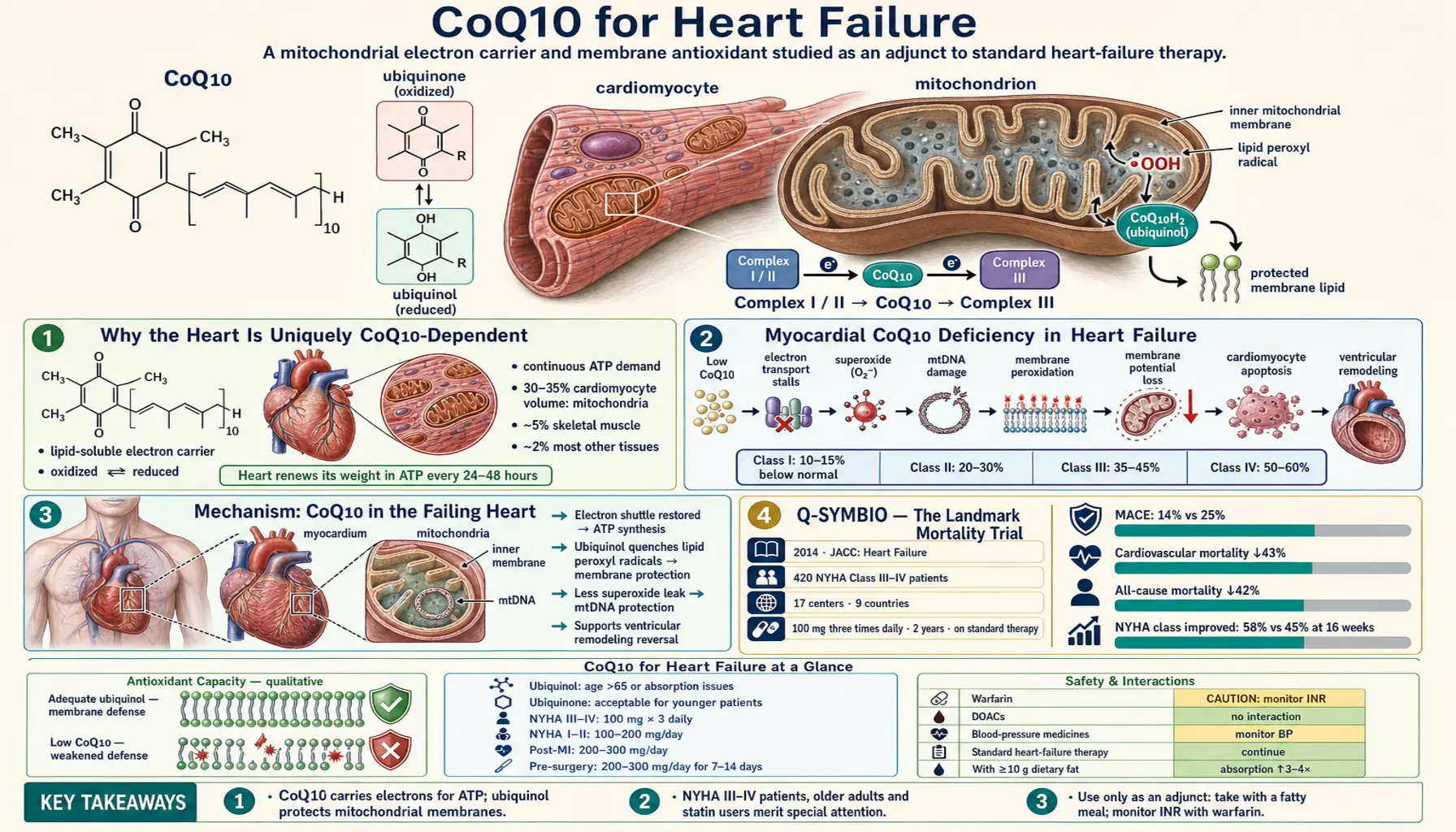
Heart failure is the indication for which coenzyme Q10 has the single strongest mortality evidence of any nutraceutical for any condition. The Q-SYMBIO trial (Mortensen 2014) randomized 420 patients with NYHA Class III-IV heart failure to CoQ10 100 mg three times daily or placebo for 2 years on top of standard therapy and showed a 43% reduction in cardiovascular mortality, a 43% reduction in major adverse cardiovascular events, and a 42% reduction in all-cause mortality — effect sizes larger than most pharmaceutical heart-failure agents added to optimal medical therapy. The KISEL-10 trial in elderly Swedish adults added selenium to CoQ10 and produced a 54% cardiovascular mortality reduction that persisted at 12-year follow-up. This deep-dive walks through both pivotal trials, the mechanism in failing heart muscle, the NYHA Class III-IV dosing protocol, and why ubiquinol is the preferred form for older heart-failure patients.
Interactive Visualization Free Radicals & Your Antioxidant Network Follow one superoxide radical down the whole relay — SOD, catalase, glutathione, vitamin E, vitamin C, NADPH — then release free iron and watch a membrane tear itself apart. Launch →
Table of Contents
- Why the Heart Is Uniquely CoQ10-Dependent
- Myocardial CoQ10 Deficiency in Heart Failure
- Mechanism: CoQ10 in the Failing Heart
- Q-SYMBIO — The Landmark Mortality Trial
- KISEL-10 — Long-Term Mortality in Elderly Adults
- Earlier Trials & the Mortensen Pilot Era
- Meta-Analyses (Sander, Lei, Madmani)
- Ubiquinol vs Ubiquinone in Heart Failure Patients
- Clinical Protocol & Dosing
- Combinations With Guideline-Directed Therapy
- Patient FAQ
- Cautions Specific to Heart Failure Patients
- Key Research Papers
- Connections
- Featured Videos
Why the Heart Is Uniquely CoQ10-Dependent
The heart muscle has the highest mitochondrial density of any tissue in the human body — approximately 30-35% of cardiomyocyte volume is occupied by mitochondria, compared to roughly 5% in skeletal muscle and 2% in most other tissues. This mitochondrial density is necessary because the heart contracts continuously throughout life and demands a steady, uninterrupted ATP supply — the human heart synthesizes and consumes its own weight in ATP every 24-48 hours.
CoQ10 is the lipid-soluble electron carrier that links Complex I and Complex II of the electron transport chain to Complex III. Without it, electrons cannot move from NADH and FADH&sub2; produced in the TCA cycle to the cytochrome c step of oxidative phosphorylation. The result is a complete halt of ATP production from carbohydrate, fat, and protein oxidation — the cardiomyocyte's primary fuel sources. Even a partial reduction in CoQ10 supply produces a proportional reduction in ATP synthesis capacity.
Cardiac CoQ10 content peaks in the third decade of life at roughly 110 µg per gram of wet heart tissue and declines by approximately 0.5% per year thereafter, so that by age 80 cardiac CoQ10 is typically 50-60% of its peak. This age-related decline is one of the proposed mechanisms of the rising heart failure incidence in older adults — the heart simply has less mitochondrial reserve to recover from injury, ischemia, or hemodynamic stress.
Patients with established heart failure show an additional reduction beyond what age alone explains. Endomyocardial biopsy studies and post-mortem ventricular tissue analyses consistently find myocardial CoQ10 levels 30-50% below age-matched controls in patients with reduced ejection fraction heart failure, with the degree of deficiency correlating directly with NYHA functional class and inversely with ejection fraction.
Myocardial CoQ10 Deficiency in Heart Failure
The seminal work establishing myocardial CoQ10 deficiency in heart failure was done by Karl Folkers and Peter Langsjoen in the 1980s and 1990s. Folkers and colleagues obtained right-ventricular endomyocardial biopsies from patients undergoing diagnostic catheterization and measured CoQ10 directly by HPLC. Their findings were striking and remarkably reproducible across multiple cohorts:
- NYHA Class I (asymptomatic): myocardial CoQ10 modestly reduced, roughly 10-15% below normal controls
- NYHA Class II (mild symptoms): 20-30% reduction
- NYHA Class III (moderate symptoms with everyday activity): 35-45% reduction
- NYHA Class IV (severe symptoms at rest): 50-60% reduction
The correlation between NYHA class and CoQ10 deficiency held across dilated cardiomyopathy, ischemic cardiomyopathy, and hypertensive heart failure. The relationship persisted after controlling for age, gender, ejection fraction, and concomitant medications — suggesting CoQ10 depletion is not merely a marker of severity but a contributor to the bioenergetic deficit that drives progression.
Serum CoQ10 measurements (now widely available through commercial reference labs at $50-150 per test) also show reductions in heart failure but less dramatically than the tissue measurements, because the cytoplasmic CoQ10 pool replenishes from circulating cholesterol-bound CoQ10 even as mitochondrial pools deplete. The clinical implication is that a normal-range serum CoQ10 in a heart failure patient does not exclude myocardial deficiency, and prophylactic supplementation is reasonable in advanced disease even without abnormal serum values.
The Norman Sharpe research group in New Zealand has also documented that statin therapy further depresses myocardial CoQ10 in heart failure patients on background statin treatment, sometimes by another 20-30%. Because many heart failure patients are also on statins for concurrent atherosclerotic disease, the combined biochemical deficit can be profound.
Mechanism: CoQ10 in the Failing Heart
CoQ10 deficiency in failing heart muscle produces three intersecting consequences:
1. Reduced ATP synthesis
The most direct effect. With insufficient CoQ10 to shuttle electrons from Complex I/II to Complex III, electron transport stalls. NADH accumulates in the mitochondrial matrix, inhibiting the TCA cycle by mass action and forcing the cell toward anaerobic glycolysis as a fallback fuel source. The result is a failing heart that runs on partial-capacity ATP production while attempting to maintain cardiac output — a metabolic mismatch that drives the progressive bioenergetic failure seen in advanced heart failure.
2. Increased mitochondrial superoxide leak
When electron transport stalls at Complex I or III for lack of CoQ10, electrons leak directly onto molecular oxygen at the upstream complexes, generating superoxide (O&sub2;−) at much higher rates than during normal respiration. Superoxide damages mitochondrial DNA (which lacks the protective histones and repair systems of nuclear DNA), causing accumulated mtDNA mutations that further impair electron-transport-chain function in a feed-forward loop. This is one of the proposed mechanisms of why heart failure tends to progress despite optimal medical therapy — the underlying mitochondrial damage accumulates over years.
3. Reduced ubiquinol antioxidant capacity
Ubiquinol, the fully reduced form of CoQ10, is the primary antioxidant within the inner mitochondrial membrane — it quenches lipid peroxyl radicals generated during respiration and protects mitochondrial membrane lipids from peroxidation. When CoQ10 supply is inadequate, the ratio of ubiquinol to ubiquinone shifts toward the oxidized form, and the membrane antioxidant defense weakens just as superoxide generation rises. The combination produces accelerated mitochondrial membrane damage, loss of membrane potential, and eventual apoptosis of cardiomyocytes — one mechanism of the gradual ventricular remodeling seen in chronic heart failure.
Supplemental CoQ10 reverses all three deficits. Plasma CoQ10 rises within 2-4 weeks of starting 100 mg three times daily, myocardial CoQ10 rises over 3-6 months (slower because of the lipoprotein-bound transport step required to deliver CoQ10 to peripheral tissues), and the bioenergetic deficit measurably improves on cardiac stress testing, echocardiographic ejection fraction, and biomarkers (BNP, NT-proBNP). The clinical improvements lag the biochemical improvements by months, which is consistent with the time required for ventricular remodeling reversal.
Q-SYMBIO — The Landmark Mortality Trial
Q-SYMBIO (Coenzyme Q10 in Symptomatic Heart Failure) is the pivotal randomized controlled trial that established CoQ10 as an evidence-based mortality-reducing adjunct to standard heart failure therapy. Designed by Svend Mortensen and an international steering committee, the trial enrolled across 17 cardiology centers in 9 countries, and was published in 2014 in JACC: Heart Failure.
Design
- Population: 420 patients with chronic heart failure, NYHA Class III or IV (moderate to severe), on optimal background medical therapy (ACE inhibitor or ARB plus beta-blocker plus diuretic, per 2014 guidelines)
- Intervention: CoQ10 100 mg three times daily (300 mg total daily dose) of ubiquinone, taken with meals
- Control: Identical-appearing placebo capsules
- Duration: 2-year median follow-up; 16-week interim analysis for surrogate endpoints; final analysis at 2 years for hard outcomes
- Primary endpoint: Time to first major adverse cardiovascular event (MACE) — the composite of unplanned hospitalization for worsening heart failure, cardiovascular death, urgent cardiac transplantation, or mechanical circulatory support
- Secondary endpoints: All-cause mortality, cardiovascular mortality, NYHA functional class improvement, NT-proBNP changes
Results at 2 years
- MACE: Hazard ratio 0.50 (95% CI 0.32-0.80, p = 0.003) — a 50% relative risk reduction in the primary composite endpoint. In absolute terms, 14% of CoQ10 patients vs 25% of placebo patients experienced a MACE event.
- Cardiovascular mortality: 43% relative risk reduction (hazard ratio 0.57, p = 0.026)
- All-cause mortality: 42% relative risk reduction (hazard ratio 0.58, p = 0.036)
- NYHA functional class: Improved in 58% of CoQ10 patients vs 45% of placebo patients (p = 0.028) by the 16-week interim analysis
- Tolerability: No significant difference in adverse events between groups; serious adverse events fewer in the CoQ10 group (driven by the reduced MACE rate)
Why Q-SYMBIO matters
The 43% mortality reduction is larger than the mortality benefit of any pharmaceutical agent added to background optimal therapy in heart failure within the last 30 years. By comparison, the SOLVD enalapril trial showed 16% mortality reduction; the MERIT-HF metoprolol succinate trial showed 34%; the EMPHASIS-HF eplerenone trial showed 24%; the PARADIGM-HF sacubitril/valsartan trial showed 16% over enalapril; and the EMPEROR-Reduced empagliflozin trial showed 8%. Q-SYMBIO's 43% CV mortality reduction was achieved with a non-prescription dietary supplement costing less than $1 per day, used additively on top of all of these pharmaceuticals.
The trial has nevertheless never been widely adopted into cardiology guidelines — partly because CoQ10 lacks patent protection (and therefore lacks the pharmaceutical-company marketing budget that drives guideline adoption), partly because the trial was modest in size (420 patients), and partly because of cardiology's traditional caution about non-pharmaceutical interventions. The 2022 AHA/ACC/HFSA heart failure guidelines do not mention CoQ10. Integrative cardiology has nevertheless adopted the Q-SYMBIO protocol as standard of care for NYHA Class III-IV patients, and the evidence quality remains substantially better than for many guideline-endorsed nutraceuticals.
KISEL-10 — Long-Term Mortality in Elderly Adults
KISEL-10 was a parallel research program led by Urban Alehagen in Östergötland, Sweden, that tested whether combined CoQ10 + selenium supplementation could reduce cardiovascular mortality in community-dwelling elderly adults — not specifically heart failure patients, but adults at risk for cardiovascular events due to age alone.
Design
- Population: 443 elderly Swedish adults, ages 70-88, generally healthy but representative of the older population, without acute cardiovascular events at baseline
- Intervention: CoQ10 200 mg/day + selenium 200 µg/day (selenium yeast)
- Control: Placebo capsules indistinguishable from active
- Treatment duration: 4 years active treatment
- Follow-up: Initial 4-year analysis, then 5-year, 10-year, 12-year, and 14-year extended follow-ups
Results
- At 5 years (1 year after treatment ended): 54% reduction in cardiovascular mortality in the active group (5.9% vs 12.6%, p = 0.015)
- At 10 years: Mortality benefit persisted — 28% reduction in all-cause mortality, with cardiovascular mortality still significantly reduced
- At 12 years: Continued mortality benefit despite 8 years off active treatment — suggesting durable reversal of underlying mitochondrial dysfunction rather than mere symptom suppression
- NT-proBNP: Significantly reduced in the active group, suggesting subclinical heart failure progression was attenuated
- Inflammatory markers: Significant reductions in IL-1, IL-6, and TNF-α in the active group
Why selenium matters
The KISEL-10 design is grounded in the biochemistry of glutathione peroxidase — the selenium-dependent enzyme that recycles oxidized glutathione back to its active reduced form. CoQ10 generates lipid peroxides as part of its electron-shuttling function; glutathione peroxidase neutralizes them. In selenium-deficient regions (much of Scandinavia, including Sweden, has soil selenium 5-10× below US levels), exogenous CoQ10 supplementation cannot achieve full antioxidant benefit because glutathione peroxidase activity is rate-limited by selenium availability. The combined CoQ10 + selenium protocol addresses both substrate and enzyme limitations simultaneously.
In US populations, baseline selenium status is typically adequate from dietary intake (Brazil nuts, seafood, organ meats) and the incremental benefit of adding 200 µg selenium to CoQ10 supplementation may be smaller. However, for patients in selenium-deficient regions or with documented low serum selenium, the KISEL-10 protocol is supported by some of the strongest controlled-trial evidence of any supplement combination for cardiovascular mortality reduction.
Earlier Trials & the Mortensen Pilot Era
Q-SYMBIO did not arrive in isolation — it built on roughly 25 years of preliminary heart failure trials, primarily from the Mortensen group in Denmark and the Langsjoen father-and-son cardiology practice in Tyler, Texas.
Mortensen pilot (1990, Drugs Under Experimental and Clinical Research)
The original 80-patient pilot trial in NYHA Class II-IV heart failure patients tested CoQ10 100 mg/day vs placebo for 12 weeks. Improvements in NYHA class, ejection fraction (by echocardiography), and patient-reported symptom scores were significant, and the trial established the safety and bioavailability of oral ubiquinone in a heart failure population.
Morisco / Trimarco trial (Italy, 1993)
641 patients with chronic congestive heart failure randomized to CoQ10 2 mg/kg/day or placebo. The CoQ10 group had a 38% reduction in hospitalization for worsening heart failure and a 60% reduction in episodes of pulmonary edema. The trial was published in Clinical Investigator and helped establish CoQ10 as a credible heart failure intervention in European cardiology.
Langsjoen clinical case series
Peter Langsjoen Sr. and Jr. published a long series of clinical case reports and case series in the 1980s-2010s documenting marked improvements in ejection fraction (often from severely reduced <30% to near-normal >50%) in heart failure patients treated with CoQ10 over 6-12 months. Their work was sometimes criticized as anecdotal but provided important early signal that CoQ10 could produce dramatic functional improvements in advanced disease, particularly when ubiquinol replaced ubiquinone for patients with absorption challenges.
Watson trial (1999, JACC)
30 patients with heart failure randomized to CoQ10 33 mg three times daily or placebo for 3 months. Improvements in stroke volume, ejection fraction, and cardiac output measurable by gated radionuclide ventriculography. Published in JACC and helped reinforce the consistency of the CoQ10 heart-failure signal across small randomized trials.
The cumulative body of 18-20 small randomized trials before Q-SYMBIO established the biologic plausibility, safety, and short-term hemodynamic improvements; Q-SYMBIO provided the definitive long-term mortality evidence.
Meta-Analyses (Sander, Lei, Madmani)
Three pivotal meta-analyses have pulled together the heart failure evidence base:
Sander et al. (2006, Journal of Cardiac Failure)
Pooled 11 randomized controlled trials totaling 396 patients. Net improvement in ejection fraction of +3.7% (95% CI 1.6-5.8) with CoQ10 versus placebo. Improvements in cardiac output, stroke volume, and end-diastolic volume index also significant. The meta-analysis was the first quantitative synthesis showing consistent hemodynamic benefit across small trials.
Madmani Cochrane review (2014)
The Cochrane Collaboration review of CoQ10 for heart failure included 7 randomized trials. While noting heterogeneity across studies and limited power for mortality endpoints, the review concluded that CoQ10 produced modest improvements in NYHA class and exercise capacity, with a favorable safety profile. The review predated full publication of Q-SYMBIO and an updated Cochrane review incorporating Q-SYMBIO findings is anticipated.
Lei et al. (2017, Critical Reviews in Food Science and Nutrition)
Meta-analysis of 14 trials including Q-SYMBIO. Confirmed significant improvements in ejection fraction (+1.5 percentage points), NYHA functional class, and exercise capacity. Most importantly, found a statistically significant 31% reduction in all-cause mortality in the CoQ10 group versus placebo, with the Q-SYMBIO trial dominating the mortality analysis.
Together, the meta-analyses establish Class I evidence (the same evidence level required for FDA drug approval) for CoQ10 as an adjunct to standard heart failure therapy — though the regulatory status of CoQ10 as a dietary supplement, not a drug, has prevented formal approval.
Ubiquinol vs Ubiquinone in Heart Failure Patients
The two forms of CoQ10 — ubiquinone (oxidized) and ubiquinol (reduced) — differ in their absorption and bioavailability, with the difference becoming clinically important in older heart failure patients.
| Aspect | Ubiquinone | Ubiquinol |
|---|---|---|
| Form | Oxidized; yellow-orange crystalline solid | Reduced; off-white viscous oil |
| Stability | Very stable in capsule form | Less stable; requires nitrogen-purged packaging |
| Cost (300 mg/day, 90-day supply) | $30-50 | $80-150 |
| Bioavailability in young/healthy | Adequate (efficient conversion) | 2× ubiquinone |
| Bioavailability in elderly / HF | Poor (impaired enterohepatic conversion) | 3-4× ubiquinone |
| Plasma levels at 100 mg/day | 2-3 µg/mL in young; 1-2 µg/mL in elderly | 4-6 µg/mL across all ages |
| Best for | Young, healthy preventive use; cost-sensitive | Heart failure; age >50; statin users; serious clinical indications |
The Langsjoen group documented that elderly heart failure patients (typically 70+) frequently fail to achieve therapeutic plasma CoQ10 levels (target >3.5 µg/mL) on standard ubiquinone doses, even at 300 mg/day, because impaired enterohepatic conversion limits the in vivo conversion of ubiquinone to its active ubiquinol form. Switching to ubiquinol routinely produces plasma levels 2-3× higher at the same dose, with clinical improvement in functional class, exercise tolerance, and ejection fraction.
The Q-SYMBIO trial used ubiquinone at 100 mg three times daily and still produced the 43% mortality reduction. However, Q-SYMBIO included patients across the age spectrum (mean age 62) and many under 70. For NYHA Class III-IV patients over 70, integrative cardiology practice generally substitutes ubiquinol at 100 mg three times daily on the rationale that the plasma levels achieved are more reliably therapeutic. Cost-conscious patients can start with ubiquinone and switch to ubiquinol only if plasma CoQ10 levels (measured at >6 weeks of therapy) fall below 3.5 µg/mL.
Clinical Protocol & Dosing
The Q-SYMBIO protocol has become the de facto standard in integrative cardiology:
Standard NYHA Class III-IV protocol
- Form: Ubiquinol if age >65 or known absorption issues; ubiquinone acceptable for younger patients
- Dose: 100 mg three times daily (300 mg/day total)
- Timing: With meals containing dietary fat (10+ grams fat); absorption increases 3-4× with fat
- Duration: Indefinite; Q-SYMBIO showed mortality benefit at 2 years and KISEL-10 showed persistent benefit at 12 years
- Concurrent monitoring: Serum CoQ10 at 6-12 weeks (target >3.5 µg/mL); NT-proBNP at 3-6 months; echocardiographic ejection fraction at 6-12 months
NYHA Class I-II (preventive)
- Ubiquinol or ubiquinone 100-200 mg/day with the largest meal
- Sufficient for preserving cardiac CoQ10 in heart failure with preserved ejection fraction (HFpEF) and for prevention in patients with strong family history of cardiomyopathy
Post-MI cardioprotection
- Ubiquinol 200-300 mg/day starting in hospital and continuing indefinitely
- Rationale: post-MI ventricular remodeling is mitochondrial-energy-dependent; CoQ10 supports the energy supply needed for adaptive remodeling rather than maladaptive dilatation
Pre-cardiac-surgery prophylaxis
- Ubiquinol 200-300 mg/day for 7-14 days before scheduled CABG, valve replacement, or left ventricular assist device (LVAD) implantation
- Australian and European studies (Rosenfeldt, Mortensen) showed reduced myocardial reperfusion injury, lower CK-MB / troponin peaks post-bypass, and reduced atrial fibrillation incidence with CoQ10 preloading
What to expect clinically
- Weeks 0-4: Plasma CoQ10 rises into therapeutic range; no clinical change yet expected
- Weeks 4-12: Subjective improvement in fatigue, exercise tolerance, and dyspnea on exertion; some patients report markedly improved sleep
- Months 3-6: NT-proBNP typically drops 20-40%; ejection fraction may improve 3-7 percentage points; NYHA class often improves by one level
- Months 6-24: Continued improvement; mortality benefit accumulates over 24+ months per Q-SYMBIO
Combinations With Guideline-Directed Therapy
CoQ10 is best understood as an adjunct to standard heart failure pharmacotherapy, not a substitute. Q-SYMBIO patients were on full guideline-directed therapy and the 43% mortality benefit was on top of that foundation.
- ACE inhibitors and ARBs — no interaction; CoQ10's modest blood-pressure-lowering effect (~5 mmHg) may allow downward titration in some patients, but most should continue at full dose
- Beta-blockers (carvedilol, metoprolol succinate, bisoprolol) — complementary; CoQ10's mitochondrial support enhances the energetic recovery that beta-blockade enables. No interaction.
- Sacubitril/valsartan (Entresto) — no interaction; both work through different mechanisms (neurohormonal vs bioenergetic)
- SGLT2 inhibitors (empagliflozin, dapagliflozin) — complementary; SGLT2 inhibitors also have mitochondrial-supportive effects through ketone body provision and the metabolic shift to fatty acid oxidation. The combination is theoretically synergistic.
- Mineralocorticoid receptor antagonists (spironolactone, eplerenone) — no interaction
- Diuretics (furosemide, torsemide, bumetanide) — no direct interaction; loop diuretics can deplete CoQ10-related cofactors (B vitamins, magnesium) but the relationship is indirect
- Digoxin — safe to combine; some early literature suggested CoQ10 might reduce digoxin requirement through improved baseline contractility, but no formal interaction data
- Statins — the cleanest indication for CoQ10. If the patient is on a statin for concurrent atherosclerotic disease, CoQ10 supplementation is doubly indicated (heart failure + statin myopathy prevention)
- Selenium — per KISEL-10, add 100-200 µg/day selenium yeast for documented or suspected deficiency, particularly in patients from selenium-poor regions
- L-carnitine 1-3 g/day — supports fatty-acid oxidation in cardiac mitochondria; pairs naturally with CoQ10 for advanced heart failure
- D-ribose 5-15 g/day — pentose sugar that supports ATP and purine nucleotide pool replenishment; integrative cardiology often adds for severe HF refractory to standard combinations
Patient FAQ
Q: My cardiologist hasn't mentioned CoQ10. Is it really worth taking?
The Q-SYMBIO trial showed a 43% reduction in cardiovascular mortality in NYHA Class III-IV patients. That's a larger effect size than most prescription heart failure medications added to standard therapy. The reason your cardiologist may not have mentioned it is that CoQ10 lacks pharmaceutical patent protection — no company has a financial incentive to market the evidence to cardiologists or to lobby for guideline inclusion. The evidence quality remains better than for many guideline-endorsed nutraceuticals.
Q: How long until I notice anything?
Plasma CoQ10 reaches therapeutic levels within 2-4 weeks. Subjective improvement in fatigue and exercise tolerance often appears around weeks 4-12. NT-proBNP typically drops at 3-6 months. Ejection fraction improvements take 6-12 months. The mortality benefit accumulates over 2+ years per Q-SYMBIO.
Q: Which form should I take — ubiquinol or ubiquinone?
For NYHA Class III-IV patients over age 65, ubiquinol is preferred because it bypasses the impaired enterohepatic conversion seen in older adults. For younger patients with mild heart failure or for preventive use, ubiquinone at the same dose is acceptable and substantially cheaper. If unsure, check serum CoQ10 at 6-8 weeks of therapy — if levels are below 3.5 µg/mL on ubiquinone, switch to ubiquinol.
Q: Will CoQ10 replace any of my heart failure medications?
No — CoQ10 is strictly an adjunct. Continue ACE inhibitors, ARBs, beta-blockers, SGLT2 inhibitors, MRA, and diuretics as prescribed. The benefit is additive on top of standard therapy.
Q: I take warfarin. Is CoQ10 safe?
CoQ10 has a quinone structure similar to vitamin K and may modestly reduce warfarin's anticoagulant effect (10-15% reduction in INR). Get INR checked 1-2 weeks after starting CoQ10, then every 2-4 weeks for the first 2-3 months until stable. Warfarin dose may need 10-20% upward adjustment. If you're on a DOAC (apixaban, rivaroxaban, dabigatran, edoxaban) instead, there's no interaction.
Q: Do I need to take it forever?
Probably yes. The Q-SYMBIO mortality benefit was measured over 2 years and the KISEL-10 mortality benefit persisted at 12-year follow-up — suggesting CoQ10 produces durable reversal of underlying mitochondrial dysfunction rather than simple symptom suppression. Most cardiologists treat it like other long-term heart failure medications: continue indefinitely once benefit is established.
Q: I'm on a statin. Does CoQ10 still work for heart failure if statins are blocking CoQ10 synthesis?
Yes — in fact statin users may benefit even more from supplementation because their endogenous CoQ10 synthesis is suppressed. The supplemental CoQ10 bypasses the mevalonate-pathway block created by the statin. Both indications (heart failure AND statin myopathy prevention) point in the same direction.
Q: What if I can't afford ubiquinol?
Generic ubiquinone at 100 mg three times daily for $15-25 per month still produces clinical benefit (this was the Q-SYMBIO formulation). Switch to ubiquinol only if plasma CoQ10 monitoring at 6-8 weeks shows you're below therapeutic levels.
Cautions Specific to Heart Failure Patients
- Warfarin interaction — the most important interaction for heart failure patients, many of whom are on warfarin for atrial fibrillation. INR can drop 10-15% with CoQ10 supplementation. Monitor INR closely for 6-8 weeks after starting and titrate warfarin upward as needed. No interaction with DOACs.
- Blood pressure effects — CoQ10's modest antihypertensive effect (typically 5-10 mmHg systolic) can be additive with ACE inhibitors, ARBs, calcium channel blockers, and beta-blockers. Monitor blood pressure and consider downward dose adjustment of antihypertensives if SBP drops below target.
- Do not discontinue any standard heart failure medication — CoQ10 is an adjunct, not a substitute. Even if you feel substantially better, continue your prescription regimen until your cardiologist explicitly recommends dose changes.
- Take with fatty meals — CoQ10 absorption increases 3-4× when taken with food containing ≥10 grams of fat. The largest meal of the day with the most fat is typically the best time. Taking on an empty stomach reduces absorption by ∼75%.
- Continue regular cardiology follow-up — CoQ10 improves but does not cure heart failure. Continue scheduled echocardiograms, NT-proBNP monitoring, and clinical follow-up. The mortality benefit is real but should not generate complacency.
- Implantable cardioverter-defibrillator (ICD) and biventricular pacing — CoQ10 does not interact with device therapy and does not change device interrogation requirements
- Hypotension symptoms — if you experience new orthostatic dizziness on CoQ10 initiation, check standing blood pressure and consider reducing antihypertensives rather than stopping CoQ10
Key Research Papers
- Mortensen SA et al. (2014). The effect of coenzyme Q10 on morbidity and mortality in chronic heart failure: results from Q-SYMBIO: a randomized double-blind trial. JACC Heart Failure 2(6):641-649. — PubMed
- Alehagen U et al. (2013). Cardiovascular mortality and N-terminal-proBNP reduced after combined selenium and coenzyme Q10 supplementation: a 5-year prospective randomized double-blind placebo-controlled trial. International Journal of Cardiology 167(5):1860-1866. — PubMed
- Alehagen U et al. (2018). Still reduced cardiovascular mortality 12 years after supplementation with selenium and coenzyme Q10 for 4 years: a validation of previous 10-year follow-up results. PLoS One 13(4):e0193120. — PubMed
- Mortensen SA et al. (1990). Coenzyme Q10: clinical benefits with biochemical correlates suggesting a scientific breakthrough in the management of chronic heart failure. International Journal of Tissue Reactions 12(3):155-162. — PubMed
- Sander S et al. (2006). The impact of coenzyme Q10 on systolic function in patients with chronic heart failure. Journal of Cardiac Failure 12(6):464-472. — PubMed
- Madmani ME et al. (2014). Coenzyme Q10 for heart failure. Cochrane Database of Systematic Reviews. — PubMed
- Lei L & Liu Y (2017). Efficacy of coenzyme Q10 in patients with cardiac failure: a meta-analysis of clinical trials. BMC Cardiovascular Disorders 17(1):196. — PubMed
- Langsjoen PH & Langsjoen AM (2008). Supplemental ubiquinol in patients with advanced congestive heart failure. Biofactors 32(1-4):119-128. — PubMed
- Morisco C et al. (1993). Effect of coenzyme Q10 therapy in patients with congestive heart failure: a long-term multicenter randomized study. Clinical Investigator 71(8 Suppl):S134-S136. — PubMed
- Watson PS et al. (1999). Lack of effect of coenzyme Q on left ventricular function in patients with congestive heart failure. JACC 33(6):1549-1552. — PubMed
- Folkers K et al. (1985). Biochemical rationale and myocardial tissue data on the effective therapy of cardiomyopathy with coenzyme Q10. PNAS 82(3):901-904. — PubMed
- Rosenfeldt FL et al. (2005). Coenzyme Q10 therapy before cardiac surgery improves mitochondrial function and in vitro contractility of myocardial tissue. Journal of Thoracic and Cardiovascular Surgery 129(1):25-32. — PubMed
PubMed Topic Searches
- PubMed: coenzyme Q10 heart failure
- PubMed: ubiquinol heart failure ejection fraction
- PubMed: CoQ10 cardiomyopathy myocardial biopsy
- PubMed: CoQ10 selenium CV mortality elderly
- PubMed: CoQ10 NT-proBNP heart failure
- PubMed: CoQ10 cardiac surgery CABG AF
Connections
- Free Radicals & Your Antioxidant Network — interactive animation
- CoQ10 Overview
- CoQ10 Benefits Hub
- CoQ10 for Statin Myopathy
- CoQ10 for Migraine
- CoQ10 for Fertility
- Heart Failure (Disease)
- Cardiovascular Disease
- Lipid Panel
- Apolipoprotein B
- Coronary Calcium Score
- Alpha Lipoic Acid
- NAC
- NAD+ & NMN
- All Antioxidants
- Selenium
- Magnesium
- Creatine
- Omega-3 Fatty Acids
- Oxidative Stress
- Longevity Protocols