Catechins
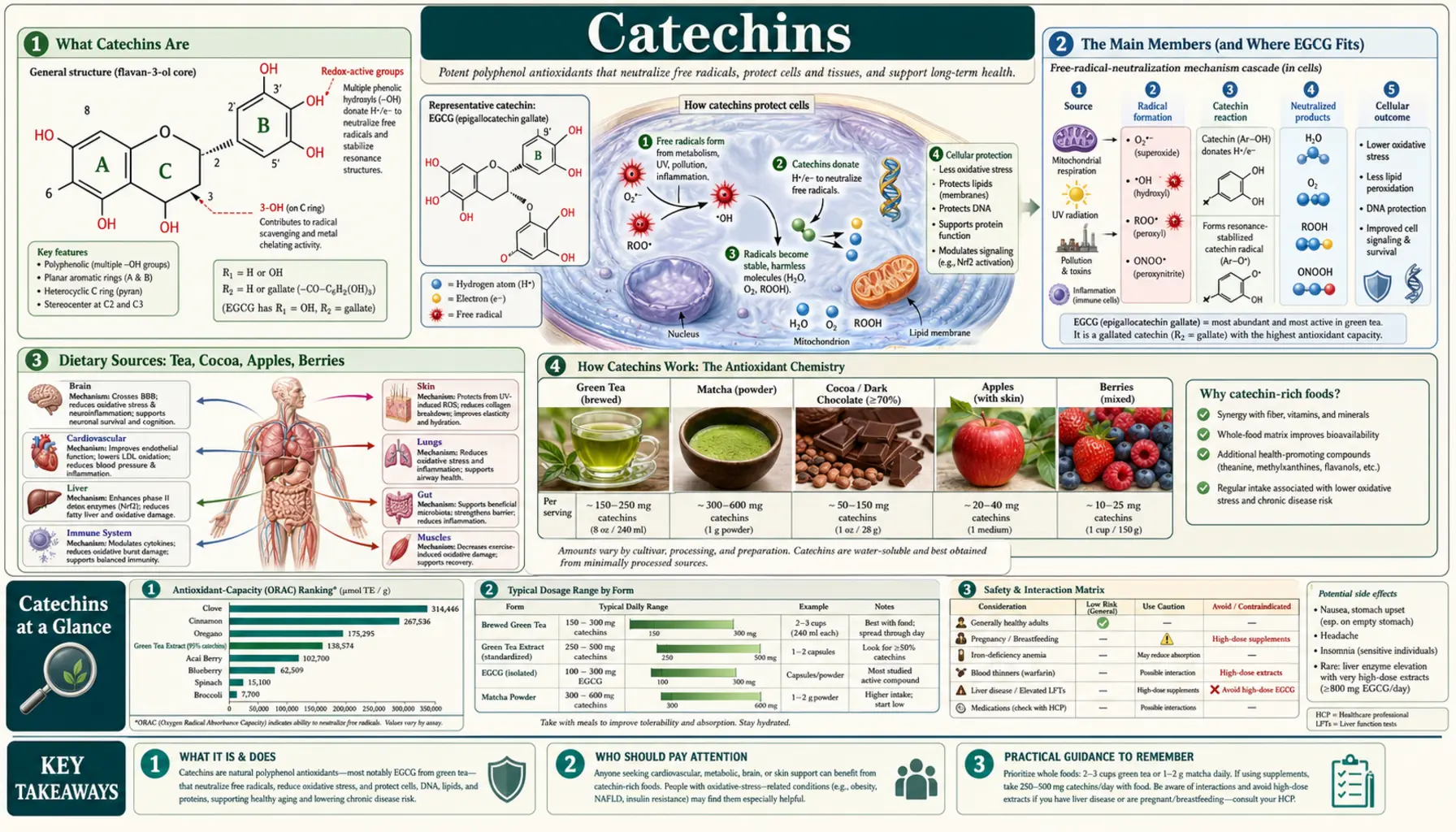
Catechins are a family of plant compounds you eat every day without thinking about it — they are what gives green tea its gentle astringency, dark chocolate its slight bitterness, and a fresh apple its faint pucker near the skin. Chemically they belong to a group called the flavan-3-ols, one branch of the larger flavonoid family of antioxidants. The best-known member, EGCG, gets most of the headlines, but the catechins are really a small clan of closely related molecules that travel together in food. This page steps back to look at the whole family: what these compounds are, the main members and where each shows up, how they work in the body, and what the research honestly does — and does not — show for the heart, the brain, and body weight. We will also be straight with you about the one real safety signal worth knowing: rare liver injury linked not to tea itself, but to concentrated high-dose green-tea-extract supplements.
Table of Contents
- What Catechins Are
- The Main Members (and Where EGCG Fits)
- Dietary Sources: Tea, Cocoa, Apples, Berries
- How Catechins Work: The Antioxidant Chemistry
- Blood Vessels and Nitric Oxide: The Epicatechin Story
- Cardiovascular Research
- Brain, Mood, and Cognition
- Green Tea Catechins, Metabolism, and Weight
- The Liver-Safety Caveat: High-Dose Extracts
- Bioavailability, Forms, and Everyday Safety
- Research Papers
- Connections
- Featured Videos
What Catechins Are
Flavonoids are a huge class of colorful, protective compounds that plants make to defend themselves from sun, pests, and stress. Within that class sit several sub-families — the flavonols (such as quercetin), the anthocyanins that paint berries blue and red, the flavanones in citrus — and the one this page is about: the flavan-3-ols, commonly called catechins.
The name is a mouthful, but the structure is tidy. Every catechin is built from the same three-ring flavonoid skeleton, decorated with several hydroxyl (–OH) groups. Those hydroxyls are the working parts. They are chemically generous: each one can hand off a hydrogen atom or an electron to calm down a reactive, unstable molecule. That single trick — donating without falling apart — is the root of nearly everything catechins do biologically.
Unlike many flavonoids, catechins in plants are usually present as free molecules rather than bound to sugars, and they readily link up with one another into chains called proanthocyanidins (also known as condensed tannins). Those chains are what make strong tea, red wine, and unsweetened cocoa taste dry and astringent. So when you notice that mouth-drying sensation, you are quite literally tasting catechins at work.
The Main Members (and Where EGCG Fits)
The catechin clan has a handful of core members. They differ only in small details — how their hydroxyl groups are arranged in space, and whether a molecule of gallic acid is attached — but those details change how strongly each one scavenges radicals and how well it is absorbed.
- Catechin and epicatechin — the two simplest members, mirror-image cousins of each other. Epicatechin is the star of the cocoa and dark-chocolate story below.
- Gallocatechin (GC) and epigallocatechin (EGC) — the same molecules with one extra hydroxyl group, which makes them even more eager electron donors.
- The gallated forms — catechin gallate (CG), epicatechin gallate (ECG), and epigallocatechin gallate (EGCG) — each carrying an attached gallic-acid unit that boosts antioxidant strength but tends to lower absorption.
Of these, EGCG is by far the most studied. It is the most abundant catechin in green tea and the subject of thousands of laboratory and clinical papers on its own. Because it deserves — and already has — its own full treatment, we do not repeat that material here. If you want the deep dive on EGCG's structure, its Nrf2 signaling, the cancer-chemoprevention research, and its specific dosing and safety profile, read the dedicated EGCG page. Think of this page as the family portrait and the EGCG page as the close-up of its most famous member.
Dietary Sources: Tea, Cocoa, Apples, Berries
You do not need a supplement to get catechins. They are woven through ordinary foods and drinks, and the way a food is grown, processed, and prepared changes how much survives to your cup or plate.
- Green tea is the richest common source. A single brewed cup can deliver on the order of 100–200 mg of catechins, dominated by EGCG and EGC. Because green tea leaves are steamed or pan-fired soon after picking, their catechins are largely preserved.
- Black and oolong tea come from the same plant (Camellia sinensis), but during their longer oxidation the simple catechins are partly converted into larger pigments called theaflavins and thearubigins. Black tea therefore has fewer free catechins — though the compounds it forms instead are also active antioxidants.
- Cocoa and dark chocolate are the leading source of epicatechin specifically. The catechin content depends heavily on processing: heavy "Dutching" (alkalizing) of cocoa destroys much of it, which is why a minimally processed dark chocolate carries far more flavanols than a sweet milk-chocolate bar. See the dark chocolate page for the full picture.
- Apples — especially the skin — along with berries, grapes, red wine, and fava beans round out everyday intake. Berries such as blueberries pair catechins with their signature anthocyanins.
For most people, tea and cocoa together supply the great majority of dietary catechins.
How Catechins Work: The Antioxidant Chemistry
In a test tube, catechins are among the more powerful plant antioxidants known. Their multiple hydroxyl groups let them neutralize reactive oxygen species directly, and their ring structure allows them to chelate (grab and hold) reactive metals like iron and copper that would otherwise catalyze damaging reactions. On paper, this looks like a tidy explanation for their benefits.
But the honest, modern view is more interesting than "catechins mop up free radicals." The amounts that actually reach your bloodstream from food are small — far below the concentrations used in a laboratory dish. Scientists now believe much of the real-world benefit comes not from brute-force radical scavenging but from signaling: catechins and their breakdown products nudge the body's own protective machinery. They can activate the Nrf2 pathway, which switches on your natural antioxidant enzymes, and they influence enzymes that govern inflammation and blood-vessel tone. In other words, a modest dose of catechins may act less like a fire extinguisher and more like a message that tells your cells to raise their own defenses.
Blood Vessels and Nitric Oxide: The Epicatechin Story
The clearest, most reproducible thing catechins do in humans happens in the lining of your blood vessels. Cocoa flavanols — and epicatechin in particular — improve flow-mediated dilation (FMD), a standard ultrasound measure of how well an artery relaxes and widens when blood flow increases. A supple, responsive artery is a hallmark of vascular health.
A landmark human study helped pin down the mechanism. When researchers gave people a flavanol-rich cocoa drink, their arteries dilated better — and when they gave pure epicatechin alone in a matching amount, they reproduced most of the effect. That was strong evidence that epicatechin is the key active ingredient, not just a bystander. The pathway runs through nitric oxide: epicatechin helps the vessel lining make more of this small signaling molecule, and nitric oxide is what tells the smooth muscle in the artery wall to relax. The result is easier blood flow and, often, a small drop in blood pressure.
This effect has been shown even in settings of stressed vessels — for example, acutely reversing some of the endothelial dysfunction seen in smokers. It is a genuinely encouraging, mechanism-backed finding, and it is the strongest single reason catechins are of interest for the cardiovascular system.
Cardiovascular Research
Beyond the short-term vessel studies, catechins have been examined for harder outcomes: blood pressure, cholesterol oxidation, and eventually heart attacks and strokes. Here it is worth separating what is well established from what is still hopeful.
Well supported: Pooled analyses of many randomized trials of chocolate, cocoa, and flavan-3-ols find small but consistent improvements in flow-mediated dilation, modest reductions in blood pressure, and slightly better insulin sensitivity and blood lipids. Large observational cohorts — most famously a long-running Japanese study of tens of thousands of adults — report that people who drink more green tea tend to have somewhat lower rates of death from cardiovascular disease. Observational data cannot prove cause and effect (tea drinkers may differ in many ways), but the signal has been remarkably durable across populations.
Still uncertain: The real test is whether giving flavanols actually prevents heart attacks and strokes. The largest trial to date, COSMOS, gave older adults a concentrated cocoa-flavanol supplement for several years. Its main result was not statistically significant, though a pre-specified analysis pointed to a possible reduction in cardiovascular deaths. That is a "promising but unproven" result, not a green light to treat heart disease with chocolate. The sensible reading: a diet that regularly includes tea, cocoa, apples, and berries fits every picture of a heart-healthy pattern — but catechins are one helpful thread in that pattern, not a stand-alone medicine.
Brain, Mood, and Cognition
Because catechins improve blood flow and dampen inflammation, researchers have asked whether they help the brain, which is exquisitely dependent on a good blood supply. The most striking work has used cocoa flavanols. In one carefully controlled study, older adults who consumed a high-flavanol drink daily for several months showed measurable improvement in a memory-related function of the dentate gyrus, a region of the hippocampus that declines with normal aging — changes visible on specialized brain imaging.
Other trials report short-term boosts in attention and mental sharpness after a flavanol dose, and better performance on cognitive tests in older people given cocoa flavanols over weeks. These are early, encouraging findings on relatively small groups, not proof that catechins prevent dementia. Still, the direction is consistent, and it dovetails with the vascular story: what is good for your arteries tends to be good for your brain.
Green Tea Catechins, Metabolism, and Weight
Green tea catechins are a fixture of "fat-burner" and "metabolism-boosting" supplements, so it is worth being especially plain here. The idea has a real basis: in laboratory and short human studies, catechins (often paired with the caffeine in tea) can modestly raise energy expenditure and fat oxidation, partly by slowing the enzyme that breaks down the body's own fat-mobilizing signals.
But when you tally up the actual weight-loss trials, the effect is small and inconsistent. Meta-analyses find that green tea catechins produce, at best, a modest average reduction — on the order of a pound or two over weeks to months — and a rigorous Cochrane systematic review concluded the effect on weight is small and not clinically important. Much of any early "boost" may come from the caffeine rather than the catechins themselves, and results vary with a person's genetics and baseline caffeine habits.
The honest bottom line: drinking green tea is a pleasant, near-calorie-free habit that fits a healthy lifestyle, but no catechin supplement is a meaningful weight-loss tool. Anything marketed that way is overpromising — and, as the next section explains, the high doses used to chase that promise are exactly where the one real safety concern lives.
The Liver-Safety Caveat: High-Dose Extracts
Here is the most important safety point on this page, stated clearly: drinking green tea is safe for the vast majority of people, but concentrated green-tea-extract supplements have been linked, in rare cases, to liver injury. The difference is dose and form, not the plant.
Reports of hepatotoxicity — ranging from mild elevations in liver enzymes to, very rarely, serious acute liver injury — have accumulated around high-dose green-tea-extract products, especially concentrated EGCG taken in large amounts and particularly on an empty stomach, which increases absorption. Case series in the medical literature document this pattern. After a formal review, the European Food Safety Authority concluded that catechin doses at or above roughly 800 mg of EGCG per day from supplements are associated with signs of liver stress, and flagged this threshold as a concern. Reaching that level from brewed tea would take an implausible number of cups; it is achievable only with concentrated pills.
Practical guidance: if you enjoy green tea, keep enjoying it. If you choose a green-tea-extract supplement, favor lower doses, take it with food rather than fasting, avoid stacking multiple catechin products, and skip it entirely if you have liver disease or drink heavily. Stop and seek care for warning signs of liver trouble — unusual fatigue, dark urine, yellowing of the skin or eyes, or right-upper-abdomen pain. This is a rare event, but it is real and worth respecting.
Bioavailability, Forms, and Everyday Safety
Bioavailability. Catechins are not efficiently absorbed. Only a fraction of what you swallow enters the bloodstream intact; much is transformed by the liver and gut wall into methylated, sulfated, and glucuronidated versions, and a large share travels to the colon, where gut bacteria break it into smaller compounds that may carry their own activity. Blood levels peak within a couple of hours and fall quickly, which is why regular, spread-out intake — a cup here, some dark chocolate there — makes more sense than one big dose. The gallated forms like EGCG absorb less well than plain epicatechin.
Forms. For everyday benefit, whole foods are the sensible default: brewed green tea, minimally processed dark chocolate or unsweetened cocoa, apples with their skin, and berries. Supplements exist as standardized green-tea-extract capsules (often labeled by EGCG or total-catechin content) and as cocoa-flavanol capsules; they concentrate the dose but, as above, that is exactly where caution is warranted.
Everyday safety and interactions. From food and beverages, catechins are well tolerated. A few practical notes: catechins bind non-heme (plant) iron, so tea taken with meals can modestly reduce iron absorption — a reason for people with low iron to drink tea between meals rather than with them. High-dose green-tea extract may interact with certain medications, including the blood thinner warfarin and some chemotherapy agents, so anyone on prescription drugs should check with a pharmacist before adding a concentrated supplement. As a general rule on this site: reach for the teapot and the fruit bowl first, and treat high-potency extracts as the exception that calls for a second thought.
Research Papers
- Schroeter H, Heiss C, Balzer J, et al. (−)-Epicatechin mediates beneficial effects of flavanol-rich cocoa on vascular function in humans. Proc Natl Acad Sci U S A. 2006;103(4):1024–1029. doi:10.1073/pnas.0510168103 — showed pure epicatechin reproduces most of cocoa's artery-relaxing effect, pinning down the active compound.
- Heiss C, Kleinbongard P, Dejam A, et al. Acute consumption of flavanol-rich cocoa and the reversal of endothelial dysfunction in smokers. J Am Coll Cardiol. 2005;46(7):1276–1283. doi:10.1016/j.jacc.2005.06.055 — flavanol-rich cocoa acutely restored blood-vessel function in smokers via nitric oxide.
- Hooper L, Kay C, Abdelhamid A, et al. Effects of chocolate, cocoa, and flavan-3-ols on cardiovascular health: a systematic review and meta-analysis of randomized trials. Am J Clin Nutr. 2012;95(3):740–751. doi:10.3945/ajcn.111.023457 — pooled trials found small, consistent gains in flow-mediated dilation, blood pressure, and insulin sensitivity.
- Sesso HD, Manson JE, Aragaki AK, et al. Effect of cocoa flavanol supplementation for the prevention of cardiovascular events: the COSMOS randomized clinical trial. Am J Clin Nutr. 2022;115(6):1490–1500. doi:10.1093/ajcn/nqac055 — the largest flavanol trial; primary endpoint not significant, with a suggestive reduction in cardiovascular deaths.
- Kuriyama S, Shimazu T, Ohmori K, et al. Green tea consumption and mortality due to cardiovascular disease, cancer, and all causes in Japan: the Ohsaki study. JAMA. 2006;296(10):1255–1265. doi:10.1001/jama.296.10.1255 — large cohort linking higher green-tea intake to lower cardiovascular and all-cause mortality.
- Mangels DR, Mohler ER. Catechins as potential mediators of cardiovascular health. Arterioscler Thromb Vasc Biol. 2017;37(5):757–763. doi:10.1161/ATVBAHA.117.309048 — a focused review of how catechins may support blood-vessel and cardiovascular function.
- Brickman AM, Khan UA, Provenzano FA, et al. Enhancing dentate gyrus function with dietary flavanols improves cognition in older adults. Nat Neurosci. 2014;17(12):1798–1803. doi:10.1038/nn.3850 — high-flavanol cocoa improved a memory-related hippocampal function on brain imaging in older adults.
- Hursel R, Viechtbauer W, Westerterp-Plantenga MS. The effects of green tea on weight loss and weight maintenance: a meta-analysis. Int J Obes (Lond). 2009;33(9):956–961. doi:10.1038/ijo.2009.135 — found green-tea catechins produce only a small effect on weight and maintenance.
- Jurgens TM, Whelan AM, Killian L, et al. Green tea for weight loss and weight maintenance in overweight or obese adults. Cochrane Database Syst Rev. 2012;(12):CD008650. doi:10.1002/14651858.CD008650.pub2 — rigorous review concluding any weight effect is small and not clinically important.
- EFSA Panel on Food Additives and Nutrient Sources (Younes M, Aggett P, Aguilar F, et al.) Scientific opinion on the safety of green tea catechins. EFSA J. 2018;16(4):e05239. doi:10.2903/j.efsa.2018.5239 — identified ≥800 mg/day EGCG from supplements as associated with signs of liver stress.
- Mazzanti G, Menniti-Ippolito F, Moro PA, et al. Hepatotoxicity from green tea: a review of the literature and two unpublished cases. Eur J Clin Pharmacol. 2009;65(4):331–341. doi:10.1007/s00228-008-0610-7 — case-based review documenting rare liver injury from concentrated green-tea products.
- Del Rio D, Rodriguez-Mateos A, Spencer JPE, et al. Dietary (poly)phenolics in human health: structures, bioavailability, and evidence of protective effects against chronic diseases. Antioxid Redox Signal. 2013;18(14):1818–1892. doi:10.1089/ars.2012.4581 — comprehensive review of how catechins and other polyphenols are absorbed, metabolized, and act.
Connections
- EGCG (the most-studied catechin)
- Quercetin
- Anthocyanins
- Hesperidin
- Grape Seed Extract
- Pycnogenol
- Resveratrol
- Curcumin
- Green Tea
- Dark Chocolate
- Apples
- Blueberries
- All Antioxidants
- All Food