Lycopene: The Red Carotenoid Antioxidant
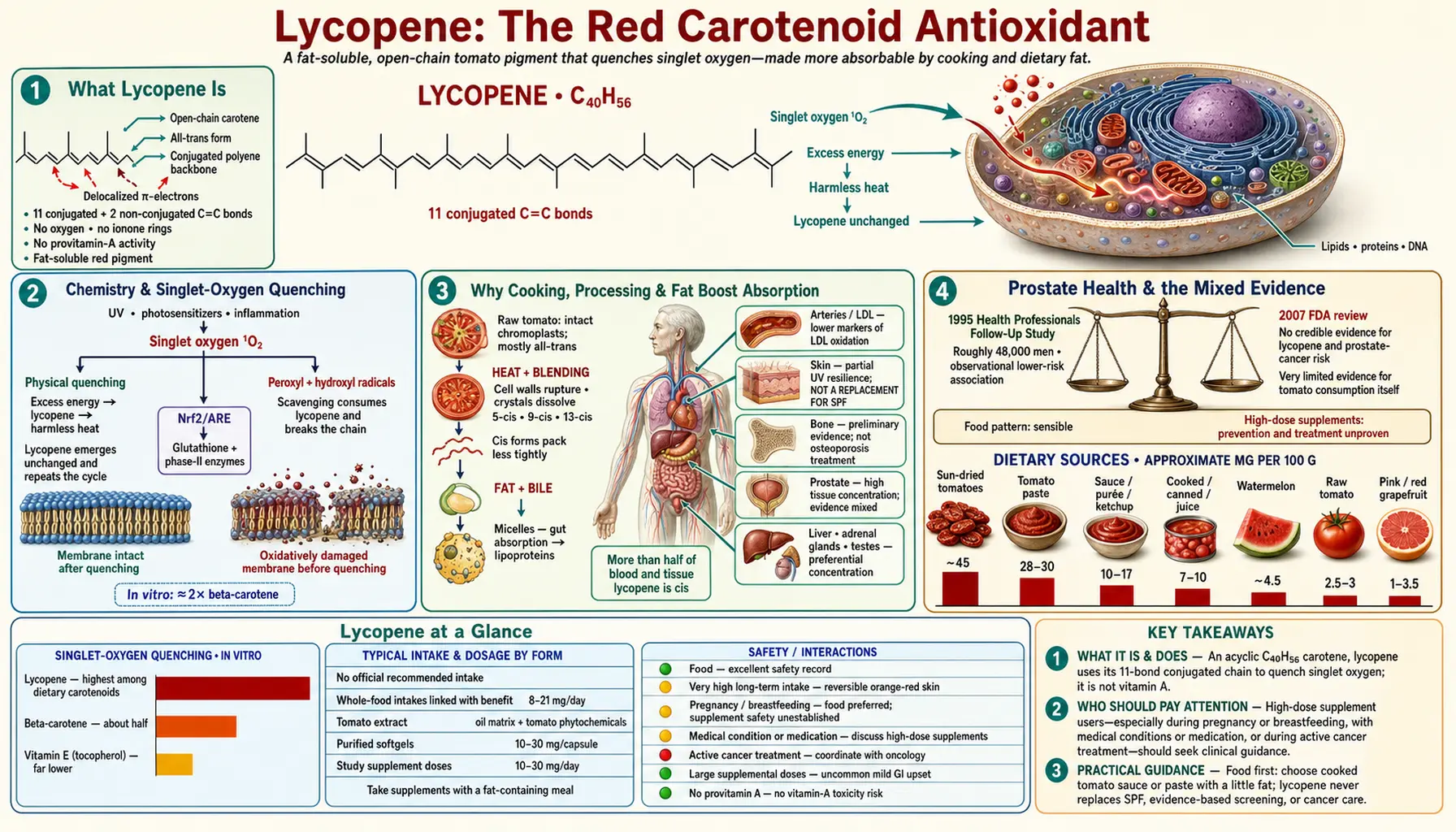
Lycopene is the red carotenoid pigment of tomatoes, watermelon, pink grapefruit and guava. Chemically it is an acyclic carotene — an open-chain hydrocarbon with eleven conjugated double bonds, no oxygen and no closed ionone ring — and in a 1989 laboratory study it had the highest singlet-oxygen quenching rate of the carotenoids measured. In human feeding studies, more lycopene was absorbed from tomato paste than from fresh tomatoes, and more when tomatoes were eaten with fat. Population studies link higher lycopene intake or blood levels with lower rates of prostate cancer, stroke and cardiovascular disease; intervention trials report modest effects on LDL cholesterol, blood pressure and UV-induced skin reddening, while a Cochrane review judged the few randomized trials on prostate cancer insufficient to support or refute a preventive effect.
Table of Contents
- What Lycopene Is
- Chemistry & Singlet-Oxygen Quenching
- Why Cooking, Processing & Fat Boost Absorption
- Prostate Health & the Mixed Evidence
- Cardiovascular Health & LDL Oxidation
- Skin Photoprotection
- Bone Health
- Other Investigated Effects
- Dietary Sources
- Forms & Amounts Used in Studies
- Cautions & Lycopenemia
- Key Research Papers
- Connections
- Featured Videos
What Lycopene Is
Lycopene is a carotenoid — one of the family of fat-soluble plant pigments that also includes beta-carotene, lutein, zeaxanthin, and astaxanthin. Its name comes from Solanum lycopersicum, the botanical name of the tomato, and tomatoes and processed tomato products are the major source of lycopene in the North American diet (Rao and Agarwal, 2000). In plants, carotenoids act as pigments and help protect tissues from light-driven oxidative damage.
Carotenoids divide into two structural groups. Carotenes are pure hydrocarbons made only of carbon and hydrogen; xanthophylls (lutein, zeaxanthin, astaxanthin) carry oxygen atoms. Lycopene is a carotene. What sets it apart from the more familiar beta-carotene is that lycopene is acyclic — it is a straight, open chain that does not curl its ends into the six-membered beta-ionone rings found in beta-carotene. Those rings are exactly the structural feature an enzyme needs to cleave a carotenoid into vitamin A. Because lycopene has no ionone rings, it has no provitamin-A activity — the body cannot turn it into retinol. Research interest in it therefore centres on its antioxidant and other non-vitamin actions.
Lycopene is one of the major carotenoids in human serum and tissues (Rao and Agarwal, 2000; Boileau and colleagues, 2002). In a 1992 analysis of serum and seven human tissues, Stahl and colleagues found that the liver, adrenal glands and testes always contained more carotenoids than the kidney, ovary and fat, and that lycopene was the predominant carotenoid in the testes. Clinton and colleagues (1996) found lycopene and all-trans beta-carotene to be the predominant carotenoids in prostate tissue from 25 men undergoing prostatectomy; that study was prompted by the Health Professionals Follow-Up Study's finding of lower prostate-cancer risk with greater consumption of tomato products.
Chemistry & Singlet-Oxygen Quenching
Lycopene's chemical formula is C40H56. Its defining feature is a conjugated polyene backbone: a long chain in which single and double bonds alternate. Lycopene carries eleven conjugated carbon–carbon double bonds (plus two non-conjugated), all within its open chain. This extended chain of delocalized electrons makes lycopene intensely red (it absorbs blue-green light) and underlies its antioxidant chemistry.
The antioxidant reaction most associated with lycopene is quenching singlet oxygen. Singlet oxygen is a high-energy, electronically excited form of molecular oxygen generated by ultraviolet light, photosensitizers, and certain inflammatory reactions; it is far more reactive than ordinary ground-state oxygen and can damage lipids, proteins, and DNA. Carotenoids neutralize singlet oxygen largely physically: the excess energy is absorbed into the conjugated chain and released as heat, leaving the molecule able to repeat the cycle. In a 1989 laboratory study, Di Mascio, Kaiser and Sies measured a physical quenching rate constant of 31 × 109 M−1 s−1 for lycopene, the highest of the carotenoids tested, against 14 × 109 for beta-carotene and 0.3 × 10⁹ for alpha-tocopherol (vitamin E). The same authors noted that once plasma levels are taken into account — compounds with low rate constants circulate at higher concentrations — the singlet-oxygen quenching capacities of lycopene, beta-carotene, albumin-bound bilirubin and alpha-tocopherol in plasma are of comparable magnitude.
Lycopene also reacts with free radicals such as peroxyl radicals (the chain-carrying radicals of lipid peroxidation); unlike physical quenching, these reactions consume the molecule. Reviews describe mechanisms beyond direct antioxidant chemistry, including modulation of gap-junction communication between cells and of hormonal, immune and metabolic pathways (Rao and Agarwal, 2000), and laboratory studies have examined lycopene's effects on the Nrf2 pathway, which controls the cell's own antioxidant and detoxification enzymes. How much each mechanism contributes in people has not been established.
Why Cooking, Processing & Fat Boost Absorption
Lycopene runs against the usual pattern for heat-sensitive nutrients: in human feeding studies, processed tomato products delivered more absorbable lycopene than fresh tomatoes. The reasons are partly physical and partly chemical; the studies are set out in detail on the Lycopene Sources & Bioavailability page.
Processing breaks down the food matrix. In a raw tomato, lycopene is held inside plant cells enclosed by cell walls. A 2000 review by Shi and Le Maguer states that food processing may improve lycopene bioavailability by breaking down cell walls, which weakens the bonding between lycopene and the tissue matrix. A frequently cited 1997 study by Gärtner, Stahl and Sies compared a single serving of fresh tomatoes with a serving of tomato paste, each supplying 23 mg of lycopene and each eaten with 15 g of corn oil: tomato paste produced 2.5-fold higher peak total lycopene concentrations in the chylomicron fraction of the blood and a 3.8-fold higher area-under-the-curve response. The lycopene isomer pattern was the same in both foods, so the difference in that study was not explained by the cis/trans shape of the molecule.
Heat converts part of the lycopene to cis-isomers. About 90% of the lycopene in dietary sources is in the straight all-trans form (Boileau and colleagues, 2002); heat converts part of it into bent cis forms, and the cis share rises with temperature and processing time (Shi and Le Maguer, 2000). Researchers have proposed that cis-isomers are better absorbed because they are shorter, more soluble in bile-acid micelles and less prone to aggregate; in ferrets, the lycopene dose and gut contents held 6–18% cis-lycopene while the mesenteric lymph held 77% cis-isomers (Boileau and colleagues, 2002). In a crossover trial in 12 healthy adults, lycopene absorption was significantly higher from a cis-rich tomato sauce than from an all-trans-rich one (Unlu and colleagues, 2007). Ordinary processed tomato products remain mostly all-trans: Clinton and colleagues (1996) measured 79–91% all-trans lycopene in tomatoes, tomato paste and tomato soup, whereas men's serum held 58–73% cis-isomers and prostate tissue 79–88% cis-isomers. Stahl and colleagues (1992) likewise found that cis-isomers (9-, 13- and 15-cis) made up more than half of the lycopene in human serum and tissues.
Fat is the carrier. Lycopene is fat-soluble, and dietary fat helps form the micelles that carry carotenoids across the gut lining. In a crossover study of 11 healthy adults, adding 150 g of avocado to tomato salsa raised lycopene absorption to 4.4 times that after avocado-free salsa (Unlu and colleagues, 2005). In a five-day study, plasma trans-lycopene rose 82% in 11 people who ate 470 g of diced tomatoes a day cooked with 25 ml of extra virgin olive oil, but did not change significantly in 12 people whose tomatoes were cooked without it (Fielding and colleagues, 2005). With a fat-free salad dressing, the appearance of lycopene in chylomicrons was negligible; it was higher with 6 g and higher again with 28 g of canola oil (Brown and colleagues, 2004). Fielding and colleagues note that cooking tomatoes with olive oil is characteristic of the Southern Mediterranean diet; olive oil is covered on the olive oil page.
Prostate Health & the Mixed Evidence
The prostate-cancer hypothesis is the most widely publicized claim about lycopene, and the evidence for it is mixed.
The observational evidence. In 1995, Giovannucci and colleagues reported on 47,894 men in the Health Professionals Follow-Up Study. Of the carotenoids measured, only lycopene intake was related to lower risk of prostate cancer (relative risk 0.79 for the highest versus lowest fifth of intake), and combined intake of tomatoes, tomato sauce, tomato juice and pizza — which supplied 82% of lycopene intake — was associated with lower risk of prostate cancer (relative risk 0.65 for more than 10 versus fewer than 1.5 servings a week) and of advanced prostate cancer (0.47). A 2002 follow-up of 47,365 men through 1998, with 2,481 cases, confirmed the association: relative risk 0.84 for the highest versus lowest fifth of lycopene intake, and 0.77 for two or more servings of tomato sauce a week versus less than one a month. In the Physicians' Health Study, men who developed prostate cancer had lower plasma lycopene than matched controls; the inverse association was weak for all prostate cancers and stronger for aggressive cancers (Gann and colleagues, 1999). A 2017 meta-analysis of 42 studies (Rowles and colleagues) found higher dietary intake and higher circulating lycopene each associated with lower prostate-cancer risk (relative risk 0.88 for each), but no association with advanced prostate cancer.
Why the evidence is called mixed. Observational associations cannot establish cause and effect — men who eat more tomato products may differ in other ways. Randomized trials are few and small. In a trial of 26 men with localized prostate cancer, 11 of 15 men given 15 mg of lycopene twice daily for three weeks before prostatectomy, against 2 of 11 controls, had no cancer involvement of the surgical margins or extraprostatic tissue; PSA fell 18% in the lycopene group and rose 14% in controls, a difference that was not statistically significant, and the authors stated that no firm conclusions could be drawn because of the small sample (Kucuk and colleagues, 2001). A 2011 Cochrane review found three randomized trials with 154 participants, two of them at high risk of bias, and concluded that there was insufficient evidence to either support or refute lycopene for the prevention of prostate cancer (Ilic and colleagues, 2011). In 2007 the U.S. Food and Drug Administration, reviewing petitions for qualified health claims, found no credible evidence for an association between lycopene intake and reduced risk of prostate cancer (or several other cancers), and very limited evidence for an association between tomato consumption and reduced risk of prostate, ovarian, gastric and pancreatic cancers (Kavanaugh and colleagues, 2007).
Where the evidence stands. Diets high in tomato products and higher blood lycopene are associated with modestly lower prostate-cancer risk in many, though not all, population studies, while randomized trials of lycopene supplements are too few and too small to show whether they prevent or treat prostate cancer. In a rat model of prostate cancer, rats fed whole tomato powder had a lower risk of death with prostate cancer than controls, while rats fed purified lycopene did not differ from controls (Boileau and colleagues, 2003); that was an animal study. The human studies are covered on the Lycopene for Prostate Health page, PSA testing on the PSA test page, and the wider topic under prostate conditions.
Cardiovascular Health & LDL Oxidation
Cardiovascular research on lycopene includes laboratory and mechanism studies, intervention trials on risk factors, and observational studies of heart attacks, strokes and deaths.
A central event in atherosclerosis is the oxidation of LDL particles. Once LDL's lipids and apolipoprotein B are oxidized, the particle is taken up by macrophages to form foam cells, an early component of arterial plaque. Because lycopene is fat-soluble, it travels in the bloodstream inside lipoproteins, including LDL. In a dietary intervention in 19 healthy adults, a week each of tomato juice, spaghetti sauce and tomato oleoresin at least doubled serum lycopene and significantly lowered serum lipid peroxidation and LDL oxidation, without changing serum cholesterol (Agarwal and Rao, 1998).
Meta-analyses of intervention trials report modest effects on risk factors. Ried and Fakler (2011) found that lycopene at 25 mg a day or more lowered LDL cholesterol (by about 10% in the authors' summary), while trials at lower doses showed no significant effect, and that across four trials systolic blood pressure fell by 5.60 mm Hg on average. Cheng and colleagues (2017), pooling 21 trials, found that tomato interventions lowered LDL cholesterol and interleukin-6 and improved flow-mediated dilation (a measure of endothelial function), and that lycopene supplements lowered systolic blood pressure (by 5.66 mm Hg); no other outcome, including C-reactive protein, was significantly affected.
In the Kuopio Ischaemic Heart Disease Risk Factor Study in eastern Finland, men in the lowest quarter of serum lycopene had a 3.3-fold risk of an acute coronary event or stroke compared with the other men (725 men; Rissanen and colleagues, 2001), and a thicker common carotid artery wall (intima-media thickness), which the authors linked to the early stages of atherosclerosis (1,028 men; Rissanen and colleagues, 2003). A meta-analysis of observational studies by the same group as the 2017 trial analysis found that people in the highest category of lycopene intake or serum concentration had lower risk of stroke (hazard ratio 0.74) and of cardiovascular disease (0.86), and that the highest serum lycopene was associated with lower mortality (0.63); lycopene was not significantly associated with myocardial infarction (Cheng and colleagues, 2019).
As with the cancer data, the effect sizes are modest, the observational findings cannot establish cause, and the trials are mostly short. The trials are covered on the Lycopene for the Heart page; blood lipids on the lipid panel page and the wider topic under cardiovascular disease.
Skin Photoprotection
Lycopene quenches the singlet oxygen generated when ultraviolet light strikes skin, and researchers have tested whether eating lycopene-rich foods reduces sunburn. The trials measured partial reductions in UV-induced skin reddening; they did not compare lycopene with topical sunscreen.
In a 2001 study, 9 volunteers ate 40 g of tomato paste (about 16 mg of lycopene a day) with 10 g of olive oil for 10 weeks, and 10 controls took olive oil alone; at week 10, UV-induced reddening (erythema) of the back was 40% lower in the tomato-paste group, with no significant difference at week 4 (Stahl and colleagues, 2001). In a 2011 randomized trial, 20 women ate 55 g of tomato paste (16 mg of lycopene) in olive oil, or olive oil alone, daily for 12 weeks; one instrument measure of erythema sensitivity improved with tomato paste, while the visually assessed minimal erythema dose did not differ significantly between groups, and UV-induced increases in matrix metalloproteinase-1 (a collagen-degrading enzyme) and in a mitochondrial DNA deletion were reduced (Rizwan and colleagues, 2011). Both studies used tomato paste, not purified lycopene. The trials are covered on the Lycopene for Skin page.
Other carotenoids studied for light protection include the marine carotenoid astaxanthin and the macular pigments lutein and zeaxanthin, the predominant carotenoids of the retina (Stahl and Sies, 2005).
Bone Health
Researchers have studied whether lycopene affects bone through oxidative stress. Osteoclasts — the cells that resorb bone — produce reactive oxygen species that can stimulate bone resorption (Rao and colleagues, 2003).
In rat bone-marrow cultures, lycopene inhibited osteoclast formation, mineral resorption and the reactive oxygen produced by osteoclasts (Rao and colleagues, 2003), and in human osteoblast-like cells it stimulated cell proliferation (Kim and colleagues, 2003); these were laboratory studies. In a cross-sectional study of 33 postmenopausal women, higher serum lycopene was associated with lower levels of the bone-resorption marker NTx and lower protein oxidation (Rao and colleagues, 2007). In a randomized trial, 60 postmenopausal women aged 50–60 took regular tomato juice, lycopene-rich tomato juice, tomato-extract lycopene capsules (30 or 70 mg of lycopene a day) or placebo capsules for four months; the lycopene groups had lower lipid peroxidation, protein oxidation and NTx than the placebo group (Mackinnon and colleagues, 2011). These studies measured markers, not bone density or fractures. Osteoporosis is covered under osteoporosis.
Other Investigated Effects
Lycopene has been studied for several other conditions, mostly in observational or early-stage research:
- Eye health — lycopene has been examined for a possible role in age-related macular degeneration and cataract; lutein and zeaxanthin, not lycopene, are the predominant carotenoids of the retina (Stahl and Sies, 2005).
- Male fertility — small trials have tested lycopene for sperm quality in men with infertility, on the rationale that oxidative stress damages sperm; the evidence is limited.
- Metabolic and liver markers — lycopene status has been examined in relation to insulin sensitivity, fatty liver and inflammation, mainly in observational and animal studies.
- Blood pressure and endothelial function — covered above under cardiovascular health; the 2011 and 2017 meta-analyses found modest reductions in systolic blood pressure.
- Neuroprotection — laboratory and animal studies have examined protection of neurons from oxidative injury; human evidence is minimal.
The human trials covered on this page that measured an effect directly were mainly on LDL oxidation, blood lipids and blood pressure (Agarwal and Rao, 1998; Ried and Fakler, 2011; Cheng and colleagues, 2017) and on UV-induced skin reddening (Stahl and colleagues, 2001; Rizwan and colleagues, 2011); the other areas rest on smaller or earlier-stage studies.
Dietary Sources
Lycopene is found in tomatoes and a limited number of red- and pink-fleshed fruits; tomatoes and processed tomato products are the major source of lycopene in the North American diet (Rao and Agarwal, 2000). The lycopene values listed in USDA FoodData Central (SR Legacy records), per 100 grams of food, are below. Actual content varies with variety, ripeness and processing, and the amount in a food is not the same as the amount absorbed.
- Tomatoes, sun-dried — 45,900 µg per 100 g
- Tomato paste, canned, without salt added — 28,800 µg per 100 g
- Tomato puree, canned, without salt added — 21,800 µg per 100 g
- Tomato sauce, canned — 13,900 µg per 100 g
- Pasta sauce, spaghetti/marinara, ready-to-serve — 12,700 µg per 100 g
- Catsup (ketchup) — 12,100 µg per 100 g
- Tomato soup, canned, condensed (undiluted) — 10,900 µg per 100 g
- Tomato juice, canned, with salt added — 9,040 µg per 100 g
- Guava, common, raw — 5,200 µg per 100 g
- Watermelon, raw — 4,530 µg per 100 g
- Tomatoes, red, ripe, canned, stewed — 4,090 µg per 100 g
- Tomatoes, red, ripe, cooked — 3,040 µg per 100 g
- Tomatoes, red, ripe, raw (year-round average) — 2,570 µg per 100 g
- Papaya, raw — 1,830 µg per 100 g
- Grapefruit, raw, pink and red — 1,420 µg per 100 g
- Grapefruit, raw, white — 0 µg per 100 g
In a USDA feeding study, watermelon juice that was not heat-processed raised plasma lycopene as much as canned tomato juice (Edwards and colleagues, 2003). Each food's FoodData Central record is linked on the Lycopene Sources & Bioavailability page; tomatoes are covered on the tomatoes food page.
Forms & Amounts Used in Studies
No Dietary Reference Intake has been set for lycopene; it is not considered an essential nutrient.
- Tomato foods — the absorption studies above used tomato paste, cooked tomatoes, tomato sauces, salsa and juice, and the two skin trials used 40–55 g of tomato paste a day in olive oil (about 16 mg of lycopene).
- Tomato extracts — standardized tomato-oleoresin extracts deliver lycopene in an oil matrix; a tomato oleoresin was one of the three sources in the 1998 LDL-oxidation study (Agarwal and Rao), and tomato-extract capsules were one arm of the 2011 bone trial (Mackinnon and colleagues).
- Purified or synthetic lycopene — sold as capsules. In a rat model of prostate cancer, purified lycopene did not lower the risk of death with prostate cancer while whole tomato powder did (Boileau and colleagues, 2003); that was an animal study.
Amounts used in the human trials covered on this page include 2 mg a day in pregnancy (Banerjee and colleagues, 2009), 15 mg twice daily for three weeks (Kucuk and colleagues, 2001), about 16 mg a day from tomato paste (Stahl and colleagues, 2001; Rizwan and colleagues, 2011) and 30 or 70 mg a day for four months (Mackinnon and colleagues, 2011); in the Ried and Fakler meta-analysis, the LDL-lowering effect was seen in trials using 25 mg a day or more. Because lycopene is fat-soluble, the dietary-fat findings above concern absorption from any source. Concentrated long-term supplementation has not been studied as thoroughly as ordinary dietary intake, and decisions about supplements belong with a clinician.
Cautions & Lycopenemia
Lycopene is a normal constituent of diets that include tomatoes. The safety findings reported in the research:
- Lycopenemia — lycopenemia was described in 1960 as a variant of carotenemia (Reich and colleagues). A 2022 case report describes yellow-orange skin colouring (carotenoderma) caused by excessive intake of lycopene-rich vegetables and fruits, with the pigment deposited particularly in the outermost layer of the skin; the authors describe carotenoderma as benign and harmless (Tanaka and colleagues, 2022).
- No vitamin-A toxicity — because lycopene has no provitamin-A activity, it is not converted to vitamin A and does not carry the hypervitaminosis-A concern associated with high intakes of preformed retinol.
- Pregnancy — in a randomized, placebo-controlled trial in 159 healthy first-time pregnant women, 2 mg of lycopene a day from 12–20 weeks of pregnancy until delivery did not reduce pre-eclampsia (18.18% with lycopene versus 18.29% with placebo), and preterm labour (10.39% versus 1.22%) and low-birthweight babies (22.08% versus 9.76%) were more frequent in the lycopene group (Banerjee and colleagues, 2009). The safety of concentrated lycopene supplements in pregnancy and breastfeeding has not been established.
- Theoretical interactions — lycopene lowered systolic blood pressure modestly in the meta-analyses above, and, as with other antioxidants, there is a theoretical concern about interference with cancer treatments that act through oxidation; direct clinical data on lycopene are lacking.
Key Research Papers
The following are real, peer-reviewed publications on lycopene's chemistry, bioavailability, and clinical associations.
- Di Mascio P, Kaiser S, Sies H. Lycopene as the most efficient biological carotenoid singlet oxygen quencher. Archives of Biochemistry and Biophysics. 1989;274(2):532–538. — doi:10.1016/0003-9861(89)90467-0
- Giovannucci E, Ascherio A, Rimm EB, Stampfer MJ, Colditz GA, Willett WC. Intake of carotenoids and retinol in relation to risk of prostate cancer. Journal of the National Cancer Institute. 1995;87(23):1767–1776. — doi:10.1093/jnci/87.23.1767
- Gann PH, Ma J, Giovannucci E, et al. Lower prostate cancer risk in men with elevated plasma lycopene levels: results of a prospective analysis. Cancer Research. 1999;59(6):1225–1230. — PubMed PMID: 10096552
- Stahl W, Sies H. Bioactivity and protective effects of natural carotenoids. Biochimica et Biophysica Acta. 2005;1740(2):101–107. — doi:10.1016/j.bbadis.2004.12.006
- Boileau TW, Boileau AC, Erdman JW. Bioavailability of all-trans and cis-isomers of lycopene. Experimental Biology and Medicine. 2002;227(10):914–919. — doi:10.1177/153537020222701012
- Unlu NZ, Bohn T, Francis DM, Nagaraja HN, Clinton SK, Schwartz SJ. Lycopene from heat-induced cis-isomer-rich tomato sauce is more bioavailable than from all-trans-rich tomato sauce in human subjects. British Journal of Nutrition. 2007;98(1):140–146. — doi:10.1017/S0007114507685201
- Rao AV, Agarwal S. Role of antioxidant lycopene in cancer and heart disease. Journal of the American College of Nutrition. 2000;19(5):563–569. — doi:10.1080/07315724.2000.10718953
- Rissanen TH, Voutilainen S, Nyyssonen K, et al. Low serum lycopene concentration is associated with an excess incidence of acute coronary events and stroke: the Kuopio Ischaemic Heart Disease Risk Factor Study. British Journal of Nutrition. 2001;85(6):749–754. — doi:10.1079/BJN2001357
- Ried K, Fakler P. Protective effect of lycopene on serum cholesterol and blood pressure: meta-analyses of intervention trials. Maturitas. 2011;68(4):299–310. — doi:10.1016/j.maturitas.2010.11.018
- Stahl W, Heinrich U, Wiseman S, Eichler O, Sies H, Tronnier H. Dietary tomato paste protects against ultraviolet light-induced erythema in humans. Journal of Nutrition. 2001;131(5):1449–1451. — doi:10.1093/jn/131.5.1449
- Ilic D, Forbes KM, Hassed C. Lycopene for the prevention of prostate cancer. Cochrane Database of Systematic Reviews. 2011;(11):CD008007. — doi:10.1002/14651858.CD008007.pub2
- Mackinnon ES, Rao AV, Josse RG, Rao LG. Supplementation with the antioxidant lycopene significantly decreases oxidative stress parameters and the bone resorption marker N-telopeptide of type I collagen in postmenopausal women. Osteoporosis International. 2011;22(4):1091–1101. — doi:10.1007/s00198-010-1308-0
- Giovannucci E, Rimm EB, Liu Y, Stampfer MJ, Willett WC. A prospective study of tomato products, lycopene, and prostate cancer risk. Journal of the National Cancer Institute. 2002;94(5):391–398. — PubMed PMID: 11880478
- Kucuk O, Sarkar FH, Sakr W, et al. Phase II randomized clinical trial of lycopene supplementation before radical prostatectomy. Cancer Epidemiology, Biomarkers & Prevention. 2001;10(8):861–868. — PubMed PMID: 11489752
- Kavanaugh CJ, Trumbo PR, Ellwood KC. The U.S. Food and Drug Administration's evidence-based review for qualified health claims: tomatoes, lycopene, and cancer. Journal of the National Cancer Institute. 2007;99(14):1074–1085. — PubMed PMID: 17623802
- Rowles JL 3rd, Ranard KM, Smith JW, An R, Erdman JW Jr. Increased dietary and circulating lycopene are associated with reduced prostate cancer risk: a systematic review and meta-analysis. Prostate Cancer and Prostatic Diseases. 2017;20(4):361–377. — PubMed PMID: 28440323
- Boileau TW, Liao Z, Kim S, Lemeshow S, Erdman JW Jr, Clinton SK. Prostate carcinogenesis in N-methyl-N-nitrosourea (NMU)-testosterone-treated rats fed tomato powder, lycopene, or energy-restricted diets. Journal of the National Cancer Institute. 2003;95(21):1578–1586. — PubMed PMID: 14600090
- Agarwal S, Rao AV. Tomato lycopene and low density lipoprotein oxidation: a human dietary intervention study. Lipids. 1998;33(10):981–984. — PubMed PMID: 9832077
- Cheng HM, Koutsidis G, Lodge JK, Ashor A, Siervo M, Lara J. Tomato and lycopene supplementation and cardiovascular risk factors: a systematic review and meta-analysis. Atherosclerosis. 2017;257:100–108. — PubMed PMID: 28129549
- Cheng HM, Koutsidis G, Lodge JK, Ashor AW, Siervo M, Lara J. Lycopene and tomato and risk of cardiovascular diseases: a systematic review and meta-analysis of epidemiological evidence. Critical Reviews in Food Science and Nutrition. 2019;59(1):141–158. — PubMed PMID: 28799780
- Rissanen TH, Voutilainen S, Nyyssönen K, Salonen R, Kaplan GA, Salonen JT. Serum lycopene concentrations and carotid atherosclerosis: the Kuopio Ischaemic Heart Disease Risk Factor Study. American Journal of Clinical Nutrition. 2003;77(1):133–138. — PubMed PMID: 12499332
- Rizwan M, Rodriguez-Blanco I, Harbottle A, Birch-Machin MA, Watson RE, Rhodes LE. Tomato paste rich in lycopene protects against cutaneous photodamage in humans in vivo: a randomized controlled trial. British Journal of Dermatology. 2011;164(1):154–162. — PubMed PMID: 20854436
- Stahl W, Schwarz W, Sundquist AR, Sies H. cis-trans isomers of lycopene and beta-carotene in human serum and tissues. Archives of Biochemistry and Biophysics. 1992;294(1):173–177. — PubMed PMID: 1550343
- Clinton SK, Emenhiser C, Schwartz SJ, et al. cis-trans lycopene isomers, carotenoids, and retinol in the human prostate. Cancer Epidemiology, Biomarkers & Prevention. 1996;5(10):823–833. — PubMed PMID: 8896894
- Gärtner C, Stahl W, Sies H. Lycopene is more bioavailable from tomato paste than from fresh tomatoes. American Journal of Clinical Nutrition. 1997;66(1):116–122. — PubMed PMID: 9209178
- Shi J, Le Maguer M. Lycopene in tomatoes: chemical and physical properties affected by food processing. Critical Reviews in Food Science and Nutrition. 2000;40(1):1–42. — PubMed PMID: 10674200
- Unlu NZ, Bohn T, Clinton SK, Schwartz SJ. Carotenoid absorption from salad and salsa by humans is enhanced by the addition of avocado or avocado oil. Journal of Nutrition. 2005;135(3):431–436. — PubMed PMID: 15735074
- Fielding JM, Rowley KG, Cooper P, O'Dea K. Increases in plasma lycopene concentration after consumption of tomatoes cooked with olive oil. Asia Pacific Journal of Clinical Nutrition. 2005;14(2):131–136. — PubMed PMID: 15927929
- Brown MJ, Ferruzzi MG, Nguyen ML, et al. Carotenoid bioavailability is higher from salads ingested with full-fat than with fat-reduced salad dressings as measured with electrochemical detection. American Journal of Clinical Nutrition. 2004;80(2):396–403. — PubMed PMID: 15277161
- Edwards AJ, Vinyard BT, Wiley ER, et al. Consumption of watermelon juice increases plasma concentrations of lycopene and beta-carotene in humans. Journal of Nutrition. 2003;133(4):1043–1050. — PubMed PMID: 12672916
- Rao LG, Krishnadev N, Banasikowska K, Rao AV. Lycopene I—effect on osteoclasts: lycopene inhibits basal and parathyroid hormone-stimulated osteoclast formation and mineral resorption mediated by reactive oxygen species in rat bone marrow cultures. Journal of Medicinal Food. 2003;6(2):69–78. — PubMed PMID: 12935316
- Kim L, Rao AV, Rao LG. Lycopene II—effect on osteoblasts: the carotenoid lycopene stimulates cell proliferation and alkaline phosphatase activity of SaOS-2 cells. Journal of Medicinal Food. 2003;6(2):79–86. — PubMed PMID: 12935317
- Rao LG, Mackinnon ES, Josse RG, Murray TM, Strauss A, Rao AV. Lycopene consumption decreases oxidative stress and bone resorption markers in postmenopausal women. Osteoporosis International. 2007;18(1):109–115. — PubMed PMID: 16941193
- Banerjee S, Jeyaseelan S, Guleria R. Trial of lycopene to prevent pre-eclampsia in healthy primigravidas: results show some adverse effects. Journal of Obstetrics and Gynaecology Research. 2009;35(3):477–482. — PubMed PMID: 19527386
- Reich P, Shwachman H, Craig JM. Lycopenemia: a variant of carotenemia. New England Journal of Medicine. 1960;262:263–269. — PubMed PMID: 14437033
- Tanaka A, Miyauchi T, Kitamura S, Iwata H, Hata H, Ujiie H. Carotenoderma due to lycopenemia: a case report and evaluation of lycopene deposition in the skin. Journal of Dermatology. 2022;49(12):1320–1324. — PubMed PMID: 35938228
PubMed Topic Searches
- PubMed: Lycopene singlet oxygen & antioxidant mechanism
- PubMed: Lycopene cis-isomer bioavailability & tomato processing
- PubMed: Lycopene & prostate cancer
- PubMed: Lycopene, LDL oxidation & cardiovascular risk
- PubMed: Lycopene, skin & UV photoprotection
- PubMed: Lycopene & bone mineral density
- PubMed: Lycopene, blood pressure & endothelial function
- PubMed: Lycopene supplementation clinical trials