Apigenin: Antioxidant & Anti-Inflammatory Mechanisms
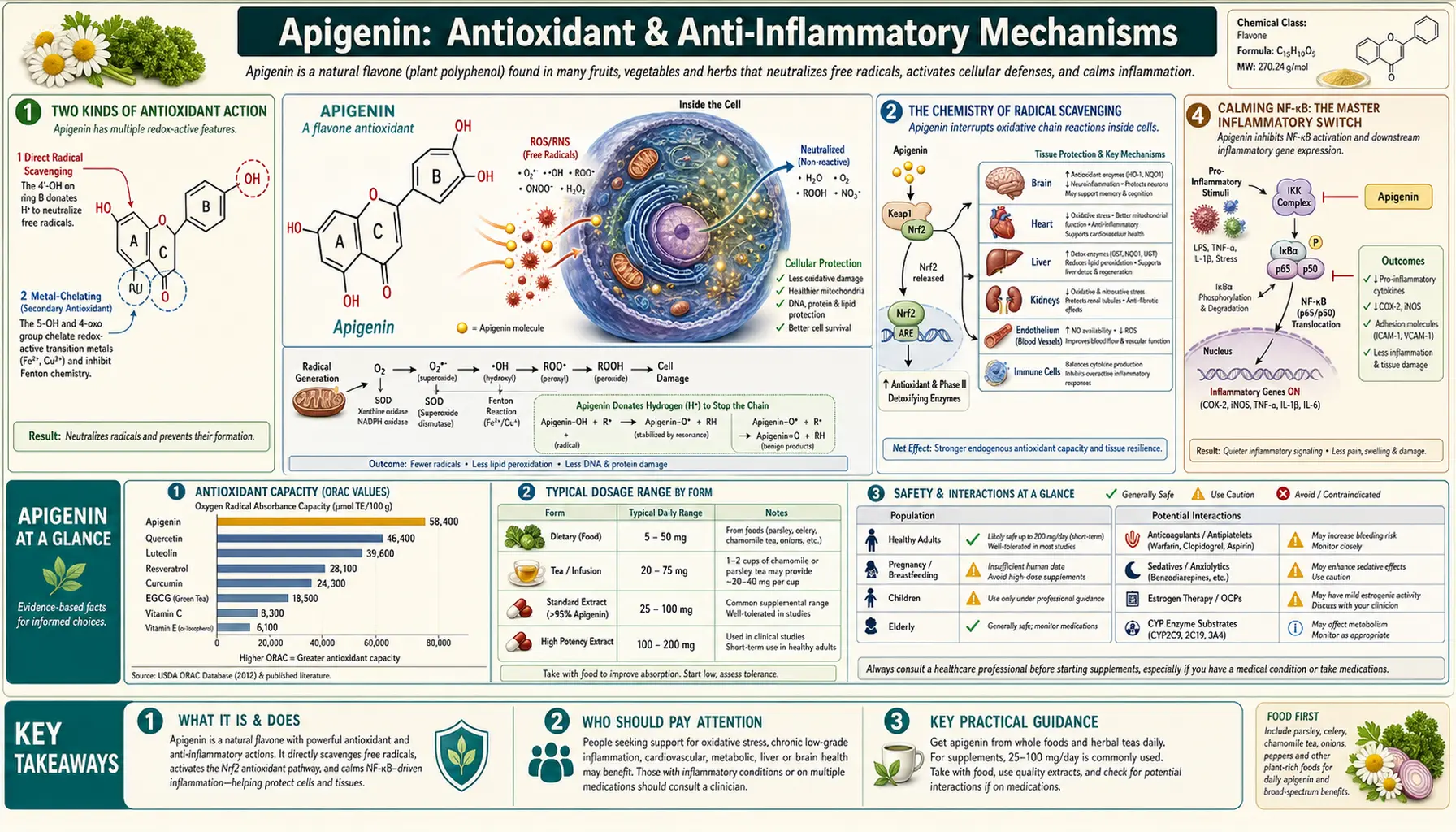
The most reproducible arm of apigenin biology is its antioxidant and anti-inflammatory activity — and the most important thing to understand is that this is only partly about "mopping up free radicals." The bigger effect is on cellular signaling: apigenin nudges the Nrf2 pathway to switch on the cell's own antioxidant defenses, and it quiets NF-κB, the master switch that turns on inflammation. This page is a mechanism-first tour — radical chemistry, Nrf2, NF-κB, COX-2 and cytokines, and macrophage polarization — with an honest boundary drawn between what has been shown in cells and animals (a great deal) and what has been proven in humans (much less).
Table of Contents
- Two Kinds of Antioxidant Action
- The Chemistry of Radical Scavenging
- Activating Nrf2: The Cell's Own Antioxidant Program
- Calming NF-κB: The Master Inflammatory Switch
- COX-2, Prostaglandins & Cytokines
- Macrophage Polarization (M1 to M2)
- Where This Shows Up: Skin, Airways, Joints & Organs
- The Honest Limits: Cell Culture vs Humans
- Key Research Papers
- Connections
- Featured Videos
Two Kinds of Antioxidant Action
When people hear "antioxidant" they usually picture a molecule that neutralizes a free radical directly — a chemical sponge. Apigenin can do this, but it is not where most of the biological action is. It is worth separating two very different mechanisms, because conflating them produces a lot of overblown marketing.
- Direct (stoichiometric) scavenging — apigenin's hydroxyl groups can donate a hydrogen atom or electron to a radical, converting the reactive species into something harmless and leaving a comparatively stable apigenin radical behind. This happens one radical at a time, and given apigenin's low tissue concentrations it is probably a minor contributor in living tissue.
- Indirect (catalytic) signaling — apigenin changes which genes a cell turns on. By activating the Nrf2 transcription factor it induces the cell to make its own antioxidant enzymes (which then neutralize radicals continuously and catalytically), and by suppressing NF-κB it lowers the production of the enzymes and cytokines that generate inflammation and oxidative stress in the first place.
The second mechanism is far more powerful in principle, because one apigenin molecule that flips a genetic switch can trigger the production of thousands of catalytic antioxidant-enzyme molecules. Nearly every "apigenin is a strong antioxidant" claim that holds up traces back to this signaling effect rather than to raw radical-quenching.
The Chemistry of Radical Scavenging
Apigenin is 4′,5,7-trihydroxyflavone. Its antioxidant chemistry depends on where those hydroxyl (–OH) groups sit and on the conjugated double-bond system of the flavone core, which can stabilize an unpaired electron by spreading it across the ring system (resonance delocalization).
Zheng and colleagues dissected exactly this in a 2018 Molecules paper on "the substituent effect on the radical scavenging activity of apigenin," using computational chemistry to identify which hydroxyl donates its hydrogen most easily and how substituents change the bond-dissociation energy. Compared with its cousin luteolin — which has an extra hydroxyl forming a catechol group on the B-ring — apigenin is a somewhat weaker direct scavenger, because the catechol arrangement in luteolin and quercetin makes those flavonoids better at stabilizing the radical. This is a useful reminder that within the flavone family, small structural differences produce meaningful potency differences, and apigenin is a moderate, not a maximal, direct antioxidant.
Older comparative work (for example Horváthová and colleagues, comparing quercetin, rutin, luteolin, and apigenin against hydrogen-peroxide-induced damage in human cells) consistently ranks apigenin as active but generally behind the catechol-bearing flavonoids for pure radical scavenging — which again points to signaling, not sponging, as apigenin's main contribution.
Activating Nrf2: The Cell's Own Antioxidant Program
Nrf2 (nuclear factor erythroid 2–related factor 2) is a transcription factor that functions as the master regulator of the cell's antioxidant defense. Under resting conditions it is held in the cytoplasm by its partner KEAP1 and continuously degraded. When the cell senses oxidative or electrophilic stress — or is nudged by certain phytochemicals — Nrf2 escapes, moves into the nucleus, and binds the antioxidant response element (ARE) in the promoters of a large battery of protective genes: glutathione-synthesizing enzymes, heme oxygenase-1 (HO-1), NAD(P)H quinone dehydrogenase 1 (NQO1), superoxide dismutase, and others.
Apigenin activates this pathway. Tang and colleagues (2024) showed apigenin ameliorated hydrogen-peroxide-induced oxidative damage in melanocytes through Nrf2 together with the PI3K/Akt/mTOR pathway, and reduced reactive-oxygen-species generation in a zebrafish model. Jia and colleagues (2022) reported that apigenin protected cochlear hair cells from drug-induced oxidative damage specifically via Nrf2 signaling. The upshot: apigenin does not merely donate an electron — it convinces the cell to reinforce its own defenses, which is a durable, catalytic form of antioxidant protection. This mechanism overlaps with the way sulforaphane and other well-known Nrf2 activators work; see our Sulforaphane page for the archetype.
Calming NF-κB: The Master Inflammatory Switch
If Nrf2 is the antioxidant on-switch, NF-κB (nuclear factor kappa-B) is the inflammation on-switch. It is a transcription factor that, when activated by infection, injury, or stress signals, moves into the nucleus and turns on hundreds of pro-inflammatory genes — cytokines like TNF-α, interleukin-1β, and interleukin-6, the enzyme COX-2, adhesion molecules, and more. Chronic, low-grade NF-κB activation is a common thread in many age-related and inflammatory conditions.
Apigenin is a fairly consistent NF-κB suppressor across models. Li and colleagues (2023) showed apigenin attenuated the inflammatory response in a mouse model of allergic rhinitis by inhibiting the TLR4/MyD88/NF-κB signaling pathway — TLR4 being an upstream sensor that feeds into NF-κB. Singh and colleagues (2023) reported anti-inflammatory and anti-psoriatic effects in macrophages, keratinocytes, and a psoriasis-like mouse model, again with NF-κB pathway involvement. Park and colleagues (2020) documented anti-allergic and anti-inflammatory activity across mast cells, macrophages, and skin cells. The recurring theme is that apigenin dials down the amplitude of the inflammatory transcriptional program rather than blocking any single downstream mediator.
COX-2, Prostaglandins & Cytokines
Downstream of NF-κB sits cyclooxygenase-2 (COX-2), the inducible enzyme that produces pro-inflammatory prostaglandins — the same enzyme targeted by NSAIDs such as ibuprofen and by celecoxib. Because apigenin lowers NF-κB activity, it tends to reduce COX-2 expression and the prostaglandin output that follows, along with the secreted cytokines (TNF-α, IL-1β, IL-6) that amplify and sustain inflammation.
This gives apigenin an NSAID-adjacent flavor in laboratory models — it lowers the machinery of inflammation — but the comparison should not be pushed too far. NSAIDs directly and potently inhibit COX enzymes at achievable blood levels and have proven human clinical effects; apigenin's effect is upstream, gentler, gene-expression-level, and constrained by its low bioavailability. It is better understood as a mild anti-inflammatory dietary signal than as a drug-strength analgesic. Broad reviews of flavonoids as anti-inflammatory molecules (Al-Khayri and colleagues, 2022) place apigenin among the more promising members of the class while emphasizing the same caveats.
Macrophage Polarization (M1 to M2)
Macrophages — the immune system's cleanup and signaling cells — exist along a spectrum between two functional states. "M1" macrophages are pro-inflammatory (they fight pathogens and drive tissue inflammation); "M2" macrophages are pro-resolution (they dampen inflammation and support tissue repair). Chronic disease often features macrophages stuck in the M1 state.
Several studies suggest apigenin can shift the balance toward the resolving M2 phenotype. Ji and colleagues (2023) reported that apigenin slowed the progression of osteoarthritis in a model by mediating macrophage polarization, and Geng and colleagues (2025) found apigenin attenuated sepsis-induced acute lung injury by polarizing macrophages toward M2. This is a mechanistically satisfying complement to the NF-κB story: apigenin does not just turn down the inflammatory signal, it may help nudge the immune cells themselves from an attack posture toward a repair posture. As with everything on this page, these are animal and cell findings, not human trials.
Where This Shows Up: Skin, Airways, Joints & Organs
The same antioxidant/anti-inflammatory toolkit shows up across a scattered set of preclinical models, which is exactly what you would expect from a compound that acts on general-purpose pathways like Nrf2 and NF-κB rather than on one tissue-specific target:
- Skin — anti-inflammatory, anti-allergic, and photoprotective activity in keratinocytes and psoriasis-like models (Park 2020; Singh 2023; Sánchez-Marzo 2019). This connects to apigenin's presence in topical botanical formulations.
- Airways / allergy — reduced allergic-rhinitis inflammation via TLR4/NF-κB (Li 2023) and mast-cell stabilization.
- Joints — slowed osteoarthritis progression through macrophage polarization (Ji 2023).
- Organ protection — reduced oxidative injury in kidney (Wu 2021, against doxorubicin toxicity) and in the inner ear (Jia 2022).
- Brain — anti-neuroinflammatory signals in preclinical models (Olasehinde 2024; Charrière 2024), which is one bridge between this page and the calming effects covered on the Calm & Sleep page.
The breadth is real, but breadth in preclinical models is not the same as proven clinical benefit in any one of these conditions.
The Honest Limits: Cell Culture vs Humans
This is the section we consider mandatory. The antioxidant/anti-inflammatory literature on apigenin is large, mechanistically coherent, and genuinely interesting — and it is also overwhelmingly in vitro and animal. Three caveats keep it honest:
- Concentration mismatch. Many cell-culture experiments expose cells to apigenin concentrations (tens of micromolar) far higher than the low, transient plasma levels a human reaches from food or ordinary supplements. Effects seen at 25 µM in a dish may not occur at the concentrations tissue actually experiences.
- Bioavailability. As covered on the Sources page, apigenin is poorly absorbed and rapidly conjugated. Circulating apigenin is often present mainly as glucuronide/sulfate metabolites, whose activity can differ from the parent compound.
- Few human endpoints. There is not yet a body of large, randomized human trials showing that supplemental apigenin reduces a clinical inflammatory outcome. The strongest human data remain for chamomile extract in anxiety, not for isolated apigenin as an anti-inflammatory.
None of this means the effects are fake. It means the honest claim is "apigenin has well-characterized antioxidant and anti-inflammatory mechanisms in laboratory models, and eating apigenin-rich vegetables and herbs is part of a sensibly anti-inflammatory diet" — not "apigenin is a proven anti-inflammatory treatment." A diet rich in parsley, celery, and colorful plants delivers apigenin alongside dozens of other beneficial compounds, and that whole-food context is where the realistic benefit lives.
Key Research Papers
- Zheng YZ, Deng G, Guo R, et al. (2018). The substituent effect on the radical scavenging activity of apigenin. Molecules. — PubMed 30103379
- Horváthová K et al. (2004). Free radical scavenging activity of quercetin, rutin, luteolin and apigenin in H₂O₂-treated human cells. Neoplasma. — PubMed 15640946
- Tang QQ et al. (2024). Apigenin ameliorates H₂O₂-induced oxidative damage in melanocytes through Nrf2 and PI3K/Akt/mTOR pathways. Pharmaceuticals (Basel). — Search PubMed
- Jia G et al. (2022). Apigenin alleviates neomycin-induced oxidative damage via the Nrf2 signaling pathway in cochlear hair cells. Frontiers in Medicine. — PubMed 34921675
- Li H et al. (2023). Apigenin attenuates inflammatory response in allergic rhinitis mice by inhibiting the TLR4/MyD88/NF-κB signaling pathway. Environmental Toxicology. — PubMed 36350155
- Singh VK et al. (2023). Anti-inflammatory, anti-proliferative and anti-psoriatic potential of apigenin in RAW 264.7 cells, HaCaT cells and psoriasis-like dermatitis in mice. Life Sciences. — PubMed 37414141
- Park CH et al. (2020). Effects of apigenin on RBL-2H3, RAW264.7, and HaCaT cells: anti-allergic, anti-inflammatory, and skin-protective activities. Int. J. Molecular Sciences. — PubMed 32610574
- Ji X et al. (2023). Apigenin inhibits the progression of osteoarthritis by mediating macrophage polarization. Molecules. — PubMed 37049677
- Geng J et al. (2025). Apigenin attenuated sepsis-induced acute lung injury via polarizing macrophages toward M2. International Immunopharmacology. — PubMed 40088874
- Wu Q et al. (2021). Apigenin ameliorates doxorubicin-induced renal injury via inhibition of oxidative stress and inflammation. Biomedicine & Pharmacotherapy. — PubMed 33556877
- Olasehinde TA, Olaokun OO (2024). Apigenin and inflammation in the brain: can apigenin inhibit neuroinflammation in preclinical models? Inflammopharmacology. — PubMed 39126572
- Al-Khayri JM et al. (2022). Flavonoids as potential anti-inflammatory molecules: a review. Molecules. — PubMed 35566252
PubMed Topic Searches
- PubMed: apigenin NF-κB inflammation
- PubMed: apigenin Nrf2 oxidative stress
- PubMed: apigenin macrophage polarization
- PubMed: apigenin antioxidant / ROS
Connections
- Apigenin Benefits Hub
- Apigenin (Main Page)
- Cellular & Longevity Research
- Apigenin: Dietary Sources
- All Antioxidants
- Luteolin
- Quercetin
- Sulforaphane (Nrf2 activator)
- Curcumin
- EGCG
- Hesperidin
- Rutin
- Chamomile
- Celery