Tyrosine: Food Sources & Daily Intake
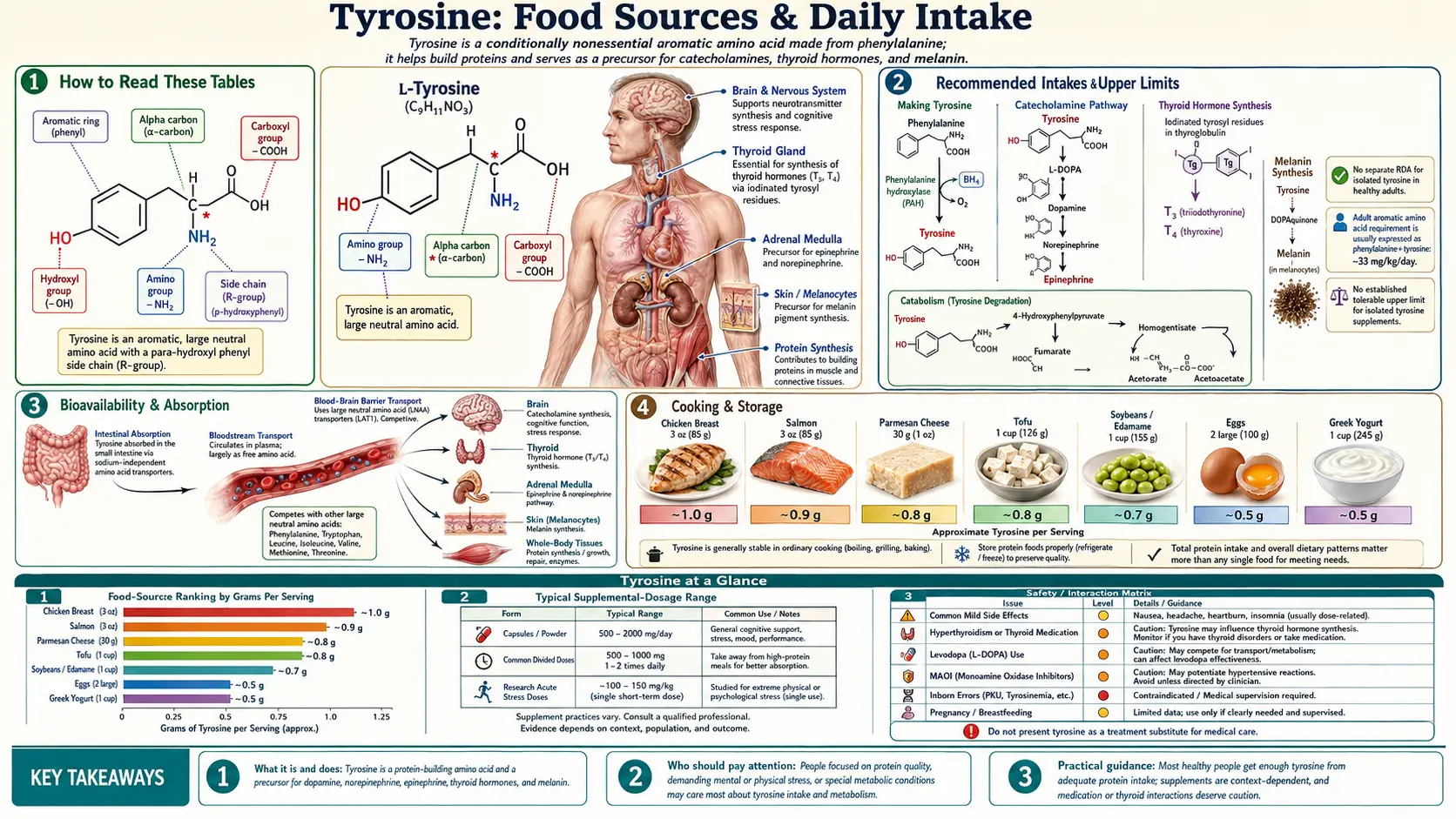
Tyrosine is the body’s raw material for some of its most important signaling chemicals. It is the direct precursor to the catecholamines — dopamine, noradrenaline (norepinephrine) and adrenaline (epinephrine) — as well as to thyroid hormone and to melanin, the pigment of skin, hair and eyes. Because the body normally makes tyrosine from the essential amino acid phenylalanine, it is called conditionally essential: it only has to come from food when phenylalanine runs short, or when that conversion is blocked (as in the inherited condition PKU). Most research interest centers on tyrosine’s role in focus, alertness and performance under stress. The richest sources are aged cheeses, then meat, fish, eggs, seeds and legumes. The table below shows grams of tyrosine per 100 g of food; there is no FDA Daily Value for individual amino acids, so amounts are absolute.
| Tyrosine: Food Sources & Daily Intake | |||||
|---|---|---|---|---|---|
| Rank | Food (serving) | Per 100 g | Glucose | Fructose | Notes |
| 1 | Parmesan Cheese 1 oz / 28 g | 🟢 2.0 g | — | — | Aged cheeses are the most concentrated source. |
| 2 | Cheddar Cheese 1 oz / 28 g | 🟢 1.3 g | 0 | 0 | |
| 3 | Pumpkin Seeds 1 oz / 28 g | 🟢 1.1 g | 0.1 | 0.1 | Top plant source. |
| 4 | Peanuts 1 oz / 28 g | 🟢 1.1 g | — | — | |
| 5 | Beef Meat 3 oz / 85 g | 🟢 1.0 g | 0 | 0 | |
| 6 | Salmon 3 oz / 85 g | 🟢 1.0 g | 0 | 0 | |
| 7 | Pork Organ Meats 3 oz / 85 g | 🟡 0.9 g | — | — | Nutrient-dense organ meat. |
| 8 | Chicken Organ Meats 3 oz / 85 g | 🟡 0.9 g | — | — | Nutrient-dense organ meat (giblets). |
| 9 | Tuna 3 oz / 85 g | 🟡 0.9 g | 0 | 0 | |
| 10 | Beef Organ Meats 3 oz / 85 g | 🟡 0.8 g | — | — | Nutrient-dense organ meat. |
| 11 | Pork 3 oz / 85 g | 🟡 0.8 g | 0 | 0 | |
| 12 | Sesame Seeds 1 oz / 28 g | 🟡 0.7 g | — | — | |
| 13 | Turkey Breast 3 oz / 85 g | 🟡 0.7 g | 0 | 0 | |
| 14 | Cod 3 oz / 85 g | 🟡 0.6 g | 0 | 0 | Lean white fish. |
| 15 | Egg 1 large / 50 g | 🟡 0.5 g | 0.4 | 0 | |
| 16 | Almonds 1 oz / 28 g | 🟡 0.5 g | 0.2 | 0.1 | |
| 17 | Brown Rice 1 cup / 195 g | ⚪ 0.1 g | 0 | 0 | Common staple. |
Interactive Visualization Dopamine, Reward & How Habits Hijack You Dopamine is not the pleasure chemical. Watch the spike migrate from the reward to the cue — then withhold the reward and see it dip below zero. That dip is craving. Launch →
Table of Contents
- How to Read These Tables
- Recommended Intakes & Upper Limits
- Bioavailability & Absorption
- Cooking & Storage
- Vegetarian & Vegan Sources
- Who Needs to Pay Attention
- Data Sources & References
- Connections
- Featured Videos
How to Read These Tables
- Conditionally essential. Your body usually makes tyrosine from phenylalanine, so a healthy person eating enough protein rarely needs it from food directly. It becomes essential — meaning it must be eaten — when phenylalanine is low or when the conversion enzyme is missing or impaired.
- Grams per 100 g, not %DV. There is no FDA Daily Value for individual amino acids, so this table reports the absolute grams per 100 g of food and ranks foods by that. A typical serving is shown beside each food.
- Counted with phenylalanine. Nutrition guidelines set a single combined target for phenylalanine + tyrosine (about 25 mg per kg of body weight per day), because the two amino acids are metabolically linked — phenylalanine can be turned into tyrosine, but not the reverse.
Recommended Intakes & Upper Limits
Your personal target depends on age, sex and pregnancy. The Daily Value used for the %DV column above is a single label figure; the table below is the age-specific guidance.
| Reference | Adult value | Notes |
|---|---|---|
| Status | Conditionally essential | Made from phenylalanine; becomes essential when phenylalanine is low or in PKU. |
| Requirement | 25 mg/kg/day | Combined phenylalanine + tyrosine target (WHO/FAO/UNU 2007). |
| Why it matters | Precursor molecule | Building block for dopamine, noradrenaline and adrenaline, thyroid hormone, and melanin. |
| Richest in | Aged cheese & animal protein | Parmesan and hard cheeses, then meat, fish, eggs, seeds and legumes. |
Bioavailability & Absorption
Tyrosine from food is well absorbed as part of dietary protein. One quirk sets it apart from most amino acids: getting tyrosine into the brain — where it is converted to dopamine and noradrenaline — depends on a shared transporter that also carries the other large neutral amino acids (phenylalanine, tryptophan, leucine, isoleucine, valine). They compete for the same doorway, so a meal very high in mixed protein does not flood the brain with tyrosine the way an isolated dose can. This competition is the reason supplement studies use purified tyrosine on an empty stomach, and it is why simply eating protein keeps brain chemistry in a steady, balanced range rather than spiking it.
Cooking & Storage
Amino acids are stable to ordinary cooking — tyrosine is not destroyed by normal heat, and cooking actually makes protein easier to digest. The slow protein breakdown of aging and fermentation is why hard cheeses such as Parmesan are so tyrosine-rich: as the cheese matures, proteins are split into free amino acids, and tyrosine, being poorly soluble, sometimes appears as the tiny white crystals seen in well-aged cheese. No special handling is needed for cooking at home.
Vegetarian & Vegan Sources
Plant-based eaters can get plenty of tyrosine with a little variety. The strongest plant sources are pumpkin and sesame seeds, peanuts, almonds, lentils and beans; for those who eat dairy, aged cheeses are by far the densest source of all. Because no single plant food carries every essential amino acid in ideal proportion, eating a mix across the day — legumes plus seeds plus whole grains — supplies tyrosine’s parent amino acid phenylalanine and everything else the body needs to make tyrosine itself.
Who Needs to Pay Attention
True tyrosine deficiency is rare in anyone eating enough total protein, because the body simply makes it from phenylalanine. The one group that genuinely cannot is people with phenylketonuria (PKU), an inherited disorder in which the phenylalanine-to-tyrosine enzyme is missing. They must restrict phenylalanine and add supplemental tyrosine, since for them it becomes a true essential nutrient — this is done under medical supervision. A few interactions are worth knowing: tyrosine is a building block for thyroid hormone, so people with thyroid conditions should be thoughtful about high-dose supplements, and because it shares an absorption pathway with the Parkinson’s drug levodopa, large protein meals or tyrosine supplements can blunt that medication’s effect. For everyone else, a normal varied diet covers tyrosine comfortably.
Data Sources & References
- NIH MedlinePlus — Amino acids
- Linus Pauling Institute — protein and amino acids
- PubMed — tyrosine, catecholamines and cognitive performance under stress
- PubMed — phenylalanine and tyrosine requirements in humans
Connections
- All Amino Acids
- Dopamine, Reward & How Habits Hijack You — interactive animation
- Tyrosine (Main Page)
- Tyrosine Benefits
- Tyrosine History
- Phenylalanine
- Tryptophan
- Eggs