Phenylalanine: History and Discovery
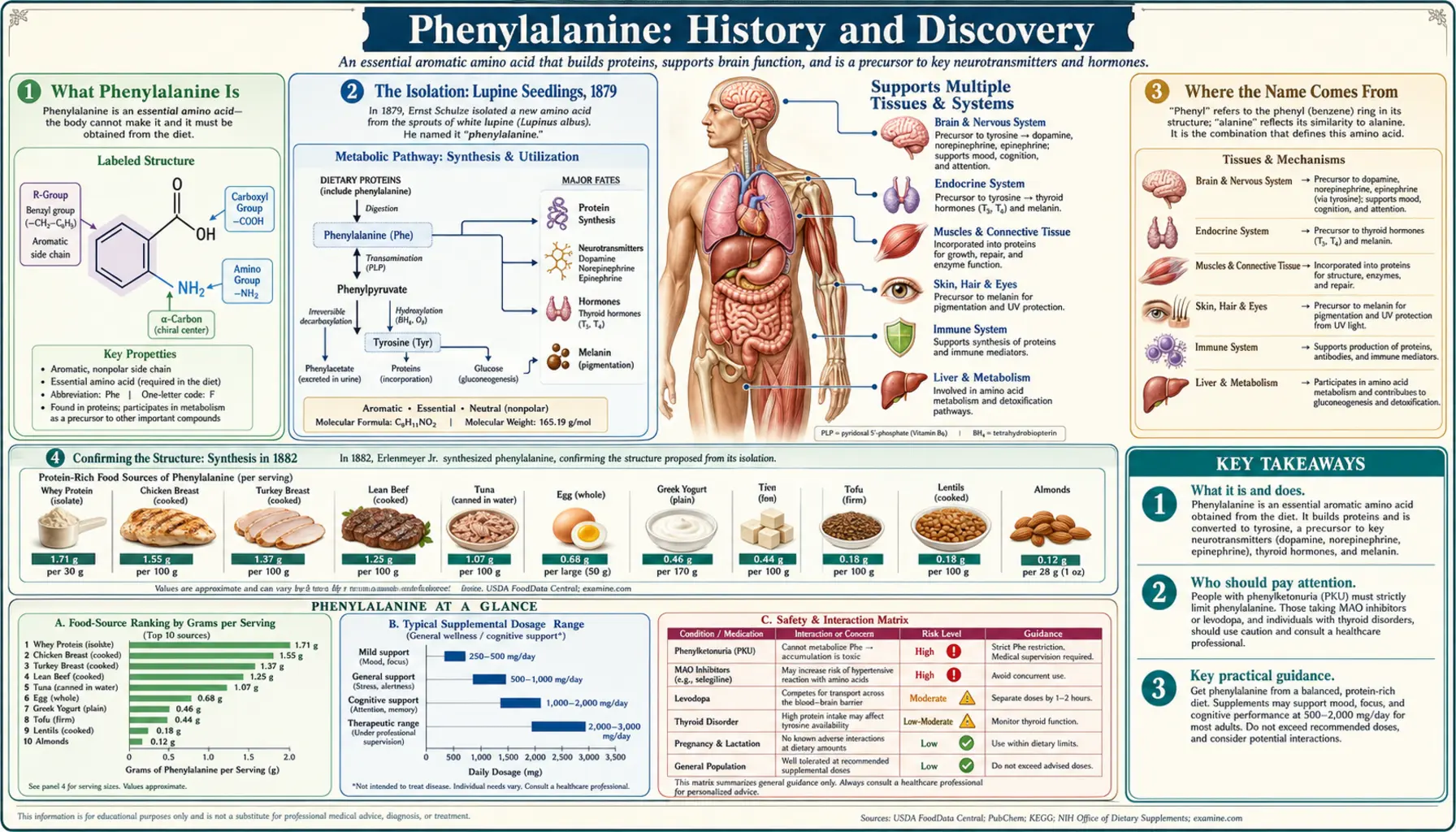
In 1879, two chemists studying the seedlings of the yellow lupine pulled an unfamiliar compound out of the plant and wrote down its formula — and without quite knowing it, became the first people to hold phenylalanine in their hands. The molecule they found turned out to be one of the body's nine essential amino acids: a building block of protein and the raw material the brain uses to make dopamine, adrenaline, and the colour of our skin and hair. This article traces what the historical record actually supports — the plant it was first drawn from, the chemists who isolated and then synthesised it, where its name comes from, the careful nutrition experiments that proved the human body cannot make it, the Norwegian doctor who linked it to a devastating childhood disease, and the moment in 1961 when phenylalanine became the very first word of the genetic code ever read. Where the record is firm we say so; where a date is rounded differently by different sources, or a co-discoverer's first name is simply not preserved, we say that too.
Table of Contents
- What Phenylalanine Is
- The Isolation: Lupine Seedlings, 1879
- Where the Name Comes From
- Confirming the Structure: Synthesis in 1882
- Proving It Is Essential: William Cumming Rose
- Phenylketonuria: Følling's 1934 Discovery
- The First Word of the Genetic Code (1961)
- From a Plant Extract to Modern Use
- Research Papers and References
- Connections
- Featured Videos
What Phenylalanine Is
Before the history, a sentence of orientation. Phenylalanine is one of the twenty amino acids that link together to build the proteins in our bodies, and it is one of the nine that are called essential — meaning the human body cannot manufacture it and must take it in from food. It belongs to a small group of aromatic amino acids, so named because each carries a flat, ring-shaped cluster of carbon atoms (a benzene, or "phenyl," ring) as part of its structure. That ring is exactly what its discoverers detected, and it is what gives the molecule its name.
What makes phenylalanine matter beyond simple nutrition is that it is a starting point. The body converts it into the amino acid tyrosine, and from there into a cascade of important molecules: the neurotransmitters dopamine and noradrenaline, the hormone adrenaline, the thyroid hormones, and melanin, the pigment of skin and hair. A great deal of the story below — why a missing enzyme is so harmful, why the molecule was the natural choice for a famous genetic experiment — flows from the fact that phenylalanine sits at the head of these pathways. The detailed biology is covered on the main Phenylalanine page and in the Benefits articles; this page is concerned with how the molecule came to be known.
The Isolation: Lupine Seedlings, 1879
The first documented description of phenylalanine dates to 1879. Working with the seedlings of the yellow lupine (Lupinus luteus), the chemists Ernst Schulze and Barbieri isolated a previously unknown nitrogen-containing compound and determined its empirical formula as C9H11NO2. That formula — nine carbons, eleven hydrogens, one nitrogen, two oxygens — is the formula of phenylalanine, and this isolation from germinating lupine is the moment the molecule entered the scientific record.
It is worth being precise about who did this. Ernst Schulze (1840–1912) was a German chemist who spent four decades as professor of agricultural chemistry at the polytechnic in Zürich, where he became one of the pioneers of plant biochemistry; over his career he is credited with discovering or first describing several amino acids, phenylalanine among them, along with glutamine and arginine. His co-author on the phenylalanine work is recorded simply as Barbieri; the historical sources that report the 1879 isolation do not reliably preserve a first name, so this page names him as the record does and does not invent one. Lupine seedlings were a natural hunting ground for such discoveries: germinating seeds break down their stored proteins into free amino acids to fuel the growing plant, briefly concentrating individual amino acids enough to be isolated by the laborious crystallisation methods of the nineteenth century, long before chromatography existed.
One honest note on dating. The most detailed sources place the first description in 1879; some general references, including the Encyclopædia Britannica, round the event to "first isolated in 1881 from lupine seedlings." The two-year discrepancy reflects how the early reports were dated and summarised rather than any disagreement about the essentials — the source (lupine seedlings) and the people (Schulze and Barbieri) are consistent across accounts. This page uses 1879 as the primary date while noting the rounded 1881 figure.
Where the Name Comes From
The name phenylalanine is a plain description of the molecule's structure, stitched together from two parts. The first part, phenyl-, refers to the phenyl group — the six-carbon benzene ring that the molecule carries. The term "phenyl" itself traces back through chemistry to a Greek root (phaino, "to bring to light"), a nod to the fact that early aromatic compounds were obtained from the illuminating gas used in nineteenth-century lamps. The second part, -alanine, is the name of the simplest of the amino acids that share the same basic backbone. Read literally, then, phenylalanine is simply "alanine with a phenyl ring attached" — which is exactly what the molecule is.
This naming is a small but telling example of how nineteenth-century chemists worked. They named substances by their composition as they worked it out, so the name encodes the very feature — the aromatic ring — that the isolation and later synthesis revealed. The modern single-letter abbreviation chemists use for phenylalanine, the letter F, was assigned much later when amino acids needed compact symbols; with the obvious letter P already taken by proline, F was chosen for its phonetic echo of the "F"-sound at the start of the word. The closely related amino acid tyrosine, into which the body converts phenylalanine, got its own name from a different source entirely — the Greek tyros, "cheese," the material it was first isolated from in 1846 — a reminder that amino-acid names are a patchwork of structures, sources, and historical accidents.
Confirming the Structure: Synthesis in 1882
Isolating a compound from a plant tells you it exists and gives you its formula, but it does not, by itself, prove exactly how the atoms are arranged. That confirmation came only three years after the isolation. In 1882, the German chemist Emil Erlenmeyer — the same Erlenmeyer whose name is on the conical laboratory flask — together with Lipp, achieved the first laboratory synthesis of phenylalanine, building it up from simpler ingredients: phenylacetaldehyde, hydrogen cyanide, and ammonia.
This kind of build-it-from-scratch synthesis was the decisive test of nineteenth-century structural chemistry. If you can assemble a molecule from known starting materials by known reactions, and the product is identical to the substance pulled from nature, you have proven what that natural substance actually is. Erlenmeyer and Lipp's synthesis therefore did for phenylalanine what isolation alone could not: it pinned down the structure that the formula C9H11NO2 only hinted at. A historical curiosity is that the synthetic chemistry and the natural product converged so closely in time that the short name "phenylalanin" was being used in the title of this synthetic work almost as soon as the compound had been found in lupine — the laboratory and the plant naming the same molecule within a few years of each other.
Proving It Is Essential: William Cumming Rose
Knowing what phenylalanine is chemically is a separate question from knowing what it does in nutrition — and in particular whether the body can make its own or must be fed it. That question was answered decades later, in one of the great careful research programmes of twentieth-century nutrition, led by the American biochemist William Cumming Rose (1887–1985) at the University of Illinois.
Rose's work is usually remembered for its grand finale: in 1935 he and his colleagues discovered threonine, the last of the common amino acids to be found, which finally allowed rats to be raised on a diet whose only source of nitrogen was a defined mixture of pure amino acids. With the full set of amino acids now in hand, Rose could do something no one had been able to do before — remove them from the diet one at a time and watch what happened. Through the late 1930s his rat experiments, and then from the 1940s a meticulous series of nitrogen-balance studies in healthy young men (famously, male graduate students), sorted the amino acids into those the body can synthesise for itself and those it cannot. The studies measured whether a person stayed in nitrogen balance — building as much protein as they broke down — when each amino acid was withheld.
The verdict for our molecule was clear: phenylalanine is essential. It was one of the amino acids Rose identified as indispensable in the human diet, alongside isoleucine, leucine, lysine, methionine, threonine, tryptophan, and valine (with histidine later added for a total of nine). This is why phenylalanine is grouped today among the essential amino acids, and why the deficiency and dietary-requirement sections on the main page exist at all. Rose did not discover phenylalanine — that had happened half a century earlier in a lupine seedling — but he is the reason we know it must come from food. His name belongs in the history of nearly every essential amino acid for exactly this reason, and it recurs on the history pages of phenylalanine's dietary companions such as methionine and leucine.
Phenylketonuria: Følling's 1934 Discovery
No history of phenylalanine is complete without the discovery of what happens when the body cannot process it — because that discovery transformed phenylalanine from a chemical curiosity into a molecule that newborns are screened for to this day. In 1934, the Norwegian physician and biochemist Asbjørn Følling was consulted by a mother, Borgny Egeland, whose two young children had been normal at birth but had developed intellectual disability, and whose urine carried a strange odour. Følling tested the children's urine and, after methodical chemistry, identified the responsible substance as phenylpyruvic acid — a breakdown product of phenylalanine that does not normally accumulate.
Følling did not stop at two children. He went on to test the urine of more than four hundred institutionalised patients in the Oslo area and found the same chemical signature in several more, establishing that he had uncovered a distinct, inherited condition. He named it imbecillitas phenylpyruvica; it later became known as phenylketonuria, or PKU. The cause, worked out over the following years, is an inherited deficiency of the enzyme that converts phenylalanine to tyrosine: without it, phenylalanine builds up to levels that are toxic to the developing brain.
The reason this discovery looms so large is what it made possible. Because the damage of PKU comes from too much phenylalanine, and because phenylalanine comes from the diet, the condition is one of the few causes of severe intellectual disability that can be prevented — by detecting it at birth and managing the amount of phenylalanine a child eats. This is the direct historical root of newborn blood-spot screening programmes and of the phenylalanine warnings on products containing the sweetener aspartame, which releases phenylalanine when digested. Følling's careful detective work in 1934 is the reason a single amino acid is measured in nearly every baby born in much of the world.
The First Word of the Genetic Code (1961)
Phenylalanine holds a unique distinction in the history of biology: it was the subject of the experiment that first cracked the genetic code. By 1961 scientists understood that DNA carried instructions for building proteins, and that the instructions were spelled out in some combination of the four chemical "letters" of nucleic acid — but no one had yet read a single word of that code, and no one knew which combinations specified which amino acids.
The breakthrough came at the National Institutes of Health, where Marshall W. Nirenberg and J. Heinrich Matthaei built a "cell-free" system — the protein-making machinery of E. coli bacteria broken open in a test tube — and fed it an artificial genetic message made of a single repeating letter: a long strand of uracil, known as poly-U. Early in the morning of 27 May 1961, the experiment produced a protein built from one amino acid repeated over and over, and that amino acid was phenylalanine. The conclusion was historic: the three-letter code word UUU must mean "phenylalanine." For the first time, a word of the genetic code had been read — and it happened to spell our molecule.
That single result opened the floodgates. Over the next five years Nirenberg and others worked out the full dictionary of sixty-four code words for all twenty amino acids, one of the central achievements of modern biology. Nirenberg shared the 1968 Nobel Prize in Physiology or Medicine with Robert W. Holley and Har Gobind Khorana for the interpretation of the genetic code. Phenylalanine's place in this story is partly an accident of chemistry — poly-U was simply the easiest synthetic message to make, and UUU happens to code for phenylalanine — but it is a genuine historical fact that of all twenty amino acids, phenylalanine was the first whose genetic code word was ever known.
From a Plant Extract to Modern Use
The thread from a nineteenth-century lupine seedling to the present runs through the wider story of how proteins themselves came to be understood. The very word protein was coined in 1838, when the Swedish chemist Jöns Jacob Berzelius suggested the term to the Dutch chemist Gerardus Johannes Mulder — from a Greek root meaning "of first importance" — decades before chemists like Schulze began isolating the individual amino acids that proteins are built from. Later, around the turn of the twentieth century, the German chemist Emil Fischer (awarded the Nobel Prize in Chemistry in 1902 for his work on sugars and purines) showed that amino acids are joined into proteins through what he named the peptide bond, and synthesised the first simple peptides. Phenylalanine took its place as one tile in this much larger mosaic: a single amino acid whose isolation, naming, and synthesis were part of chemistry learning to read the language of proteins.
In the modern era phenylalanine is no longer a substance painstakingly crystallised from germinating seeds. It is manufactured at industrial scale — chiefly by microbial fermentation — and used in three broad ways: as a dietary amino acid and nutritional supplement, as one half of the widely consumed sweetener aspartame, and as a clinical concern in the lifelong dietary management of PKU. The same molecule that Schulze and Barbieri first drew out of a lupine in 1879, that Rose proved we cannot live without, that Følling tied to a preventable disease, and that Nirenberg used to read the first word of the genetic code, is now measured in newborns, printed on food labels, and sold on supplement shelves. Its history is a compact tour of modern bioscience — from plant chemistry to human nutrition to the genetic code — told through a single small building block of life. The biology behind today's uses is covered on the main Phenylalanine page and the Benefits articles.
Research Papers and References
The references below document the historical milestones described in this article. Author names, titles, and journals are given as plain text; only the stable DOI, PMID, or archive link is hyperlinked, and each opens in a new tab. The earliest nineteenth-century reports (Schulze and Barbieri's 1879 isolation and Erlenmeyer and Lipp's 1882 synthesis) are named in the article as historical primary sources; the citations here point to the modern scholarly and reference literature that records and dates them.
- Nirenberg MW, Matthaei JH. The dependence of cell-free protein synthesis in E. coli upon naturally occurring or synthetic polyribonucleotides. Proceedings of the National Academy of Sciences USA. 1961;47(10):1588-1602. — doi:10.1073/pnas.47.10.1588 · PMID: 14479932
- The Nobel Prize in Physiology or Medicine 1968 — Robert W. Holley, Har Gobind Khorana, and Marshall W. Nirenberg, for their interpretation of the genetic code and its function in protein synthesis. — NobelPrize.org: 1968 Physiology or Medicine
- Christ SE. Asbjørn Følling and the discovery of phenylketonuria. Journal of the History of the Neurosciences. 2003;12(1):44-54. — doi:10.1076/jhin.12.1.44.13788 · PMID: 12785112
- Simoni RD, Hill RL, Vaughan M. The discovery of the amino acid threonine: the work of William C. Rose [classical article]. Journal of Biological Chemistry. 2002;277(37):E25. — PMID: 12218068
- The Nobel Prize in Chemistry 1902 — Hermann Emil Fischer, for his work on sugar and purine syntheses. — NobelPrize.org: 1902 Chemistry
- Phenylalanine — discovery, isolation, and history — PubMed: phenylalanine history and discovery
- Phenylketonuria — history and newborn screening — PubMed: phenylketonuria history and screening
External Authoritative Resources
- NobelPrize.org — Marshall W. Nirenberg
- MedlinePlus — Phenylketonuria
- PubMed — All research on phenylalanine
Connections
- All Amino Acids
- Phenylalanine
- Phenylalanine Benefits
- Tyrosine
- Methionine
- Leucine
- Tryptophan
- Aspartame