Carnitine — Benefits Deep Dive
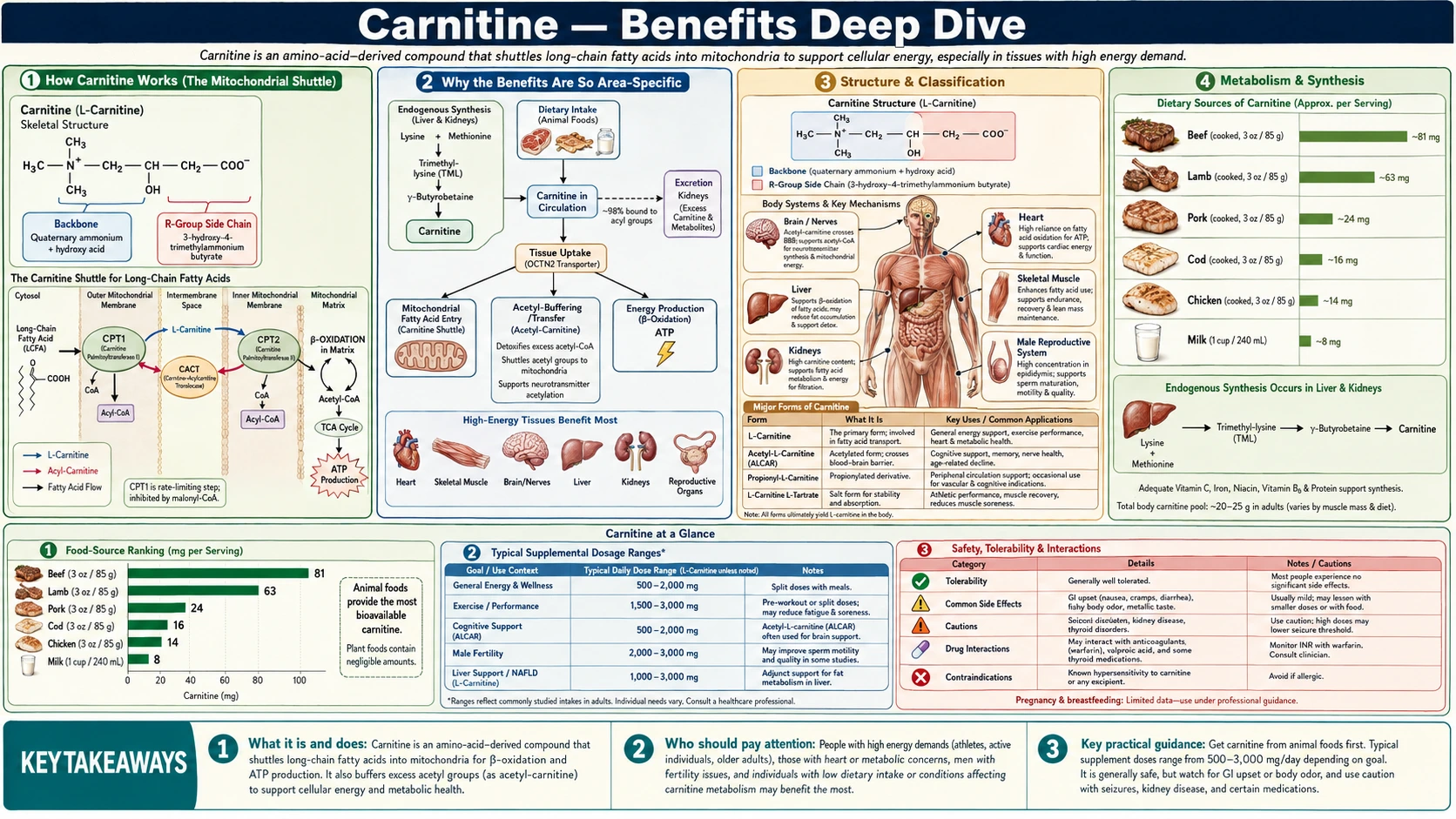
Carnitine has exactly one indispensable job in human biology: it ferries long-chain fatty acids across the inner mitochondrial membrane so they can be burned for energy. Every deeper claim about carnitine — that it strengthens a failing heart, speeds recovery from hard exercise, or melts away body fat — is a claim about what happens when you add more of a molecule the body already makes and tightly regulates. The honest answer differs sharply by area. The heart-failure and vascular evidence is the strongest (though it is adjunctive and rests largely on older trials); the exercise evidence is mixed and modest; and the popular "fat-burner" reputation is essentially unsupported in well-nourished people. This hub links seven focused deep-dives that separate the real, cited benefits from the marketing — from the failing heart to the fatty liver to the depressed brain to the fertility clinic, and it tackles the unsettled question of whether the gut microbiome turns dietary carnitine into the pro-atherogenic compound TMAO.
Deep-Dive Articles
Heart & Circulation
Carnitine's strongest evidence base. Why the ischemic and failing heart becomes carnitine-depleted, the CEDIM post-heart-attack remodeling trials, the DiNicolantonio secondary-prevention meta-analysis, dilated cardiomyopathy survival data, propionyl-L-carnitine for angina and peripheral artery disease, and the honest framing: an adjunct layered on top of proven therapy, not a replacement, resting mostly on trials from the 1990s and 2000s.
Exercise & Recovery
The muscle-carnitine loading problem (you cannot raise muscle carnitine without co-ingested carbohydrate and insulin), the L-carnitine L-tartrate recovery studies showing reduced markers of muscle damage and soreness, why carnitine is not a reliable performance enhancer, and what the systematic reviews actually conclude about endurance, power, and delayed-onset muscle soreness.
Fat Metabolism & Weight
The central honest correction: carnitine is required for fat transport, but supplementing it does not reliably burn fat or drive weight loss in well-nourished people. Why "necessary for a process" does not mean "rate-limiting," what the Pooyandjoo and Talenezhad meta-analyses really show (small effects, low-to-moderate quality, confounded populations), and where a genuine deficiency changes the picture.
Forms & the TMAO Question
L-carnitine vs acetyl-L-carnitine (ALCAR, which crosses the blood-brain barrier) vs L-carnitine L-tartrate (LCLT) vs propionyl-L-carnitine — which form for which goal. Then the unresolved paradox: gut bacteria convert carnitine to TMA and then TMAO, a compound linked to atherosclerosis, yet supplement trials show cardiovascular benefit. What is actually known, and what is not.
Brain, Mood & Depression
The acetyl form (ALCAR) crosses the blood–brain barrier and carries some of the strongest randomized evidence in the whole carnitine family: a meta-analysis in which it beat placebo for depressive symptoms and matched prescription antidepressants head-to-head with fewer side effects; the Rockefeller discovery that ALCAR is measurably low in major depression; meta-analytic support in early memory decline; 1,257 patients of diabetic nerve-pain trial data; and the centenarian fatigue trial.
Male Fertility
The epididymis concentrates carnitine to extraordinary levels exactly where sperm learn to swim. Italian randomized placebo-controlled trials (2–3 g/day for six months) improved sperm motility — most in the men who started lowest — alongside measurable gains in the semen's antioxidant capacity, and a 2025 network meta-analysis ranked L-carnitine best-in-class for progressive motility. With honest limits: pregnancy-rate evidence remains thin, and a supplement never replaces a fertility workup.
Liver Disease
The liver is where carnitine is made — and where fat-burning failure shows up as NAFLD, the world's most common liver condition. A 2023 meta-analysis of eight RCTs found L-carnitine lowered the liver-injury enzymes AST and ALT and improved triglycerides and HDL "with no significant adverse effects"; a 24-week randomized NASH trial added biopsy-graded improvement. Plus the hepatic-encephalopathy evidence (ammonia falls; Cochrane remains honestly unconvinced on outcomes) and carnitine's one established hospital niche: valproate toxicity.
Interactive Visualization Fat Burning & Ketosis — what actually happens Follow a fatty acid out of a fat cell to the mitochondrial gate and find it padlocked by insulin. Drop the carbs, open CPT1, and watch the liver start making ketones. Launch →
Table of Contents
- Deep-Dive Articles
- How Carnitine Works (The Mitochondrial Shuttle)
- Why the Benefits Are So Area-Specific
- Research Papers: Heart & Circulation
- Research Papers: Exercise & Recovery
- Research Papers: Fat Metabolism & Weight
- Research Papers: Forms & the TMAO Question
- Research Papers: Brain, Mood & Depression
- Research Papers: Male Fertility
- Research Papers: Liver Disease
- External Authoritative Resources
- Connections
- Featured Videos
How Carnitine Works (The Mitochondrial Shuttle)
Carnitine (chemically 3-hydroxy-4-trimethylaminobutyric acid) is not a classic dietary amino acid built into proteins. It is a small molecule the body synthesizes from two amino acids — lysine provides the carbon backbone and methionine donates the methyl groups — in a pathway that also needs vitamin C, vitamin B6, niacin, and iron. Roughly 75% of the body's carnitine comes from the diet (overwhelmingly red meat and dairy) and about 25% from endogenous synthesis in the liver and kidneys. About 98% of the body's carnitine sits inside skeletal and cardiac muscle.
Its single essential function is the carnitine shuttle. Long-chain fatty acids cannot cross the inner mitochondrial membrane on their own. At the outer membrane, the enzyme carnitine palmitoyltransferase I (CPT1) attaches the fatty acid to carnitine, forming acylcarnitine. A translocase (CACT) carries the acylcarnitine across the inner membrane, and CPT2 on the inside detaches the carnitine and releases the fatty acid into the mitochondrial matrix, where beta-oxidation burns it for ATP. Without carnitine, long-chain fats simply cannot reach the furnace.
Carnitine has a second, subtler job: it acts as a buffer for the mitochondrial acetyl-CoA pool. When a cell is flooded with more acetyl-CoA than the Krebs cycle can process, carnitine soaks up the excess as acetylcarnitine, keeping free CoA available so other reactions do not stall. This buffering role is central to the exercise and metabolic-flexibility story, and it is the reason acetyl-L-carnitine exists as a distinct supplement form.
Why the Benefits Are So Area-Specific
The reason carnitine helps dramatically in some settings and not at all in others comes down to one principle: a nutrient can only produce a benefit where its supply is actually limiting the outcome. In a healthy, meat-eating adult, muscle and heart carnitine are already saturated, endogenous synthesis tops up any shortfall, and adding more changes nothing measurable. That is why the fat-loss and general-performance claims fall flat.
- The failing or ischemic heart becomes genuinely carnitine-depleted — oxygen shortage and cellular stress drain cardiac carnitine and shift metabolism toward glucose. Here, restoring supply can measurably help, which is why the cardiovascular evidence is the strongest.
- Hard, glycogen-depleting exercise transiently stresses the acetyl-CoA buffer and generates muscle damage. Carnitine's buffering and possible effects on blood flow and androgen-receptor density may modestly aid recovery — but the effect is small and inconsistent.
- Genuine carnitine deficiency — primary carnitine transporter defects, valproate or certain antibiotic exposure, dialysis, and severe malabsorption — is the one setting where supplementation is unambiguously therapeutic, sometimes life-saving. This is a medical diagnosis, not a wellness use case.
Keeping this "is supply limiting here?" question in mind is the single best defense against carnitine marketing. The four deep-dives below apply it area by area.
Research Papers: Heart & Circulation
- DiNicolantonio JJ et al. (2013). L-carnitine in the secondary prevention of cardiovascular disease: systematic review and meta-analysis. Mayo Clin Proc. — PubMed 23597877
- Iliceto S et al. (1995). Effects of L-carnitine administration on left ventricular remodeling after acute anterior myocardial infarction: the CEDIM trial. J Am Coll Cardiol. — PubMed 7608438
- CEDIM Trial Investigators (2000). Myocardial infarction and left ventricular remodeling: results of the CEDIM trial. Am Heart J. — PubMed 10650326
- Rizos I (2000). Three-year survival of patients with heart failure caused by dilated cardiomyopathy and L-carnitine administration. Am Heart J. — PubMed 10650325
- Study Group (1999). Study on propionyl-L-carnitine in chronic heart failure. Eur Heart J. — PubMed 10075143
- Salvadori C et al. / Cochrane (2021). Propionyl-L-carnitine for intermittent claudication. Cochrane Database Syst Rev. — PubMed 34954832
- Systematic review (2013). Propionyl-L-carnitine effects on exercise performance in peripheral arterial disease. Vasc Med. — PubMed 23321261
- Ferrari R et al. (2004). Therapeutic effects of L-carnitine and propionyl-L-carnitine on cardiovascular diseases: a review. Ann N Y Acad Sci. — PubMed 15591005
Research Papers: Exercise & Recovery
- Volek JS et al. (2002). L-Carnitine L-tartrate supplementation favorably affects markers of recovery from exercise stress. Am J Physiol Endocrinol Metab. — PubMed 11788381
- Stephens FB, Constantin-Teodosiu D, Greenhaff PL (2007). New insights concerning the role of carnitine in the regulation of fuel metabolism in skeletal muscle. J Physiol. — PubMed 17331998
- Wall BT et al. (2011). Chronic oral ingestion of L-carnitine and carbohydrate increases muscle carnitine content and alters muscle fuel metabolism during exercise. J Physiol. — PubMed 21224234
- Fielding R et al. (2018). L-Carnitine supplementation in recovery after exercise. Nutrients. — PubMed 29534031
- Orer GE, Guzel NA (2014). The effects of acute L-carnitine supplementation on endurance performance of athletes. J Strength Cond Res. — PubMed 24263659
Research Papers: Fat Metabolism & Weight
- Pooyandjoo M et al. (2016). The effect of (L-)carnitine on weight loss in adults: a systematic review and meta-analysis of randomized controlled trials. Obes Rev. — PubMed 27335245
- Talenezhad N et al. (2020). Effects of l-carnitine supplementation on weight loss and body composition: a systematic review and meta-analysis. Clin Nutr ESPEN. — PubMed 32359762
- Wall BT et al. (2011). Muscle carnitine loading requires co-ingested carbohydrate. J Physiol. — PubMed 21224234
- Stephens FB et al. (2007). Carnitine and the regulation of fuel metabolism in skeletal muscle. J Physiol. — PubMed 17331998
Research Papers: Forms & the TMAO Question
- Koeth RA et al. (2013). Intestinal microbiota metabolism of L-carnitine, a nutrient in red meat, promotes atherosclerosis. Nat Med. — PubMed 23563705
- Tang WH et al. (2013). Intestinal microbial metabolism of phosphatidylcholine and cardiovascular risk. N Engl J Med. — PubMed 23614584
- Koeth RA et al. (2019). L-Carnitine in omnivorous diets induces an atherogenic gut microbial pathway in humans. J Clin Invest. — PubMed 30530985
Research Papers: Brain, Mood & Depression
- Veronese N et al. (2018). Acetyl-L-carnitine supplementation and the treatment of depressive symptoms: a systematic review and meta-analysis. Psychosom Med. — PubMed 29076953
- Nasca C et al. (2018). Acetyl-L-carnitine deficiency in patients with major depressive disorder. Proc Natl Acad Sci USA. — PubMed 30061399
- Nasca C et al. (2013). L-acetylcarnitine causes rapid antidepressant effects through the epigenetic induction of mGlu2 receptors. Proc Natl Acad Sci USA. — PubMed 23382250
- Montgomery SA, Thal LJ, Amrein R (2003). Meta-analysis of double blind randomized controlled clinical trials of acetyl-L-carnitine versus placebo in mild cognitive impairment and mild Alzheimer's disease. Int Clin Psychopharmacol. — PubMed 12598816
- Malaguarnera M et al. (2007). L-Carnitine treatment reduces severity of physical and mental fatigue and increases cognitive functions in centenarians. Am J Clin Nutr. — PubMed 18065594
- Sima AA et al. (2005). Acetyl-L-carnitine improves pain, nerve regeneration, and vibratory perception in patients with chronic diabetic neuropathy. Diabetes Care. — PubMed 15616239
Research Papers: Male Fertility
- Jeulin C, Lewin LM (1996). Role of free L-carnitine and acetyl-L-carnitine in post-gonadal maturation of mammalian spermatozoa. Hum Reprod Update. — PubMed 9079406
- Lenzi A et al. (2003). Use of carnitine therapy in selected cases of male factor infertility: a double-blind crossover trial. Fertil Steril. — PubMed 12568837
- Lenzi A et al. (2004). A placebo-controlled double-blind randomized trial of the use of combined L-carnitine and L-acetyl-carnitine treatment in men with asthenozoospermia. Fertil Steril. — PubMed 15193480
- Balercia G et al. (2005). Placebo-controlled double-blind randomized trial on the use of L-carnitine, L-acetylcarnitine, or combined L-carnitine and L-acetylcarnitine in men with idiopathic asthenozoospermia. Fertil Steril. — PubMed 16169400
- Khaw SC, Wong ZZ, Anderson R, Martins da Silva S (2020). L-carnitine and L-acetylcarnitine supplementation for idiopathic male infertility. Reprod Fertil. — PubMed 35128424
- Niu C et al. (2025). Effects of carnitine and coenzyme Q10 on sperm quality and pregnancy rates in men with unexplained infertility: a systematic review and network meta-analysis. Reprod Sci. — PubMed 40813743
Research Papers: Liver Disease
- Liu A, Cai Y, Yuan Y, et al. (2023). Efficacy and safety of carnitine supplementation on NAFLD: a systematic review and meta-analysis. Syst Rev. — PubMed 37120548
- Malaguarnera M et al. (2010). L-carnitine supplementation to diet: a new tool in treatment of nonalcoholic steatohepatitis — a randomized and controlled clinical trial. Am J Gastroenterol. — PubMed 20068559
- Malaguarnera M et al. (2011). Acetyl-L-carnitine improves cognitive functions in severe hepatic encephalopathy: a randomized and controlled clinical trial. Metab Brain Dis. — PubMed 21870121
- Martí-Carvajal AJ, Gluud C, Arevalo-Rodriguez I, Martí-Amarista CE (2019). Acetyl-L-carnitine for patients with hepatic encephalopathy. Cochrane Database Syst Rev. — PubMed 30610762
- Lheureux PE, Hantson P (2009). Carnitine in the treatment of valproic acid-induced toxicity. Clin Toxicol. — PubMed 19280426
External Authoritative Resources
- NIH Office of Dietary Supplements — Carnitine Fact Sheet (Health Professionals) — the most balanced overview of what is and is not established
- Linus Pauling Institute — L-Carnitine Micronutrient Information Center
- MedlinePlus — L-Carnitine
- PubMed — L-carnitine cardiovascular clinical trials
- PubMed — All research on carnitine supplementation
Connections
- All Amino Acids
- Fat Burning & Ketosis — interactive animation
- Carnitine (Main Page)
- Carnitine for Heart & Circulation
- Carnitine for Exercise & Recovery
- Fat Metabolism & Weight
- Forms & the TMAO Question
- Brain, Mood & Depression
- Male Fertility
- Liver Disease
- Lysine (Precursor)
- Methionine (Precursor)
- Creatine
- Taurine
- Heart Failure
- Angina
- Peripheral Artery Disease
- Atherosclerosis
- Beef (Dietary Source)
- Exercise