Beta-Alanine — Benefits Deep Dive
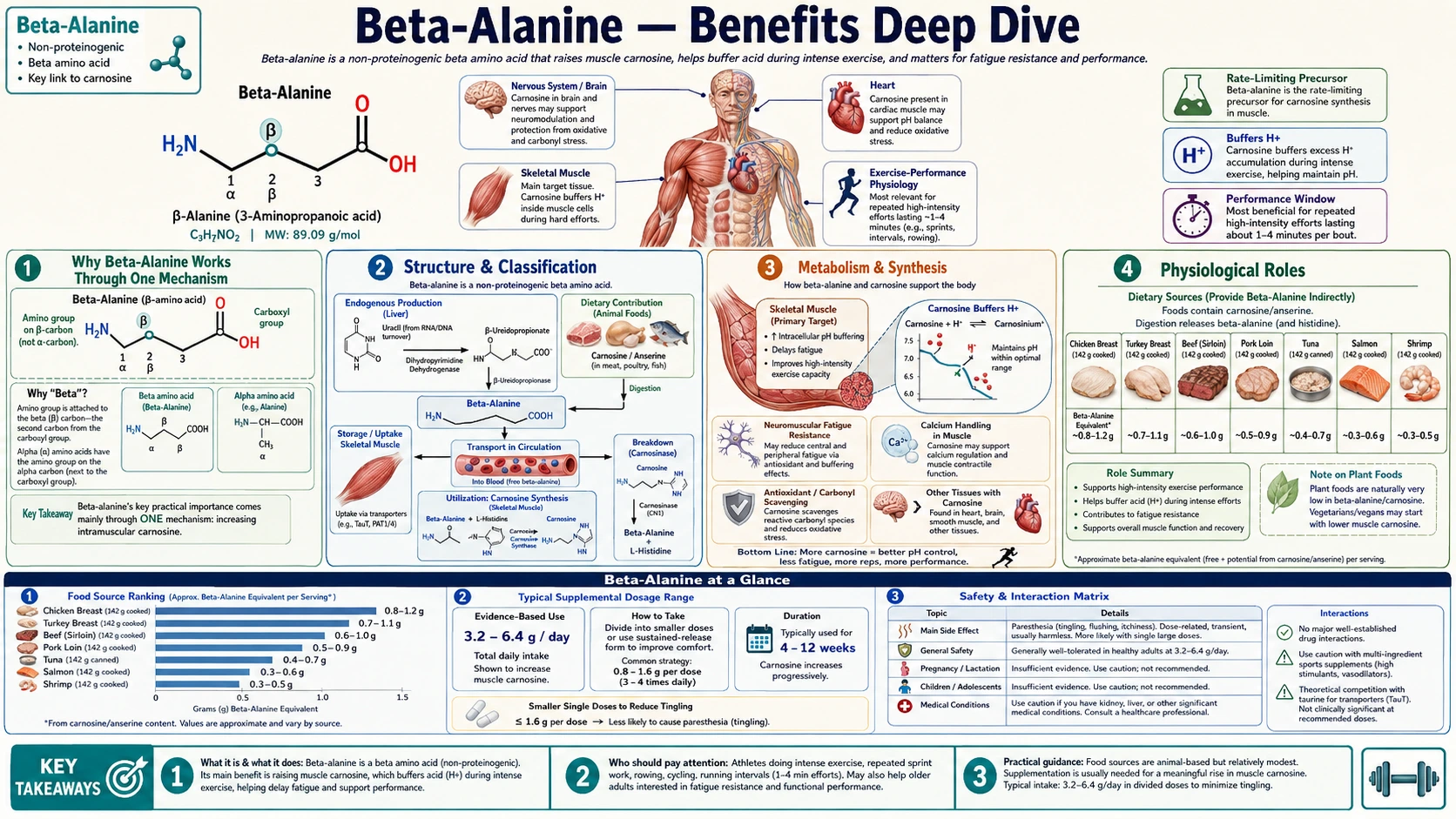
Beta-Alanine is a non-proteinogenic amino acid — it is never built into proteins, and its entire supplemental value comes from a single downstream product. Once absorbed, beta-alanine is joined to the amino acid histidine to form carnosine (beta-alanyl-L-histidine), a dipeptide stored at high concentration inside skeletal muscle where it acts as an intracellular pH buffer. Because the beta-alanine step is the rate-limiter, taking it by mouth for several weeks reliably raises muscle carnosine by roughly 40–80%. The four deep-dive pages below explain the mechanism honestly: how the buffering works, where the performance benefit is real (continuous maximal efforts of about one to four minutes) and where it is not, how to dose it and why it makes your skin tingle, and what is genuinely known about its safety, the taurine-transporter question, and stacking it with creatine.
Deep-Dive Articles
Exercise & Carnosine
The core mechanism. How dietary beta-alanine is converted to muscle carnosine, why carnosine is an ideal intracellular pH buffer in the acidic conditions of hard exercise, the roughly 40–80% rise in muscle carnosine after weeks of loading, and why vegetarians, women, and older adults tend to start with less.
High-Intensity Performance
The evidence, told honestly. Meta-analyses show the benefit is concentrated in continuous maximal efforts lasting about one to four minutes, with a small average effect of a few percent. Where it helps (rowing, 400–1500 m running, repeated sprints), where it does not (single sprints under a minute, long endurance), and realistic expectations.
Dosing & the Tingle
Practical protocol: about 3.2–6.4 g per day split into small doses, loaded steadily over several weeks because total accumulated dose — not timing — drives the carnosine rise. Why it makes your skin tingle (harmless paresthesia), and how split doses or sustained-release tablets tame it.
Safety & Stacking
What a formal risk assessment actually found, the theoretical taurine-transporter competition and why it has not translated into demonstrated harm in humans, special populations (women, older adults), and the rationale for pairing beta-alanine with creatine — two supplements that buffer different parts of the same effort.
Table of Contents
- Deep-Dive Articles
- Why Beta-Alanine Works Through One Mechanism
- Research Papers: Carnosine & the Buffering Mechanism
- Research Papers: High-Intensity Performance Evidence
- Research Papers: Dosing, Absorption & Paresthesia
- Research Papers: Safety, Special Populations & Stacking
- External Authoritative Resources
- Connections
- Featured Videos
Why Beta-Alanine Works Through One Mechanism
Most amino-acid supplements have several plausible mechanisms. Beta-alanine is unusually simple: it has essentially one that matters. Beta-alanine is not incorporated into any protein — the "beta" describes an amino group on the beta carbon rather than the alpha carbon, which is the position the ribosome's protein-building machinery requires. Instead, beta-alanine's job is to be the raw material for carnosine, a small dipeptide made by joining beta-alanine to the amino acid histidine.
Carnosine is stored at high concentration inside the fast-twitch fibers of skeletal muscle. It has one especially valuable chemical property: the imidazole ring it inherits from histidine has a dissociation constant (pKa near 6.8–7.0) that sits right in the range muscle pH falls to during hard exercise. That means carnosine can soak up the hydrogen ions (H+) produced when muscles burn glucose anaerobically, blunting the drop in pH that would otherwise interfere with muscle contraction. In short, carnosine is a built-in intracellular acid sponge.
The reason supplementation works is that the enzyme that builds carnosine (carnosine synthase) is not the bottleneck — the amount of available beta-alanine is. Histidine is already abundant inside muscle, so simply supplying more beta-alanine drives more carnosine to be made and stored. Human muscle-biopsy studies consistently show that several weeks of daily beta-alanine raises muscle carnosine by roughly 40–80%, and that the rise tracks the total amount taken over time rather than any single dose. The four deep-dive pages break this down:
- The buffering mechanism — how the beta-alanine-to-carnosine pathway works and why carnosine is such an effective pH buffer is covered on the Exercise & Carnosine page.
- The performance evidence — the honest, meta-analysis-level picture of who benefits and by how much is on the High-Intensity Performance page.
- The practical protocol — how much to take, how to split it, and why it makes your skin prickle is on the Dosing & the Tingle page.
- Safety and combinations — the risk-assessment data, the taurine question, and stacking with creatine are on the Safety & Stacking page.
A useful honesty check runs through all four pages: beta-alanine is one of a small handful of sports supplements with genuinely good evidence, but the size of its effect is modest and specific. It is not a general strength or endurance booster. It buffers acid, so it helps most in the narrow window of exercise where acid accumulation is the limiting factor.
Research Papers: Carnosine & the Buffering Mechanism
- Harris RC, et al. (2006). The absorption of orally supplied beta-alanine and its effect on muscle carnosine synthesis in human vastus lateralis. Amino Acids. — PubMed 16554972
- Boldyrev AA, Aldini G, Derave W (2013). Physiology and pathophysiology of carnosine. Physiological Reviews. — PubMed 24137022
- Dolan E, et al. (2019). Comparative physiology investigations support a role for histidine-containing dipeptides in intracellular acid-base regulation of skeletal muscle. Comparative Biochemistry and Physiology A. — PubMed 31029715
- Baguet A, et al. (2009). Carnosine loading and washout in human skeletal muscles. Journal of Applied Physiology. — PubMed 19131472
- Everaert I, et al. (2011). Vegetarianism, female gender and increasing age, but not CNDP1 genotype, are associated with reduced muscle carnosine levels in humans. Amino Acids. — PubMed 20865290
- Derave W, et al. (2007). Beta-alanine supplementation augments muscle carnosine content and attenuates fatigue during repeated isokinetic contraction bouts in trained sprinters. Journal of Applied Physiology. — PubMed 17690198
- Sale C, Saunders B, Harris RC (2010). Effect of beta-alanine supplementation on muscle carnosine concentrations and exercise performance. Amino Acids. — PubMed 20091069
- Culbertson JY, et al. (2010). Effects of beta-alanine on muscle carnosine and exercise performance: a review of the current literature. Nutrients. — PubMed 22253993
- Harris RC, Stellingwerff T (2013). Effect of beta-alanine supplementation on high-intensity exercise performance. Medicine and Sport Science. — PubMed 23075550
Research Papers: High-Intensity Performance Evidence
- Hobson RM, et al. (2012). Effects of beta-alanine supplementation on exercise performance: a meta-analysis. Amino Acids. — PubMed 22270875
- Saunders B, et al. (2017). Beta-alanine supplementation to improve exercise capacity and performance: a systematic review and meta-analysis. British Journal of Sports Medicine. — PubMed 27797728
- Quesnele JJ, et al. (2014). The effects of beta-alanine supplementation on performance: a systematic review of the literature. International Journal of Sport Nutrition and Exercise Metabolism. — PubMed 23918656
- Hill CA, et al. (2007). Influence of beta-alanine supplementation on skeletal muscle carnosine concentrations and high intensity cycling capacity. Amino Acids. — PubMed 16868650
- Van Thienen R, et al. (2009). Beta-alanine improves sprint performance in endurance cycling. Medicine & Science in Sports & Exercise. — PubMed 19276843
- Bellinger PM (2014). Beta-alanine supplementation for athletic performance: an update. Journal of Strength and Conditioning Research. — PubMed 24276304
- Walter AA, et al. (2010). Six weeks of high-intensity interval training with and without beta-alanine supplementation for improving cardiovascular fitness in women. Journal of Strength and Conditioning Research. — PubMed 20386120
- Kern BD, Robinson TL (2011). Effects of beta-alanine supplementation on performance and body composition in collegiate wrestlers and football players. Journal of Strength and Conditioning Research. — PubMed 21659893
- Trexler ET, et al. (2015). International Society of Sports Nutrition position stand: Beta-Alanine. Journal of the International Society of Sports Nutrition. — Search PubMed
Research Papers: Dosing, Absorption & Paresthesia
- Stellingwerff T, et al. (2012). Effect of two beta-alanine dosing protocols on muscle carnosine synthesis and washout. Amino Acids. — PubMed 21847611
- Stellingwerff T, et al. (2012). Optimizing human in vivo dosing and delivery of beta-alanine supplements for muscle carnosine synthesis. Amino Acids. — PubMed 22358258
- Décombaz J, et al. (2012). Effect of slow-release beta-alanine tablets on absorption kinetics and paresthesia. Amino Acids. — PubMed 22139410
- Liu Q, et al. (2012). Mechanisms of itch evoked by beta-alanine. Journal of Neuroscience. — PubMed 23077038
- Harris RC, et al. (2006). The absorption of orally supplied beta-alanine and its effect on muscle carnosine synthesis in human vastus lateralis. Amino Acids. — PubMed 16554972
- Baguet A, et al. (2009). Carnosine loading and washout in human skeletal muscles. Journal of Applied Physiology. — PubMed 19131472
- Artioli GG, et al. (2010). Role of beta-alanine supplementation on muscle carnosine and exercise performance. Medicine & Science in Sports & Exercise. — PubMed 20479615
- Trexler ET, et al. (2015). International Society of Sports Nutrition position stand: Beta-Alanine. Journal of the International Society of Sports Nutrition. — Search PubMed
Research Papers: Safety, Special Populations & Stacking
- Dolan E, et al. (2019). A systematic risk assessment and meta-analysis on the use of oral beta-alanine supplementation. Advances in Nutrition. — PubMed 30980076
- Hoffman J, et al. (2006). Effect of creatine and beta-alanine supplementation on performance and endocrine responses in strength/power athletes. International Journal of Sport Nutrition and Exercise Metabolism. — PubMed 17136944
- Stout JR, et al. (2007). Effects of beta-alanine supplementation on the onset of neuromuscular fatigue and the physical working capacity fatigue threshold in young women. Amino Acids. — PubMed 17136505
- Stout JR, et al. (2008). The effect of beta-alanine supplementation on neuromuscular fatigue in elderly (55–92 years): a double-blind randomized study. Journal of the International Society of Sports Nutrition. — PubMed 18992136
- McCormack WP, et al. (2013). Oral nutritional supplement fortified with beta-alanine improves physical working capacity in older adults. Experimental Gerontology. — PubMed 23832078
- Hoffman JR, et al. (2014). Beta-alanine supplementation improves tactical performance but not cognitive function in combat soldiers. Journal of the International Society of Sports Nutrition. — PubMed 24716994
- Liu Q, et al. (2012). Mechanisms of itch evoked by beta-alanine. Journal of Neuroscience. — PubMed 23077038
- Saunders B, et al. (2017). Beta-alanine supplementation to improve exercise capacity and performance: a systematic review and meta-analysis. British Journal of Sports Medicine. — PubMed 27797728
External Authoritative Resources
- NIH Office of Dietary Supplements — Dietary Supplements for Exercise and Athletic Performance — the government fact sheet, with a balanced beta-alanine section
- Search PubMed — the consensus statement summarizing dose, efficacy, and safety
- PubChem — beta-Alanine — the chemistry and identity record
- Examine.com — Beta-Alanine — an independent evidence summary graded by study quality
- PubMed — all research on beta-alanine, carnosine, and exercise
Connections
- All Amino Acids
- Beta-Alanine (Main Page)
- Exercise & Carnosine
- High-Intensity Performance
- Dosing & the Tingle
- Safety & Stacking
- Histidine (Carnosine Partner)
- Creatine
- Taurine
- Citrulline
- Exercise
- Beef (Dietary Carnosine)
- Chicken (Dietary Carnosine)
- Pork (Dietary Carnosine)
- Eggs