Beta-Alanine Safety and Stacking
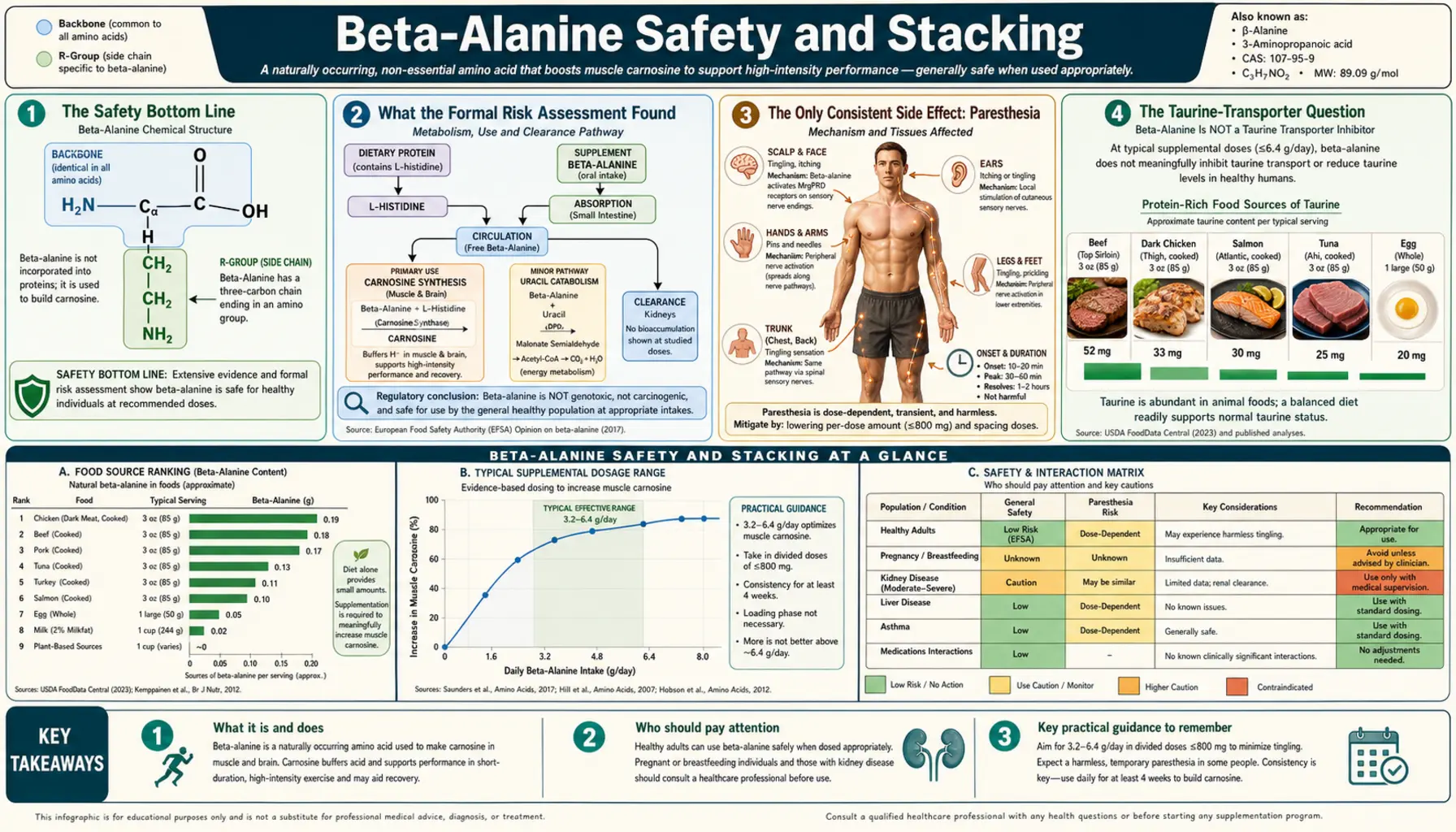
Beta-alanine has a reassuring safety record at the doses used for performance. A formal risk assessment pooling the trial evidence found no signal of harm beyond the harmless tingle, and no consistent effect on blood markers, organ function, or other safety measures. The most-cited theoretical concern — that beta-alanine competes with the amino acid taurine for the same cell transporter and might lower taurine levels — is real in the test tube and in high-dose rodent studies, but has not translated into demonstrated taurine depletion or harm in humans at supplement doses. Beta-alanine is also one half of a popular pairing with creatine, because the two buffer different parts of the same hard effort. This page covers the safety data honestly and explains sensible stacking.
Table of Contents
- The Safety Bottom Line
- What the Formal Risk Assessment Found
- The Only Consistent Side Effect: Paresthesia
- The Taurine-Transporter Question
- Stacking with Creatine
- Stacking with Bicarbonate and Others
- Special Populations and Sensible Caution
- Drug Interactions and Who Should Be Careful
- Quality, Purity, and Tested Athletes
- Key Research Papers
- External Authoritative Resources
- Connections
- Featured Videos
The Safety Bottom Line
For healthy adults using the standard performance doses (about 3.2–6.4 grams per day, ideally split), beta-alanine is considered one of the safer sports supplements. The only reliably reported effect is the temporary skin tingling covered on the Dosing & the Tingle page. Across many trials there is no established pattern of harm to the liver, kidneys, blood counts, or other standard safety measures at these doses.
As always, "no established harm in studied populations at studied doses" is not the same as "proven safe for everyone at any dose." The honest position is that the evidence available is reassuring for healthy adults using recommended amounts, and thinner for very high doses, long-term use beyond the study durations, and populations that have not been studied (which is a caution about missing data, not a known danger).
What the Formal Risk Assessment Found
The most rigorous safety review is the systematic risk assessment and meta-analysis by Dolan and colleagues (2019) in Advances in Nutrition. The authors specifically set out to test whether beta-alanine causes harm, pooling the controlled trials and examining reported adverse events and safety outcomes. Their conclusion was that, at the doses commonly studied, there was no evidence of harm beyond paresthesia, and no consistent adverse effect on the measured clinical and biochemical safety markers.
This is an important paper precisely because it was designed to look for problems rather than benefits. When a review built to detect harm finds essentially only the tingle, it substantially strengthens confidence in the supplement's safety at the studied doses. The ISSN position stand (Trexler et al. 2015) reached a compatible conclusion, judging beta-alanine safe for healthy people at recommended intakes.
The Only Consistent Side Effect: Paresthesia
The tingling sensation (paresthesia) is the one effect that shows up consistently. As detailed on the dosing page, it results from beta-alanine activating MrgprD sensory receptors in the skin (Liu et al. 2012), it is harmless, and it is easily reduced by splitting doses or using sustained-release tablets. It is worth restating here because it is the whole of the "side effect" conversation for most people — a transient, benign skin sensation, not a health risk.
Rarely, individuals report the tingle as uncomfortable enough to prefer lower single doses or a slow-release product. That is a comfort issue, not a safety one. There is no evidence that experiencing (or not experiencing) the tingle relates to any underlying problem.
The Taurine-Transporter Question
This is the concern most often raised, and it deserves an honest, careful answer. Beta-alanine and the amino acid taurine are structurally similar, and they share the same cell-membrane transporter (the taurine transporter, TauT) to get into cells. Because they compete for that transporter, a large amount of beta-alanine can, in principle, reduce taurine uptake — and in rodent studies using high doses, beta-alanine has been shown to lower taurine concentrations in some tissues.
The critical question is whether this happens meaningfully in humans at supplement doses, and here the honest answer is: it has not been demonstrated. Human studies have not shown clinically meaningful taurine depletion or associated harm from beta-alanine at the doses used for performance. The Dolan risk assessment specifically considered the taurine issue among safety outcomes and did not find evidence of a problem in humans. In short, the mechanism is real and worth knowing, but the feared consequence remains theoretical at human doses rather than an established effect.
A few practical takeaways follow from this honest uncertainty:
- There is no strong evidence that you need to co-supplement taurine to "protect" against beta-alanine, and no established taurine deficiency from beta-alanine in humans.
- Some people choose to take modest taurine alongside beta-alanine as a precaution; this is low-risk but not clearly necessary based on current data.
- The rodent-versus-human gap is a genuine limitation of the evidence, so this is an area to watch rather than dismiss entirely.
Stacking with Creatine
Beta-alanine and creatine are a logical pairing because they support different, complementary parts of a hard effort:
- Creatine supports the phosphagen system — the rapid energy supply for very short, explosive efforts (a few seconds), and helps replenish it between bouts.
- Beta-alanine (via carnosine) buffers acid in slightly longer, sustained high-intensity efforts of roughly one to four minutes, as covered on the High-Intensity Performance page.
The theory is that together they cover a wider portion of the high-intensity spectrum than either alone. Hoffman and colleagues (2006) studied creatine plus beta-alanine in strength/power athletes and reported benefits from the combination. The honest caveat is that the evidence for true synergy — the combination doing more than the sum of its parts — is limited and mixed; what is clearer is that they are complementary and safe to take together. Many pre-made products combine them for this reason. They have independent mechanisms and no known negative interaction.
Stacking with Bicarbonate and Others
Two other pairings come up:
- Sodium bicarbonate. Bicarbonate is an extracellular (blood) buffer, whereas carnosine is an intracellular (inside the muscle cell) buffer. In theory they buffer acid at different locations and could complement each other for high-intensity efforts. Some studies suggest additive benefits, though bicarbonate carries its own well-known downside of gastrointestinal upset. This is a more advanced, individual-response stack.
- Citrulline, nitrate, and pre-workout blends. Beta-alanine is frequently included in multi-ingredient pre-workouts alongside citrulline, caffeine, and others. There is no known harmful interaction, but remember that the tingle you feel from such a blend is the beta-alanine acting acutely on skin receptors, not evidence the blend is "working."
Special Populations and Sensible Caution
- Women. Beta-alanine has been studied in women (for example, Stout and colleagues on neuromuscular fatigue) with a similar safety profile to men. Women may start with somewhat lower muscle carnosine, giving room to respond.
- Older adults. Trials in older people (Stout et al.; McCormack et al.) have used beta-alanine for physical function without notable safety problems, making it a supplement of interest for age-related muscle decline.
- Pregnancy, breastfeeding, and children. Beta-alanine has not been studied in these groups. The sensible default is to avoid it during pregnancy and breastfeeding and in children — not because harm is known, but because the safety data simply do not exist for them.
- People with medical conditions. Anyone with kidney disease, liver disease, or another chronic condition, or who is on medication, should check with a clinician before adding any supplement, beta-alanine included.
Drug Interactions and Who Should Be Careful
Beta-alanine has no widely established, clinically significant drug interactions at performance doses. It is not a stimulant and does not raise heart rate or blood pressure the way caffeine-based products can — a useful distinction, since beta-alanine is often bundled into stimulant pre-workouts whose other ingredients do carry cardiovascular considerations. If you are sensitive to stimulants, note that beta-alanine itself is not the stimulant; the caffeine in a blend is.
The main practical caution is simply the theoretical taurine-transporter interaction discussed above, and general prudence for anyone with a medical condition or on medication. Beyond that, the interaction profile is quiet.
Quality, Purity, and Tested Athletes
Because supplements are not tightly regulated before sale, product quality varies. Two sensible steps:
- Choose third-party-tested products. Look for certification (such as NSF Certified for Sport or Informed Sport), especially if you compete in a tested sport, to reduce the risk of contamination with banned substances.
- Buy plain beta-alanine when possible. A single-ingredient product lets you control the dose and split it to manage the tingle, rather than being locked into a fixed blend.
Beta-alanine itself is not a banned substance in sport. It is a permitted, evidence-backed ergogenic aid — the anti-doping concern is contamination of poorly made products, not beta-alanine per se. For the underlying mechanism and the honest evidence on how much it helps, revisit the Exercise & Carnosine and High-Intensity Performance pages.
Key Research Papers
- Dolan E, et al. (2019). A systematic risk assessment and meta-analysis on the use of oral beta-alanine supplementation. Advances in Nutrition. — PubMed 30980076
- Trexler ET, et al. (2015). International Society of Sports Nutrition position stand: Beta-Alanine. Journal of the International Society of Sports Nutrition. — PubMed 26175657
- Liu Q, et al. (2012). Mechanisms of itch evoked by beta-alanine. Journal of Neuroscience. — PubMed 23077038
- Hoffman J, et al. (2006). Effect of creatine and beta-alanine supplementation on performance and endocrine responses in strength/power athletes. International Journal of Sport Nutrition and Exercise Metabolism. — PubMed 17136944
- Balshaw TG, et al. (2013). The effect of acute taurine ingestion on 3-km running performance in trained middle-distance runners. Amino Acids. — PubMed 22855206
- Stout JR, et al. (2007). Effects of beta-alanine supplementation on the onset of neuromuscular fatigue and the physical working capacity fatigue threshold in young women. Amino Acids. — PubMed 17136505
- Stout JR, et al. (2008). The effect of beta-alanine supplementation on neuromuscular fatigue in elderly (55–92 years): a double-blind randomized study. Journal of the International Society of Sports Nutrition. — PubMed 18992136
- McCormack WP, et al. (2013). Oral nutritional supplement fortified with beta-alanine improves physical working capacity in older adults. Experimental Gerontology. — PubMed 23832078
- Hoffman JR, et al. (2015). Beta-alanine ingestion increases muscle carnosine content and combat specific performance in soldiers. Amino Acids. — PubMed 25510839
- Saunders B, et al. (2017). Beta-alanine supplementation to improve exercise capacity and performance: a systematic review and meta-analysis. British Journal of Sports Medicine. — PubMed 27797728
PubMed Topic Searches
- PubMed: Beta-alanine safety and adverse effects
- PubMed: Beta-alanine and taurine transporter
- PubMed: Beta-alanine and creatine co-supplementation
- PubMed: Beta-alanine and sodium bicarbonate
External Authoritative Resources
- NIH Office of Dietary Supplements — Exercise and Athletic Performance
- Dolan et al. (2019) — Systematic Risk Assessment of Beta-Alanine
- Examine.com — Beta-Alanine (safety and interactions)
Connections
- All Amino Acids
- Beta-Alanine (Main Page)
- Beta-Alanine Benefits Hub
- Exercise & Carnosine
- High-Intensity Performance
- Dosing & the Tingle
- Creatine (Stacking Partner)
- Taurine (Transporter Note)
- Citrulline
- Histidine
- Exercise
- Beef