L-Theanine
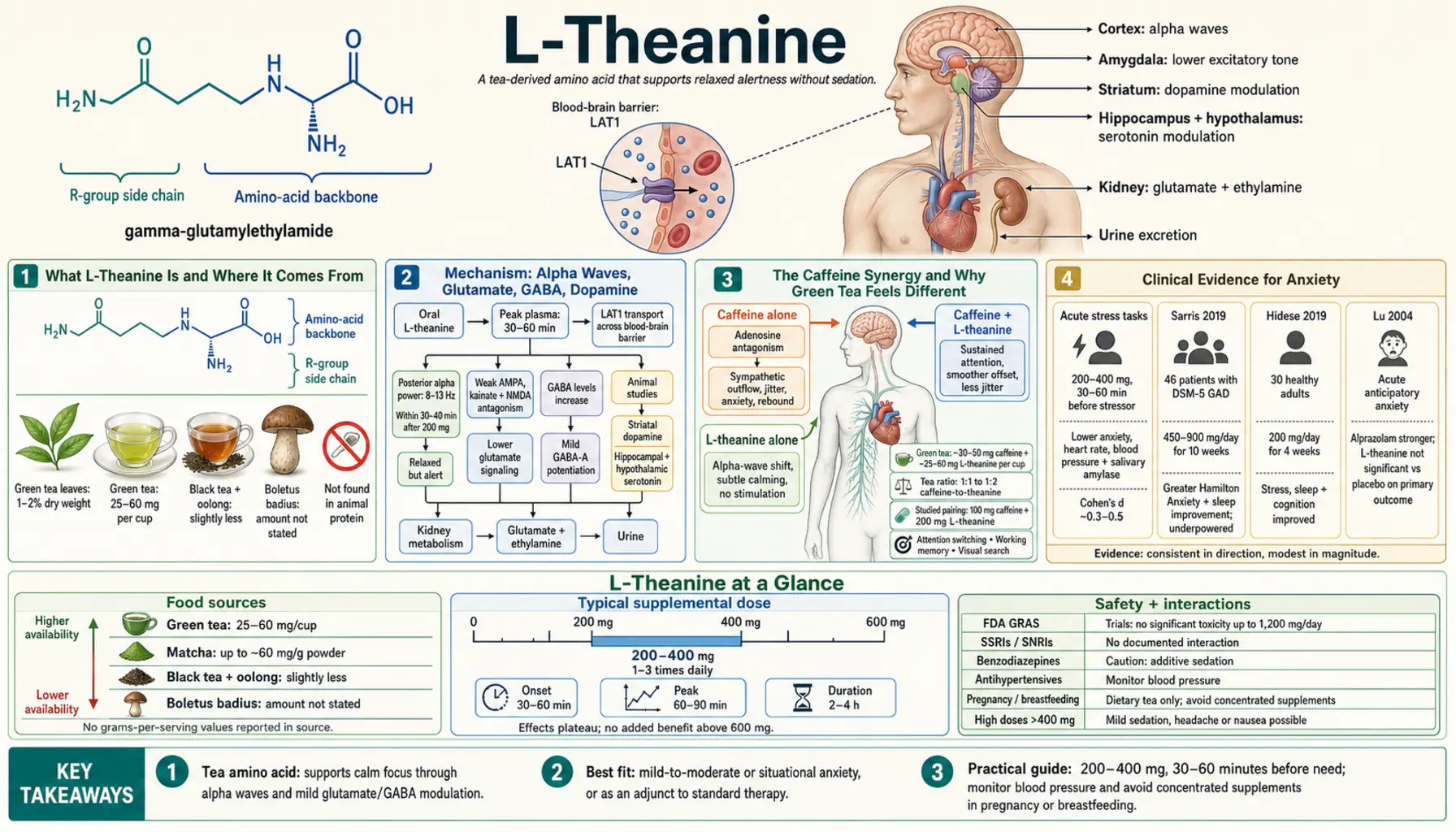
L-theanine is a non-protein amino acid found mainly in the leaves of the tea plant, Camellia sinensis (green, black and white tea); it has also been reported in one edible mushroom, the bay bolete (Boletus badius). It is commonly credited with the calm-but-alert quality associated with tea, and histories of the compound record its first isolation from tea in 1949 by the Japanese chemist Yajiro Sakato. In resting EEG recordings, L-theanine increased alpha-band brain activity, which researchers interpret as relaxation without drowsiness — including at 50 mg, close to dietary amounts. A 2020 systematic review of nine randomized controlled trials concluded that 200–400 mg/day may assist in reducing stress and anxiety in people exposed to stressful conditions, while calling for longer and larger trials; the one trial in diagnosed generalized anxiety disorder did not find an anxiety benefit over placebo. Human data on drug interactions are limited.
Interactive Visualization Sleep Stages & Your Body Clock — run a whole night Watch deep sleep and REM cycle through the night — then add late-night light, an afternoon coffee, or a nightcap and see what breaks. Launch → Interactive Visualization Caffeine, Adenosine & Why Coffee Stops Working Caffeine doesn’t give you energy — it blocks the tiredness signal while adenosine keeps piling up behind the blockade. Move your coffee to 2 p.m. and watch your deep sleep vanish. Launch → Interactive Visualization GABA, the Brain's Brake — press it with a benzo or alcohol Watch glutamate try to fire a neuron while GABA slams the chloride brake on — then add a benzodiazepine or alcohol and see the brake amplified, and why stacking them is dangerous. Launch →
Table of Contents
- What L-Theanine Is and Where It Comes From
- Proposed Mechanisms: EEG, Glutamate, GABA, Dopamine
- L-Theanine Combined with Caffeine: What the Trials Found
- Clinical Evidence for Stress and Anxiety
- Doses Used in Trials and Available Forms
- Green Tea Compared with L-Theanine Supplements
- L-Theanine Alongside Other Supplements and Medicines
- Safety Data and Possible Interactions
- Key Research Papers
- Connections
- Featured Videos
What L-Theanine Is and Where It Comes From
L-theanine (gamma-glutamylethylamide) is a free amino acid that is not built into proteins. It occurs mainly in the tea plant and is commonly described as contributing to the savory umami taste of green tea.
The molecule is structurally related to glutamate (the brain's main excitatory neurotransmitter) and to glutamine. In rats given theanine by stomach tube, it entered the brain across the blood-brain barrier via a leucine-preferring transport system (Yokogoshi 1998). In 12 healthy people given 100 mg, plasma L-theanine peaked 0.8 hours after intake, with comparable kinetics whether it was taken as capsules or in green tea; plasma and urine levels of its breakdown products, ethylamine and glutamic acid, also rose (Scheid 2012). In rats, theanine-degrading enzyme activity was detected only in the kidney (Tsuge 2003).
The amount of L-theanine in a cup of tea depends on the tea and how it is brewed. One research group put a cup of black tea at approximately 20 mg (Nobre 2008) — well below the 200–400 mg/day used in many supplement trials.
Several of the trials cited on this page were run with industry involvement: in Hidese 2019, two co-authors were employees of the ingredient manufacturer that supplied the L-theanine and placebo tablets, and Nobre 2008, Owen 2008 and Giesbrecht 2010 came from a consumer-goods company's research laboratories. The trials cited here used the L-isomer.
Proposed Mechanisms: EEG, Glutamate, GABA, Dopamine
Several mechanisms have been proposed. Most come from animal and cell studies; the human evidence is mainly EEG recordings and questionnaires:
- Alpha-band EEG activity — alpha activity (about 8–13 Hz) is the dominant rhythm of relaxed wakefulness with the eyes closed. In resting participants with eyes closed, 50 mg L-theanine (n=16) produced a greater increase in alpha activity than placebo (n=19) over 45–105 minutes after intake, and a second study replicated this during passive activity; the authors note that earlier EEG work had used higher doses (Nobre 2008). During demanding attention tasks the direction differs: 250 mg L-theanine reduced background (tonic) alpha power compared with placebo in 13 people doing a visuo-spatial task (Gomez-Ramirez 2009), and 100 mg L-theanine with 50 mg caffeine also lowered tonic alpha (Kelly 2008). The researchers interpret the task-time reduction as a shift in how attention is deployed, not as relaxation.
- Glutamate receptors — in rat cortical neurons, theanine bound AMPA, kainate and NMDA-type glutamate receptors, but its binding (IC50) was 80- to 30,000-fold weaker than that of glutamate itself (Kakuda 2002). These are laboratory findings.
- GABA and other inhibitory signalling — a 2014 review summarises animal work reporting an up-regulation of inhibitory neurotransmitters after theanine (Lardner 2014). The human studies cited on this page did not measure GABA-A receptor effects directly.
- Dopamine and serotonin — in rats, theanine increased serotonin and/or dopamine concentrations, especially in the striatum, hypothalamus and hippocampus, and injecting it into the striatum increased dopamine release (Yokogoshi 1998, Neurochem Res). A separate rat study from the same group found brain serotonin decreased after theanine (Yokogoshi 1998, Biosci Biotechnol Biochem). These are animal results.
The “relaxed but alert” description comes mainly from the resting EEG findings. Behavioural results for L-theanine on its own are mixed: 250 mg alone increased ‘headache’ ratings and reduced correct serial-seven subtractions (Haskell 2008); 100 mg alone had no detectable effect on an attention task (Kelly 2008); and in a four-week trial, 200 mg/day improved verbal fluency and executive function scores (Hidese 2019).
L-Theanine Combined with Caffeine: What the Trials Found
Caffeine works by blocking adenosine receptors; at higher doses it can cause a rapid heartbeat, tremor, jitteriness and anxiety in susceptible people. Tea supplies caffeine and L-theanine together, and several placebo-controlled trials have tested the two in combination:
- Owen 2008 — 27 participants; 50 mg caffeine with and without 100 mg L-theanine, compared with placebo. Caffeine alone improved subjective alertness at 60 minutes and attention-switching accuracy at 90 minutes. The combination improved both speed and accuracy of attention switching at 60 minutes and reduced susceptibility to distracting information in a memory task at 60 and 90 minutes.
- Haskell 2008 — crossover trial of 250 mg L-theanine and 150 mg caffeine, alone and combined. The combination led to faster simple reaction time and numeric working-memory reaction time, better sentence-verification accuracy, lower ‘headache’ and ‘tired’ ratings and higher ‘alert’ ratings. L-theanine alone increased ‘headache’ ratings and reduced correct serial-seven subtractions.
- Kelly 2008 — 100 mg L-theanine and 50 mg caffeine, alone and together, on a visual attention task. The combination increased hit rate and target discriminability; caffeine alone increased discriminability only; no effects were detected for L-theanine alone.
- Giesbrecht 2010 — 44 young adults; 97 mg L-theanine with 40 mg caffeine versus placebo. The combination improved task-switching accuracy and self-reported alertness and reduced self-reported tiredness, with no significant effect on visual search, choice reaction time or mental rotation.
- Camfield 2014 (meta-analysis) — 11 randomized placebo-controlled studies of tea constituents. It found moderate effect sizes in favour of combined caffeine and L-theanine in the first two hours for alertness and attention-switching accuracy, and trends toward greater change in effect size with caffeine dose than with L-theanine dose.
Across these trials, the combination's effects centred on attention switching and alertness; not every task improved, and not every design included an L-theanine-only arm. Combination capsules are sold; the trials above used 97–250 mg L-theanine with 40–150 mg caffeine.
Clinical Evidence for Stress and Anxiety
L-theanine has been tested for stress and anxiety in three main settings:
- Acute laboratory stress — during a mental-arithmetic stressor, 12 participants taking L-theanine showed smaller heart-rate and salivary immunoglobulin A responses than with placebo, which the authors attributed to reduced sympathetic activation (Kimura 2007). In 14 participants, L-theanine inhibited the rise in blood pressure after mental tasks among those whose blood pressure rose more than average, and lowered Profile of Mood States Tension-Anxiety scores compared with placebo (Yoto 2012). In an anticipatory-anxiety model in 16 healthy volunteers, 200 mg L-theanine showed some relaxing effect at rest on one subscale, but neither L-theanine nor alprazolam (1 mg) had significant anxiolytic effects under experimentally induced anxiety (Lu 2004).
- Generalized anxiety disorder (GAD) — Sarris 2019 gave 46 adults with DSM-5 GAD 450–900 mg L-theanine or placebo alongside their stable antidepressant treatment, in a 10-week study with an 8-week double-blind phase. L-theanine did not outperform placebo on anxiety (Hamilton Anxiety Rating Scale, p = 0.73) or on overall insomnia severity (p = 0.35); participants on L-theanine reported greater sleep satisfaction on one item of the Insomnia Severity Index (p = 0.015). The authors concluded that the study did not support L-theanine for anxiety symptoms in GAD and that its use for sleep disturbance merits further study.
- Stress and sleep in adults without a psychiatric diagnosis — Hidese 2019 was a randomized, placebo-controlled, double-blind crossover trial in 30 adults (mean age 48) with no major psychiatric illness, using 200 mg/day for four weeks. Depression (SDS), trait-anxiety (STAI-trait) and sleep-quality (PSQI) scores decreased after L-theanine; the PSQI subscores for sleep latency, sleep disturbance and use of sleep medication fell compared with placebo; and verbal fluency and executive function scores improved.
A 2020 systematic review of nine randomized controlled trials of pure L-theanine supplements concluded that 200–400 mg/day may assist in reducing stress and anxiety in people exposed to stressful conditions, and that longer-term and larger studies are needed before it can be clinically justified as a therapeutic agent (Williams 2020). The trials so far are small, the results vary by setting, and the one trial in a diagnosed anxiety disorder was negative for anxiety.
Doses Used in Trials and Available Forms
The doses below are the ones used in the studies cited on this page. They describe what was studied; they are not a dosing guide.
| Study | L-theanine dose | Design |
|---|---|---|
| Nobre 2008 | 50 mg, single dose | Resting EEG, 45–105 minutes after intake; placebo-controlled |
| Lu 2004 | 200 mg, single dose | Anticipatory-anxiety model, 16 healthy volunteers; compared with alprazolam 1 mg and placebo |
| Owen 2008 | 100 mg with 50 mg caffeine | Cognition and mood, 27 participants; tested at 60 and 90 minutes |
| Haskell 2008 | 250 mg, alone and with 150 mg caffeine | Placebo-controlled crossover; cognition and mood |
| Giesbrecht 2010 | 97 mg with 40 mg caffeine | Cognition and alertness, 44 young adults; tested at 20 and 70 minutes |
| Hidese 2019 | 200 mg/day for 4 weeks | Placebo-controlled crossover, 30 healthy adults |
| Sarris 2019 | 450–900 mg/day, 8-week double-blind phase | 46 adults with GAD, added to stable antidepressant treatment |
| Williams 2020 (review) | 200–400 mg/day | Systematic review of 9 randomized controlled trials |
L-theanine is sold as capsules, tablets, chewables and powder, and in combination products with caffeine or with other ingredients such as lemon balm, GABA or magnesium. It dissolves in water; one EEG study described its 250 mg water solution as colorless and tasteless (Gomez-Ramirez 2009).
Green Tea Compared with L-Theanine Supplements
Brewed tea delivers L-theanine together with catechins such as EGCG and with caffeine. In a crossover study, 100 mg L-theanine taken in capsules or in green tea produced comparable plasma kinetics and urinary excretion (Scheid 2012). The amount per cup is lower than most supplement doses studied (Nobre 2008 put a cup of black tea at approximately 20 mg).
Tea itself carries separate considerations. Its caffeine can disturb sleep when taken late in the day, and tea polyphenols reduce the absorption of non-heme iron from a meal. The European Food Safety Authority's 2018 opinion on green tea catechins concluded that catechins from traditionally prepared green tea infusions are in general considered safe at the intakes reported in Europe; that rare cases of liver injury have nonetheless been reported after green tea infusions, most probably as an idiosyncratic reaction; and that intervention trials show 800 mg EGCG/day or more taken as a food supplement significantly raises serum transaminases (EFSA 2018). Purified L-theanine supplements do not contain these catechins.
L-Theanine Alongside Other Supplements and Medicines
L-theanine is often sold in, or taken alongside, other products. What the cited research says about each pairing:
- L-theanine + caffeine — the best-studied pairing; see the caffeine trials above.
- L-theanine + green tea extract — in 91 adults with mild cognitive impairment, a combined green tea extract and L-theanine product (1,680 mg/day for 16 weeks) only marginally increased delayed recognition overall (P = .0572); significant memory and attention gains appeared in the subgroup with lower MMSE-K scores (Park 2011).
- L-theanine + magnesium glycinate — no trial of this combination is cited here; magnesium glycinate for anxiety is covered on the linked page.
- L-theanine + ashwagandha — no trial of this combination is cited here; ashwagandha is covered on its own page.
- L-theanine + lemon balm — both are marketed for calm and some herbal tea blends contain both; no trial of the combination is cited here.
- L-theanine + passionflower — no trial of the combination is cited here; passionflower's own evidence is on the linked page.
Pairings the research raises questions about:
- L-theanine + benzodiazepines — additive sedation is a theoretical concern; no interaction study is cited here.
- L-theanine + blood-pressure medicines — L-theanine blunted stress-related blood-pressure rises in high-response participants (Yoto 2012); whether it adds to the effect of blood-pressure medicines has not been studied in the trials cited here.
- Pregnancy and breastfeeding — there are few safety data on concentrated L-theanine supplements in pregnancy and breastfeeding.
Safety Data and Possible Interactions
The U.S. FDA has issued “no questions” letters on several Generally Recognized as Safe (GRAS) notices for L-theanine, the first in 2007 (GRN 209). In a 13-week dietary study in rats, the no-observed-adverse-effect level was 4,000 mg/kg body weight per day, the highest dose tested (Borzelleca 2006). Findings from human trials include:
- Headache — 250 mg L-theanine alone increased ‘headache’ ratings in one trial, while the combination with caffeine reduced them (Haskell 2008).
- Blood pressure — L-theanine blunted stress-related blood-pressure rises in high-response participants (Yoto 2012).
- No measurable effect — several trials found no benefit on their main outcome (Lu 2004 under induced anxiety; Sarris 2019 for GAD anxiety; Kelly 2008 for L-theanine alone).
Possible interactions:
- Prescription stimulants (amphetamines, methylphenidate) — no controlled study of the combination is cited here.
- SSRIs and SNRIs — in Sarris 2019, L-theanine was given alongside participants' stable antidepressant treatment; the abstract does not report on interactions.
- Blood-pressure medicines — an additive effect is theoretically possible; it has not been studied in the trials cited here.
- Warfarin — a case report describes a man on warfarin whose INR fell from 3.79 to 1.37 and then 1.14 after he began drinking one-half to one gallon of green tea a day, and rose to 2.55 when he stopped; the authors attributed this to the vitamin K in green tea (Taylor 1999). That report concerns tea, not purified L-theanine.
Decisions about supplements belong with a clinician. Other approaches studied for stress and anxiety, such as magnesium and ashwagandha, are covered on their own pages.
Key Research Papers
- Nobre AC, Rao A, Owen GN (2008). L-theanine, a natural constituent in tea, and its effect on mental state. Asia Pacific Journal of Clinical Nutrition — PubMed PMID: 18296328
- Williams JL, Everett JM, D'Cunha NM et al. (2020). The effects of green tea amino acid L-theanine consumption on the ability to manage stress and anxiety levels: a systematic review. Plant Foods for Human Nutrition — PubMed PMID: 31758301
- Hidese S, Ogawa S, Ota M et al. (2019). Effects of L-theanine administration on stress-related symptoms and cognitive functions in healthy adults: a randomized controlled trial. Nutrients — PubMed PMID: 31623400
- Kimura K, Ozeki M, Juneja LR, Ohira H (2007). L-theanine reduces psychological and physiological stress responses. Biological Psychology — PubMed PMID: 16930802
- Lardner AL (2014). Neurobiological effects of the green tea constituent theanine and its potential role in the treatment of psychiatric and neurodegenerative disorders. Nutritional Neuroscience — PubMed PMID: 23883567
- Owen GN, Parnell H, De Bruin EA, Rycroft JA (2008). The combined effects of L-theanine and caffeine on cognitive performance and mood. Nutritional Neuroscience — PubMed PMID: 18681988
- Haskell CF, Kennedy DO, Milne AL et al. (2008). The effects of L-theanine, caffeine and their combination on cognition and mood. Biological Psychology — PubMed PMID: 18006208
- Yoto A, Motoki M, Murao S, Yokogoshi H (2012). Effects of L-theanine or caffeine intake on changes in blood pressure under physical and psychological stresses. Journal of Physiological Anthropology — PubMed PMID: 23107346
- Sarris J, Byrne GJ, Cribb L et al. (2019). L-theanine in the adjunctive treatment of generalized anxiety disorder: a double-blind, randomised, placebo-controlled trial. Journal of Psychiatric Research — PubMed PMID: 30580081
- Lu K, Gray MA, Oliver C et al. (2004). The acute effects of L-theanine in comparison with alprazolam on anticipatory anxiety in humans. Human Psychopharmacology — PubMed PMID: 15378679
- Higashiyama A, Htay HH, Ozeki M et al. (2011). Effects of L-theanine on attention and reaction time response. Journal of Functional Foods 3:171-178 — doi:10.1016/j.jff.2011.03.009
- Park SK, Jung IC, Lee WK et al. (2011). A combination of green tea extract and L-theanine improves memory and attention in subjects with mild cognitive impairment: a double-blind placebo-controlled study. Journal of Medicinal Food — PubMed PMID: 21303262
- Kelly SP, Gomez-Ramirez M, Montesi JL, Foxe JJ (2008). L-theanine and caffeine in combination affect human cognition as evidenced by oscillatory alpha-band activity and attention task performance. Journal of Nutrition — PubMed PMID: 18641209
- Gomez-Ramirez M, Kelly SP, Montesi JL, Foxe JJ (2009). The effects of L-theanine on alpha-band oscillatory brain activity during a visuo-spatial attention task. Brain Topography — PubMed PMID: 18841456
- Giesbrecht T, Rycroft JA, Rowson MJ, De Bruin EA (2010). The combination of L-theanine and caffeine improves cognitive performance and increases subjective alertness. Nutritional Neuroscience — PubMed PMID: 21040626
- Camfield DA, Stough C, Farrimond J, Scholey AB (2014). Acute effects of tea constituents L-theanine, caffeine, and epigallocatechin gallate on cognitive function and mood: a systematic review and meta-analysis. Nutrition Reviews — PubMed PMID: 24946991
- Kakuda T, Nozawa A, Sugimoto A, Niino H (2002). Inhibition by theanine of binding of [3H]AMPA, [3H]kainate, and [3H]MDL 105,519 to glutamate receptors. Bioscience, Biotechnology, and Biochemistry — PubMed PMID: 12596867
- Yokogoshi H, Kobayashi M, Mochizuki M, Terashima T (1998). Effect of theanine, r-glutamylethylamide, on brain monoamines and striatal dopamine release in conscious rats. Neurochemical Research — PubMed PMID: 9566605
- Yokogoshi H, Mochizuki M, Saitoh K (1998). Theanine-induced reduction of brain serotonin concentration in rats. Bioscience, Biotechnology, and Biochemistry — PubMed PMID: 9614715
- Scheid L, Ellinger S, Alteheld B et al. (2012). Kinetics of L-theanine uptake and metabolism in healthy participants are comparable after ingestion of L-theanine via capsules and green tea. Journal of Nutrition — PubMed PMID: 23096008
- Tsuge H, Sano S, Hayakawa T, Kakuda T, Unno T (2003). Theanine, gamma-glutamylethylamide, is metabolized by renal phosphate-independent glutaminase. Biochimica et Biophysica Acta — PubMed PMID: 12595072
- Borzelleca JF, Peters D, Hall W (2006). A 13-week dietary toxicity and toxicokinetic study with l-theanine in rats. Food and Chemical Toxicology — PubMed PMID: 16759779
- EFSA Panel on Food Additives and Nutrient Sources added to Food (ANS); Younes M et al. (2018). Scientific opinion on the safety of green tea catechins. EFSA Journal — PubMed PMID: 32625874
- Taylor JR, Wilt VM (1999). Probable antagonism of warfarin by green tea. Annals of Pharmacotherapy — PubMed PMID: 10332534
PubMed Topic Searches
Connections
- All Amino Acids
- GABA: The Brain’s Brake — interactive animation
- Caffeine, Adenosine & Why Coffee Stops Working — interactive animation
- Sleep Stages & Your Body Clock — interactive animation
- 5-HTP
- Natural Anxiety Relief Hub
- Natural Anxiety Relief Benefits
- Magnesium Glycinate for Anxiety
- Adaptogenic Herbs for Anxiety
- Breath and Cold Exposure for Anxiety
- GABA
- Glutamine
- Green Tea
- Lemon Balm
- Passionflower
- Magnesium
- Stress Management
- Sleep Hygiene
- All Remedies
- Glutamate