Breath and Cold Exposure for Anxiety
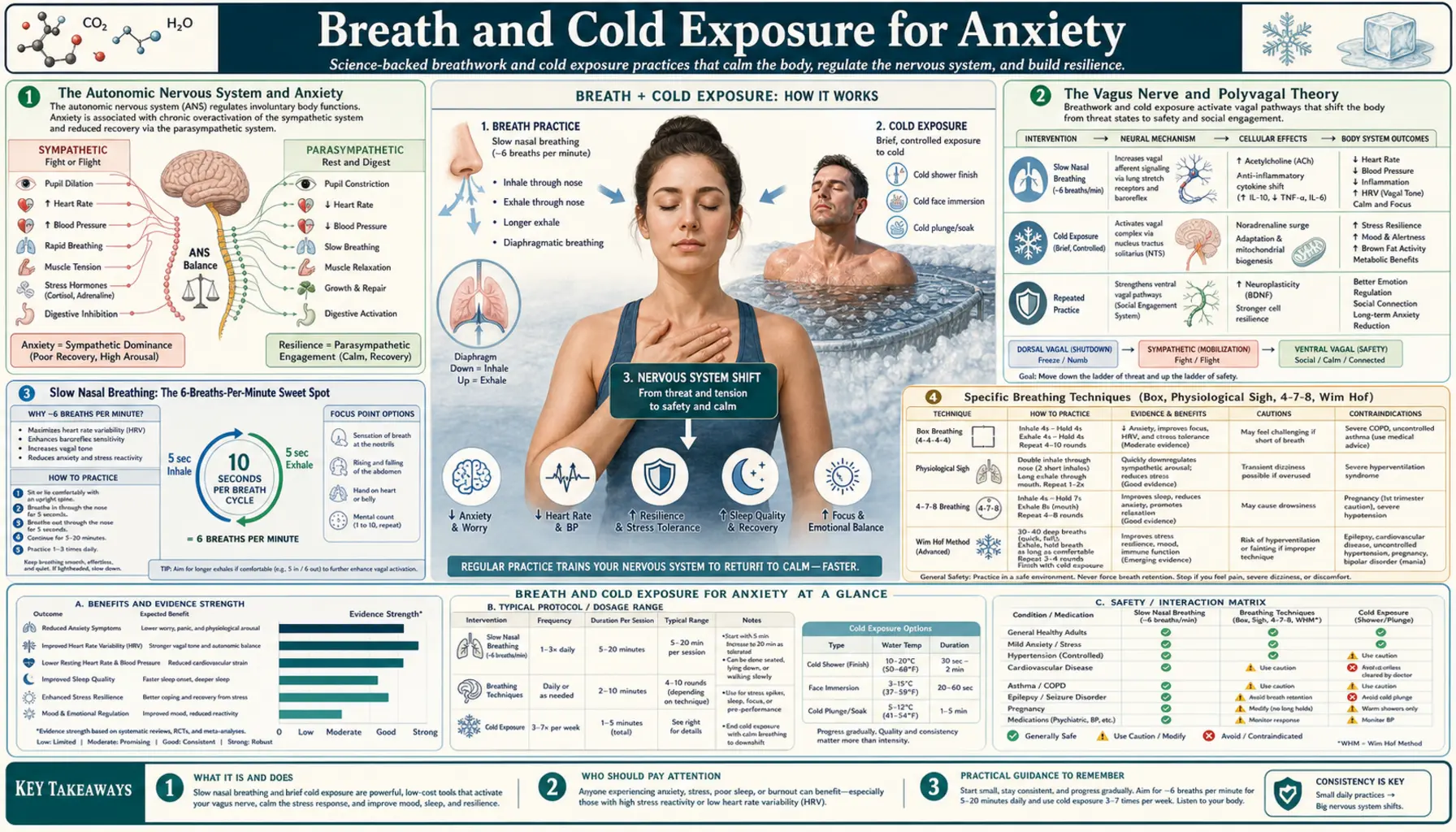
Breathing and cold exposure both act on the autonomic nervous system without a supplement or a drug. In healthy people, slow breathing (under 10 breaths per minute) is associated with higher heart rate variability, more EEG alpha power and fewer self-reported symptoms of arousal and anxiety (Zaccaro 2018), and heart rate variability biofeedback has people breathe at a resonance of approximately 0.1 Hz, about six breaths a minute (Lehrer 2000). A 2023 meta-analysis of randomized trials found breathwork associated with small-to-medium reductions in self-reported stress, anxiety and depressive symptoms, while its authors urged caution about hype (Fincham 2023). In young men immersed head-out for one hour in 14°C water, plasma noradrenaline (norepinephrine) rose by 530% and dopamine by 250% (Šrámek 2000); that study measured levels during the immersion, not how long they stayed raised afterwards. Cold water also carries documented hazards — the cold shock response, strain on the heart and drowning — and hyperventilation before breath-holding in water is a recognized cause of drowning. This page reports what the studies found, the practices as the studies used them, and the documented hazards.
Table of Contents
- The Autonomic Nervous System and Anxiety
- The Vagus Nerve and Polyvagal Theory
- Slow Breathing Near Six Breaths per Minute
- Specific Breathing Techniques (Box, Physiological Sigh, 4-7-8, Wim Hof)
- Cold Exposure: Dive Reflex, Dopamine, and Norepinephrine
- Cold Exposures as Used in Studies (Shower, Immersion, Face)
- Combining Breath and Cold (Wim Hof Method)
- Clinical Evidence for Anxiety
- How Practice Schedules Were Structured in Studies
- Hazards and Who the Research Raises Concerns For
- Key Research Papers
- Connections
- Featured Videos
The Autonomic Nervous System and Anxiety
The autonomic nervous system has two branches that operate in dynamic balance:
- Sympathetic nervous system — the "fight or flight" branch. Releases norepinephrine at end organs. Increases heart rate, blood pressure, respiratory rate, pupil diameter, sweat production, blood glucose, and skeletal muscle perfusion. Diverts blood away from the gut and reproductive organs.
- Parasympathetic nervous system — the "rest and digest" branch. Acts primarily through the vagus nerve, releasing acetylcholine at end organs. Slows heart rate, lowers blood pressure, slows respiration, and promotes digestion, repair, and recovery.
Heart rate variability (HRV) — the beat-to-beat variation in heart rate — is widely used as an index of vagal (parasympathetic) influence on the heart. A 2014 meta-analysis of 36 studies (2,086 patients, 2,294 controls) found lower resting HRV in anxiety disorders than in healthy controls, a small-to-moderate effect; panic disorder, PTSD, generalized anxiety disorder and social anxiety disorder showed reduced high-frequency HRV, obsessive-compulsive disorder did not (Chalmers 2014). Critics point out that HRV measures such as respiratory sinus arrhythmia are approximate indices of vagal activity, not the same thing as "vagal tone" (Grossman 2023).
Breathing and cold are studied as ways to shift this balance without a drug. Breathing changes heart rate on every cycle — heart rate rises on the in-breath and falls on the out-breath (respiratory sinus arrhythmia) — and slow breathing enlarges these oscillations (Russo 2017; Lehrer 2000). Cold water on the face triggers the diving reflex, a fall in heart rate (Caspers 2011), while whole-body cold immersion raises noradrenaline, heart rate and blood pressure (Šrámek 2000).
The Vagus Nerve and Polyvagal Theory
The vagus nerve is cranial nerve X, the longest cranial nerve. Its name comes from the Latin vagus, "wandering": it runs from the brainstem through the neck and chest into the abdomen. It is the main component of the parasympathetic nervous system and sends information about the state of the inner organs to the brain through afferent (sensory) fibres (Breit 2018). Tracing studies show vagal afferent fibres supplying the esophagus, lower airways, heart, aorta, the entire gastrointestinal tract, liver, portal vein, biliary system and pancreas, but not the spleen (Berthoud 2000).
Stephen Porges's polyvagal theory (introduced in the mid-1990s and restated in Porges 2007) proposes two vagal systems with different evolutionary origins:
- The ventral vagal complex — in the theory, the newer, myelinated branch arising in the nucleus ambiguus, which Porges links to social engagement, vocal prosody, facial expression and a "calm and connected" state.
- The dorsal vagal complex — in the theory, the older, unmyelinated branch arising in the dorsal motor nucleus, which Porges links to defensive immobilization — the "freeze" or "shutdown" response.
Within this framework, practitioners describe slow, exhale-focused breathing as a way to favour the ventral, "calm and engaged" state. That is an interpretation built on the theory: the studies cited on this page measured heart rate variability, respiratory rate and self-reported mood, not ventral versus dorsal vagal activity.
The theory is contested. A 2023 critique in Biological Psychology argued that each of its five basic premises has been shown to be either untenable or highly implausible on the available scientific literature, and that treating respiratory sinus arrhythmia as equivalent to vagal tone is a category mistake (Grossman 2023). The measured effects of slow breathing on heart rate variability and mood described below do not depend on the polyvagal framework.
Slow Breathing Near Six Breaths per Minute
Normal resting respiratory rate in adults is about 12–20 breaths per minute. Research on "slow breathing" usually means fewer than 10 breaths per minute. A systematic review of 15 studies in healthy people (Zaccaro 2018) and a review of slow-breathing physiology (Russo 2017) report these effects:
- Heart rate variability increases, with larger respiratory sinus arrhythmia (Zaccaro 2018; Russo 2017)
- Baroreflex and chemoreflex sensitivity change — the feedback loops that steady blood pressure and respond to blood gases (Russo 2017)
- EEG alpha power increases and theta power decreases (Zaccaro 2018)
- Self-reported comfort, relaxation, vigour and alertness increase, and symptoms of arousal, anxiety, depression, anger and confusion decrease (Zaccaro 2018)
The reason six breaths a minute keeps appearing comes from heart rate variability biofeedback. Lehrer and colleagues report that biofeedback training to increase respiratory sinus arrhythmia maximally increases heart rate oscillations only at approximately 0.1 Hz; breathing at this rate produces resonance between breathing-driven heart rate oscillations and oscillations that occur naturally at this rate, probably triggered partly by baroreflex activity, and the authors hypothesize that this exercises the baroreflexes (Lehrer 2000). The exact resonant frequency differs between people — in one study it was lower in men than in women and in taller people — and it stayed constant across 10 biofeedback sessions (Vaschillo 2006). A later review names strengthening of baroreflex homeostasis as the best-supported mechanism of HRV biofeedback (Lehrer 2014).
Slow-breathing studies and HRV biofeedback describe the practice in broadly these terms:
- Sitting upright or lying down, at rest.
- Breathing slowly, often through the nose. Nasal breathing carries nitric oxide made in the paranasal sinuses into the lungs; in one small study, transcutaneous oxygen tension was 10% higher during nasal than mouth breathing in six of eight healthy subjects (Lundberg 1996).
- Pacing the breath at a set rate — about six breaths a minute, or each person's measured resonant frequency, in HRV biofeedback (Lehrer 2000; Vaschillo 2006).
- In some practices, making the exhale longer than the inhale; in the Balban 2023 trial the exhale-focused practice (cyclic sighing) showed the clearest mood benefit.
Not everyone finds breathing exercises comfortable. In the optional end-of-study questionnaire of the Balban 2023 trial, 90% of participants reported positive experiences during the exercises and 10% reported negative experiences related to them. The studies cited here did not test whether a practice learned at rest helps during an acute panic attack.
Specific Breathing Techniques (Box, Physiological Sigh, 4-7-8, Wim Hof)
- Box breathing (4-4-4-4) — inhale, hold, exhale and hold for equal counts; it is often described as taught in military training. It was one of the three breathing practices in the Balban 2023 trial, in which breathwork as a whole improved mood more than mindfulness meditation and the exhale-focused cyclic sighing showed the clearest effect.
- Physiological sigh / cyclic sighing — sighs are long, deep breaths that also occur spontaneously every few minutes to reinflate the alveoli, and sighing increases under hypoxia, stress and certain psychiatric conditions; the brain circuit that produces sighs was mapped in mice (Li 2016). As a practice, cyclic sighing uses a double inhale (a second inhale stacked on the first) followed by a prolonged exhale. In the Balban 2023 remote randomized trial of 108 adults, 5 minutes a day of cyclic sighing for one month produced greater improvement in mood and a larger fall in respiratory rate than mindfulness meditation. State anxiety fell after each session in both the breathwork groups and the mindfulness group.
- 4-7-8 breathing — popularized by physician Andrew Weil: inhale for 4 counts, hold for 7, exhale for 8. It is widely described as a sleep aid; none of the studies cited on this page tested it.
- Wim Hof breathing — named for the Dutch cold-exposure athlete: cycles of hyperventilation, each followed by a breath hold after exhaling. In the Kox 2014 trial, practicing it (with cold exposure and meditation) produced intermittent respiratory alkalosis and low blood oxygen and sharply raised plasma epinephrine. The hyperventilation produces light-headedness, tingling and breathlessness on breath-holding that overlap with panic symptoms. Its hazards in water are described below.
- Sudarshan Kriya Yoga (SKY) — a multi-phase yogic technique combining slow, medium and fast rhythmic breathing. Brown and Gerbarg's 2005 review concluded there was sufficient evidence to consider it a beneficial, low-risk, low-cost adjunct to the treatment of stress, anxiety, PTSD and depression, while noting that more clinical studies are needed; the authors describe training by a skilled teacher and a 30-minute daily practice.
- Alternate nostril breathing (Nadi Shodhana) — a pranayama technique from yoga in which one nostril is closed at a time, alternating sides from breath to breath. None of the studies cited on this page tested it separately.
Across techniques, the Fincham 2023 meta-analysis found breathwork associated with lower self-reported stress than non-breathwork controls (12 trials, Hedges' g = −0.35), with similar effects on self-reported anxiety (20 trials, g = −0.32) and depressive symptoms (18 trials, g = −0.40). The authors concluded that breathwork may be effective for improving stress and mental health, urged caution, and called for study designs with a low risk of bias.
Cold Exposure: Dive Reflex, Dopamine, and Norepinephrine
Deliberate cold exposure — cold showers, face immersion and whole-body immersion — acts on the nervous system in at least two different ways. The most-cited catecholamine study, Šrámek 2000 (European Journal of Applied Physiology), examined young men during 1-hour head-out immersions in water at 32°C, 20°C and 14°C. At 14°C:
- Plasma noradrenaline (norepinephrine) rose by 530%
- Plasma dopamine rose by 250%
- Plasma adrenaline did not change; metabolic rate rose by 350%, and heart rate and systolic and diastolic blood pressure rose by 5%, 7% and 8%
- Cortisol tended to decrease; immersion at none of the three temperatures raised cortisol
The authors concluded that the responses induced by cold are mainly due to increased activity of the sympathetic nervous system. The study measured hormones during the immersion; its abstract does not report how long the rises lasted afterwards, and the study did not measure mood or anxiety. Popular accounts often describe the dopamine rise as lasting for hours; the studies cited on this page do not report a duration. In a 2023 imaging study, participants after a 5-minute head-out whole-body cold-water immersion reported feeling more active, alert, attentive, proud and inspired, and less distressed and nervous (Yankouskaya 2023).
The diving reflex works differently: water on the face, especially with breath-holding, slows the heart through a parasympathetic response. A meta-analysis of human diving bradycardia found that breath-holding with the face immersed lowered heart rate with a time constant of 10.4 seconds, faster and more pronounced than breath-holding in air alone (Caspers 2011). The authors described the diving reflex as useful for testing the integrity of the efferent cardiovascular autonomic pathways.
Cold Exposures as Used in Studies (Shower, Immersion, Face)
| Exposure | Temperature | Duration | Study |
|---|---|---|---|
| Cold shower finish (after a hot shower) | Cold tap water (temperature not stated in the abstract) | 30, 60 or 90 seconds daily for 30 days | Buijze 2016 — randomized trial, 3,018 adults |
| Head-out immersion | 14°C, 20°C or 32°C | 1 hour | Šrámek 2000 — young men |
| Head-out whole-body immersion | Cold water | 5 minutes | Yankouskaya 2023 — fMRI study |
| Face immersion with breath-hold | Water on the face (conditions varied between studies) | Seconds (heart-rate fall time constant 10.4 s) | Caspers 2011 — meta-analysis of diving bradycardia |
| Open-water swimming | Outdoor cold water | Weekly | van Tulleken 2018 — single case report |
In the Buijze 2016 trial, adults aged 18–65 with no routine experience of cold showering ended a hot shower with cold water for 30 consecutive days, followed by 60 days of cold showering at their own discretion. 79% of participants in the cold-shower groups completed the 30-day protocol. The cold-shower groups reported 29% less sickness absence from work than controls (incidence rate ratio 0.71), with no difference in illness days and no related serious adverse events. Anxiety was one of the trial's secondary outcomes; its abstract does not report a result for it.
Face immersion — briefly putting the face in cold water while holding the breath to trigger the diving reflex — is described in dialectical behavior therapy (DBT) skills training as part of its "TIP" (Temperature, Intense exercise, Paced breathing) distress-tolerance skills. None of the trials cited on this page tested it against panic attacks.
Neuroscientist Andrew Huberman has popularized a figure of about 11 minutes of deliberate cold exposure per week, spread over several sessions. None of the trials cited on this page tested a weekly dose; their exposures are the ones in the table above.
Combining Breath and Cold (Wim Hof Method)
Wim Hof, a Dutch cold-exposure athlete, describes a method with three pillars: a breathing technique, gradual cold exposure, and commitment (mindset). In the 2014 PNAS trial by Kox and colleagues at Radboud University Medical Center, 24 healthy volunteers were randomized to 10 days of training in meditation, breathing techniques (including cyclic hyperventilation followed by breath retention) and cold exposure (including immersion in ice-cold water), or to no training (12 per group). All then received intravenous E. coli endotoxin. In the trained group, the techniques produced intermittent respiratory alkalosis and hypoxia and profoundly increased plasma epinephrine; anti-inflammatory IL-10 rose more rapidly and was higher, the pro-inflammatory mediators TNF-α, IL-6 and IL-8 were lower, and flu-like symptoms were lower. The authors set the result against the view that the autonomic nervous system and the innate immune system cannot be voluntarily influenced. The trial measured a single short-term challenge in healthy volunteers; it did not measure anxiety.
The breathing as described in the trials:
- Cycles of hyperventilation, each followed by a breath hold (retention) after exhaling (Kox 2014).
- The trial abstracts cited here give no exact breath counts or hold times; the 30–40 breaths per round and three to four rounds often quoted come from the method's own instructions, not from a trial.
In the method as Hof describes it, the breathing is combined with cold exposure. A 2022 follow-up by the same research group found that both breathing variants raised plasma epinephrine regardless of training length or trainer; in a second trial of 48 men given endotoxin, the breathing exercise lowered the inflammatory response, cold exposure training alone did not relevantly change it, and cold training enhanced the breathing exercise's effect (Zwaag 2022).
The research raises particular concerns for people with anxiety. The hyperventilation phase produces light-headedness, tingling and breathlessness during breath-holds that overlap with panic symptoms, and people with panic disorder were not studied in these trials. Hyperventilation followed by breath-holding underwater is linked to fatal and nonfatal drownings among healthy swimmers (Boyd 2015), and reduced alertness at peak hyperventilation is why the breathing is described as dangerous while driving.
Clinical Evidence for Anxiety
Published reviews and trials on breath and cold for anxiety and mood include:
- Zaccaro 2018 (Frontiers in Human Neuroscience) — systematic review of slow breathing (under 10 breaths per minute) in healthy subjects; 15 studies met the criteria out of 2,461 abstracts. It reported increased HRV and respiratory sinus arrhythmia, increased EEG alpha and decreased theta power, and reduced symptoms of arousal, anxiety, depression, anger and confusion.
- Fincham 2023 (Scientific Reports) — meta-analysis of randomized controlled trials: breathwork was associated with lower self-reported stress than controls (12 trials, g = −0.35), anxiety (20 trials, g = −0.32) and depressive symptoms (18 trials, g = −0.40); the trials were at moderate risk of bias.
- Balban 2023 (Cell Reports Medicine) — remote randomized controlled trial at Stanford of 108 adults comparing 5 minutes a day of cyclic sighing, box breathing or cyclic hyperventilation with retention against mindfulness meditation for one month. Breathwork, especially the exhale-focused cyclic sighing, produced greater improvement in mood and greater reduction in respiratory rate than mindfulness meditation. State anxiety fell after each session in both the breathwork and the mindfulness groups.
- Lehrer / Gevirtz 2014 (Frontiers in Psychology) — review of the possible mechanisms of HRV biofeedback, a treatment studied in conditions as varied as asthma and depression; the best-supported mechanism is strengthening of baroreflex homeostasis, with effects on vagal afferent pathways to frontal cortical areas also proposed.
- Brown and Gerbarg 2005 (Journal of Alternative and Complementary Medicine) — review of clinical studies of Sudarshan Kriya Yoga; concluded there was sufficient evidence to consider it a beneficial, low-risk, low-cost adjunct for stress, anxiety, PTSD and depression, and that more clinical studies are needed.
- Buijze 2016 (PLoS ONE) — randomized controlled trial of 3,018 adults assigned to end a daily hot shower with 30, 60 or 90 seconds of cold water for 30 days, or to a control group. 29% less self-reported sickness absence in the cold-shower groups (incidence rate ratio 0.71), no difference in illness days.
- Kox 2014 (PNAS) — 10 days of training in breathing, cold exposure and meditation (12 trained vs 12 untrained healthy volunteers) produced raised epinephrine, higher IL-10, lower TNF-α, IL-6 and IL-8 and fewer flu-like symptoms after endotoxin. Anxiety was not an outcome.
- van Tulleken 2018 (BMJ Case Reports) — case report of a 24-year-old woman with major depressive disorder and anxiety whose symptoms had not responded to fluoxetine and then citalopram. A programme of weekly open (cold) water swimming was followed by an immediate improvement in mood after each swim, a gradual reduction in depressive symptoms, and a reduction and then cessation of medication; a year later she remained medication-free. A single case cannot show cause and effect.
- Yankouskaya 2023 (Biology) — functional MRI study after a 5-minute head-out whole-body cold-water immersion. Participants reported more positive affect (feeling more active, alert, attentive, proud and inspired) and less distress and nervousness; the rise in positive affect was linked to increased interaction between large-scale brain networks, including the medial prefrontal node of the default mode network and parts of the frontoparietal and salience networks.
Taken together, the broadest evidence here is for breathwork's small-to-medium effects on self-reported stress, anxiety and depressive symptoms (Fincham 2023), with the meta-analysis authors cautioning against over-reading it. The evidence on cold exposure and anxiety is thinner: one large trial whose main outcome was sickness absence, small physiological and imaging studies, and a single case report.
How Practice Schedules Were Structured in Studies
The studies cited on this page used these schedules:
- Balban 2023 — 5 minutes a day of one breathing practice, or of mindfulness meditation, for one month, done remotely.
- Buijze 2016 — 30, 60 or 90 seconds of cold water at the end of a daily hot shower for 30 days, then 60 days of cold showering at participants' own discretion.
- Brown and Gerbarg 2005 — Sudarshan Kriya Yoga learned from a skilled teacher, with a 30-minute daily practice.
- HRV biofeedback — paced breathing at each person's resonant frequency, near 0.1 Hz, over a course of training sessions (Lehrer 2000; Vaschillo 2006).
- Kox 2014 — 10 days of training in breathing, cold exposure and meditation.
- van Tulleken 2018 — weekly open-water swimming (a single case).
The studies did not compare schedules with one another, and none tested a combined daily routine of slow breathing, cold showers and other techniques.
Hazards and Who the Research Raises Concerns For
Cold exposure:
- Heart disease — head-out immersion at 14°C raised heart rate and blood pressure (Šrámek 2000); the cold shock response increases cardiac arrhythmias (Barwood 2024); and reviews treat cold-water immersion as a precursor to drowning, cardiac arrest and hypothermia (Tipton 2017). These findings matter most for people with high blood pressure, coronary disease, a recent heart attack, arrhythmias or heart failure. Face immersion also changes heart rhythm, through the diving reflex's slowing of the heart (Caspers 2011).
- Raynaud's phenomenon — cold can trigger painful vasospasm of the fingers and toes.
- Pregnancy — the studies cited here did not include pregnant women; there is no good safety data on deliberate cold immersion in pregnancy.
- Cold urticaria — cold exposure provokes wheals or swelling, and a subset of patients have cold-induced anaphylaxis, a potentially life-threatening reaction most commonly triggered by full-body cold exposure such as swimming (Bizjak 2025).
- Cold shock and drowning — sudden immersion in cold water triggers the cold shock response: hyperventilation, a rise in heart rate and increased cardiac arrhythmias. The response is life-threatening and raises drowning risk by impairing safety behaviour. It habituates with repeated immersion, after about four immersions, with variation between studies (Barwood 2024).
- Hypothermia — the Tipton 2017 review ("Cold water immersion: kill or cure?") examines cold-water immersion as a precursor to drowning, cardiac arrest and hypothermia, and concludes that the evidence for its claimed benefits varies, with some claims resting on anecdotal speculation.
Breathwork:
- Breath-holding in or under water — hyperventilation before breath-holding underwater is linked to fatal and nonfatal drownings among healthy, capable swimmers; a New York State review identified 16 cases and found that combining more than one such behaviour increased the risk of death (Boyd 2015). After hyperventilation, consciousness can be lost without warning (hypoxic blackout).
- Driving and machinery — light-headedness and reduced alertness at peak hyperventilation are why breath-hold and hyperventilation techniques are described as dangerous while driving or operating machinery.
- Pregnancy — the trials cited here did not include pregnant women; there is no safety data on breath-retention practices in pregnancy.
- Epilepsy or seizure history — voluntary hyperventilation is used as a standard EEG provocation test because it can trigger seizure activity in susceptible people.
- Severe COPD or asthma — people with severe lung disease were not included in the breath-hold trials cited here. HRV biofeedback with slow paced breathing has been studied in asthma (Vaschillo 2006; Lehrer 2014).
- Panic disorder — hyperventilation produces light-headedness, tingling and breathlessness that overlap with panic symptoms, and some people with panic disorder are highly sensitive to breathing sensations. In the Balban 2023 trial, 10% of participants reported negative experiences related to the exercises.
- Heart disease — the epinephrine surge of hyperventilation breathing (Kox 2014) and long breath holds add stress on the heart; the trials cited here enrolled healthy volunteers.
Most of the studies cited here enrolled healthy adults, and their safety data come from short, often supervised trials. Decisions about breathwork or cold exposure, especially with heart disease, belong with a clinician.
Key Research Papers
- Zaccaro A, Piarulli A, Laurino M et al. (2018). How breath-control can change your life: a systematic review on psycho-physiological correlates of slow breathing. Frontiers in Human Neuroscience — PubMed PMID: 30245619
- Balban MY, Neri E, Kogon MM et al. (2023). Brief structured respiration practices enhance mood and reduce physiological arousal. Cell Reports Medicine — PubMed PMID: 36630953
- Lehrer PM, Gevirtz R (2014). Heart rate variability biofeedback: how and why does it work? Frontiers in Psychology — PubMed PMID: 25101026
- Russo MA, Santarelli DM, O'Rourke D (2017). The physiological effects of slow breathing in the healthy human. Breathe — PubMed PMID: 29209423
- Kox M, van Eijk LT, Zwaag J et al. (2014). Voluntary activation of the sympathetic nervous system and attenuation of the innate immune response in humans. PNAS — PubMed PMID: 24799686
- Buijze GA, Sierevelt IN, van der Heijden BC et al. (2016). The effect of cold showering on health and work: a randomized controlled trial. PLoS ONE — PubMed PMID: 27631616
- Srámek P, Simecková M, Janský L et al. (2000). Human physiological responses to immersion into water of different temperatures. European Journal of Applied Physiology — PubMed PMID: 10751106
- Brown RP, Gerbarg PL (2005). Sudarshan Kriya yogic breathing in the treatment of stress, anxiety, and depression: part II. Clinical applications and guidelines. Journal of Alternative and Complementary Medicine — PubMed PMID: 16131297
- Porges SW (2007). The polyvagal perspective. Biological Psychology — PubMed PMID: 17049418
- Tipton MJ, Collier N, Massey H et al. (2017). Cold water immersion: kill or cure? Experimental Physiology — PubMed PMID: 28833689
- van Tulleken C, Tipton M, Massey H, Harper CM (2018). Open water swimming as a treatment for major depressive disorder. BMJ Case Reports — PubMed PMID: 30131418
- Bordoni B, Purgol S, Bizzarri A et al. (2018). The influence of breathing on the central nervous system. Cureus — PubMed PMID: 30083485
- Yankouskaya A, Williamson R, Stacey C et al. (2023). Short-term head-out whole-body cold-water immersion facilitates positive affect and increases interaction between large-scale brain networks. Biology — PubMed PMID: 36829490
- Fincham GW, Strauss C, Montero-Marin J, Cavanagh K (2023). Effect of breathwork on stress and mental health: a meta-analysis of randomised-controlled trials. Scientific Reports — PubMed PMID: 36624160
- Lehrer PM, Vaschillo E, Vaschillo B (2000). Resonant frequency biofeedback training to increase cardiac variability: rationale and manual for training. Applied Psychophysiology and Biofeedback — PubMed PMID: 10999236
- Vaschillo EG, Vaschillo B, Lehrer PM (2006). Characteristics of resonance in heart rate variability stimulated by biofeedback. Applied Psychophysiology and Biofeedback — PubMed PMID: 16838124
- Chalmers JA, Quintana DS, Abbott MJ, Kemp AH (2014). Anxiety disorders are associated with reduced heart rate variability: a meta-analysis. Frontiers in Psychiatry — PubMed PMID: 25071612
- Grossman P (2023). Fundamental challenges and likely refutations of the five basic premises of the polyvagal theory. Biological Psychology — PubMed PMID: 37230290
- Breit S, Kupferberg A, Rogler G, Hasler G (2018). Vagus nerve as modulator of the brain-gut axis in psychiatric and inflammatory disorders. Frontiers in Psychiatry — PubMed PMID: 29593576
- Berthoud HR, Neuhuber WL (2000). Functional and chemical anatomy of the afferent vagal system. Autonomic Neuroscience — PubMed PMID: 11189015
- Li P, Janczewski WA, Yackle K, Kam K, Pagliardini S, Krasnow MA, Feldman JL (2016). The peptidergic control circuit for sighing. Nature — PubMed PMID: 26855425
- Lundberg JO, Settergren G, Gelinder S, Lundberg JM, Alving K, Weitzberg E (1996). Inhalation of nasally derived nitric oxide modulates pulmonary function in humans. Acta Physiologica Scandinavica — PubMed PMID: 8971255
- Caspers C, Cleveland S, Schipke JD (2011). Diving reflex: can the time course of heart rate reduction be quantified? Scandinavian Journal of Medicine & Science in Sports — PubMed PMID: 21083770
- Zwaag J, Naaktgeboren R, van Herwaarden AE, Pickkers P, Kox M (2022). The effects of cold exposure training and a breathing exercise on the inflammatory response in humans: a pilot study. Psychosomatic Medicine — PubMed PMID: 35213875
- Barwood MJ, Eglin C, Hills SP et al. (2024). Habituation of the cold shock response: a systematic review and meta-analysis. Journal of Thermal Biology — PubMed PMID: 38211547
- Boyd C, Levy A, McProud T, Huang L, Raneses E, Olson C (2015). Fatal and nonfatal drowning outcomes related to dangerous underwater breath-holding behaviors — New York State, 1988–2011. MMWR Morbidity and Mortality Weekly Report — PubMed PMID: 25996093
- Bizjak M (2025). Cold urticaria: from wheals to anaphylaxis. Allergy, Asthma & Immunology Research — PubMed PMID: 41044831