Adaptogenic Herbs for Anxiety
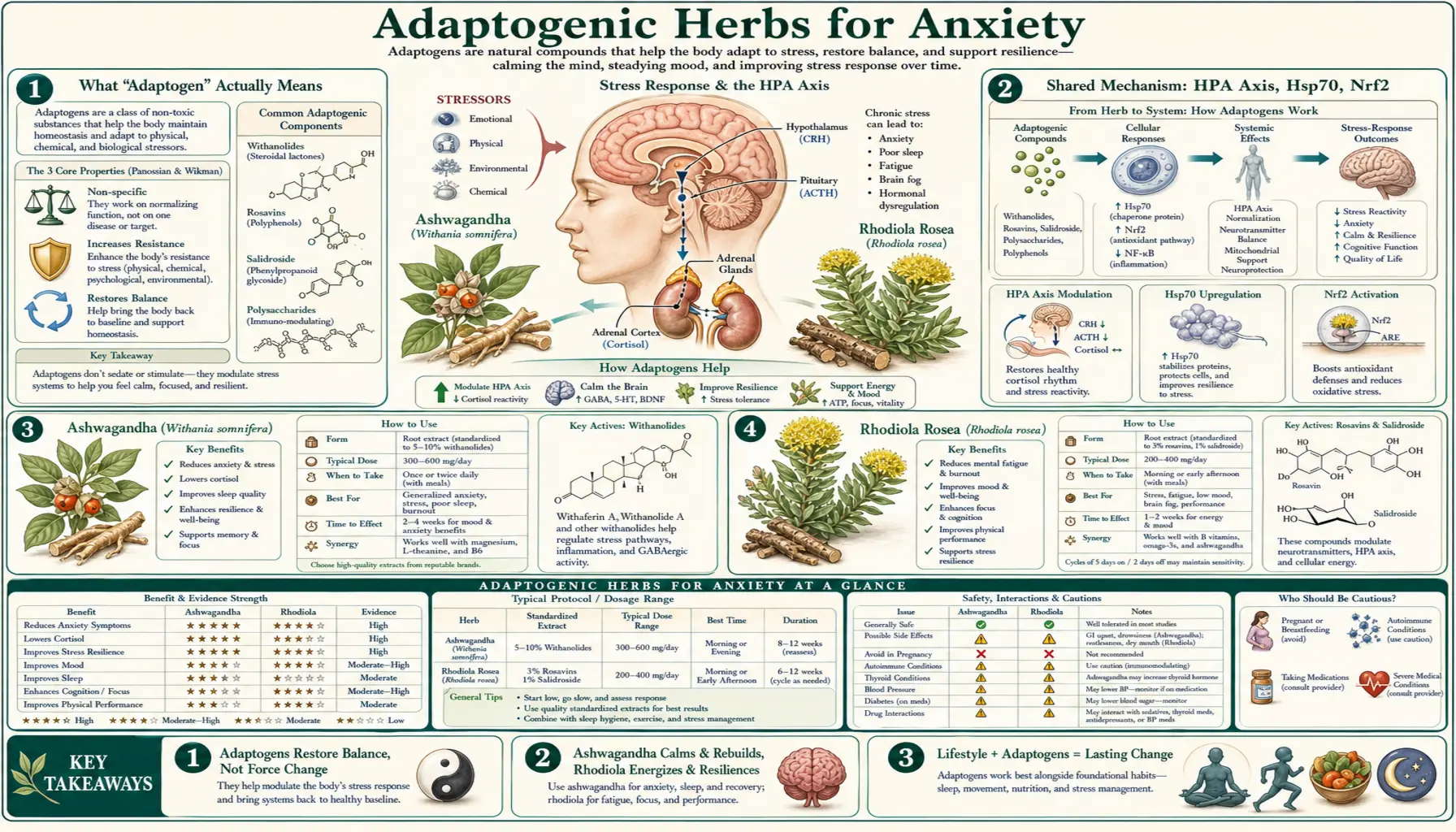
"Adaptogen" is a term from Soviet pharmacology: according to a 2021 review, the toxicologist Nikolai Lazarev introduced it in 1958, and Israel Brekhman and I. V. Dardymov set out its defining criteria in 1969 — that an adaptogen produces a "state of nonspecifically increased resistance" to stress, disturbs normal body functions minimally, and may have a normalizing action whichever direction a disturbance runs (Panossian 2021). The European Medicines Agency's herbal committee concluded in 2008 that the principle of an adaptogenic action needs further clarification, and that the term is not accepted in the pharmacological and clinical terminology commonly used in the EU. This page summarizes what human trials report for four herbs often discussed for stress and anxiety — ashwagandha, rhodiola, holy basil and lemon balm (the last usually classed as a calming herb rather than an adaptogen) — together with the safety findings. Decisions about supplements belong with a clinician.
Table of Contents
- What "Adaptogen" Means
- Proposed Mechanisms: What Lab and Human Studies Show
- Ashwagandha (Withania somnifera)
- Rhodiola Rosea
- Holy Basil (Tulsi, Ocimum sanctum)
- Lemon Balm (Melissa officinalis)
- Other Herbs Called Adaptogens
- How the Evidence Compares
- Combinations: What Has Been Studied
- Safety Findings and Drug Interactions
- Key Research Papers
- Connections
- Featured Videos
What "Adaptogen" Means
A 2021 review by Panossian and colleagues traces the concept to Soviet research. Lazarev first applied the term in 1958 to a synthetic stimulant, dibazol, building on wartime Soviet studies of Schisandra chinensis; Brekhman and Dardymov's 1969 review then defined adaptogens as substances that cause a "state of nonspecifically increased resistance" of the organism (Panossian 2021; Brekhman 1969). The same review reports that adaptogens were used by Soviet cosmonauts during long missions on the Mir space station and by sailors, pilots and athletes, that adaptogenic plants entered the official medicine and pharmacopoeia of the USSR, and it names Eleutherococcus senticosus (Siberian ginseng), Schisandra, Panax ginseng and Rhodiola rosea as the plants whose extracts have most commonly been studied (Panossian 2021).
The 1969 definition, as quoted in that review, has three parts:
- Innocuousness — the substance causes minimal disorder in the body's physiological functions.
- Nonspecific action — it increases resistance to adverse influences of a wide range of physical, chemical and biological factors.
- Normalizing action — it may act to normalize function whichever direction the preceding disturbance has taken.
The review also quotes the European Medicines Agency's Committee on Herbal Medicinal Products, whose 2008 reflection paper on the adaptogenic concept stated that the principle needs further clarification in preclinical and clinical studies, that the term is not accepted in the pharmacological and clinical terminology commonly used in the EU, and that the clinical data have shortcomings, including poor descriptions of inclusion criteria, medication, diagnosis and study design, and very small numbers of patients in some studies (Panossian 2021).
Proposed Mechanisms: What Lab and Human Studies Show
A 2010 review states that studies in animals and isolated nerve cells have found neuroprotective, anti-fatigue, antidepressive, anxiolytic, nootropic and stimulating effects of adaptogens, and that a number of clinical trials show an anti-fatigue effect that increases mental work capacity against a background of stress and fatigue. It links their stress-protective activity to the hypothalamic-pituitary-adrenal (HPA) axis and to mediators of the stress response, including the chaperone protein HSP70, the kinase JNK1, the FOXO transcription factor DAF-16, cortisol and nitric oxide (Panossian 2010). Both authors listed as their affiliation the research and development department of the company that makes the standardized rhodiola extract used in the Olsson 2009 and Mao 2015 trials below (Panossian 2010; Mao 2015).
- Cortisol and the HPA axis in people — a 2024 meta-analysis of ashwagandha trials found lower serum cortisol than with placebo (mean difference −2.58) (Arumugam 2024). The authors of a 2019 ashwagandha trial suggested that its effects may occur through the HPA axis, based on greater falls in morning cortisol and DHEA-S than with placebo (Lopresti 2019). In a rhodiola trial in stress-related fatigue, the cortisol response to awakening changed differently in the extract and placebo groups (Olsson 2009).
- Ashwagandha: GABA and serotonin pathways — a 2021 review of animal and human studies proposed that ashwagandha acts mainly through the HPA and sympathetic-adrenal-medullary axes and through GABAergic and serotonergic pathways, and noted evidence for active compounds beyond the withanolides that are not yet identified (Speers 2021).
- Rhodiola: monoamine oxidase — in laboratory tests, methanol and water extracts of rhodiola root inhibited the enzymes monoamine oxidase A and B (van Diermen 2009).
- Lemon balm: GABA breakdown — the makers of one standardized lemon balm extract reported that it contains compounds that inhibit the breakdown of GABA, and had earlier reported a moderate improvement in stress in mice given the extract (Cases 2011).
A mechanism shown in cells or animals does not establish an effect in people; the human trial results for each herb follow below.
Ashwagandha (Withania somnifera)
Ashwagandha (Withania somnifera, nightshade family, Solanaceae) is used in Ayurveda and other traditional medicine systems, and a 2021 review notes that its worldwide use has increased because of its reputation as an adaptogen (Speers 2021).
Active compounds and preparations: the steroidal lactones called withanolides, among them withaferin A and withanolide A, are the most studied constituents, and extracts are usually standardized by withanolide content. The trials below used different preparations:
- a root-only extract standardized to at least 5% withanolides (Chandrasekhar 2012), and a root extract from the same manufacturer (Salve 2019);
- an ethanol-water extract standardized to not less than 35% withanolide glycosides (Lopresti 2019);
- a root preparation standardized to 1.5% withanolides (Cooley 2009).
A 2021 review concluded that the variability of the extracts studied prevents a consensus on the optimum preparation or dose (Speers 2021).
Clinical evidence for stress and anxiety:
- Arumugam 2024 (Explore) — a systematic review and meta-analysis of nine randomized controlled trials (558 patients) found that ashwagandha preparations lowered Perceived Stress Scale scores (mean difference −4.72), Hamilton Anxiety Scale scores (−2.19) and serum cortisol (−2.58) compared with placebo; four of the included studies reported mild to moderate adverse events, and the authors stated that more information is needed on safety with long-term use. An earlier 2014 systematic review found five human trials, all reporting greater improvement than the comparison group on anxiety or stress scales, but all at unclear or high risk of bias (Pratte 2014). The WFSBP/CANMAT taskforce rated ashwagandha as modestly supported (++) for anxiety disorders (Sarris 2022).
- Chandrasekhar 2012 (Indian Journal of Psychological Medicine) — 64 adults with a history of chronic stress took one 300 mg capsule of a root extract or placebo twice a day for 60 days. Perceived Stress Scale scores fell by 44.0% on the extract and 5.5% on placebo, and serum cortisol fell by 27.9% and 7.9%, respectively; adverse effects were mild and comparable in both groups. The extract was provided by its manufacturer.
- Lopresti 2019 (Medicine, Baltimore) — 60 stressed, healthy adults took 240 mg a day of the 35% withanolide-glycoside extract or placebo for 60 days. The extract group had a significantly greater fall in Hamilton Anxiety Rating Scale scores (P = .040), a near-significant fall on the DASS-21 (P = .096), and greater falls in morning cortisol and DHEA-S. The study was funded by the extract's manufacturer.
- Salve 2019 (Cureus) — 60 stressed healthy adults (Perceived Stress Scale score above 20) took 125 mg or 300 mg of a root extract twice a day (250 or 600 mg a day) or placebo for eight weeks. Perceived stress and serum cortisol fell at both doses compared with placebo, and sleep quality improved. The extract was manufactured and supplied free of charge by its maker.
- Cooley 2009 (PLoS ONE) — in a 12-week trial in employees with moderate to severe anxiety, a naturopathic package (dietary counseling, deep-breathing relaxation techniques, a standard multivitamin and ashwagandha 300 mg twice daily) was compared with psychotherapy plus matched breathing techniques and placebo. Beck Anxiety Inventory scores fell by 56.5% in the naturopathic group and 30.5% in the psychotherapy group, a significant difference in favor of the naturopathic package. Because several elements were combined, the trial does not isolate the herb's effect; the authors called for study of the individual components.
Doses in trials: the doses and durations differ by trial, as listed above, and the 2021 review found no consensus on dose (Speers 2021). "Cycling" ashwagandha (periods on and off the herb), which some practitioners describe, was not tested in any trial cited here.
Safety findings for ashwagandha: liver injury has been reported. A case series from Iceland and the US Drug-Induced Liver Injury Network described five people who developed jaundice 2 to 12 weeks after starting ashwagandha-containing supplements; the injury was cholestatic or mixed, no patient developed liver failure, and liver tests normalized within 1 to 5 months in four of them (Björnsson 2020). According to a regulatory review, a risk assessment carried out for the Danish food authority by the Technical University of Denmark's Food Institute (published in 2020) cited the herb's traditional use as an abortifacient, its potential effects on sex and thyroid hormone levels, on acetylcholinesterase and on the immune system, and five cases of liver damage; on that basis Denmark banned ashwagandha in food supplements in 2023. Poland limited the permitted daily intake and the Netherlands proposed a ban (Brendler 2026).
Rhodiola Rosea
Rhodiola rosea (golden root, arctic root) is a flowering plant of cold and mountainous regions whose root is used in traditional medicine. A 2008 pilot study notes that many people in Russia and elsewhere have used it for decades to relieve everyday anxiety, depression and insomnia (Bystritsky 2008), and rhodiola root is among the adaptogenic plants in the official medicine of the USSR and the State Pharmacopoeia of the Russian Federation (Panossian 2021).
Active compounds: rhodiola root extracts are standardized to rosavins and salidroside; the extract used in a 2015 trial was standardized to rosavin 3.07% and rhodioloside (salidroside) 1.95% (Mao 2015).
Clinical evidence:
- Bystritsky 2008 (Journal of Alternative and Complementary Medicine) — an open-label pilot study without a control group: 10 adults with generalized anxiety disorder (DSM-IV) took 340 mg of rhodiola extract a day for 10 weeks. Hamilton Anxiety Rating Scale scores fell significantly; adverse events were generally mild or moderate, most commonly dizziness and dry mouth. The authors called the findings preliminary.
- Cropley 2015 (Phytotherapy Research) — 80 mildly anxious adults were randomized to a rhodiola extract (200 mg before breakfast and 200 mg before lunch) or no treatment for 14 days. Self-reported anxiety, stress, anger, confusion and depression fell significantly compared with controls, with no difference in cognitive performance. There was no placebo, and the authors stated that a causal relationship could not be determined.
- Olsson 2009 (Planta Medica) — in a randomized, double-blind trial in 60 people with stress-related fatigue, 576 mg a day of a standardized root extract for 28 days improved a burnout scale and several attention measures more than placebo and changed the cortisol response to awakening; many measures also improved in the placebo group. This trial measured fatigue and burnout rather than anxiety.
- Mao 2015 (Phytomedicine) — 57 adults with mild to moderate major depressive disorder were randomized to 12 weeks of a standardized rhodiola extract, sertraline or placebo. The groups did not differ significantly; Hamilton depression scores fell by 8.2 points with sertraline, 5.1 with rhodiola and 4.6 with placebo, and adverse events were reported by 63.2% on sertraline, 30.0% on rhodiola and 16.7% on placebo. The authors concluded that rhodiola was less effective than sertraline but better tolerated.
The WFSBP/CANMAT taskforce did not support rhodiola for mood disorders (Sarris 2022).
Safety findings for rhodiola: a 2022 case report describes mania associated with rhodiola (Whig 2022). In one of the five ashwagandha liver-injury cases, rhodiola was considered a possible cause along with ashwagandha (Björnsson 2020). The laboratory monoamine-oxidase inhibition described above has not been tested for drug interactions in the studies cited here, and these studies give no safety data for pregnancy or breastfeeding.
Holy Basil (Tulsi, Ocimum sanctum)
Holy basil, called tulsi in Sanskrit, is native to the Indian subcontinent and highly revered for its medicinal uses in the Ayurvedic and Siddha medical systems (Jamshidi 2017). It is a different plant from culinary basil (Ocimum basilicum); holy basil is Ocimum sanctum, also called Ocimum tenuiflorum.
Active compounds: a 2014 review attributes the anti-inflammatory action of tulsi seen in animal models to its eugenol and linoleic acid content (Cohen 2014).
Clinical evidence:
- Saxena 2012 (Evidence-Based Complementary and Alternative Medicine) — 158 adults with stress-related symptoms were enrolled in a double-blind trial and 150 were analyzed (71 on a holy basil extract, 1,200 mg of actives a day, and 79 on placebo) over six weeks. Total stress-symptom scores, and the scores for forgetfulness, sexual problems, exhaustion and sleep problems, fell significantly more on the extract; the authors reported an overall improvement 1.6 times, or 39%, greater than with placebo, and no adverse events. Three of the eight authors, including the corresponding author, were from the research and development centre of the extract's manufacturer.
- Bhattacharyya 2008 (Nepal Medical College Journal) — 35 people with generalized anxiety disorder took 500 mg of holy basil leaf extract twice daily after meals for 60 days. Anxiety, and related stress and depression, fell significantly from baseline; the abstract reports no placebo or comparison group.
- Jamshidi 2017 (Evidence-Based Complementary and Alternative Medicine) — a systematic review identified 24 human studies reporting effects on metabolic disorders, cardiovascular disease, immunity and neurocognition; all reported favorable outcomes and none reported significant adverse events, and the authors called for further studies to clarify dosage, dose form and the populations most likely to benefit.
- Cohen 2014 (Journal of Ayurveda and Integrative Medicine) — a narrative review describing tulsi's reported effects on physical, chemical, metabolic and psychological stress, including anxiolytic and antidepressant properties. The author disclosed that he consults for a company that makes tulsi products.
Safety findings for holy basil: the 2017 review found no significant adverse events in the human studies (Jamshidi 2017). Because those studies report effects on blood glucose in metabolic disorders, combined use with glucose-lowering medicines is a question that none of the studies cited here tested. In male mice, a leaf extract given at 0.5 g per kg of body weight for 15 days lowered serum thyroxine (T4) (Panda 1998); this has not been shown in people. The studies cited here give no safety data for pregnancy.
Lemon Balm (Melissa officinalis)
Lemon balm is a perennial herb of the mint family with a lemony aroma, native to southern Europe and the Mediterranean region, with a long history of use in European herbal medicine. It is used as a mild sedative or calming agent (Kennedy 2004).
Lemon balm is usually classed as a nervine (a calming herb that acts on the nervous system) rather than an adaptogen; it is included here because it is often discussed and combined with adaptogens for anxiety.
Active compounds: rosmarinic acid is the main phenolic acid; one standardized leaf extract used in a trial contained more than 7% rosmarinic acid and more than 15% hydroxycinnamic acid derivatives (Cases 2011).
Clinical evidence:
- Kennedy 2004 (Psychosomatic Medicine) — in a double-blind, placebo-controlled crossover study, 18 healthy volunteers took single doses of 300 mg and 600 mg of a standardized lemon balm extract and placebo on separate days, then completed a laboratory stress battery (the Defined Intensity Stressor Simulation). The 600 mg dose reduced the negative mood effects of the stressor, with higher self-rated calmness and lower self-rated alertness; the 300 mg dose increased the speed of mathematical processing without loss of accuracy. The authors concluded that the effect on stress deserves further investigation.
- Cases 2011 (Mediterranean Journal of Nutrition and Metabolism) — an open-label, 15-day study without a placebo in 20 stressed volunteers with mild to moderate anxiety disorders and sleep disturbances, who took 300 mg of a leaf extract twice a day. On clinician rating scales, anxiety manifestations fell by 18%, anxiety-associated symptoms by 15% and insomnia by 42%, and 14 of the 20 achieved full remission for anxiety. Four of the five authors worked for the extract's manufacturer, which also gave financial assistance; the authors stated that further studies need a placebo.
- Akhondzadeh 2003 (Journal of Neurology, Neurosurgery and Psychiatry) — 42 people aged 65 to 80 with mild to moderate Alzheimer's disease were randomized to lemon balm extract (60 drops a day) or placebo for four months. Cognitive scores (ADAS-cog and CDR) were significantly better with lemon balm, and agitation was more common in the placebo group.
Safety findings for lemon balm: in laboratory experiments with human thyroid membranes, freeze-dried lemon balm extracts inhibited the binding of thyroid-stimulating hormone (Auf'mkolk 1984); whether this matters at the doses people take has not been studied in the trials cited here. Interactions with sedative medicines and alcohol were not studied in these trials.
Other Herbs Called Adaptogens
- Eleuthero (Eleutherococcus senticosus, formerly "Siberian ginseng") — one of the most commonly studied adaptogens in Soviet research; the European Medicines Agency's herbal committee found in 2008 that the clinical studies of Eleutherococcus preparations had methodological shortcomings (Panossian 2021).
- Schisandra (Schisandra chinensis) — the Chinese "five-flavor berry"; its stimulating and tonic effects were studied in the Soviet Union during World War II (Panossian 2021).
- Panax ginseng — listed among the adaptogenic plants in the Russian pharmacopoeia (Panossian 2021); a 2001 review of herbal medicines in perioperative care listed bleeding and low blood sugar among ginseng's possible effects (Ang-Lee 2001).
- American ginseng (Panax quinquefolius), cordyceps, reishi (Ganoderma lucidum) and Bacopa monnieri — also marketed as adaptogens; their research is covered on their own pages, and anxiety trials for them are not reviewed here.
- Mucuna pruriens — velvet bean, a natural source of L-DOPA, the precursor of dopamine.
How the Evidence Compares
The table summarizes the human studies and safety findings described above. It reports what the studies found; it is not a guide to choosing a product.
| Herb | Main Human Evidence Described Here | Safety Findings Described Here |
|---|---|---|
| Ashwagandha | Meta-analysis of nine placebo-controlled trials (558 patients): lower stress, anxiety and cortisol scores than placebo; rated modestly supported (++) for anxiety disorders by the WFSBP/CANMAT taskforce | Five-case liver-injury series; banned in food supplements in Denmark in 2023; long-term safety not established |
| Rhodiola | Open-label pilot in 10 people with generalized anxiety disorder; no-treatment-controlled trial in 80 mildly anxious adults; placebo-controlled trial in 60 people with stress-related fatigue; not supported for mood disorders by the WFSBP/CANMAT taskforce | Case report of mania; possible co-cause in one liver-injury case |
| Holy basil | Placebo-controlled stress-symptom trial (150 analyzed); uncontrolled study in 35 people with generalized anxiety disorder; 2017 review of 24 human studies | No significant adverse events in the 2017 review; lowered T4 in a mouse study |
| Lemon balm | Single-dose laboratory-stress crossover study in 18 volunteers; 15-day open-label study in 20 people; four-month Alzheimer's trial in 42 people | Extracts inhibited thyroid-stimulating hormone binding in laboratory experiments |
Combinations: What Has Been Studied
Combination products and "stacks" of adaptogens are widely marketed, but few combinations have been tested. Among the trials cited on this page, the only combination tested was the naturopathic package in Cooley 2009, in which ashwagandha was given together with dietary counseling, deep-breathing techniques and a multivitamin; its design does not show which component produced the effect (Cooley 2009).
The research on magnesium glycinate and on L-theanine is summarized on their own pages; no trial of either combined with an adaptogen is cited here.
The WFSBP/CANMAT taskforce stated that nutrient-based and herbal products are primarily recommended, where supportive evidence exists, as add-on treatments within standard medical care, especially in more severe mental illness (Sarris 2022). No trial cited here tested adaptogens together with SSRIs or other antidepressants, and a 2021 review of ashwagandha stated that potential herb-drug interactions will need investigation if it is used alongside pharmaceutical treatments (Speers 2021).
Safety Findings and Drug Interactions
- Pregnancy and breastfeeding — the Danish risk assessment cited ashwagandha's traditional use as an abortifacient (Brendler 2026). None of the trials cited here studied pregnant or breastfeeding women.
- Thyroid — the Danish risk assessment cited ashwagandha's potential effects on thyroid hormone levels (Brendler 2026); a holy basil leaf extract lowered T4 in mice (Panda 1998); lemon balm extracts inhibited thyroid-stimulating hormone binding in laboratory experiments (Auf'mkolk 1984).
- Bipolar disorder — mania associated with rhodiola has been described in a case report (Whig 2022).
- Immune system — the Danish risk assessment cited potential effects of ashwagandha on the immune system (Brendler 2026).
- Liver — five cases of cholestatic or mixed liver injury with jaundice after ashwagandha-containing supplements, with rhodiola a possible co-cause in one (Björnsson 2020).
- Surgery — a 2001 JAMA review of herbal medicines in perioperative care covered ginseng (possible bleeding and low blood sugar) and found that kava and valerian may potentiate the sedative effect of anesthetics; it did not cover ashwagandha, rhodiola, holy basil or lemon balm (Ang-Lee 2001).
- Children — the trials described on this page enrolled adults.
- Antidepressants and sedatives — no trial cited here tested interactions with SSRIs, SNRIs, benzodiazepines, sleep medicines or alcohol; rhodiola's monoamine-oxidase inhibition has been shown only in laboratory tests (van Diermen 2009).
- Blood sugar — the human studies of holy basil report effects on blood glucose in metabolic disorders (Jamshidi 2017); combined use with diabetes medicines was not studied in the trials cited here.
- Contamination — in a 2008 study of 193 Ayurvedic medicines bought online, 20.7% contained detectable lead, mercury or arsenic, with similar rates in US-made (21.7%) and Indian-made (19.5%) products; 75% of the metal-containing products claimed Good Manufacturing Practices, and all of them exceeded at least one standard for acceptable daily intake of toxic metals (Saper 2008).
Key Research Papers
- Chandrasekhar K, Kapoor J, Anishetty S (2012). A prospective, randomized double-blind, placebo-controlled study of safety and efficacy of a high-concentration full-spectrum extract of ashwagandha root in reducing stress and anxiety in adults. Indian Journal of Psychological Medicine — PubMed PMID: 23439798
- Lopresti AL, Smith SJ, Malvi H, Kodgule R (2019). An investigation into the stress-relieving and pharmacological actions of an ashwagandha (Withania somnifera) extract: A randomized, double-blind, placebo-controlled study. Medicine (Baltimore) — PubMed PMID: 31517876
- Salve J, Pate S, Debnath K, Langade D (2019). Adaptogenic and anxiolytic effects of ashwagandha root extract in healthy adults: a double-blind, randomized, placebo-controlled clinical study. Cureus — PubMed PMID: 32021735
- Panossian A, Wikman G (2010). Effects of adaptogens on the central nervous system and the molecular mechanisms associated with their stress-protective activity. Pharmaceuticals (Basel) — PubMed PMID: 27713248
- Cropley M, Banks AP, Boyle J (2015). The effects of Rhodiola rosea L. extract on anxiety, stress, cognition and other mood symptoms. Phytotherapy Research — PubMed PMID: 26502953
- Bystritsky A, Kerwin L, Feusner JD (2008). A pilot study of Rhodiola rosea (Rhodax) for generalized anxiety disorder. Journal of Alternative and Complementary Medicine — PubMed PMID: 18307390
- Olsson EM, von Schéele B, Panossian AG (2009). A randomised, double-blind, placebo-controlled, parallel-group study of the standardised extract SHR-5 of the roots of Rhodiola rosea in the treatment of subjects with stress-related fatigue. Planta Medica — PubMed PMID: 19016404
- Saxena RC, Singh R, Kumar P et al. (2012). Efficacy of an Extract of Ocimum tenuiflorum (OciBest) in the Management of General Stress. Evidence-Based Complementary and Alternative Medicine — PubMed PMID: 21977056
- Cohen MM (2014). Tulsi - Ocimum sanctum: A herb for all reasons. Journal of Ayurveda and Integrative Medicine — PubMed PMID: 25624701
- Kennedy DO, Little W, Scholey AB (2004). Attenuation of laboratory-induced stress in humans after acute administration of Melissa officinalis (lemon balm). Psychosomatic Medicine — PubMed PMID: 15272110
- Cases J, Ibarra A, Feuillere N et al. (2011). Pilot trial of Melissa officinalis L. leaf extract in the treatment of volunteers suffering from mild-to-moderate anxiety disorders and sleep disturbances. Mediterranean Journal of Nutrition and Metabolism — PubMed PMID: 22207903
- Speers AB, Cabey KA, Soumyanath A, Wright KM (2021). Effects of Withania somnifera (ashwagandha) on stress and the stress-related neuropsychiatric disorders. Current Neuropharmacology — PubMed PMID: 34254920
- Arumugam V, Vijayakumar V, Balakrishnan A et al. (2024). Effects of Ashwagandha (Withania Somnifera) on stress and anxiety: A systematic review and meta-analysis. Explore (New York) — PubMed PMID: 39348746
- Pratte MA, Nanavati KB, Young V, Morley CP (2014). An alternative treatment for anxiety: a systematic review of human trial results reported for the Ayurvedic herb ashwagandha (Withania somnifera). Journal of Alternative and Complementary Medicine — PubMed PMID: 25405876
- Sarris J, Ravindran A, Yatham LN et al. (2022). Clinician guidelines for the treatment of psychiatric disorders with nutraceuticals and phytoceuticals: The World Federation of Societies of Biological Psychiatry (WFSBP) and Canadian Network for Mood and Anxiety Treatments (CANMAT) Taskforce. World Journal of Biological Psychiatry — PubMed PMID: 35311615
- Björnsson HK, Björnsson ES, Avula B et al. (2020). Ashwagandha-induced liver injury: A case series from Iceland and the US Drug-Induced Liver Injury Network. Liver International — PubMed PMID: 31991029
- Brendler T, Al-Mondhiry R, Lang L et al. (2026). Ashwagandha: Is It Safe? Part 1: A Regulatory Review. Phytotherapy Research — PubMed PMID: 41420287
- Cooley K, Szczurko O, Perri D et al. (2009). Naturopathic care for anxiety: a randomized controlled trial ISRCTN78958974. PLoS ONE — PubMed PMID: 19718255
- Mao JJ, Xie SX, Zee J et al. (2015). Rhodiola rosea versus sertraline for major depressive disorder: A randomized placebo-controlled trial. Phytomedicine — PubMed PMID: 25837277
- Jamshidi N, Cohen MM (2017). The Clinical Efficacy and Safety of Tulsi in Humans: A Systematic Review of the Literature. Evidence-Based Complementary and Alternative Medicine — PubMed PMID: 28400848
- Bhattacharyya D, Sur TK, Jana U, Debnath PK (2008). Controlled programmed trial of Ocimum sanctum leaf on generalized anxiety disorders. Nepal Medical College Journal — PubMed PMID: 19253862
- Akhondzadeh S, Noroozian M, Mohammadi M et al. (2003). Melissa officinalis extract in the treatment of patients with mild to moderate Alzheimer's disease: a double blind, randomised, placebo controlled trial. Journal of Neurology, Neurosurgery, and Psychiatry — PubMed PMID: 12810768
- Panossian AG, Efferth T, Shikov AN et al. (2021). Evolution of the adaptogenic concept from traditional use to medical systems: Pharmacology of stress- and aging-related diseases. Medicinal Research Reviews — PubMed PMID: 33103257
- Brekhman II, Dardymov IV (1969). New substances of plant origin which increase nonspecific resistance. Annual Review of Pharmacology — PubMed PMID: 4892434
- Whig R, Leo RJ (2022). Mania Associated With Rhodiola Rosea: An Adaptogen With Antidepressant Effects. Primary Care Companion for CNS Disorders — PubMed PMID: 35303403
- van Diermen D, Marston A, Bravo J et al. (2009). Monoamine oxidase inhibition by Rhodiola rosea L. roots. Journal of Ethnopharmacology — PubMed PMID: 19168123
- Panda S, Kar A (1998). Ocimum sanctum leaf extract in the regulation of thyroid function in the male mouse. Pharmacological Research — PubMed PMID: 9721597
- Auf'mkolk M, Ingbar JC, Amir SM et al. (1984). Inhibition by certain plant extracts of the binding and adenylate cyclase stimulatory effect of bovine thyrotropin in human thyroid membranes. Endocrinology — PubMed PMID: 6745167
- Saper RB, Phillips RS, Sehgal A et al. (2008). Lead, mercury, and arsenic in US- and Indian-manufactured Ayurvedic medicines sold via the Internet. JAMA — PubMed PMID: 18728265
- Ang-Lee MK, Moss J, Yuan CS (2001). Herbal medicines and perioperative care. JAMA — PubMed PMID: 11448284