D-Serine: The Brain's NMDA Receptor Co-Agonist
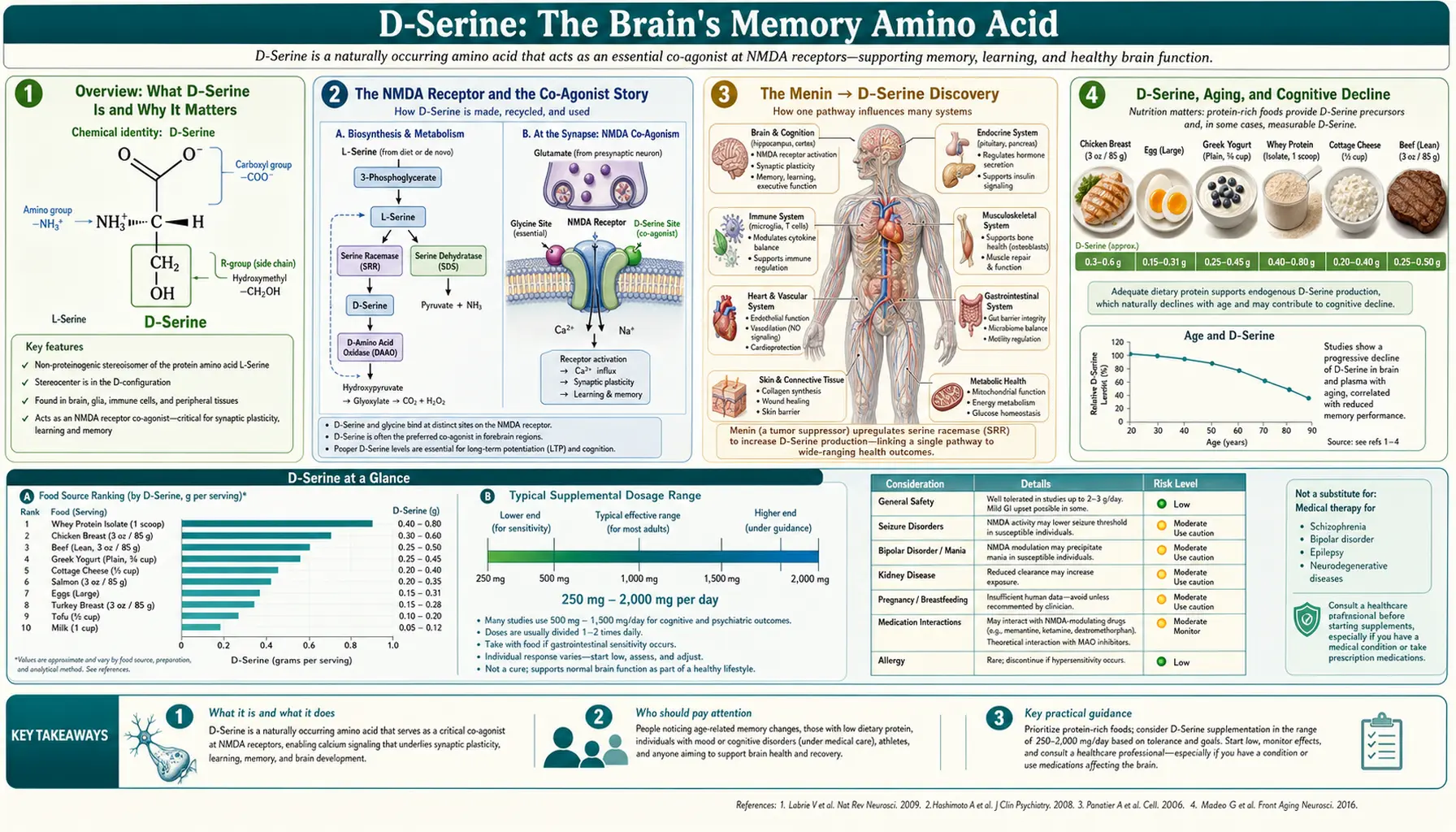
Table of Contents
- Overview: What D-Serine Is and Why It Matters
- The NMDA Receptor and the Co-Agonist Story
- The 2023 Menin Mouse Study
- D-Serine, Aging, and Cognitive Decline
- D-Serine in Schizophrenia and Psychiatric Research
- Doses Used in Research and Bioavailability
- Safety and the Kidney Question
- Dietary Sources and Body Synthesis
- Future Research Directions
- Key Research Papers
- Connections
- Featured Videos
Overview: What D-Serine Is and Why It Matters
D-Serine is the mirror-image form of the common amino acid serine. Most amino acids come in two shapes — like a left hand and a right hand — called L- and D-forms. The discovery of large amounts of D-serine in the brain challenged the long-held view that only L-amino acids matter in animals and humans; a 2012 review by Wolosker and Mori reports that brain D-serine levels are higher than those of many L-amino acids and reach as much as one-third of L-serine levels.
D-Serine acts at the NMDA receptor, a glutamate receptor involved in brain development, synaptic plasticity and learning (Wolosker, 2006). In a 2000 study, Mothet and colleagues showed that removing D-serine with an enzyme greatly reduced NMDA receptor signalling in brain cells, and that adding D-serine back reversed this. They concluded that D-serine is a natural ligand of the receptor's "glycine site" and fully occupies that site at some synapses.
D-Serine has been described as a gliotransmitter — a signalling molecule released by astrocytes, the support cells that wrap around synapses. Wolosker's 2006 review notes that D-serine is enriched in astrocytes and that astrocytes release it, but also that D-serine and the enzyme that makes it are present in substantial amounts in neurons, so its signalling does not depend on glia alone. A 2019 mouse study (Neame and colleagues) went further and suggested that neurons are the main source of newly made D-serine, using L-serine supplied by astrocytes.
Research on D-serine spans normal brain aging (mostly in rats and mice), Alzheimer's disease, schizophrenia, and a 2023 mouse study that linked a protein called menin in the hypothalamus to D-serine supply. Among the papers cited here, the only human trial outside psychiatry is a randomized crossover study of a single dose in healthy older adults (Avellar and colleagues, 2016).
The NMDA Receptor and the Co-Agonist Story
Unlike most neurotransmitter receptors, which are activated by a single transmitter, the NMDA receptor needs glutamate plus a second molecule, a co-agonist — D-serine or glycine — bound to its glycine site (Wolosker, 2006). Mothet and colleagues (2000) noted that the brain distribution of D-serine and of its making enzyme matches the distribution of NMDA receptors more closely than glycine does, and that D-serine is a more potent agonist at the site than glycine.
Which co-agonist is used depends on where the receptor sits. A 2012 study by Papouin and colleagues reported that NMDA receptors inside synapses are gated by D-serine, while those outside synapses (extrasynaptic receptors) are gated by glycine. In the same study, long-term potentiation (LTP, a cellular model of memory) relied on the synaptic receptors only, while long-term depression required both synaptic and extrasynaptic receptors.
The enzyme that makes D-serine is serine racemase. Wolosker and colleagues purified it from rat brain in 1999 and reported that it converts L-serine directly into D-serine, requires pyridoxal 5'-phosphate for its activity, and is highly selective for L-serine. A second enzyme, D-amino acid oxidase (DAAO), breaks D-serine down; Mothet and colleagues used it in their 2000 study to remove D-serine from brain tissue.
Mice bred without serine racemase, and therefore unable to make their own D-serine, had profoundly altered glutamate signalling and relatively subtle but significant behavioural changes: hyperactivity, impaired spatial memory, and signs consistent with raised anxiety (Basu and colleagues, 2009). D-Serine and serine racemase are also found outside the brain proper: a 2003 study detected both in the retinas of salamanders, rats and mice, located in Müller cells and astrocytes, where D-serine enhanced NMDA receptor responses of retinal ganglion cells (Stevens and colleagues, 2003).
Genetic studies link this system to schizophrenia. A 2010 review by Kantrowitz and Javitt describes reported gene variants in NMDA receptor subunits and in the enzymes that regulate brain D-serine synthesis, including serine racemase and DAAO/G72. A 2018 meta-analysis of case-control studies found associations between certain DAO and DAOA (G72) gene variants and schizophrenia (Jagannath and colleagues, 2018).
The 2023 Menin Mouse Study
In March 2023, a team at Xiamen University in China (Leng and colleagues) published a mouse study in PLOS Biology that links a protein called menin to D-serine. Menin signalling in the hypothalamus fell in aged mice. Restoring menin in the ventromedial hypothalamus of aged mice extended lifespan, improved learning and memory and improved aging markers, while blocking it in middle-aged mice produced premature aging and faster cognitive decline (DOI: 10.1371/journal.pbio.3002033).
The study's full text reports that menin binds the promoter of the Phgdh gene, which encodes PHGDH, the first rate-limiting enzyme of serine synthesis. When menin was deleted, PHGDH and D-serine fell; when menin was raised in old mice, hypothalamic D-serine rose. The study did not report that menin controls serine racemase itself. Giving D-serine in drinking water for 3 weeks (about 100 mg/kg body weight) raised D-serine in the blood, hypothalamus and hippocampus and reduced the cognitive decline of menin-knockout mice and of 22-month-old mice. The authors noted that this rescue was limited to cognition: aging changes in the rest of the body were not reversed by D-serine. The paper's only human data were serum D-serine levels, lower in 5 people aged 83–94 than in 5 aged 22–26.
These are animal results, not a tested human therapy. The fuller story is on the Menin Protein page and in the dedicated History article.
D-Serine, Aging, and Cognitive Decline
In a 2006 rat study, Mothet and colleagues found that the hippocampal content of D-serine and the expression of serine racemase were significantly lower in old rats than in young ones, and that the impaired LTP of old rats' hippocampal slices was rescued by adding D-serine. The menin study described above reported a similar cognitive rescue with oral D-serine in old mice.
In people, a 2016 randomized, double-blind, placebo-controlled crossover study gave 50 healthy older adults a single oral dose of D-serine (30 mg/kg, in orange juice) and placebo on separate sessions (Avellar and colleagues). D-Serine improved performance on one test, the Groton Maze Learning test of spatial memory, learning and problem solving; people whose plasma D-serine rose more improved more. It produced no significant change on the other cognitive tests or on mood. The authors called for studies of long-term administration, and noted that the safety of higher doses in older adults was not assessed.
Alzheimer's disease points in a different direction. A 2015 study (Madeira and colleagues) found higher D-serine in post-mortem hippocampus and parietal cortex of 14 Alzheimer's patients than of 8 non-demented people, higher D-serine and serine racemase in animal models of the disease, and higher D-serine in the cerebrospinal fluid of 21 patients with probable Alzheimer's than in comparison groups (normal pressure hydrocephalus, major depression, healthy controls). The authors proposed cerebrospinal-fluid D-serine as a candidate biomarker for early diagnosis. Wolosker and Mori (2012) note that D-serine is needed both for normal NMDA receptor activity and for the receptor overactivation that occurs in neurodegenerative conditions.
A 2020 mouse study (Le Douce and colleagues) adds another angle: the astrocyte pathway that makes L-serine, the raw material for D-serine, was impaired in young Alzheimer's-model mice and in Alzheimer's patients, and the mice showed lower occupancy of the NMDA receptor co-agonist site with synaptic and behavioural deficits. L-serine added to the diet prevented those deficits in the mice.
Lower D-serine with normal aging in rats and higher D-serine in human Alzheimer's brain tissue are separate findings, and the studies cited here do not show how they fit together.
D-Serine in Schizophrenia and Psychiatric Research
Much of the human research on D-serine is in schizophrenia, where a 2021 review notes it remains under active study (Meftah and colleagues). The NMDA receptor model of the disease rests partly on drug effects: Kantrowitz and Javitt's 2010 review states that NMDA receptor antagonists produce a clinical syndrome that closely resembles schizophrenia and, uniquely, includes its negative and cognitive symptoms. The same review describes reported reductions of glycine, D-serine and glutathione in the plasma and brain of people with schizophrenia.
A 2016 meta-analysis of 20 studies (Cho and colleagues) found significantly lower serum D-serine in people with schizophrenia than in healthy controls, and found that D-serine added to antipsychotics improved negative and positive symptoms; the authors named heterogeneity between studies as a major limitation.
Individual trials have been mixed:
- Open-label dose escalation (Kantrowitz and colleagues, 2010): the abstract notes that earlier double-blind studies had used 30 mg/kg/day (approximately 2 g/day). In this 4-week open-label (unblinded) trial, 42 patients stable on antipsychotics added D-serine at 30, 60 or 120 mg/kg/day. Symptoms improved across doses (effect size d=0.74 for total PANSS score). On the MATRICS cognitive battery, improvement at 30 mg/kg was not significant, while doses of 60 mg/kg or more produced a large improvement in the composite score (d=1.0). Plasma D-serine rose with dose. The authors called for double-blind trials at 60 mg/kg/day or more.
- Multicentre randomized trial (Weiser and colleagues, 2012): 195 patients with persistent negative symptoms received D-serine 2 g/day or placebo for 16 weeks on top of antipsychotics. Both groups improved, with no significant difference between them on negative symptoms or cognition. D-Serine was well tolerated. The authors noted a large placebo response and lower achieved doses than in earlier studies.
Pooled evidence for this class of add-on treatments is broader. A 2021 meta-analysis of 40 double-blind, placebo-controlled trials with 4,937 patients (Goh and colleagues) found that NMDA receptor modulators added to antipsychotics improved symptoms, particularly negative symptoms, with glycine, D-serine and sarcosine showing better treatment profiles than the other agents; the benefit was seen only with antipsychotics other than clozapine.
Sarcosine (N-methylglycine) works by a different route: it inhibits the type 1 glycine transporter (GlyT1). A 2020 meta-analysis of 7 trials with 326 participants (Chang and colleagues) found an effect of sarcosine on overall clinical symptoms but no significant effect on overall cognitive function.
Doses Used in Research and Bioavailability
The doses below are those reported in the cited studies; they are listed as findings, not as guidance.
- Schizophrenia trials: 30 mg/kg/day (approximately 2 g/day) in earlier double-blind studies, and 30, 60 or 120 mg/kg/day in a 4-week open-label trial (Kantrowitz and colleagues, 2010); 2 g/day for 16 weeks in a multicentre randomized trial (Weiser and colleagues, 2012).
- Healthy older adults: one oral dose of 30 mg/kg (Avellar and colleagues, 2016).
- Mice: about 100 mg/kg body weight, given in drinking water, for 3 weeks (Leng and colleagues, 2023).
In the 2010 schizophrenia trial, plasma D-serine rose with dose, and higher plasma levels were associated with greater improvement in symptoms and neuropsychological function. A 2021 safety review (Meftah and colleagues) gives the peak plasma concentration after a single 120 mg/kg dose, the highest dose tested in humans, as about 500 nmol/mL.
Oral bioavailability is a recognised limitation. Avellar and colleagues wrote that D-serine's poor oral bioavailability can limit its effects on cognition and may account for the mixed results of clinical trials, and that larger doses should be evaluated, while noting that the safety of higher doses in older adults had not been assessed.
Safety and the Kidney Question
The main safety concern about D-serine comes from rats. A 2021 systematic review of D-serine safety across species (Meftah and colleagues) found that when doses above 500 mg/kg are given to rats, kidney damage in the form of acute tubular necrosis appears within hours and is highly common, if not universal. In other species, including mice and rabbits, D-serine kidney toxicity has not been reported. Even in rats the toxicity was dose dependent and reversible, and did not appear at doses producing a peak plasma level below 2,000 nmol/mL — compared with about 500 nmol/mL after 120 mg/kg in humans.
A 2007 rat study (Krug and colleagues) described the mechanism: D-serine selectively damages the S3 segment of the kidney's proximal tubules, where it is reabsorbed and reaches the enzyme DAAO. Breaking D-serine down there produces reactive oxygen species, and kidney glutathione fell to about 30% of control after a D-serine injection; co-injecting glutathione prevented the damage marker measured (excess amino acids in the urine).
In people, the 2021 review found that across all published human studies, only one participant had abnormal kidney values related to D-serine treatment; the abnormality did not clearly match the rat syndrome and fully resolved within a few days of stopping. The review found no other clinically significant safety concerns in the literature, reported that DAAO inhibitors may protect the kidney, and concluded that D-serine appears safe at the maximal doses studied so far when current FDA-guided monitoring is used. The review's abstract does not address older adults or people with reduced kidney function. In the 16-week multicentre trial, D-serine 2 g/day was well tolerated (Weiser and colleagues, 2012).
Dietary Sources and Body Synthesis
The body makes D-serine from L-serine through serine racemase (Wolosker and colleagues, 1999). That enzyme requires pyridoxal 5'-phosphate (PLP), which a 2025 review describes as the active form of vitamin B6 and a coenzyme in neurotransmitter synthesis (Falsaperla and colleagues). The papers cited here did not test whether vitamin B6 intake changes brain D-serine.
L-Serine, the raw material, is also made in the body from glucose. Astrocytes carry the enzyme 3-phosphoglycerate dehydrogenase (PHGDH) needed for this step (Neame and colleagues, 2019). In mouse hippocampus, blocking astrocyte PHGDH reduced the production of both L- and D-serine and weakened NMDA receptor signals and LTP, which supports a "serine shuttle" in which astrocytes pass L-serine to neurons to make D-serine. The menin mouse study (2023) describes the same pathway starting from the glycolysis product 3-phosphoglycerate, with PHGDH as the first rate-limiting step.
Glycine, the other NMDA receptor co-agonist, is linked to this system as well. Neame and colleagues reported that, in mice lacking serine racemase, synaptic NMDA receptor activation in adults depended on glycine made through the PHGDH pathway, and that glycine itself regulates D-serine metabolism in two ways (by inhibiting serine racemase inside cells and by triggering D-serine release through the Asc-1 transporter).
In the 2020 Alzheimer's-model mouse study (Le Douce and colleagues), L-serine added to the diet prevented synaptic and behavioural deficits. Human studies of dietary L-serine and brain D-serine are not among the papers cited here.
Future Research Directions
The cited papers name several open questions:
- Aging in people: Avellar and colleagues (2016) called for studies of long-term D-serine administration on cognition in older adults; their own study tested a single dose.
- The menin pathway: the 2023 menin findings come from one mouse study, and the paper's only human data were serum D-serine levels in 10 people.
- Schizophrenia doses: Kantrowitz and colleagues (2010) supported double-blind trials at 60 mg/kg/day or more; Weiser and colleagues (2012) wrote that future studies would use higher doses and other mechanisms, such as glycine reuptake inhibitors.
- Alzheimer's diagnosis: Madeira and colleagues (2015) proposed cerebrospinal-fluid D-serine as a candidate biomarker for early Alzheimer's disease, based on their cohort.
- Kidney safety: D-serine remains under study for schizophrenia directly and through DAAO inhibitors, which the 2021 safety review suggests may protect the kidney (Meftah and colleagues).
No trial of D-serine for mild cognitive impairment or age-related cognitive decline appears among the papers cited on this page.
Key Research Papers
- Leng L, Yuan Z, Su X, et al. "Hypothalamic Menin regulates systemic aging and cognitive decline." PLOS Biology. 2023;21(3):e3002033. — doi:10.1371/journal.pbio.3002033
- Mothet JP, Parent AT, Wolosker H, et al. "D-Serine is an endogenous ligand for the glycine site of the N-methyl-D-aspartate receptor." Proc Natl Acad Sci USA. 2000;97(9):4926-4931. — PubMed PMID: 10781100
- Wolosker H. "D-Serine regulation of NMDA receptor activity." Science's STKE. 2006;2006(356):pe41. — PubMed PMID: 17033043
- Kantrowitz JT, Malhotra AK, Cornblatt B, et al. "High dose D-Serine in the treatment of schizophrenia." Schizophrenia Research. 2010;121(1-3):125-130. — PubMed PMID: 20541910
- Madeira C, Lourenco MV, Vargas-Lopes C, et al. "D-Serine levels in Alzheimer's disease: implications for novel biomarker development." Translational Psychiatry. 2015;5(5):e561. — PubMed PMID: 25942042
- Basu AC, et al. "Targeted disruption of serine racemase affects glutamatergic neurotransmission and behavior." Molecular Psychiatry. 2009;14(7):719-727. — PubMed PMID: 19065142
- Stevens ER, Esguerra M, Kim PM, et al. "D-Serine and serine racemase are present in the vertebrate retina and contribute to the physiological activation of NMDA receptors." Proc Natl Acad Sci USA. 2003;100(11):6789-6794. — PubMed PMID: 12750462
- Wolosker H, Sheth KN, Takahashi M, et al. "Purification of serine racemase: biosynthesis of the neuromodulator D-serine." Proc Natl Acad Sci USA. 1999;96(2):721-725. — PubMed PMID: 9892700
- Wolosker H, Mori H. "Serine racemase: an unconventional enzyme for an unconventional transmitter." Amino Acids. 2012;43(5):1895-1904. — PubMed PMID: 22847782
- Papouin T, Ladépêche L, Ruel J, et al. "Synaptic and extrasynaptic NMDA receptors are gated by different endogenous coagonists." Cell. 2012;150(3):633-646. — PubMed PMID: 22863013
- Mothet JP, Rouaud E, Sinet PM, et al. "A critical role for the glial-derived neuromodulator D-serine in the age-related deficits of cellular mechanisms of learning and memory." Aging Cell. 2006;5(3):267-274. — PubMed PMID: 16842499
- Avellar M, Scoriels L, Madeira C, et al. "The effect of D-serine administration on cognition and mood in older adults." Oncotarget. 2016;7(11):11881-11888. — PubMed PMID: 26933803
- Le Douce J, Maugard M, Veran J, et al. "Impairment of glycolysis-derived L-serine production in astrocytes contributes to cognitive deficits in Alzheimer's disease." Cell Metabolism. 2020;31(3):503-517.e8. — PubMed PMID: 32130882
- Kantrowitz JT, Javitt DC. "N-methyl-D-aspartate (NMDA) receptor dysfunction or dysregulation: the final common pathway on the road to schizophrenia?" Brain Research Bulletin. 2010;83(3-4):108-121. — PubMed PMID: 20417696
- Cho SE, Na KS, Cho SJ, Kang SG. "Low D-serine levels in schizophrenia: a systematic review and meta-analysis." Neuroscience Letters. 2016;634:42-51. — PubMed PMID: 27717827
- Weiser M, Heresco-Levy U, Davidson M, et al. "A multicenter, add-on randomized controlled trial of low-dose D-serine for negative and cognitive symptoms of schizophrenia." Journal of Clinical Psychiatry. 2012;73(6):e728-e734. — PubMed PMID: 22795211
- Goh KK, Wu TH, Chen CH, Lu ML. "Efficacy of N-methyl-D-aspartate receptor modulator augmentation in schizophrenia: a meta-analysis of randomised, placebo-controlled trials." Journal of Psychopharmacology. 2021;35(3):236-252. — PubMed PMID: 33406959
- Chang CH, Lin CH, Liu CY, et al. "Efficacy and cognitive effect of sarcosine (N-methylglycine) in patients with schizophrenia: a systematic review and meta-analysis of double-blind randomised controlled trials." Journal of Psychopharmacology. 2020;34(5):495-505. — PubMed PMID: 32122256
- Jagannath V, Gerstenberg M, Correll CU, et al. "A systematic meta-analysis of the association of Neuregulin 1 (NRG1), D-amino acid oxidase (DAO), and DAO activator (DAOA)/G72 polymorphisms with schizophrenia." Journal of Neural Transmission. 2018;125(1):89-102. — PubMed PMID: 28864885
- Meftah A, Hasegawa H, Kantrowitz JT. "D-Serine: a cross species review of safety." Frontiers in Psychiatry. 2021;12:726365. — PubMed PMID: 34447324
- Krug AW, Völker K, Dantzler WH, Silbernagl S. "Why is D-serine nephrotoxic and alpha-aminoisobutyric acid protective?" American Journal of Physiology. Renal Physiology. 2007;293(1):F382-F390. — PubMed PMID: 17429029
- Neame S, Safory H, Radzishevsky I, et al. "The NMDA receptor activation by D-serine and glycine is controlled by an astrocytic Phgdh-dependent serine shuttle." Proc Natl Acad Sci USA. 2019;116(41):20736-20742. — PubMed PMID: 31548413
- Falsaperla R, Sortino V, Scalia B, et al. "Is vitamin B6 a precision therapy for neonatal seizures?" Neurology International. 2025;17(10):157. — PubMed PMID: 41149778
PubMed Topic Searches
Connections
- All Amino Acids
- Serine (L-Serine) — the dietary precursor to D-Serine
- Glycine — NMDA co-agonist and metabolic relative
- Neurology Disease Index
- Alzheimer's Disease
- Parkinson's Disease
- Psychiatry Disease Index
- Schizophrenia
- Longevity Protocols
- Menin Protein — upstream regulator of D-Serine
- Active B12 Test — B12 and neurological function
- Lab Tests Index
- Vitamin B6 — cofactor for serine racemase
- Magnesium — NMDA receptor modulator
- MCAS and neurological overlap
- May 28, 2026 News — Menin and D-Serine discovery