Alanine: History and Discovery
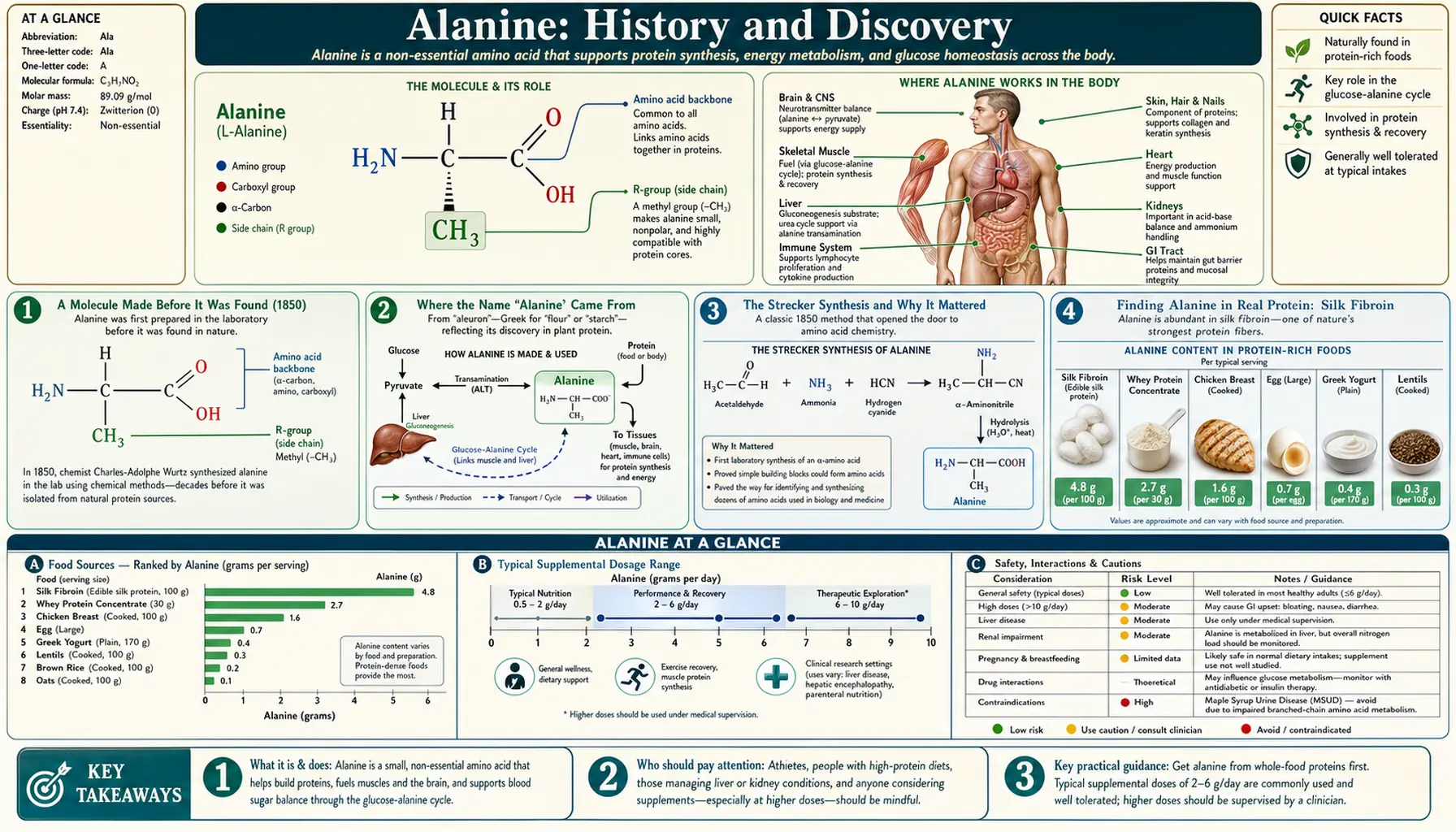
Alanine has one of the most unusual origin stories of any amino acid: it was built in a laboratory before anyone knew it was a piece of protein. In 1850, the German chemist Adolph Strecker, trying to make lactic acid, instead crystallised a new substance he chose to call alanine — making it one of the first amino acids ever produced by chemical synthesis. The plant and animal world had been quietly using alanine for as long as there has been life, but for nearly four decades after Strecker named it, no one had yet pulled it out of a natural protein. This article tells that story plainly: how alanine was first synthesised and named, the puzzle of where its name came from, when it was finally found in real protein (a date the sources do not fully agree on), and how it took its place in the larger nineteenth- and twentieth-century effort to understand what proteins are made of. Where the record is firm we say so; where it is uncertain or disputed, we say that too.
Table of Contents
- A Molecule Made Before It Was Found (1850)
- Where the Name "Alanine" Came From
- The Strecker Synthesis and Why It Mattered
- Finding Alanine in Real Protein: Silk Fibroin
- Alanine and the Birth of Protein Chemistry
- A Second Alanine: Beta-Alanine and Carnosine
- From Curiosity to Cornerstone Metabolite
- Research Papers and References
- Connections
- Featured Videos
A Molecule Made Before It Was Found (1850)
Most amino acids were first discovered by taking a natural material apart — boiling gelatin, cheese, or asparagus juice until a new crystalline substance fell out. Asparagine, the very first amino acid ever isolated, was pulled from asparagus in 1806; glycine was teased out of gelatin in 1820. Alanine's story runs the other way around. It was first made from scratch in a laboratory, and only later recognised inside living protein.
The chemist responsible was Adolph Strecker (1822–1871), a German organic chemist. In 1850 he was studying lactic acid and the related chemistry of aldehydes when a reaction he ran — combining an aldehyde (acetaldehyde), ammonia, and hydrogen cyanide — produced, after he treated it with acid, an unexpected crystalline solid. It was not the product he had been chasing. On analysis it proved to be a new compound that we now know as alanine (in modern terms, the simplest amino acid after glycine: 2-aminopropanoic acid). Strecker reported the work in 1850 in the journal then titled Annalen der Chemie und Pharmacie (today known as Justus Liebigs Annalen der Chemie), in a paper whose German title translates as "On the artificial formation of lactic acid and a new substance homologous to glycine."
Two things make this moment worth dwelling on. First, alanine became one of the earliest amino acids ever synthesised, at a time when chemists were only beginning to believe that the substances of living things could be built in glassware at all. Second — and this is the genuinely strange part — alanine was a known, named, man-made chemical for years before anyone confirmed it was a normal building block of protein. The molecule that the body relies on every hour to shuttle nitrogen and feed glucose production first reached human attention as a chemical curiosity, not as a discovery from biology.
Where the Name "Alanine" Came From
Strecker himself coined the name. In his 1850 report he simply announced a new substance that he would call Alanin (the German spelling; "alanine" in English) — and, frustratingly for later historians, he gave no explanation for the choice. That silence has left the etymology of one of biochemistry's most common molecules an open, lightly debated question.
The most widely repeated explanation is chemical. Alanine was made from aldehyde (the old, bare name for what we now call acetaldehyde), and the name is generally read as built from al- (for aldehyde) plus an inserted syllable -an- added simply to make the word easier to say — "aline" being an awkward mouthful — finished with the chemical ending -in / -ine that runs through so many compound names. By this reading the name is a small fossil of how the molecule was first made: it remembers the aldehyde it came from. This aldehyde-based account is the explanation most reference sources treat as primary.
It is only fair to note that this remains an educated reconstruction, not a documented fact, precisely because Strecker never spelled out his reasoning. Other suggestions have been floated over the years — including the idea that the -an- might nod to the cyanide that was the reaction's other key ingredient. None of these can be proven from Strecker's own words. What is certain is the shape of the name and who gave it; the "why" is best presented, as it is here, as the leading interpretation rather than settled history.
The Strecker Synthesis and Why It Mattered
The reaction that gave us alanine did far more than name one molecule. The sequence Strecker stumbled into — an aldehyde (or ketone) reacting with ammonia and a cyanide source to give an intermediate that is then hydrolysed into an amino acid — turned out to be general. It became one of the standard laboratory routes for making amino acids and is known to every chemistry student today as the Strecker synthesis, alanine being its original product.
Its importance is partly historical and partly scientific. Historically, it landed in the middle of the nineteenth-century argument over whether the molecules of life were somehow special — whether they required a living "vital force" to exist. Friedrich Wöhler's 1828 synthesis of urea had already cracked that belief; Strecker's 1850 synthesis of an amino acid in the laboratory was another blow to it, showing that a building block of protein could be assembled from simple, non-living starting materials. Scientifically, having a reliable way to make amino acids — rather than only to extract them from tissue — gave chemists pure, defined material to study, and a tool that would later be used to prepare many other amino acids and related compounds.
The honest scope of the claim is this: Strecker discovered a reaction and, with it, a new compound he named alanine. He did not set out to discover an amino acid, and at the time the very category "amino acid" was still taking shape. The lasting significance — that he had opened a general doorway into amino-acid chemistry — became clear only as the field matured around his reaction in the decades that followed.
Finding Alanine in Real Protein: Silk Fibroin
For alanine to graduate from laboratory novelty to recognised component of life, someone had to find it inside a natural protein. The protein that gave it up was silk fibroin — the structural protein of silkworm silk — and the reason is no accident: silk fibroin is extraordinarily rich in alanine, which makes up a large share of its amino acids. When the long fibroin chains are broken apart by acid hydrolysis, alanine comes out in unusually generous, easy-to-detect amounts. Silk was, in effect, nature's most convenient alanine ore.
Here the historical record becomes less tidy, and we report it as we found it. Reference sources agree that alanine was first obtained from silk fibroin in the late nineteenth century, but they do not fully agree on the year. A widely cited reference work gives the first isolation from silk fibroin as 1879. Other sources instead credit the isolation of alanine from silk fibroin to the German chemist Theodor Weyl in 1888. We have not been able to reconcile these two dates against a single primary source we can verify, so this page does not declare one as "the" correct answer or name a single undisputed discoverer. What can be said with confidence is the substance of the event: in the closing decades of the 1800s, roughly three to four decades after Strecker first synthesised it, alanine was finally extracted from a genuine protein — silk fibroin — closing the loop between the man-made molecule and the natural one.
That long gap is itself the memorable lesson. A molecule can be made, named, and catalogued by chemists well before biology claims it, and confirming a synthetic compound's place in living tissue is a separate piece of work from making it. Alanine sat in that gap for the better part of forty years.
Alanine and the Birth of Protein Chemistry
Alanine's discovery did not happen in isolation; it sits inside the larger nineteenth- and early-twentieth-century project of working out what proteins actually are. A few firmly documented landmarks set the scene.
The word protein itself dates to 1838. It was introduced in the work of the Dutch chemist Gerardus Johannes Mulder, and the term is generally credited to a suggestion from the great Swedish chemist Jöns Jacob Berzelius, who proposed it (from a Greek root meaning "of first importance") for what was thought to be a fundamental substance of living matter. Naming the class of molecules was a first step; understanding that they were chains of amino acids took much longer, and it depended on chemists steadily isolating and characterising the individual amino acids — alanine among them.
The decisive structural insight came around the turn of the twentieth century with the German chemist Emil Fischer, who showed that amino acids are joined together through what he called the peptide bond, with the amino acids linked end to end into peptides and polypeptides — terms he helped establish. Fischer was awarded the Nobel Prize in Chemistry in 1902; it is worth being precise that the prize was given for his work on sugars and purines rather than specifically for the protein chemistry he is also famous for, though his peptide-bond work, advanced in that same period, ranks among his most influential contributions. (Notably, Fischer and the chemist Franz Hofmeister independently put forward the peptide-bond idea at the same scientific meeting in 1902.) Within this framework, alanine ceased to be an isolated curiosity and took its proper place: one of the standard amino-acid links from which proteins — including the silk fibroin it was first drawn from — are built.
A Second Alanine: Beta-Alanine and Carnosine
The name "alanine" is shared by two related but distinct molecules, and a complete history has to mention both. The alanine of this article — the one Strecker made and the one found in silk — is the standard protein amino acid, sometimes written L-alanine, in which the amino group sits on the carbon next to the acid group. There is also beta-alanine, a structural variant in which the amino group sits one carbon further along. Beta-alanine is not used to build ordinary proteins, and chemically it is a different compound that happens to carry a related name.
Beta-alanine earned its own place in the historical record through carnosine, a small muscle compound (a dipeptide of beta-alanine and the amino acid histidine). Carnosine was first identified in muscle tissue in the early twentieth century by Russian investigators, and untangling what it was made of is what brought beta-alanine to scientific attention — beta-alanine being one of carnosine's two building blocks. In recent decades beta-alanine has become far better known to the public than ordinary alanine, because supplementing with it raises muscle carnosine levels and has been studied extensively as a sports-performance aid. That modern story — the science, the dosing, the characteristic harmless skin-tingling — is told on the main Alanine page and in the Alanine Benefits articles; here it is enough to note that the "alanine" family contains two characters, and that the more famous one in today's gyms is the beta- form.
From Curiosity to Cornerstone Metabolite
The arc of alanine's history runs from oddity to indispensability. It began as an accident of the lab bench in 1850, a crystalline by-product of a reaction aimed at something else. It was a man-made chemical with a name and no known biological home for decades. Only late in the nineteenth century was it pinned to a real protein, and only as protein chemistry matured did its role as a routine amino-acid building block become clear.
The twentieth century then revealed why the body bothers with so much of it. Alanine turned out to be one of the central players in metabolism — a principal carrier of nitrogen from muscle to liver and a key feedstock for the liver's production of new glucose, the relationship captured in what is now called the glucose–alanine cycle (or Cahill cycle). The same molecule lent its name to a workhorse of modern medicine: alanine aminotransferase (ALT), the liver enzyme measured in standard blood tests, whose level rises when liver cells are injured. A compound that started life as a chemical curiosity now appears on millions of routine lab reports every year.
That is the quiet moral of alanine's history. The label "non-essential" — meaning the body can make its own — undersells it badly. Alanine was important to living things long before chemistry noticed it, important enough that evolution packed it densely into a protein as tough and ancient as silk. The detailed metabolism, the food sources, and the modern uses are covered on the companion Alanine and Alanine Benefits pages; this history has aimed only to trace, honestly, how a molecule made by mistake in 1850 came to be recognised as one of the building blocks of life.
Research Papers and References
The list below pairs the primary historical source for alanine's discovery with authoritative reference entries and curated PubMed topic-search links into the chemistry and history of amino acids. The conflicting dates for alanine's first isolation from silk fibroin (1879 versus 1888) are discussed in the article above; this page does not assert a single date as definitive. Author names, titles, and journals are given as plain text; only the stable DOI, PMID, or archive link is hyperlinked, and each opens in a new tab.
- Strecker A. Ueber die künstliche Bildung der Milchsäure und einen neuen, dem Glycocoll homologen Körper (On the artificial formation of lactic acid and a new substance homologous to glycine). Annalen der Chemie und Pharmacie (now Justus Liebigs Annalen der Chemie). 1850;75:27–45. — The original paper in which alanine was synthesised and named. doi:10.1002/jlac.18500750103
- Alanine. In: Encyclopædia Britannica. — Reference entry summarising alanine's properties and its first isolation from silk fibroin. britannica.com/science/alanine
- Alanine — compound summary (history, identity, and structure). PubChem, National Library of Medicine. — PubChem CID 5950
- History and discovery of the amino acids — PubMed: history and discovery of amino acids
- Strecker amino acid synthesis — chemistry and applications — PubMed: Strecker amino acid synthesis
External Authoritative Resources
- NobelPrize.org — Emil Fischer, Nobel Prize in Chemistry 1902
- Encyclopædia Britannica — Alanine
- PubMed — research on alanine metabolism