Folate and Mental Health
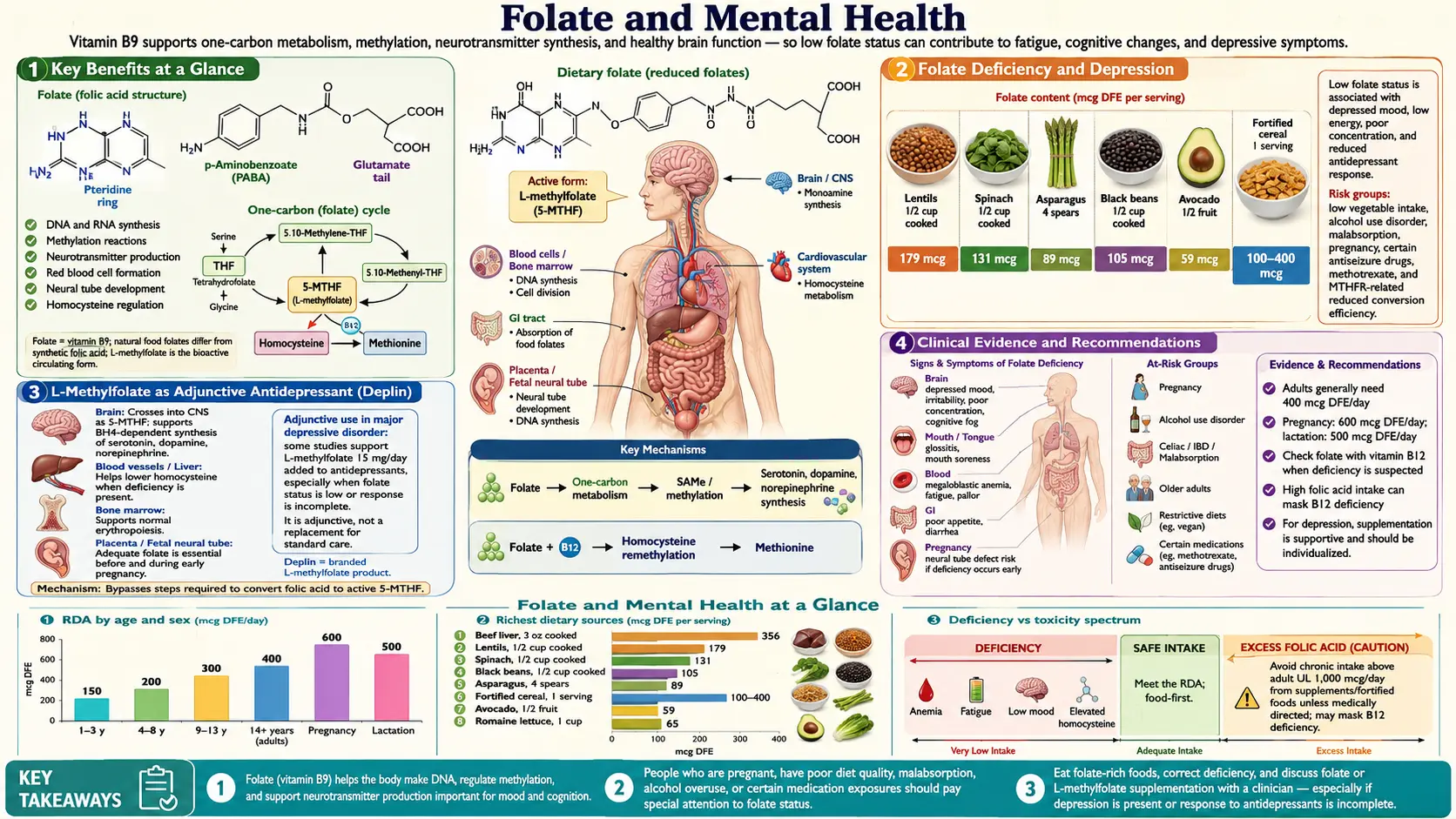
Folate (vitamin B9) is part of the one-carbon metabolism that makes S-adenosylmethionine (SAMe), and low folate status has been linked with depression and, through homocysteine, with cognitive decline. In a meta-analysis of observational studies, low folate was associated with depression (pooled odds ratio 1.55 unadjusted, 1.42 adjusted), although the authors note that a causal relationship has not been confirmed (Gilbody 2007). Trials that added a folate form to antidepressants have given mixed results: folic acid improved response in women but not men in a 2000 trial (Coppen 2000), a large 2014 trial of 5 mg of folic acid found no benefit (Bedson 2014), and of two 2012 trials of L-methylfolate the first found no difference from placebo while the second found 15 mg a day more effective (Papakostas 2012). In older adults with mild cognitive impairment, B vitamins slowed brain atrophy in one trial (Smith 2010), while a meta-analysis of 11 trials found no effect of homocysteine-lowering B vitamins on cognitive aging (Clarke 2014).
Table of Contents
- Key Findings at a Glance
- One-Carbon Metabolism and SAMe Production
- Methylation, BH4 and Neurotransmitter Synthesis
- Folate Status and Depression
- MTHFR C677T Polymorphism
- L-Methylfolate as an Add-On to Antidepressants
- Homocysteine and Cognitive Decline
- B-Vitamin Trials in Cognitive Impairment
- What the Clinical Evidence Shows
- Key Research Papers
- Connections
- Featured Videos
Key Findings at a Glance
- SAMe and methylation — folate and vitamin B12 are required both to turn homocysteine back into methionine and to make SAMe, which takes part in methylation reactions involving proteins, phospholipids, DNA and neurotransmitter metabolism (Bottiglieri 1996).
- Low folate and depression — in 11 observational studies (15,315 participants), low folate was associated with depression (adjusted odds ratio 1.42); the authors call for cohort studies and randomized trials to confirm or refute a causal relationship (Gilbody 2007).
- L-methylfolate trials — in two 2012 trials in people who had not responded fully to an SSRI, the first found no significant difference from placebo and the second found 15 mg/day more effective, with a number needed to treat of about six (Papakostas 2012). A 2022 meta-analysis described the effect as small and the efficacy as possibly modest (Maruf 2022).
- Folic acid trials — 500 mcg added to fluoxetine improved results in women only (Coppen 2000); 5 mg added to antidepressants gave no benefit in the FolATED trial (Bedson 2014).
- BH4 — tetrahydrobiopterin is an essential cofactor for tyrosine hydroxylase and the tryptophan hydroxylases (Longo 2009); the sources reviewed for this page do not show folate acting through BH4 in people with depression.
- Homocysteine — in the Framingham Study, a plasma homocysteine above 14 µmol/L nearly doubled the risk of Alzheimer's disease (Seshadri 2002).
- VITACOG — folic acid, B12 and B6 slowed brain atrophy in older adults with mild cognitive impairment, with the benefit confined to those with higher homocysteine (Smith 2010; Douaud 2013). A meta-analysis of 11 trials in about 22,000 people found no significant effect of B vitamins on cognitive function (Clarke 2014).
- MTHFR 677TT genotype — modestly associated with depression (odds ratio 1.36 versus CC) (Gilbody 2007, Am J Epidemiol; Lewis 2006).
- Lamotrigine — in a bipolar depression trial, folic acid reduced the effectiveness of lamotrigine at 12 weeks, and the authors wrote that it “seems to nullify” lamotrigine's effect (Geddes 2016).
One-Carbon Metabolism and SAMe Production
Folate's proposed links with mental health run through one-carbon metabolism, the set of reactions that produces the methyl donor S-adenosylmethionine (SAMe).
- The folate cycle: the enzyme methylenetetrahydrofolate reductase (MTHFR) converts 5,10-methylenetetrahydrofolate to 5-methyltetrahydrofolate (5-MTHF), the predominant circulating form of folate and the carbon donor for the remethylation of homocysteine to methionine (Frosst 1995).
- Methionine and SAMe: folate and vitamin B12 are required both in the methylation of homocysteine to methionine and in the synthesis of SAMe, which is involved in numerous methylation reactions involving proteins, phospholipids, DNA and neurotransmitter metabolism (Bottiglieri 1996). Coppen and Bolander-Gouaille describe SAMe as donating methyl groups that are crucial for neurological function (Coppen & Bolander-Gouaille 2005).
- The methylation theory: folate and B12 deficiency may cause similar neurological and psychiatric disturbances, including depression and dementia, and a current theory proposes that a defect in methylation is central to the biochemical basis of these effects (Bottiglieri 1996). Raised plasma homocysteine is described as a functional marker of both folate and B12 deficiency (Coppen & Bolander-Gouaille 2005).
- SAMe as a treatment: a 2016 Cochrane review of eight trials (934 adults) found no strong evidence of a difference between SAMe and placebo as monotherapy (very low quality evidence), similar results to imipramine (low quality evidence), and low quality evidence of benefit over placebo as an add-on to an SSRI in one trial of 73 people. The authors concluded that SAMe for depression needs further investigation (Galizia 2016).
Methylation, BH4 and Neurotransmitter Synthesis
The monoamines (serotonin, dopamine and norepinephrine) are the neurotransmitter systems most often discussed in folate and mood research.
- Monoamines: folate is needed in the brain for the synthesis of norepinephrine, serotonin and dopamine (Fava & Mischoulon 2009), and folate deficiency may specifically affect central monoamine metabolism and aggravate depressive disorders (Bottiglieri 1996).
- BH4 as a cofactor: tetrahydrobiopterin (BH4) is an essential cofactor for phenylalanine hydroxylase, tyrosine hydroxylase and the two tryptophan hydroxylases, as well as the nitric oxide synthases. In inherited BH4 deficiency, defective tyrosine and tryptophan hydroxylase activity explains the neurological deterioration, and patients with one of these disorders (dihydropteridine reductase deficiency) also need folinic acid, since that enzyme may help keep folate in its tetrahydro form (Longo 2009).
- What is not shown: a folate–BH4 “recycling” pathway is sometimes put forward to explain how folate affects mood. The sources reviewed for this page do not describe a measured effect of folate or L-methylfolate on BH4 in the brains of people with depression, so this remains a hypothesis rather than a finding.
- Homocysteine: homocysteine is a sensitive marker of folate and B12 deficiency; whether it is only a marker or plays a more direct role in mood disorders is not completely understood (Bottiglieri 2005).
Folate Status and Depression
The link between low folate and depression comes mainly from observational studies.
- Meta-analysis: Gilbody and colleagues pooled 11 observational studies (15,315 participants: three case-control studies, seven population surveys and one cohort study). Low folate was associated with depression (pooled unadjusted odds ratio 1.55, 95% CI 1.26–1.91; adjusted 1.42, 1.10–1.83), and folate levels were lower in depression. Much of the evidence comes from case-control and cross-sectional studies, and the authors state that cohort studies and definitive randomized trials are required to confirm or refute a causal relationship (Gilbody 2007, J Epidemiol Community Health).
- Reviews: Coppen and Bolander-Gouaille describe low plasma and particularly red-cell folate in major depression, low B12 status in depressive patients, and raised homocysteine in depression (Coppen & Bolander-Gouaille 2005). Bottiglieri states that numerous studies have confirmed the association between folate deficiency and depression (Bottiglieri 2005).
- Response to antidepressants: among 213 outpatients given fluoxetine 20 mg/day for 8 weeks, those with low folate were more likely to have melancholic depression and significantly less likely to respond (Fava 1997). In 55 patients who had not responded to fluoxetine, response to the next treatment was 7.1% with low serum folate (14 patients) and 44.7% without it (38 patients) (Papakostas 2004, Part 1). In 71 patients in remission, relapse during continued fluoxetine was 42.9% with low folate (7 patients) and 3.2% without it (64 patients) (Papakostas 2004, Part 2). These were small subgroups.
- Limits of the evidence: observational studies are affected by confounding, reverse causality and measurement error, which is why genetic studies of the MTHFR variant have been used to ask whether the link is causal (Lewis 2006).
MTHFR C677T Polymorphism
The MTHFR C677T variant has been studied as a natural test of whether folate metabolism affects depression risk. The associations found are modest.
- Functional impact: the variant was found on about 38% of unselected chromosomes in its 1995 description; in the heterozygous or homozygous state it correlates with reduced enzyme activity and increased thermolability, and people homozygous for it have significantly raised plasma homocysteine (Frosst 1995). In a large folic acid trial in Chinese women, the TT genotype was associated with lower folate and higher homocysteine at every dose, and the genotype did not significantly interact with folic acid dose (Crider 2011).
- Depression risk: in the Gilbody 2007 HuGE meta-analysis, the TT versus CC odds ratio for unipolar depression was 1.36 (95% CI 1.11–1.67), based on 1,280 cases and 10,429 controls (Gilbody 2007, Am J Epidemiol). Lewis and colleagues found an odds ratio of 1.35 (1.01–1.80) for ever being diagnosed with depression in 3,478 women, and a summary odds ratio of 1.36 (1.11–1.67) when eight other studies were added (Lewis 2006). An updated meta-analysis of 26 studies (4,992 cases, 17,082 controls) found a TT versus CC odds ratio of 1.42 (1.16–1.75), a clearer association in Asian populations, a marginal one in White populations and none in the elderly (Wu 2013). A meta-analysis limited to Asian populations (13 studies) reported a TT versus CC odds ratio of 1.78 (1.17–2.69) (Rai 2014).
- Genotype and treatment response: a post hoc analysis of the second 2012 L-methylfolate trial reported greater improvement with L-methylfolate than placebo among patients with certain genetic markers related to folate metabolism; its authors state that confirmatory studies are needed (Papakostas 2014).
- Folic acid and the variant: CDC's MTHFR Gene Variant and Folic Acid Facts page states that “people with an MTHFR gene variant can process all types of folate, including folic acid,” and that more people in the United States have one or two copies of the C677T variant than do not.
L-Methylfolate as an Add-On to Antidepressants
L-methylfolate (also called 5-MTHF or methylfolate) is one of three forms of folate commonly used in depression research, alongside folic acid and folinic acid. Fava and Mischoulon write that some forms may be more bioavailable than others in people with a genetic polymorphism and in those who take particular medications or use alcohol (Fava & Mischoulon 2009).
- The 2012 trials: Papakostas and colleagues ran two multicenter trials using a sequential parallel comparison design in outpatients with major depressive disorder who had partial or no response to an SSRI, with SSRI doses kept constant. In the first (148 patients; L-methylfolate 7.5 mg/day then 15 mg/day), no significant difference was observed between the treatment groups. In the second (75 patients; 15 mg/day throughout), L-methylfolate was significantly more effective than placebo on both primary outcomes (response rate and change in depression score) and two secondary measures, with a number needed to treat for response of approximately six. Adverse event rates did not differ from placebo (Papakostas 2012).
- Meta-analysis: Maruf and colleagues reviewed nine articles (6,707 patients). In three studies (483 patients), adjunctive L-methylfolate was associated with a small effect on Hamilton response versus antidepressant monotherapy (relative risk 1.25, 95% CI 1.08–1.46); four studies (507 patients) using a continuous measure gave a standardized mean difference of −0.38. They note that L-methylfolate augmentation is rarely included in major clinical practice guidelines, and concluded that it may have modest efficacy (Maruf 2022).
- Regulatory status: L-methylfolate for depression is described in the research literature as a medical food (Jain 2020). The FDA's Frequently Asked Questions About Medical Foods guidance (third edition, 2023) states that medical foods are not drugs and are not subject to regulatory requirements that specifically apply to drugs; that there is no federal requirement for a prescription and their labeling may not bear the symbol “Rx only”; and that “under the supervision of a physician” means active and ongoing medical supervision by a physician who has determined that the medical food is necessary to the patient's overall medical care. The guidance does not name L-methylfolate or state that the FDA has evaluated it for depression.
- Folic acid versus L-methylfolate: no head-to-head trial of the two in depression was found for this page. The FolATED authors described their negative folic acid result as consistent with the view that methylfolate is a better candidate, and called for trials of it (Bedson 2014).
Homocysteine and Cognitive Decline
Raised homocysteine, which reflects low folate or B12 status, has been studied as a risk factor for dementia.
- Framingham Study: among 1,092 people without dementia (mean age 76), dementia developed in 111, including 83 with Alzheimer's disease, over a median of eight years. The adjusted relative risk of Alzheimer's disease was 1.8 (95% CI 1.3–2.5) for each standard-deviation increase in log homocysteine at baseline, and with plasma homocysteine above 14 µmol/L the risk of Alzheimer's disease nearly doubled. The authors described raised homocysteine as a strong, independent risk factor for dementia and Alzheimer's disease (Seshadri 2002).
- Proposed mechanism: neurotoxic effects of homocysteine have been proposed as one way folate and B12 deficiency could contribute to neurological and psychiatric disturbances (Bottiglieri 1996).
- Brain atrophy: in the VITACOG trial (271 people over 70 with mild cognitive impairment), folic acid 0.8 mg, vitamin B12 0.5 mg and vitamin B6 20 mg daily for 24 months gave a brain atrophy rate of 0.76% a year versus 1.08% with placebo among the 168 who completed the MRI part (P=0.001); in participants with homocysteine above 13 µmol/L the atrophy rate was 53% lower with treatment (Smith 2010). A later analysis found that treatment reduced atrophy by as much as sevenfold in grey-matter regions vulnerable to Alzheimer's disease, including the medial temporal lobe, with the benefit confined to participants with homocysteine above the median (11 µmol/L) (Douaud 2013).
- Trials of cognition: a meta-analysis of 11 large trials (about 22,000 participants) found that B vitamins lowered homocysteine by 26–28% but had no significant effect on individual cognitive domains, global cognitive function or cognitive aging (Clarke 2014).
B-Vitamin Trials in Cognitive Impairment
- VITACOG cognitive outcomes: with 0.8 mg folic acid, 0.5 mg B12 and 20 mg B6 daily for two years, mean plasma homocysteine was 30% lower than with placebo and executive function was stabilized. Benefits in global cognition, episodic memory and semantic memory were seen among participants with baseline homocysteine above the median (11.3 µmol/L), and clinical benefit among those in the top quarter of homocysteine. The authors call it a small trial and state that further trials are needed to see whether this treatment slows or prevents conversion to dementia (de Jager 2012).
- The wider trial evidence: the meta-analysis of 11 trials described above found no significant effect of homocysteine-lowering B vitamins on cognitive aging (Clarke 2014). Fava and Mischoulon describe the evidence for folate improving cognitive symptoms as equivocal, noting that most studies used folic acid (Fava & Mischoulon 2009).
- Unanswered question: the VITACOG authors called for trials of whether the same treatment delays the development of Alzheimer's disease (Smith 2010); the trials reviewed for this page do not show that it does.
What the Clinical Evidence Shows
- Folate testing in depression: the authors of the 1997 fluoxetine study wrote that folate levels might be considered in the evaluation of depressed patients who do not respond to antidepressant treatment (Fava 1997). A 2005 review suggested trying folic acid (800 mcg daily) with vitamin B12 (1 mg daily) to improve treatment outcome (Coppen & Bolander-Gouaille 2005); that suggestion predates the FolATED trial, whose authors wrote that their findings undermine treatment guidelines that advocate folic acid for depression (Bedson 2014).
- Guidelines: L-methylfolate augmentation is rarely included in major clinical practice guidelines (Maruf 2022).
- Doses used in the trials: L-methylfolate 7.5 mg/day then 15 mg/day (no significant difference) and 15 mg/day (benefit), each added to an SSRI over 60 days (Papakostas 2012); folic acid 500 mcg/day added to fluoxetine 20 mg for 10 weeks (Coppen 2000); folic acid 5 mg/day added to antidepressants for 12 weeks, no benefit (Bedson 2014); folic acid 0.8 mg, B12 0.5 mg and B6 20 mg daily for 24 months in mild cognitive impairment (Smith 2010). This is a record of the research, not dosing guidance.
- Food sources: the Linus Pauling Institute describes green leafy vegetables as rich sources of folate, and citrus fruit juices, legumes and fortified foods as excellent sources; its table of food sources lists cooked lentils, chickpeas, asparagus and spinach.
- Interactions and safety: in the CEQUEL trial of bipolar depression, folic acid reduced the effectiveness of lamotrigine at 12 weeks, and the authors wrote that concurrent folic acid might reduce its effectiveness (Geddes 2016). Fava and Mischoulon list cancer risk, masking of B12 deficiency and worsening depressive symptoms among the concerns historically raised about folate, describe folate as generally well tolerated, and write that 5-MTHF may be less likely to incur some of these risks (Fava & Mischoulon 2009). Side effects were less common with folic acid than with placebo in the fluoxetine trial (Coppen 2000), and adverse event rates with L-methylfolate did not differ from placebo in the 2012 trials (Papakostas 2012).
- Antidepressants: the depression trials on this page added a folate form to an antidepressant; none tested a folate form as a replacement for one. Decisions about medicines and supplements belong with a clinician.
Summary
Folate is needed for one-carbon metabolism and SAMe production, and low folate status is associated with depression and with poorer response to antidepressants in observational studies. The MTHFR 677TT genotype is modestly associated with depression. Trials of adding folate to antidepressants are mixed: L-methylfolate 15 mg/day helped in one of two 2012 trials and shows a small, possibly modest effect in meta-analysis, while 5 mg of folic acid gave no benefit in the largest trial. Raised homocysteine predicts dementia in cohort studies, and B vitamins slowed brain atrophy in people with mild cognitive impairment and higher homocysteine, but a meta-analysis of large trials found no effect on cognitive aging.
Key Research Papers
- Papakostas GI, et al. L-methylfolate as adjunctive therapy for SSRI-resistant major depression: results of two randomized, double-blind, parallel-sequential trials. Am J Psychiatry. 2012;169(12):1267-1274. — PubMed PMID: 23212058
- Gilbody S, Lewis S, Lightfoot T. Methylenetetrahydrofolate reductase (MTHFR) genetic polymorphisms and psychiatric disorders: a HuGE review. Am J Epidemiol. 2007;165(1):1-13. — PubMed PMID: 17074966 (Editorial note: this entry previously linked PMID 26177556, a different paper, now listed separately below.)
- Gilbody S, Lightfoot T, Sheldon T. Is low folate a risk factor for depression? A meta-analysis and exploration of heterogeneity. J Epidemiol Community Health. 2007;61(7):631-637. — PubMed PMID: 17568057 (Editorial note: this entry was previously a PubMed topic search for folate and depression meta-analyses, now listed under PubMed Topic Searches.)
- Smith AD, et al. Homocysteine-lowering by B vitamins slows the rate of accelerated brain atrophy in mild cognitive impairment: a randomized controlled trial (VITACOG). PLoS ONE. 2010;5(9):e12244. — PubMed PMID: 20838622
- Seshadri S, Beiser A, Selhub J, Jacques PF, Rosenberg IH, D'Agostino RB, Wilson PW, Wolf PA. Plasma homocysteine as a risk factor for dementia and Alzheimer's disease. N Engl J Med. 2002;346(7):476-483. — PubMed PMID: 11844848
- Galizia I, et al. S-adenosyl methionine (SAMe) for depression in adults. Cochrane Database Syst Rev. 2016;10:CD011286. — PubMed PMID: 27727432 (Editorial note: this entry was previously a PubMed topic search for SAMe in depression, now listed under PubMed Topic Searches.)
- Longo N. Disorders of biopterin metabolism. J Inherit Metab Dis. 2009;32(3):333-342. — PubMed PMID: 19234759 (Editorial note: this entry was previously a PubMed topic search for BH4 and monoamine synthesis, now listed under PubMed Topic Searches.)
- Clarke R, et al. Effects of homocysteine lowering with B vitamins on cognitive aging: meta-analysis of 11 trials with cognitive data on 22,000 individuals. Am J Clin Nutr. 2014;100(2):657-666. — PubMed PMID: 24965307 (Editorial note: this entry was previously a PubMed topic search for folate and cognitive decline, now listed under PubMed Topic Searches.)
- NIH Office of Dietary Supplements — Folate Fact Sheet for Health Professionals
- Linus Pauling Institute — Folate
- Harvard T.H. Chan School of Public Health — Folate (Folic Acid)
- Rai V. Genetic polymorphisms of methylenetetrahydrofolate reductase (MTHFR) gene and susceptibility to depression in Asian population: a systematic meta-analysis. Cell Mol Biol (Noisy-le-grand). 2014;60(3):29-36. — PubMed PMID: 26177556
- Coppen A, Bailey J. Enhancement of the antidepressant action of fluoxetine by folic acid: a randomised, placebo controlled trial. J Affect Disord. 2000;60(2):121-130. — PubMed PMID: 10967371
- Bedson E, et al. Folate Augmentation of Treatment – Evaluation for Depression (FolATED): randomised trial and economic evaluation. Health Technol Assess. 2014;18(48):1-159. — PubMed PMID: 25052890
- Maruf AA, Poweleit EA, Brown LC, Strawn JR, Bousman CA. Systematic review and meta-analysis of L-methylfolate augmentation in depressive disorders. Pharmacopsychiatry. 2022;55(3):139-147. — PubMed PMID: 34794190
- Papakostas GI, et al. Effect of adjunctive L-methylfolate 15 mg among inadequate responders to SSRIs in depressed patients who were stratified by biomarker levels and genotype: results from a randomized clinical trial. J Clin Psychiatry. 2014;75(8):855-863. — PubMed PMID: 24813065
- Lewis SJ, Lawlor DA, Davey Smith G, Araya R, Timpson N, Day IN, Ebrahim S. The thermolabile variant of MTHFR is associated with depression in the British Women's Heart and Health Study and a meta-analysis. Mol Psychiatry. 2006;11(4):352-360. — PubMed PMID: 16402130
- Wu YL, et al. Association between MTHFR C677T polymorphism and depression: an updated meta-analysis of 26 studies. Prog Neuropsychopharmacol Biol Psychiatry. 2013;46:78-85. — PubMed PMID: 23831680
- Frosst P, et al. A candidate genetic risk factor for vascular disease: a common mutation in methylenetetrahydrofolate reductase. Nat Genet. 1995;10(1):111-113. — PubMed PMID: 7647779
- Crider KS, et al. MTHFR 677C→T genotype is associated with folate and homocysteine concentrations in a large, population-based, double-blind trial of folic acid supplementation. Am J Clin Nutr. 2011;93(6):1365-1372. — PubMed PMID: 21508090
- Bottiglieri T. Folate, vitamin B12, and neuropsychiatric disorders. Nutr Rev. 1996;54(12):382-390. — PubMed PMID: 9155210
- Bottiglieri T. Homocysteine and folate metabolism in depression. Prog Neuropsychopharmacol Biol Psychiatry. 2005;29(7):1103-1112. — PubMed PMID: 16109454
- Coppen A, Bolander-Gouaille C. Treatment of depression: time to consider folic acid and vitamin B12. J Psychopharmacol. 2005;19(1):59-65. — PubMed PMID: 15671130
- Fava M, Mischoulon D. Folate in depression: efficacy, safety, differences in formulations, and clinical issues. J Clin Psychiatry. 2009;70 Suppl 5:12-17. — PubMed PMID: 19909688
- Fava M, Borus JS, Alpert JE, Nierenberg AA, Rosenbaum JF, Bottiglieri T. Folate, vitamin B12, and homocysteine in major depressive disorder. Am J Psychiatry. 1997;154(3):426-428. — PubMed PMID: 9054796
- Papakostas GI, et al. Serum folate, vitamin B12, and homocysteine in major depressive disorder, Part 1: predictors of clinical response in fluoxetine-resistant depression. J Clin Psychiatry. 2004;65(8):1090-1095. — PubMed PMID: 15323594
- Papakostas GI, et al. Serum folate, vitamin B12, and homocysteine in major depressive disorder, Part 2: predictors of relapse during the continuation phase of pharmacotherapy. J Clin Psychiatry. 2004;65(8):1096-1098. — PubMed PMID: 15323595
- Geddes JR, et al. Comparative evaluation of quetiapine plus lamotrigine combination versus quetiapine monotherapy (and folic acid versus placebo) in bipolar depression (CEQUEL): a 2 × 2 factorial randomised trial. Lancet Psychiatry. 2016;3(1):31-39. — PubMed PMID: 26687300
- Douaud G, et al. Preventing Alzheimer's disease-related gray matter atrophy by B-vitamin treatment. Proc Natl Acad Sci U S A. 2013;110(23):9523-9528. — PubMed PMID: 23690582
- de Jager CA, Oulhaj A, Jacoby R, Refsum H, Smith AD. Cognitive and clinical outcomes of homocysteine-lowering B-vitamin treatment in mild cognitive impairment: a randomized controlled trial. Int J Geriatr Psychiatry. 2012;27(6):592-600. — PubMed PMID: 21780182
- Jain R, Manning S, Cutler AJ. Good, better, best: clinical scenarios for the use of L-methylfolate in patients with MDD. CNS Spectr. 2020;25(6):750-764. — PubMed PMID: 31833826
- CDC — MTHFR Gene Variant and Folic Acid Facts
- FDA — Guidance for Industry: Frequently Asked Questions About Medical Foods, Third Edition (2023)