Folate and Pregnancy: Neural Tube Defect Prevention
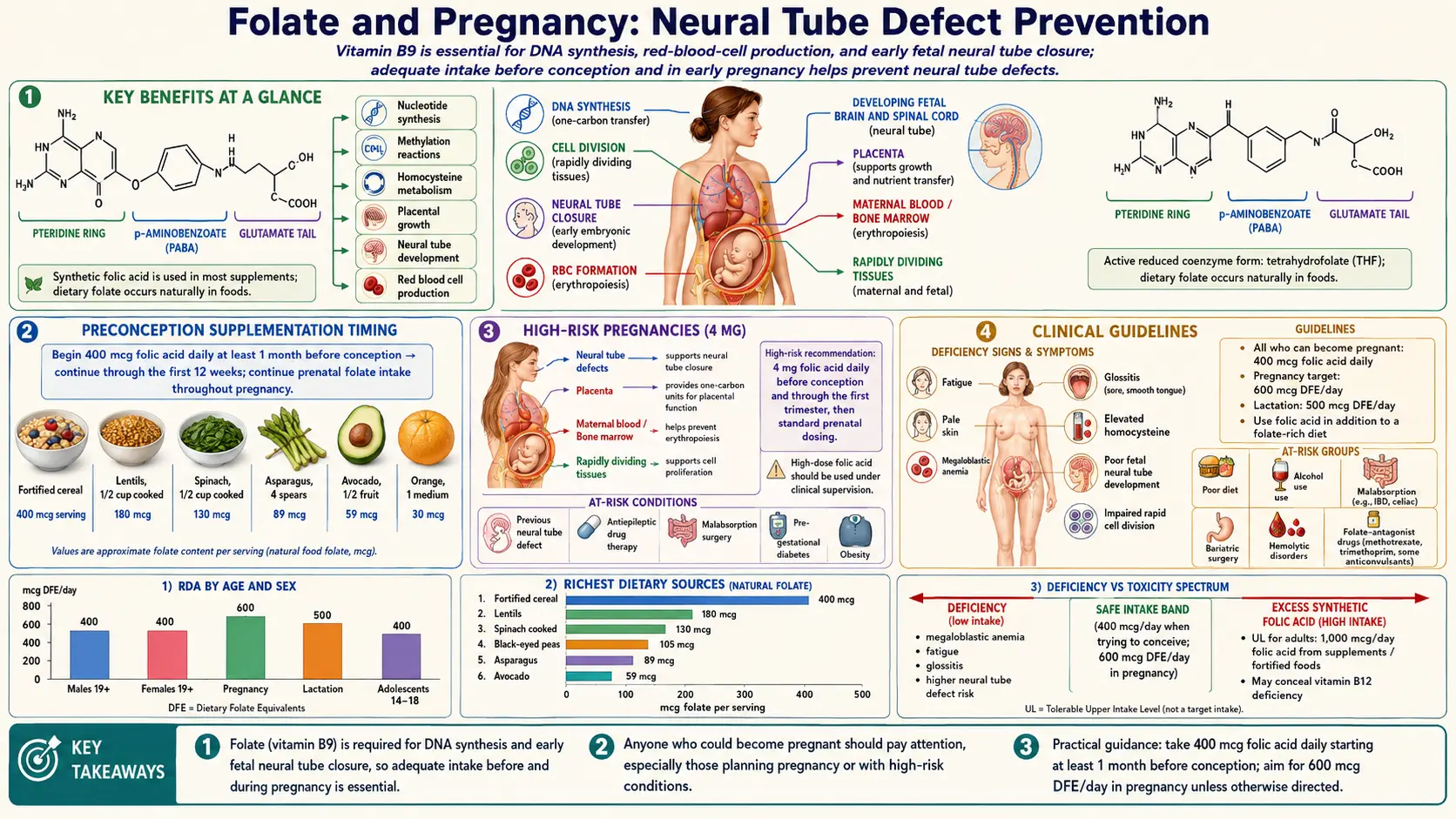
Randomized trials published in 1991 and 1992 showed that folic acid, alone or in a multivitamin, taken around conception lowers the risk of neural tube defects (NTDs). In the 1991 Medical Research Council (MRC) Vitamin Study, women with a previously affected pregnancy who were allocated folic acid had a 72% lower risk of a recurrence (relative risk 0.28). ACOG's 2017 practice bulletin notes that, in contrast to many other congenital abnormalities, primary prevention of NTDs is possible with folic acid. This page covers neural tube closure, the trials, the results of mandatory food fortification in the United States, Canada and Chile, MTHFR variants, the folic acid and methylfolate question, what has been studied for preterm birth and the placenta, and what the guideline bodies state.
Table of Contents
- Key Findings at a Glance
- Neural Tube Closure (First Month After Conception)
- Spina Bifida and Anencephaly
- Folic Acid Fortification History
- Preconception Supplementation Timing
- MTHFR Polymorphisms and Methylfolate
- Doses Named in Guidelines (400-800 mcg)
- Higher-Risk Pregnancies (4-5 mg)
- Folic Acid vs. Methylfolate Debate
- Placental Folate Transport
- Folate and Preterm Birth: What Studies Found
- What Guideline Bodies State
- Key Research Papers
- Connections
- Featured Videos
Key Findings at a Glance
- 72% lower recurrence risk with folic acid in women with a previously affected pregnancy (MRC Vitamin Study, 1991: 6 vs 21 NTDs, relative risk 0.28).
- Cochrane review (2015, 5 trials): folic acid, alone or with other vitamins and minerals, prevents NTDs (risk ratio 0.31, high-quality evidence), but has no clear effect on other birth defects.
- Fortification: after mandatory fortification began in 1998, NTD prevalence fell by 28% across 19 US surveillance programs (35% in programs that counted prenatal diagnoses) and by 46% in seven Canadian provinces; in Chile, Santiago hospitals recorded a 50% fall after wheat flour fortification began in 2000.
- Doses named in guidelines: the USPSTF recommends 0.4 to 0.8 mg (400 to 800 mcg) a day for all persons planning to or who could become pregnant; after a prior NTD-affected pregnancy, CDC states 4,000 mcg a day, WHO 5 mg and SOGC 4.0 mg.
- Preterm birth: in one cohort of 34,480 pregnancies, folate supplementation for a year or more before conception was associated with a 50-70% lower risk of early spontaneous preterm birth (20-32 weeks), but not later preterm birth; a 2013 Cochrane review of trials found no effect of folic acid on preterm birth.
- Red blood cell folate above 906 nmol/L (400 ng/mL) is the WHO population-level threshold for the greatest reduction of NTDs; WHO notes that it cannot predict an individual's risk.
- MTHFR: CDC states that people with an MTHFR variant can process all types of folate, including folic acid, and that folic acid is the only type of folate shown to help prevent NTDs.
Neural Tube Closure (First Month After Conception)
The neural tube is the embryonic structure that becomes the brain and spinal cord; NTDs are caused by a failure of its closure, which results in birth defects of the brain, spinal cord and overlying tissues (USPSTF).
- Timing: the USPSTF's 2023 statement notes that “the neural plate completes its formation and closure early in pregnancy (usually 26 to 28 days after fertilization).” The Linus Pauling Institute places closure between the 21st and 28th days after conception, a time when many women may not realize they are pregnant. CDC states that NTDs “happen in the first few weeks of pregnancy, often before you know you are pregnant.”
- How closure works: a 2017 review by Nikolopoulou, Copp and colleagues describes neural tube closure as a complex process involving cellular events such as convergent extension, apical constriction and interkinetic nuclear migration, under molecular control that includes the planar cell polarity pathway and Shh/BMP signalling, as well as biomechanical inputs. The review draws on studies of various vertebrate species.
- Where folate fits: the USPSTF states that adequate maternal folate is important in preventing NTDs but that the mechanism by which folate reduces the risk “is not well understood.” Folate is necessary for nucleotide synthesis and DNA and RNA function, and inadequate folate may lead to incomplete neural folds.
- Why timing matters for policy: because closure happens so early, the USPSTF describes the critical period for folic acid as starting at least 1 month before conception and continuing through the first 2 to 3 months of pregnancy, and notes that nearly half of all US pregnancies are unplanned.
Spina Bifida and Anencephaly
The USPSTF lists anencephaly, encephalocele and spina bifida as the most common forms of NTD, and estimates that about 3,000 US pregnancies are affected each year.
- Spina bifida: the vertebral column is open, often with spinal cord involvement. In myelomeningocele (open spina bifida), the most clinically significant subtype, the lumbosacral neural tube fails to close; the exposed neural tissue degenerates in utero, and the neurological deficit varies with the level of the lesion. Associated problems include the Chiari II brain malformation, hydrocephalus, and urological and orthopaedic sequelae. Myelomeningocele occurs in approximately 1 per 1,000 births worldwide (Copp 2015). ACOG notes that most infants with spina bifida survive after surgical repair.
- Anencephaly: CDC describes anencephaly as a serious birth defect in which a baby is born without parts of the brain and skull, and states that “about 1 in every 4,762 babies is born with anencephaly in the United States” and that almost all die shortly after birth. ACOG describes it as incompatible with life.
- Encephalocele: the third NTD counted as an outcome in the MRC Vitamin Study, alongside anencephaly and spina bifida.
- Global prevalence: a CDC-led systematic review (Zaganjor 2016) found NTD data for only 75 countries; 120 of 194 WHO member states had no NTD prevalence data. Reported median prevalence per 10,000 births ranged from 6.9 (Western Pacific) and 9.0 (Europe) to 15.8 (South-East Asia) and 21.9 (Eastern Mediterranean), with very wide ranges within regions. The Linus Pauling Institute cites a worldwide estimate of about 2 per 1,000 births.
Folic Acid Fortification History
Mandatory fortification of staple foods with folic acid was introduced in the late 1990s in the United States and Canada and in 2000 in Chile; the results below come from different study designs and are not directly comparable.
- United States mandate: before fortification, only an estimated 29% of US reproductive-aged women took a supplement containing 400 mcg of folic acid daily. The FDA authorized adding folic acid to enriched grain products in March 1996, with compliance mandatory by January 1998 (Honein 2001). Since 1998, enriched cereal grain products have been fortified with 140 mcg of folic acid per 100 g (Williams 2015).
- US results: on birth certificates, spina bifida and anencephaly fell from 37.8 to 30.5 per 100,000 live births, a 19% decline, and the authors noted that factors other than fortification may have contributed (Honein 2001). In CDC's 2015 analysis of 19 surveillance programs, prevalence fell by 28% overall; in programs that included prenatal diagnoses it fell by 35%, from 10.7 per 10,000 live births in 1995-1996 to 7.0 per 10,000 in 1999-2011. About 1,326 NTD-affected births a year (95% CI 1,122-1,531) are averted (Williams 2015).
- Canada (De Wals 2007): in seven provinces (1.9 million births, including stillbirths and terminations for fetal anomalies), NTD prevalence fell from 1.58 per 1,000 births before fortification to 0.86 per 1,000 in the full-fortification period, a 46% reduction (95% CI 40-51). The fall was 53% for spina bifida, 38% for anencephaly and 31% for encephalocele, and was largest in provinces with the highest baseline rates.
- Chile: folic acid was added to wheat flour (2.2 mg per 100 g) from January 2000. In a hospital-based study covering 25% of national births, the NTD rate fell from 17.1 to 9.7 per 10,000 births in 2001-2002, a 43% reduction (Hertrampf & Cortés 2008). Over 2001-2009 in nine Santiago public maternity hospitals, it fell to 8.6 per 10,000, a 50% reduction (RR 0.5, 95% CI 0.42-0.59) (Cortés 2012). A separate hospital-network study found a 51% fall in spina bifida and a 42% fall in anencephaly in 2001-2002 and no pre-existing downward trend (López-Camelo 2005).
- Global adoption and debate: a 2026 policy review states that about 90 countries fortify cereal grains with folic acid. Its author argues that studies using pre-fortification periods as controls do not account for changing socioeconomic conditions, and concludes that the evidence for supplementation to prevent recurrent NTDs is well supported but the evidence in favor of mandatory fortification is limited (Westmark 2026). CDC's 2015 report concludes that “mandatory folic acid fortification remains an effective public health intervention.”
- Remaining disparities: CDC reports remaining opportunities for prevention among women with lower folic acid intakes, especially Hispanic women (Williams 2015). Maternal obesity is also associated with a higher NTD risk (Rasmussen 2008, described below).
Preconception Supplementation Timing
Because the neural tube closes so early, the guideline bodies frame folic acid as something that starts before conception.
- What guidelines state about timing: USPSTF: the critical period starts at least 1 month before conception and continues through the first 2 to 3 months of pregnancy. CDC (for anyone who had a previous NTD-affected pregnancy): start 1 month before becoming pregnant again and continue through the first 3 months. WHO: from the moment of trying to conceive until 12 weeks of gestation. SOGC (2015, low risk): at least 2 to 3 months before conception, through pregnancy and for 4 to 6 weeks postpartum or as long as breastfeeding continues.
- Red blood cell folate rises slowly: in a 24-week randomized trial in 144 women, red blood cell folate had not reached a plateau in any supplemented group, while plasma folate plateaued after 12 weeks; the authors suggested that the preconception period of supplementation be extended beyond 4 weeks (Lamers 2006).
- Population threshold: WHO guidelines state that, at the population level, red blood cell folate concentrations should be above 400 ng/mL (906 nmol/L) in women of reproductive age to achieve the greatest reduction of NTDs (a strong recommendation based on low-quality evidence). WHO adds that because low folate cannot explain all NTDs, the threshold cannot predict an individual's risk (Cordero 2015). CDC's 2015 report states that 21.6% of US women of childbearing age still did not have red blood cell folate concentrations associated with a lower NTD risk, and that targeted strategies might be needed to bring this group above 1,000 nmol/L.
- Unplanned pregnancies: the USPSTF notes that nearly half of all US pregnancies are unplanned; SOGC applies its folic acid guidance to all women who may become pregnant “because so many pregnancies are unplanned.”
- Everyone who could become pregnant: CDC states: “All women capable of becoming pregnant should get 400 micrograms (mcg) of folic acid daily.”
MTHFR Polymorphisms and Methylfolate
Genetic variation in folate metabolism, especially in the MTHFR gene, is one of the factors studied as a modifier of NTD risk.
- MTHFR C677T variant: MTHFR converts 5,10-methylenetetrahydrofolate to 5-methyltetrahydrofolate, the predominant circulating form of folate. Frosst and colleagues (1995) identified the common C677T substitution on about 38% of unselected chromosomes; it correlated with reduced enzyme activity and heat sensitivity (thermolability), and people with two copies had significantly higher plasma homocysteine. Two copies (the TT genotype) range from 1% or less among Black populations in Africa and the US to 20% or more among Italians and US Hispanics (Botto & Yang 2000); the Linus Pauling Institute gives a range of 3% to 32% depending on the population.
- NTD risk: in Botto and Yang's pooled analysis, TT in the infant was associated with a moderately higher risk of spina bifida (odds ratio 1.8, 95% CI 1.4-2.2), and maternal TT also appears to be a moderate risk factor (pooled odds ratio 2.0, 95% CI 1.5-2.8). The authors note that some data suggest this risk may depend on nutritional status, such as blood folate levels and vitamin intake.
- MTHFR A1298C variant: a second common variant. Botto and Yang report that A1298C combined with C677T could also be associated with a higher spina bifida risk.
- What CDC states: “People with an MTHFR gene variant can process all types of folate, including folic acid.” “Common MTHFR variants, such as MTHFR C677T, are not a reason to avoid folic acid.” “Your folic acid intake is more important than your MTHFR genotype for determining the amount of folate in your blood.” CDC also states that folic acid is the only type of folate shown to help prevent NTDs.
- Methylfolate: some practitioners advocate L-methylfolate (5-MTHF) rather than folic acid for people with MTHFR variants, on the reasoning that it bypasses the MTHFR step. The NTD-prevention trials (MRC 1991, Czeizel 1992) and the China campaign (Berry 1999) all used folic acid; studies of 5-MTHF have measured blood folate, not NTDs (see the debate section).
Doses Named in Guidelines (400-800 mcg)
- Average risk: the USPSTF (2023, grade A) recommends that all persons planning to or who could become pregnant take a daily supplement containing 0.4 to 0.8 mg (400 to 800 mcg) of folic acid. As summarized by the USPSTF, ACOG, the American Academy of Family Physicians and the American Academy of Pediatrics recommend 400 mcg (0.4 mg) a day. WHO states 400 mcg daily from trying to conceive until 12 weeks of gestation; CDC states 400 mcg daily.
- Product strengths: SOGC's 2015 guideline reports that in Canada, multivitamins with folic acid are usually available as over-the-counter multivitamins with 0.4 to 0.6 mg, over-the-counter prenatal multivitamins with 1.0 mg, and prescription multivitamins with 5.0 mg.
- Dietary folate equivalents (DFE): 1 mcg of food folate provides 1 mcg DFE; 1 mcg of folic acid taken with meals or as fortified food provides 1.7 mcg DFE; and 1 mcg of folic acid taken on an empty stomach provides 2 mcg DFE. The recommended dietary allowance is 600 mcg DFE a day in pregnancy and 500 mcg DFE during breastfeeding (Linus Pauling Institute).
- Upper limit: the tolerable upper intake level for adults is 1,000 mcg (1 mg) a day of folic acid from supplements and fortified foods. It was set to guard against irreversible neurologic damage in people with undiagnosed vitamin B12 deficiency; the Food and Nutrition Board also noted that B12 deficiency is very rare in women of childbearing age (Linus Pauling Institute). The 1992 US Public Health Service recommendation advised keeping total folate below 1 mg a day except under a physician's supervision, because higher intakes can complicate the diagnosis of B12 deficiency.
Higher-Risk Pregnancies (4-5 mg)
Guideline bodies name higher folic acid doses for some groups at elevated NTD risk; the USPSTF recommendation explicitly does not cover them.
- Previous NTD-affected pregnancy: in a Hungarian genetic counselling clinic, the recurrence rate after one baby with an isolated NTD was 2.3% (Czeizel & Métneki 1984). The MRC trial that found the 72% reduction enrolled women in this group. For this group, CDC states: “The current recommendation is to get 4,000 mcg of folic acid every day,” starting 1 month before becoming pregnant again; WHO states that these women be offered high-dose supplementation of 5 mg daily; SOGC (2015) lists 4.0 mg daily for at least 3 months before conception until 12 weeks' gestation, then a multivitamin with 0.4 to 1.0 mg. The USPSTF recommendation does not apply to this group.
- Antiseizure medicines: in a European registry study (Jentink 2010), first-trimester valproic acid monotherapy was associated with spina bifida (adjusted odds ratio 12.7, 95% CI 7.7-20.7), and carbamazepine with a smaller increase (odds ratio 2.6, 95% CI 1.2-5.3). A Dutch case-control study found a lower spina bifida risk with correct folic acid use in pregnancies not exposed to antiepileptic drugs (OR 0.5), but no measurable effect in valproate-exposed pregnancies (OR 1.0, 95% CI 0.1-7.6); the authors note that the study lacked the power to rule out an effect. The USPSTF recommendation does not apply to persons taking medications that block the function of folic acid (it names methotrexate, carbamazepine and valproic acid).
- Diabetes: the USPSTF states that pregestational diabetes and obesity have been associated with a higher NTD risk. In an Atlanta case-control study, the excess risk of selected diabetes-associated birth defects was limited to infants of mothers with diabetes who had not taken multivitamins around conception (odds ratio 3.93) (Correa 2003).
- Obesity: in a meta-analysis of 12 studies, the unadjusted odds ratios for an NTD-affected pregnancy were 1.22 for overweight, 1.70 for obese and 3.11 for severely obese women, compared with normal-weight women (Rasmussen 2008). The published guidelines quoted on this page do not state a separate dose for obesity; SOGC's 2022 guideline says personalized approaches could be considered for women with complex genetic, medical or surgical risks.
- Family history: SOGC (2015) applies its 4.0 mg regimen to a male partner with a personal history of an NTD and to a previous NTD pregnancy in either partner. The USPSTF lists family history among the reasons a person may be at very high risk and outside its recommendation.
- SOGC 2022 update: Guideline No. 427 recommends high-dose folic acid only for women who can become pregnant and have had a previous pregnancy affected by an NTD or another folate-sensitive congenital anomaly.
Folic Acid vs. Methylfolate Debate
A continuing question in prenatal nutrition is whether L-methylfolate (5-MTHF) can stand in for folic acid.
- Arguments made for methylfolate: proponents argue that 5-MTHF is the form that directly enters the folate cycle, bypasses the MTHFR step, and does not produce unmetabolized folic acid (UMFA) in the circulation.
- What comparison trials found: in Lamers 2006, 416 mcg/day of [6S]-5-MTHF raised red blood cell folate significantly more than 400 mcg/day of folic acid over 24 weeks. In a 2026 randomized trial in 80 pregnant women from the second trimester, a prenatal multivitamin with 1,000 mcg DFE of 6S-5-MTHF and one with 1,330 mcg DFE of folic acid gave similar total folate in maternal serum, cord serum and placenta at 24 weeks, with fewer women having detectable UMFA in the 5-MTHF group (7% vs 31%); several co-authors were employed by the supplement company that sponsored it (Draicchio 2026). These studies measured folate in blood and tissue, not NTDs.
- The case for folic acid as stated by CDC: the NTD-prevention trials used folic acid, and CDC states that folic acid is the only type of folate shown to help prevent NTDs. Every guideline recommendation quoted on this page is stated in terms of folic acid.
- Unmetabolized folic acid (UMFA): in acute feeding studies, unaltered folic acid appeared in serum above a threshold of about 266 mcg per meal from fortified foods, and above 200 mcg when given in saline, milk or bread (Kelly 1997). In 105 postmenopausal women (not a pregnancy study), detectable UMFA was associated with about 23% lower natural killer cell cytotoxicity; the authors called for further studies (Troen 2006). In a trial of 1 mg/day folic acid in people with prior colorectal adenomas, folic acid did not reduce adenoma risk, and advanced lesions at the second follow-up were 11.6% vs 6.9% (RR 1.67, 95% CI 1.00-2.80, P=0.05); the authors called for research into whether folic acid might increase colorectal neoplasia risk (Cole 2007). What UMFA means for fetal development has not been established.
- Where guidelines stand: SOGC's 2022 guideline states that optimizing folic acid supplementation is complex and depends on factors including the type of supplement and metabolic and genetic factors, and that personalized approaches could be considered for women with complex risks.
Placental Folate Transport
- Concentration toward the fetus: the Linus Pauling Institute states that the placenta concentrates folate into the fetal circulation, leading to higher folate concentrations in the fetus than in the pregnant woman, and that the folate transport proteins (the reduced folate carrier, the proton-coupled folate transporter and the folate receptors) have all been associated with folate transport across the placenta.
- Pre-eclampsia (FACT trial): in a randomized trial in 2,301 women at high risk of pre-eclampsia, 4.0 mg/day of folic acid from 8-16 weeks of gestation until delivery did not prevent pre-eclampsia (14.8% vs 13.5% with placebo; RR 1.10, 95% CI 0.90-1.34), and there was no evidence of differences in other adverse maternal or neonatal outcomes (Wen 2018).
- Other pregnancy outcomes: a 2013 Cochrane review of 31 trials found no conclusive evidence of benefit of folic acid during pregnancy on pregnancy outcomes; it found a higher mean birthweight and a lower incidence of megaloblastic anaemia (RR 0.21) (Lassi 2013).
Folate and Preterm Birth: What Studies Found
- Cohort study (Bukowski 2009): among 34,480 low-risk singleton pregnancies, folate supplementation for 1 year or longer before conception was associated with a 70% lower risk of spontaneous preterm delivery at 20-28 weeks (HR 0.22, 95% CI 0.08-0.61) and a 50% lower risk at 28-32 weeks (HR 0.45, 95% CI 0.24-0.83). After adjustment for maternal characteristics the hazard ratios were 0.31 and 0.53. Supplementation was not significantly associated with spontaneous preterm birth beyond 32 weeks, and shorter supplementation (under 1 year) was not significant after adjustment. As an observational study, it cannot show cause and effect.
- Duration: in the same cohort, the risk of spontaneous preterm birth decreased with the duration of preconception supplementation (test for trend, p = 0.01) and was lowest with 1 year or longer.
- Randomized trials (Lassi 2013 Cochrane review): folic acid supplementation during pregnancy had no impact on preterm birth (RR 1.01, 95% CI 0.73-1.38; three studies, 2,959 participants). These trials tested supplementation during pregnancy rather than for a year before conception.
- High-dose folic acid (FACT trial): 4.0 mg/day from early pregnancy in high-risk women showed no evidence of differences in other adverse maternal or neonatal outcomes compared with placebo (Wen 2018).
What Guideline Bodies State
- USPSTF (2023 reaffirmation, grade A): “all persons planning to or who could become pregnant take a daily supplement containing 0.4 to 0.8 mg (400 to 800 μg) of folic acid.” The Task Force found high certainty of a substantial net benefit. The recommendation does not apply to persons with a previous NTD-affected pregnancy, at very high risk for other reasons such as family history, or taking medications that block the function of folic acid.
- CDC: 400 mcg of folic acid daily for all women capable of becoming pregnant; 4,000 mcg daily after a previous NTD-affected pregnancy.
- WHO: 400 mcg of folic acid daily from trying to conceive until 12 weeks of gestation; 5 mg daily offered to women who have had a fetus or baby with an NTD.
- SOGC (Canada): the 2015 guideline lists 0.4 mg (low risk), 1.0 mg (moderate risk) and 4.0 mg (high risk) regimens, and recommends that all women of reproductive age with preserved fertility be advised about folic acid at wellness visits whether or not a pregnancy is contemplated. It states that folic acid is unlikely to mask B12 deficiency and that testing is not required before starting it, and recommends taking folic acid in a multivitamin with 2.6 mcg/day of B12 to address even theoretical concerns. The 2022 update recommends a low daily dose for all women who could become pregnant and high doses only after a previous affected pregnancy.
- MTHFR testing: the American College of Medical Genetics and Genomics' 2013 practice guideline (with a 2020 addendum) concluded that MTHFR polymorphism testing has minimal clinical utility and should not be ordered as part of a routine evaluation for thrombophilia. CDC states that common MTHFR variants are not a reason to avoid folic acid.
- Blood folate testing: WHO's red blood cell folate threshold of 906 nmol/L is intended for population-level assessment and cannot predict an individual's risk. SOGC's 2022 guideline mentions red blood cell or serum folate testing as part of possible personalized approaches for women with complex risks.
Summary
The link between folic acid and neural tube defects rests on randomized trials: a 72% lower recurrence risk in the MRC study and no NTDs among 2,104 women given a multivitamin with 0.8 mg folic acid in the Hungarian trial, compared with six in the control group. Mandatory fortification was followed by falls in NTD prevalence of 28-35% in the US, 46% in Canada and about 43-50% in Chile. The USPSTF recommends 0.4 to 0.8 mg a day for everyone who could become pregnant; after a prior affected pregnancy, CDC states 4 mg, WHO 5 mg and SOGC 4.0 mg. Studies comparing methylfolate with folic acid have measured blood folate, not birth defects, and CDC states that folic acid is the only form shown to help prevent NTDs. Evidence on preterm birth is mixed: an observational association with long preconception use, and no effect in randomized trials of supplementation during pregnancy. Decisions about supplements and doses before and during pregnancy belong with a clinician.
Key Research Papers
- MRC Vitamin Study Research Group. Prevention of neural tube defects: results of the Medical Research Council Vitamin Study. Lancet. 1991;338(8760):131-137. — PubMed PMID: 1677062
- Czeizel AE, Dudas I. Prevention of the first occurrence of neural-tube defects by periconceptional vitamin supplementation. N Engl J Med. 1992;327(26):1832-1835. — PubMed PMID: 1307234
- Westmark CJ. Reassessing Mandatory Folic Acid Fortification for Neural Tube Defect Prevention: Evidence, Uncertainty, and Policy Implications. Nutrients. 2026;18(11):1758. — PubMed PMID: 42280401
- Botto LD, Yang Q. 5,10-Methylenetetrahydrofolate reductase gene variants and congenital anomalies: a HuGE review. Am J Epidemiol. 2000;151(9):862-877. — PubMed PMID: 10791559
- Tesfaye B, Woldeyohannes M, Tessema M, Arnold CD, McDonald CM, Brown KH. Serum Folate Concentration Corresponding to the Red Blood Cell Folate Threshold for Increased Risk of Neural Tube Defects Among Ethiopian Women of Reproductive Age. Matern Child Nutr. 2025:e70121. — PubMed PMID: 40980992
- Draicchio F, Hausser J, Sharafi M, et al. Using 6S-5-methyltetrahydrofolate instead of folic acid in prenatal multivitamin reduces unmetabolized folic acid concentrations in the mother-fetus dyad: a 24-week randomized controlled trial. Front Nutr. 2026;13:1679067. — PubMed PMID: 41971363
- Bukowski R, Malone FD, Porter FT, et al. Preconceptional folate supplementation and the risk of spontaneous preterm birth: a cohort study. PLoS Med. 2009;6(5):e1000061. — PubMed PMID: 19434228
- Jentink J, Loane MA, Dolk H, et al. Valproic acid monotherapy in pregnancy and major congenital malformations. N Engl J Med. 2010;362(23):2185-2193. — PubMed PMID: 20558369
- NIH Office of Dietary Supplements — Folate Fact Sheet for Health Professionals
- Linus Pauling Institute — Folate
- CDC — Folic Acid
- Harvard T.H. Chan School of Public Health — Folate (Folic Acid)
- Berry RJ, Li Z, Erickson JD, et al. Prevention of neural-tube defects with folic acid in China. China-U.S. Collaborative Project for Neural Tube Defect Prevention. N Engl J Med. 1999;341(20):1485-1490. — PubMed PMID: 10559448
- Honein MA, Paulozzi LJ, Mathews TJ, Erickson JD, Wong LY. Impact of folic acid fortification of the US food supply on the occurrence of neural tube defects. JAMA. 2001;285(23):2981-2986. — PubMed PMID: 11410096
- Williams J, Mai CT, Mulinare J, et al. Updated estimates of neural tube defects prevented by mandatory folic acid fortification - United States, 1995-2011. MMWR Morb Mortal Wkly Rep. 2015;64(1):1-5. — PubMed PMID: 25590678
- De Wals P, Tairou F, Van Allen MI, et al. Reduction in neural-tube defects after folic acid fortification in Canada. N Engl J Med. 2007;357(2):135-142. — PubMed PMID: 17625125
- Hertrampf E, Cortés F. National food-fortification program with folic acid in Chile. Food Nutr Bull. 2008;29(2 Suppl):S231-S237. — PubMed PMID: 18709898
- Cortés F, Mellado C, Pardo RA, Villarroel LA, Hertrampf E. Wheat flour fortification with folic acid: changes in neural tube defects rates in Chile. Am J Med Genet A. 2012;158A(8):1885-1890. — PubMed PMID: 22711368
- López-Camelo JS, Orioli IM, da Graça Dutra M, et al. Reduction of birth prevalence rates of neural tube defects after folic acid fortification in Chile. Am J Med Genet A. 2005;135(2):120-125. — PubMed PMID: 15846825
- De-Regil LM, Peña-Rosas JP, Fernández-Gaxiola AC, Rayco-Solon P. Effects and safety of periconceptional oral folate supplementation for preventing birth defects. Cochrane Database Syst Rev. 2015;(12):CD007950. — PubMed PMID: 26662928
- Lassi ZS, Salam RA, Haider BA, Bhutta ZA. Folic acid supplementation during pregnancy for maternal health and pregnancy outcomes. Cochrane Database Syst Rev. 2013;(3):CD006896. — PubMed PMID: 23543547
- US Preventive Services Task Force; Barry MJ, Nicholson WK, Silverstein M, et al. Folic Acid Supplementation to Prevent Neural Tube Defects: US Preventive Services Task Force Reaffirmation Recommendation Statement. JAMA. 2023;330(5):454-459. — PubMed PMID: 37526713
- Wilson RD; Genetics Committee (SOGC). Pre-conception Folic Acid and Multivitamin Supplementation for the Primary and Secondary Prevention of Neural Tube Defects and Other Folic Acid-Sensitive Congenital Anomalies. J Obstet Gynaecol Can. 2015;37(6):534-552. — PubMed PMID: 26334606
- Wilson RD, O'Connor DL. Guideline No. 427: Folic Acid and Multivitamin Supplementation for Prevention of Folic Acid-Sensitive Congenital Anomalies. J Obstet Gynaecol Can. 2022;44(6):707-719.e1 (erratum: 44(10):1114). — PubMed PMID: 35691683
- US Public Health Service / CDC. Recommendations for the use of folic acid to reduce the number of cases of spina bifida and other neural tube defects. MMWR Recomm Rep. 1992;41(RR-14):1-7. — PubMed PMID: 1522835
- American College of Obstetricians and Gynecologists. Practice Bulletin No. 187 Summary: Neural Tube Defects. Obstet Gynecol. 2017;130(6):1394-1396. — PubMed PMID: 29189691
- Cordero AM, Crider KS, Rogers LM, Cannon MJ, Berry RJ. Optimal serum and red blood cell folate concentrations in women of reproductive age for prevention of neural tube defects: World Health Organization guidelines. MMWR Morb Mortal Wkly Rep. 2015;64(15):421-423. — PubMed PMID: 25905896
- Lamers Y, Prinz-Langenohl R, Brämswig S, Pietrzik K. Red blood cell folate concentrations increase more after supplementation with [6S]-5-methyltetrahydrofolate than with folic acid in women of childbearing age. Am J Clin Nutr. 2006;84(1):156-161. — PubMed PMID: 16825690
- Frosst P, Blom HJ, Milos R, et al. A candidate genetic risk factor for vascular disease: a common mutation in methylenetetrahydrofolate reductase. Nat Genet. 1995;10(1):111-113. — PubMed PMID: 7647779
- Copp AJ, Adzick NS, Chitty LS, Fletcher JM, Holmbeck GN, Shaw GM. Spina bifida. Nat Rev Dis Primers. 2015;1:15007. — PubMed PMID: 27189655
- Nikolopoulou E, Galea GL, Rolo A, Greene ND, Copp AJ. Neural tube closure: cellular, molecular and biomechanical mechanisms. Development. 2017;144(4):552-566. — PubMed PMID: 28196803
- Zaganjor I, Sekkarie A, Tsang BL, et al. Describing the Prevalence of Neural Tube Defects Worldwide: A Systematic Literature Review. PLoS One. 2016;11(4):e0151586. — PubMed PMID: 27064786
- Czeizel A, Métneki J. Recurrence risk after neural tube defects in a genetic counselling clinic. J Med Genet. 1984;21(6):413-416. — PubMed PMID: 6512828
- Jentink J, Bakker MK, Nijenhuis CM, Wilffert B, de Jong-van den Berg LT. Does folic acid use decrease the risk for spina bifida after in utero exposure to valproic acid? Pharmacoepidemiol Drug Saf. 2010;19(8):803-807. — PubMed PMID: 20680999
- Jentink J, Dolk H, Loane MA, et al. Intrauterine exposure to carbamazepine and specific congenital malformations: systematic review and case-control study. BMJ. 2010;341:c6581. — PubMed PMID: 21127116
- Correa A, Botto L, Liu Y, Mulinare J, Erickson JD. Do multivitamin supplements attenuate the risk for diabetes-associated birth defects? Pediatrics. 2003;111(5 Pt 2):1146-1151. — PubMed PMID: 12728128
- Rasmussen SA, Chu SY, Kim SY, Schmid CH, Lau J. Maternal obesity and risk of neural tube defects: a metaanalysis. Am J Obstet Gynecol. 2008;198(6):611-619. — PubMed PMID: 18538144
- Kelly P, McPartlin J, Goggins M, Weir DG, Scott JM. Unmetabolized folic acid in serum: acute studies in subjects consuming fortified food and supplements. Am J Clin Nutr. 1997;65(6):1790-1795. — PubMed PMID: 9174474
- Troen AM, Mitchell B, Sorensen B, et al. Unmetabolized folic acid in plasma is associated with reduced natural killer cell cytotoxicity among postmenopausal women. J Nutr. 2006;136(1):189-194. — PubMed PMID: 16365081
- Cole BF, Baron JA, Sandler RS, et al. Folic acid for the prevention of colorectal adenomas: a randomized clinical trial. JAMA. 2007;297(21):2351-2359. — PubMed PMID: 17551129
- Wen SW, White RR, Rybak N, et al. Effect of high dose folic acid supplementation in pregnancy on pre-eclampsia (FACT): double blind, phase III, randomised controlled, international, multicentre trial. BMJ. 2018;362:k3478. — PubMed PMID: 30209050
- Hickey SE, Curry CJ, Toriello HV. ACMG Practice Guideline: lack of evidence for MTHFR polymorphism testing. Genet Med. 2013;15(2):153-156 (addendum: Genet Med. 2020;22(12):2125). — PubMed PMID: 23288205
- CDC — About Folic Acid
- CDC — MTHFR Gene Variant and Folic Acid Facts
- CDC — About Anencephaly
- WHO eLENA — Periconceptional folic acid supplementation to prevent neural tube defects
- USPSTF — Folic Acid for the Prevention of Neural Tube Defects