Vitamin B6 for Neurotransmitter Synthesis (Serotonin, Dopamine, GABA)
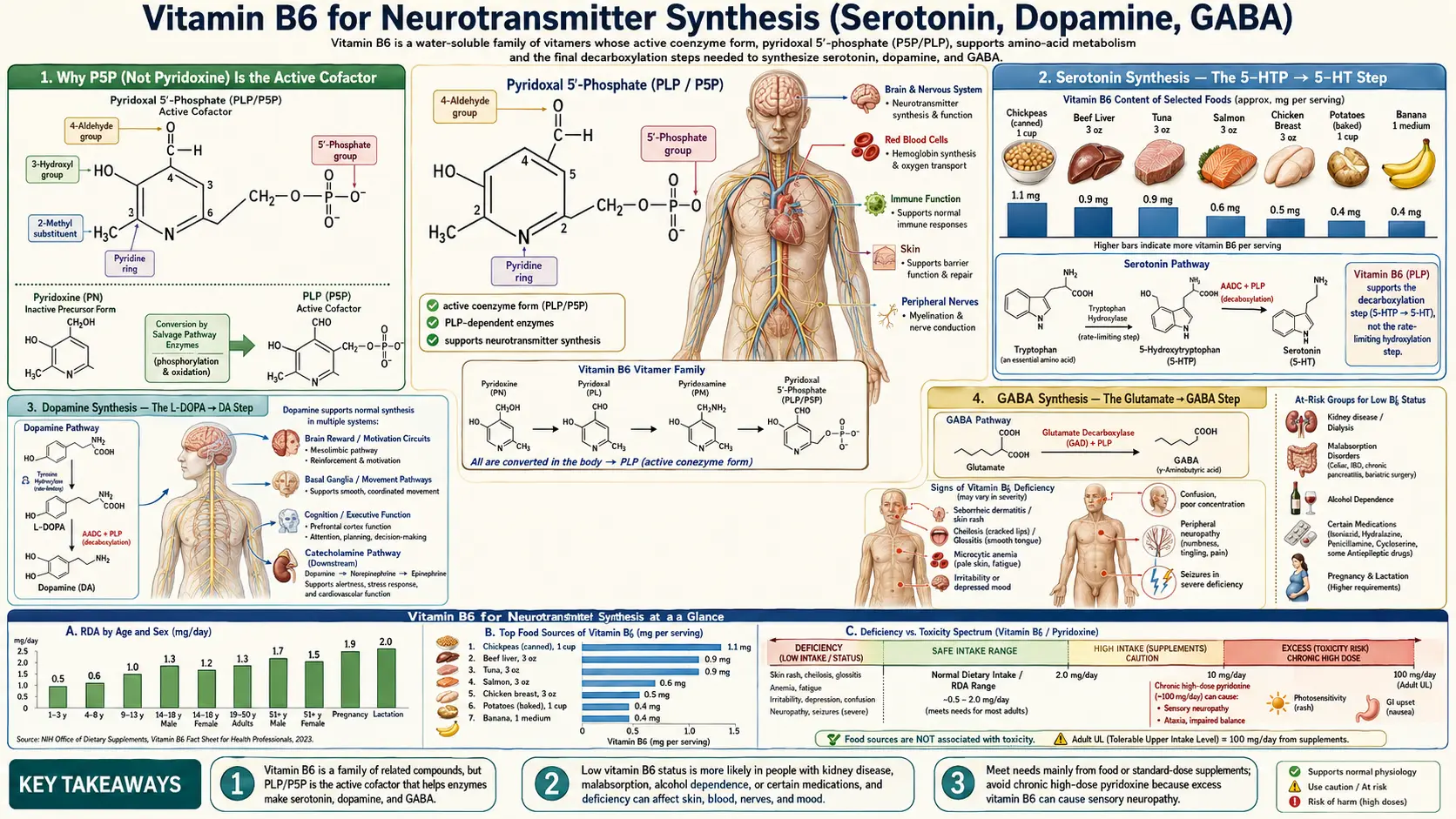
Pyridoxal 5'-phosphate (PLP, also written P5P), the active coenzyme form of vitamin B6, is the cofactor for the decarboxylase enzymes that make serotonin, dopamine, GABA, and histamine; norepinephrine and epinephrine depend on it indirectly, because they are made from dopamine. When the brain cannot maintain PLP, as in the rare inherited B6-dependent epilepsies, the result can be severe neonatal seizures with evidence of reduced neurotransmitter synthesis. Whether milder low B6 status contributes to depression or anxiety is less certain: observational studies link low plasma PLP with depressive symptoms, and trial evidence is limited. This deep dive covers the biochemistry, the PDE and PNPO genetic epilepsies, the B6 + magnesium autism studies, and what trials of B6 in mood and anxiety have reported.
Table of Contents
- Why P5P (Not Pyridoxine) Is the Active Cofactor
- Serotonin Synthesis — The 5-HTP → 5-HT Step
- Dopamine Synthesis — The L-DOPA → DA Step
- GABA Synthesis — The Glutamate → GABA Step
- Norepinephrine, Epinephrine, and Histamine
- Why One Enzyme (AADC) Makes Both Serotonin and Dopamine
- Why B6 Deficiency Causes Seizures
- Pyridoxine-Dependent Epilepsy (PDE, ALDH7A1)
- PNPO Deficiency and P5P-Responsive Epilepsy
- Autism Spectrum — The B6 + Magnesium Studies
- Depression and Anxiety: What Studies Report
- B6 and Antidepressant Medicines
- Doses Reported in Trials and Guidelines
- Safety Findings and Drug Interactions
- Key Research Papers
- Connections
- Featured Videos
Why P5P (Not Pyridoxine) Is the Active Cofactor
Of the vitamin B6 forms (pyridoxine, pyridoxal, pyridoxamine, and their phosphates), only pyridoxal 5'-phosphate (PLP/P5P) can function as a cofactor for enzymes; its role depends on its reactive aldehyde group (Wilson 2019). PLP forms a Schiff base (an imine bond) with the amino group of an amino-acid substrate, and its pyridine ring stabilizes the reaction intermediate. This chemistry lets PLP-dependent enzymes carry out transamination, decarboxylation, racemization, and elimination reactions on amino acids.
The intestine absorbs the non-phosphorylated B6 forms, which the body then converts to PLP (Wilson 2019). Pyridoxine and pyridoxamine are first phosphorylated by pyridoxal kinase (an ATP-dependent enzyme) and then oxidized by pyridox(am)ine 5'-phosphate oxidase (PNPO), a flavin (FMN)-dependent enzyme whose flavin comes from riboflavin (B2); pyridoxal needs only the kinase step. The difference matters most in inherited PNPO deficiency (below), where some infants' seizures stop with PLP after resisting pyridoxine (Mills 2005). Whether PLP supplements have advantages over pyridoxine HCl in people without these disorders has not been tested in human trials found for this review; a laboratory cell-culture comparison of the forms is covered in the Toxicity deep dive linked below.
Serotonin Synthesis — The 5-HTP → 5-HT Step
Serotonin (5-hydroxytryptamine, 5-HT) is synthesized in two enzymatic steps from dietary tryptophan:
- Tryptophan + O&sub2; → 5-hydroxytryptophan (5-HTP), catalyzed by tryptophan hydroxylase (TPH1/TPH2). This is the rate-limiting step and requires tetrahydrobiopterin (BH4), iron, and molecular oxygen.
- 5-HTP → serotonin, catalyzed by aromatic L-amino acid decarboxylase (AADC) — a P5P-dependent enzyme. This is the B6 step.
When PLP is lacking, AADC activity falls. In the five infants with PNPO deficiency described by Mills and colleagues (2005), cerebrospinal fluid and urine tests indicated reduced activity of AADC and other PLP-dependent enzymes. Serotonin is also the precursor of melatonin (see Insomnia). How far milder low B6 status lowers brain serotonin in adults has not been established in human studies.
Tryptophan and 5-HTP supply the substrate for this pathway and B6 the cofactor for its second step. Some integrative practitioners combine 5-HTP with P5P on that rationale; no controlled trial of the combination was found for this review.
Dopamine Synthesis — The L-DOPA → DA Step
Dopamine synthesis follows a structurally identical pathway from tyrosine (or phenylalanine → tyrosine):
- Tyrosine + O&sub2; → L-DOPA (3,4-dihydroxyphenylalanine), catalyzed by tyrosine hydroxylase. Rate-limiting; requires BH4, iron, oxygen.
- L-DOPA → dopamine, catalyzed by aromatic L-amino acid decarboxylase (AADC) — the same P5P-dependent enzyme that decarboxylates 5-HTP. This is the B6 step.
Dopamine signaling is involved in motivation, attention, working memory, and movement, and dopamine suppresses prolactin release through the tuberoinfundibular pathway. In inherited AADC deficiency, where this step fails, the combined lack of serotonin, dopamine, norepinephrine, and epinephrine produces hypotonia, movement disorders (oculogyric crises, dystonia, hypokinesia), developmental delay, and autonomic symptoms (Wassenberg 2017).
The Parkinson's disease combination of levodopa with carbidopa relies on the same enzyme: carbidopa inhibits AADC outside the brain, so less levodopa is converted to dopamine before it reaches the brain. Before carbidopa was added, pyridoxine was reported to reduce the effect of levodopa given alone, by speeding its conversion outside the brain; the carbidopa combination largely removed this interaction.
GABA Synthesis — The Glutamate → GABA Step
GABA (gamma-aminobutyric acid) is the brain's main inhibitory neurotransmitter; benzodiazepines, barbiturates, and alcohol act in part through GABA-A receptors. GABA is synthesized in a single enzymatic step:
- Glutamate → GABA + CO&sub2;, catalyzed by glutamate decarboxylase (GAD). GAD is a P5P-dependent enzyme. Two forms exist, the products of two genes: GAD65, found to a greater degree in nerve terminals, and GAD67, distributed more uniformly through the cell (Martin and Rimvall 1993).
This reaction converts glutamate, the brain's main excitatory neurotransmitter, into GABA, its main inhibitory one, so GAD activity bears directly on the balance between excitation and inhibition.
The binding of PLP is itself a major regulator of GAD. Martin and Rimvall (1993) report that at least 50% of brain GAD is present as apoenzyme (enzyme without bound PLP), mostly GAD65, forming a reserve of inactive enzyme that can be drawn on when more GABA is needed. Loss of GAD activity when PLP is depleted is the usual explanation for seizures in severe B6 deficiency and in the B6-dependent epilepsies described below.
Norepinephrine, Epinephrine, and Histamine
P5P participates in or supports the synthesis of several additional neuroactive amines:
- Norepinephrine — produced from dopamine by dopamine beta-hydroxylase (requires copper and vitamin C, not P5P). Because dopamine itself requires P5P-dependent AADC, a lack of PLP can lower norepinephrine indirectly; inherited AADC deficiency causes a combined deficiency of serotonin, dopamine, norepinephrine, and epinephrine (Wassenberg 2017).
- Epinephrine (adrenaline) — produced from norepinephrine by phenylethanolamine N-methyltransferase, which uses S-adenosylmethionine (SAMe) as its methyl donor; PLP is not a cofactor for this step.
- Histamine — produced from histidine by histidine decarboxylase, a P5P-dependent enzyme. While histamine is best known as an allergic mediator, it also functions as a neurotransmitter regulating wakefulness, and it stimulates gastric acid secretion.
- Melatonin — produced from serotonin in two steps, first to N-acetylserotonin and then to melatonin by an enzyme that uses SAMe as its methyl donor. Because serotonin synthesis needs PLP, B6 is indirectly upstream of melatonin.
- Taurine — not a classical neurotransmitter but an amino acid with inhibitory actions in the brain. Taurine synthesis from cysteine uses cysteine sulfinic acid decarboxylase, a P5P-dependent enzyme.
Why One Enzyme (AADC) Makes Both Serotonin and Dopamine
A single P5P-dependent enzyme — aromatic L-amino acid decarboxylase — performs the final synthetic step for both serotonin (5-HTP → 5-HT) and dopamine (L-DOPA → DA). Both substrates are aromatic amino acids, and the decarboxylation proceeds through the same PLP Schiff-base chemistry whether the side chain is the indole ring of 5-HTP or the catechol ring of L-DOPA.
A lack of PLP can therefore reduce serotonin and dopamine synthesis together, as the cerebrospinal fluid findings in PNPO deficiency indicate (Mills 2005). The idea that milder B6 shortfalls produce a combined serotonin-and-dopamine "dual depletion" picture in depression, or limit the response to SSRIs, is a hypothesis; no human study testing it was found for this review.
Inherited AADC deficiency (biallelic DDC mutations) is a rare autosomal recessive disorder that begins early in life with hypotonia, movement disorders such as oculogyric crises and dystonia, developmental delay, and autonomic symptoms. The 2017 international consensus guideline lists selective dopamine agonists, MAO inhibitors, and pyridoxine as first-line medical treatments, the vitamin being given to optimize residual AADC activity (Wassenberg 2017). A gene therapy, eladocagene exuparvovec, which delivers the DDC gene in an adeno-associated virus vector, was approved in the EU in July 2022 for patients aged 18 months and older with a severe phenotype (Keam 2022).
Why B6 Deficiency Causes Seizures
Severe vitamin B6 deficiency — from diet, from drugs that interfere with B6 such as isoniazid (the tuberculosis drug), or from genetic disorders — can cause convulsive seizures. Coursin's 1954 report in JAMA described convulsive seizures in infants fed a pyridoxine-deficient diet. The usual explanation is the loss of GAD activity described above.
With too little PLP, glutamate decarboxylase loses its cofactor, GABA synthesis falls, and the balance between excitation and inhibition shifts toward excitation.
For neonates with seizures that do not respond to standard antiseizure drugs, the 2011 recommendations for pyridoxine-dependent epilepsy describe a dose of 100 mg pyridoxine-HCl given intravenously, or 30 mg/kg/day by mouth or feeding tube. Because the first dose can cause respiratory arrest in responders, the recommendations describe giving it with respiratory support available, and continuing oral pyridoxine until antiquitin deficiency is excluded by biochemical or genetic testing, so that a late or masked response is not missed (Stockler 2011).
Pyridoxine-Dependent Epilepsy (PDE, ALDH7A1)
Pyridoxine-Dependent Epilepsy is a rare autosomal recessive metabolic disorder caused by mutations in ALDH7A1 (encoding antiquitin, an aldehyde dehydrogenase in the lysine breakdown pathway). It is characterized by early-onset epileptic encephalopathy that responds to large doses of pyridoxine; despite seizure control, most patients have intellectual disability (Stockler 2011).
The mechanism: when antiquitin fails, alpha-aminoadipic semialdehyde (alpha-AASA) and its cyclic partner piperideine-6-carboxylate (P6C) accumulate. P6C inactivates PLP by combining with it chemically (a Knoevenagel condensation), producing a functional B6 deficiency despite normal dietary intake (Mills 2006). Measurement of urinary alpha-AASA is used to confirm the diagnosis.
Treatment reported in the 2011 recommendations: long-term pyridoxine doses of 15–30 mg/kg/day in infants, up to 200 mg/day in neonates, and up to 500 mg/day in adults, with oral PLP up to 30 mg/kg/day as an alternative. A lysine-restricted diet has been proposed to address the accumulating metabolites; the authors state that a multicenter study on long-term outcomes is needed to document its benefit (Stockler 2011).
The recommendations also note that the first response to pyridoxine can be late or masked, which is why oral pyridoxine is continued until the diagnosis has been excluded (Stockler 2011).
PNPO Deficiency and P5P-Responsive Epilepsy
A closely related but distinct disorder: pyridox(am)ine 5'-phosphate oxidase (PNPO) deficiency. PNPO is the enzyme that converts pyridoxine phosphate or pyridoxamine phosphate into the active P5P. In children with biallelic PNPO mutations, the body cannot efficiently make PLP from pyridoxine or pyridoxamine.
In the first five patients described, neonatal seizures had resisted pyridoxine and stopped when pyridoxal 5'-phosphate (P5P) was given (Mills 2005). Later series showed a broader picture. Plecko and colleagues (2014) found PNPO mutations in 11 patients whose seizures responded to pyridoxine, and two of them developed status epilepticus when switched to PLP; Mills and colleagues (2014) described a further group with PNPO mutations whose seizures responded to pyridoxine, and some patients whose symptoms worsened on changing from pyridoxine to PLP. Plecko and colleagues concluded that the findings challenge the idea of exclusive PLP responsiveness and underline the importance of testing pyridoxine and PLP one after the other in neonates with drug-resistant seizures.
The 2011 recommendations for pyridoxine-dependent epilepsy note that starting treatment with PLP does not delay treatment in PNPO-deficient patients who respond only to PLP (Stockler 2011).
Autism Spectrum — The B6 + Magnesium Studies
Bernard Rimland, founder of the Autism Research Institute, was a leading early proponent of high-dose vitamin B6 for autism. In his 1978 double-blind crossover study, 16 children who had apparently improved on B6 in an earlier open study had their supplement replaced, during two trial periods, by either B6 or a matched placebo; behavior was rated as deteriorating significantly during B6 withdrawal (Rimland 1978). Magnesium was later combined with B6; the Cochrane review notes it was found to reduce undesirable side effects from B6 (Nye and Brice 2005).
The proposed rationale: because B6 is the cofactor for serotonin and dopamine synthesis, proponents suggest that a subgroup of autistic children has impaired PLP-dependent neurotransmitter metabolism. This remains a hypothesis.
What the systematic review found: the 2005 Cochrane review included three randomized studies with 33 participants in total. One provided insufficient data for analysis; one crossover study found no significant differences between B6 and placebo on social interaction, communication, compulsivity, impulsivity, or hyperactivity; and one small study (n=8) of children with features similar to pyridoxine-dependent epilepsy reported a statistically significant IQ benefit. Because of the small number of studies, their methodological quality, and small sample sizes, the reviewers concluded that no recommendation can be advanced regarding B6-magnesium as a treatment for autism (Nye and Brice 2005). A separate three-month randomized trial of a broad vitamin/mineral supplement (not B6 and magnesium alone) in 141 children and adults with autism reported greater improvement than placebo on a parent-rated global scale, but not on three other assessment tools (Adams 2011).
The neuropathy concern: high-dose pyridoxine is linked to sensory neuropathy. The US/Canadian adult Tolerable Upper Intake Level is 100 mg/day (Institute of Medicine, 1998), and the European Food Safety Authority set 12 mg/day in 2023. Case series, doses, and recovery are covered in the Toxicity deep dive. Decisions about supplements belong with a clinician.
Depression and Anxiety: What Studies Report
Observational studies have linked low B6 status with depressive symptoms: in a Danish study of 140 people, a low plasma PLP level was significantly associated with the depression score, and the authors called for randomized trials to test whether B6 treatment improves symptoms (Hvas 2004). A 2005 systematic review of vitamin B6 as a treatment for depression (ten articles, including five randomized trials) found no meaningful treatment effect for depression in general, but a consistent message in papers on pre-menopausal women, and called for further study in hormone-related depression (Williams 2005).
For anxiety, a double-blind trial at the University of Reading (Field 2022) recruited 478 young adults over five linked phases and gave 100 mg pyridoxine HCl, 1,000 µg vitamin B12, or placebo daily for one month. In the participants assessed for anxiety (N = 265), B6 reduced self-reported anxiety; it also produced a trend toward reduced depression and increased visual surround suppression, a sensory measure of neural inhibition. The authors interpret the results as consistent with B6's role in GABA synthesis. The 100 mg/day dose equals the US/Canadian adult Upper Intake Level and is above the EFSA limit of 12 mg/day.
For depression, no large randomized trial of B6 alone and no controlled trial of P5P added to SSRI treatment was found for this review; reports of P5P augmentation come from integrative practice rather than trials.
For premenstrual symptoms, a 1999 systematic review in the BMJ of nine trials (940 patients) reported an odds ratio of 2.32 versus placebo for improvement in overall premenstrual symptoms and 1.69 for depressive symptoms (four trials, 541 patients). The authors state that conclusions are limited by the low quality of most of the trials and that the results suggest doses up to 100 mg/day are likely to be of benefit (Wyatt 1999). This is covered in the PMS deep dive.
B6 and Antidepressant Medicines
SSRIs (sertraline, escitalopram, fluoxetine, etc.) work by blocking serotonin reuptake, leaving more 5-HT in the synapse to act on receptors. They do not increase serotonin synthesis, which depends on the PLP-dependent AADC step. Whether low B6 status limits the response to SSRIs has not been tested in a controlled trial found for this review.
Some integrative practitioners describe adding P5P to SSRI treatment in people who respond poorly, on the rationale that serotonin synthesis may be limited. This rests on biochemistry and clinical observation rather than trial evidence.
SNRIs (venlafaxine, duloxetine) also block norepinephrine reuptake; norepinephrine depends on PLP indirectly, through dopamine synthesis.
Tricyclic antidepressants, MAOIs, and atypical antidepressants (bupropion, mirtazapine) also act on monoamine systems whose synthesis involves PLP. No study found for this review tested whether B6 status changes their effect.
Doses Reported in Trials and Guidelines
In anxiety, mood, and premenstrual studies
- Anxiety trial (Field 2022): 100 mg pyridoxine HCl daily for one month in young adults
- Premenstrual syndrome trials reviewed by Wyatt (1999): the authors conclude doses up to 100 mg/day are likely to be of benefit, with low trial quality limiting conclusions
- No controlled trial of P5P for mood or anxiety was found for this review
- Magnesium is often combined with B6 in integrative practice; the studied example is the B6 + magnesium regimen in autism (Nye and Brice 2005)
- Upper limits for total B6 intake in adults: 100 mg/day (US/Canadian Institute of Medicine, 1998); 12 mg/day (EFSA, 2023)
Alongside antidepressants
- No trial-derived dose was found; decisions about combining supplements with prescription medicines belong with the prescribing clinician
In pyridoxine-dependent epilepsy and PNPO deficiency
- Managed by pediatric neurology and metabolic specialists
- PDE (Stockler 2011): 100 mg pyridoxine-HCl IV, or 30 mg/kg/day orally, to interrupt seizures; long-term 15–30 mg/kg/day in infants, up to 200 mg/day in neonates, up to 500 mg/day in adults; oral PLP up to 30 mg/kg/day as an alternative
- PNPO deficiency: some patients respond only to PLP, others to pyridoxine (Mills 2005; Plecko 2014; Mills 2014)
- A lysine-restricted diet has been proposed for PDE; its benefit has not yet been documented in a multicenter outcome study (Stockler 2011)
In AADC deficiency
- The 2017 consensus guideline lists pyridoxine as a first-line agent, starting at 100 mg/day in two doses, maximum 200 mg/day (Wassenberg 2017)
In the autism B6 + magnesium studies
- The Cochrane review found too few, too small, and methodologically limited studies for any recommendation to be advanced (Nye and Brice 2005)
- High pyridoxine doses carry the neuropathy risk described in the Toxicity deep dive
Safety Findings and Drug Interactions
- Sensory neuropathy is the main toxicity of high-dose B6 — the US/Canadian adult Tolerable Upper Intake Level is 100 mg/day (Institute of Medicine, 1998) and the European Food Safety Authority's is 12 mg/day (2023); EFSA states that symptoms may occur at daily intakes of 50 mg and below, with large differences between individuals. The AADC deficiency guideline notes that both pyridoxine and PLP can cause reversible polyneuropathy when used in high doses for long periods (Wassenberg 2017). No human study comparing neuropathy rates between PLP and pyridoxine HCl was found. See the Toxicity deep dive for full discussion.
- Isoniazid interaction — the tuberculosis drug isoniazid interferes with vitamin B6 metabolism, and pyridoxine supplementation during isoniazid therapy is used to prevent peripheral neuropathy, particularly in higher-risk groups (Snider 1980). A 2011 systematic review notes that guidelines differ between industrialized and developing countries and that the optimum pyridoxine dose where TB and HIV are common remains to be defined (van der Watt 2011).
- Levodopa interaction (legacy concern) — pyridoxine was reported to reduce the effect of levodopa given without a decarboxylase inhibitor; carbidopa/levodopa combinations largely removed this interaction. In AADC deficiency, the guideline reports gastrointestinal complaints, sleep problems, and extreme motor restlessness in patients on very high pyridoxine doses together with L-Dopa (Wassenberg 2017).
- Anticonvulsants — long-term use of some antiseizure drugs, including phenytoin and phenobarbital, has been associated with lower B6 status.
- Penicillamine, hydralazine, cycloserine — are reported to act as B6 antagonists.
- Oral contraceptives — in US national survey data (NHANES 2003–2004), most oral contraceptive users had plasma PLP below 20 nmol/L (Morris 2008). See the PMS & Hormonal deep dive.
- Pregnancy — pyridoxine is used for nausea and vomiting of pregnancy; the evidence is covered in the PMS & Hormonal deep dive.
Key Research Papers
- Wassenberg T, Molero-Luis M, Jeltsch K, et al. (2017). Consensus guideline for the diagnosis and treatment of aromatic l-amino acid decarboxylase (AADC) deficiency. Orphanet Journal of Rare Diseases, 12:12. — PubMed PMID: 28100251
- Mills PB et al. (2006). Mutations in antiquitin in individuals with pyridoxine-dependent seizures. Nature Medicine, 12:307-309. — PubMed PMID: 16491085
- Mills PB et al. (2005). Neonatal epileptic encephalopathy caused by mutations in the PNPO gene encoding pyridox(am)ine 5'-phosphate oxidase. Human Molecular Genetics. — PubMed PMID: 15772097
- Stockler S et al. (2011). Pyridoxine dependent epilepsy and antiquitin deficiency: clinical and molecular characteristics and recommendations for diagnosis, treatment and follow-up. Molecular Genetics and Metabolism. — PubMed PMID: 21704546
- Field DT et al. (2022). High-dose Vitamin B6 supplementation reduces anxiety and strengthens visual surround suppression. Human Psychopharmacology. — PubMed PMID: 35851507
- Adams JB et al. (2011). Effect of a vitamin/mineral supplement on children and adults with autism. BMC Pediatrics. — PubMed PMID: 22151477
- Nye C, Brice A (2005). Combined vitamin B6-magnesium treatment in autism spectrum disorder. Cochrane Database. — PubMed PMID: 16235322
- Rimland B, Callaway E, Dreyfus P (1978). The effect of high doses of vitamin B6 on autistic children: a double-blind crossover study. American Journal of Psychiatry. — PubMed PMID: 345827
- Williams AL et al. (2005). The role for vitamin B-6 as treatment for depression: a systematic review. Family Practice, 22:532-537. — PubMed PMID: 15964874
- Hellmann H, Mooney S (2010). Vitamin B6: a molecule for human health? Molecules. — PubMed PMID: 20110903
- Coursin DB (1954). Convulsive seizures in infants with pyridoxine-deficient diet. JAMA. The original report. — PubMed PMID: 13117629
- Wyatt KM, Dimmock PW, Jones PW, O'Brien PMS (1999). Efficacy of vitamin B-6 in the treatment of premenstrual syndrome: systematic review. BMJ, 318:1375-1381. — PubMed PMID: 10334745
- Wilson MP, Plecko B, Mills PB, Clayton PT (2019). Disorders affecting vitamin B6 metabolism. Journal of Inherited Metabolic Disease, 42:629-646. — PubMed PMID: 30671974
- Plecko B et al. (2014). Pyridoxine responsiveness in novel mutations of the PNPO gene. Neurology, 82:1425-1433. — PubMed PMID: 24658933
- Mills PB et al. (2014). Epilepsy due to PNPO mutations: genotype, environment and treatment affect presentation and outcome. Brain, 137:1350-1360. — PubMed PMID: 24645144
- Keam SJ (2022). Eladocagene exuparvovec: first approval. Drugs, 82:1427-1432. — PubMed PMID: 36103022
- Martin DL, Rimvall K (1993). Regulation of gamma-aminobutyric acid synthesis in the brain. Journal of Neurochemistry, 60:395-407. — PubMed PMID: 8419527
- Hvas AM, Juul S, Bech P, Nexø E (2004). Vitamin B6 level is associated with symptoms of depression. Psychotherapy and Psychosomatics, 73:340-343. — PubMed PMID: 15479988
- Morris MS, Picciano MF, Jacques PF, Selhub J (2008). Plasma pyridoxal 5'-phosphate in the US population: the National Health and Nutrition Examination Survey, 2003-2004. American Journal of Clinical Nutrition, 87:1446-1454. — PubMed PMID: 18469270
- Snider DE Jr (1980). Pyridoxine supplementation during isoniazid therapy. Tubercle, 61:191-196. — PubMed PMID: 6269259
- van der Watt JJ, Harrison TB, Benatar M, Heckmann JM (2011). Polyneuropathy, anti-tuberculosis treatment and the role of pyridoxine in the HIV/AIDS era: a systematic review. International Journal of Tuberculosis and Lung Disease, 15:722-728. — PubMed PMID: 21477422
PubMed Topic Searches
Connections
- All Vitamins
- Vitamin B6 Overview
- B6 Benefits Hub
- B6 for PMS & Hormonal
- B6 for Homocysteine
- B6 Toxicity (READ FIRST)
- Pyridoxine and Brain Health
- Vitamin B2 (Riboflavin — required for B6 activation)
- Vitamin B9 (Folate)
- Vitamin B12
- Magnesium
- Tryptophan
- Glycine
- Depression
- Anxiety
- Insomnia
- Peripheral Neuropathy
- Deficiency
- Toxicity
- History
- Sources