Vitamin B6 Toxicity & Pyridoxine-Induced Sensory Neuropathy
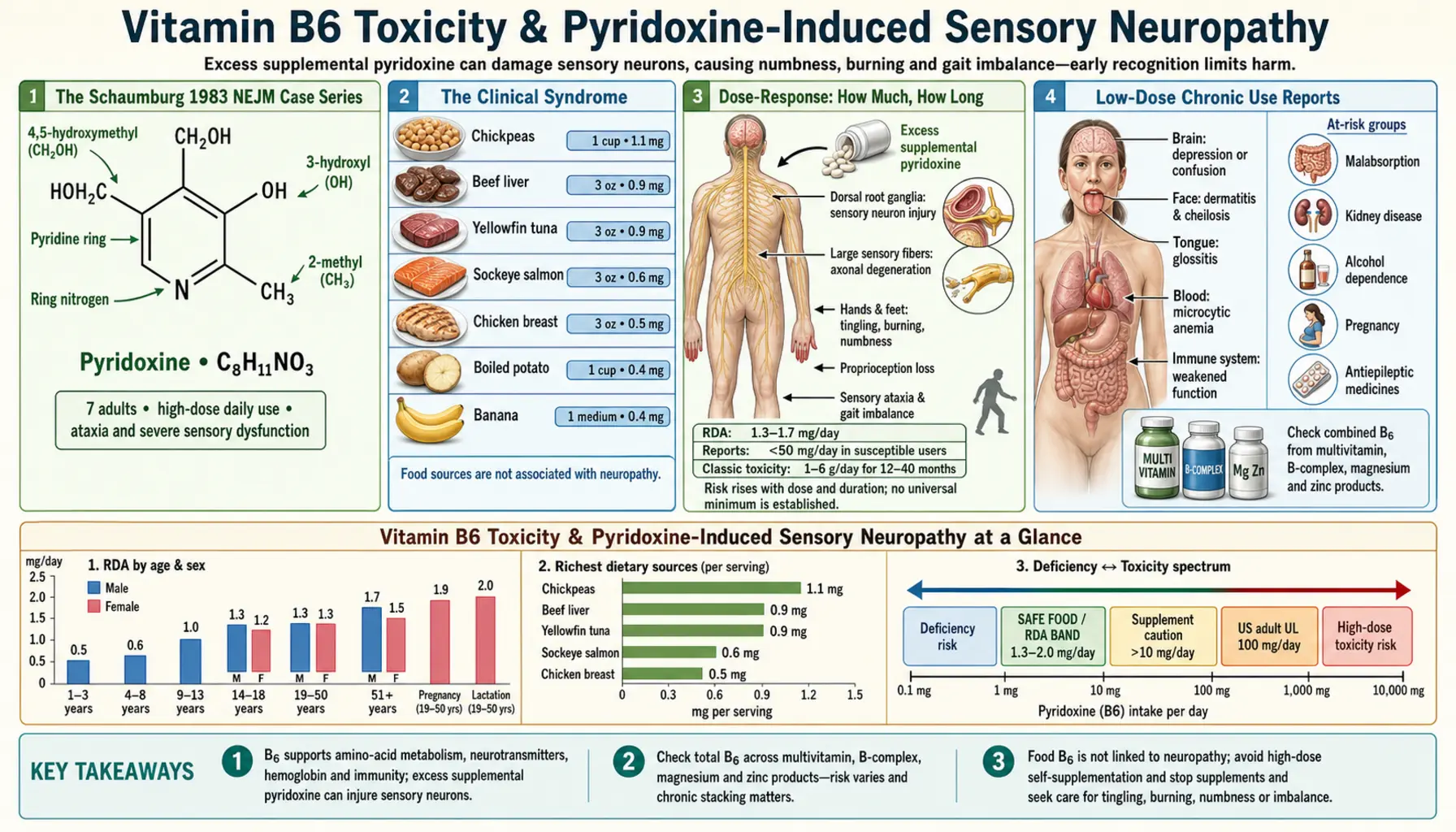
⚠ Key safety findings on high-dose vitamin B6
High supplemental intakes of pyridoxine, the form of vitamin B6 in most supplements, are linked to a peripheral sensory neuropathy. The US/Canadian Institute of Medicine (1998) set the adult Tolerable Upper Intake Level at 100 mg/day; the European Food Safety Authority (2023) set it at 12 mg/day, stating that symptoms may occur at daily intakes of 50 mg and below, with large differences between individuals. Most case series describe improvement after pyridoxine is withdrawn, but some patients have not recovered. Both upper limits refer to total intake, so B6 from several products adds together. Decisions about supplements belong with a clinician.
The first clinical report of pyridoxine-induced neurotoxicity in humans was published in 1983 by Herbert Schaumburg and colleagues in the New England Journal of Medicine: seven adults with ataxia and severe sensory dysfunction after high daily pyridoxine intake. Later case series extended the reports to lower doses, expert bodies and regulators in the United States and Canada, Europe, the United Kingdom, Australia and the Netherlands set different limits, and laboratory studies proposed how excess pyridoxine might injure sensory neurons. This deep dive sets out what the case series report about doses and recovery, how each authority derived its limit, the mechanism hypotheses, what blood tests have shown, and how the syndrome differs from B12-deficiency neuropathy.
Table of Contents
- The Schaumburg 1983 NEJM Case Series
- The Clinical Syndrome
- Dose-Response: How Much, How Long
- Low-Dose Chronic Use Reports
- Proposed Mechanisms
- P5P Versus Pyridoxine HCl: What Is Known
- The US/Canadian Upper Limit and Other National Limits
- EFSA 2023, the Netherlands and Australia
- Early Symptoms Described in the Reports
- Reversibility & Time Course of Recovery
- Differential Diagnosis vs B12-Deficiency Neuropathy
- Where Supplemental B6 Comes From
- Use Patterns Seen in the Case Reports
- Lab Testing: What Blood B6 and PLP Levels Show
- Key Points From the Research
- Key Research Papers
- Connections
- Featured Videos
The Schaumburg 1983 NEJM Case Series
Herbert Schaumburg and colleagues published "Sensory neuropathy from pyridoxine abuse: a new megavitamin syndrome" in the New England Journal of Medicine on 25 August 1983. The abstract describes seven adults who had ataxia and severe sensory-nervous-system dysfunction after daily high-level pyridoxine consumption.
- The Institute of Medicine's 1998 review of the paper describes five women and two men whose intakes started at 50–100 mg/day and were steadily increased to 2–6 g/day over 2 to 40 months; none had signs or symptoms at doses below 2 g/day.
- Four of the seven were severely disabled; the IOM review states that four were unable to walk.
- Weakness was not a feature, and the central nervous system was clinically spared.
- All seven improved after pyridoxine was withdrawn.
The authors concluded that large doses of pyridoxine can cause sensory neuropathy or neuronopathy syndromes and called for safe guidelines for the vitamin's use. The IOM notes that the causal link between high-dose pyridoxine and neuropathy had been documented in animals since 1940 and in humans since this 1983 report.
The Clinical Syndrome
The case series describe a predominantly sensory disorder, with some reported exceptions:
- Sensory ataxia and sensory loss — ataxia and severe sensory dysfunction in the Schaumburg series; sensory ataxia with signs of polyneuropathy in three patients aged 80–83 (Kulkantrakorn 2014).
- Pure sensory pattern — Parry and Bredesen (1985) described a consistent clinical picture of a "pure sensory central-peripheral distal axonopathy" in 16 patients.
- Burning pain, numbness and tingling in a stocking-glove distribution, with both large- and small-fiber nerve dysfunction and abnormal autonomic tests, in a 2017 case report (Bacharach 2017).
- Other reported symptoms — paraesthesia, hyperaesthesia, bone pains, muscle weakness, numbness and fasciculation, most marked in the extremities, in the Dalton and Dalton (1987) series of women taking B6 for premenstrual syndrome.
- Motor involvement in some cases — mixed motor and sensory neuropathy in an 81-year-old woman (Foca 1985) and a severe sensorimotor neuropathy with muscle weakness after 9.6 g/day (Gdynia 2008), described by those authors as unusual for what the literature suggests is a pure sensory neuronopathy.
Electrodiagnostic and sensory testing
- Symmetric axonal sensory polyneuropathy on electrodiagnostic testing in two of three patients (Kulkantrakorn 2014).
- In a prospective study in five healthy volunteers given 1 or 3 g/day, sensory symptoms and quantitative sensory threshold (QST) abnormalities appeared together, and QST changes could precede changes in nerve conduction studies (Berger 1992).
- After massive parenteral (injected) doses, Albin and colleagues (1987) described an acute, profound and permanent sensory deficit, probably from a sensory ganglion neuronopathy, with transient autonomic dysfunction and mild weakness.
Dose-Response: How Much, How Long
The reports describe both dose and duration as contributing:
- 2–6 g/day — the Schaumburg 1983 series (2 to 40 months). The IOM review states that the risk of sensory neuropathy "decreases quite rapidly at doses below 1 g/day."
- 0.2–5 g/day — Parry and Bredesen (1985), 16 patients; duration of use before symptoms was inversely proportional to the daily dose. The IOM notes that the paper's tables include two patients on 500 mg/day (for 8 and 36 months) and one on 100–200 mg/day for 36 months, a finding the IOM judged in conflict with the weight of evidence for 100–200 mg/day.
- 1 or 3 g/day — in Berger (1992), volunteers on the higher dose became symptomatic earlier, and the authors describe a clear dose relationship.
- 600 mg/day for 3–10 years — three older patients taking a combination B1-B6-B12 tablet (Kulkantrakorn 2014).
- 100–150 mg/day for up to 5 years — no sensory neuropathy detected in 70 patients treated for diabetic neuropathy or carpal tunnel syndrome (Bernstein and Lobitz 1988, as summarised by the IOM); 100–300 mg/day for 4 months in 24 carpal tunnel patients (Del Tredici 1985) likewise formed part of the IOM's no-observed-adverse-effect level.
- 50–500 mg/day — Dalton and Dalton (1987) studied 172 women with raised serum B6; the 103 with neurological symptoms had taken a mean of 117 mg/day, similar to the women without symptoms, but for longer on average (2.9 versus 1.6 years).
- 50 mg/day and below — EFSA (2023) concluded that symptoms "may occur at daily vitamin B6 intakes of 50 mg and below with a large interindividual variability," and described 50 mg/day as the lowest intake associated with certainty with neuropathy when consumed for more than 6 months.
Susceptibility. EFSA describes large differences between individuals and an inverse relationship between dose and time to onset. The IOM's 1998 review "failed to identify special subgroups that are distinctly susceptible," and EFSA found no indication that men are more susceptible than women.
Low-Dose Chronic Use Reports
Reports at doses below the US/Canadian upper limit of 100 mg/day come mainly from pharmacovigilance (adverse-reaction reporting) systems and one older clinic series:
- Dalton and Dalton (1987) — women attending a premenstrual-syndrome practice who had taken 50–500 mg/day (mean 117 mg/day in those with symptoms). The IOM judged the study too weak to use for its limit, citing poorly detailed symptoms and possibly underestimated doses; EFSA used it in 2023 as the basis of its 50 mg/day reference point.
- Netherlands Pharmacovigilance Centre Lareb (van Hunsel 2018) — 90 reports of peripheral-neuropathy-type reactions with B6-containing products, which contained 1.4 to 100 mg per tablet. The authors concluded a causal role was plausible, "especially the case with higher dosages and prolonged use, but dosages < 50 mg/day also cannot be excluded."
- The same Dutch database to the end of 2023 (van Hunsel 2025) — 224 reports. After the 2018 dose maximum, only one report mentioned a dose much higher than 21 mg/day, and reports per time period were lower from the second half of 2019, though low-dose cases were still reported.
- EFSA's review of Dutch vigilance data — of the 47 cases with dose, latency and plasma data, supplemental doses ranged from 1.4 to 209 mg/day, and 41 had taken 100 mg/day or less. EFSA notes there was no information on how neuropathy was diagnosed.
Not every study finds an association. In a Dutch case-control study of 381 patients with chronic idiopathic axonal polyneuropathy and 140 controls, blood B6 levels, daily dose, cumulative dose and duration of use did not differ significantly, though more patients than controls used B6-containing supplements (31% versus 22%); the authors concluded an association with this milder neuropathy "appears unlikely" (Visser 2014).
Why some people react at lower doses is not established. EFSA notes individual differences in vitamin B6 metabolism that have been described, especially with supplemental pyridoxine HCl.
Proposed Mechanisms
How excess pyridoxine injures sensory neurons is not settled; Hadtstein and Vrolijk (2021) write that "the pathogenic mechanisms associated with PN toxicity remain elusive." The main hypotheses in the literature:
- Competitive inhibition of PLP-dependent enzymes. In a cell-culture study, pyridoxine — but not pyridoxal, pyridoxamine, pyridoxal-5'-phosphate (PLP, also called P5P) or pyridoxamine-5'-phosphate — reduced the viability of SH-SY5Y neuronal cells in a concentration-dependent way and inhibited two PLP-dependent enzymes. The authors propose that the inactive form pyridoxine competitively inhibits the active PLP, so that symptoms of excess resemble those of deficiency (Vrolijk 2017). This is an in vitro (laboratory cell) finding.
- Inhibition of pyridoxal kinase (PDXK). Hadtstein and Vrolijk (2021) note that inherited PDXK mutations cause an axonal sensory neuropathy, propose that high circulating pyridoxine may inhibit PDXK in a similar way, and suggest disrupted GABA signalling in sensory neurons as the downstream step. Because pyridoxine is relatively impermeable to the blood-brain barrier, they suggest the effect would be confined to peripheral tissues. They conclude this is "the most plausible mechanism," a hypothesis rather than a demonstrated pathway.
- Sensory ganglion injury. Clinical reports describe the pattern as a sensory neuronopathy or ganglion neuronopathy (Schaumburg 1983; Albin 1987).
EFSA (2023), citing Hadtstein and Vrolijk, notes that the symptoms of B6-toxicity neuropathy "do not fully overlap" with those of vitamin B6 deficiency, so the "functional deficiency" explanation is not complete.
P5P Versus Pyridoxine HCl: What Is Known
- In the cell-culture study by Vrolijk and colleagues (2017), only pyridoxine reduced neuronal cell viability; PLP (P5P) and the other vitamers did not. This is a laboratory finding and has not been tested as a human outcome.
- Pyridoxine HCl is the most widespread form of vitamin B6 in food supplements (EFSA 2023).
- EFSA notes that free pyridoxine may also be detected in some individuals after PLP supplementation; its 2023 opinion covers all sources of vitamin B6 authorised for addition to foods and food supplements in the EU.
- No human study comparing neuropathy rates between PLP and pyridoxine HCl was found for this review.
The US/Canadian Upper Limit and Other National Limits
The Food and Nutrition Board of the Institute of Medicine (now the National Academies) set the adult Tolerable Upper Intake Level (UL) for vitamin B6 at 100 mg/day in 1998. The UL is often attributed to the FDA, but it was set by the IOM. Its derivation, as the report states it:
- No-observed-adverse-effect level (NOAEL): 200 mg/day, from Bernstein and Lobitz (1988; 100–150 mg/day for up to 5 years) and Del Tredici and colleagues (1985; 100–300 mg/day for 4 months), described as "the average of 100 and 300 mg/day."
- Lowest-observed-adverse-effect level (LOAEL): 500 mg/day, from a case report by Berger and Schaumburg (1984) of a woman who developed neuropathy after raising her dose from 200 to 500 mg/day.
- Uncertainty factor: 2, "based on the limitations of the data involving pyridoxine doses of less than 500 mg/day." 200 divided by 2 gives the 100 mg/day UL for adults.
- The IOM states that the UL "is not meant to apply to individuals who are being treated with PN under close medical supervision."
The IOM report gives median US intakes of B6 from food of about 2 mg/day for men and 1.4 mg/day for women, and an RDA of 1.3 mg for young adults. No adverse effects have been associated with high intake of vitamin B6 from food sources.
Other limits, as listed by EFSA (2023, Table 1)
- European Commission Scientific Committee on Food (SCF), 2000: 25 mg/day for adults, including pregnant and lactating women.
- UK Expert Group on Vitamins and Minerals (EVM), 2003: 10 mg/day, expressed as 0.17 mg/kg body weight per day of supplemental pyridoxine for a 60-kg adult.
- Australian and New Zealand NHMRC, 2006: 50 mg/day. It used the same 200 mg/day NOAEL but an uncertainty factor of 4, because exposure in the underlying studies was 5–6 months or less and symptoms may take longer to appear.
- EFSA, 2023: 12 mg/day (next section).
EFSA 2023, the Netherlands and Australia
The European Food Safety Authority's Panel on Nutrition, Novel Foods and Food Allergens published its scientific opinion on the vitamin B6 UL in May 2023, replacing the SCF's 25 mg/day. As the abstract states:
- Peripheral neuropathy is "well established" as the critical effect; a LOAEL "could not be established based on human data."
- A reference point of 50 mg/day was taken from a case-control study (Dalton and Dalton 1987), supported by case reports and vigilance data.
- An uncertainty factor of 4 was applied for the inverse relationship between dose and time to onset and the limited data, giving 12.5 mg/day. A separate calculation from a subchronic study in Beagle dogs gave 11.7 mg/day; from the midpoint of the two, rounded down, the Panel set 12 mg/day for adults, including pregnant and lactating women.
- ULs for children were scaled from the adult value: 2.2–2.5 mg/day (4–11 months), 3.2–4.5 mg/day (1–6 years) and 6.1–10.7 mg/day (7–17 years).
- EU populations are "unlikely to exceed ULs, except for regular users of food supplements containing high doses of vitamin B6."
The Netherlands
After review of cases in the Dutch spontaneous reporting system, the maximum daily dose of vitamin B6 in supplements was lowered to 21 mg/day from 1 October 2018 (van Hunsel 2025). EFSA's survey of member states lists other national supplement maxima of 4.2 mg/day (Luxembourg), 10 mg/day (Italy) and 18 mg/day (Poland).
Australia
A 2026 analysis of Australian pharmacy sales describes regulatory action to reschedule products containing 50 mg or more of pyridoxine to Schedule 3 (pharmacist only), with an implementation period, and a 2023 withdrawal of products above 100 mg. Over August 2022 to July 2025, products providing 10–49 mg made up 54.20% of unit sales of products at 5 mg or more, and products at 50 mg or more made up 16.75% (Chan 2026). The Therapeutic Goods Administration's own notices could not be retrieved for this review, so the dates and thresholds above are as that paper reports them.
Early Symptoms Described in the Reports
- Tingling, numbness and burning pain in the feet and hands, in a stocking-glove distribution (Bacharach 2017).
- Paraesthesia, hyperaesthesia, numbness, bone pains, muscle weakness and fasciculation, mostly in the extremities and usually on both sides (Dalton and Dalton 1987).
- Changes in temperature and vibration sensing. In healthy volunteers given 1 g/day, rises in thermal sensory thresholds came before or exceeded those for vibration; at 3 g/day both changed together (Berger 1992).
- Unsteady gait — sensory ataxia was the presenting problem in the Schaumburg series and in three older patients after 3–8 months of symptoms (Kulkantrakorn 2014).
In Berger's study, sensory symptoms and quantitative sensory test abnormalities appeared at the same time, and the authors describe QST as a sensitive measure for detecting early peripheral neuropathy.
Reversibility & Time Course of Recovery
Recovery varies across the reports:
- Coasting. In Berger (1992), symptoms continued to progress for 2 to 3 weeks after pyridoxine was stopped, even though serum pyridoxal phosphate had returned to normal; the authors concluded that coasting appears unrelated to persistently elevated blood levels.
- Improvement after withdrawal. All seven Schaumburg patients improved after withdrawal, and Parry and Bredesen (1985) report improvement in all patients with adequate follow-up.
- Complete recovery within 6 months in the Dalton and Dalton (1987) series; EFSA's reading of the data is that 55% of women reported partial or complete recovery after 3 months and all had recovered after 6 months. The authors suggested that the lower doses may account for the complete recovery.
- No significant improvement in neuropathy or gait two years after stopping, in three patients aged 80–83 who had taken 600 mg/day for 3–10 years (Kulkantrakorn 2014).
- Permanent deficit after massive parenteral doses (Albin 1987).
- In the Dutch case-control study of chronic idiopathic axonal polyneuropathy, patients confirmed to have stopped B6 supplements showed slow progression in 64%, stabilisation in 26% and regression in 10% (Visser 2014) — a different, milder neuropathy whose link to B6 the authors judged unlikely.
No trial of treatments used for other neuropathies — such as alpha-lipoic acid, studied in diabetic neuropathy (covered in the ALA for Diabetic Neuropathy deep dive) — in pyridoxine-induced neuropathy was found in PubMed for this review.
Differential Diagnosis vs B12-Deficiency Neuropathy
B12 deficiency and B6 excess can both produce a sensory neuropathy, and the reported management runs in opposite directions: B12 deficiency is treated with B12 replacement, while pyridoxine neuropathy has been managed in the case reports by withdrawing pyridoxine. Some of the reported B6 cases involved combination B1-B6-B12 tablets (Kulkantrakorn 2014). The table below summarises general clinical features.
| Feature | B6 Toxicity | B12 Deficiency |
|---|---|---|
| Sensory deficit | Predominantly sensory; small-fiber and autonomic involvement reported in one case | Sensory with prominent posterior column involvement; vibration and position both lost |
| Motor deficit | Usually none; motor involvement reported in some cases | May have spasticity, weakness (subacute combined degeneration) |
| Reflexes | Diminished or absent | May be diminished or hyperactive (UMN involvement) |
| Plantar response | Downgoing (normal) | May be upgoing (Babinski) |
| Cognition | Preserved | May have memory loss, dementia features |
| Lhermitte's sign | Sometimes present | Sometimes present |
| CBC / smear | Normal | Macrocytic anemia with hypersegmented neutrophils |
| Plasma B12 | Not affected by B6 itself | Low or low-normal; elevated MMA confirms deficiency |
| Plasma P5P (B6 status) | Often markedly elevated in case reports | Not specifically affected |
| Treatment | Pyridoxine withdrawn in the case reports | B12 replacement (oral or injection) |
In the reported cases, the work-up included a supplement history, investigations for other causes of neuropathy and blood vitamin B6 measurement (Kulkantrakorn 2014; Bacharach 2017).
Where Supplemental B6 Comes From
- Over-the-counter strengths. The IOM (1998) notes that pyridoxine "is available over the counter in many dosages ranging up to 100 mg or more." Products in the Dutch reports contained 1.4 to 100 mg per tablet (van Hunsel 2018).
- Combination products. The three patients in Kulkantrakorn (2014) took their 600 mg/day as a vitamin B1-B6-B12 combination tablet.
- Several products at once. In the Australian sales data, multiple B6 products were bought in 7.73% of transactions and duplicate purchases occurred in 9.17%; the authors note that combinations of lower-dose products would not be affected by the proposed rescheduling (Chan 2026).
- Energy drinks. EFSA cites a case report of neuropathy in a man after energy-drink consumption (Blackburn and Warren 2017).
- Food. Median US food intakes are about 1.4–2 mg/day (IOM 1998), and no adverse effects have been associated with B6 from food. Among adult supplement users in the European surveys EFSA reviewed, supplements contributed more than 50% of total B6 intake in every country except Ireland (EFSA 2023).
Both the IOM and EFSA limits refer to total vitamin B6 intake, so amounts from separate products add together.
Use Patterns Seen in the Case Reports
- Premenstrual syndrome — the women in the Dalton and Dalton (1987) series; the IOM states that increased risks are likely to result from large intakes of pyridoxine used to treat conditions such as carpal tunnel syndrome, painful neuropathies, seizures, premenstrual syndrome, asthma and sickle cell disease.
- Carpal tunnel syndrome — an 81-year-old woman taking large daily doses for several months (Foca 1985).
- Long-term combination B-vitamin tablets in older adults (Kulkantrakorn 2014).
- Escalating self-dosing — intakes that started at 50–100 mg/day and rose to grams per day (Schaumburg 1983); 9.6 g/day in one case (Gdynia 2008).
- Massive parenteral doses — acute, permanent deficits (Albin 1987).
- Multiple products at once — in Australian pharmacy sales (Chan 2026).
Lab Testing: What Blood B6 and PLP Levels Show
- Plasma PLP as a status marker. The IOM describes plasma PLP as "probably the best single indicator" of B6 status, taking about 10 days to reach a new steady state after a change in intake; its adequacy cutoff for setting requirements was 20 nmol/L. EFSA treats a population mean of 30 nmol/L as indicative of adequate status.
- High levels in case reports. Blood B6 was 66.9 to 104.6 times the upper normal limit in the three Kulkantrakorn (2014) patients. In the Dutch reports, serum B6 ranged from 88 to 4,338 nmol/L (mean 907) where known (van Hunsel 2018).
- Levels do not track dose closely. No statistical correlation between dose and blood B6 was found in the 2018 Dutch series, and only 15% of the variability in plasma levels was explained by daily dose in the 2025 analysis (van Hunsel 2018, 2025).
- Levels do not track symptoms closely. Symptoms kept progressing for 2 to 3 weeks after serum pyridoxal phosphate returned to normal (Berger 1992), and blood B6 in patients with chronic idiopathic axonal polyneuropathy was not significantly higher than in controls (Visser 2014).
- At high intakes the plasma profile changes. EFSA notes that pyridoxal becomes the predominant vitamer in plasma at high intakes, and that pyridoxine, usually not present in plasma, starts to appear in circulation with supplementation.
Key Points From the Research
- Upper limits differ by authority: 100 mg/day (IOM 1998), 50 mg/day (NHMRC 2006), 25 mg/day (SCF 2000), 12 mg/day (EFSA 2023) and 10 mg/day for supplements (UK EVM 2003); the Netherlands caps supplements at 21 mg/day.
- The limits refer to total intake, so B6 from several products adds together; no adverse effects have been linked to B6 from food.
- Reports at lower doses come mostly from pharmacovigilance data, where diagnosis and dose are less certain; one case-control study did not find an association with chronic idiopathic axonal polyneuropathy.
- Most series describe improvement after withdrawal, after a possible 2–3-week coasting period, but some patients have not recovered.
- Blood B6 levels are often high in case reports but correlate poorly with dose.
- Whether P5P (PLP) carries less risk than pyridoxine HCl has been studied in cell culture, not in human outcome trials.
- The B6 and B12 neuropathies can look alike; case reports describe excluding other causes and measuring blood B6 as part of the work-up.
Key Research Papers
- Schaumburg H, Kaplan J, Windebank A, et al. (1983). Sensory neuropathy from pyridoxine abuse: a new megavitamin syndrome. NEJM. The original case series. — PubMed PMID: 6308447
- Parry GJ, Bredesen DE (1985). Sensory neuropathy with low-dose pyridoxine. Neurology. The first low-dose chronic case reports. — PubMed PMID: 2993949
- Bendich A, Cohen M (1990). Vitamin B6 safety issues. Annals of the New York Academy of Sciences. A safety review. — PubMed PMID: 2192616
- Bacharach R, Lowden M, Ahmed A (2017). Pyridoxine toxicity small fiber neuropathy with dysautonomia: a case report. Journal of Clinical Neuromuscular Disease. — PubMed PMID: 28827489
- Institute of Medicine (1998). Dietary Reference Intakes for Thiamin, Riboflavin, Niacin, Vitamin B6, Folate, Vitamin B12, Pantothenic Acid, Biotin, and Choline. National Academy Press. Chapter 7, Vitamin B6. The IOM UL document. — doi:10.17226/6015
- Hadtstein F, Vrolijk M (2021). Vitamin B-6-induced neuropathy: exploring the mechanisms of pyridoxine toxicity. Advances in Nutrition. The modern mechanistic review. — PubMed PMID: 33912895
- Vrolijk MF, Opperhuizen A, Jansen E, et al. (2017). The vitamin B6 paradox: supplementation with high concentrations of pyridoxine leads to decreased vitamin B6 function. Toxicology in Vitro. — PubMed PMID: 28716455
- Kulkantrakorn K (2014). Pyridoxine-induced sensory ataxic neuronopathy and neuropathy: revisited. Neurological Sciences. A modern clinical review. — PubMed PMID: 25056196
- Albin RL, Albers JW, Greenberg HS, et al. (1987). Acute sensory neuropathy-neuronopathy from pyridoxine overdose. Neurology. The acute high-dose toxicity report. — PubMed PMID: 2823181
- EFSA Panel on Nutrition, Novel Foods and Food Allergens (2023). Scientific opinion on the tolerable upper intake level for vitamin B6. EFSA Journal. The 2023 European reassessment. — PubMed PMID: 37207271
- Australian Therapeutic Goods Administration safety alert (2022). Vitamin B6 (pyridoxine) and risk of peripheral neuropathy. (Editorial note: the alert text could not be retrieved for this review; the Australian regulatory details on this page are taken from Chan et al. 2026, below.) — PubMed
- Foca FJ (1985). Motor and sensory neuropathy secondary to excessive pyridoxine ingestion. Archives of Physical Medicine and Rehabilitation. — PubMed PMID: 2994596
- Berger AR, Schaumburg HH, Schroeder C, Apfel S, Reynolds R (1992). Dose response, coasting, and differential fiber vulnerability in human toxic neuropathy: a prospective study of pyridoxine neurotoxicity. Neurology. 42(7):1367-1370. — PubMed PMID: 1620347
- Dalton K, Dalton MJ (1987). Characteristics of pyridoxine overdose neuropathy syndrome. Acta Neurologica Scandinavica. 76(1):8-11. — PubMed PMID: 3630649
- van Hunsel F, van de Koppel S, van Puijenbroek E, Kant A (2018). Vitamin B6 in health supplements and neuropathy: case series assessment of spontaneously reported cases. Drug Safety. 41(9):859-869. — PubMed PMID: 29737502
- van Hunsel F, Scholl J, Vrolijk M, Ekhart C (2025). Impact of regulatory action on dose maximalization for vitamin B6 dietary supplements on the reporting pattern for neuropathy. Pharmacoepidemiology and Drug Safety. 34(2):e70108. — PubMed PMID: 39888171
- Chan WJ, Hunter J, Lee VY, Cairns R, Mathews S, Harnett JE (2026). Vitamin B6: too much, too little, too late? An analysis of sales trends in Australia from 2023 to 2025. Internal Medicine Journal. Online ahead of print. — PubMed PMID: 42503003
- Visser NA, Notermans NC, Degen LA, de Kruijk JR, van den Berg LH, Vrancken AF (2014). Chronic idiopathic axonal polyneuropathy and vitamin B6: a controlled population-based study. Journal of the Peripheral Nervous System. 19(2):136-144. — PubMed PMID: 24813907
- Gdynia HJ, Müller T, Sperfeld AD, Kühnlein P, Otto M, Kassubek J, Ludolph AC (2008). Severe sensorimotor neuropathy after intake of highest dosages of vitamin B6. Neuromuscular Disorders. 18(2):156-158. — PubMed PMID: 18060778
PubMed Topic Searches
Connections
- All Vitamins
- Vitamin B6 Overview
- B6 Benefits Hub
- B6 for Neurotransmitter Synthesis
- B6 for PMS & Hormonal
- B6 for Homocysteine
- Peripheral Neuropathy
- Vitamin B12 (for differential)
- Folate (B9)
- Riboflavin (B2)
- Alpha Lipoic Acid for Neuropathy
- Acetyl-L-Carnitine
- Numbness & Tingling
- Chronic Pain
- Toxins (general)
- Deficiency
- Toxicity
- History
- Sources