⚠ Evidence warning: Clinical trials or other evidence do not support the claims that keeping vitamin D blood levels at 40 to 60 ng/mL prevents cancer and that most adults need 4,000 to 6,000 IU a day for it. This page keeps it as a report of what people, websites or other media say.
Vitamin D3 and Cancer Prevention
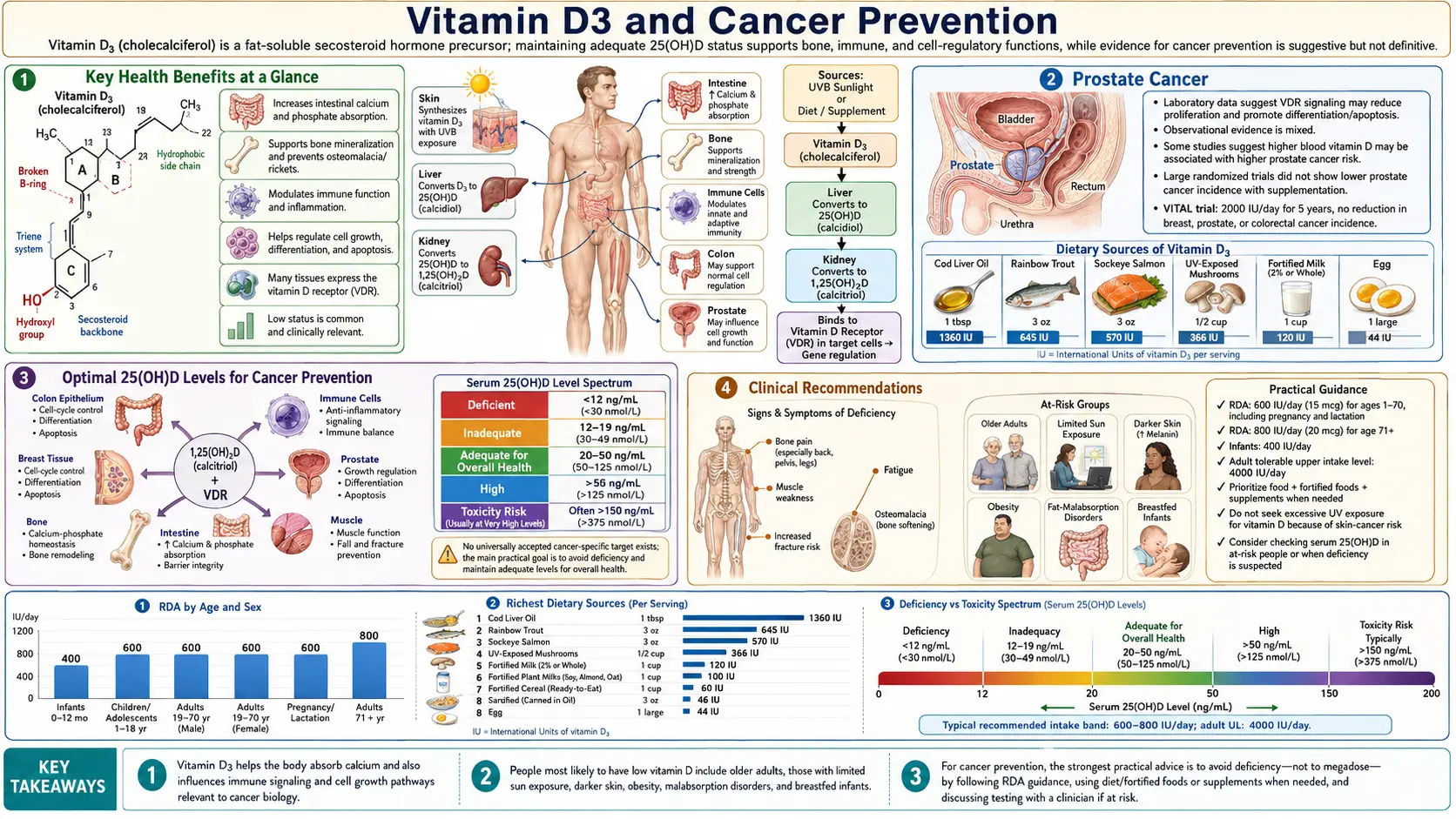
The relationship between vitamin D and cancer was first proposed by Cedric and Frank Garland in 1980, based on the observation that colon cancer mortality in the United States followed a striking geographic gradient, with highest rates in the Northeast (lowest sunlight) and lowest rates in the South and Southwest. Since that seminal ecological observation, extensive laboratory, epidemiological, and clinical trial evidence has accumulated supporting a role for vitamin D in cancer prevention, particularly through the regulation of cell proliferation, differentiation, apoptosis, and angiogenesis. The landmark VITAL trial of nearly 26,000 U.S. adults, while not showing a reduction in overall cancer incidence with 2,000 international units (IU)/day of vitamin D3, did show, in a secondary analysis, a 25% reduction in cancer mortality when the first two years of follow-up were excluded — suggesting that vitamin D's strongest anticancer effect lies in slowing progression rather than preventing initiation.
Table of Contents
- Key Health Benefits at a Glance
- VDR Gene Regulation: Anti-Cancer Mechanisms
- Colorectal Cancer: The Strongest Evidence
- Breast Cancer
- Prostate Cancer
- Pancreatic Cancer
- Cancer Mortality Reduction
- Optimal 25(OH)D Levels for Cancer Prevention
- VITAL Trial Cancer Results
- Lappe Trial
- Extrarenal Calcitriol Production in Tissues
- What Researchers and Guidelines State
- What the 2024 Endocrine Society Guideline States
- Key Research Papers
- Connections
- Featured Videos
Key Health Benefits at a Glance
The following is a high-level summary of the evidence-backed cancer-prevention benefits of adequate vitamin D3 status. Each is explored in more depth below, and the supporting studies are linked in the Key Research Papers section.
- Reduces cancer mortality by ~13–25% – The 2019 VITAL trial (Manson et al.) found a 25% reduction in cancer deaths in the vitamin D arm when the first two years were excluded; meta-analyses support an overall 13% mortality reduction with supplementation.
- Lowers colorectal cancer risk – Pooled data from 17 prospective cohorts link 25(OH)D levels of 30 to 40 ng/mL with a 19–27% lower colorectal cancer risk than levels of 20 to 25 ng/mL; risk did not fall further above 40 ng/mL, and the link was clearer in women than in men.
- Reduces advanced/metastatic cancer – VITAL showed a 17% reduction in metastatic or fatal cancer overall and a 38% reduction in normal-BMI participants, consistent with anti-invasion and anti-angiogenesis mechanisms.
- Induces cancer cell apoptosis – Calcitriol upregulates BAX/BAK and downregulates BCL-2/BCL-XL, restoring programmed cell death in pre-malignant and malignant cells.
- Inhibits angiogenesis – Calcitriol suppresses VEGF and upregulates thrombospondin-1, limiting the tumor neovascularization required for growth beyond a few millimeters.
- Promotes differentiation – Calcitriol drives immature proliferating cells toward mature, specialized phenotypes with reduced division capacity — the same principle behind calcipotriol therapy for psoriasis.
- Suppresses Wnt/beta-catenin – In colonocytes, calcitriol dampens the Wnt pathway activated by APC mutations in most colorectal cancers.
- Remodels pancreatic tumor stroma – VDR activation in pancreatic stellate cells (Sherman et al.) returns them to quiescence, improving chemotherapy drug delivery in preclinical models.
VDR Gene Regulation: Anti-Cancer Mechanisms
The vitamin D receptor (VDR) is expressed in most human tissues, including those where the most common cancers arise. When activated by calcitriol, the VDR-RXR heterodimer regulates the expression of genes involved in several hallmarks of cancer.
- Cell Proliferation Control – Calcitriol induces cell cycle arrest, primarily at the G0/G1 checkpoint, by upregulating cyclin-dependent kinase inhibitors (p21 and p27) and downregulating cyclins (cyclin D1) and cyclin-dependent kinases (CDK2, CDK4, CDK6). These actions slow or halt the uncontrolled cell division that characterizes cancer. In addition, calcitriol inhibits the expression of c-Myc, a proto-oncogene that drives proliferation in many cancer types.
- Cellular Differentiation – Calcitriol promotes the differentiation of many cell types, pushing immature, rapidly dividing cells toward a mature, functionally specialized phenotype with reduced proliferative capacity. This pro-differentiation effect has been demonstrated in colonic epithelial cells, breast cells, prostate cells, and myeloid leukemia cells. The therapeutic application of the vitamin D analogue calcipotriol in psoriasis (a hyperproliferative skin disorder) is a clinical example of this principle.
- Apoptosis Induction – Calcitriol activates both intrinsic and extrinsic apoptotic pathways in cancer cells. It upregulates pro-apoptotic proteins (BAX, BAK) and downregulates anti-apoptotic proteins (BCL-2, BCL-XL). Calcitriol also sensitizes cancer cells to other apoptotic stimuli, including chemotherapy agents, through caspase activation and mitochondrial membrane permeabilization. The ability to restore apoptotic potential in cancer cells that have evaded programmed cell death is one of the most important anti-cancer properties of vitamin D.
- Angiogenesis Inhibition – Tumors require new blood vessel formation (angiogenesis) to grow beyond a few millimeters in diameter. Calcitriol inhibits angiogenesis by suppressing the expression of vascular endothelial growth factor (VEGF) and its receptors in tumor cells and by directly inhibiting endothelial cell proliferation and migration. Calcitriol also upregulates thrombospondin-1, a potent endogenous angiogenesis inhibitor.
- Invasion and Metastasis Suppression – Calcitriol upregulates E-cadherin, a cell adhesion molecule that maintains epithelial cell-cell contacts and whose loss is associated with epithelial-to-mesenchymal transition (EMT) and metastatic potential. Calcitriol also inhibits matrix metalloproteinases (MMPs) that degrade the extracellular matrix, reducing tumor invasiveness. Additionally, vitamin D suppresses the Wnt/beta-catenin signaling pathway, which drives both proliferation and invasion in colorectal and other cancers.
- DNA Repair – Emerging evidence suggests that calcitriol may enhance DNA damage repair mechanisms, reducing the accumulation of mutations that drive carcinogenesis. This effect has been demonstrated in colonocytes exposed to oxidative stress and may contribute to the cancer-preventive effect independent of proliferation control.
Colorectal Cancer: The Strongest Evidence
- Ecological Studies – The Garland brothers' original observation of a latitude gradient in colon cancer mortality has been replicated in multiple countries and time periods. Regions with greater ultraviolet B (UVB) exposure consistently show lower colorectal cancer incidence and mortality.
- Prospective Cohort Studies – Multiple large prospective studies have found significant inverse associations between 25(OH)D levels and colorectal cancer risk. A 2019 international pooling project of 17 cohorts (5,706 people who developed colorectal cancer and 7,107 who did not) compared blood levels measured before diagnosis. Against levels of 20 to 25 ng/mL (50 to under 62.5 nmol/L), levels below 12 ng/mL (30 nmol/L) carried a 31 percent higher risk, while levels of 30 to 35 ng/mL and 35 to 40 ng/mL carried a 19 percent and a 27 percent lower risk. At 40 ng/mL (100 nmol/L) or more, risk did not continue to fall and the reduction was no longer statistically significant. Each 10 ng/mL (25 nmol/L) rise was linked to a 19 percent lower risk in women and a 7 percent lower risk in men, which was not statistically significant.
- Mechanistic Support – The colon is one of the tissues with the highest VDR expression and local CYP27B1 activity. Calcitriol suppresses the Wnt/beta-catenin pathway, which is activated by APC gene mutations in the majority of colorectal cancers. This provides a compelling mechanistic link between vitamin D signaling and colorectal carcinogenesis. Vitamin D also promotes E-cadherin expression in colonocytes and reduces the pro-proliferative effects of secondary bile acids.
- Clinical Implications – Based on the strength and consistency of the colorectal cancer evidence, the authors of the 17-cohort pooling project concluded that the levels linked to the lowest colorectal cancer risk, 30 to 40 ng/mL (75 to 100 nmol/L), appear higher than the Institute of Medicine’s recommendations, which are based on bone health alone. The 2024 Endocrine Society guideline found no clear evidence defining the blood level needed for disease prevention. Some researchers advocate for levels above 40 ng/mL based on the dose-response data.
Breast Cancer
- Epidemiological Evidence – Higher 25(OH)D levels are consistently associated with lower breast cancer risk in observational studies, particularly for premenopausal breast cancer. A 2007 pooled analysis by Garland et al. of two studies (1,760 people) estimated that 25(OH)D levels of approximately 52 ng/mL were associated with a 50 percent lower breast cancer risk than levels below 13 ng/mL. These are observational data.
- Tumor Biology – VDR is expressed in normal breast tissue and in the majority of breast tumors. Calcitriol inhibits proliferation and induces apoptosis in breast cancer cell lines, and animal studies show that vitamin D deficiency accelerates mammary tumor development. VDR expression in breast tumors is associated with better prognosis, smaller tumor size, and lower grade.
- Breast Density – Higher vitamin D levels are associated with lower mammographic breast density, an established risk factor for breast cancer. This relationship may represent one mechanism through which vitamin D reduces breast cancer risk.
- Survival – Among women diagnosed with breast cancer, higher 25(OH)D levels at diagnosis are associated with improved overall survival and lower rates of recurrence in multiple observational studies. This prognostic association persists after adjustment for stage, grade, and treatment.
Prostate Cancer
- Mixed Epidemiological Data – The association between vitamin D and prostate cancer is less consistent than for colorectal cancer. Some studies show an inverse association (higher vitamin D, lower risk), while others show no association or even a U-shaped relationship with increased risk at both very low and very high 25(OH)D levels.
- Laboratory Evidence – In contrast to the mixed epidemiological data, laboratory evidence is compelling. Prostate epithelial cells express VDR and CYP27B1, and calcitriol consistently inhibits prostate cancer cell proliferation, induces apoptosis, and reduces invasiveness in cell culture and animal models. The discrepancy between laboratory and epidemiological findings may reflect the complexity of prostate cancer biology, including the influence of androgen signaling on VDR expression.
- Clinical Applications – High-dose calcitriol in combination with chemotherapy (docetaxel) has been studied in advanced prostate cancer, with some trials showing improved prostate-specific antigen (PSA) response rates. However, hypercalcemia limits the therapeutic window of calcitriol, and vitamin D analogues with reduced calcemic activity are under development for oncology applications.
Pancreatic Cancer
- Epidemiological Associations – Several prospective studies have found inverse associations between 25(OH)D levels and pancreatic cancer risk. Pooled studies disagree. A 2012 pooled analysis of five US cohorts (451 people with pancreatic cancer) found 33 percent lower odds in the highest fifth of blood levels than in the lowest fifth (odds ratio 0.67), and 29 percent lower odds at 30 ng/mL (75 nmol/L) or more than below 20 ng/mL (50 nmol/L) (odds ratio 0.71). The larger Cohort Consortium Vitamin D Pooling Project of Rarer Cancers (8 cohorts, 952 cases) found no link at lower levels, but levels of 40 ng/mL (100 nmol/L) or higher carried twice the risk of pancreatic cancer (odds ratio 2.12, 95% confidence interval 1.23 to 3.64) — a finding that falls inside the 40 to 60 ng/mL range some researchers propose (see below). The five-cohort analysis did not see a raised risk at 40 ng/mL or more.
- Stromal VDR Targeting – Particularly exciting research by Sherman and colleagues has demonstrated that VDR activation in pancreatic stellate cells (the cells that create the dense fibrotic stroma characteristic of pancreatic cancer) can reprogram these cells from an activated, tumor-promoting state to a quiescent state. This stromal remodeling enhances chemotherapy drug delivery and improves treatment efficacy in preclinical models.
- Paricalcitol Combination Therapy – Based on the stromal VDR data, clinical trials have tested a vitamin D analogue, paricalcitol, together with chemotherapy. A 2026 trial randomised 36 people with metastatic pancreatic cancer to gemcitabine and albumin-bound paclitaxel (nab-paclitaxel) plus placebo, intravenous paricalcitol or oral paricalcitol. Its main aim was safety: paricalcitol could be given safely with the chemotherapy, although five patients (42%) on oral paricalcitol developed grade 2–4 high blood calcium (hypercalcemia) and needed a lower dose. Tumor biopsies taken during treatment showed fewer activated fibroblasts (the stromal cells described above) and more CD8 T cells (immune cells that attack tumor cells) close to the tumor cells. This represents one of the most promising translational applications of vitamin D in oncology.
Cancer Mortality Reduction
- Meta-Analysis Evidence – While randomized trials have generally not shown reduced cancer incidence with vitamin D supplementation, meta-analyses of trial data have consistently found reduced cancer mortality. A 2019 meta-analysis by Keum et al. of randomized trials found a 13 percent reduction in cancer mortality with vitamin D supplementation (relative risk (RR) 0.87, 95% confidence interval (CI) 0.79 to 0.96), despite no significant effect on cancer incidence (RR 0.98). The authors found the mortality result was largely due to trials that gave vitamin D daily. The Chowdhury et al. (2014) meta-analysis also found an inverse relationship between 25(OH)D concentration and cause-specific mortality including cancer.
- Daily Versus Large Occasional Doses – A 2022 update by the same research group found no significant drop in cancer deaths across all trials (summary RR 0.92, 95% CI 0.82 to 1.03), but a 13 percent lower cancer death rate in trials that gave vitamin D daily (RR 0.87, 95% CI 0.78 to 0.96), and no such drop in trials that gave large doses weeks or months apart. Cancer incidence was not lower overall; among trials of daily dosing it was 24 percent lower in normal-weight people (RR 0.76) but not in people with overweight or obesity.
- Interpretation – The dissociation between incidence and mortality effects suggests that vitamin D may be more important in slowing cancer progression, reducing metastatic potential, and improving treatment responsiveness than in preventing the initial malignant transformation. This is consistent with vitamin D's effects on differentiation, apoptosis, angiogenesis, and immune surveillance against established tumors.
- Clinical Relevance – If vitamin D supplementation reduces cancer mortality by 13 percent, this would translate to tens of thousands of avoided cancer deaths annually in the United States alone. This population-level impact, combined with the safety and low cost of vitamin D3 supplementation, makes this one of the most important public health implications of vitamin D research.
Optimal 25(OH)D Levels for Cancer Prevention
- Minimum Threshold – Epidemiological evidence suggests that cancer risk reduction begins at 25(OH)D levels above 20 ng/mL (50 nmol/L), with progressively greater protection at higher levels.
- Proposed Target Range: 40 to 60 ng/mL – Based on dose-response analyses of prospective cohort data, many cancer researchers and integrative oncologists recommend maintaining 25(OH)D levels between 40 and 60 ng/mL (100 to 150 nmol/L) for optimal cancer prevention. A 2016 pooled analysis of two groups of women aged 55 and older — 1,169 women from a Lappe randomized trial and 1,135 from the GrassrootsHealth prospective cohort — found that women with levels of 40 ng/mL or more had a 67 percent lower cancer risk than women with levels below 20 ng/mL (hazard ratio 0.33, with a wide 95% confidence interval of 0.12 to 0.90).
- Doses Reported for This Range – Proponents of this range report that, to achieve 25(OH)D levels of 40 to 60 ng/mL, most adults require 4,000 to 6,000 international units of vitamin D3 daily, depending on body weight, baseline levels, and sun exposure. Obese individuals may require 2 to 3 times higher doses due to vitamin D sequestration in adipose tissue. The upper end of that dose range is above the Institute of Medicine’s tolerable upper intake level for adults of 4,000 international units a day.
- Safety at These Levels – 25(OH)D levels of 40 to 60 ng/mL are well below the toxicity threshold (typically above 150 ng/mL). In the 2017 Lappe trial, in which the supplemented women reached about 44 ng/mL, kidney stones were reported in 16 women taking vitamin D3 plus calcium against 10 on placebo, and raised blood calcium in 6 against 2. The IOM's tolerable upper intake of 4,000 international units daily is considered conservative by many vitamin D researchers.
VITAL Trial Cancer Results
- Primary Cancer Endpoint – The VITAL trial (25,871 participants, 2,000 international units vitamin D3 daily, median follow-up 5.3 years) did not find a statistically significant reduction in total invasive cancer incidence in the vitamin D group compared to placebo (hazard ratio (HR) 0.96, 95% confidence interval 0.88 to 1.06).
- Cancer Mortality – However, when excluding the first two years of follow-up (to allow a latency period for vitamin D to exert anti-cancer effects), the vitamin D group showed a 25 percent reduction in cancer mortality (hazard ratio 0.75, 95% confidence interval 0.59 to 0.96). This was a secondary analysis. Over all years of follow-up, the result for death from cancer (341 deaths; hazard ratio 0.83, 95% confidence interval 0.67 to 1.02) was not statistically significant, and neither were the results for single cancers: colorectal (HR 1.09), breast (HR 1.02) and prostate (HR 0.88). This time-dependent pattern is biologically plausible, as the effects of vitamin D on tumor biology would require time to manifest in mortality outcomes.
- Body mass index (BMI) Interaction – A significant interaction with body mass index was observed. In participants with normal body mass index (under 25), vitamin D supplementation reduced cancer incidence by 24 percent. In overweight and obese participants, no benefit was observed. This finding is attributed to the dilution of 2,000 international units daily across larger body mass, resulting in smaller increments in 25(OH)D levels in heavier individuals.
- Metastatic Cancer – A secondary analysis found that vitamin D supplementation reduced the incidence of advanced (metastatic or fatal) cancer by 17 percent overall, and by 38 percent in the normal-BMI subgroup. This reduction in metastatic cancer is consistent with vitamin D's effects on tumor invasion, angiogenesis, and immune surveillance.
Lappe Trial
- Study Design – The Lappe et al. trial randomized 2,303 healthy postmenopausal women in Nebraska to vitamin D3 (2,000 international units daily) plus calcium (1,500 mg daily) or placebo for 4 years, with cancer incidence as the primary outcome.
- Results – The intervention group showed a non-significant 30 percent reduction in total cancer incidence (hazard ratio 0.70, 95% confidence interval 0.47 to 1.02, p = 0.06). While not reaching statistical significance in the intention-to-treat analysis, the direction and magnitude of the effect were consistent with a meaningful cancer-preventive effect.
- 25(OH)D Levels Achieved – The supplementation group achieved mean 25(OH)D levels of approximately 44 ng/mL, well within the proposed optimal range. The control group had mean levels of approximately 32 ng/mL, which was higher than expected and may have attenuated the between-group difference, reducing the power to detect a significant effect.
- Earlier Lappe Trial (2007) – A previous trial by Lappe et al. with 1,179 postmenopausal women using vitamin D3 (1,100 international units daily) plus calcium and calcium (1,400 to 1,500 mg daily) did find a significant 60 percent reduction in all-cancer risk over 4 years (unadjusted relative risk 0.40, P = 0.01). Cancer was that trial’s principal secondary outcome; its primary outcome was fractures. The discrepancy between the two trials may reflect differences in baseline vitamin D status, statistical power, and the specific cancer types that occurred.
Extrarenal Calcitriol Production in Tissues
- Local Synthesis – Many tissues outside the kidney express CYP27B1 (1-alpha-hydroxylase) and can convert circulating 25(OH)D to active calcitriol locally. These include colonic epithelial cells, breast cells, prostate cells, pancreatic cells, skin keratinocytes, and immune cells within the tumor microenvironment. This local production is critical because it allows tissue-specific regulation of cell growth and differentiation independently of systemic calcium homeostasis.
- Substrate Dependence – Unlike renal calcitriol production (which is tightly regulated by parathyroid hormone (PTH), calcium, and FGF23), extrarenal calcitriol synthesis is primarily substrate-dependent, meaning it is directly proportional to the circulating concentration of 25(OH)D. This explains why maintaining adequate 25(OH)D levels is important for cancer prevention: higher circulating 25(OH)D provides more substrate for local calcitriol production in tissues at risk for malignant transformation.
- Loss in Cancer – As tumors progress, they often downregulate CYP27B1 and upregulate CYP24A1 (the enzyme that degrades calcitriol), effectively disabling the local vitamin D-mediated growth control. This loss of local vitamin D signaling may represent a selective advantage for tumor cells that escape growth inhibition. Restoring vitamin D signaling through pharmacological means (high-dose calcitriol or analogues) is an active area of therapeutic research.
- Tumor Microenvironment – Immune cells within the tumor microenvironment (tumor-associated macrophages, tumor-infiltrating lymphocytes) also produce calcitriol locally, which may influence anti-tumor immune surveillance. Adequate vitamin D status may therefore support immune-mediated tumor control in addition to direct effects on cancer cell biology.
What Researchers and Guidelines State
- General Population – Proponents of vitamin D for cancer prevention argue that, while definitive randomized trial evidence is still emerging, the combined weight of ecological, observational, mechanistic, and trial data supports 25(OH)D levels of at least 30 ng/mL and ideally 40 to 60 ng/mL, which they report most adults reach with 2,000 to 4,000 international units of vitamin D3 daily. The 2024 Endocrine Society guideline found no clear evidence defining the blood level needed for disease prevention (see the next section).
- High-Risk Individuals – Those with a family history of colorectal, breast, or prostate cancer, or with pre-malignant conditions (colorectal adenomas, ductal carcinoma in situ), are the people for whom some practitioners propose the higher end of that range (50 to 60 ng/mL).
- Cancer Survivors – Practitioners cite the mortality data in favour of adequate vitamin D status during and after cancer treatment. Vitamin D deficiency is common in cancer patients due to reduced outdoor activity, chemotherapy effects, and other factors.
- Monitoring – Some practitioners test 25(OH)D regularly in people taking more than 2,000 international units daily or with risk factors for deficiency (obesity, dark skin, limited sun exposure, malabsorption), to check that a target level is reached without oversupplementation. The 2024 Endocrine Society guideline found no clinical trial evidence supporting routine 25(OH)D screening in the general population, or in people with obesity or dark complexion, and suggests against routine testing in all the populations it considered.
- Vitamin D3 vs. D2 – Vitamin D3 (cholecalciferol) is more potent than D2 (ergocalciferol) in raising and maintaining 25(OH)D levels. D3 has approximately 87 percent greater potency than D2 and a longer duration of action, which is why proponents favour it for cancer prevention.
- Comprehensive Approach – In cancer prevention research, vitamin D is one component of a wider pattern that includes a diet rich in fruits, vegetables, and fiber; regular physical activity; a healthy body weight; limited alcohol; no tobacco; and age-appropriate cancer screening programs.
This content is provided for informational purposes only and does not constitute medical advice. Vitamin D supplementation is not a substitute for cancer screening, proven cancer therapy, or the guidance of an oncologist. The Institute of Medicine’s tolerable upper intake level for adults is 4,000 international units of vitamin D a day; in the 2017 Lappe trial, kidney stones (16 against 10) and raised blood calcium (6 against 2) were more common with vitamin D3 plus calcium than with placebo.
What the 2024 Endocrine Society Guideline States
In 2024 the Endocrine Society published a clinical practice guideline on vitamin D for preventing disease in people without a medical reason for vitamin D treatment or blood testing. Its panel suggests extra vitamin D, beyond the dietary reference intake and without blood testing, for four groups: children and teenagers aged 1 to 18, adults over 75, people who are pregnant, and people with high-risk prediabetes. It suggests against doses above the dietary reference intake to lower disease risk in healthy adults younger than 75. It also suggests against routine 25(OH)D blood testing, because no clinical trial evidence supported routine screening and there was no clear evidence defining the target level needed for disease prevention. For people over 50 who take vitamin D for one of these reasons, it suggests a daily dose rather than large doses taken occasionally. The panel states that further research is needed to find the best 25(OH)D levels for specific health benefits.
Key Research Papers
The following are landmark and frequently cited research papers underpinning the claims on this page. Links resolve to the publisher DOI or PubMed record.
Foundational Reviews
- Holick MF. Vitamin D deficiency. New England Journal of Medicine. 2007;357(3):266-281. — doi:10.1056/NEJMra070553
- Bikle DD. Vitamin D metabolism, mechanism of action, and clinical applications. Chemistry & Biology. 2014;21(3):319-329. — doi:10.1016/j.chembiol.2013.12.016
Major Cancer Prevention Trials
- Manson JE, Cook NR, Lee IM, et al. Vitamin D supplements and prevention of cancer and cardiovascular disease (VITAL). New England Journal of Medicine. 2019;380(1):33-44. — doi:10.1056/NEJMoa1809944
- Chowdhury R, Kunutsor S, Vitezova A, et al. Vitamin D and risk of cause specific death: systematic review and meta-analysis. BMJ. 2014;348:g1903. — doi:10.1136/bmj.g1903
- Lappe J, Watson P, Travers-Gustafson D, et al. Effect of vitamin D and calcium supplementation on cancer incidence in older women: a randomized clinical trial. JAMA. 2017;317(12):1234-1243. — PubMed PMID: 28350929
- Keum N, Lee DH, Greenwood DC, Manson JE, Giovannucci E. Vitamin D supplementation and total cancer incidence and mortality: a meta-analysis of randomized controlled trials. Annals of Oncology. 2019;30(5):733-743. — PubMed PMID: 30796437
- Keum N, Chen QY, Lee DH, Manson JE, Giovannucci E. Vitamin D supplementation and total cancer incidence and mortality by daily vs. infrequent large-bolus dosing strategies: a meta-analysis of randomised controlled trials. British Journal of Cancer. 2022;127(5):872-878. — PubMed PMID: 35676320
- Lappe JM, Travers-Gustafson D, Davies KM, Recker RR, Heaney RP. Vitamin D and calcium supplementation reduces cancer risk: results of a randomized trial. American Journal of Clinical Nutrition. 2007;85(6):1586-1591. — PubMed PMID: 17556697
- Demay MB, Pittas AG, Bikle DD, et al. Vitamin D for the prevention of disease: an Endocrine Society clinical practice guideline. Journal of Clinical Endocrinology and Metabolism. 2024;109(8):1907-1947. — PubMed PMID: 38828931
Colorectal, Breast, and Prostate Cancer Epidemiology
- McCullough ML, Zoltick ES, Weinstein SJ, et al. Circulating vitamin D and colorectal cancer risk: an international pooling project of 17 cohorts. Journal of the National Cancer Institute. 2019;111(2):158-169. — PubMed PMID: 29912394
- Garland CF, Gorham ED, Mohr SB, et al. Vitamin D and prevention of breast cancer: pooled analysis. Journal of Steroid Biochemistry and Molecular Biology. 2007;103(3-5):708-711. — PubMed PMID: 17368188
- Vitamin D and prostate cancer risk (PubMed search).
- Wolpin BM, Ng K, Bao Y, et al. Plasma 25-hydroxyvitamin D and risk of pancreatic cancer. Cancer Epidemiology, Biomarkers & Prevention. 2012;21(1):82-91. — PubMed PMID: 22086883
- Stolzenberg-Solomon RZ, Jacobs EJ, Arslan AA, et al. Circulating 25-hydroxyvitamin D and risk of pancreatic cancer: Cohort Consortium Vitamin D Pooling Project of Rarer Cancers. American Journal of Epidemiology. 2010;172(1):81-93. — PubMed PMID: 20562185
- McDonnell SL, Baggerly C, French CB, et al. Serum 25-hydroxyvitamin D concentrations ≥40 ng/ml are associated with >65% lower cancer risk: pooled analysis of randomized trial and prospective cohort study. PLoS One. 2016;11(4):e0152441. — PubMed PMID: 27049526
Mechanistic and Translational Research
- Sherman MH et al. Vitamin D receptor in pancreatic stellate cells: stromal reprogramming (PubMed search).
- Calcitriol, VDR signaling, and apoptosis in cancer cells (PubMed search).
- Perez KJ, Dias Costa A, Jordan A, et al. Gemcitabine and nab-paclitaxel with or without the VDR agonist paricalcitol for metastatic pancreatic cancer: a randomized, multiarm, run-in phase trial. Nature Cancer. 2026;7(6):928-943. — PubMed PMID: 42185478