Phthalates: Plasticizers, Endocrine Disruption, and Exposure
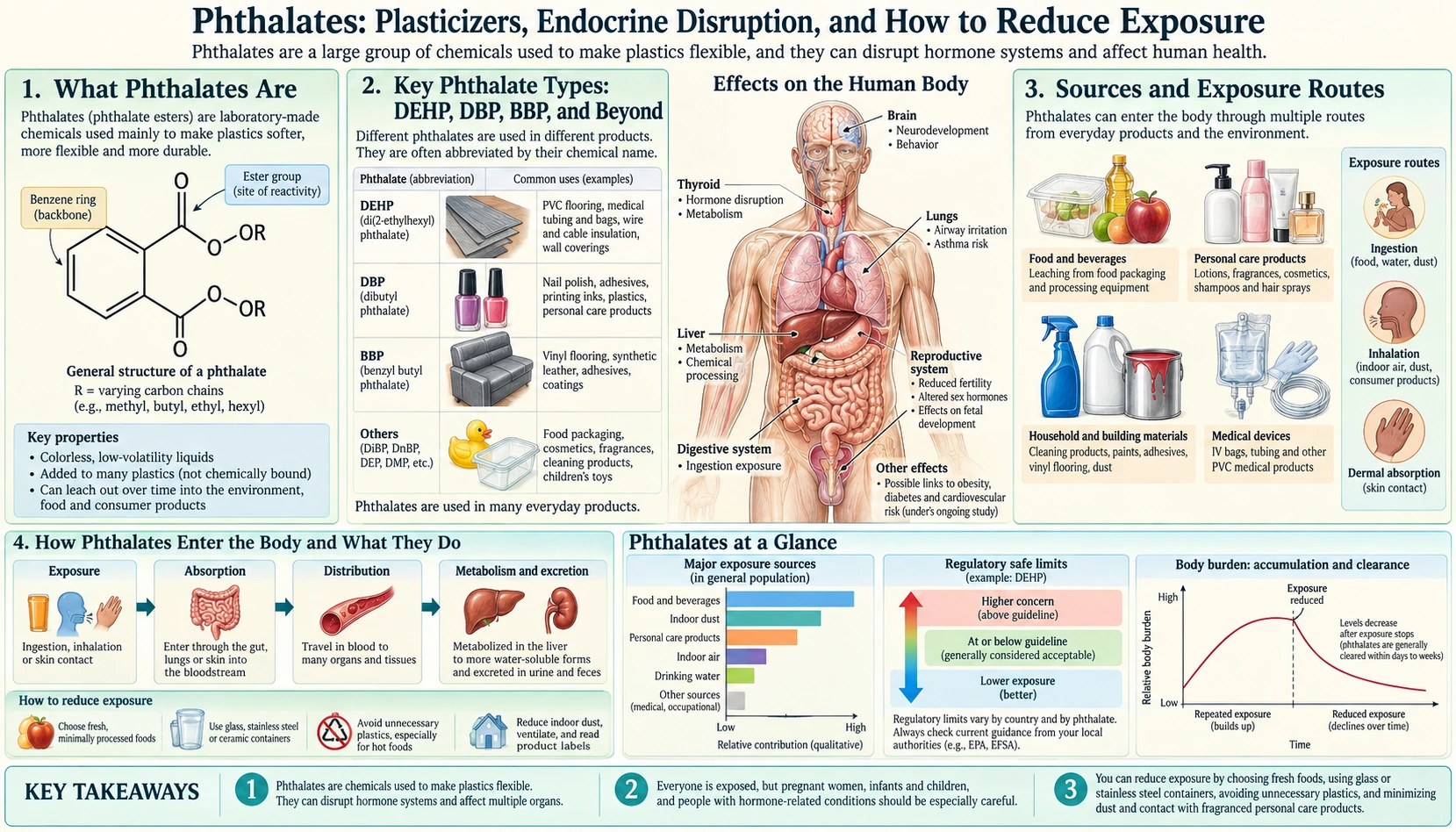
Phthalates are a family of synthetic chemical plasticizers added to polyvinyl chloride (PVC) to make it flexible, and used in personal care products, medical devices, food packaging, and building materials. In the U.S. Centers for Disease Control and Prevention’s NHANES survey of 1999–2000, four phthalate metabolites were each detected in more than 75% of urine samples (Silva 2004). Because some phthalates lower testosterone production in animal studies and are associated with hormonal measures in people, they are widely studied as endocrine disruptors. Unlike persistent pollutants such as PCBs, individual phthalates are eliminated quickly, with urinary elimination half-lives measured in hours (Koch 2004) — but repeated exposure from many daily sources keeps them measurable in most people.
This article covers what phthalates are, the main types, how exposure occurs, the health associations reported in human and animal studies — particularly for male reproductive development, fertility, and metabolic function — what intervention studies report about lowering exposure, and how regulators have acted.
Table of Contents
- What Phthalates Are
- Key Phthalate Types: DEHP, DBP, BBP, and Beyond
- Sources and Exposure Routes
- How Phthalates Enter the Body
- Health Effects: Hormonal and Reproductive
- Neurological and Metabolic Effects
- Mechanisms of Harm
- Body Burden and Biomonitoring
- What Studies Report About Lowering Exposure
- Regulatory Status and Policy
- Key Research Papers
- Connections
- Featured Videos
What Phthalates Are
Phthalates (pronounced THAL-ates) are diesters of phthalic acid. They are not covalently bound to the polymers they soften (Calafat 2004); instead they sit between polymer chains, allowing the material to flex. Because they are not chemically bound, they can be released from products into food, air, dust, and water. DEHP was first produced in the United States in 1939, according to the National Toxicology Program (NTP), and global phthalate production was put at about 3.5 million metric tons a year in a 2004 study (Bornehag 2004). PVC without plasticizers is rigid; the NTP reports that about 95% of DEHP produced is used as a plasticizer in flexible PVC, and that products typically contain 1% to 40% DEHP. Uses it lists include medical tubing and blood bags, floor tiles, shower curtains, rainwear, toys, and food packaging materials.
The class splits into two broad groups by molecular weight. High-molecular-weight (HMW) phthalates — led by DEHP (di(2-ethylhexyl) phthalate) — dominate industrial PVC and medical applications. Low-molecular-weight (LMW) phthalates — such as DBP (dibutyl phthalate) and DEP (diethyl phthalate) — are described in the research as commonly found in cosmetics and other personal care products (Trasande 2013).
Key Phthalate Types: DEHP, DBP, BBP, and Beyond
- DEHP (di(2-ethylhexyl) phthalate). Among the most widely studied phthalates. Found in PVC medical tubing, IV bags, flooring, and food-contact materials. The FDA’s 2022 review of a food-additive petition lists DEHP among phthalates that show antiandrogenic effects in toxicology data. It is restricted in children’s toys and child care articles in the U.S. and in plasticised material in articles in the EU (see Regulatory Status).
- DBP (dibutyl phthalate). Used in nail polishes, adhesives, and printing inks. Restricted in U.S. children’s products and in EU articles; the FDA’s 2012 guidance asks drug makers not to use it as an excipient.
- BBP (butyl benzyl phthalate). Primarily in vinyl flooring, traffic cones, and artificial leather. In a Swedish study, BBP levels in house dust were associated with rhinitis and eczema in children (Bornehag 2004).
- DINP and DIDP. High-molecular-weight phthalates used as DEHP substitutes. The FDA’s 2022 review lists DINP among phthalates with antiandrogenic effects and DIDP among those shown not to have them; the EPA’s final TSCA risk evaluations (January 2025) concluded that each poses unreasonable risk to human health under specific conditions of use.
- DEP (diethyl phthalate). Used in fragrance formulations and personal care products. Its metabolite MEP is higher in infants after recent use of baby lotion (Sathyanarayana 2008).
- DMP (dimethyl phthalate). Historically used in insect repellents. In 2022 the FDA removed its food-contact authorizations because those uses had been abandoned.
Sources and Exposure Routes
- Food. Diet is a primary source of exposure to high-molecular-weight phthalates such as DEHP (Sathyanarayana 2013). The NTP reports that ingestion is the most important route for the general population, that DEHP has been found at low levels in packaged food because of its use in products that contact food during manufacture, and that, because DEHP is lipophilic, higher levels are expected in fattier foods.
- Personal care products. In infants, recent use of lotion was associated with higher urinary MEP and MMP, powder with MiBP, and shampoo with MMP, and levels rose with the number of products used (Sathyanarayana 2008).
- Household dust. The NTP reports that DEHP in house dust is associated with PVC flooring and wall coverings, and that dust ingestion was estimated to account for about half of infants’ total DEHP intake.
- Medical devices. The NTP reports that DEHP exposure levels are highest for medical procedures. Premature infants receiving intensive treatment in a neonatal intensive care unit had urinary DEHP metabolite levels several times those of the U.S. general population (Calafat 2004).
- Drinking water. The NTP reports DEHP in drinking water, generally in the low parts-per-billion range; the EPA’s drinking-water standard sets a maximum contaminant level of 0.006 mg/L for DEHP.
- Air. According to the NTP, DEHP in indoor air comes mainly from volatilization from consumer products and building materials, and concentrations are generally higher indoors than outdoors.
- Medicines. Some drug products have used phthalates as excipients; in 2012 the FDA issued guidance recommending that the pharmaceutical industry avoid DBP and DEHP as excipients in prescription and nonprescription products.
How Phthalates Enter the Body
Ingestion is the primary route for HMW phthalates like DEHP, with food as the main vector (Sathyanarayana 2013). Dermal absorption matters for products applied to the skin: in infants, use of lotion, powder and shampoo was associated with higher urinary phthalate metabolites (Sathyanarayana 2008). Inhalation of indoor air is a further route (NTP). Medical-device infusion delivers the parent compound directly into the blood (Calafat 2004).
Once absorbed, phthalates are broken down to monoester metabolites (e.g., MEHP from DEHP, MBP from DBP). The FDA’s 2022 review notes that for shorter-chain phthalates (such as DMP, DEP and BBP) these monoesters are the main urinary metabolites, while for longer-chain phthalates (such as DEHP, DINP and DIDP) the monoesters are mostly metabolized further before excretion. In a volunteer given a single labelled oral dose of DEHP, urinary metabolites peaked 2–4 hours after the dose, elimination half-lives were about 2 hours in the first phase and 5–10 hours in the second, and 47% of the dose had been excreted in urine after 44 hours (Koch 2004). This rapid elimination means individual measurements vary with recent exposure, but U.S. biomonitoring detects the main metabolites in most people tested (Silva 2004).
Health Effects: Hormonal and Reproductive
The most-studied concern is anti-androgenic activity. In rats exposed in utero to DBP, fetal testes showed dose-dependent reductions in proteins involved in cholesterol transport and steroid synthesis (StAR, P450 side-chain cleavage, 3β-HSD and P450c17) and lower testosterone (Lehmann 2004). In rodents, prenatal phthalate exposure impairs testicular function and shortens anogenital distance (AGD), part of a pattern of incomplete virilization sometimes called “phthalate syndrome” (Swan 2005). Human epidemiological studies report:
- Shorter anogenital distance in male infants whose mothers had higher urinary phthalate metabolites during pregnancy. In a 2005 U.S. study of 85 boys, the metabolites associated with a shorter anogenital index were MBP, MEP, MBzP and MiBP (Swan 2005). In the larger TIDES cohort (366 boys), first-trimester DEHP metabolites were associated with shorter AGD in boys; no metabolite was associated with AGD in girls (Swan 2015).
- Lower testosterone and poorer semen measures in men with higher urinary phthalate metabolites. Among men from subfertile couples, MBP and MBzP showed dose-response relations with lower sperm concentration or motility (Duty 2003); among 425 men from an infertility clinic, MEHP was associated with lower testosterone and estradiol (Meeker 2009); in NHANES 2011–2012, several phthalates were associated with lower serum testosterone in both sexes and in differing age groups (Meeker 2014); and workers at a PVC-flooring factory with high urinary MBP and MEHP had lower free testosterone than unexposed workers (Pan 2006).
- Pubertal timing in girls: findings are mixed and do not show a consistent shift toward earlier puberty. In a U.S. cohort of 1,170 girls, higher DEHP and other high-molecular-weight metabolites were associated with later pubic-hair development (Wolff 2014), and an NHANES 2005–2008 analysis found total phthalates were not significantly associated with age at menarche (Buttke 2012).
- Polycystic ovary syndrome (PCOS): studies comparing women with and without PCOS have been pooled in a 2026 meta-analysis, which found phthalate levels only slightly higher in women with PCOS (standardized mean difference 0.07, against 1.92 for BPA) (Lu 2026).
- Preterm birth: in a Boston nested case-control study of 130 preterm births and 352 controls, DEHP metabolites measured during pregnancy were associated with significantly increased odds of preterm birth (Ferguson 2014; a 2019 erratum corrected its Results section).
Neurological and Metabolic Effects
Beyond reproductive endpoints, observational studies link phthalate exposure to:
- Behaviour and cognition in children. In a New York City cohort (188 children assessed at 4–9 years), higher third-trimester low-molecular-weight phthalate metabolites were associated with poorer scores for aggression, conduct problems, attention problems and executive function; the authors note these domains are commonly affected in children diagnosed with conduct or attention-deficit/hyperactivity disorders (Engel 2010). In another New York cohort of 328 mothers and children, prenatal DnBP and DiBP metabolites were associated with lower full-scale IQ at age 7 (Factor-Litvak 2014).
- Insulin resistance and diabetes. In NHANES 2003–2008, among 766 fasting adolescents, higher DEHP metabolites were associated with higher insulin resistance (HOMA-IR) (Trasande 2013); among 2,350 women in NHANES 2001–2008, several phthalate metabolites were associated with self-reported diabetes (James-Todd 2012). Both are cross-sectional, so they cannot show which came first.
- Obesity. In cell studies, MEHP and some other monoesters activate PPARγ and promote fat-cell differentiation (Hurst 2003; Feige 2007). Human findings are mixed: in NHANES 1999–2002, several metabolites were positively associated with BMI and waist circumference in men aged 20–59, while MEHP was inversely associated with BMI in adolescent girls and women aged 20–59 (Hatch 2008); in New York City children, MEP and low-molecular-weight metabolites were associated with BMI and waist circumference only among overweight children (Teitelbaum 2012).
- Thyroid hormones. Urinary MEHP was associated with lower free T4 and total T3 in 408 men (Meeker 2007), and phthalate metabolites were associated with lower T3, mainly in girls, among 845 Danish children aged 4–9 (Boas 2010). The mechanism has not been established in humans.
- Asthma and allergy. In a Swedish case-control study, BBP in house dust was associated with rhinitis and eczema and DEHP with asthma (Bornehag 2004); in Bulgarian children aged 2–7, DEHP in dust was associated with wheezing (Kolarik 2008).
Mechanisms of Harm
- Androgen suppression. In fetal rat testes, DBP exposure reduced expression of StAR (steroidogenic acute regulatory protein, which moves cholesterol into mitochondria where steroid synthesis begins) and of several steroidogenic enzymes, with lower testicular testosterone at higher doses (Lehmann 2004).
- PPARγ activation. MEHP and related monoesters activate peroxisome proliferator-activated receptor gamma, a nuclear receptor involved in fat storage, insulin sensitivity and adipocyte differentiation; in cell models this promotes adipogenesis, though less strongly than the drug rosiglitazone (Hurst 2003; Feige 2007).
- Sperm DNA damage. Among 379 men from an infertility clinic, urinary MEP and MEHP (after adjustment for oxidative DEHP metabolites) were associated with more sperm DNA damage (Hauser 2007).
- Thyroid hormone changes. The human associations above (Meeker 2007; Boas 2010) suggest effects on thyroid hormone levels; how phthalates would produce them is not established.
Body Burden and Biomonitoring
The CDC measures phthalate metabolites in urine as part of NHANES. Findings from the 1999–2000 survey of about 2,540 people aged 6 and older (Silva 2004):
- MEP, MBP, MBzP and MEHP were each detected in more than 75% of samples.
- Children had higher levels of MBP, MBzP and MEHP than adolescents and adults, but lower levels of MEP.
- Females had higher MEP and MBzP than males, and higher MBP at all ages. A later NHANES analysis notes that women’s higher levels of several metabolites may reflect greater use of personal care products (James-Todd 2012).
- Occupational exposure can be far higher: PVC-flooring factory workers had urinary MEHP of 565.7 versus 5.7 µg/g creatinine and MBP of 644.3 versus 129.6 µg/g creatinine in unexposed workers (Pan 2006).
- Premature infants in intensive care had a geometric mean urinary MEHP of 100 ng/mL, against 3.43 ng/mL in the U.S. population aged 6 and older (Calafat 2004).
Because phthalates are excreted rapidly, a single spot urine sample reflects recent exposure; studies relying on one sample note that this may misclassify exposure (Swan 2015).
What Studies Report About Lowering Exposure
Intervention studies have tested whether changing food or personal care products lowers urinary phthalate levels, with mixed results:
- Fresh food with limited packaging. In 20 people from five families, three days of fresh food that was not canned or packaged in plastic reduced geometric-mean urinary DEHP metabolites by 53–56% (Rudel 2011).
- Food contamination can override a dietary change. In a 2013 randomized trial, a 5-day complete dietary replacement intended to lower exposure instead raised urinary DEHP metabolites sharply; testing traced this to DEHP in ingredients (21,400 ng/g in ground coriander, 673 ng/g in milk). Written recommendations alone produced no significant change (Sathyanarayana 2013).
- Personal care products. In 100 adolescent girls, three days of using products whose labels stated they did not contain phthalates, parabens, triclosan or BP-3 lowered urinary MEP by 27.4%, with no significant change in MnBP or MiBP (Harley 2016).
- Infant care products. Infant urinary phthalate levels rose with the number of lotions, powders and shampoos used in the previous 24 hours (Sathyanarayana 2008).
- Medical care. The NTP reports that the FDA expressed special concern about aggregate DEHP exposure from repeated medical procedures, which often occurs in neonatal intensive care. Decisions about medical devices belong with the treating clinicians.
Regulatory Status and Policy
U.S. consumer-product regulation focuses on children’s products. Under the Consumer Product Safety Improvement Act of 2008 and the CPSC’s 2017 rule (16 CFR part 1307), children’s toys and child care articles may not contain more than 0.1% of DEHP, DBP, BBP, DINP, DIBP, DPENP, DHEXP or DCHP. For food contact, in May 2022 the FDA removed the authorizations for 25 plasticizers — including DBP, BBP, DIBP, DEP and DMP — because those uses had been abandoned, and denied a separate petition to revoke food-contact uses of 28 ortho-phthalates (87 FR 31080; 87 FR 31066). DEHP was not among the 25, and the FDA states that some ortho-phthalates continue to be permitted in food-contact applications. The EPA’s drinking-water standard sets a maximum contaminant level of 0.006 mg/L for DEHP (40 CFR 141.61).
In the EU, a REACH restriction (revised Annex XVII entry 51) limits DEHP, BBP, DBP and DIBP to below 0.1% by weight, individually or combined, in any plasticised material in articles placed on the market; ECHA and Denmark prepared the proposal in 2016, and ECHA’s committees found an inadequately controlled risk to human health. Entry 52 covers DINP, DIDP and DNOP (European Commission, REACH restrictions).
Under the Toxic Substances Control Act, the EPA published final risk evaluations in January 2026 concluding that BBP, DBP, DCHP, DEHP and DIBP pose unreasonable risk to human health and/or the environment under specific conditions of use, after final evaluations of DIDP and DINP (January 2025) found unreasonable risk to human health; TSCA requires the EPA to begin risk-management action (91 FR 373). The NTP Report on Carcinogens has listed DEHP as “reasonably anticipated to be a human carcinogen” since 1983, based on liver tumours in rats and mice; it states that epidemiological data are inadequate to evaluate DEHP and human cancer (NTP RoC profile).
Key Research Papers
- Swan SH, et al. Decrease in anogenital distance among male infants with prenatal phthalate exposure. Environ Health Perspect. 2005;113(8):1056–1061. — PubMed PMID: 16079079
- Duty SM, et al. Phthalate exposure and human semen parameters. Epidemiology. 2003;14(3):269–277. — PubMed PMID: 12859026
- Meeker JD, et al. Urinary metabolites of di(2-ethylhexyl) phthalate are associated with decreased steroid hormone levels in adult men. J Androl. 2009;30(3):287–297. — PubMed PMID: 19059903
- Kolarik B, et al. The association between phthalates in dust and allergic diseases among Bulgarian children. Environ Health Perspect. 2008;116(1):98–103. — PubMed PMID: 18197306
- Trasande L, et al. Urinary phthalates and increased insulin resistance in adolescents. Pediatrics. 2013;132(3):e646–e655. — PubMed PMID: 23958772
- Engel SM, et al. Prenatal phthalate exposure is associated with childhood behavior and executive functioning. Environ Health Perspect. 2010;118(4):565–571. — PubMed PMID: 20106747
- Teitelbaum SL, et al. Associations between phthalate metabolite urinary concentrations and body size measures in New York City children. Environ Res. 2012;112:186–193. — PubMed PMID: 22222007
- Boas M, et al. Childhood exposure to phthalates: associations with thyroid function, insulin-like growth factor I, and growth. Environ Health Perspect. 2010;118(10):1458–1464. — PubMed PMID: 20621847
- Cobellis L, et al. High plasma concentrations of di-(2-ethylhexyl)-phthalate in women with endometriosis. Hum Reprod. 2003;18(7):1512–1515. — PubMed PMID: 12832380
- Sathyanarayana S, et al. Baby care products: possible sources of infant phthalate exposure. Pediatrics. 2008;121(2):e260–e268. — PubMed PMID: 18245401
- Factor-Litvak P, et al. Persistent Associations between Maternal Prenatal Exposure to Phthalates on Child IQ at Age 7 Years. PLoS One. 2014;9(12):e114003. — PubMed PMID: 25493564
- Swan SH, et al. First trimester phthalate exposure and anogenital distance in newborns. Hum Reprod. 2015;30(4):963–972. — PubMed PMID: 25697839
- Meeker JD, Ferguson KK. Urinary phthalate metabolites are associated with decreased serum testosterone in men, women, and children from NHANES 2011-2012. J Clin Endocrinol Metab. 2014;99(11):4346–4352. — PubMed PMID: 25121464
- Pan G, et al. Decreased serum free testosterone in workers exposed to high levels of di-n-butyl phthalate (DBP) and di-2-ethylhexyl phthalate (DEHP): a cross-sectional study in China. Environ Health Perspect. 2006;114(11):1643–1648. — PubMed PMID: 17107847
- Hauser R, et al. DNA damage in human sperm is related to urinary levels of phthalate monoester and oxidative metabolites. Hum Reprod. 2007;22(3):688–695. — PubMed PMID: 17090632
- Wolff MS, et al. Phthalate exposure and pubertal development in a longitudinal study of US girls. Hum Reprod. 2014;29(7):1558–1566. — PubMed PMID: 24781428
- Buttke DE, et al. Exposures to endocrine-disrupting chemicals and age of menarche in adolescent girls in NHANES (2003-2008). Environ Health Perspect. 2012;120(11):1613–1618. — PubMed PMID: 23124194
- Lu M, et al. Hormonal perturbations induced by multicategory endocrine-disrupting chemicals increase the risk of polycystic ovary syndrome. Environ Pollut. 2026;395:127825. — PubMed PMID: 41692269
- Ferguson KK, et al. Environmental phthalate exposure and preterm birth. JAMA Pediatr. 2014;168(1):61–67. — PubMed PMID: 24247736
- James-Todd T, et al. Urinary phthalate metabolite concentrations and diabetes among women in the National Health and Nutrition Examination Survey (NHANES) 2001-2008. Environ Health Perspect. 2012;120(9):1307–1313. — PubMed PMID: 22796563
- Hatch EE, et al. Association of urinary phthalate metabolite concentrations with body mass index and waist circumference: a cross-sectional study of NHANES data, 1999-2002. Environ Health. 2008;7:27. — PubMed PMID: 18522739
- Hurst CH, Waxman DJ. Activation of PPARalpha and PPARgamma by environmental phthalate monoesters. Toxicol Sci. 2003;74(2):297–308. — PubMed PMID: 12805656
- Feige JN, et al. The endocrine disruptor monoethyl-hexyl-phthalate is a selective peroxisome proliferator-activated receptor gamma modulator that promotes adipogenesis. J Biol Chem. 2007;282(26):19152–19166. — PubMed PMID: 17468099
- Meeker JD, et al. Di(2-ethylhexyl) phthalate metabolites may alter thyroid hormone levels in men. Environ Health Perspect. 2007;115(7):1029–1034. — PubMed PMID: 17637918
- Bornehag CG, et al. The association between asthma and allergic symptoms in children and phthalates in house dust: a nested case-control study. Environ Health Perspect. 2004;112(14):1393–1397. — PubMed PMID: 15471731
- Silva MJ, et al. Urinary levels of seven phthalate metabolites in the U.S. population from the National Health and Nutrition Examination Survey (NHANES) 1999-2000. Environ Health Perspect. 2004;112(3):331–338. — PubMed PMID: 14998749
- Koch HM, et al. Di(2-ethylhexyl)phthalate (DEHP) metabolites in human urine and serum after a single oral dose of deuterium-labelled DEHP. Arch Toxicol. 2004;78(3):123–130. — PubMed PMID: 14576974
- Lehmann KP, et al. Dose-dependent alterations in gene expression and testosterone synthesis in the fetal testes of male rats exposed to di (n-butyl) phthalate. Toxicol Sci. 2004;81(1):60–68. — PubMed PMID: 15141095
- Calafat AM, et al. Exposure to di-(2-ethylhexyl) phthalate among premature neonates in a neonatal intensive care unit. Pediatrics. 2004;113(5):e429–e434. — PubMed PMID: 15121985
- Rudel RA, et al. Food packaging and bisphenol A and bis(2-ethyhexyl) phthalate exposure: findings from a dietary intervention. Environ Health Perspect. 2011;119(7):914–920. — PubMed PMID: 21450549
- Sathyanarayana S, et al. Unexpected results in a randomized dietary trial to reduce phthalate and bisphenol A exposures. J Expo Sci Environ Epidemiol. 2013;23(4):378–384. — PubMed PMID: 23443238
- Harley KG, et al. Reducing Phthalate, Paraben, and Phenol Exposure from Personal Care Products in Adolescent Girls: Findings from the HERMOSA Intervention Study. Environ Health Perspect. 2016;124(10):1600–1607. — PubMed PMID: 26947464