Mouth Taping: History and Origins
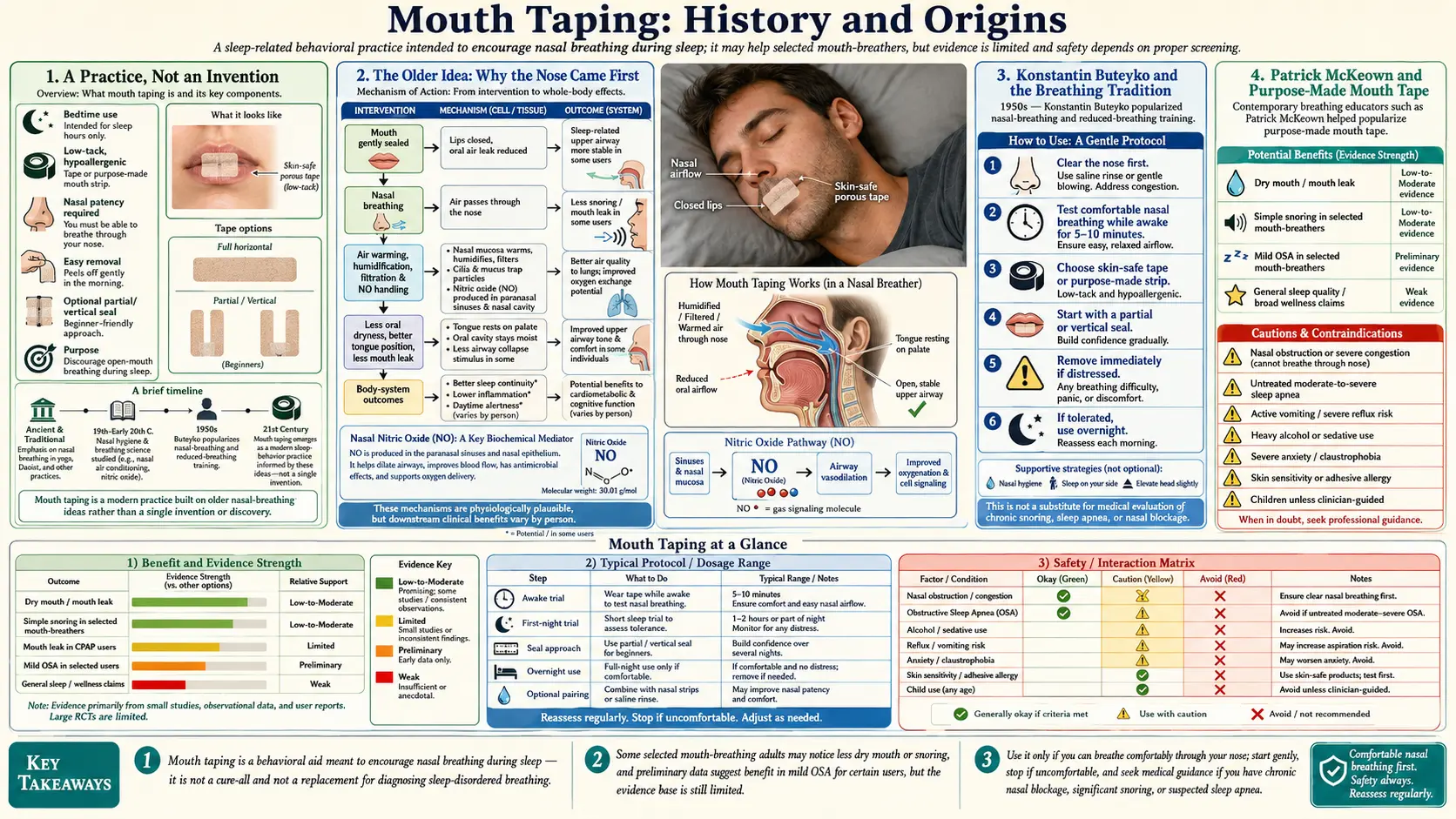
Mouth taping — placing a small strip of tape across the lips at bedtime to keep the mouth shut and encourage breathing through the nose — has no single inventor and is not an ancient remedy. It is better understood as a recent, popularised expression of a much older idea: that breathing through the nose, especially during sleep, is healthier than breathing through the mouth. This article traces that history honestly. It separates the long-standing clinical interest in mouth breathing from the specific modern habit of taping the lips; credits the people who actually drove the practice into public view — the Ukrainian physician Konstantin Buteyko and his breathing tradition, the Irish breathing educator Patrick McKeown, and the journalist James Nestor, whose 2020 book turned a niche idea into a social-media trend; and then states plainly what the published evidence does and does not support. Where a claim is firm we say so. Where it is folklore, marketing, or still unsettled in the research, we name it as such — because on a practice that can be genuinely unsafe for some people, the history only matters if it is truthful.
Table of Contents
- A Practice, Not an Invention
- The Older Idea: Why the Nose Came First
- Konstantin Buteyko and the Breathing Tradition
- Patrick McKeown and Purpose-Made Mouth Tape
- James Nestor, “Breath,” and the Viral Era
- What the Clinical Studies Actually Found
- Evidence and Reception: An Honest Accounting
- Research Papers and References
- Connections
- Featured Videos
A Practice, Not an Invention
It is worth being clear at the outset about what this history can and cannot claim. Mouth taping is a general practice, not a branded therapy with a documented founding moment. Nobody “discovered” that a piece of tape will hold the lips together; people have used adhesive tape on skin for well over a century, and the leap to placing it over the mouth to discourage mouth breathing is simple enough that it has almost certainly been improvised many times, by many people, without anyone writing it down. Any page that names a single “inventor of mouth taping” is overstating the record.
What does have a real, traceable history is the chain of ideas and people that carried mouth taping from improvised home trick to mainstream sleep habit. That chain runs through a much older clinical concern about mouth breathing, through a twentieth-century breathing movement that made nasal breathing during sleep a central goal, through an educator who turned the idea into a purpose-built product, and through a best-selling book that put it in front of millions. Those are the threads this article follows — and, just as importantly, it follows the research that arrived afterward to test whether the habit actually helps.
The Older Idea: Why the Nose Came First
Long before anyone taped a mouth shut, physicians and dentists had noticed that habitual mouth breathing tends to travel with problems — dry mouth, snoring, dental and facial changes in children, and disturbed sleep. The conviction that the nose, not the mouth, is the body’s proper airway is itself old; the nineteenth-century American artist and writer George Catlin made it the theme of a popular book on the subject, arguing from his travels that peoples who kept their mouths closed in sleep enjoyed better health. Catlin’s claims were anecdotal and of their time, but they capture the durable intuition that sits underneath mouth taping: the nose is built for the job and the mouth is not.
Modern physiology gave that intuition a concrete footing. The nose warms, humidifies, and filters incoming air, slows the breath, and — a finding that became central to later enthusiasm — the paranasal sinuses produce nitric oxide, a signalling molecule that is carried into the lungs on nasally inhaled air. That nitric oxide discovery was reported in 1995 by Jon Lundberg and colleagues at the Karolinska Institute in Sweden, and it is frequently cited as a reason nasal breathing might matter beyond simple comfort. It is fair to say the nose does things the mouth cannot; it is a much larger leap to say that taping the mouth reliably delivers all those benefits, and that leap is where honest history has to slow down.
The key point for this history is that the problem mouth taping aims at — mouth breathing during sleep — was recognised and studied for generations before the tape itself became fashionable. Taping is one proposed fix for an old and genuine observation, not the observation itself.
Konstantin Buteyko and the Breathing Tradition
The single figure most often invoked in the back-story of mouth taping is Konstantin Pavlovich Buteyko (born 27 January 1923 in Ivanitsa, Ukraine, then part of the Soviet Union; died 2 May 2003 in Moscow). Buteyko was a Soviet physician whose name now attaches to an entire school of breathing re-education. His path to medicine was unusual: accepted to study mechanics at the Kyiv Polytechnic Institute, he had his education interrupted by the Second World War, spent years repairing vehicles for the Soviet army, and only afterward, in 1946, enrolled at the First Moscow Institute of Medicine, then the country’s leading medical school. He graduated in 1952.
As a young doctor he was struck by how the breathing of seriously ill patients seemed to grow heavier as their condition worsened — an observation that turned into a lifelong conviction that over-breathing, rather than under-breathing, lay behind many chronic complaints. Buteyko himself suffered from severe high blood pressure, and he dated the birth of his method to 7 October 1952, when, by his account, deliberately reducing his breathing relieved his symptoms. From this he built the Buteyko method: a programme of reduced, gentle, nasal breathing aimed initially at asthma and later at a range of conditions. He began a clinical trial of 200 patients in 1959, and by the early 1980s Soviet authorities permitted formal trials and approved the method for wider use.
Within this tradition, a permanently closed mouth — awake and asleep — is treated as fundamental, on the view that the mouth is for eating and speaking and the nose is for breathing. It is from Buteyko practitioners that the modern habit of encouraging nasal breathing during sleep, including by taping the lips, is usually traced. Here a careful caution is required, and this page makes it explicitly: reliable biographical sources on Buteyko describe his breathing method and his emphasis on nasal breathing, but they do not document Buteyko personally inventing or prescribing mouth taping. The honest statement is that mouth taping grew up within the Buteyko breathing movement and its descendants as one practical tactic for keeping the mouth closed at night — not that Buteyko himself is the documented originator of the tape. The broader importance of the man is real and well attested: he made nasal breathing during sleep an explicit therapeutic goal, and the practice of taping followed from that goal rather than the other way around.
Patrick McKeown and Purpose-Made Mouth Tape
If Buteyko supplied the underlying philosophy, the figure who did the most to carry nasal-breathing-during-sleep — and mouth taping specifically — into the modern English-speaking wellness world is Patrick McKeown, an Irish breathing educator and author based in Galway. McKeown’s involvement began personally: a lifelong asthma sufferer, he discovered Buteyko’s work in 1997 after graduating from Trinity College Dublin, trained directly in the Buteyko tradition, and credits the method with reversing his own symptoms. He went on to become a prolific writer on breathing — his books include Close Your Mouth, Asthma-Free Naturally, and the widely read The Oxygen Advantage (2015) — and a director of education at Buteyko Clinic International, training instructors internationally.
McKeown’s contribution to the mouth-taping story is twofold. First, through his books and teaching he popularised the simple instruction to keep the mouth closed during sleep, and discussed taping the lips as a way to achieve it for habitual mouth-breathers. Second, and more concretely, he developed a purpose-made product for the job: MyoTape, a tape designed to sit around the mouth and gently draw the lips together rather than seal them shut. That distinction — encouraging closure rather than forming an airtight seal — is itself a meaningful piece of the practice’s history, because it is the safer design philosophy and one that later commentators would echo. McKeown is a commercial advocate for the practice as well as an educator, which is worth stating plainly; but his role in turning “keep your mouth closed at night” into a concrete, named, widely sold tool is a real and datable part of how mouth taping spread.
James Nestor, “Breath,” and the Viral Era
The moment mouth taping left the breathing-clinic subculture and entered everyday conversation can be dated quite precisely to 2020, with the publication of Breath: The New Science of a Lost Art by the American science journalist James Nestor (Riverhead Books, 26 May 2020). The book — which went on to sell more than two million copies and be translated into dozens of languages — is a popular, narrative account of how humans came to breathe through their mouths and why that may be harmful. To dramatise the contrast, Nestor underwent a much-discussed self-experiment, having his nostrils plugged so that he breathed only through his mouth for ten days, then reversing it for ten days of strict nasal breathing, which included taping his mouth at night.
Nestor did not invent mouth taping and does not claim to; in his telling he learned of it from clinicians, including a breathing therapist who kept a roll of tape on her desk and a dentist who used a small piece of surgical tape about the size of a postage stamp. What Breath did was give the practice a vivid, memorable story and an enormous audience. In the wake of the book, mouth taping spread rapidly across social media, where it was credited — often far beyond any evidence — with everything from deeper sleep and sharper focus to improved immunity and a more defined jawline. This is the point in the history where promotion clearly outran proof, and it is the reason the practice now arrives wrapped in claims a careful reader should treat with caution. The chain is therefore clear and honest: an old clinical concern about mouth breathing, formalised by Buteyko, productised and taught by McKeown, and finally made viral by Nestor’s 2020 book.
What the Clinical Studies Actually Found
Running alongside the popular story is a small but real research record, and it is worth laying out in order because it is frequently misrepresented. The earliest directly relevant clinical work predates the social-media boom. In 2015, Tsung-Wei Huang and Tai-Horng Young in Taiwan published a pilot study of a porous oral patch in thirty patients with mild obstructive sleep apnea and mouth breathing, reporting improvement in some measures — an early, small signal that closing the mouth might help a carefully selected group.
The most-cited supportive study came in 2022, when Yi-Chieh Lee and colleagues at Chang Gung Memorial Hospital in Taiwan published a preliminary study in the journal Healthcare on mouth taping in mouth-breathers with mild obstructive sleep apnea. In that selected group the apnea-hypopnea index and snoring fell substantially — the source of the widely quoted “about a 47% reduction” figure. Crucially, the patients had mild disease and were screened mouth-breathers; the authors framed taping as a possible step before CPAP or surgery in such people, not as a general remedy or a cure.
The counter-evidence is just as important and more recent. In 2024, a nonrandomized clinical trial published in JAMA Otolaryngology–Head & Neck Surgery examined what actually happens to airflow when the mouth is held closed in patients with obstructive sleep apnea. The results were mixed by design: while closing the mouth increased airflow for the group overall, in patients who breathe mainly through the mouth and have obstruction at the soft palate (the velopharynx), forcing the mouth shut made airflow worse. That is a mechanistic warning, not a marketing slogan: for some airways, taping the mouth is the wrong move. The studies, in short, point in different directions for different people — which is exactly why the next section, on the overall evidence and reception, matters more than any single trial.
Evidence and Reception: An Honest Accounting
By 2024 and 2025 the wider research community had begun to weigh the practice as a whole, and the verdict is sobering for anyone treating mouth taping as proven. A scoping review published in the American Journal of Otolaryngology (Fangmeyer, Badger, and Thakkar, 2024–2025) catalogued the gap between the sweeping benefits credited to mouth taping on social media — energy, immunity, dental health, and more — and the thin published evidence actually supporting them. A more formal systematic review in PLOS One in 2025 (Rhee and colleagues) pooled ten studies covering roughly two hundred patients and reached a blunt conclusion: the clinical benefit is limited, only a minority of studies showed statistically significant improvement, and — in the authors’ own framing — there is a potentially serious risk of harm for people who adopt the trend indiscriminately, above all those with nasal obstruction, for whom a taped mouth and a blocked nose can become a dangerous combination.
That is the honest reception of the practice as it stands. Mouth taping is not an established medical treatment, it is not a treatment for obstructive sleep apnea, and it should never be used to self-treat loud snoring, witnessed pauses in breathing, or significant daytime sleepiness in place of a proper sleep evaluation. The most credible reading of the evidence is narrow: for a carefully selected adult who is a habitual mouth-breather, breathes comfortably through the nose, and has had serious sleep-disordered breathing ruled out, taping may modestly help with snoring and dry mouth — and even then the supporting trials are small and preliminary. For people with undiagnosed sleep apnea, nasal blockage, recent alcohol or sedative use, or anyone unable to remove the tape reliably, the practice ranges from useless to hazardous.
The fair conclusion to this history is the same caution that should follow any fashionable health habit. Mouth taping rests on a genuine and old observation — that nasal breathing is the body’s default and that chronic mouth breathing carries real downsides — but the tape itself is a recent, lightly evidenced, heavily marketed intervention whose popularity has badly outrun its proof. Knowing where it came from, and who carried it, is useful precisely because it makes clear what is solid (the value of nasal breathing) and what is not (the claim that a strip of tape is a safe, broadly beneficial fix). The detailed practical guidance, the safety rules, and who should and should not try it are covered on the main Mouth Taping page and in the Mouth Taping Benefits articles.
Research Papers and References
The list below gathers the key peer-reviewed studies and reviews behind mouth taping and the nasal-breathing rationale, followed by curated PubMed topic-search links and authoritative external resources. Historical figures named in the article above (Konstantin Buteyko, Patrick McKeown, James Nestor, and George Catlin) are discussed as historical and popular sources rather than cited as clinical evidence. Author names, titles, and journals are given as plain text; only the stable DOI, PMID, or archive link is hyperlinked, and each opens in a new tab.
- Rhee J, Iansavitchene A, Mannala S, Graham ME, Rotenberg B. Breaking social media fads and uncovering the safety and efficacy of mouth taping in patients with mouth breathing, sleep disordered breathing, or obstructive sleep apnea: a systematic review. PLoS One. 2025;20(5):e0323643. — doi:10.1371/journal.pone.0323643 · PMID: 40397877
- Fangmeyer SK, Badger CD, Thakkar PG. Nocturnal mouth-taping and social media: a scoping review of the evidence. American Journal of Otolaryngology. 2025;46(1):104545. — doi:10.1016/j.amjoto.2024.104545 · PMID: 39662104
- Mouth Closure and Airflow in Patients With Obstructive Sleep Apnea: A Nonrandomized Clinical Trial. JAMA Otolaryngology–Head & Neck Surgery. 2024;150(11):1012-1019. — doi:10.1001/jamaoto.2024.3319
- Lee YC, Lu CT, Cheng WN, Li HY. The impact of mouth-taping in mouth-breathers with mild obstructive sleep apnea: a preliminary study. Healthcare (Basel). 2022;10(9):1755. — doi:10.3390/healthcare10091755 · PMID: 36141367
- Huang TW, Young TH. Novel porous oral patches for patients with mild obstructive sleep apnea and mouth breathing: a pilot study. Otolaryngology–Head and Neck Surgery. 2015;152(2):369-373. — doi:10.1177/0194599814559383 · PMID: 25450408
- Lundberg JO, Farkas-Szallasi T, Weitzberg E, et al. High nitric oxide production in human paranasal sinuses. Nature Medicine. 1995;1(4):370-373. — doi:10.1038/nm0495-370 · PMID: 7585069
- Mouth taping and nasal breathing during sleep — PubMed: mouth taping and nasal breathing during sleep
- Mouth breathing, sleep-disordered breathing, and obstructive sleep apnea — PubMed: mouth breathing and obstructive sleep apnea
External Authoritative Resources
Connections
- All Remedies
- Mouth Taping
- Mouth Taping Benefits
- Breathwork
- Sleep Hygiene
- Oral Microbiome
- Obstructive Sleep Apnea
- Asthma