Castor Oil
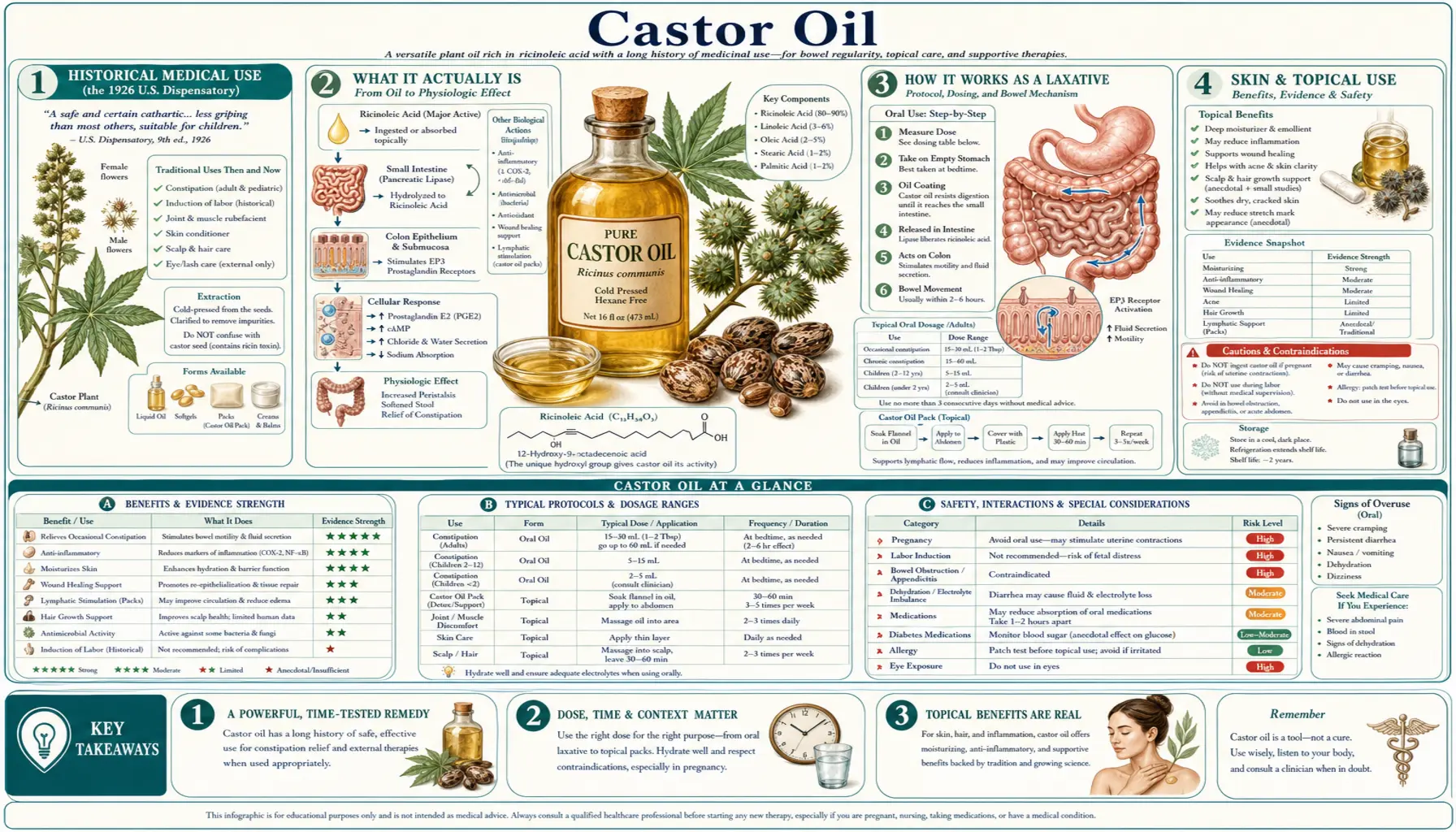
Castor oil is one of the oldest remedies in the medicine cabinet — a thick, pale-yellow oil pressed from the seeds of the castor plant, used for centuries to "move the bowels" and to soothe irritated skin. The 1926 Dispensatory of the United States (21st edition) listed castor oil as a cathartic and, externally, as an emollient for seborrhea and other skin diseases. Both of those old uses have a modern basis: its main fatty acid, ricinoleic acid, stimulates intestinal muscle, and the oil works as a skin-conditioning emollient. Castor oil has also collected a layer of modern marketing — "castor oil packs" that "pull toxins," "liver flushes," daily eyelid and belly-button routines — that runs well ahead of the evidence. The sections below set out what the pharmacology and the clinical studies show, what remains folklore, and what the drug labels, reviews and case reports record about safety.
Table of Contents
- Historical Medical Use (the 1926 U.S. Dispensatory)
- What It Actually Is
- How It Works as a Laxative
- Skin & Topical Use
- Castor Oil Packs (an Honest Look)
- Castor Oil & Labor Induction
- How It's Used Today
- Safety, Cautions & Myths
- The Ricin Question (Seed vs. Refined Oil)
- Key Research Papers
- Connections
- Featured Videos
Historical Medical Use (the 1926 U.S. Dispensatory)
By 1926, castor oil had been in the Western pharmacopeia for generations. The 21st edition of the Dispensatory of the United States listed it as a cathartic and attributed its action to ricinoleic acid, "split off in the intestinal tract," which "excites active peristalsis in the upper bowel." It described its use in colic, enteritis and dysentery, noted that it was "frequently resorted to" for pregnant women and women after childbirth, and called it — in the language of the time — "the best and safest cathartic for children." The stated dose was half a fluidounce to two fluidounces (15–60 cc). Because of its disagreeable, oily taste, the Dispensatory described giving it floated in cinnamon water or orange juice, or on the froth of sarsaparilla syrup mixed with carbonated water.
The Dispensatory described the action as a "gentle irritation" of the bowel lining that drives peristalsis — what modern classification calls a stimulant laxative, a drug that works by driving the muscular contractions of the intestine. It also noted that because castor oil empties the bowel so thoroughly, constipation "is liable to follow" on the next day, and for that reason it was "not to be recommended as a habitual laxative."
Castor oil's second 1926 role was topical: the Dispensatory called it "useful for its emollient effects in seborrhea and other skin diseases," with the advantage over other oils of being soluble in alcohol.
How to read this history: the 1926 uses were laxative and skin-softening, and both have a basis in chemistry studied since. The "detox pack" and "liver flush" claims are not part of the 1926 entry; they are addressed below.
What It Actually Is
Castor oil is a vegetable oil pressed from the seeds — the "beans" — of Ricinus communis, the castor plant. The plant is thought to have been domesticated in eastern Africa and is now grown in warm regions around the world; a 2016 review describes global castor oil production as concentrated mainly in Gujarat, in western India.
What makes castor oil chemically unusual is its fatty-acid makeup. The same review gives it as up to 90% ricinoleic acid, about 4% linoleic, 3% oleic, 1% stearic and less than 1% linolenic acid. Ricinoleic acid is an unusual fatty acid: it carries an extra hydroxyl (–OH) group on its carbon chain, which the review notes makes castor oil a natural polyol with good oxidative stability. Ricinoleic acid is also the part of the oil responsible for its effects on the gut.
That high ricinoleic-acid content makes castor oil an industrial feedstock as well as a medicine — used in soaps, lubricants, coatings and polyurethane-type polymers. The pharmaceutical and cosmetic grades are the same plant oil, purified for those uses.
One point the ricin section returns to: the oil and the toxic part of the seed are not the same substance. The poison ricin is a protein found in the seed's endosperm. A 2007 Cosmetic Ingredient Review safety assessment states that castor oil does not contain ricin because ricin does not partition into the oil; the toxic material stays in the press cake left after pressing.
How It Works as a Laxative
By 1926 it was already known that ricinoleic acid, released from the oil in the intestine, drives peristalsis, but its molecular target was unknown until 2012. When castor oil is swallowed, intestinal lipases split it and release ricinoleic acid. In a 2012 study in mice, Tunaru and colleagues showed that ricinoleic acid specifically activates the prostaglandin EP3 receptor, and that this receptor on intestinal and uterine smooth-muscle cells mediates castor oil's effects: in mice lacking EP3 receptors, the laxative effect and the uterine contraction induced by ricinoleic acid were absent, and mice lacking the receptor only in smooth muscle did not respond, while deleting it only in the intestinal lining did not prevent the diarrhea. Stronger contraction of intestinal muscle is the defining action of a stimulant laxative. The same receptor in the uterus offers a mechanism for the labor-induction folklore covered below, and is one basis for the concerns about use in pregnancy.
This puts castor oil in the stimulant laxative family — the same broad category as senna and bisacodyl — rather than the "bulk-forming" laxatives (like psyllium) or the "osmotic" ones (like magnesium or polyethylene glycol). The 2007 Cosmetic Ingredient Review assessment records that the U.S. Food and Drug Administration classifies castor oil as generally recognized as safe and effective as a stimulant laxative; it is sold as a regulated over-the-counter drug for occasional constipation.
U.S. over-the-counter castor oil labels (listed on the National Library of Medicine's DailyMed database) state that it generally produces a bowel movement in 6 to 12 hours and warn against use for longer than one week. The 1926 Dispensatory already noted constipation the following day after a thorough clear-out. Approaches to everyday constipation that begin with gentler measures are described on the Natural Constipation Relief page.
Skin & Topical Use
The 1926 use of castor oil as a skin-softening oil also holds up, though for more modest reasons than enthusiasts claim. The 2007 Cosmetic Ingredient Review describes castor oil and its ricinoleate derivatives as functioning mainly as skin-conditioning agents, emulsion stabilizers and surfactants in cosmetics; it reported castor oil in 769 cosmetic products in 2002, with the highest use concentration (81%) in lipstick. Its thick texture is one reason it appears in lip balms, ointments and cosmetics, and it is used as a carrier for other ingredients — the same review notes that castor oil and ricinoleic acid can enhance the skin penetration of other chemicals.
There is also animal evidence that ricinoleic acid has anti-inflammatory activity. In a 2000 study in mice and guinea pigs, a single topical application of ricinoleic acid increased experimentally induced paw swelling, but repeated application over 8 days markedly reduced it and lowered tissue levels of substance P (a nerve-derived inflammatory signal), a pattern the researchers compared to capsaicin; similar effects were seen on histamine-induced eyelid swelling in guinea pigs. The authors described ricinoleic acid as a "capsaicin-like, non-pungent anti-inflammatory agent." This is animal work, not human trials: it gives a plausible footing for the traditional use on inflamed skin, but it does not establish castor oil as a proven treatment for any skin disease.
Castor oil shows up in a few specific modern niches, chiefly eye care. In a randomized, double-masked, placebo-controlled crossover trial in 20 patients with non-inflamed obstructive meibomian gland dysfunction (Goto 2002), eye drops containing 2% castor oil improved symptoms, tear-film stability and tear evaporation compared with placebo. In a randomized, investigator-masked, paired-eye trial in 26 people with blepharitis (Muntz 2021), cold-pressed castor oil applied to the eyelids of one eye twice daily for 4 weeks improved symptoms and several eyelid-margin signs in the treated eye, with no adverse events reported; the authors called for longer efficacy trials. As for the popular claim that castor oil grows hair, eyelashes, or eyebrows: no clinical trial testing castor oil alone for hair, eyelash or eyebrow growth was found in PubMed. A 2026 narrative review describes evidence for improved hair luster (a cosmetic effect) and only a proposed, untested mechanism in pattern hair loss, and case reports describe acute hair felting — sudden, irreversible matting of long scalp hair — after washing with coconut and castor oil.
Castor Oil Packs (an Honest Look)
A "castor oil pack" is a traditional home practice: a cloth soaked in castor oil is laid over the skin — usually the abdomen, over the liver or lower belly — often with a heat source on top, and left in place for an hour or so. The practice is commonly credited to the 20th-century writings of Edgar Cayce and is widely promoted today for "liver detox," "reducing inflammation," easing constipation, menstrual cramps, and a long list of other complaints.
The scientific evidence for packs is very thin. The human study most often cited (Arslan and Eşer 2011) followed elderly residents of two rest homes in Turkey for 7 days before, 3 days during and 4 days after castor oil pack use; 80% had been constipated for 10 years or longer. The packs did not change the number of bowel movements or the amount of stool, but they lowered straining and stool-consistency scores and improved the feeling of complete evacuation — a real, if modest, finding for one specific use.
No study indexed in PubMed shows that a castor oil pack "detoxes the liver," "pulls toxins out through the skin," "cleanses the lymph," or strengthens immune function; those claims come from proponents of the practice, not from published trials. The liver and kidneys are the organs that clear most waste products from the body. Related coverage: Liver Cleansing and Detox Protocols.
Castor Oil & Labor Induction
One of castor oil's oldest folk uses is to bring on labor in pregnant women at or past their due date — and unlike the "detox" claims, this one has a mechanistic basis. In the 2012 mouse study above, ricinoleic acid acted on EP3 prostaglandin receptors not only in the intestine but also in the uterus, where it triggered muscle contraction.
The clinical evidence is limited and mixed. The 2001 Cochrane review (Kelly and colleagues) found one trial of 100 women, judged it small and of poor methodological quality, and reported that all women who took castor oil felt nauseous. Its 2013 update included three trials with 233 women: it found no difference in caesarean, instrumental-delivery, meconium-stained-fluid or low-Apgar rates, again reported that all women who took castor oil felt nauseous, warned that the trials were too small to detect all but large differences and of poor methodological quality, and concluded that further research is needed to quantify castor oil's efficacy. A 2022 meta-analysis of eight studies (Moradi and colleagues) reported higher Bishop scores (a measure of cervical readiness) and higher odds of labor induction after oral castor oil, and its authors concluded that it is effective.
Individual studies point in different directions. A 2018 randomized trial in 81 women with low-risk pregnancies past their due date (Gilad and colleagues; 60 mL castor oil versus 60 mL sunflower oil) found that women who had given birth before were more likely to enter active labor within 24, 36 and 48 hours, but first-time mothers were not; no differences in obstetric complications or newborn outcomes were seen. A 2009 review of hospital records for 612 women past 40 weeks on the Thai–Burmese border (Boel and colleagues) found no difference in time to birth and no harmful effects in the 205 who took castor oil. A 2018 retrospective review of 323 women given a castor oil "cocktail" at a U.S. freestanding birth center (DeMaria and colleagues) reported that 90.7% gave birth vaginally and that maternal adverse effects such as nausea, vomiting or extreme diarrhea occurred in under 7%.
The safety findings: because castor oil stimulates uterine muscle, its use in pregnancy carries specific hazards. Case reports describe a uterine rupture in a woman at 39 weeks with a previous caesarean delivery shortly after she took 5 mL of castor oil (Sicuranza 2003), and an amniotic fluid embolism with cardiorespiratory arrest temporally associated with castor oil ingestion in a full-term pregnancy (Steingrub 1988). The controlled studies above were too small to rule out uncommon harms. U.S. over-the-counter castor oil labels direct pregnant or breast-feeding women to ask a health professional before use. Decisions about labor induction belong with a midwife or obstetrician.
How It's Used Today
Castor oil remains an inexpensive, widely available product with a few evidence-based and several traditional uses:
- Occasional constipation. Sold over the counter as a stimulant laxative. U.S. labels list 15 to 60 mL in a single daily dose for adults and children over 12, 5 to 15 mL for children 2 to under 12, and no use under age 2 except on a doctor's advice; they state that it generally works in 6 to 12 hours and is not for use longer than one week.
- Bowel emptying. Historically used to empty the bowel thoroughly; the 1926 Dispensatory also describes its use as an enema.
- Skin emollient. As a skin-conditioning, barrier oil in balms, ointments, lipsticks and cosmetics.
- Eye care. As an ingredient in some lubricating eye drops, and in small trials for meibomian gland dysfunction and blepharitis (see above).
- Castor oil packs. As a traditional warm compress, with the thin evidence described above.
- Cosmetics and hair/skin care. As a conditioning, shine-adding oil — a cosmetic effect, not a medical one.
In summary, the evidence supports castor oil as an occasional stimulant laxative and an emollient; it does not support it as a daily supplement, a detox method, or a treatment for chronic conditions. U.S. labels list a sudden change in bowel habits lasting more than 2 weeks as a reason to ask a doctor before use.
Safety, Cautions & Myths
Castor oil is an approved over-the-counter drug with known adverse effects. The findings below come from drug labels, safety reviews, trials and case reports.
- Nausea, cramping and diarrhea. As a forceful stimulant laxative, castor oil can cause abdominal cramps, urgency, and loose or watery stools. In the Cochrane labor-induction review, all women who took castor oil felt nauseous.
- Dehydration and electrolyte loss. Strong, repeated bowel evacuation can deplete water and electrolytes, especially potassium; electrolyte imbalance can cause weakness and an irregular heartbeat. U.S. castor oil labels warn that frequent or prolonged use may result in dependence on laxatives, and the 1926 Dispensatory noted that constipation tends to follow a thorough clear-out.
- Pregnancy. Castor oil stimulates uterine muscle (via the EP3 mechanism above), and case reports describe uterine rupture and amniotic fluid embolism after ingestion at term (see the labor section). U.S. labels direct pregnant or breast-feeding women to ask a health professional before use.
- Bowel obstruction or acute abdomen. U.S. labels list abdominal pain, nausea or vomiting as reasons to ask a doctor before use, and rectal bleeding or failure to have a bowel movement after use as reasons to stop and ask a doctor, noting these could be signs of a serious condition. Bowel obstruction and suspected appendicitis are standard contraindications for stimulant laxatives, because forcing peristalsis against a blockage is dangerous.
- Chronic, daily use. The labels limit use to one week, and the 1926 Dispensatory already described it as unsuitable as a habitual laxative because constipation tends to follow.
- Other conditions and medicines. People with kidney or heart disease are more vulnerable to fluid and electrolyte shifts, and laxative-driven potassium loss is a particular concern with digoxin, diuretics, and other medications affected by electrolytes. U.S. labels advise asking a doctor or pharmacist before use with any other drug and taking castor oil 2 or more hours before or after other drugs, because laxatives may affect how other drugs work.
- Allergy and skin sensitivity. The 2007 Cosmetic Ingredient Review found that castor oil was not a significant skin irritant, sensitizer or photosensitizer in human clinical tests and that sensitization reactions are seen infrequently, though people with existing occupational skin disease may react to castor oil or ricinoleic acid; case reports describe allergic contact dermatitis. Instilling castor oil solutions into the eye caused discomfort and corneal surface changes in two human studies the review summarizes.
Myths worth correcting:
- "Castor oil packs detox your liver / pull out toxins through the skin." No study indexed in PubMed shows that a topical pack cleanses the liver, lymph, or blood; the liver and kidneys do that work.
- "Castor oil is poisonous because it comes from the same plant as ricin." The 2007 Cosmetic Ingredient Review states that castor oil does not contain ricin, because ricin does not partition into the oil (see the next section).
- "Castor oil regrows hair, eyelashes, and eyebrows." No clinical trial of castor oil alone for hair growth was found; the reported effect is on luster, a cosmetic coating, not regrowth.
- "It's a gentle, everyday laxative." It's a stimulant laxative — effective but forceful, and labeled for occasional constipation and no more than one week of use.
The Ricin Question (Seed vs. Refined Oil)
Because castor oil comes from castor beans, and because ricin — one of the most notorious plant poisons — also comes from castor beans, people understandably worry. Here is what the sources say.
Ricin is a protein (a lectin of the ribosome-inactivating type) found in the seed's endosperm. It is genuinely dangerous: animals can die after low doses of ricin by skin contact, injection, inhalation or mouth, and the 1926 Dispensatory recorded that as few as three seeds had caused fatal gastro-enteritis in an adult. The oil is a different matter. The 2007 Cosmetic Ingredient Review states that cosmetic castor oil is produced by cold pressing the seeds and then clarifying the oil by heat, and that castor oil does not contain ricin because ricin does not partition into the oil. The 1926 Dispensatory likewise describes removing the "albuminous principles" from the oil by steaming, and notes that the press cake "contains the poisonous constituents of the seed" and was unfit for feeding animals. U.S. FDA regulations permit castor oil as a food additive — as a release and anti-sticking agent in hard candy (up to 500 parts per million) and in protective coatings on vitamin and mineral tablets (21 CFR 172.876) — and the review records that the joint FAO/WHO Expert Committee on Food Additives set an acceptable daily intake of 0 to 0.7 mg per kg of body weight.
In short, the sources describe the raw seed and its press cake as toxic and the pressed, clarified oil as free of ricin. Raw castor beans are a real poisoning hazard; the safety record of pharmaceutical- and food-grade castor oil rests on that separation.
Key Research Papers
- Tunaru S, Althoff TF, Nüsing RM, Diener M, Offermanns S. (2012). Castor oil induces laxation and uterus contraction via ricinoleic acid activating prostaglandin EP3 receptors. Proceedings of the National Academy of Sciences, 109(23):9179–9184. — The mechanism paper: in mice, it identified the EP3 prostaglandin receptor on smooth-muscle cells as the target through which ricinoleic acid, released from castor oil, causes both laxation and uterine contraction. — doi:10.1073/pnas.1201627109 (PubMed PMID: 22615395)
- Vieira C, Evangelista S, Cirillo R, Lippi A, Maggi CA, Manzini S. (2000). Effect of ricinoleic acid in acute and subchronic experimental models of inflammation. Mediators of Inflammation, 9(5):223–228. — Mouse and guinea-pig experiments: a single topical application of ricinoleic acid increased experimental swelling, while repeated application over 8 days reduced it, a capsaicin-like pattern — preclinical, not human-trial, evidence. — doi:10.1080/09629350020025737 (PubMed PMID: 11200362)
- Arslan GG, Eşer İ. (2011). An examination of the effect of castor oil packs on constipation in the elderly. Complementary Therapies in Clinical Practice, 17(1):58–62. — A study in rest-home residents in Turkey finding that castor oil packs reduced constipation symptoms (straining, stool consistency, sense of incomplete emptying) without changing the number of bowel movements or amount of stool — the most-cited human evidence for packs, and a modest result. — doi:10.1016/j.ctcp.2010.04.004 (PubMed PMID: 21168117)
- Kelly AJ, Kavanagh J, Thomas J. (2001). Castor oil, bath and/or enema for cervical priming and induction of labour. Cochrane Database of Systematic Reviews, (2):CD003099. — One included trial of 100 women, judged small and of poor methodological quality; all women who took castor oil felt nauseous; further research needed. (Superseded by the 2013 update below.) — doi:10.1002/14651858.CD003099 (PubMed PMID: 11406076)
- Moradi M, Niazi A, Mazloumi E, Lopez V. (2022). Effect of Castor Oil on Cervical Ripening and Labor Induction: a systematic review and meta-analysis. Journal of Pharmacopuncture, 25(2):71–78. — A meta-analysis of eight studies reporting higher Bishop scores and higher odds of labor induction after oral castor oil; its authors concluded it is effective. — doi:10.3831/kpi.2022.25.2.71 (PubMed PMID: 35837141)
- Kelly AJ, Kavanagh J, Thomas J. (2013). Castor oil, bath and/or enema for cervical priming and induction of labour. Cochrane Database of Systematic Reviews, (7):CD003099. — Update of the 2001 review: three trials, 233 women; no difference in caesarean, instrumental-delivery, meconium or low-Apgar rates; all women who took castor oil felt nauseous; trials small and of poor methodological quality. — doi:10.1002/14651858.CD003099.pub2 (PubMed PMID: 23881775)
- Gilad R, Hochner H, Savitsky B, Porat S, Hochner-Celnikier D. (2018). Castor oil for induction of labor in post-date pregnancies: A randomized controlled trial. Women and Birth, 31(1):e26–e31. — 81 women past their due date, 60 mL castor oil vs sunflower oil; more women who had given birth before entered active labor within 24–48 hours; no effect in first-time mothers. — doi:10.1016/j.wombi.2017.06.010 (PubMed PMID: 28750937)
- Boel ME, Lee SJ, Rijken MJ, Paw MK, Pimanpanarak M, Tan SO, Singhasivanon P, Nosten F, McGready R. (2009). Castor oil for induction of labour: not harmful, not helpful. Australian and New Zealand Journal of Obstetrics and Gynaecology, 49(5):499–503. — Hospital records of 612 women past 40 weeks; no difference in time to birth and no harmful effects observed with castor oil. — doi:10.1111/j.1479-828X.2009.01055.x (PubMed PMID: 19780733)
- DeMaria AL, Sundstrom B, Moxley GE, Banks K, Bishop A, Rathbun L. (2018). Castor oil as a natural alternative to labor induction: A retrospective descriptive study. Women and Birth, 31(2):e99–e104. — 323 women at a U.S. birth center; 90.7% gave birth vaginally; maternal adverse effects under 7%; no comparison group. — doi:10.1016/j.wombi.2017.08.001 (PubMed PMID: 28838804)
- Sicuranza GB, Figueroa R. (2003). Uterine rupture associated with castor oil ingestion. Journal of Maternal-Fetal & Neonatal Medicine, 13(2):133–134. — Case report: rupture of a previous caesarean scar at 39 weeks after 5 mL of castor oil. — doi:10.1080/jmf.13.2.133.134 (PubMed PMID: 12735415)
- Steingrub JS, Lopez T, Teres D, Steingart R. (1988). Amniotic fluid embolism associated with castor oil ingestion. Critical Care Medicine, 16(6):642–643. — Case report of amniotic fluid embolism with cardiorespiratory arrest temporally associated with castor oil at term. — doi:10.1097/00003246-198806000-00016 (PubMed PMID: 3371030)
- Goto E, Shimazaki J, Monden Y, Takano Y, Yagi Y, Shimmura S, Tsubota K. (2002). Low-concentration homogenized castor oil eye drops for noninflamed obstructive meibomian gland dysfunction. Ophthalmology, 109(11):2030–2035. — Randomized, double-masked, placebo-controlled crossover trial in 20 patients; 2% castor oil drops improved symptoms and tear-film measures. — doi:10.1016/s0161-6420(02)01262-9 (PubMed PMID: 12414410)
- Muntz A, Sandford E, Claassen M, Curd L, Jackson AK, Watters G, Wang MTM, Craig JP. (2021). Randomized trial of topical periocular castor oil treatment for blepharitis. The Ocular Surface, 19:145–150. — Paired-eye trial in 26 people; 4 weeks of eyelid application improved symptoms and lid-margin signs; no adverse events. — doi:10.1016/j.jtos.2020.05.007 (PubMed PMID: 32422285)
- [No authors listed; Cosmetic Ingredient Review Expert Panel]. (2007). Final report on the safety assessment of Ricinus Communis (Castor) Seed Oil, Hydrogenated Castor Oil, Glyceryl Ricinoleate, Glyceryl Ricinoleate SE, Ricinoleic Acid, Potassium Ricinoleate, Sodium Ricinoleate, Zinc Ricinoleate, Cetyl Ricinoleate, Ethyl Ricinoleate, Glycol Ricinoleate, Isopropyl Ricinoleate, Methyl Ricinoleate, and Octyldodecyl Ricinoleate. International Journal of Toxicology, 26(Suppl 3):31–77. — States that castor oil does not contain ricin, records FDA's classification of castor oil as a safe and effective stimulant laxative, and reviews skin and eye safety data. — doi:10.1080/10915810701663150 (PubMed PMID: 18080873)
- Patel VR, Dumancas GG, Kasi Viswanath LC, Maples R, Subong BJ. (2016). Castor Oil: Properties, Uses, and Optimization of Processing Parameters in Commercial Production. Lipid Insights, 9:1–12. — Fatty-acid composition (up to 90% ricinoleic acid), ricin location in the endosperm, and production concentrated in Gujarat, India. — doi:10.4137/LPI.S40233 (PubMed PMID: 27656091)
- Girdler K, Cabatu A, Olds H, Potts GA. (2026). Use of Castor Oil in Dermatology: A Narrative Review. Cureus, 18(2):e103289. — Narrative review: evidence for hair luster and skin hydration; rare contact dermatitis and hair felting. — doi:10.7759/cureus.103289 (PubMed PMID: 41822610)
- Maduri VR, Vedachalam A, Kiruthika S. (2017). "Castor Oil" - The Culprit of Acute Hair Felting. International Journal of Trichology, 9(3):116–118. — Case report of irreversible scalp-hair matting after washing with coconut and castor oil. — doi:10.4103/ijt.ijt_22_17 (PubMed PMID: 28932063)
- Wood HC, LaWall CH, Youngken HW, et al. (1926). Oleum Ricini (Castor Oil). In: The Dispensatory of the United States of America, 21st edition. Philadelphia: J.B. Lippincott. — The 1926 monograph: cathartic action of ricinoleic acid, uses, dose (15–60 cc), and ricin in the seed and press cake. — Internet Archive: dispensatoryofun0000hora
PubMed Topic Searches
For the latest studies, browse these live searches (each opens PubMed in a new tab):
Connections
- All Remedies
- Castor Oil & Acanthamoeba
- Acanthamoeba
- Natural Constipation Relief
- Liver Cleansing
- Liver Detox
- Detox Protocols
- Gut Healing
- Gut-Brain Axis
- Olive Oil
- Castor Oil Packs — the topical abdominal pack technique, its EP3 mechanism, and the randomized data.
- Camphor