Pears for Digestion, Bowel Movements, and Constipation Relief
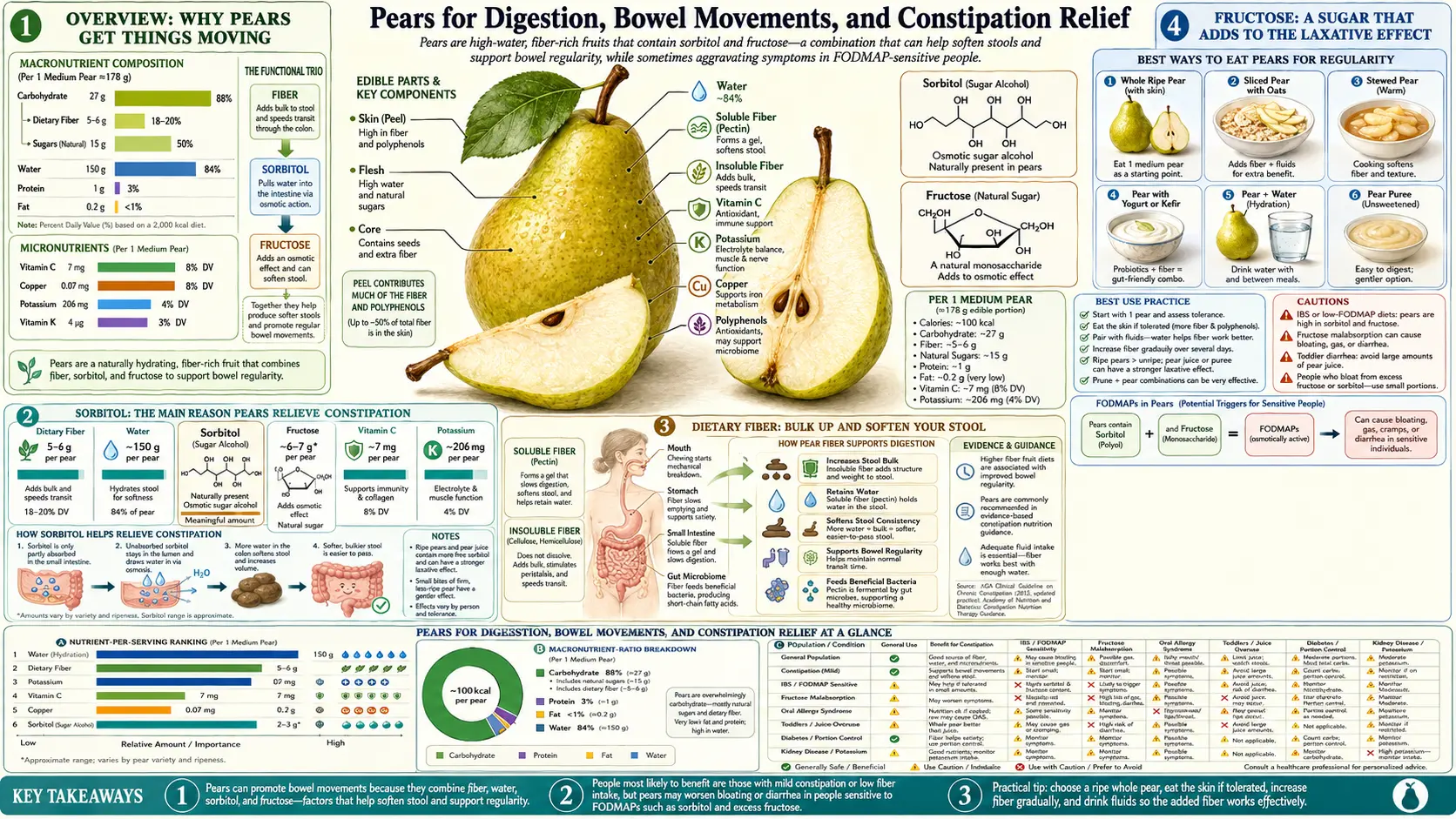
Among ordinary fruits, the humble pear has one of the strongest reputations for getting things moving. Pears are a famously gentle, natural laxative because they pack three things that work together to ease constipation and produce a comfortable bowel movement: sorbitol (a sugar your body absorbs poorly that pulls water into the intestine), a generous helping of dietary fiber (much of it in the skin), and a high water content. The result is softer stool, easier passage, and better regularity — from a food, not a pill. This page explains, in plain language, exactly why pears work for digestion and constipation relief, how people use them, and who tends to have trouble with them.
Table of Contents
- Overview: Why Pears Get Things Moving
- Sorbitol: The Main Reason Pears Relieve Constipation
- Dietary Fiber: Bulk Up and Soften Your Stool
- Fructose: A Sugar That Adds to the Laxative Effect
- Water: Keeping Stool Soft for an Easy Bowel Movement
- How They Work Together: The Gentle Natural Laxative Combo
- How People Use Pears for Constipation Relief
- The Flip Side: Gas, Bloating, and Loose Stools
- Who Tends to React: Irritable Bowel Syndrome, FODMAPs, and Fructose
- Warning Signs That Need a Prompt Medical Check
- Key Research Papers
- Connections
- Featured Videos
Overview: Why Pears Get Things Moving
When people talk about "regularity" foods, prunes usually get the spotlight. But pears belong in the same conversation — and for almost exactly the same reasons. A ripe pear is one of the most effective everyday fruits for easing constipation and encouraging a soft, comfortable bowel movement. It works as a natural laxative not through any single magic ingredient, but through a simple, well-understood combination of features that all push in the same direction.
Here is the short version. Pears carry a sugar alcohol called sorbitol that your small intestine cannot fully absorb. What is not absorbed travels on into the colon, where it draws water in by osmosis — softening the stool and gently stimulating a bowel movement. On top of that, pears are rich in dietary fiber, especially in the skin, which adds bulk and speeds the passage of waste through the gut. They are also relatively high in fructose (another sugar that, in excess, is incompletely absorbed and adds to the same water-drawing effect) and are about 84% water, which on its own helps keep stool soft. Put those together and you have a food that supports digestion and regularity from several angles at once.
One honest note up front: pears have been studied less directly for constipation than prunes have. There is a large body of research on the individual mechanisms — sorbitol as an osmotic laxative, fiber for bowel function, fructose malabsorption — and pears are a clear, concentrated source of all of them. So the effect is real and mechanism-based. What we are short on is large clinical trials testing pears specifically. That is worth knowing, and it is the reason this page leans on mechanism and on the well-studied building blocks rather than overpromising. Pears are an excellent, gentle aid for everyday constipation relief — not a treatment for serious disease.
Sorbitol: The Main Reason Pears Relieve Constipation
If you want to understand why pears work, start with sorbitol. Sorbitol is a sugar alcohol — a naturally occurring sweet compound found in pears, apples, prunes, peaches, and several other fruits. The crucial thing about it is that your small intestine absorbs it slowly and incompletely. Whatever sorbitol your body does not absorb keeps moving down into the large intestine.
Once it reaches the colon, sorbitol behaves as an osmotic laxative. "Osmotic" simply means it pulls water toward itself: because the unabsorbed sorbitol raises the concentration of dissolved material in the gut, water is drawn from the body into the intestine to balance it out. That extra water does two helpful things at once — it softens the stool, and the added volume gently stretches the colon wall, which is one of the natural triggers for a bowel movement. This is the same principle behind many pharmacy laxatives. In fact, sorbitol is not just a food ingredient that happens to have this effect; it is literally used as a medical laxative in its own right. A classic study found sorbitol worked about as well as the prescription laxative lactulose for relieving constipation in older adults — at a fraction of the cost.
This also explains why prunes and apples are famous for the same job: they share the sorbitol mechanism. And it explains a practical detail about pears — riper, juicier pears and pear juice tend to carry more available sorbitol, which is part of why a soft, ripe pear (or a glass of pear juice) tends to be more effective for constipation than a hard, under-ripe one. The sorbitol is doing much of the heavy lifting in a pear's reputation as a gentle laxative.
Dietary Fiber: Bulk Up and Soften Your Stool
The second pillar of a pear's digestive power is dietary fiber. A medium pear delivers roughly 5 to 6 grams of fiber — a substantial share of the daily target (about 25–38 g for most adults) from a single piece of fruit, and considerably more than many other common fruits. That alone makes pears a standout for regularity.
A large part of that fiber lives in the skin, so eating pears with the skin on keeps that fiber; peeling a pear throws away a meaningful chunk of the very thing that helps bowel movements. Pears actually carry both major kinds of fiber, and they work in complementary ways:
- Insoluble fiber does not dissolve in water. It adds bulk to the stool and speeds up "transit time" how quickly waste moves through the colon. By bulking up the stool and keeping it moving, insoluble fiber is the classic "roughage" that fights constipation and helps you stay regular. Much of this is concentrated in the pear's skin.
- Soluble fiber, including the pectin that pears are rich in, dissolves into a soft gel in the gut. That gel holds onto water and helps soften the stool, making it easier and more comfortable to pass. Soluble fiber is also fermented by your gut bacteria, which is good for overall digestive health (see the companion page on Gut Health & Microbiome).
So fiber attacks constipation from two sides at once — insoluble fiber bulks up and pushes things along, while soluble fiber and pectin draw in water to keep the stool soft. This is why fiber-rich foods are a first-line, doctor-recommended approach to constipation relief, and pears are one of the easiest and tastiest ways to get there. Fiber works best with enough fluid, which the pear's own water content helps supply.
Fructose: A Sugar That Adds to the Laxative Effect
Pears are also relatively high in fructose, the natural fruit sugar — and notably, they contain more fructose than glucose. That ratio matters for digestion. Your gut absorbs fructose more easily when there is glucose alongside it; when fructose is in excess of glucose, a portion of it tends to go unabsorbed in many people.
Any fructose that is not absorbed does the same thing the unabsorbed sorbitol does: it travels into the colon and exerts an osmotic, water-drawing effect, plus it gets fermented by gut bacteria. Both add to the laxative-like action — more water in the stool, more gentle stimulation of a bowel movement. In other words, fructose reinforces the sorbitol effect rather than competing with it. The two unabsorbed sugars work in the same direction.
This is a double-edged trait, and it is worth being honest about it. For someone who is constipated, the extra osmotic pull is exactly what you want — it is part of why pears are such an effective natural laxative. But the very same incompletely-absorbed fructose is what can cause gas, bloating, or loose stools when pears are eaten in large amounts, and it is a real problem for people with fructose malabsorption. We cover that flip side in the sections below.
Water: Keeping Stool Soft for an Easy Bowel Movement
The third ingredient is the simplest: water. A pear is roughly 84% water, which means every time you eat one you are also taking in fluid. That matters more than it sounds, because dehydration is one of the most common and most overlooked causes of constipation. When the body is short on fluid, the colon pulls extra water out of the stool, leaving it hard, dry, and difficult to pass.
By delivering both water and fiber in the same bite, pears help on the most basic level: they keep the stool hydrated and soft so it can move comfortably. Fiber and water are partners — fiber needs fluid to do its job of softening and bulking, and a watery fruit like the pear supplies some of that fluid automatically. It is a small effect compared with the sorbitol and fiber, but it rounds out why pears are so reliably good for regularity and digestion.
How They Work Together: The Gentle Natural Laxative Combo
No single feature of a pear is dramatic on its own. What makes the pear such a good natural laxative is that four mild effects stack on top of one another, all pushing toward a softer stool and an easier bowel movement:
- Sorbitol — the unabsorbed sugar alcohol draws water into the colon (the osmotic effect), softening stool and triggering the urge to go. This is the engine.
- Dietary fiber — insoluble fiber bulks up the stool and speeds transit; soluble fiber and pectin hold water to keep it soft. This is the bulk and the movement.
- Fructose — the portion that goes unabsorbed adds further osmotic, water-drawing action, reinforcing the sorbitol.
- Water — the pear's high water content keeps the whole system hydrated so the stool stays soft.
Think of it as a gentle, multi-pronged nudge rather than a forceful shove. That is precisely why pears are described as a gentle laxative: the effect is real but mild and food-based, working with your digestion instead of overriding it the way a strong stimulant laxative can. For everyday constipation relief and to help you stay regular, that combination is hard to beat in a single ordinary fruit.
How People Use Pears for Constipation Relief
Here is how pears are commonly used to get things moving, in plain practical terms.
- A common home approach is 1 to 2 ripe pears, skin on, with a glass of water. Ripeness matters — a soft, juicy pear carries more available sorbitol than a hard one, which is why people let pears ripen on the counter. The skin is where much of the fiber is, and the accompanying water helps the fiber do its job.
- Whole fruit vs. pear juice. Both work, but differently. Whole pears give you the full package — sorbitol, fructose, water, and all the fiber — so they are the better all-round choice for ongoing regularity. Pear juice is more concentrated in sorbitol and fructose but has lost most of the fiber; because the sugars are concentrated and there is no fiber to slow things down, juice can act faster and is a common gentle remedy for constipation (fruit juice is a long-standing home approach for mild constipation in children: the American Academy of Pediatrics' 2017 statement on fruit juice notes that juice was "sometimes recommended for children with constipation", and lists its downsides — its high sugar adds calories and raises the risk of tooth decay, and its lack of protein and fiber can lead to too much or too little weight gain). Many people use the whole fruit for day-to-day gut health and keep juice for when they want a quicker nudge.
- Consistency and time. Pears are a gentle food remedy, not an instant purge. Some people notice an effect within a day; eating pears a few times a week supports steady regularity rather than a one-off result, and many people make one a morning or evening habit.
- Pears vs. prunes. Prunes (dried plums) are the better-studied constipation remedy and tend to be a bit more potent gram-for-gram — they are higher in sorbitol and fiber and have good clinical trial support. Pears are milder, juicier, lower in sugar concentration, and easier to eat in quantity as fresh fruit, which many people find more pleasant. They share the same sorbitol mechanism, so they are natural alternatives or partners. When pears alone are not quite enough, prunes are the usual next step.
- Starting gradually. For people who normally eat little fruit or fiber, ramping up slowly (see the next section) lets the gut adjust and reduces gas and bloating.
For the broader nutrition picture, see the main Pears page. Apples work through the very same sorbitol mechanism and are an easy partner fruit.
The Flip Side: Gas, Bloating, and Loose Stools
The honest counterpart to all of this: the exact same features that make pears a good natural laxative can become unwelcome in larger amounts. The unabsorbed sorbitol and excess fructose that draw water into the colon are also fermented by your gut bacteria, and that fermentation produces gas. The dietary fiber adds to fermentation too. So in bigger portions, pears can cause:
- Gas and bloating — from bacterial fermentation of the sorbitol, fructose, and fiber in the colon.
- Abdominal cramping — the same osmotic water-drawing and increased gut activity that ease constipation can, when overdone, cause crampy discomfort.
- Loose stools or diarrhea — too much sorbitol and fructose pulls in too much water, which can tip a helpful softening effect into watery, urgent stools.
This is dose-dependent and very individual. For most people, one or two pears is comfortable and helpful; problems tend to appear with large quantities, a lot of concentrated pear juice, or in those who are simply more sensitive to these sugars. What usually helps is moderation and ramping up slowly: building up fruit and fiber gradually over a week or two lets the gut adapt, along with drinking water. When pears reliably cause gas, bloating, or loose stools even in small amounts, the next section is the relevant one.
Who Tends to React: Irritable Bowel Syndrome, FODMAPs, and Fructose
Pears are healthy for the great majority of people, but there is one group for whom they often cause trouble: people with sensitive guts, particularly irritable bowel syndrome (IBS) and fructose malabsorption.
The reason comes down to a category called FODMAPs — short for Fermentable Oligosaccharides, Disaccharides, Monosaccharides And Polyols. These are exactly the kinds of poorly-absorbed, rapidly-fermented carbohydrates we have been describing, and pears are a high-FODMAP fruit on two counts at once: they contain sorbitol (a polyol) and excess fructose (fructose in excess of glucose, a monosaccharide). For someone with irritable bowel syndrome, those fermentable sugars can trigger the very symptoms they struggle with — gas, bloating, cramping, and either diarrhea or worsened constipation — even from a modest portion. The strict phase of a structured low-FODMAP approach for irritable bowel syndrome limits or leaves out pears, and tolerance is tested carefully when foods are reintroduced. See the Irritable Bowel Syndrome (IBS) page for the bigger picture.
People with fructose malabsorption (sometimes called dietary fructose intolerance) have a reduced ability to absorb fructose, so high-fructose foods like pears can cause pronounced gas, bloating, pain, and diarrhea. For them, pears are one of the fruits most likely to cause trouble.
What people with sensitive guts commonly do is introduce pears gradually and in small amounts, watching how they respond. Tolerance varies a lot from person to person — some people with mild sensitivity handle a small portion fine, while others react to very little. Pears (or fruit in general) that consistently cause distress fit the pattern of irritable bowel syndrome or fructose malabsorption described above; a structured low-FODMAP diet removes these foods only for its strict phase and then reintroduces them one at a time to find each person's limit.
Warning Signs That Need a Prompt Medical Check
More pears (and fiber and fluids) are a common first step for ordinary, occasional constipation. But constipation is sometimes a signal of something that needs medical attention, and food does not treat those causes. The following are warning signs that need a prompt medical check rather than more pears:
- Blood in the stool, or black, tarry stools.
- Unexplained weight loss alongside constipation.
- A sudden or persistent change in your bowel habits — for example, new constipation that is unlike your normal pattern, especially after age 50.
- Severe abdominal pain, vomiting, or a swollen, tender belly — which can signal a blockage, something hospitals treat as an emergency.
- Constipation that does not improve after a couple of weeks of more fiber, fluids, and movement, or that keeps coming back.
- Constipation alternating with diarrhea, or constipation accompanied by fever.
To keep this in perspective: pears are an excellent, gentle, food-based aid for everyday regularity and mild constipation relief, with a clear, well-understood mechanism behind them. They are not a treatment for serious bowel disease, and they have been studied less directly for constipation than prunes have. They are a simple, healthy helper, and the warning signs above mark when constipation is more than a passing nuisance. For more on the symptom itself, see the Constipation page.
Key Research Papers
- Reiland H, Slavin J. Systematic Review of Pears and Health. Nutrition Today. 2015. — broad review of pears' nutrient profile and health effects, including fiber and digestive benefits. — doi:10.1097/NT.0000000000000112
- Lederle FA, et al. Cost-effective treatment of constipation in the elderly: a randomized double-blind comparison of sorbitol and lactulose. The American Journal of Medicine. 1990. — trial showing the sugar alcohol sorbitol relieves constipation about as well as the laxative lactulose. — doi:10.1016/0002-9343(90)90177-f
- Yang J, et al. Effect of dietary fiber on constipation: a meta analysis. World Journal of Gastroenterology. 2012. — pooled evidence that dietary fiber increases stool frequency in people with constipation. — doi:10.3748/wjg.v18.i48.7378
- Christodoulides S, et al. Systematic review with meta-analysis: effect of fibre supplementation on chronic idiopathic constipation in adults. Alimentary Pharmacology & Therapeutics. 2016. — review confirming fiber improves stool frequency and consistency in chronic constipation. — doi:10.1111/apt.13662
- Lever E, et al. Systematic review: the effect of prunes on gastrointestinal function. Alimentary Pharmacology & Therapeutics. 2014. — the prune evidence base; relevant because prunes and pears share the sorbitol-plus-fiber mechanism. — doi:10.1111/apt.12913
- Müller-Lissner SA, et al. Myths and misconceptions about chronic constipation. The American Journal of Gastroenterology. 2005. — sorts what actually helps constipation (fiber, fluid) from common myths. — doi:10.1111/j.1572-0241.2005.40885.x
- Fedewa A, Rao SSC. Dietary fructose intolerance, fructan intolerance and FODMAPs. Current Gastroenterology Reports. 2014. — why high-fructose, high-FODMAP foods like pears can cause gas and diarrhea in sensitive people. — doi:10.1007/s11894-013-0370-0
- Anderson JW, et al. Health benefits of dietary fiber. Nutrition Reviews. 2009. — overview of how dietary fiber supports bowel function, regularity, and overall health. — doi:10.1111/j.1753-4887.2009.00189.x
- Heyman MB, Abrams SA; Section on Gastroenterology, Hepatology, and Nutrition; Committee on Nutrition. Fruit Juice in Infants, Children, and Adolescents: Current Recommendations. Pediatrics. 2017. — the American Academy of Pediatrics statement on fruit juice, including its past use for constipation in children and its downsides (sugar, tooth decay, weight). — doi:10.1542/peds.2017-0967