⚠ Evidence warning: Clinical trials or other evidence do not support the claim that high-dose iodine pushes stored fluoride and bromide out of the body, and that salt loading clears the resulting detox reaction. This page keeps it as a report of what people, websites or other media say.
Iodine and Halide Displacement
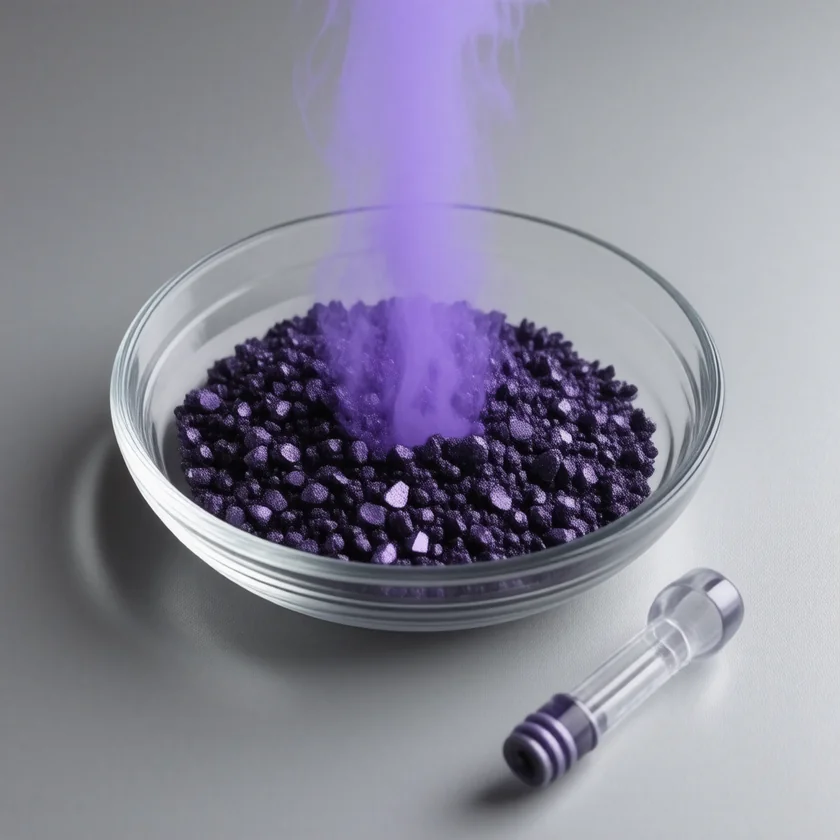
This is the protocol people mean when they say fluoride can be displaced rather than merely blocked. The idea is simple enough to explain in one sentence: fluoride is sitting in seats that belong to iodine, and if you bring enough iodine back, it takes its seats back and the fluoride is pushed out. It is the most talked-about fluoride protocol after boron, and the one with the most to say about how you will feel while doing it.
Table of Contents
The Halide Family
Fluorine, chlorine, bromine and iodine sit in the same column of the periodic table. They are the halogens, and as ions in the body they are the halides. Same family, same outer-shell arrangement, same general shape — different sizes.
| Halide | Where you meet it | The concern |
|---|---|---|
| Iodine | Seafood, seaweed, dairy, iodised salt | The one you actually need. Thyroid hormone is built from it. |
| Fluoride | Water, toothpaste, tea, processed food | The subject of this section. |
| Bromide | Brominated flour, formerly some soft drinks in the US (the FDA revoked brominated vegetable oil as a food ingredient, effective August 2, 2024), flame retardants, pool chemicals, some medications | Treated as fluoride’s twin problem — the two are almost always discussed together. |
| Chloride | Salt, tap water treatment | Needed, and not usually part of the argument. |
The reason iodine gets singled out is that iodine intake fell in exactly the decades when fluoride and bromide exposure rose — bromine replaced iodine in commercial bread, and people moved away from iodised salt. That coincidence is the historical spine of the whole argument.
The Displacement Idea
The reasoning, as it is given:
- The thyroid, breast, salivary glands, stomach and other tissues have machinery for pulling iodine out of the blood and concentrating it.
- That machinery is not perfectly selective. When iodine is scarce, the other halides get taken up and held in its place.
- So a body low in iodine ends up carrying fluoride and bromide where iodine should be.
- Flood the system with iodine and it outcompetes them for those places, and the displaced halides are turned loose into the blood and cleared through the urine.
Whether fluoride specifically competes at the iodine transporter the way bromide does is argued about — bromide is the clearer case, and honest practitioners of this protocol say so. What people report, though, is not usually parsed that finely: they take iodine, they feel the detox reaction, and they judge by how they end up.
There is a second, less contested reason people take iodine here: fluoride is thought to press on thyroid function, and a thyroid that is well supplied with iodine has reserve to absorb that. See Fluoride and Thyroid Function.
The Forms People Use
| Form | What it is | Notes |
|---|---|---|
| Lugol’s solution | Iodine plus potassium iodide in water. Sold at 2% and 5%. | The classic, and the form most protocols are written around. Drops are counted, dropped into water or juice, never taken neat. |
| Potassium iodide tablets | Iodide only. | Tidy and measurable. Some argue the body wants both iodine and iodide, since different tissues prefer different forms. |
| Nascent iodine | Atomic iodine in an alcohol base. | Marketed as gentler and better absorbed. Popular with people who found Lugol’s harsh. |
| Kelp, bladderwrack, dulse | Seaweed, whole food. | The slow route, and the traditional one. Iodine content varies enormously batch to batch, which cuts both ways. |
| Povidone-iodine | Topical antiseptic. | Not for internal use. Mentioned only because people ask. |
The Protocol and the Ramp
The single most repeated piece of advice about iodine is start far lower than you think and go up slowly. People who jump straight to a high dose have a miserable fortnight and usually quit. The steps as protocols describe them:
- The companions come first — selenium and magnesium especially — for a week or two before any iodine.
- The starting dose is a fraction of a drop of Lugol’s, or a small kelp dose, taken in a full glass of water, in the morning, with food.
- Each level is held for a week or more before an increase. If the detox reaction appears, protocols hold or drop back rather than pushing.
- The build-up runs over months, not weeks. People who do well on this describe it as a long, patient process.
- Plenty of water and unrefined salt throughout — see salt loading below.
The Companion Nutrients Protocols Insist On
Everyone who runs iodine protocols insists on these, and the reason is that iodine on its own is what produces the bad experiences.
- Selenium — the one nobody skips. Selenium is what the enzymes protecting the thyroid are built from, and iodine without selenium is the combination people blame for thyroid trouble. Commonly 200 mcg a day, or a couple of Brazil nuts. Selenium has its own ceiling — the Institute of Medicine’s adult upper limit is 400 mcg a day.
- Magnesium — for the headaches and the wired feeling.
- Vitamin C — taken in generous split doses throughout. See Vitamin C and Antioxidants.
- B vitamins, especially B2 and B3 — part of the classic protocol, credited with helping the body use the iodine.
- Unrefined salt — the carrier. See below.
Salt Loading
This is the piece specific to halide displacement, and the reasoning is neat: chloride and bromide compete for the same route out through the kidney, so flooding the system with chloride from salt means the kidney dumps the bromide rather than reabsorbing it.
The version that circulates: a quarter to half a teaspoon of unrefined salt — sea salt or rock salt, not table salt — stirred into a small glass of warm water, followed immediately by a large glass of plain water, repeated until urine flows freely. People use it specifically when a detox reaction hits, describing it as the thing that clears the headache.
The obvious caution: a salt load is a large dose of sodium, and high blood pressure, heart failure and kidney disease are the conditions in which this is the part of the protocol most likely to cause a real problem.
The Detox Reaction
Almost everyone who takes iodine seriously describes this, usually in the first two weeks. The symptoms named most often:
- Headache, often frontal
- A metallic or chemical taste
- Acne or skin breakouts, classically on the face and back
- Fatigue, brain fog, or the opposite — feeling wired and unable to sleep
- Runny nose, sneezing, watery eyes
- Irritability and a short temper
- A dull ache in the neck over the thyroid
The standard response described is not to push through: a lower dose, more salt loading, water, vitamin C and magnesium, and time. People who describe good outcomes are almost always the ones who backed off when this happened.
Iodine From Food
- Kelp and kombu — by far the richest, and easy to overdo. A small piece in a soup pot is the traditional dose.
- Nori — far milder, which makes it the everyday choice.
- Cod, haddock and other white fish — reliable and unremarkable.
- Oysters, shrimp, shellfish
- Eggs — the yolk.
- Dairy — often the largest single source in a Western diet.
- Iodised salt — the reason deficiency became rare, and its decline is the reason this conversation restarted.
The Dose Ceiling and Who the Research Raises Concerns For
What this page reports. Everything on this page is what people do and report. Some of it is centuries old, some of it is community practice from the last twenty years. Where a substance has a real dose ceiling — boron and iodine above all — the number is given, because the people who get hurt are the ones who assume natural means unlimited. The Institute of Medicine’s adult upper limit for iodine is 1,100 mcg (1.1 mg) a day, and a 2014 review says the risk of iodine-induced thyroid dysfunction might be raised in people with existing thyroid disease, the elderly, fetuses and newborns. Pregnancy, dialysis, kidney disease, thyroid disease and prescription medication are the situations in which community protocols flag the most concern, and lab results show what is happening in each.
Iodine is the item on this site where getting it wrong can genuinely make you unwell, so the limits are stated plainly.
- Everyday nutritional need is measured in micrograms — around 150 mcg a day for an adult, more in pregnancy. High-dose protocols run in milligrams, which is a thousandfold different.
- The official figures. The Institute of Medicine (2001) recommends 150 mcg a day for adults and 220 mcg in pregnancy, and sets the adult upper limit at 1,100 mcg (1.1 mg) a day, the same in pregnancy from age 19. Protocols in the milligram range can run above that limit.
- What a trial found at lower doses. In a 4-week double-blind trial in 256 adults in China with normal thyroid function, subclinical hypothyroidism (a mildly underactive thyroid seen on blood tests) appeared in 5% of those given 400 mcg a day and in 15–47% of those given 500–2,000 mcg a day. The authors cautioned against a total intake above about 800 mcg a day in China and called for more research to set a safe upper limit.
- Iodine can push a thyroid in either direction. It can trigger both overactivity and underactivity, and the effect is unpredictable in an individual. A 2014 review says intake above the 150 mcg recommendation is generally well tolerated, but that the risk might be raised in people with existing thyroid disease, the elderly, fetuses and newborns, and that the source of the excess iodine may not be readily apparent.
- In Hashimoto’s or Graves’, or any autoimmune thyroid disease, high-dose iodine is the one protocol on this site most likely to cause trouble. Many people with Hashimoto’s report flares. Existing thyroid disease is among the groups in which the 2014 review says the risk might be raised.
- Protocol writers warn against iodine without selenium. The most repeated warning in the field.
- Baseline labs — protocols describe testing thyroid-stimulating hormone (TSH), free T4, free T3 and thyroid antibodies — before starting, and again a few months in. This is one place where a number beats a feeling.
- Pregnancy — adequate iodine matters enormously, and the recommended intake is 220 mcg a day. High-dose protocols in the milligram range are far above it, and the 2014 review names fetuses and newborns among those whose risk of thyroid dysfunction from excess iodine might be raised.
- Salt loading carries the most concern for people with hypertension, heart failure or kidney disease.
Key Research Papers
- Institute of Medicine (2001). Iodine (chapter 8). In: Dietary Reference Intakes for Vitamin A, Vitamin K, Arsenic, Boron, Chromium, Copper, Iodine, Iron, Manganese, Molybdenum, Nickel, Silicon, Vanadium, and Zinc. National Academies Press. — National Academies Press, doi:10.17226/10026
- Institute of Medicine (2000). Selenium. In: Dietary Reference Intakes for Vitamin C, Vitamin E, Selenium, and Carotenoids. National Academies Press. — doi:10.17226/9810
- Sang Z, Wang PP, Yao Z, Shen J, Halfyard B, Tan L, Zhao N, Wu Y, Gao S, Tan J, Liu J, Chen Z, Zhang W (2012). Exploration of the safe upper level of iodine intake in euthyroid Chinese adults: a randomized double-blind trial. Am J Clin Nutr. 95(2):367-73. — PubMed PMID: 22205314
- Leung AM, Braverman LE (2014). Consequences of excess iodine. Nat Rev Endocrinol. 10(3):136-42. — PubMed PMID: 24342882
- U.S. Food and Drug Administration (2024). Revocation of Authorization for Use of Brominated Vegetable Oil in Food. Final rule, Federal Register, published July 3, 2024, effective August 2, 2024. — Federal Register document 2024-14300
Connections
- Fluoride Chelation — the full toolkit
- Boron and Borax — the other displacement protocol
- Vitamin C and Antioxidants — selenium and the companions
- Binders, Sweating and Water
- Iodine
- Iodine for Thyroid Function
- Fluoride and Thyroid Function
- Thyroid Control — animation
- Fluoride Toxicity
- Fluoride in Water