Ear Candling
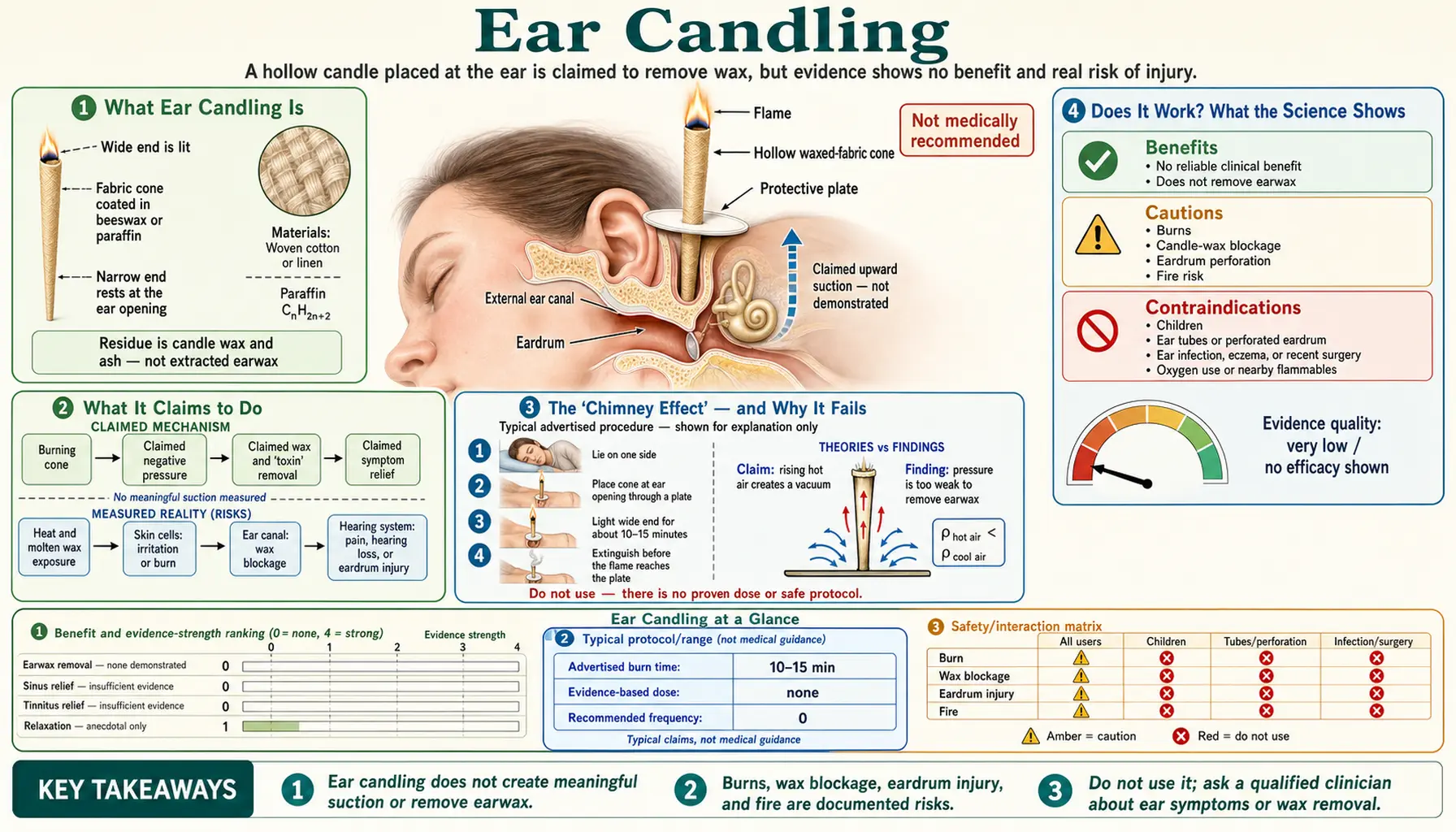
Ear candling — also called ear coning, thermal-auricular therapy, or simply "ear candles" — is a practice in which a hollow cone of fabric stiffened with wax or paraffin is placed with its narrow end at the opening of the ear and lit at the top. As the candle burns, it is said to create gentle suction — a "chimney effect" — that draws earwax, debris, and "toxins" up and out of the ear. It is sold in spas, wellness shops, and online, and it is often marketed for sinus pressure, ear infections, ringing in the ears, and better hearing. This page looks at ear candling honestly, and it does not take long to reach the point: it does not work, and it can genuinely hurt you. Careful measurements show ear candles produce no suction and remove no wax; the brown "residue" people are shown as proof is just burnt candle wax and soot. Worse, ear candling causes real, documented injuries — burns, hot wax dripping into the ear canal, blocked canals, and even punctured eardrums — which is why the U.S. Food and Drug Administration (FDA) and other regulators have warned against these products. We will walk through what the practice is, what it claims, what the science shows, where the danger lies, who is most at risk, and what to do instead. This is one of those rare cases where the safest advice is also the simplest: don't use ear candles.
Table of Contents
- What Ear Candling Is
- What It Claims to Do
- The "Chimney Effect" — and Why It Fails
- Does It Work? What the Science Shows
- The "Residue" Trick
- The Real Risks
- Who Is Especially at Risk
- What to Do Instead: Earwax
- What to Do Instead: Sinus, Ear & Hearing Problems
- The Honest Bottom Line
- Research Papers
- Connections
- Featured Videos
What Ear Candling Is
An ear candle is not a candle in the ordinary sense. It is a long, hollow cone — usually a strip of cotton or linen fabric that has been soaked in wax or paraffin (and sometimes beeswax) and wound into a tapering tube, roughly the length of your forearm. The narrow tip is placed gently into or against the opening of the ear canal while the person lies on their side. The wide top is then lit, and the candle is allowed to burn down toward the ear over about ten or fifteen minutes, usually with a paper plate or foil shield around the base to catch drips. A practitioner or a friend holds it in place and trims the burnt tip as it goes.
The claim built into this setup is that the flame warms the air inside the hollow cone and creates a mild vacuum — the so-called "chimney effect" — that gently sucks wax, dead skin, and impurities up out of the ear and into the base of the candle. When the candle is later cut open, a brown, waxy, sometimes flaky material is found inside, and this is presented as the wax and "toxins" that were pulled from the ear. As we will see, that material has nothing to do with your ear.
It is worth being clear about what ear candling is not. It is not a medical procedure, it is not performed or endorsed by ear specialists, and in most places it is an unregulated wellness service sold by people with no medical training. The candles themselves are marketed as everything from "relaxation" aids to treatments for specific medical conditions — and it is precisely those medical claims that have drawn warnings and enforcement action from health regulators.
What It Claims to Do
To be fair to the practice, here is what its promoters typically say it does. The list is long, which is itself a warning sign — genuine treatments tend to do one thing well, not a dozen unrelated things:
- Removing earwax — the central claim, that the "chimney effect" gently draws wax out of the canal without instruments.
- Drawing out "toxins" and "impurities" — a vague detox claim, that candling clears the body of unspecified poisons through the ear.
- Relieving sinus pressure and congestion — often marketed for colds, sinus headaches, and "pressure" in the head.
- Treating or preventing ear infections.
- Improving hearing — on the theory that "clogged" ears are muffling sound.
- Easing tinnitus (ringing in the ears) and vertigo (dizziness).
- General relaxation and a feeling of "clearing" or lightness.
Some of these promises tap into real, uncomfortable problems — blocked ears, sinus pressure, ringing, muffled hearing — which is part of what makes the pitch appealing. But an attractive promise is not evidence, and when researchers have actually measured what ear candles do, the promises collapse.
The "Chimney Effect" — and Why It Fails
The whole practice rests on one idea: that a small flame at the top of a hollow cone can create enough suction at the bottom to pull wax out of your ear. It sounds like it could be true — heat rises, warm air moves upward, and that must draw something up behind it. But the physics does not cooperate.
A rising column of warm air inside an open tube does not create a meaningful vacuum at the sealed-ish bottom; if anything, a burning candle tends to produce a slight positive pressure and warm downdrafts of air, not negative pressure. When investigators actually put a pressure gauge on a burning ear candle, they found no negative pressure at all — the suction that is supposed to do the work simply is not there. And even if a gentle vacuum did exist, earwax is a sticky, tenacious substance that clings to the warm, curved walls of the ear canal. It does not float free and drift upward on a wisp of moving air. The mechanism, in short, is not just weak — it is absent.
There is also a basic anatomical problem. The eardrum seals off the ear canal from the middle ear and sinuses. Even in theory, no amount of suction at the opening of the ear can reach through an intact eardrum to "drain" the sinuses or the middle ear. The pathways the marketing imagines — ear to sinus, ear to "the rest of the body" — are closed off by a membrane. So the claim to relieve sinus pressure or pull toxins from the body is not merely unproven; it runs against how the ear is built.
Does It Work? What the Science Shows
Unusually for an alternative practice, ear candling has been tested directly — and it failed the tests plainly. The best-known study, published in The Laryngoscope by Seely and colleagues in 1996, did two things. First, the researchers measured the pressure produced by burning ear candles and found no negative pressure — no suction. Second, they candled ears (and candles over an ear canal) and confirmed that no wax was removed; in fact, candle wax was sometimes deposited into the ear canal, adding debris rather than removing it. The same team surveyed ear, nose, and throat physicians and gathered reports of numerous injuries caused by ear candling — a first, direct look at the harm side of the ledger.
Later reviews reached the same verdict. A 2004 commentary in the Journal of Laryngology & Otology, pointedly titled "Ear candles: a triumph of ignorance over science," summarized the evidence as showing no benefit and real risk. A 2007 review in Canadian Family Physician asked directly whether general practitioners should recommend ear candling and concluded that they should not — there is no evidence it works and clear evidence it can cause harm. And when researchers systematically reviewed complementary and alternative treatments for ear infections (otitis media), ear candling was not among the approaches with any supporting evidence; ear infections are a medical problem that candling cannot address.
Put simply: the one careful measurement study found no suction and no wax removal, and every serious review since has told people to steer clear. There is no credible body of evidence on the other side — only testimonials and the "residue" that people are shown at the end of a session, which brings us to the trick at the heart of the pitch.
The "Residue" Trick
The single most persuasive moment in an ear-candling session is the reveal: the practitioner cuts open the burnt candle and shows you a mound of brown, waxy, sometimes powdery material. "Look at everything that came out of your ear." It is genuinely convincing — and it is genuinely misleading.
That residue is simply burnt candle wax, ash, and soot — the ordinary byproducts of a wax-and-fabric cone burning down. You can prove this to yourself with a test that requires no ear at all: burn an ear candle while holding it over a glass or a bowl instead of an ear, and you get the same brown, waxy residue inside the stub. Nothing was drawn out of a bowl, because a bowl has no wax and no toxins to give — yet the "proof" appears anyway. The residue is a product of the candle, not the ear. Under a microscope, that material matches the composition of the candle itself, not earwax.
Once you see the bowl demonstration, the illusion is hard to un-see. The dramatic "everything that came out of you" reveal is manufactured by the candle every single time, whether it burns over a healthy ear, a wax-free ear, or no ear at all. It is theater, and it is the main reason satisfied customers believe the practice worked.
The Real Risks
This is the part that matters most, because ear candling is not merely an expensive way to accomplish nothing. You are holding an open flame, dripping hot wax, next to your face, your hair, and one of the most delicate structures in your body. The injuries are real, they are documented in the medical literature, and they are exactly why regulators have acted.
- Burns to the face, ear, neck, and hair. An open flame beside the head can singe hair and burn the outer ear, cheek, and neck. Hair catching fire during a session has been reported.
- Hot wax dripping into the ear canal. Molten candle wax can run down into the canal and onto the eardrum, causing painful burns to the canal lining and the drum itself.
- Candle wax blocking the ear canal. Rather than removing wax, ear candles can deposit hardened candle wax deep in the canal — occluding it and, ironically, muffling hearing and requiring a clinician to remove it. A published case describes a patient whose ear was plugged with candle wax after candling.
- Perforated (punctured) eardrum. A burn from hot wax, or injury to the drum, can perforate the eardrum — a hole in the membrane that can cause pain, hearing loss, and infection, and that may need medical or surgical care to heal.
- Ear-canal injury and secondary infection. Burns and deposited debris damage the protective lining of the canal and can set the stage for infection (otitis externa).
- House and clothing fires. An unattended or knocked-over ear candle, drips of flaming wax, and nearby hair or bedding are a genuine fire hazard. Serious burns and property fires have resulted.
These are not hypothetical worries dredged up to scare you. They come from case reports and from surveys of ear specialists who have treated the aftermath. The U.S. Food and Drug Administration has warned consumers about the risk of serious injuries from ear candles, has stated that it is not aware of any valid scientific evidence that they are effective, and has taken regulatory action against ear-candle products marketed with medical claims (including warning letters and blocking shipments at the border). Health Canada and other regulators have issued similar warnings. When a product with no proven benefit carries burns, perforated eardrums, and fire among its known outcomes, the risk-versus-reward math is not close.
Who Is Especially at Risk
Ear candling is a bad idea for anyone, but for some people the danger is sharply higher. Do not use ear candles — and do not let anyone use them on you — and be especially protective in these situations:
- Children. Kids squirm, and a moving child beside an open flame and hot wax is a recipe for a burn or a drum injury. A published case describes an ear-candling burn in a four-year-old girl. Children's earwax problems, when they exist at all, should be handled by a clinician — never with a candle.
- Anyone with ear tubes (tympanostomy tubes). A tube creates a direct opening through the eardrum into the middle ear. Dripped wax or debris has an unobstructed path to cause real harm.
- Anyone with a current or past perforated eardrum. A hole in the drum removes the barrier that normally protects the middle ear from wax, heat, and debris.
- Anyone who has had ear surgery. Healing or reconstructed structures are fragile and unusually vulnerable to heat and pressure.
- Anyone with an active ear infection, eczema of the ear canal, or a mastoid cavity — all of which make the ear more delicate and more prone to injury and infection.
If any of these describe you or your child, the case against ear candling is not just "it doesn't work" — it is that a session could do lasting damage to hearing.
What to Do Instead: Earwax
Here is the reassuring part. In most people, earwax is not a problem that needs solving at all. Earwax (cerumen) is normal and healthy: it traps dust and debris, lubricates the canal, and has mild antibacterial properties, and the ear is self-cleaning — wax naturally migrates outward and falls away on its own. National ear, nose, and throat guidelines specifically advise against ear candling for wax and recommend simple, safe alternatives instead:
- Leave normal wax alone. If it is not causing symptoms — muffled hearing, fullness, discomfort — you do not need to remove it. Chasing wax you cannot see usually causes more trouble than the wax ever would.
- Soften stubborn wax with drops. A few drops of ordinary softeners — over-the-counter cerumen drops, or a little mineral oil, baby oil, or saline — over several days can soften wax so it works its way out on its own. This is gentle, cheap, and safe for intact eardrums.
- Gentle irrigation, if appropriate. For some people, rinsing the canal with warm water (a bulb syringe or a pharmacy kit) after softening can help — but skip irrigation if you have, or might have, a perforated eardrum, tubes, or an ear infection.
- Let a clinician remove impacted wax. If wax is truly blocking the canal and bothering you, a doctor, nurse, or audiologist can remove it quickly and safely with suction, a curette, or microscope-guided cleaning — in minutes, without a flame.
- Never push cotton swabs (Q-tips) deep into the canal. They tend to pack wax down against the eardrum, making blockage worse, and can scratch the canal or injure the drum. Clean only the outer ear.
Every one of these does more for your ears than an ear candle, at less cost and with none of the risk.
What to Do Instead: Sinus, Ear & Hearing Problems
Ear candling is often reached for when something genuinely uncomfortable is going on — sinus pressure, an aching or draining ear, ringing, or muffled hearing. A candle cannot touch any of these, but real, effective options exist, and the right move is to get the actual problem identified:
- Sinus pressure and congestion. Saline rinses, steam, decongestants where appropriate, treating allergies, and time handle most sinus congestion; persistent or severe sinus problems deserve a clinician's evaluation. A candle in the ear does nothing for the sinuses, which are sealed off from the ear canal by the eardrum.
- Ear pain, drainage, or suspected infection. These need a look inside the ear and, sometimes, treatment — not a flame. See a clinician, especially for a child, for fever, or for pain that is severe or lasting.
- Ringing in the ears (tinnitus) or dizziness. These have many possible causes and should be assessed properly; candling has no effect on them.
- New or worsening hearing loss. Muffled hearing can be simple wax — or it can be something that needs prompt attention. Sudden hearing loss in particular is a medical urgency. Get hearing changes checked rather than guessing.
For more on these conditions and how they are actually managed, see our pages on ear infections, tinnitus, sinusitis, and hearing loss. And for a broader, honest look at "detox" claims like the ones behind ear candling, see Detox Protocols.
The Honest Bottom Line
Ear candling does not remove earwax, does not draw out toxins, does not relieve sinus pressure, and does not treat ear infections or improve hearing. When it was measured directly, it produced no suction and removed no wax — and sometimes left candle wax behind in the ear. The brown "residue" held up as proof is just burnt candle wax and soot, produced whether the candle burns over an ear or over an empty bowl. There is, in short, no benefit here to weigh.
On the other side of the scale are real, documented harms: burns to the face and ear, hot wax dripping into the canal, canals blocked with candle wax, punctured eardrums, and house fires — harms serious enough that the FDA and other regulators have warned against these products and acted against them. Children, people with ear tubes, and anyone with a past perforated eardrum or ear surgery are at even greater risk. Our honest recommendation is unambiguous: do not use ear candles. If your ears feel blocked, let normal wax be, soften stubborn wax with a few drops, or have a clinician clear it safely in minutes. If something feels genuinely wrong — pain, drainage, ringing, or a change in hearing — see a professional and find out what is actually going on. Your ears will be better for it, and you will keep the flame away from your face.
Research Papers
- Seely DR, Quigley SM, Langman AW. Ear candles — efficacy and safety. The Laryngoscope. 1996;106(10):1226–1229. — Search PubMed — the key study: measured no negative pressure (no suction), found no earwax removed, and surveyed physicians documenting numerous ear-candling injuries.
- Ernst E. Ear candles: a triumph of ignorance over science. Journal of Laryngology & Otology. 2004;118(1):1–2. doi:10.1258/002221504322731529 — a review concluding there is no benefit and real risk, and advising against the practice.
- Rafferty J, Tsikoudas A, Davis BC. Ear candling: should general practitioners recommend it? Canadian Family Physician. 2007;53(12):2121–2122. PMID: 18077749 — concludes physicians should not recommend ear candling; no evidence of benefit, clear evidence of harm.
- Zackaria M, Aymat A. Ear candling: a case report. European Journal of General Practice. 2009;15(3):168–169. doi:10.3109/13814780903260756 — a patient whose ear canal was occluded by candle wax after ear candling.
- Hornibrook J. Where there's smoke there's fire — ear candling in a 4-year-old girl. New Zealand Medical Journal. 2012;125(1367):138–140. — Search PubMed — a pediatric ear-candling injury, underscoring the special danger to children.
- Kutz JW Jr, Fayad JN. Ear candling. Ear, Nose & Throat Journal. 2008;87(9):499. PMID: 18800318 — a clinical note on the ineffectiveness and hazards of ear candling.
- Marom T, Marchisio P, Tamir SO, Torretta S, et al. Complementary and alternative medicine treatment options for otitis media: a systematic review. Medicine (Baltimore). 2016;95(6):e2695. PMID: 26871802 — reviews CAM options for ear infections; ear candling is not among approaches with supporting evidence.
- Schwartz SR, Magit AE, Rosenfeld RM, et al. Clinical practice guideline (update): earwax (cerumen impaction). Otolaryngology–Head and Neck Surgery. 2017;156(1_suppl):S1–S29. doi:10.1177/0194599816671491 — the U.S. ENT guideline; advises against ear candling and describes safe, evidence-based wax management.
- Michaudet C, Malaty J. Cerumen impaction: diagnosis and management. American Family Physician. 2018;98(8):525–529. — Search PubMed — a practical review of safe options for earwax: softening drops, irrigation, and clinician removal.
- Horton GA, Simpson MTW, Beyea MM, Beyea JA. Cerumen management: an updated clinical review and evidence-based approach for primary care physicians. Journal of Primary Care & Community Health. 2020;11:2150132720904181. doi:10.1177/2150132720904181 — an up-to-date, evidence-based guide to managing earwax safely.
Connections
- All Remedies
- Detox Protocols
- Oil Pulling
- Ear, Nose & Throat
- Ear Infections
- Hearing Loss
- Tinnitus
- Sinusitis
- Cholesteatoma
- Salt in Socks — a folk remedy that fares better than ear candling, but still credits the wrong ingredient