Cramp Prevention — Benefits Deep Dive
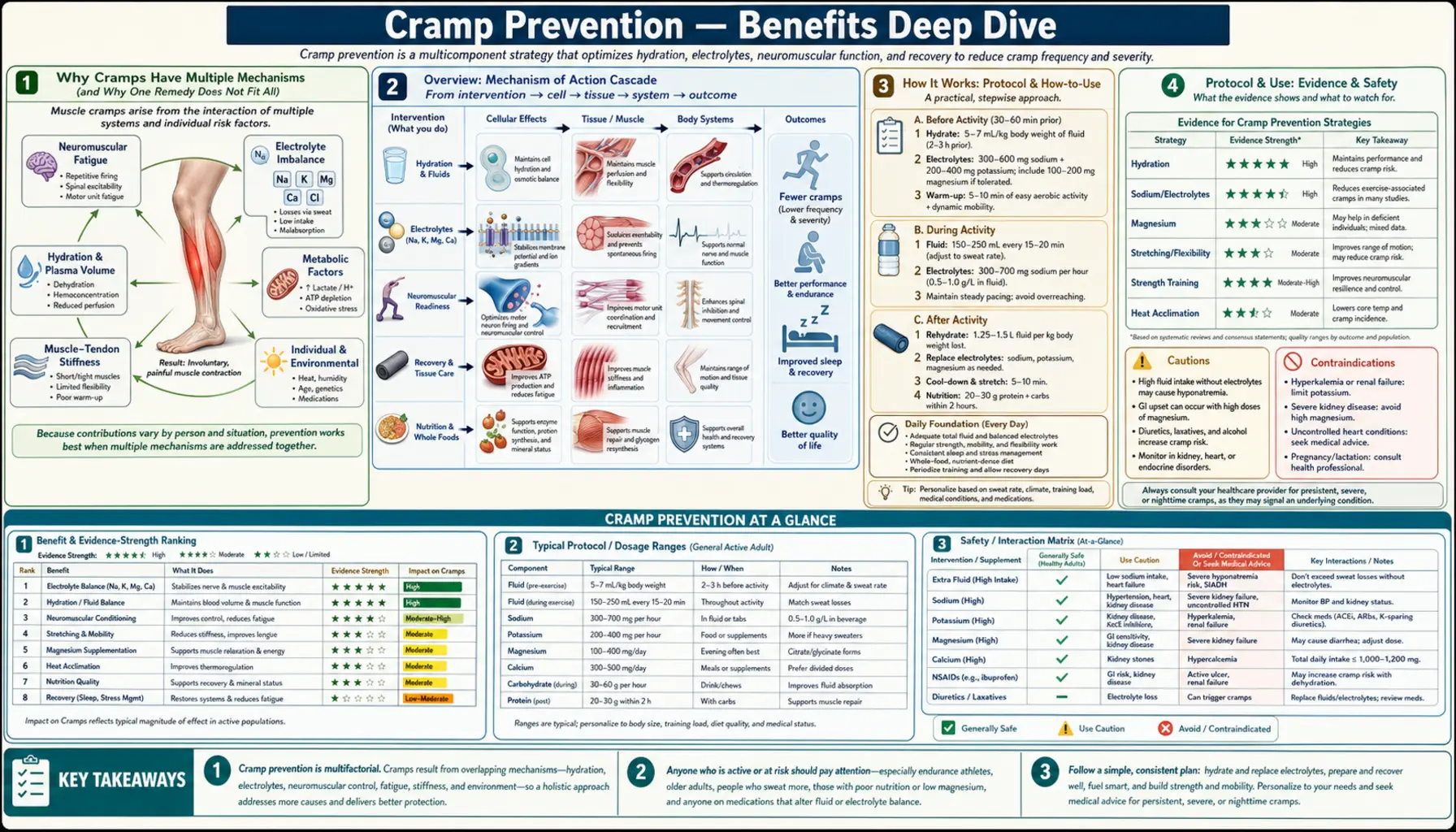
Muscle cramps look like a single problem — an involuntary, painful contraction that won't let go — but they emerge from at least four mechanistically distinct origins. Electrolyte gradient collapse (low intracellular magnesium and potassium, low extracellular sodium relative to total body water), neural over-excitation at the alpha-motoneuron pool, dehydration-driven compartment shifts, and structural shortening of chronically immobilized muscle fibers each respond to different interventions. The four deep-dive pages below map each mechanism to the strategy that addresses it, with the evidence base and practical regimen for each.
Deep-Dive Articles
Magnesium & Electrolytes
The Na/K/Mg/Ca ionic gradient that determines whether a muscle relaxes after contraction. What the magnesium trials found: a 2020 Cochrane review of 11 trials (735 people) concluded that magnesium is unlikely to give clinically meaningful cramp prevention to older adults, a magnesium citrate trial (300 mg magnesium) showed only a trend toward fewer cramps, and no cramp trial has tested glycinate or malate. The Food and Nutrition Board set the adult upper limit for supplemental magnesium at 350 mg a day, the highest daily intake from supplements likely to cause no diarrhea in almost everyone. Potassium from food vs. supplements. The serum-vs-cellular paradox that explains why a normal blood test does not rule out functional deficiency.
Read the deep dive →Pickle Juice & the Neural Reflex
Why a small drink of pickle juice (1 mL per kg of body weight, about 74 mL) shortened electrically induced cramps in dehydrated men to about 85 seconds, against about 134 seconds after water — too fast to be electrolyte absorption, since blood composition barely changed in the first 5 minutes. The TRPV1/TRPA1 receptor reflex hypothesis, the Miller 2010 dehydration (hypohydration) cramp trial, the comparable effects of mustard, vinegar, and ginger, and how to use this knowledge in real-time cramp interruption.
Read the deep dive →Hydration Beyond Water
Why drinking plain water actually worsens cramp risk above ~3 liters/day. The sodium-volume relationship: total body water expands faster than electrolyte intake, diluting plasma sodium and producing exercise-associated hyponatremia. Properly built oral rehydration solution (WHO ORS), electrolyte drink-mix and salt-capsule math, and matching fluid choice to sweat rate.
Read the deep dive →Stretch & Reset Techniques
Passive stretching and what the randomized trials found for night cramps: a 2012 trial of 80 adults over 55 found fewer and milder cramps with calf and hamstring stretches done nightly just before sleep for six weeks, while a 2005 trial of 191 patients found calf-stretching exercises did not reduce cramp frequency or severity. The Hallegraeff nightly stretch protocol, Daniell's 1979 letter on calf stretching, contract-relax (PNF) for acute cramp termination, foam rolling for chronic shortening, and why static post-workout stretching gets a partial pass despite the broader controversy.
Read the deep dive →Interactive Visualization Magnesium — the mineral that makes adenosine triphosphate (ATP) work Bare adenosine triphosphate is useless and enzymes reject it. Watch magnesium clamp the phosphates and switch it on, plug the N-methyl-D-aspartate (NMDA) channel, and let a cramping muscle finally let go. Launch →
Table of Contents
- Deep-Dive Articles
- Why Cramps Have Multiple Mechanisms (and Why One Remedy Does Not Fit All)
- Research Papers: Magnesium & Electrolytes
- Research Papers: Pickle Juice & Neural Reflex
- Research Papers: Hydration & Sodium
- Research Papers: Stretching & Manual Therapy
- Research Papers: Cross-Cutting (Pathophysiology, Drugs, Older Adults)
- External Authoritative Resources
- Connections
- Featured Videos
Why Cramps Have Multiple Mechanisms (and Why One Remedy Does Not Fit All)
Muscle cramps come in at least four clinically distinct types, and the same person can experience more than one. Sorting which type is dominant in a given episode is the single most useful diagnostic step, because the four types respond to different interventions:
- Exercise-associated muscle cramps (EAMC) — the hard, focal cramps experienced by athletes during or shortly after sustained submaximal exercise. The current dominant model is not the older "dehydration / electrolyte loss" hypothesis but the altered neuromuscular control model proposed by Schwellnus and colleagues at the University of Cape Town. Under fatigue, alpha-motoneuron excitability rises while Golgi tendon organ inhibitory feedback falls, and a motor unit fires sustained involuntary discharges. Pickle juice, mustard, and other "neural reflex" interventions work for this type by triggering oropharyngeal TRPV1/TRPA1 receptors that descend-inhibit the motor pool.
- Nocturnal leg cramps (the geriatric cramp) — the cramp that wakes adults over 50 at 3 AM with a vise-grip in the gastrocnemius or arch. A 2016 survey of 516 primary-care patients aged 60 and older found cramps in about 46%, and 31% reported being woken up by them. Mechanism is mixed: chronic calf shortening from sedentary posture, peripheral nerve hyperexcitability, and (in many) functional magnesium and potassium insufficiency. Trials of nightly calf stretching disagree, and in trials of magnesium in older adults it did no better than placebo (2020 Cochrane review; 2017 magnesium oxide trial). Pickle juice does nothing for this type.
- Heat / dehydration cramps — the "salt cramps" historically described in steel-mill and construction workers in hot environments. Driven by genuine sodium-volume depletion: the worker sweats out 2-4 liters of dilute saline per shift, replaces with plain water, and develops hyponatremic muscle cramps that resolve with oral salt and electrolyte solution. Properly built oral rehydration (sodium and glucose, not water alone) is the specific remedy.
- Drug-induced and disease-induced cramps — cramps caused by statins (myopathy, coenzyme Q10 (CoQ10) depletion), diuretics (potassium and magnesium loss), beta-agonists (catecholamine-driven hyperexcitability), nifedipine, donepezil, raloxifene, lithium, and others. Also cramps from electrolyte disorders, hypothyroidism, peripheral neuropathy, restless legs / Willis-Ekbom disease, amyotrophic lateral sclerosis (ALS), and pregnancy. In a 13-year British Columbia prescription study of adults 50 and older, new cramp treatment was 2.42 times more likely in the year after starting a long-acting beta-agonist inhaler, 2.12 times after a potassium-sparing diuretic and 1.48 times after a thiazide-like diuretic, while the links for statins and loop diuretics were small; 60.3% of people treated for cramps had taken at least one of these medicines (Garrison 2012).
The diagnostic question to ask is therefore not "what stops a cramp" but "which kind of cramp is this." For night calf cramps in older adults, magnesium did no better than placebo in the 2020 Cochrane review and the 2017 magnesium oxide trial, and several common medicines are linked to these cramps (see the list above). For end-of-race cramps in athletes, the pickle-juice trial tested a fast mouth-and-throat reflex on electrically induced cramps, not salt replacement. The four deep-dive pages treat each mechanism in clinical depth.
A 2015 Cochrane review of quinine (23 trials, 1,586 people) found that, compared with placebo, quinine (200 to 500 mg a day) cut the number of cramps over two weeks by 28%, cramp intensity by 10% and cramp days by 20%; cramp duration did not change. Because serious side effects of quinine can, rarely, be fatal, its prescription is severely restricted in some countries. The American Academy of Neurology's 2010 review notes a 2006 Food and Drug Administration (FDA) advisory warning against off-label use of quinine sulfate for muscle cramps, and its panel concluded that quinine derivatives, though likely effective, should be avoided for routine use because of their potential toxicity.
What is not known: the two stretching trials disagree — nightly calf and hamstring stretches before sleep reduced night cramps by 1.2 cramps per night in a 2012 trial of 80 adults over 55, while calf-stretching exercises had no effect on cramp frequency or severity in a 2005 trial of 191 patients — and the 2020 Cochrane review found no randomized trials of magnesium for exercise-associated cramps at all.
Research Papers: Magnesium & Electrolytes
- Garrison SR et al., Magnesium for skeletal muscle cramps (Cochrane review 2020) — PubMed PMID: 32956536
- Roffe C et al., Randomised, cross-over, placebo controlled trial of magnesium citrate in the treatment of chronic persistent leg cramps. — PubMed PMID: 12011773
- Frusso R et al., Magnesium for treating nocturnal leg cramps (randomized trial) — Search PubMed
- Dahle LO et al., The effect of oral magnesium substitution on pregnancy-induced leg cramps. — Search PubMed
- Roguin Maor N et al., Effect of magnesium oxide supplementation on nocturnal leg cramps: a randomized clinical trial (JAMA Intern Med 2017) — PubMed PMID: 28241153
- Walker AF et al., Mg citrate found more bioavailable than other Mg preparations. — PubMed PMID: 14596323
- Coudray C et al., Study of magnesium bioavailability from ten organic and inorganic Mg salts in Mg-depleted rats. — PubMed PMID: 16548135
- Lindberg JS et al., Magnesium bioavailability from magnesium citrate and magnesium oxide. — PubMed PMID: 2407766
- Costello R et al., Perspective: The case for an evidence-based reference interval for serum magnesium. — Search PubMed
- Schwalfenberg GK, Genuis SJ, The Importance of Magnesium in Clinical Healthcare. — PubMed PMID: 29093983
Research Papers: Pickle Juice & Neural Reflex
- Miller KC et al., Reflex inhibition of electrically induced muscle cramps in hypohydrated humans (the pickle juice trial) — PubMed PMID: 19997012
- Miller KC, Electrolyte and plasma responses after pickle juice, mustard, and deionized water ingestion in dehydrated humans (J Athl Train 2014) — PubMed PMID: 24955622
- Behringer M et al., Effects of TRPV1 and TRPA1 activators on the cramp threshold frequency: a randomized, double-blind placebo-controlled trial (Eur J Appl Physiol 2017) — PubMed PMID: 28573374
- Craighead DH et al., Ingestion of transient receptor potential channel agonists attenuates exercise-induced muscle cramps. — Search PubMed
- Schwellnus MP, Cause of exercise associated muscle cramps (EAMC) — altered neuromuscular control, dehydration or electrolyte depletion? — Search PubMed
- Schwellnus MP et al., Serum electrolyte concentrations and hydration status are not associated with exercise associated muscle cramping. — Search PubMed
- Khan SI, Burne JA, Reflex inhibition of normal cramp following electrical stimulation of the muscle tendon. — Search PubMed
- Bertolasi L et al., The influence of muscular lengthening on cramps. — Search PubMed
- PubMed topic search — pickle juice interventions for cramping PubMed: Pickle juice clinical reports
- PubMed topic search — oropharyngeal TRPV1 reflex and cramp motoneurons PubMed: TRPV1 motoneuron reflex
Research Papers: Hydration & Sodium
- Hew-Butler T et al., Statement of the Third International Exercise-Associated Hyponatremia Consensus Development Conference. — PubMed PMID: 26102445
- Almond CS et al., Hyponatremia among runners in the Boston Marathon (NEJM 2005) — PubMed PMID: 15829535
- Sawka MN et al., American College of Sports Medicine position stand: Exercise and fluid replacement. — PubMed PMID: 17277604
- Maughan RJ, Shirreffs SM, Dehydration and rehydration in competitive sport PubMed: Maughan rehydration
- Noakes TD, Speedy DB, Time for the medical profession to acknowledge that overhydration causes problems. — Search PubMed
- Lau WY et al., Water intake after dehydration makes muscles more susceptible to cramp but electrolytes reverse that effect. — Search PubMed
- Eichner ER, The role of sodium in heat cramping. — Search PubMed
- Bergeron MF, Heat cramps: fluid and electrolyte challenges during tennis in the heat. — Search PubMed
- WHO/UNICEF, Oral rehydration salts (ORS) composition and reduced osmolarity formulation PubMed: WHO ORS
- Speedy DB et al., Oral salt supplementation during ultradistance exercise (Clin J Sport Med 2002) — PubMed PMID: 12394199
Research Papers: Stretching & Manual Therapy
- Hallegraeff JM et al., Stretching before sleep reduces the frequency and severity of nocturnal leg cramps in older adults: a randomised trial (J Physiother 2012) — PubMed PMID: 22341378
- Daniell HW, Simple cure for nocturnal leg cramps (letter, N Engl J Med 1979) — PubMed PMID: 449985
- Coppin RJ et al., Managing nocturnal leg cramps — calf-stretching exercises and cessation of quinine treatment: a factorial randomised controlled trial (Br J Gen Pract 2005) — PubMed PMID: 15808033
- Allen RE, Kirby KA, Nocturnal leg cramps (American Family Physician review) — Search PubMed
- Maisonneuve H et al., Prevalence of cramps in patients over the age of 60 in primary care: a cross sectional study (BMC Fam Pract 2016) — PubMed PMID: 27520635
- Garrison SR et al., Nocturnal leg cramps and prescription use that precedes them: a sequence symmetry analysis (Arch Intern Med 2012) — PubMed PMID: 22157068
- Page P, Current concepts in muscle stretching for exercise and rehabilitation. — PubMed PMID: 22319684
- Sharman MJ et al., Proprioceptive neuromuscular facilitation stretching: mechanisms and clinical implications. — Search PubMed
- Cheatham SW et al., The effects of self-myofascial release using a foam roll or roller massager. — PubMed PMID: 26618062
- PubMed topic search — stretching before sleep and cramp frequency (randomized trials) PubMed: Stretch RCT mid-age
Research Papers: Cross-Cutting (Pathophysiology, Drugs, Older Adults)
- Miller KC et al., An evidence-based review of the pathophysiology, treatment, and prevention of exercise-associated muscle cramps. — Search PubMed
- Minetto MA et al., Origin and development of muscle cramps. — Search PubMed
- Katzberg HD et al., Assessment: symptomatic treatment for muscle cramps (an evidence-based review): report of the therapeutics and technology assessment subcommittee of the American Academy of Neurology (Neurology 2010) — PubMed PMID: 20177124
- Mandal AK, Hypokalemia and hyperkalemia. — Search PubMed
- PubMed topic search — thiazide diuretics, potassium depletion and muscle cramps PubMed: Thiazides and cramps
- Mantle D et al., Coenzyme Q10 supplementation in statin myopathy PubMed: CoQ10 and statin myopathy
- El-Tawil S et al., Quinine for muscle cramps (Cochrane review) — PubMed PMID: 25842375
- FDA, Drug Safety Communication: New risk management plan and patient Medication Guide for quinine sulfate PubMed: FDA quinine warning
- PubMed topic search — triggers of night cramps in older adults PubMed: Cramp triggers in older adults
- PubMed topic search — restless legs syndrome (Willis-Ekbom disease) versus nocturnal leg cramps PubMed: RLS vs cramp differential
External Authoritative Resources
- Linus Pauling Institute — Magnesium Micronutrient Information Center — a summary of magnesium biology, food sources and the supplement upper limit
- U.S. National Institutes of Health (NIH) Office of Dietary Supplements — Magnesium Fact Sheet
- American Family Physician — Nocturnal Leg Cramps (Allen & Kirby 2012)
- ACSM Position Stand — Exercise and Fluid Replacement (Med Sci Sports Exerc 2007)
- PubMed — All research on muscle cramp pathophysiology and prevention
Connections
- All Remedies
- Magnesium: The Mineral That Makes Adenosine Triphosphate Work — interactive animation
- Cramp Prevention (Main Page)
- Magnesium & Electrolytes for Cramps
- Pickle Juice & the Neural Reflex
- Hydration Beyond Water
- Stretch & Reset Techniques
- Magnesium
- Potassium
- Sodium
- Calcium
- Vitamin D3
- Restless Legs Syndrome
- Hyponatremia
- Bananas (Potassium)
- Pumpkin Seeds (Magnesium)