Aspirin: History and Origins
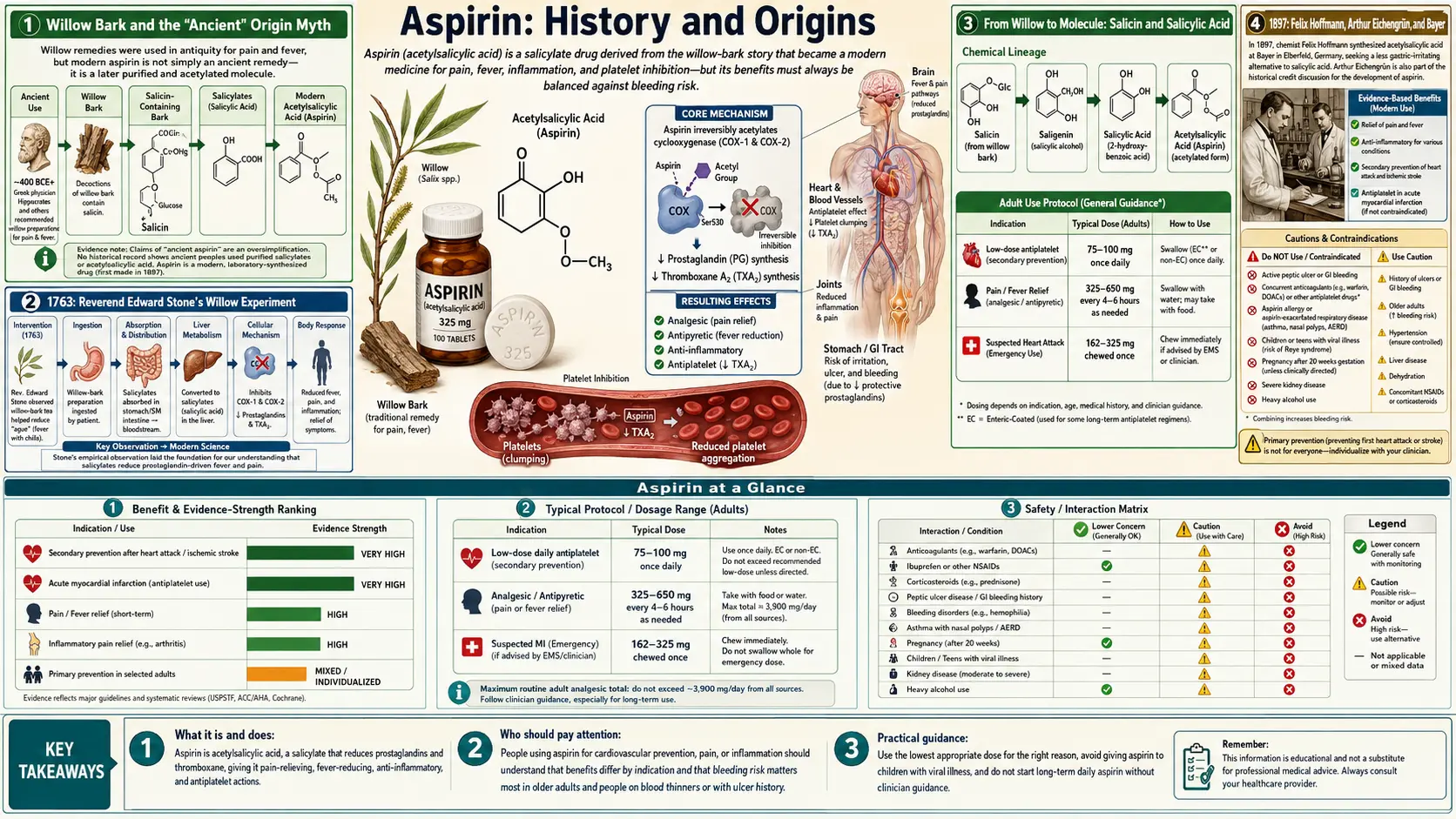
Aspirin — acetylsalicylic acid — is often called the world's first true wonder drug, and its origin story is usually told as a clean line from ancient willow bark to a young Bayer chemist. The real history is more interesting, more human, and in places more contested than the legend. There is no lone genius who "discovered" aspirin out of nothing; instead there is a chain of named people across a century and a half — a country clergyman who tested willow bark on fever patients, the chemists who pulled salicin and then salicylic acid out of plants, and the Bayer team of 1897 whose own internal credit dispute — Felix Hoffmann versus Arthur Eichengrün — is still argued by historians today. This article traces that chain, names what is firmly documented, flags what is romantic myth (including the popular "4,000 years of willow" tale), and ends honestly with where the science and the guidelines actually stand. Aspirin is genuinely proven — but for whom, and at what dose, has changed a great deal.
Table of Contents
- Willow Bark and the "Ancient" Origin Myth
- 1763: Reverend Edward Stone's Willow Experiment
- From Willow to Molecule: Salicin and Salicylic Acid
- 1897: Felix Hoffmann, Arthur Eichengrün, and Bayer
- The Disputed Credit: Hoffmann vs. Eichengrün
- 1899: The Name "Aspirin" and a Global Brand
- 1971: Sir John Vane Finds Out How It Works
- Evidence & Reception: From Cure-All to Careful Use
- Research Papers and References
- Connections
- Featured Videos
Willow Bark and the "Ancient" Origin Myth
Almost every popular account of aspirin opens the same way: that people have used willow bark (the genus Salix) as a painkiller for four thousand years, that the Egyptian Ebers Papyrus and Sumerian tablets prescribed it, and that Hippocrates told women to chew willow for the pains of childbirth. It is a lovely story. It is also, in large part, a retrospective myth — and an honest history has to say so plainly.
The connection people imagine is chemical: willow contains salicin, the body turns salicin into salicylic acid, salicylic acid is the parent of aspirin — therefore the ancients who used willow "must" have been using a primitive aspirin. But when historians actually go back to the primary sources, the chain breaks. Reviewers who searched translations of the Ebers Papyrus found willow used for things like ear discharge, not as a general fever-and-pain remedy. Pharmacology historians note that willow appears only glancingly in the Hippocratic writings, and that Roman authors such as Pliny, Celsus, and Dioscorides mention willow mainly for narrow complaints, not as a broad analgesic. The famous "Hippocrates prescribed willow for labour pain" line is repeated everywhere but is hard to anchor in the actual texts.
There is also a hard pharmacological problem. The salicin content of raw willow bark is low and highly variable, so the amount of active drug in a realistic dose of bark tea or chewed bark is far below a modern therapeutic dose of aspirin — by some estimates you would need to drink dozens of cups of willow tea to reach a single full aspirin dose, and the bark is bitterly astringent and nauseating besides. This does not mean willow is useless — modern standardized willow extracts do contain measurable salicin and related compounds — but it does mean the romantic picture of ancient peoples routinely dosing themselves into pain relief with a cup of bark is not well supported.
The honest takeaway: willow bark is a real plant with a real, if modest, place in folk medicine, and the chemistry that eventually led to aspirin really did begin with willow. But the sweeping "humans have used aspirin for 4,000 years" claim is a story stitched together after the fact. The genuinely documented scientific history of aspirin starts not in ancient Egypt but in eighteenth-century England.
1763: Reverend Edward Stone's Willow Experiment
The first firmly documented, deliberately tested use of willow bark in the modern record belongs to an English country clergyman. On 25 April 1763, the Reverend Edward Stone of Chipping Norton in Oxfordshire wrote a letter to the President of the Royal Society describing what happened when he treated fever sufferers with powdered willow bark. The letter was read before the Society and published in its Philosophical Transactions under the title "An account of the success of the bark of the willow in the cure of agues."
Stone's reasoning was, by modern standards, completely wrong — and that makes the result all the more striking. He was working from the old "doctrine of signatures," the belief that a cure is often found growing near the cause of a disease. Because willow grew in the damp, marshy ground where ague (the intermittent fevers we now associate largely with malaria) was common, Stone guessed the tree might hold a remedy for it. He dried a pound of white willow bark for months near a baker's oven, ground it to powder, and gave doses of about twenty grains in water to roughly fifty patients with agues and feverish complaints. He reported it to be reliably effective at easing their fevers.
Two points of honesty matter here. First, Stone was treating fever, not general pain — and the fevers of true malaria are not actually cured by salicylates, so his glowing results were partly the natural waxing and waning of intermittent fever rather than a malaria cure. Second, Stone himself searched for any earlier precedent for using willow this way and, by his own account, found none — which is further evidence against the idea that he was reviving a well-known ancient practice. What Stone did do, genuinely and for the first time in the documented record, was take a folk material, test it systematically on many patients, and publish the result. That is where the real scientific trail to aspirin begins.
From Willow to Molecule: Salicin and Salicylic Acid
Stone used the whole bark; the nineteenth century's work was to find out what in the bark was doing the work, and then to make it in bulk. This is the chemistry phase of aspirin's history, and it runs through a series of named European chemists.
Around 1828, the German pharmacy professor Johann Andreas Buchner obtained relatively pure bitter crystals from willow bark and named the substance salicin, after the Latin salix for willow. The following year, in 1829, the French pharmacist Henri Leroux improved the extraction and isolated salicin in usable quantity. In 1838, the Italian chemist Raffaele Piria chemically converted salicin into a more active acid he called salicylic acid — the compound that does most of the real anti-inflammatory and fever-reducing work. Salicylic acid was also found to occur naturally in Spiraea ulmaria, the meadowsweet plant — a detail that would later be stamped right into aspirin's name.
The next leap was industrial. In 1859, the German chemist Hermann Kolbe worked out how to synthesize salicylic acid from cheap starting materials (sodium phenoxide reacted with carbon dioxide under heat and pressure), a method later refined into the Kolbe–Schmitt reaction. This turned salicylic acid from a scarce plant extract into something a factory could produce by the ton, and by the 1870s salicylates were widely used for fever, pain, and especially rheumatism. The Scottish physician Thomas MacLagan reported in The Lancet in 1876 that salicin produced dramatic improvement in patients with acute rheumatism — one of the first careful clinical demonstrations of a salicylate's power.
But there was a catch that everyone of the era complained about: plain salicylic acid is harsh. It burns the throat, irritates the stomach, and at the high doses then used it caused real gastric distress, which limited how much patients could tolerate. Solving that problem — keeping the benefit, taming the harshness — is exactly what the Bayer laboratory set out to do, and it is where the modern drug is born.
1897: Felix Hoffmann, Arthur Eichengrün, and Bayer
The decisive step happened at the Bayer dye-and-pharmaceutical works in Elberfeld, Germany, in 1897. The chemistry itself was not new in principle — salicylic acid had been acetylated (had an acetyl group attached) by others decades earlier — but Bayer produced it in a pure, stable, reproducible form and recognized what it had: a salicylate that kept the therapeutic punch while being far gentler on the stomach than salicylic acid alone.
According to Bayer's long-official account, the young chemist Felix Hoffmann (1868–1946) carried out the key synthesis, recording the preparation of acetylsalicylic acid in his laboratory notebook on 10 August 1897. Hoffmann was a trained pharmacist and chemist who had joined Bayer in 1894; the same period of his work is also associated, less happily, with the acetylation that produced diacetylmorphine, which Bayer marketed as Heroin. The romantic version of the aspirin story — widely retold for most of the twentieth century — adds that Hoffmann was personally motivated to find a gentler salicylate to ease his own father's rheumatism. That touching detail is part of the legend and is not securely documented; treat it as a likely embellishment rather than established fact.
Whoever pointed the way, the new compound then had to be tested and championed inside the company. Bayer's head of pharmacology, Heinrich Dreser (1860–1924), oversaw the toxicological and clinical evaluation. Dreser is reported to have been initially skeptical of acetylsalicylic acid (he was more enthusiastic about Heroin), but the drug was tested for safety and effect, moved into trials, and prepared for market. The science of the era could already see what it did at the bedside — lower fever, relieve pain, calm inflammation — even though why it did so would remain a mystery for another seventy years.
The Disputed Credit: Hoffmann vs. Eichengrün
Here is the part of aspirin's history that is genuinely unsettled, and that a truth-first account must lay out rather than paper over. For decades, Bayer credited Felix Hoffmann as the inventor of aspirin. But that attribution itself has a troubling timeline, and a serious rival claim.
The man at the center of the rival claim is Arthur Eichengrün (1867–1949), a gifted Jewish chemist who led the pharmaceutical research group at Bayer in the 1890s — Hoffmann's superior. Eichengrün maintained that the acetylsalicylic acid project was carried out under his direction, that it was his idea to pursue it, and that he was responsible for pushing the drug toward clinical use over Dreser's initial resistance — even, by his account, arranging quiet testing of it himself when the official line was discouraging. He first set this claim down in print in the 1940s, including in a remarkable letter written in 1944 from the Theresienstadt concentration camp, where he was imprisoned by the Nazi regime, and again in a published article in 1949, shortly before his death.
What makes the dispute more than a simple priority quarrel is when Hoffmann was first named as sole inventor. The clear attribution of aspirin to Hoffmann appears prominently around 1934 — in Nazi-era Germany, at a time when crediting a Jewish scientist with one of the nation's proudest inventions was politically unacceptable. In 2000, the pharmaceutical historian Walter Sneader of the University of Strathclyde published a reappraisal in the BMJ arguing, from the archival and published record, that Eichengrün's account is credible and that the standard Hoffmann-only story is doubtful — in other words, that Eichengrün was unfairly written out of the history, plausibly for antisemitic reasons.
Bayer disputes this. The company points out that Hoffmann was named as inventor on the relevant U.S. patent filed in 1899, long before the Nazi period, and continues to credit him. So the honest state of the matter is this: Felix Hoffmann performed (or at least recorded) the key synthesis; Arthur Eichengrün very likely played a central directing role that was later minimized, probably for ugly political reasons; and the exact division of credit cannot be settled with certainty from the surviving evidence. Anyone who tells you flatly that "Felix Hoffmann invented aspirin" — or, equally, that "Eichengrün really invented it and Hoffmann was a fraud" — is choosing one side of a real historical dispute and stating it as settled fact. It is not.
1899: The Name "Aspirin" and a Global Brand
Bayer registered the trademark Aspirin in early 1899 (the German registration is dated 6 March 1899) and brought the drug to market that year, first as a powder supplied to physicians and soon after in the convenient tablet form that made it a household staple. The name was a small piece of branding genius assembled from three parts: a for the acetyl group; spir for Spiraea (meadowsweet), the plant that is another natural source of salicylic acid; and in, a generic suffix common in drug names of the period.
Aspirin spread worldwide with remarkable speed and became one of the first truly global pharmaceutical brands. Its commercial story took a sharp turn after the First World War: under the Treaty of Versailles, Germany ceded various assets, and Bayer lost its exclusive trademark rights to the word "aspirin" in a number of countries. As a result, in the United States, the United Kingdom, France, and others, aspirin became a generic name for the drug that anyone could use, while in much of the rest of the world Aspirin remains a registered Bayer trademark to this day. That is why the same compound is a brand name in one country and an ordinary common noun in the next.
One darker chapter belongs to this early era. During the 1918–1919 influenza pandemic, the recommended doses of aspirin were extraordinarily high by modern standards. A 2009 analysis argued that salicylate toxicity at those doses — which can cause fluid in the lungs — may have worsened outcomes in some patients, a sobering reminder that even a genuinely effective drug is dose-dependent and can harm when pushed too far. (This pandemic episode concerns dosing history, not the drug's core action.)
1971: Sir John Vane Finds Out How It Works
For roughly seventy years, aspirin was used by hundreds of millions of people without anyone knowing how it worked. That changed in 1971, when the British pharmacologist Sir John Vane (1927–2004), then at the Royal College of Surgeons in London, published in Nature New Biology his discovery that aspirin and aspirin-like drugs act by blocking the production of prostaglandins — the local hormone-like molecules that drive inflammation, pain, fever, and the clumping of platelets.
The enzyme aspirin blocks was later named cyclooxygenase (COX). Aspirin's mechanism turned out to be unusual and elegant: it inhibits COX irreversibly, by chemically attaching an acetyl group to the enzyme's active site. This is why a single small daily dose can switch off the thromboxane production of platelets for the platelet's entire 7–10 day lifespan — platelets cannot make fresh enzyme — and that single fact is the molecular reason a "baby aspirin" can thin the blood enough to help prevent heart attacks and strokes. Vane's insight reframed aspirin from an empirical folk-derived remedy into a precisely understood drug, and it opened the door to the entire modern class of non-steroidal anti-inflammatory drugs.
The work was honored at the highest level: in 1982, John Vane shared the Nobel Prize in Physiology or Medicine with the Swedish scientists Sune Bergström and Bengt Samuelsson, who had unraveled the chemistry of the prostaglandins themselves. Vane was later knighted. It is a fitting symmetry in aspirin's story that a drug whose human origin is tangled and disputed has, at its scientific heart, one of the cleanest and best-documented mechanistic discoveries in twentieth-century pharmacology.
Evidence & Reception: From Cure-All to Careful Use
Unlike many of the disputed remedies catalogued on this site, aspirin is not fringe or unproven — it is one of the most rigorously studied medicines ever made, and its core uses are firmly established. The honesty this section owes the reader is therefore of a different kind: not "does it work at all?" but "for whom, at what dose, and at what risk?" — because the answers have shifted substantially, and the old habit of treating aspirin as a harmless daily tonic for everyone is now considered wrong.
What is well established: for people who already have cardiovascular disease — a prior heart attack, certain strokes, or known coronary artery disease — low-dose aspirin meaningfully reduces the risk of a further event (this is called secondary prevention), and the landmark ISIS-2 trial in 1988 showed that aspirin given during a suspected heart attack saves lives. Aspirin is also an effective analgesic, antipyretic (fever reducer), and anti-inflammatory, and a substantial body of long-term trial data links regular aspirin use to a reduced incidence of colorectal cancer. These are real, mainstream, guideline-backed conclusions.
What has changed is the picture for primary prevention — healthy people with no established heart disease taking daily aspirin "just in case." Three large trials reported in 2018 (ARRIVE, ASCEND, and ASPREE) found that for such people the modest benefit of aspirin was roughly offset by an increased risk of serious bleeding. On the strength of that evidence, the U.S. Preventive Services Task Force in 2022 sharply narrowed its recommendation, advising against routinely starting daily aspirin for primary prevention in older adults and urging individualized decisions for younger ones. The message from the experts reversed within a generation: from "most middle-aged adults should consider a daily aspirin" to "don't start one without a specific reason and a conversation with your clinician."
And aspirin is not benign. Its real harms include gastrointestinal bleeding and peptic ulcers, an increased risk of hemorrhagic (bleeding) stroke, kidney effects, ringing in the ears and toxicity at high doses, and — importantly — Reye's syndrome, a rare but devastating condition that led to firm advice against giving aspirin to children and teenagers with viral illnesses. The arc of aspirin's reception, then, mirrors the arc of its history: a substance that began wrapped in folklore, was proven by hard science to be genuinely powerful, and is now used with far more precision and humility than the "wonder drug" headlines of the past suggested. The detailed clinical evidence, dosing, and cautions are covered in the companion Aspirin Benefits articles and on the main Aspirin page; this history is concerned with how the drug came to be.
Research Papers and References
The list below combines key primary and historical sources on aspirin with curated PubMed topic-search links. Author names, titles, and journals are given as plain text; only the stable DOI, PMID, or archival link is hyperlinked, and each opens in a new tab. Historical primary documents (Edward Stone's 1763 letter; Arthur Eichengrün's own writings) are named in the article as historical sources.
- Stone E. An account of the success of the bark of the willow in the cure of agues. Philosophical Transactions of the Royal Society of London. 1763;53:195-200. — doi:10.1098/rstl.1763.0033
- Sneader W. The discovery of aspirin: a reappraisal. BMJ. 2000;321(7276):1591-1594. — PMID: 11124191
- Vane JR. Inhibition of prostaglandin synthesis as a mechanism of action for aspirin-like drugs. Nature New Biology. 1971;231(25):232-235. — doi:10.1038/newbio231232a0
- Desborough MJR, Keeling DM. The aspirin story — from willow to wonder drug. British Journal of Haematology. 2017;177(5):674-683. — PMID: 28106908
- Vane JR, Botting RM. The mechanism of action of aspirin. Thrombosis Research. 2003;110(5-6):255-258. — PMID: 14592543
- Jack DB. One hundred years of aspirin. The Lancet. 1997;350(9075):437-439. — PMID: 9259670
- MacLagan TJ. The treatment of acute rheumatism by salicin (republished historical text). The Journal of Rheumatology. 2002;29(6):1321. — PMID: 12064852
- Nobel Prize in Physiology or Medicine 1982 (Sune K. Bergström, Bengt I. Samuelsson, John R. Vane). The Nobel Foundation. — NobelPrize.org — 1982 Medicine
- Aspirin history and the willow-to-drug story — PubMed: aspirin history and salicylates
- Aspirin discovery, Hoffmann and Eichengrün — PubMed: aspirin discovery and disputed credit
External Authoritative Resources
- Science History Institute — Felix Hoffmann
- Wikipedia — History of aspirin
- USPSTF — Aspirin to Prevent Cardiovascular Disease
Connections
- All Remedies
- Aspirin
- Aspirin Benefits
- Willow Bark
- Glycine & Aspirin Metabolism
- Anti-Inflammatory Diet
- Cardiovascular Disease
- Stroke
- Peptic Ulcer Disease