Applied Kinesiology
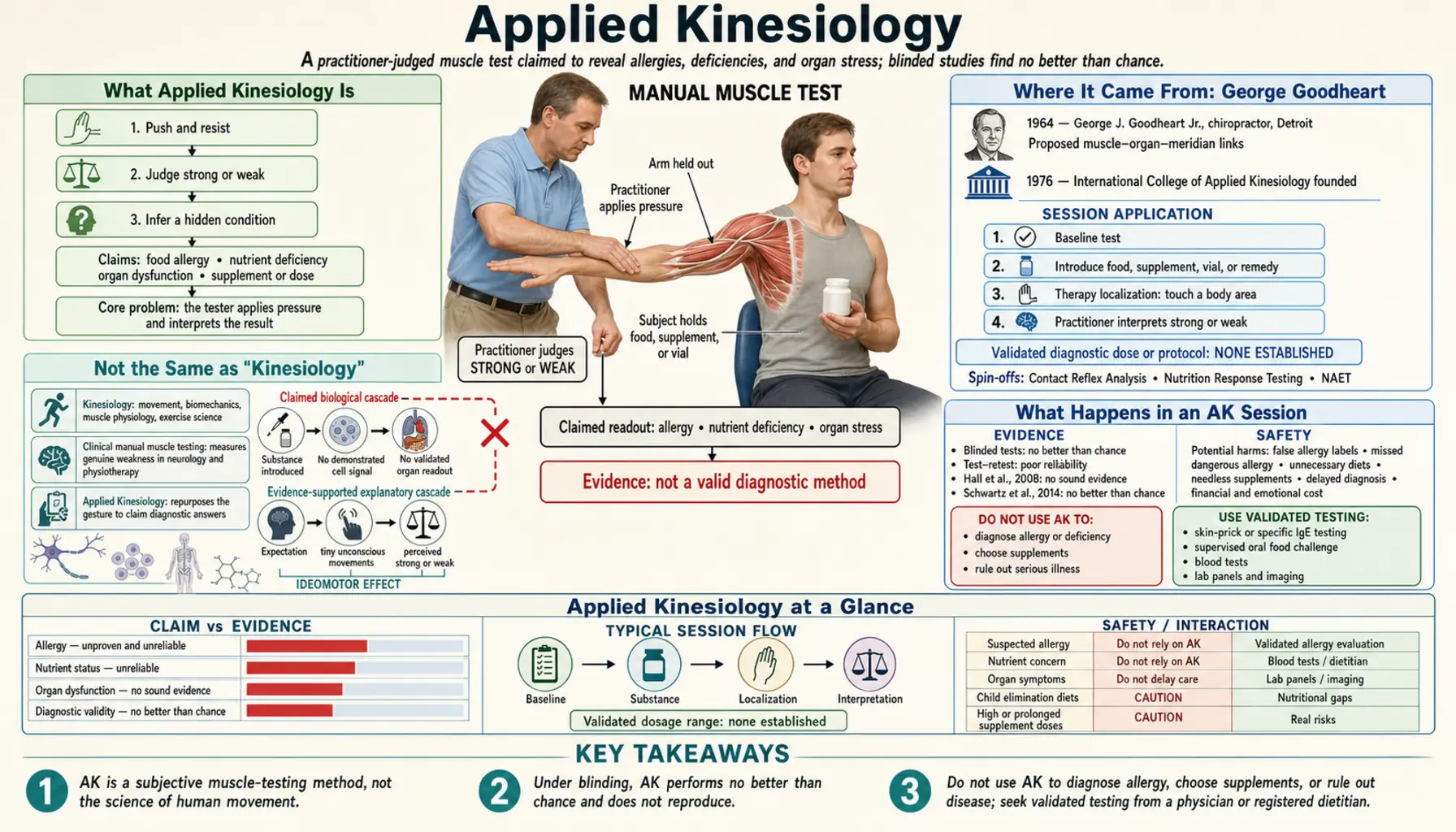
Applied Kinesiology (AK) is a form of "muscle testing." A practitioner — often a chiropractor, naturopath, or alternative-health provider — asks you to hold out an arm or leg, presses on it, and judges whether the muscle tests "strong" or "weak." From that push-and-feel, they claim to read hidden information about your body: which foods you are allergic to, which vitamins or minerals you are short on, which organ is "stressed," or which supplement your body "needs." Sometimes a bottle of pills or a bit of food is placed in your hand or on your tongue while the test is repeated, and a sudden "weakening" of the arm is taken as proof of a problem. It can be a strikingly persuasive thing to watch. This page tries to be fair and clear about it. The honest summary, which we will walk through carefully below, is that when Applied Kinesiology has been tested under proper blinded conditions — where neither the tester nor the patient knows which substance is being tested — its results are no better than chance and do not reproduce. It is not a valid way to diagnose allergies, deficiencies, or disease. Below we explain what AK is, why it is not the same thing as the real science of kinesiology, how a session works, what the controlled studies actually found, why it nonetheless feels convincing, and where its real harms lie.
Table of Contents
- What Applied Kinesiology Is
- Not the Same as "Kinesiology"
- Where It Came From: George Goodheart
- What Happens in an AK Session
- The Honest Science: It Does Not Work
- The Ideomotor Effect and Suggestion
- Why It Feels So Convincing
- The Real Harm
- What to Do Instead: Validated Testing
- The Honest Bottom Line
- Research Papers
- Connections
- Featured Videos
What Applied Kinesiology Is
Applied Kinesiology is a diagnostic method built around a single idea: that the momentary strength of a muscle can act as a kind of biological dial, giving yes-or-no answers about what is happening elsewhere in the body. The practitioner performs a manual muscle test — you resist as they push on your outstretched arm — and interprets a muscle that seems to "give way" or test "weak" as a signal of an underlying problem.
What makes AK distinctive is the enormous range of claims attached to that simple push. Depending on the practitioner, a "weak" muscle is said to reveal:
- A food allergy or intolerance — often "confirmed" by having you hold or taste a suspect food while the arm is tested again.
- A nutrient deficiency — you hold a vitamin or mineral bottle, and if the arm "strengthens," your body supposedly needs it.
- Organ or gland "dysfunction" — a weak muscle mapped to the liver, thyroid, adrenals, and so on.
- The right supplement, remedy, or dose to buy — testing product after product to see which one "makes you strong."
These are concrete, testable claims. They are not vague statements about feeling better; they are specific assertions that a muscle test can detect a real physiological fact. That matters, because a claim that can be tested can also be checked — and, as we will see, it has been checked many times.
Not the Same as "Kinesiology"
This is the single most important point of confusion, and it is worth clearing up before anything else. The word "kinesiology" is used for two very different things.
Kinesiology, the science, is the academic study of human movement — biomechanics, muscle physiology, exercise science, and how the body moves and produces force. It is a legitimate university field. Athletic trainers, physical therapists, and exercise physiologists study it, and it underpins rehabilitation and sports medicine. When someone earns a degree in kinesiology, this is what they studied.
Applied Kinesiology, despite borrowing the name, is a separate alternative-medicine method invented in the 1960s. It uses muscle testing not to measure movement or strength for its own sake, but as a supposed diagnostic "read-out" of allergies, nutrition, and organ health. The overlap is only in the word.
There is a third thing worth separating out, too. Manual muscle testing is a real and valuable clinical tool in neurology and physiotherapy. When a doctor asks you to push against their hand to check for genuine muscle weakness — after a stroke, a nerve injury, or in a condition like Guillain–Barré syndrome — they are measuring actual strength, graded on a validated scale, to find real nerve or muscle damage. That is legitimate. Applied Kinesiology takes the form of this exam — the push, the resistance — and repurposes it to answer questions muscle strength cannot answer, such as "am I allergic to wheat?" The physical gesture looks similar; the claim behind it is entirely different, and it is the claim that fails.
Where It Came From: George Goodheart
Applied Kinesiology was developed in 1964 by George J. Goodheart Jr., a chiropractor in Detroit, Michigan. Goodheart proposed that specific muscles were functionally linked to specific internal organs and to acupuncture "meridians," and that testing a muscle could therefore reveal the state of the organ he believed it was connected to. He taught that "weak" muscles could be strengthened by rubbing certain points, adjusting the spine, or correcting nutrition, and he wove together ideas from chiropractic, acupuncture, and nutrition into a single system.
In 1976, the International College of Applied Kinesiology (ICAK) was founded to organize and teach the method, and it spread through chiropractic and naturopathic practice in the United States and internationally. Over the decades it branched into many spin-off "muscle testing" systems — Contact Reflex Analysis, Nutrition Response Testing, NAET (for allergies), and others — that share the same core assumption even where they drop the AK name.
Knowing this history helps set expectations honestly. Applied Kinesiology is a mid-twentieth-century invention founded on the theories of one practitioner, not a discovery that emerged from anatomy or physiology. Its central premise — that muscle strength is wired to organ health and can be read like a gauge — was asserted first and tested later. When it finally was tested, it did not hold up.
What Happens in an AK Session
Sessions vary, but the core routine is consistent. Knowing the choreography makes it easier to see where the result actually comes from.
- The baseline test. You hold an arm out to the side (or another limb is positioned), and the practitioner presses on it while you resist. This establishes a "strong" muscle as the reference.
- Introducing a substance. A food, a supplement bottle, a vial of a suspected allergen, or a homeopathic remedy is then placed in your other hand, on your tongue, or on your chest — sometimes merely held near the body. The idea is that contact with a "bad" substance will make the test muscle go weak, and contact with a "good" one will keep it strong.
- "Therapy localization." The practitioner may have you touch a part of your own body (say, over the stomach or thyroid) while the muscle is tested, claiming a change in strength localizes the "problem" to that area.
- The interpretation. Whether the arm feels "strong" or "weak" is judged by the practitioner's own hands. On that basis they announce a diagnosis — an allergy, a deficiency, a stressed organ — and often a product to correct it.
Notice who controls the crucial step. The person applying the pressure and deciding whether the muscle "gave way" is the same person who knows which substance is being tested and what answer the system predicts. That is precisely the situation that good experimental design exists to guard against — and it is why blinding, described below, changes everything.
The Honest Science: It Does Not Work
Applied Kinesiology has been studied for decades, and the verdict from controlled research is unusually clear for an alternative-medicine topic. When AK muscle testing is examined under proper conditions, its results are no better than chance and are not reproducible.
The most telling experiments use blinding. In an unblinded session, the tester knows which substance you are holding and what result AK predicts. In a properly blinded study, the substances are concealed in identical, coded containers so that neither the practitioner nor the patient knows which is which until the codes are broken afterward. This one change — removing everyone's knowledge of the substance — consistently makes the effect vanish:
- A double-blind study of "materials testing" published in the Journal of Dental Research (Staehle and colleagues, 2005) tested whether AK could distinguish substances a person supposedly reacted to from placebos. Under blinding, the muscle-test responses matched the true substances no better than random guessing.
- An early double-blind pilot study in the Journal of Prosthetic Dentistry (Friedman and Weisberg, 1981) likewise found that AK muscle responses did not track the substances being tested once the test was properly controlled.
- A reliability study in Complementary Therapies in Medicine (Lüdtke and colleagues, 2001) found that the kinesiology muscle test had poor test–retest reliability and no demonstrated validity — meaning even the same practitioner often could not get the same answer twice, and the answers did not correspond to any real condition.
- A large double-blind, randomized study in the journal EXPLORE (Schwartz and colleagues, 2014) put AK to a rigorous test as a diagnostic tool and found it did not perform better than chance.
The pattern is consistent across the specific claims. On nutrient status, a study in the Journal of the American Dietetic Association (Kenney and colleagues, 1988) compared AK's verdicts to actual laboratory measures of nutritional status and concluded AK was unreliable for assessing nutrient needs — its recommendations did not match what people's bodies actually showed. On food allergy, the physician-researcher J. S. Garrow tested it on himself under double-blind conditions and reported in the BMJ (1988) that the muscle test could not tell a genuine allergen from a harmless control once he could not see which was which.
Systematic reviews — the careful pooling of all the reasonable studies — reach the same place. A review of the applied-kinesiology literature by Hall and colleagues (2008) found the research base was of poor quality and provided no sound evidence that AK can diagnose disease or organic dysfunction. A critical reappraisal by Haas and colleagues (2007) reached a similar conclusion. When the field's own better studies are examined together, the finding is not "mixed" or "promising" — it is that AK does not do what it claims.
The Ideomotor Effect and Suggestion
If blinding makes the effect disappear, then the "weakness" everyone feels in an ordinary session has to be coming from somewhere other than the substance. The best-supported explanation is the ideomotor effect — the same mechanism behind a Ouija board planchette or a swinging pendulum.
The ideomotor effect describes how a person can make small, genuine muscle movements without being aware that they are doing it, driven by expectation rather than conscious intention. In a muscle test, the practitioner already knows which substance is present and what result they expect. Without meaning to, they can press a fraction harder or at a slightly different angle, or time the push differently, when they expect a "weak" response — and the patient, who can also sense the situation, may unconsciously resist a little less. Neither person is cheating. Both may be completely sincere. But those tiny, unconscious differences are enough to produce a convincing "weakening" of the arm on cue.
This is exactly why the result survives in the open room but evaporates under blinding. Remove the tester's knowledge of the substance, and there is nothing left to unconsciously steer the outcome — so the muscle stops "knowing" which pill is which. The signal was never coming from your body's reaction to the substance; it was coming from shared expectation, transmitted through the tester's own hands. Suggestion does the rest: told that a food is "weakening" you, both people watch for — and find — weakness.
Why It Feels So Convincing
None of this explains itself away easily in the moment, because a muscle-testing demonstration can be genuinely dramatic. It is worth understanding why an ineffective test can feel so compelling — that understanding is your best protection.
- The in-office demonstration is vivid. Your own arm really does seem to collapse when the "bad" substance is introduced and hold firm when the "good" one is. Feeling it happen in your own body is far more persuasive than any statistic — even though, under blinding, the very same arm can no longer tell the difference.
- Confirmation bias. When the test "reveals" the food you already suspected was bothering you, it feels like proof. Hits are remembered and count as evidence; misses are quietly forgotten or explained away.
- It feels personalized and attentive. A practitioner spending time hands-on with you, taking your concerns seriously and tailoring recommendations, builds trust — and trust makes the verdict feel more credible than it is.
- Regression and coincidence. People often seek help when symptoms are at their worst. Many complaints then ease on their own, and if you cut out a "tested" food around the same time, AK gets the credit for improvement it did not cause.
- Sincerity is disarming. Because the ideomotor effect is unconscious, the practitioner genuinely believes the test works, and that sincerity is persuasive. A confident, well-meaning provider is easy to trust.
A demonstration that feels real is not the same as a test that is real. The whole point of blinded studies is that they can tell the difference when our own senses cannot.
The Real Harm
It is tempting to think that a harmless-looking push on the arm can't hurt anyone. But Applied Kinesiology can cause real damage, and it is worth being specific about how.
- False allergy "diagnoses." AK routinely flags foods as allergens that are not. This can lead to unnecessary, sometimes sweeping dietary restrictions — cutting out whole food groups on the strength of a muscle test. In children especially, needless elimination diets can cause nutritional gaps and disordered eating around food. Just as bad, AK can miss a genuine, dangerous allergy, giving false reassurance to someone who really is at risk of a serious reaction.
- False deficiency "diagnoses" and needless supplements. Because the test conveniently "recommends" whichever products are on hand — often the ones the practitioner sells — people can leave with an expensive armful of supplements they don't need. Beyond the cost, some supplements carry real risks at high or prolonged doses.
- Missed and delayed real diagnoses. This is the gravest danger. If AK is used to "rule out" a serious condition — telling someone their fatigue is a "stressed adrenal" or their pain is a "food sensitivity" — it can delay the proper work-up that would have caught anemia, thyroid disease, celiac disease, an infection, or a cancer. Time lost to a test that cannot actually diagnose anything is time a real illness keeps advancing.
- Financial and emotional cost. Repeated visits, product sales, and an ever-growing list of "sensitivities" can drain money and narrow a person's life around fears the test invented.
Real allergy and nutrition testing exists precisely because getting these answers right matters. Substituting a method that performs no better than chance is not a neutral choice — it trades a validated answer for a coin flip dressed up as certainty.
What to Do Instead: Validated Testing
The good news is that the questions AK claims to answer usually can be answered — with real tests that have been shown to work. If a practitioner's muscle test worries you about a food or a deficiency, take the concern to a physician or registered dietitian and ask for proper evaluation.
- For allergy: validated tools include skin-prick testing, specific IgE blood tests, and — the gold standard — a supervised oral food challenge, all interpreted alongside your actual history of reactions. For non-allergic food reactions, a carefully structured elimination-and-reintroduction diet guided by a clinician is the evidence-based approach.
- For nutrient status: ordinary blood tests measure real levels — ferritin and iron studies, vitamin B12, vitamin D, and so on — giving numbers you and your doctor can act on.
- For organ function: established lab panels and imaging — thyroid tests, liver and kidney panels, blood counts — assess how organs are actually working.
These tests are not perfect, and good doctors interpret them with judgment and your story in mind. But they share the one quality Applied Kinesiology lacks: when studied under blinded, controlled conditions, they measure something real. That is the whole difference.
The Honest Bottom Line
Applied Kinesiology is a "muscle testing" method that claims to diagnose allergies, nutrient deficiencies, and organ problems from how strong your arm feels when a practitioner pushes on it. It was invented by a chiropractor in the 1960s, and it is not the same as the legitimate science of kinesiology (the study of movement) or the real manual muscle testing that neurologists and physiotherapists use to find genuine weakness.
Tested properly — under blinding, where no one knows which substance is being used — AK's results are no better than chance and do not reproduce. The "weakness" people feel in the office is best explained by the ideomotor effect and suggestion: tiny, unconscious movements guided by shared expectation, not a signal from your body. It can feel utterly convincing and still be measuring nothing.
The kind thing and the true thing line up here. Applied Kinesiology is not a valid diagnostic method, and it should not be used to decide what you are allergic to, what supplements to take, or whether a serious illness can be ruled out. If you have those questions — and they are good questions — ask for validated testing from a doctor or dietitian. That is where the real answers are, and they are worth having.
Research Papers
- Hall S, Lewith G, Brien S, Little P. A review of the literature in applied and specialised kinesiology. Forschende Komplementärmedizin. 2008;15(1):40–46. doi:10.1159/000112820 — A systematic review finding the research base poor and no sound evidence that applied kinesiology can diagnose disease or organ dysfunction.
- Schwartz SA, Utts J, Spottiswoode SJP, Shade CW, Tully L, Morris WF. A double-blind, randomized study to assess the validity of applied kinesiology (AK) as a diagnostic tool and as a nonlocal proximity effect. EXPLORE. 2014;10(2):99–108. doi:10.1016/j.explore.2013.12.002 — Under proper blinding, AK muscle testing performed no better than chance as a diagnostic tool.
- Kenney JJ, Clemens R, Forsythe KD. Applied kinesiology unreliable for assessing nutrient status. Journal of the American Dietetic Association. 1988;88(6):698–704. doi:10.1016/s0002-8223(21)02038-1 — AK's verdicts did not match actual laboratory measures of nutritional status; it was unreliable for assessing nutrient needs.
- Lüdtke R, Kunz B, Seeber N, Ring J. Test-retest reliability and validity of the kinesiology muscle test. Complementary Therapies in Medicine. 2001;9(3):141–145. doi:10.1054/ctim.2001.0455 — The muscle test showed poor test–retest reliability and no demonstrated validity.
- Staehle HJ, Koch MJ, Pioch T. Double-blind study on materials testing with applied kinesiology. Journal of Dental Research. 2005;84(11):1066–1069. doi:10.1177/154405910508401119 — Under blinding, AK could not distinguish reactive substances from placebos better than random guessing.
- Friedman MH, Weisberg J. Applied kinesiology—double-blind pilot study. The Journal of Prosthetic Dentistry. 1981;45(3):321–323. doi:10.1016/0022-3913(81)90398-x — An early controlled test found AK muscle responses did not track the substances being tested.
- Garrow JS. Kinesiology and food allergy. BMJ. 1988;296(6636):1573–1574. doi:10.1136/bmj.296.6636.1573 — A physician tested AK on himself double-blind and found it could not tell a genuine allergen from a harmless control.
- Haas M, Cooperstein R, Peterson D. Disentangling manual muscle testing and Applied Kinesiology: critique and reinterpretation of a literature review. Chiropractic & Osteopathy. 2007;15:11. doi:10.1186/1746-1340-15-11 — A critical reappraisal concluding the evidence does not support AK's diagnostic claims.
- Teuber SS, Porch-Curren C. Unproved diagnostic and therapeutic approaches to food allergy and intolerance. Current Opinion in Allergy and Clinical Immunology. 2003;3(3):217–221. doi:10.1097/00130832-200306000-00011 — A clinical review listing applied kinesiology among unproven, unreliable food-allergy tests.
- Beyer K, Teuber SS. Food allergy diagnostics: scientific and unproven procedures. Current Opinion in Allergy and Clinical Immunology. 2005;5(3):261–266. doi:10.1097/01.all.0000168792.27948.f9 — Contrasts validated allergy tests with unproven ones such as muscle-testing/AK.
Connections
- All Remedies
- Chiropractic
- Lab Tests
- Detox Protocols
- Elimination Diet
- Reflexology
- Acupuncture
- Gerson Therapy
- Colon Hydrotherapy