Neuroscience and the Senses
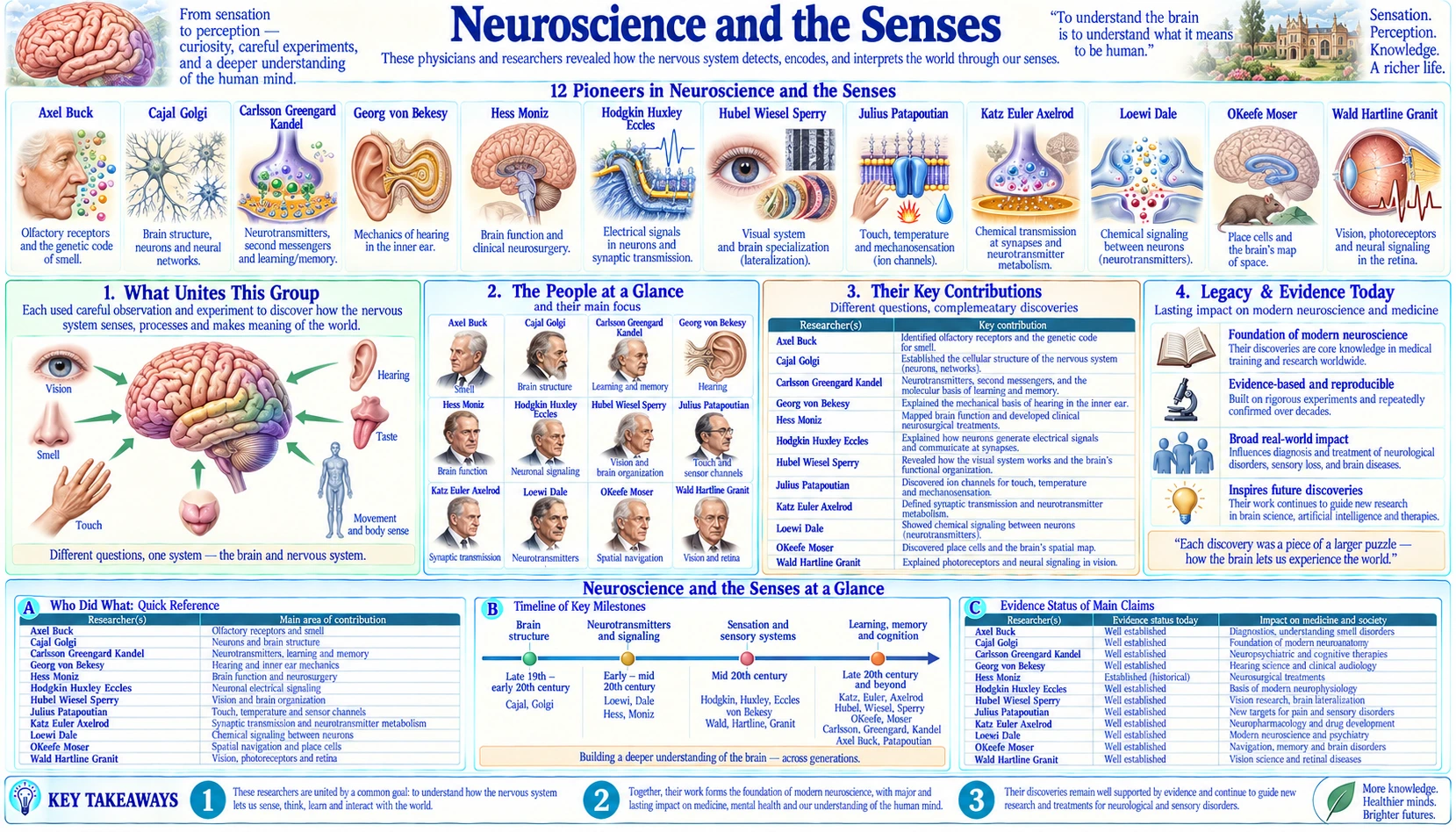
The People (11)
Cajal Golgi
Italian pathologist Camillo Golgi invented the black-reaction stain in 1873; Spaniard Santiago Ramón y Cajal used it to show the brain is built of separate neurons.
Read the deep dive →Georg von Bekesy
Hungarian telephone-laboratory physicist Georg von Békésy (1899–1972), who worked out how the cochlea turns sound into pitch and won the unshared 1961 Nobel Prize.
Read the deep dive →Hess Moniz
Swiss physiologist Walter Hess mapped how the interbrain runs the body's automatic functions; Portuguese neurologist Egas Moniz introduced cerebral angiography and the prefrontal leucotomy (Nobel 1949).
Read the deep dive →Wald Hartline Granit
George Wald found vitamin A at the heart of the eye's light-catching pigment, while Keffer Hartline and Ragnar Granit recorded how the retina signals (Nobel 1967).
Read the deep dive →Hodgkin Huxley Eccles
British physiologists Alan Hodgkin and Andrew Huxley and Australian John Eccles worked out how sodium and potassium ions carry the nerve impulse (Nobel 1963).
Read the deep dive →Carlsson Greengard Kandel
Arvid Carlsson showed dopamine is a brain transmitter, Paul Greengard traced its signal inside the cell, and Eric Kandel tied that chemistry to memory (Nobel 2000).
Read the deep dive →Hubel Wiesel Sperry
David Hubel and Torsten Wiesel decoded how the visual cortex processes sight and found its critical period; Roger Sperry studied split-brain patients (Nobel 1981).
Read the deep dive →OKeefe Moser
John O'Keefe discovered the brain's place cells in 1971, and May-Britt and Edvard Moser found grid cells, together a positioning system in the brain (Nobel 2014).
Read the deep dive →Axel Buck
American scientists Richard Axel and Linda Buck, whose 1991 discovery of the odorant-receptor gene family explained how the nose tells smells apart (Nobel 2004).
Read the deep dive →Deisseroth Hegemann Nagel
Peter Hegemann and Georg Nagel found channelrhodopsin, a light-gated ion channel in algae; Karl Deisseroth made it a light switch for nerve cells (Nobel 2026).
Read the deep dive →Julius Patapoutian
David Julius found TRPV1, the receptor for heat and chili, and Ardem Patapoutian found Piezo1 and Piezo2, the receptors for pressure and touch (Nobel 2021).
Read the deep dive →Everyone in this group is a Nobel laureate in Physiology or Medicine, grouped by what the prize was awarded for. The neuron doctrine, how nerves fire and talk to each other, and how sight, smell, hearing, touch and temperature reach the brain.
Connections
- All Notable Doctors
- Infection and Microbiology
- Genetics and Molecular Biology
- Immunology and Immunotherapy
- Metabolism and Nutrition
- Cell Biology and Physiology
- Medical Technology and Surgery
- Pharmacology
- Nutrition and Orthomolecular
- Contemporary Practitioners
- Public Health and Institutional Medicine