Élie Metchnikoff: Phagocytes, Yogurt, and the Birth of Immunology
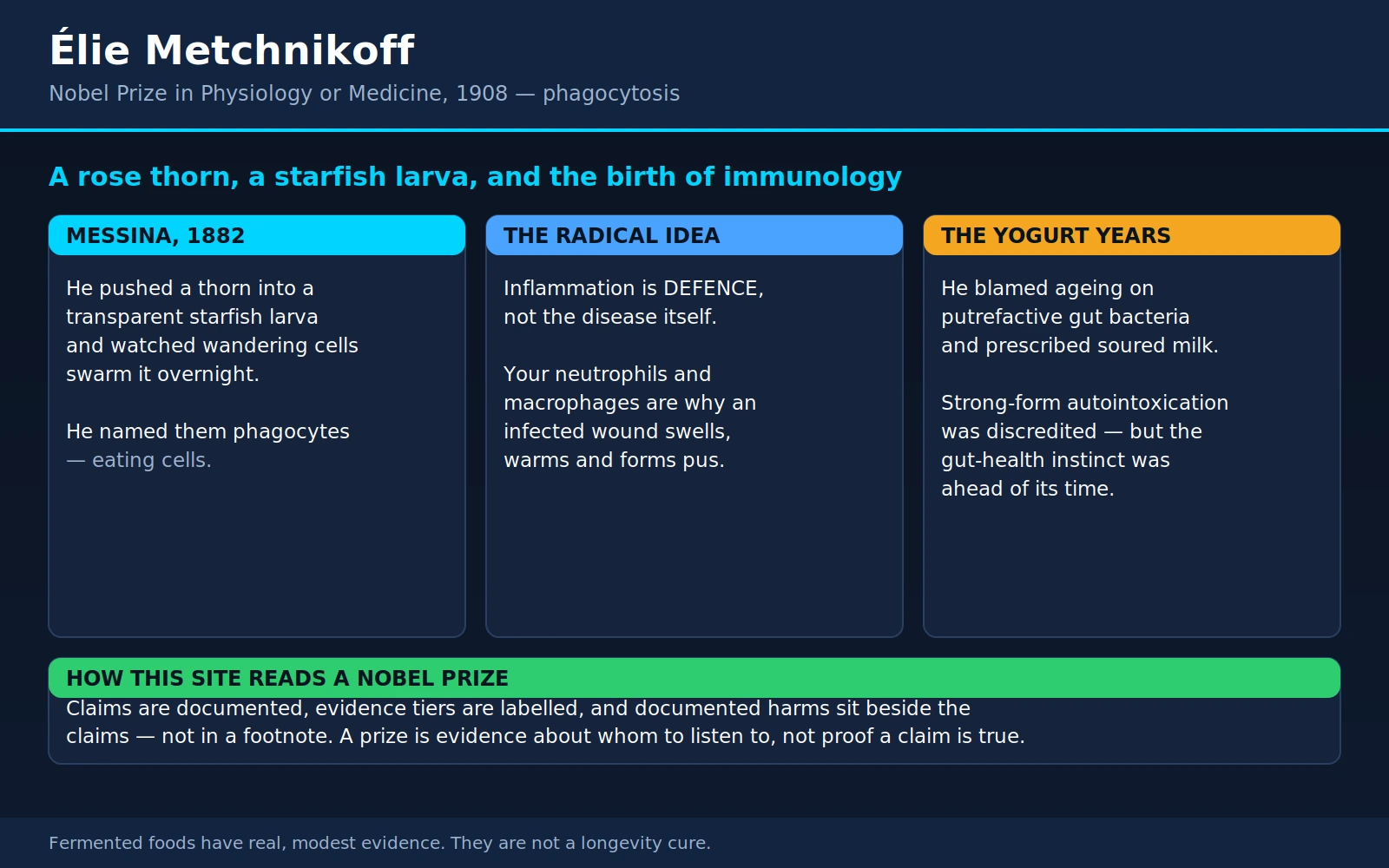
Table of Contents
- Who He Was
- The Rose Thorn and the Starfish
- Cellular vs. Humoral: Immunology's First Great War
- Phagocytes in Your Body Today
- The Turn to Aging
- Yogurt, Bulgaria, and Lactobacillus
- What Held Up and What Didn't
- Fermented Foods on This Site
- Where Mainstream Medicine Agrees / Where the Claims Outran the Evidence
- What Metchnikoff Means for You Today
- Key Research Papers
- Connections
- Featured Videos
1. Who He Was
Élie Metchnikoff (Ilya Ilyich Mechnikov, 1845–1916) was a Russian-born zoologist who never earned a medical degree, never treated a patient, and nonetheless changed medicine twice. Once by discovering phagocytosis — the process by which specialized cells of your body physically hunt down, engulf, and digest invading microbes — for which he shared the 1908 Nobel Prize in Physiology or Medicine with Paul Ehrlich, "in recognition of their work on immunity." And once more, near the end of his life, by convincing an entire continent that the bacteria living in the gut shape health and aging — and that eating soured milk could tilt that inner ecosystem in your favor. Every yogurt aisle, every kefir bottle, every probiotic capsule on a pharmacy shelf traces its intellectual pedigree back to this one man. He is, quite literally, the grandfather of probiotics.
He was born on May 15, 1845, in the village of Ivanovka near Kharkiv — then part of the Russian Empire, today Ukraine — the youngest son of an Imperial Guard officer and a mother, Emilia Nevakhovich, whose encouragement he credited for his scientific path. The boy was a prodigy of the impatient kind: local tutors nicknamed him "Quicksilver," and he tore through the four-year natural sciences course at Kharkiv University in two years. By his early twenties he had studied marine invertebrates in Germany and Italy, quarreled with half the professors he met, and begun the comparative embryology work — tracing how simple animals digest food with wandering cells — that would later hand him the biggest idea of his life.
It is worth knowing how much darkness sat underneath the science, because his later philosophy makes no sense without it. His first wife, Ludmila, was already ill with tuberculosis when they married in 1869 — she was carried to the wedding in a chair — and when she died in 1873, Metchnikoff swallowed a large dose of morphine intending to die with her. The dose was so large he vomited it up and survived. Seven years later his second wife, Olga, nearly died of typhoid fever, and in despair he deliberately injected himself with relapsing fever, telling himself it was an experiment on whether the disease could be transmitted through blood. The illness nearly killed him — and, by his own account, something changed on the far side of it. The pessimist who had twice sought death spent the rest of his life building a philosophy of scientific optimism: the conviction that disease, senility, and even humanity's fear of death were problems science could study and soften. He would later call the ideal a life lived out fully and calmly to its natural end, and he wrote books about it between experiments.
In 1888, after years of political turbulence in Odessa made university life impossible, Louis Pasteur personally offered the stateless zoologist a laboratory at the newly founded Pasteur Institute in Paris. Metchnikoff worked there for the remaining twenty-eight years of his life, refusing a salary at first, mentoring a generation of researchers, and becoming one of the most famous scientists in Europe. He died of heart failure in 1916, at seventy-one; his ashes rest in a marble urn on a shelf in the Pasteur Institute's library, which is exactly where he would have wanted to spend eternity.
2. The Rose Thorn and the Starfish
The discovery itself has a precise time and place: Messina, Sicily, December 1882. Metchnikoff, thirty-seven, had resigned his Odessa professorship and set up a private laboratory by the sea, studying the larvae of starfish — tiny creatures with a priceless property: they are transparent. Under a microscope you can watch their cells live, move, and work in real time, like fish in a lit aquarium.
He had noticed something odd: wandering, amoeba-like cells inside these larvae that crept around the body engulfing particles — food, dye grains, debris. Other scientists had seen such cells before and assumed they were merely the body's janitors, or that cells swallowed microbes only to give them a free ride around the body. Metchnikoff, watching them, was struck by a different thought — in his own later telling, it came in a flash while his family was at the circus: if these cells swallow whatever intrudes, perhaps they are not janitors at all. Perhaps they are defenders.
The experiment he improvised that evening is one of the most famous in the history of medicine. He fetched thorns from a rose in the garden — by the family's account, near a little tangerine tree they had decorated as a Christmas tree for the children — and pushed one under the skin of a transparent starfish larva, the way a splinter pierces a finger. Then he went to bed, too agitated to sleep. At dawn he looked into the microscope and saw the answer: the wandering cells had swarmed the thorn overnight, surrounding the foreign object in a dense, purposeful mob — a living wall between the intruder and the rest of the body. A starfish larva has no blood vessels and no nervous system to speak of; no one could argue the reaction was some property of blood or nerves. The cells themselves were the defense.
Metchnikoff named these cells phagocytes — "eating cells," from the Greek — a term settled in consultation with the Vienna zoology professor Carl Claus, in whose journal he published the theory in 1883. And he drew from them a conclusion that sounds obvious now and was radical then: inflammation is not the disease — it is the defense. The swelling, redness, and pus that physicians since antiquity had treated as harm to be suppressed were, he argued, the visible signature of an army doing its job: phagocytes streaming to the site of injury and eating the invaders. Where the great pathologists of his day saw inflammation as a passive, damaging disturbance, Metchnikoff insisted the body was an active combatant in its own survival. That single reframing — the body fights — is the founding idea of immunology.
3. Cellular vs. Humoral: Immunology's First Great War
Almost nobody believed him. Worse for Metchnikoff, the scientists best positioned to judge his theory were the German bacteriologists around Robert Koch — the most powerful school in world medicine — and they were discovering something genuinely spectacular that pointed the other way. In 1890, Emil von Behring showed that the liquid part of the blood of immunized animals — serum, no cells in it at all — could neutralize diphtheria and tetanus toxins, and that this protection could be transferred from one animal to another in a syringe. Soon Paul Ehrlich was quantifying these antibodies and building an elegant chemical theory of how they lock onto their targets. The Germans called their view humoral immunity: protection lives in the body's fluids. Metchnikoff's view was cellular immunity: protection lives in the cells. For two decades the two camps fought — at congresses, in journals, occasionally with real venom. Koch himself was dismissive of the phagocyte theory; serum therapy was saving children from diphtheria in front of everyone's eyes; and the wandering cells of a Russian zoologist watching starfish looked, to many, like a romantic sideshow.
The beautiful thing — and the reason this quarrel is still taught — is that both sides were right, and the Nobel committee said so in the most pointed way available: the 1908 prize was deliberately split across the divide, half to Metchnikoff in Paris for cellular immunity, half to Ehrlich in Frankfurt for humoral immunity. Your immune system genuinely runs on both. Antibodies mark and neutralize invaders with exquisite specificity; phagocytes destroy what is marked, and much else besides. The two systems are not rivals but partners — antibodies even work partly by making microbes tastier to phagocytes, a bridging phenomenon (opsonization, from the Greek for "preparing food") described in Metchnikoff's own lifetime.
History then added a long ironic twist. Through the mid-twentieth century, the antibody side of immunology — elegant, molecular, chemically tractable — dominated the field so completely that phagocytes were demoted in many textbooks to humble trash collectors. It took nearly a century for Metchnikoff's side to come roaring back. In the 1990s, the discovery of Toll-like receptors — ancient sensor proteins by which phagocytes and their kin recognize the molecular signatures of microbes — revealed that Metchnikoff's "innate" immune system is not a dumb first responder but a sophisticated surveillance network that detects invaders and instructs the antibody system what to do. The 2011 Nobel Prize honored exactly this rediscovery of innate immunity. Modern macrophage biology — the study of Metchnikoff's big eater cells in cancer, heart disease, obesity, and wound repair — is today one of the hottest fields in medicine. The centenary tributes collected in the Key Research Papers below say it plainly: immunology has, in a real sense, come home to Messina.
4. Phagocytes in Your Body Today
Everything Metchnikoff saw in a starfish larva is happening in your body right now, at staggering scale. Your bone marrow manufactures on the order of a hundred billion neutrophils every day — the most numerous white blood cells, the shock troops of the phagocyte family. A neutrophil lives fast and dies young: it circulates for hours to days, and when chemical alarm signals rise from a splinter, a cut, or an infected tooth, it squeezes out of the bloodstream through vessel walls and crawls toward the source like a bloodhound following scent. There it engulfs bacteria whole, sealing each one inside an internal chamber flooded with bleach-like chemicals and digestive enzymes.
The macrophage — literally "big eater," the mature form of the cells Metchnikoff studied most — is the phagocyte family's long-lived senior officer. Macrophages take up permanent residence in every tissue you have: lining the liver, patrolling the lungs' air sacs, standing guard in the skin, the gut wall, the brain. They eat pathogens, but also your own worn-out cells — clearing something like a hundred billion aged red blood cells daily and recycling their iron — and they direct traffic at injury sites, switching from demolition mode to construction mode as a wound moves from cleanup to healing. When a macrophage catches something noteworthy, it displays fragments of the catch to the adaptive immune system, which is how the antibody side learns what to target: Metchnikoff's cells and Ehrlich's molecules, cooperating.
Once you know this, everyday symptoms translate themselves. Why does an infected cut swell and feel warm? Because local blood vessels dilate and leak on purpose, rushing fluid, defensive proteins, and phagocytes to the scene — heat, redness, and swelling are the traffic of the response, exactly as Metchnikoff argued in 1883. What is pus? Mostly the corpses of neutrophils that ate bacteria and died at their posts — the debris field of a won or ongoing battle. Why does the site throb for days? Because demolition and construction are noisy: the same signals that summon phagocytes sensitize nearby nerves. Inflammation that ends on schedule is health itself. (The modern qualifier — and it is an important one — is that inflammation which fails to end, smoldering at low grade for years, contributes to heart disease, diabetes, and dementia. Metchnikoff, remarkably, suspected something like this too, which is where his story takes its strange late turn.)
5. The Turn to Aging
Around 1900, in his mid-fifties and world-famous, Metchnikoff pivoted from infection to a bigger enemy: old age. He coined the very word for its study — "gerontology" — and in books like The Nature of Man (1903) he laid out a startling thesis: aging is not a fixed clock winding down but a partly pathological process — something closer to a slow disease — and therefore, in principle, something science could slow.
His proposed culprit sat in the large intestine. The colon, he argued, is a fermentation chamber packed with bacteria, and among them are putrefactive species — protein-rotting microbes that produce toxic waste products (compounds like phenols and indoles, which really are produced by colonic protein fermentation). These toxins, he proposed, leak continually into the bloodstream and slowly poison the body's tissues — a chronic, lifelong, low-grade intoxication he called "autointoxication," self-poisoning. In his darkest formulation, even the phagocytes he had made famous were turned by this poisoning against their owner, nibbling away at weakened tissues in old age. He was blunt about the implication: he called the large intestine a reservoir of harm, mused publicly that humans might be better off without much of it, and framed the whitening of hair and hardening of arteries as downstream casualties of the gut's resident rot.
Two things are worth holding at once about this theory. As a strong causal claim — gut rot is the driver of aging — it was wrong, and the section on what held up below is honest about the harm the idea enabled. But notice what he got structurally right, half a century before anyone could test it: that the gut hosts a vast bacterial ecosystem; that this ecosystem's composition matters to the health of the whole body; that its products cross into circulation; and that chronic low-grade processes, not dramatic ones, drive much of aging. Strip out the overconfidence and you have a fair sketch of what is now called the gut microbiome field and "inflammaging" research. He asked the right question a hundred years early, and answered it with the tools of 1903.
6. Yogurt, Bulgaria, and Lactobacillus
If bad gut bacteria age you, Metchnikoff reasoned, then changing the gut's population might protect you. And he believed he had found a natural experiment proving it: Bulgaria. Demographic reports of the day claimed Bulgarian peasant villages held remarkable numbers of centenarians — and these were populations whose daily staple was soured milk: yogurt. In 1905 a young Bulgarian medical student in Geneva, Stamen Grigorov, identified the bacterium that ferments milk into yogurt, soon named in his country's honor: Bacillus bulgaricus, known today as Lactobacillus bulgaricus (formally Lactobacillus delbrueckii subsp. bulgaricus). Here, Metchnikoff thought, was the mechanism: lactic-acid bacteria swallowed daily could acidify the gut and crowd out the putrefactive microbes, cutting off autointoxication at its source. Sour milk was, in his phrase-making, a way to seed the intestine with friendly ferments.
He laid the whole argument out in The Prolongation of Life: Optimistic Studies (1908) — published, with tidy timing, the same year as his Nobel Prize — and he practiced what he preached, drinking soured milk daily for the rest of his life. The effect on the public was electric. A Nobel laureate of the Pasteur Institute saying that a peasant food might postpone old age turned yogurt from an obscure Balkan staple into a European health craze almost overnight: newspapers ran features, pharmacies and dairies sold "Bulgarian" cultures and preparations, and physicians prescribed sour milk for all manner of complaints. Commercial empires followed — within a few years of his death, companies founded on culturing yogurt for health (including one named Danone) were carrying the idea worldwide.
The scientific afterlife of the idea ran deeper than the fad. Metchnikoff's core proposal — that deliberately ingested live bacteria can benefit the host — is the founding concept of what the twentieth century came to call probiotics, and modern reviews of that field routinely open by crediting him as its intellectual grandfather. His chosen organism is still on duty: L. bulgaricus, together with Streptococcus thermophilus, remains one of the two starter cultures in essentially every standard yogurt made on Earth. It is a strange sort of immortality — the immunologist who wanted to live to a hundred instead put his favorite bacterium into a few billion refrigerators.
7. What Held Up and What Didn't
A century on, Metchnikoff's legacy sorts cleanly into three tiers, and this site's job is to label them honestly.
Tier one — bedrock. Phagocytosis is textbook immunology, taught to every medical and biology student alive, and the larger claims it carried — that inflammation is fundamentally a defensive response, that dedicated cells actively protect the body, that this innate system is evolutionarily ancient (he found it in a starfish, after all) — are not merely accepted but central. The 2011 Nobel for innate immunity, the explosion of macrophage research, and the string of centennial tributes in top journals cited below all stand on his Messina experiment. This part is as settled as science gets.
Tier two — discredited, and it did real harm. The strong form of autointoxication — the colon as a poison factory driving aging, senility, and disease — collapsed under scrutiny in the 1910s–1920s and is rejected by modern medicine. Before it collapsed, it helped license genuinely dangerous practice. The eminent London surgeon Sir William Arbuthnot Lane, citing the logic of intestinal self-poisoning, performed total colectomies — surgical removal of the healthy large intestine — on patients with constipation, fatigue, and vague chronic complaints; patients died of an operation for a disease that did not exist. The gentler cousin of the same idea, colonic irrigation ("colon cleansing"), swept the sanatorium world of the early twentieth century and never entirely left; it survives today in spas and detox marketing, still without evidence of benefit, and with documented risks including bowel perforation and dangerous electrolyte shifts. When this site cautions that a plausible mechanism plus an eminent name is not a substitute for trials, this episode is one of the cautionary tales we mean. (Our Colon Hydrotherapy page reviews the modern practice's evidence honestly.)
Tier three — partially vindicated, with the claim size corrected. Metchnikoff's underlying instinct — that gut bacteria influence the health of the whole body — has been substantially rehabilitated by the modern microbiome field. It is now mainstream science that the intestinal flora shape immune development and systemic inflammation, that microbial metabolites enter circulation and act on distant organs, and that disturbed gut ecosystems associate with metabolic, inflammatory, and even neurological conditions. What does today's evidence actually support for his favorite intervention? More than nothing, less than he hoped. In a randomized Stanford trial (Wastyk et al., Cell 2021), ten weeks of a diet high in fermented foods — yogurt, kefir, fermented vegetables — increased gut microbiome diversity and lowered a broad panel of inflammatory blood markers, including interleukin-6; that is genuine, measured immune modulation from fermented foods in humans. Meta-analyses of probiotics show modest, strain-dependent benefits for some gut conditions — irritable bowel symptoms and antibiotic-associated diarrhea being the best supported — while the 2014 and 2021 ISAPP consensus statements cited below draw careful boundaries around what "probiotic" and "fermented food" claims the data can carry. What the evidence does not show is the claim that made the headlines in 1908: no fermented food or probiotic has been demonstrated to extend human lifespan. Bulgarian centenarian statistics of his era were, in any case, unreliable. Verdict: right that the gut's residents matter and that fermented foods can nudge them measurably; wrong about the size of the prize.
8. Fermented Foods on This Site
If Metchnikoff's story leaves you wanting to put the partially-vindicated tier on your plate, these pages cover the practical side — what each food is, what the evidence supports, and how to choose or make it:
- Yogurt — the Metchnikoff original: live L. bulgaricus and S. thermophilus cultures plus protein, calcium, and B12; look for "live and active cultures" and skip the heavily sugared versions.
- Kefir — fermented milk's stronger cousin, typically carrying a far wider range of bacterial and yeast species than yogurt; thin enough to drink, easy to make at home.
- Sauerkraut — proof the idea never needed dairy: raw, unpasteurized kraut is live-culture fermented cabbage with fiber the gut flora themselves feed on (heat-treated shelf kraut has no living cultures).
- Gut Healing — our practical protocol page for rebuilding gut health, where fermented foods sit alongside fiber, broth, and the rest of the toolkit.
- Gut-Brain Axis — the modern research frontier Metchnikoff would have loved: how gut microbes talk to the brain via nerves, immune signals, and metabolites.
9. Where Mainstream Medicine Agrees / Where the Claims Outran the Evidence
Where mainstream medicine agrees
- Phagocytosis and innate immunity — universally accepted, foundational, Nobel-anchored twice (1908 and, for the field's rebirth, 2011). Not controversial anywhere in medicine.
- Inflammation as defense — standard teaching; acute inflammation is the immune system working, and suppressing it has costs as well as benefits.
- The gut microbiome matters systemically — mainstream consensus; gut flora demonstrably shape immune tone, metabolism, and infection resistance.
- Yogurt and fermented foods as sound nutrition — broadly endorsed; yogurt is a nutrient-dense whole food, and a fermented-food-rich diet measurably increased microbiome diversity and lowered inflammatory markers in a randomized trial.
- Probiotics for specific situations — supported with qualifications: effects are strain-specific and modest, with the best evidence in antibiotic-associated diarrhea and some irritable bowel symptom relief.
Where the claims outran the evidence
- Autointoxication as the cause of aging — discredited in its strong form; aging is multifactorial, and no one-cause colon theory survived testing.
- Yogurt as a longevity treatment — never demonstrated; the Bulgarian centenarian numbers that inspired it were unreliable, and no fermented food or probiotic has been shown to extend human lifespan.
- Colon "cleansing" and its descendants — colonic irrigation, purges, and the modern detox industry descend directly from autointoxication; evidence of benefit is lacking and documented harms are real.
- Surgery on the healthy colon — Arbuthnot Lane's colectomies for "intestinal stasis" are remembered as a warning, not a therapy: patients were maimed and killed by an operation chasing a nonexistent disease.
- Probiotic marketing at large — the leap from "this specific strain helped this specific condition in a trial" to "this capsule balances your gut" is exactly the kind of overreach the ISAPP consensus papers below were written to rein in.
10. What Metchnikoff Means for You Today
Trust your inflammation, within reason. The swelling and heat around a cut, the pus in a healing wound, the fever that accompanies an infection — these are Metchnikoff's phagocytes at work, not malfunctions. Acute inflammation that arrives, does its job, and leaves is health. The modern concern is inflammation that never switches off — and the levers that lower chronic inflammation are mostly unglamorous: whole-food diet, sleep, movement, not smoking, and, per the Stanford trial, possibly a daily habit of fermented foods.
Eat fermented foods if you enjoy and tolerate them — for the right-sized reason. A daily serving of live-culture yogurt or kefir, or raw sauerkraut, is a well-supported whole-food habit: real nutrition, measurable effects on the gut ecosystem and inflammatory markers, essentially no downside for most people. That is the honest, evidence-sized version of Metchnikoff's promise. What it is not is a treatment for serious disease or a ticket to one hundred — and anyone selling it as one has left the evidence behind exactly where the yogurt craze of 1908 did.
Be suspicious of the autointoxication zombie. Metchnikoff's discredited theory did not die; it rebranded. When a product or clinic tells you your colon is caked with years of toxic sludge that must be flushed, purged, or irrigated away, you are hearing 1903's mistake in modern packaging — minus the Nobel laureate, plus a payment page. Your liver and kidneys perform actual detoxification continuously; a healthy colon is not a cesspool; and the fix for a sluggish gut is fiber, fluid, movement, and medical evaluation when warranted — not a hose.
And take the larger lesson of his life. Metchnikoff was gloriously, instructively wrong and right at the same time: the same mind produced bedrock immunology and a health fad, and the difference was not intelligence or conviction — he had both in surplus everywhere — but which claims got tested. The starfish experiment could be repeated by anyone with a microscope; the longevity claim rested on shaky census data and hope. A century later, that is still the whole art of reading health claims: not "is the mechanism plausible?" or "is the person eminent?", but "was it tested, and what did the test actually show?" He also left a gentler gift — the word gerontology and the then-heretical idea that aging is worth studying rather than merely enduring. The optimist who twice tried to die ended up teaching medicine to take the lengthening of healthy life seriously. That part held up completely.
11. Key Research Papers
- Gordon S. Elie Metchnikoff: father of natural immunity. Eur J Immunol 2008;38(12):3257-64
- Kaufmann SH. Immunology's foundation: the 100-year anniversary of the Nobel Prize to Paul Ehrlich and Elie Metchnikoff. Nat Immunol 2008;9(7):705-12
- Underhill DM, Gordon S, Imhof BA, Núñez G, Bousso P. Élie Metchnikoff (1845-1916): celebrating 100 years of cellular immunology and beyond. Nat Rev Immunol 2016;16(10):651-6
- Tauber AI. Metchnikoff and the phagocytosis theory. Nat Rev Mol Cell Biol 2003;4(11):897-901
- Cavaillon JM. The historical milestones in the understanding of leukocyte biology initiated by Elie Metchnikoff. J Leukoc Biol 2011;90(3):413-24
- Mackowiak PA. Recycling Metchnikoff: probiotics, the intestinal microbiome and the quest for long life. Front Public Health 2013;1:52
- Hill C, Guarner F, Reid G, et al. Expert consensus document: The International Scientific Association for Probiotics and Prebiotics consensus statement on the scope and appropriate use of the term probiotic. Nat Rev Gastroenterol Hepatol 2014;11(8):506-14
- Marco ML, Sanders ME, Gänzle M, et al. The International Scientific Association for Probiotics and Prebiotics (ISAPP) consensus statement on fermented foods. Nat Rev Gastroenterol Hepatol 2021;18(3):196-208
- Wastyk HC, Fragiadakis GK, Perelman D, et al. Gut-microbiota-targeted diets modulate human immune status. Cell 2021;184(16):4137-4153.e14
- Ford AC, Harris LA, Lacy BE, Quigley EMM, Moayyedi P. Systematic review with meta-analysis: the efficacy of prebiotics, probiotics, synbiotics and antibiotics in irritable bowel syndrome. Aliment Pharmacol Ther 2018;48(10):1044-1060
Live PubMed Searches
- Metchnikoff phagocytosis history
- Probiotics and immune function
- Fermented foods and the microbiome
- Lactobacillus bulgaricus and yogurt
- Macrophage innate immunity
Connections
- All Notable Doctors
- Nobel Laureates in Medicine — the wing of this site Metchnikoff shares with his fellow laureates
- Robert Koch — head of the German school whose humoral camp fought the phagocyte theory for twenty years
- Alexander Fleming — discoverer of lysozyme and penicillin, working the same innate-defense seam a generation later
- Barry Marshall — another self-experimenting heretic who insisted gut bacteria drive disease, and was right
- Yogurt — the food Metchnikoff made famous, and the cultures he championed
- Kefir — the multi-species fermented milk that carries his idea further than yogurt
- Sauerkraut — live-culture fermentation without the dairy
- Immunology — the field his starfish experiment founded
- Bacteria — the adversaries his phagocytes eat, organism by organism
- Gut Healing — the practical modern toolkit for the ecosystem he worried about
- Gut-Brain Axis — where his gut-flora instinct meets twenty-first-century neuroscience