Barry Marshall and Robin Warren: H. pylori and the Ulcer Revolution
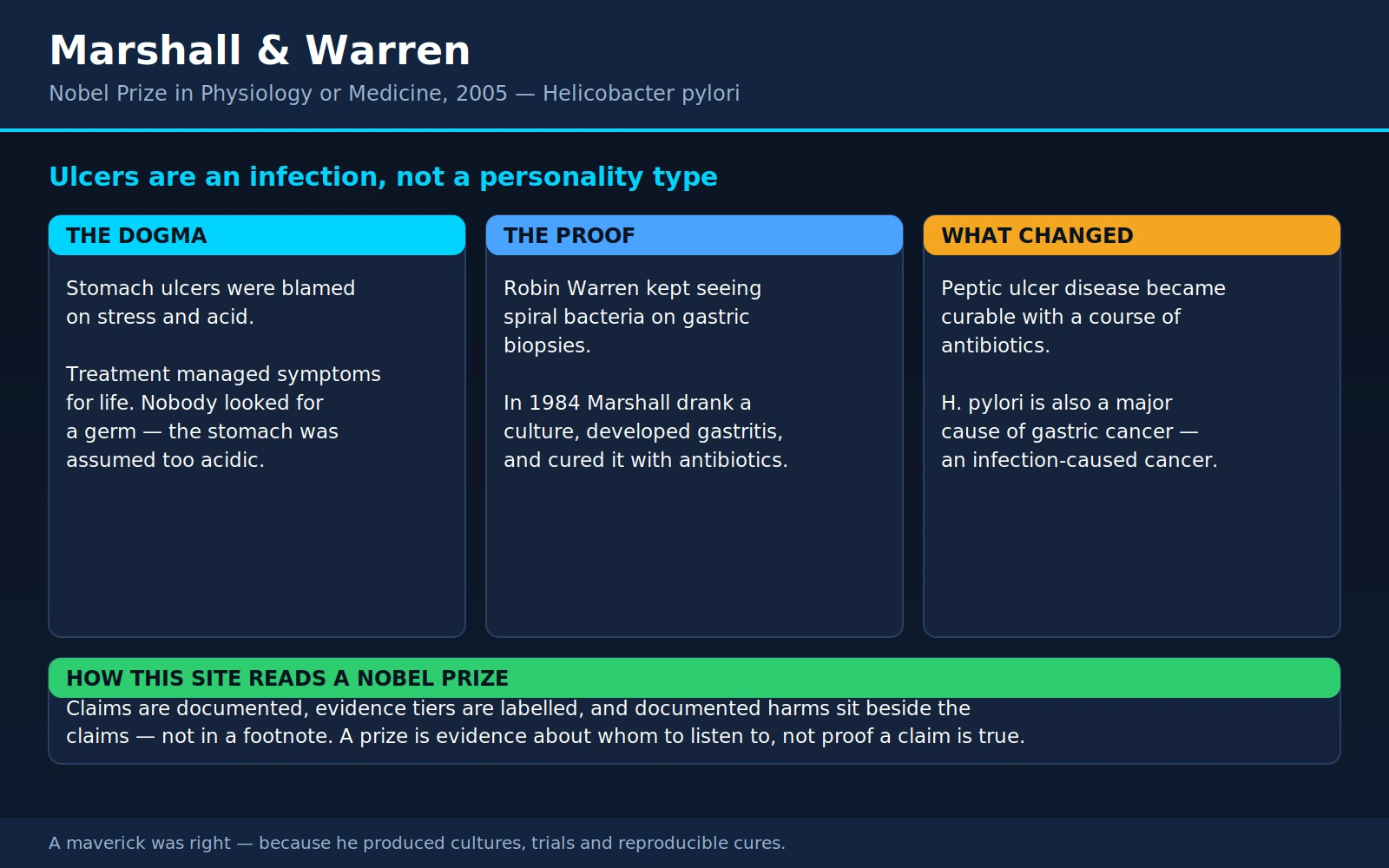
Table of Contents
- Overview
- The Dogma They Broke
- Warren's Spirals
- Marshall Joins
- The Famous Self-Experiment
- From Ridicule to Guidelines
- The 2005 Nobel Prize
- What It Means for Readers Today
- The Lesson About Medical Certainty
- Key Research Papers
- Live PubMed Searches
- Connections
- Featured Videos
1. Overview
J. Robin Warren (born 1937), a pathologist at Royal Perth Hospital in Western Australia, and Barry J. Marshall (born 1951), a young physician who joined him, together proved something the medical world was certain was impossible: that a spiral-shaped bacterium — now called Helicobacter pylori — lives in the human stomach and causes most stomach and duodenal ulcers, along with the chronic gastritis that precedes them.
Before their work, ulcers were treated as a lifelong condition of stress, diet, and excess acid — managed, never cured. After their work, most ulcers became a curable infection, treated with a short course of antibiotics. For this discovery the two shared the 2005 Nobel Prize in Physiology or Medicine. This page is often filed under Marshall's name because his self-experiment made him the public face of the story, but the discovery was a genuine partnership from the first day: Warren saw the bacteria first, insisted they were real, and supplied the pathology that anchored everything that followed. Neither half of the story works without the other.
The story matters on this site for a second reason. It is medicine's cleanest modern example of a ridiculed idea that turned out to be right — and of why it won. Warren and Marshall did not defeat the consensus with confidence or charisma. They defeated it with biopsies, cultures, a controlled trial, and a cure that any hospital in the world could reproduce. That distinction — between being dismissed and being right — is the lesson the whole page builds toward.
2. The Dogma They Broke
For most of the twentieth century, everyone — doctors, textbooks, patients, comedians — knew what caused ulcers: stress, spicy food, alcohol, and too much stomach acid. The ulcer patient of popular imagination was the harried executive with a bottle of antacids in his desk drawer. The guiding rule of ulcer medicine was a dictum coined in 1910: “no acid, no ulcer.” If acid burned the hole, then treatment meant fighting acid — forever.
And that is exactly how ulcers were treated:
- Antacids and milk-based diets, taken for years or decades, easing pain without healing anything permanently.
- Acid-blocking drugs — cimetidine and ranitidine arrived in the late 1970s and became some of the best-selling drugs on Earth, precisely because ulcer patients had to keep taking them. Stop the drug, and the ulcer usually came back.
- Major stomach surgery for severe or bleeding ulcers — cutting the vagus nerve to reduce acid signals, or removing part of the stomach outright. These operations carried real mortality and left many patients with lifelong digestive problems.
- Stress management, prescribed on the theory that personality and worry drove the disease.
Underneath it all sat one assumption so obvious nobody thought to test it anymore: the stomach is sterile. Stomach acid is strong enough to dissolve meat — of course bacteria could not live there. A handful of pathologists had reported spiral organisms in stomachs as far back as the 1890s, but a large and influential American biopsy study in 1954 examined more than a thousand patients, found no bacteria, and declared the earlier sightings contamination. The study had used the wrong stain — the organisms are nearly invisible without silver staining — but its conclusion hardened into fact. For the next generation, a bacterium in the stomach was not a finding; it was a mistake.
3. Warren's Spirals
Robin Warren was a careful, self-described stubborn pathologist who trusted his microscope over his textbooks. In June 1979, examining a routine gastric biopsy at Royal Perth Hospital, he noticed a thin blue line of curved, spiral bacteria lying on the surface of the stomach lining. According to everything he had been taught, they could not be there. He looked again. They were there.
Over the next two years Warren kept finding the same organisms on biopsy after biopsy, especially once he used silver staining, which makes the spirals stand out dramatically. And he noticed something more important than the bacteria themselves: wherever the bacteria appeared, the tissue underneath was inflamed — a pattern called active chronic gastritis — and where the bacteria were absent, the stomach lining usually looked healthy. Contamination does not behave like that. Contamination scatters at random; these organisms tracked disease.
His colleagues were unmoved. The bacteria were dismissed as contamination, as harmless passengers, or as organisms that had drifted in after death of the tissue — anything but a cause of disease. Warren later described showing his slides to physicians who simply were not interested, because everyone knew the stomach was sterile. He kept collecting cases anyway, building a file of patients whose biopsies carried the spirals, waiting for a clinician curious enough to look at the living patients behind the slides.
4. Marshall Joins
That clinician arrived in 1981: Barry Marshall, a 30-year-old physician in training who needed a research project and was handed, almost as an afterthought, the pathologist with the strange bacteria list. Marshall was not a gastroenterologist and had no stake in the acid theory — which may be exactly why he could take Warren's slides at face value. The two hit it off, reviewed Warren's collected cases together, and designed a proper study.
In 1982 they ran it: biopsies from 100 consecutive patients coming through the endoscopy unit, with Warren reading the pathology and Marshall recording each patient's clinical picture, blinded to each other's findings until the end. The spiral bacteria turned up in 58 of the 100 patients — and when the codes were broken, the pattern was striking: the organism was present in almost every patient with active chronic gastritis, duodenal ulcer, or gastric ulcer.
Meanwhile they were trying to grow the thing, and failing. The microbiology lab treated the samples like Campylobacter, a related-looking gut bacterium, and discarded culture plates if nothing appeared within two days. Plate after plate went into the bin. Then came the Easter holiday of 1982: plates set up just before the long weekend were left in the incubator for five days instead of two, because the lab was closed. When staff returned, small transparent colonies were waiting — the first culture of a bacterium no one had ever grown. The organism was simply a slow grower, and every previous attempt had been thrown away too early. It was provisionally named Campylobacter pyloridis, later corrected to Campylobacter pylori, and in 1989 — once genetic analysis showed it belonged to no existing genus — renamed Helicobacter pylori.
Warren and Marshall announced the finding in two back-to-back letters in The Lancet in 1983, and published the full 100-patient series there in 1984, arguing that the bacterium “may be an important factor in the aetiology of these diseases.” The reception ranged from indifference to open ridicule. A bacterial cause of ulcers sounded, to most of the field, like saying a germ caused heartbreak — and Marshall, young, blunt, and absolutely certain, did not soften the message. Skeptics reasonably pointed out that association is not causation: perhaps the bacteria were merely moving into tissue already damaged by acid. Answering that objection required showing the organism could make a healthy stomach sick.
5. The Famous Self-Experiment
The honest way to prove a germ causes a disease is laid out in the classical rules known as Koch's postulates: find the organism in the disease, grow it in pure culture, give it to a healthy host, watch the disease appear, and recover the organism again. Warren and Marshall had the first two. But H. pylori infects humans, and baby pigs and rats stubbornly refused to catch it. There was only one healthy host available whose consent was not in question.
So in 1984, Barry Marshall — after a baseline endoscopy confirmed his own stomach was healthy and free of the organism — drank a culture of H. pylori grown from a patient, choosing a strain that was known to be sensitive to antibiotics so he had a way out. He told almost no one in advance, including his wife.
For a few days, nothing. Then came bloating, loss of appetite, and early-morning vomiting — curiously acid-free vomiting, as the infection had switched off his stomach's acid production — along with the memorably bad breath his family reported. A repeat endoscopy with biopsies about ten days in showed exactly what he had gambled on: acute gastritis, with spiral bacteria colonizing his previously healthy stomach lining. The organism had been swallowed, had infected him, and had been recovered from the inflamed tissue. He then took a course of antibiotics, and the illness resolved.
Two things about this famous story are worth stating precisely, because retellings inflate it. First, Marshall gave himself gastritis, not an ulcer. The experiment demonstrated that the bacterium infects a healthy stomach and directly causes the inflammation that Warren had always seen beneath it — the soil in which ulcers grow — not a full ulcer itself, which typically takes sustained infection over years. Second, he did not tough it out indefinitely — he documented the infection, then treated it. The experiment, published in 1985 with the plainly honest title “Attempt to fulfil Koch's postulates for pyloric Campylobacter,” was a calculated, bounded demonstration, not a stunt — though it was certainly also a message to a profession that had stopped listening.
6. From Ridicule to Guidelines
Even after the self-experiment, acceptance took the better part of a decade — and it came the only way it ever legitimately comes: through replication. Laboratories around the world began finding the same organism in their own patients, at the same striking rates. The associations held everywhere anyone looked.
The decisive evidence was therapeutic. If the bacterium caused ulcers, then killing the bacterium should not just heal ulcers but keep them from coming back — something no acid-blocking drug had ever achieved. In a 1988 double-blind trial in The Lancet, Marshall, Warren, and colleagues followed 100 duodenal ulcer patients for a year: where the organism persisted, 84% of ulcers relapsed; where it had been eradicated, only 21% did. In 1993, an independent Austrian trial in the New England Journal of Medicine made the point unanswerable: twelve days of antibiotics alongside standard acid suppression, and among patients in whom H. pylori was actually eradicated, ulcers recurred in 2% within a year — versus 85% of those in whom the infection persisted. Chronic, relapsing ulcer disease was not being managed anymore. It was being cured.
The institutions then did what institutions do, slowly and then all at once. In 1994 a United States NIH consensus conference recommended antibiotic eradication therapy for ulcer patients infected with H. pylori — the official end of the pure acid model. The same year, the WHO's International Agency for Research on Cancer classified H. pylori as a class I (definite) human carcinogen for stomach cancer, the first bacterium ever placed in that category. Long-term studies bore the classification out: in a prospective Japanese study published in 2001, gastric cancer developed over roughly eight years of follow-up in 2.9% of H. pylori-infected patients — and in none of the uninfected. Through the 1990s, “test and treat” entered mainstream guidelines: test the dyspeptic patient for the infection, and if it is there, eradicate it. What had been career-endangering heresy in 1983 was, by the late 1990s, the standard of care taught to every medical student.
7. The 2005 Nobel Prize
In October 2005, the Karolinska Institute awarded the Nobel Prize in Physiology or Medicine jointly to Barry J. Marshall and J. Robin Warren “for their discovery of the bacterium Helicobacter pylori and its role in gastritis and peptic ulcer disease.”
The committee's announcement was unusually pointed about why this discovery earned the prize. It praised the pair for the tenacity and prepared minds to challenge prevailing dogma — and it spelled out the paradigm shift in patient terms: thanks to their work, peptic ulcer disease is no longer a chronic, frequently disabling condition, but a disease that can be cured by a short regimen of antibiotics and acid inhibitors. The prize also honored the wider door the discovery opened: the realization that a supposedly hostile, sterile organ carries persistent bacterial life, that chronic low-grade infection and inflammation can smolder for decades before surfacing as “non-infectious” disease, and that a bacterium can set the stage for cancer.
There was a satisfying symmetry in the pairing itself: the prize went to a pathologist who believed his own eyes and a clinician who believed the pathologist — two ordinary hospital doctors in Perth, working without a famous institute behind them, who between them held the complete chain of evidence.
8. What It Means for Readers Today
This is the section Warren and Marshall would most want you to read, because their discovery only helps people who get tested.
- Persistent upper-abdominal pain deserves a test, not years of antacids. If you have recurring burning or gnawing pain in the upper abdomen, bloating, nausea, or ulcer-like symptoms that keep returning when treatment stops, ask your clinician about H. pylori testing. The standard options are simple: a urea breath test (you drink a harmless labeled solution and breathe into a collector — the bacterium's own urease enzyme betrays it), a stool antigen test, or a biopsy taken during endoscopy if you need one anyway. Self-treating dyspepsia with antacids for years, exactly as patients did before 1983, means an infection — if one is there — smolders on untreated.
- Tell your clinician what you already take. Acid-suppressing drugs (proton-pump inhibitors) and recent antibiotics or bismuth can hide the infection from breath and stool tests, so the timing of testing around those medicines matters — another reason this is a job to do with a clinician rather than around one.
- Eradication is short, and it is a prescription. Modern treatment is roughly one to two weeks of two or more antibiotics plus an acid suppressor, chosen by a clinician who knows the local antibiotic-resistance picture, usually with a follow-up test to confirm the infection is gone. It is not a supplement protocol, and no supplement is a substitute for it.
- Not every ulcer is H. pylori. The other major cause is regular use of NSAIDs and aspirin, which undermine the stomach's protective mucus lining. If you take these daily — especially low-dose aspirin plus an occasional ibuprofen on top — that combination, with or without the bacterium, is the modern ulcer recipe, and it is worth an explicit conversation with your doctor.
- Alarm symptoms mean now, not later. Vomiting blood or material that looks like coffee grounds, black tarry stools, unintentional weight loss, worsening trouble swallowing, persistent vomiting, or unexplained anemia and fatigue are not “wait and see” symptoms. They can signal a bleeding ulcer or, rarely, a stomach cancer, and they mean medical evaluation immediately.
9. The Lesson About Medical Certainty
The Marshall–Warren story is told constantly — and, on much of the internet, told wrong. The wrong version goes: the experts laughed at them, the experts were wrong, therefore laugh-worthy ideas are probably right and expert consensus is probably wrong. Every seller of a miracle cure loves that version, because it casts ridicule itself as evidence.
Look at what actually happened. Warren and Marshall were not vindicated because they were mavericks. They were vindicated because they out-evidenced the consensus at every step: stained biopsies anyone could re-examine, a 100-patient blinded series, a cultured organism any lab could grow, a human demonstration of infection, and finally randomized trials — their own and, more importantly, other people's — showing that killing the bacterium cured the disease. Every claim they made was specific, testable, and falsifiable, and when tested by independent skeptics, it held. The system was embarrassingly slow, and the two men paid real career costs for about a decade. But the same evidence-demanding machinery that stalled them is also what ultimately crowned them — roughly twenty years from first observation to Nobel Prize, which is painful, but is not forever.
Now run the comparison this site keeps returning to. Linus Pauling was a far more celebrated scientist than either Australian, and just as convinced he had found a revolutionary cure. But when his biggest medical claims — megadose vitamin C against cancer and the common cold — went into randomized trials, they failed, and the claims did not change in response. Same outsider posture, same establishment resistance, opposite evidential outcome. The moral of Marshall and Warren is not “trust the maverick” and it is certainly not “distrust the maverick.” It is: ignore the posture entirely and ask what survives testing. Being dismissed is a circumstance. Producing cultures, trials, and reproducible cures is an argument. Only the second one ever changed medicine.
10. Key Research Papers
- Warren JR, Marshall B. Unidentified curved bacilli on gastric epithelium in active chronic gastritis. Lancet 1983;1(8336):1273-5
- Marshall BJ, Warren JR. Unidentified curved bacilli in the stomach of patients with gastritis and peptic ulceration. Lancet 1984;1(8390):1311-5
- Marshall BJ, Armstrong JA, McGechie DB, Glancy RJ. Attempt to fulfil Koch's postulates for pyloric Campylobacter. Med J Aust 1985;142(8):436-9
- Marshall BJ, Goodwin CS, Warren JR, Murray R, et al. Prospective double-blind trial of duodenal ulcer relapse after eradication of Campylobacter pylori. Lancet 1988;2(8626-8627):1437-42
- Hentschel E, Brandstätter G, Dragosics B, Hirschl AM, et al. Effect of ranitidine and amoxicillin plus metronidazole on the eradication of Helicobacter pylori and the recurrence of duodenal ulcer. N Engl J Med 1993;328(5):308-12
- Uemura N, Okamoto S, Yamamoto S, Matsumura N, et al. Helicobacter pylori infection and the development of gastric cancer. N Engl J Med 2001;345(11):784-9
11. Live PubMed Searches
- Helicobacter pylori and ulcer
- H. pylori eradication therapy
- Urea breath test
- H. pylori and gastric cancer
- H. pylori antibiotic resistance
Connections
- All Notable Doctors
- Gastroenterology — the specialty their discovery rebuilt
- Bacteria — the site's guide to the organisms behind infectious disease
- Gut Healing — supportive approaches for the digestive tract
- Betaine HCl — a supplement taken to raise stomach acid; the H. pylori story is essential context for any acid-focused view of stomach trouble
- Aspirin — with other NSAIDs, the other major cause of ulcers
- Alexander Fleming — the antibiotics era that made ulcer eradication possible
- Linus Pauling — the contrasting case: a maverick whose biggest claims failed testing