Alexander Fleming: Penicillin, Lysozyme, and the Antibiotic Age
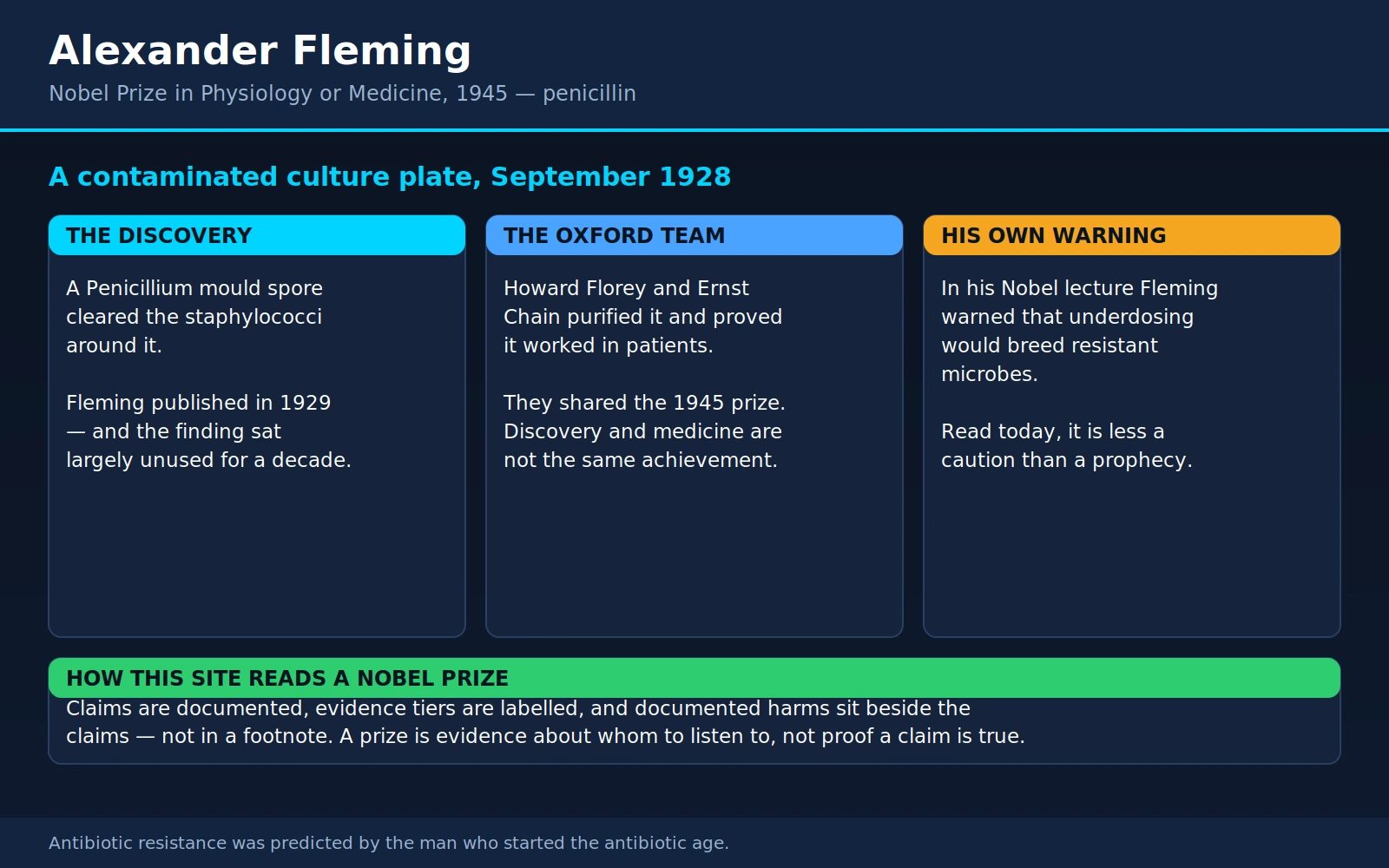
Table of Contents
- Overview
- From Ayrshire to St Mary's
- Lysozyme, 1922 — the Body's Own Antibacterial
- The Plate, September 1928
- The Decade in the Drawer
- Oxford Makes It a Medicine
- The 1945 Nobel Prize and the Resistance Warning
- Myths — Churchill, the Lone Genius, and Pure Luck
- Antibiotics and You Today
- Key Research Papers
- Connections
- Featured Videos
1. Overview
Sir Alexander Fleming (1881–1955) was a Scottish bacteriologist who spent nearly his whole career in one London laboratory — and who, in September 1928, noticed something on a contaminated culture plate that most people would have rinsed down the sink. A stray mold had landed on a dish of staphylococci, and around the mold the bacteria were dead. That observation became penicillin, penicillin became the first true antibiotic, and the antibiotic age — the era in which an infected scratch stopped being a death sentence — began on his cluttered bench.
The real story is better than the legend, and more honest. Fleming discovered penicillin, described it carefully, and then largely set it aside; it took a team at Oxford — Howard Florey, Ernst Chain, and their colleagues — to turn a temperamental mold juice into a medicine a decade later. The three men shared the 1945 Nobel Prize in Physiology or Medicine for it. Fleming was also the discoverer of lysozyme, the body's own antibacterial enzyme, found in tears and saliva — the earlier discovery that trained his eye to recognize what the famous plate was showing him. And, remarkably, he used his own Nobel lecture to warn the world about antibiotic resistance — describing, in 1945, almost exactly the problem hospitals fight today.
This page tells the whole arc plainly: the farm boy who became a scientist, the two accidental discoveries, the decade of neglect, the Oxford rescue, the warning nobody heeded soon enough — and what all of it means for the antibiotics in your own medicine cabinet. Fleming died of a heart attack in 1955; his ashes rest in St Paul's Cathedral.
2. From Ayrshire to St Mary's
Fleming was born on 6 August 1881 at Lochfield, a hill farm near Darvel in Ayrshire, Scotland, the third of four children of his father's second marriage. His father died when Alexander was seven. A farm boyhood — roaming moorland, watching animals, noticing things — was, he later felt, his first scientific training. At about thirteen he moved to London to live with an older brother, worked four dull years as a shipping clerk, and then a small inheritance from an uncle made medical school possible. He chose St Mary's Hospital Medical School in Paddington — by his own cheerful account, mainly because he had once played water polo against its team. He qualified in 1906, and in another accident of history, St Mary's rifle club wanted to keep its best shot at the hospital — so he was steered into a research job in the Inoculation Department of the formidable vaccine pioneer Sir Almroth Wright. He stayed in that department for the rest of his working life, nearly fifty years.
The First World War gave Fleming his defining early lesson. Serving as a Royal Army Medical Corps captain in Wright's wound-research laboratory — set up in a converted casino in Boulogne, France — he studied why soldiers' deep shrapnel wounds went so catastrophically septic despite being flushed with strong chemical antiseptics like carbolic acid. Standard doctrine said: stronger antiseptic, better outcome. Fleming built glass models of jagged wounds and showed the doctrine was backwards in deep injuries: the antiseptic never reached bacteria hidden in the crevices, but it efficiently killed the white blood cells — the body's own defenders — in the wound. A harsh antiseptic could leave a deep wound more infected than gentle cleaning and saline did. (Chemical antimicrobials of that pre-antibiotic era — carbolic, iodine, and silver preparations — were all the medicine had.) Army practice was slow to change, but the lesson stuck with him for life: test what a treatment does to the patient's defenses, not just what it does to germs in a dish — evidence over dogma. Both of his great discoveries flow from that habit of respecting the body's own protective machinery.
3. Lysozyme, 1922 — the Body's Own Antibacterial
In late 1921, Fleming — suffering a head cold — let a drop of his own nasal mucus fall onto a culture plate. As his assistant later told the story, the result days later was startling: where the mucus had landed, bacterial colonies were dissolving. Fleming chased the effect and found the cause: an enzyme, present in human tears, saliva, nasal mucus, skin, and breast milk, and spectacularly abundant in egg white, that ruptures the cell walls of certain bacteria. Wright named it lysozyme — the dissolving enzyme — and Fleming published it in 1922. The laboratory scenes were pure Fleming: volunteers sniffing lemon to donate tears, and a test bacterium chosen precisely because it dissolved so dramatically.
Lysozyme mattered for two reasons. Scientifically, it was hard proof that the body carries built-in chemical weapons against bacteria — what we now call innate immunity, the standing defenses you have before any vaccine or illness (the theme of our Immune Boosting section). It is part of why intact saliva and mucus matter so much to the balance of microbes in your mouth (see Oral Microbiome). Personally, it rehearsed Fleming for 1928: he had already lived through the experience of a chance landing on a culture plate revealing something that kills bacteria — and had learned to investigate instead of discard.
Why didn't lysozyme become a drug? Honest answer: it is strongest against relatively harmless bacteria and much weaker against the dangerous ones like staphylococci and streptococci — the microbes that co-evolved with us learned to resist it long ago. And in the 1920s no one could purify or concentrate it into anything usable. So lysozyme remained a scientific landmark rather than a therapy — today it earns its keep as a natural food preservative and as a cornerstone of immunology. But it kept Fleming looking for something with lysozyme's selectivity — deadly to germs, gentle to human cells — and six years later, something exactly like that drifted in through the window of opportunity.
4. The Plate, September 1928
In the summer of 1928 Fleming, newly appointed professor of bacteriology, was studying staphylococci — the pus-forming bacteria behind boils, wound infections, and worse. Before leaving for a family holiday in Suffolk he stacked used culture plates on the bench. He returned on 3 September 1928 and was sorting the pile — most of it destined for cleaning — when he looked twice at one plate. A blob of Penicillium mold had contaminated it, and around the mold lay a clear moat where the staphylococcal colonies had died and dissolved; farther away, colonies grew normally. His visitor that morning recalled Fleming's entire recorded reaction: “That's funny.”
What he did next is why he deserves the credit: he rescued the mold, grew it in broth, and found that the golden “mould juice” stopped many disease-causing bacteria at astonishing dilutions. In March 1929 he named the active broth penicillin, and in June 1929 he published his results in the British Journal of Experimental Pathology. How the miracle plate happened has been carefully reconstructed by later historians (most notably bacteriologist Ronald Hare): the spores almost certainly drifted up from a mycology lab one floor below, where molds were being collected for allergy research, and an unusual cool spell in London that August let the mold establish before the staphylococci grew — a sequence so improbable that Hare struggled for years to re-create the plate on purpose. The mold itself was misidentified at first; it is recorded in history as Penicillium notatum, and modern genome analysis calls the strain Penicillium rubens. None of that reconstruction was known at the time — label it for what it is, careful detective work done decades later.
What the 1929 paper showed:
- Selective killing. The broth stopped staphylococci, streptococci, pneumococci, and the germs of diphtheria, gonorrhea and meningitis — while typhoid and most gut bacteria grew straight through it.
- Gentleness to the body. Injected into a mouse and a rabbit, the broth caused no harm, and it did not impair the work of white blood cells — the exact test his WWI antiseptic research had taught him to run, and the exact property carbolic acid had failed.
- A practical lab trick. Because B. influenzae (today's Haemophilus influenzae) was untouched by penicillin, the broth made a perfect selective medium for isolating it — that workaday use is in the paper's title.
What he did not show — and being clear about this is not diminishing him, it is history: he never purified penicillin (it remained a raw, unstable broth), never proved it could survive in the body long enough to work, never cured an infected animal with it (that decisive experiment came later, at Oxford), and never ran a clinical trial. A few surface infections were treated with crude filtrate by people in his orbit — a colleague's infected sinus, and a former student who quietly cured several eye infections with it in 1930–31 without publishing — but nothing systematic. Penicillin in 1929 was a phenomenon, not a medicine.
5. The Decade in the Drawer
Why did the most important drug of the twentieth century then sit essentially unused for ten years? Several honest reasons, and they compound each other:
- It was unstable. The activity faded from the broth within days. A medicine that evaporates from under you is barely a medicine at all.
- It was absurdly dilute. Gallons of broth held only traces of the active substance, and nobody knew what the substance even was.
- Fleming had no chemists. Two junior colleagues made real progress concentrating it, then left the department; in 1932 a professional biochemistry team led by Harold Raistrick tried, watched the activity vanish repeatedly during extraction, and moved on. Penicillin the chemical defeated everyone who touched it in the 1930s.
- Sulfa drugs arrived. From 1935 the sulfonamides — the first pills and injections that genuinely cured systemic bacterial infections — swept through medicine and absorbed the world's attention. The itch penicillin might have scratched suddenly seemed scratched.
- Fleming himself moved on. This is the part the legend airbrushes, and it shouldn't: he kept using penicillin mainly as a lab reagent for isolating B. influenzae, mentioned it occasionally in papers and lectures, and did not mount a campaign to develop it. He was a superb observer who did not have — and knew he did not have — the chemistry or the institutional machinery the problem needed.
What he did do, faithfully, for the whole decade, turned out to matter enormously: he kept the mold alive and gave subcultures to any laboratory that asked. The culture growing at Oxford in 1938 was a descendant of Fleming's freely shared strain. Generosity with materials is an undramatic scientific virtue, and in this story it saved millions of lives.
6. Oxford Makes It a Medicine
In 1938, at Oxford's Sir William Dunn School of Pathology, the Australian pathologist Howard Florey and the biochemist Ernst Chain — a Jewish refugee from Nazi Germany — began a systematic study of natural antibacterial substances. They started, fittingly, with Fleming's lysozyme; combing the literature for more, Chain found the 1929 penicillin paper. With the quietly indispensable Norman Heatley — the team's practical genius, who devised the assay, the extraction trick that finally stabilized penicillin, and the culture vessels — they achieved in two years what the 1930s could not: penicillin concentrated, dried, and stable enough to test.
On 25 May 1940 came the experiment Fleming never ran. Eight mice were injected with lethal streptococci; four also received penicillin. By morning the four untreated mice were dead and the four treated mice were alive. That clean, brutal result — published in The Lancet in August 1940 — is the moment penicillin became a medicine-in-waiting. The first patient followed on 12 February 1941: Albert Alexander, a 43-year-old Oxford policeman dying of mixed staphylococcal and streptococcal sepsis that had consumed his face and cost him an eye. On penicillin he improved so dramatically that the team scarcely believed it — fever falling, abscesses healing — while they scrambled to extract unused penicillin from his own urine and re-inject it; Florey is said to have compared it to filling a bath with the plug out. After about five days the penicillin was simply gone. Alexander relapsed and died on 15 March 1941. The famous detail that he had scratched his face on a rose thorn is a later embellishment, repeated for decades because it made a prettier story — accounts traced through his family indicate his injury came during a German bombing raid. The tragedy taught two permanent lessons: penicillin worked in a dying human, and running out of antibiotic mid-treatment can be fatal — remember that when you meet Fleming's Nobel warning below. The next patients, several of them children needing smaller doses, recovered.
Then came production — arguably the most heroic and least famous part of the whole story. The Dunn School turned itself into a mold farm: penicillin brewed in hospital bedpans, milk churns, a bathtub, and finally custom ceramic vessels, tended by a hired team of “penicillin girls.” Wartime Britain's industry, under bombardment, could not scale it, so in mid-1941 Florey and Heatley flew to the United States. At a government lab in Peoria, Illinois, corn-steep liquor — a cheap corn-milling by-product — multiplied the yields; a worldwide hunt for better molds was won, in perfect Fleming style, by a moldy cantaloupe from a Peoria market; and American industry developed deep-tank fermentation and mass production under the War Production Board. By D-Day, 6 June 1944, there was enough penicillin for every wounded Allied soldier; by the war's end it was reaching civilians, and the price of the once-priceless had collapsed toward pennies a dose. Fleming, for his part, watched the Oxford work with delight — on his 1940 visit he is said to have remarked that he'd come to see what they'd done with his old penicillin — and in 1942 he treated a friend's meningitis at St Mary's with penicillin supplied by Florey; the recovery made the London press, which crowned Fleming the lone hero while publicity-averse Oxford stayed silent. The imbalance in fame dates from exactly there.
7. The 1945 Nobel Prize and the Resistance Warning
In 1945 the Nobel Prize in Physiology or Medicine was shared equally three ways — Fleming, Chain, and Florey, “for the discovery of penicillin and its curative effect in various infectious diseases.” The three-way split was justice in miniature: discovery, chemistry, and proof each honored. Fleming had been knighted the year before; characteristically, he spent his fame deflecting it — he liked to say that nature made penicillin and he only found it.
What makes his Nobel lecture of 11 December 1945 read like prophecy is its ending. With the world celebrating a miracle cure, Fleming chose to warn about misusing it. From the lecture: “It is not difficult to make microbes resistant to penicillin in the laboratory by exposing them to concentrations not sufficient to kill them, and the same thing has occasionally happened in the body.” And, looking ahead to over-the-counter availability: “The time may come when penicillin can be bought by anyone in the shops. Then there is the danger that the ignorant man may easily underdose himself and by exposing his microbes to non-lethal quantities of the drug make them resistant.” He even sketched a little parable — in the lecture, a Mr. X with a sore throat dosed himself with too little penicillin, killing none of his streptococci but teaching them resistance; his wife then caught the hardened strain, and penicillin could not save her pneumonia. Fleming laid the moral responsibility for her death on the careless underdoser, and closed the passage with his rule: if you use penicillin, use enough.
He was not speculating. Resistance had shadowed penicillin from before its first patient: in 1940 — the same year as the mouse experiment — Abraham and Chain reported a bacterial enzyme, penicillinase, that destroys penicillin outright. And modern genetics has deepened the point in a way Fleming would have relished: a 2022 study in Nature found that the resistance mechanism behind a major MRSA lineage was already circulating in hedgehog skin bacteria some two centuries before hospitals used such drugs — driven by a mold on hedgehog skin making its own natural penicillin-family antibiotic. Bacteria have been fighting chemical wars far longer than we have; our antibiotics joined an ancient arms race. That is exactly why careless use squanders them so quickly — the countermeasures are already out there, waiting to be selected for.
8. Myths — Churchill, the Lone Genius, and Pure Luck
Myth 1: Fleming saved Winston Churchill — twice. A beloved story says that Fleming's farmer father rescued the boy Churchill from drowning in Scotland, that Churchill's grateful father then paid for young Fleming's education, and that the debt was repaid when Fleming's penicillin saved Churchill from pneumonia in the Second World War. It is a moral fable, not history, and it has been thoroughly debunked — there is no record of any rescue, the biographical details do not line up, and Churchill's famous 1943 pneumonia at Carthage was treated by his physician Lord Moran with sulfa drugs (the newspapers of the day credited “M&B,” a sulfonamide), not penicillin. Fleming himself, sent a version of the tale, called it a “wondrous fable.” It still circulates in chain emails and inspirational speeches; you now know better.
Myth 2: Fleming single-handedly gave the world penicillin the medicine. He gave the world the discovery and the published observation — a genuine, permanent achievement. But penicillin the drug was made by Florey, Chain, Heatley, and the Oxford team, and scaled by American industrial science. The wartime press, and St Mary's talent for publicity, built the one-man legend while Oxford declined interviews; the Nobel committee, honoring three men, knew better. So did Fleming, who said so plainly and often. If one name in this story is unjustly obscure, it is Norman Heatley — no Nobel, and without him no stable penicillin in 1940.
Myth 3: It was all just luck. The mold was luck — a once-in-history collision of a stray spore, a stacked plate, and cooperative weather. What happened next was not. The man looking at that plate had spent two decades studying the body's defenses against bacteria, had discovered lysozyme from an almost identical accident six years earlier, and had trained himself to investigate anomalies rather than bin them. Countless technicians before 1928 threw away moldy plates. Pasteur's maxim — that chance favours the prepared mind — is quoted in nearly every telling of this story because there has never been a cleaner example of it.
9. Antibiotics and You Today
Fleming's discovery still saves lives daily, and his warning is now a daily clinical reality. Here is what both mean for you, practically and without alarm:
- Antibiotics kill bacteria — they do nothing against viruses. Colds, influenza, and most sore throats, coughs, and short-lived sinus and ear infections are viral. An antibiotic taken for a virus cannot shorten your illness by a single hour; it can only give you side effects and train your resident bacteria toward resistance. When a bacterial infection is the real diagnosis — strep throat, a urinary tract infection, bacterial pneumonia — antibiotics remain genuinely lifesaving. Right tool, right job.
- Resistance is a present-day fact, not a future worry. Resistant infections such as MRSA (resistant staph) are in hospitals and communities now. The pressure driving resistance comes from overuse and misuse in both human medicine and agriculture — a large share of the world's antibiotic tonnage goes to farm animals. Every unnecessary course, human or animal, adds selection pressure.
- Take antibiotics exactly as prescribed. This is Fleming's own Nobel-lecture rule in modern dress: the dose and duration are chosen to kill the infection, not to wound it and educate the survivors. Do not skip doses, do not stop early on your own judgment, and if a shorter course is appropriate — modern research is genuinely refining course lengths downward for many infections — let that be your prescriber's call, made with you, not a mid-course improvisation.
- Never take leftovers or someone else's antibiotics. Leftover antibiotics are the modern version of the underdosing Fleming warned about: usually the wrong drug, at the wrong dose, for an undiagnosed problem. Return them to a pharmacy take-back rather than keeping them “just in case.”
- Don't pressure your clinician — and ask questions instead. “Is this likely bacterial or viral? Is there a wait-and-see option?” are excellent questions that good clinicians welcome. Also mention any past penicillin reaction: many people who carry a “penicillin allergy” label turn out on formal testing not to be allergic, and shedding an incorrect label can give you back the best-fitting, gentlest drug family we have.
- Expect your gut to notice. Antibiotics cannot tell friend from foe: along with the infection, they disturb the trillions of helpful gut bacteria that digest food, make vitamins, and crowd out troublemakers. Loose stools during a course are common; a disrupted microbiome occasionally opens the door to C. difficile overgrowth — call your prescriber about severe or persistent diarrhea. Most microbiomes rebound over weeks to months, and you can support the recovery with fiber-rich and fermented whole foods; our Gut Healing section covers rebuilding the gut after antibiotics in detail.
The balance to keep: antibiotics are neither candy nor poison. They are a shared, exhaustible inheritance from Fleming's generation — used precisely, they still perform miracles; used carelessly, they stop working for everyone.
10. Key Research Papers
- Fleming A. On the antibacterial action of cultures of a penicillium, with special reference to their use in the isolation of B. influenzae. The original 1929 Br J Exp Pathol paper, via this indexed reprint: Bull World Health Organ 2001;79(8):780-90
- Fleming A. Classics in infectious diseases (1929 reprint). Rev Infect Dis 1980;2(1):129-39
- Abraham EP, Chain E. An enzyme from bacteria able to destroy penicillin. 1940 (reprinted). Rev Infect Dis 1988;10(4):677-8
- Chain E, Florey HW, Gardner AD, Heatley NG, Jennings MA, Orr-Ewing J, et al. The classic: penicillin as a chemotherapeutic agent. 1940 (the original Lancet paper, reprinted). Clin Orthop Relat Res 2005;439:23-6
- Hare R. New light on the history of penicillin. Med Hist 1982;26(1):1-24
- Fletcher C. First clinical use of penicillin. Br Med J (Clin Res Ed) 1984;289(6460):1721-3
- Ligon BL. Sir Howard Walter Florey — the force behind the development of penicillin. Semin Pediatr Infect Dis 2004;15(2):109-14
- Ventola CL. The antibiotic resistance crisis: part 1: causes and threats. P T 2015;40(4):277-83
- Lobanovska M, Pilla G. Penicillin's discovery and antibiotic resistance: lessons for the future? Yale J Biol Med 2017;90(1):135-45
- Larsen J, Raisen CL, Ba X, et al. Emergence of methicillin resistance predates the clinical use of antibiotics. Nature 2022;602(7895):135-41
Live PubMed Searches
- Penicillin discovery history
- Antibiotic resistance and stewardship
- Lysozyme antibacterial innate immunity
- Antibiotics and gut microbiome recovery
- Antimicrobial use in agriculture and resistance
Connections
- All Notable Doctors
- Bacteria — the organisms penicillin could and couldn't touch
- All Diseases — the conditions the antibiotic age transformed
- Immune Boosting — supporting the built-in defenses Fleming's lysozyme revealed
- Gut Healing — rebuilding the microbiome after a course of antibiotics
- Oral Microbiome — where salivary lysozyme stands guard
- Tu Youyou — fellow anti-infective Nobel laureate, who drew artemisinin from traditional medicine
- Silver Nanoparticles — a pre-antibiotic antimicrobial, then and now