 — May 13, 2026
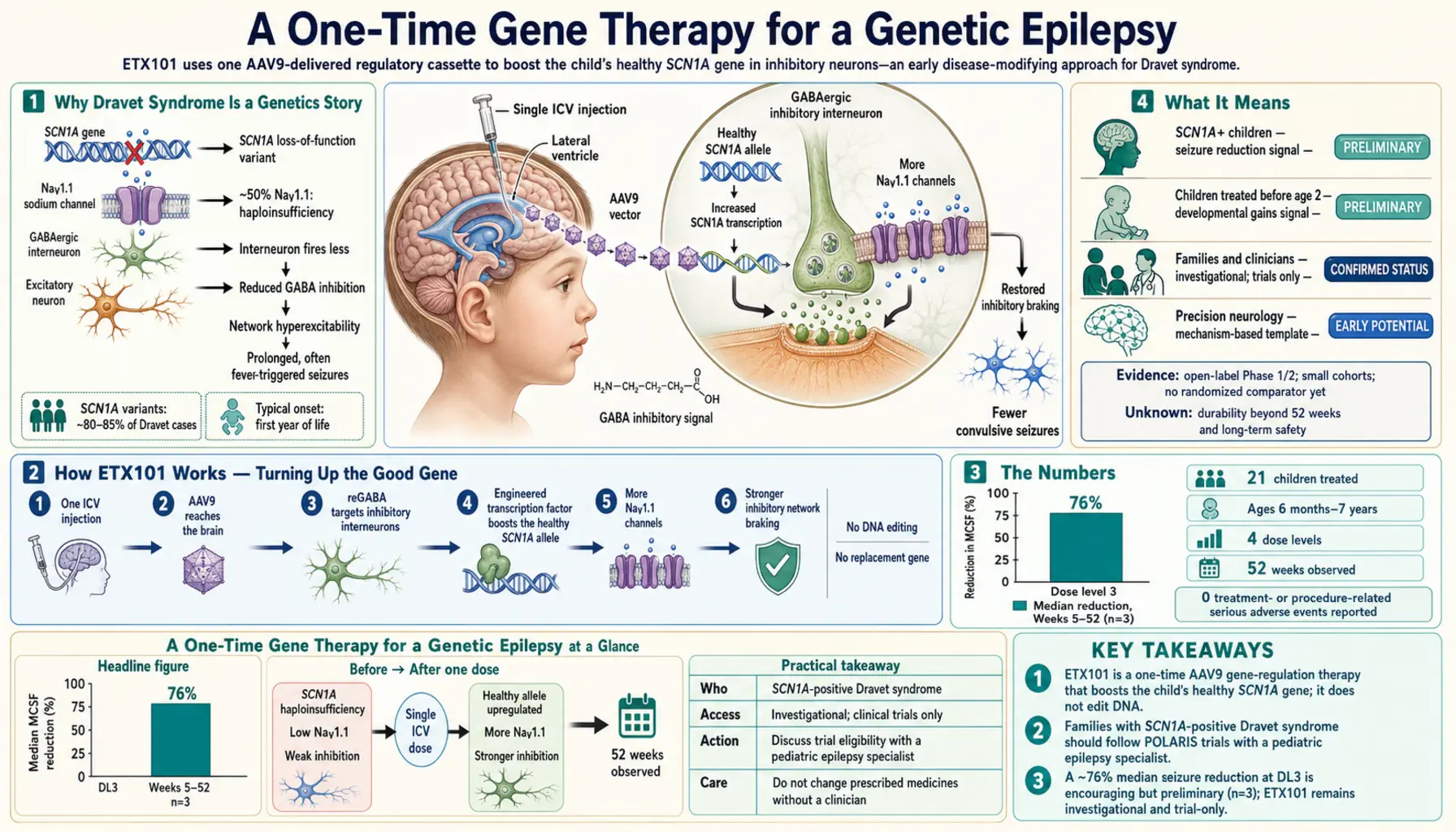
At the American Society of Gene & Cell Therapy (ASGCT) 2026 Presidential Symposium in Boston on May 13, 2026, the therapy’s developer reported interim results, with efficacy measured up to 52 weeks after dosing, for ETX101, an experimental one-time gene therapy for Dravet syndrome — a severe childhood epilepsy that is usually caused by a fault in a single gene, SCN1A. At the third of four dose levels, the three children analyzed had a median fall of about 76% in countable seizures from Week 5 to Week 52 after a single injection, and the developer reported gains in adaptive behavior and, in children treated before age two, in cognition. The studies are early, small and open-label (unblinded). The therapy is designed to correct the underlying shortage of a sodium channel in the brain’s inhibitory nerve cells, rather than only to suppress seizures.
Table of Contents
1. A One-Time Gene Therapy for a Genetic Epilepsy
ETX101 is being tested in the POLARIS program. Its first stage is three open-label, dose-escalation Phase 1/2 trials — ENDEAVOR Part 1 (United States), EXPEDITION (United Kingdom) and WAYFINDER (Australia) — which enroll children aged 6 months to 7 years who carry a predicted loss-of-function SCN1A variant. Trade-press coverage of the meeting abstract reported that 21 children had been dosed by January 26, 2026, across four escalating dose levels; the figures the developer released on May 13 used data through April 10, 2026. Each child received the therapy once, by a single intracerebroventricular (ICV) injection — a neurosurgical route that places the medicine directly into the fluid-filled spaces of the brain. Children entered the trials already taking at least one standard antiseizure medicine (a registry entry requirement), and the seizure results are measured on top of those medicines. The therapy is designed as a one-time, disease-modifying treatment aimed at the genetic shortfall itself.
2. Why Dravet Syndrome Is a Genetics Story
Dravet syndrome is a developmental and epileptic encephalopathy. In a 2011 review, Charlotte Dravet, who described the syndrome in 1978, gives its first sign as seizures beginning in the first year of life in an apparently normal infant — clonic or tonic-clonic, with or without fever, and often prolonged — followed by other seizure types and a slowing of developmental and cognitive skills. A 2026 review describes frequent drug-resistant seizures, cognitive and motor impairment, and an elevated risk of premature death, particularly from sudden unexpected death in epilepsy (SUDEP). In a 2011 series, 9 of 37 patients with Dravet syndrome (24.3%) met criteria for autism; in a 2019 cohort of children aged 24 months to 7 years, 11 (39%) had autism spectrum disorder.
Most cases are caused by a loss-of-function variant in SCN1A, the gene that encodes the Nav1.1 sodium channel. Published estimates of the share vary: the 2011 review put the share confirmed by SCN1A testing at 70–80%, the trial investigators’ 2025 meeting abstract gives more than 90%, and the 2026 review gives over 95%. In a 2001 study of seven patients, every one carried a de novo (new, not inherited) SCN1A mutation. Because one of the two copies of the gene does not work, cells make too little of the channel — a state called haploinsufficiency. Nav1.1 is the main sodium channel behind the electrical firing of GABAergic inhibitory interneurons, the cells that hold brain activity in check. In a 2006 mouse study, losing one copy of the gene substantially reduced sodium current in inhibitory interneurons but not in excitatory neurons, and the authors concluded that this may cause the hyperexcitability that leads to epilepsy. Seizure medicines that block sodium channels are generally considered contraindicated in Dravet syndrome: lamotrigine worsened seizures in 17 of 21 patients in a 1998 series, and carbamazepine had no effect or aggravated seizures in all of the SCN1A-positive patients in a 2016 study. Phenytoin, also a sodium-channel blocker, is debated: it is often used to treat status epilepticus, and a 2022 case series describes four patients whose seizures improved on long-term phenytoin.
3. How ETX101 Works — Turning Up the Good Gene
SCN1A is too large to fit inside an AAV viral vector as a replacement gene: the developers’ 2022 preclinical paper gives its coding sequence as about 6 kb, against an AAV packaging capacity of 4.7 kb. So ETX101 does not add a new copy of the gene and does not edit DNA. It is a gene-regulation therapy: the AAV9 vector carries an engineered transcription factor (a zinc-finger protein designed to switch on SCN1A) under the control of a regulatory element that limits its expression mainly to GABAergic interneurons. The factor binds a conserved control region upstream of the start of the child’s own SCN1A gene and increases its transcription; according to the paper, the working copy then makes more functional Nav1.1, while the faulty copy, which the factor also binds, makes no stable working protein. The vector mainly stays in the cell nucleus as a separate, non-replicating piece of DNA (an episome) rather than becoming part of the genome, and the developers state that working through the cell’s own gene regulation is meant to limit off-target effects and guard against overexpression. How long the effect lasts, and its long-term safety, are not yet known.
4. The Numbers
All figures in this section come from the developer’s May 13, 2026 release (data through April 10, 2026); no confidence intervals or individual results were published with them. The developer described the antiseizure effect as dose-dependent. At dose level 3, the median reduction in monthly countable seizure frequency was approximately 76% from Week 5 through Week 52 after dosing, in three children; the WAYFINDER registry record defines countable seizures as generalized tonic-clonic or clonic seizures, focal motor seizures with clearly observable signs, bilateral tonic seizures and atonic seizures. For the top dose, dose level 4, the release gave no percentage: it described early data showing continued dose-dependent activity, strongest in the four children who did not receive sirolimus, an immunosuppressant drug, which the developer said is consistent with molecular and animal data showing that sirolimus dampens the therapy’s signal by reducing protein expression. Safety outcomes did not differ between children who received sirolimus and those who did not.
On development, the nine children who had reached 52 weeks showed improvements on the caregiver-interview Vineland Adaptive Behavior Scales, most notable in receptive and expressive communication and motor function, with progress also in self-care and social interaction. In children treated before age two, cognitive gains on the Bayley-4 scales were evident from Week 16 (11 children) and continued through Week 52 (4 children), and the developer describes their course as diverging from the stagnation recorded in its ENVISION natural-history study and as generally consistent with typical development. ENVISION is an observational study of 58 children with SCN1A-positive Dravet syndrome on usual care; its published reports describe a significant fall in the mean Bayley-III cognitive composite score by Month 12 (change −11.0 points, 95% CI −15.3 to −6.8) and monthly countable seizure frequency that rose with age despite approved medicines.
On safety, the developer reported no treatment- or procedure-related serious adverse events across all four dose levels. The most common treatment-related adverse events were transaminase (liver-enzyme) elevations, which the developer described as a known class effect of AAV vectors; they caused no symptoms and resolved in all participants.
5. Where the Approach Fits
A 2026 review of Dravet treatments notes that current treatments have mainly targeted seizure control without addressing the many associated conditions or the underlying molecular defect. It describes antisense oligonucleotides that aim to restore SCN1A expression, and gene therapy approaches, including engineered AAV vectors such as ETX101 and CRISPR-mediated transcriptional activation, that seek to modify the disease biology directly; challenges it says remain include long-term safety concerns, the broad range of severity between patients, and the efficacy and accessibility of advanced therapies. Its authors describe these advances as a shift from symptomatic treatment toward precision medicine. In ENVISION, communication delays appeared early and were independent of seizure burden, and its investigators concluded that the best window to prevent language and communication delay is before age 3. ETX101 is one of several approaches built around a single, well-characterized gene defect; this one aims to restore Nav1.1 in inhibitory interneurons.
6. Limits of the Evidence
These are interim Phase 1/2 data, with these limits:
- Small and unblinded. Twenty-one children dosed across four dose levels, in open-label studies; the headline seizure figure rests on three children. The developmental comparison is with a natural-history cohort (ENVISION, sponsored by the same developer), not a randomized placebo group — a weaker benchmark that cannot rule out expectation effects (the Vineland is a caregiver interview, and caregivers knew their child had been treated) or differences between the groups.
- The pivotal trial has not read out. The seizure-reduction figure comes from an open-label dose cohort, not from a controlled comparison. The pivotal ENDEAVOR Part 2 randomizes 30 children aged 6 months to under 4 years, two to one, to ETX101 or to a sham procedure with treatment delayed, double-blind through Week 52; its primary endpoint is the change in monthly countable seizure frequency, with Bayley-4 cognition as the key secondary endpoint. The developer announced on May 6, 2026 that the first child had been dosed; it expects enrollment to finish by the end of 2026 and initial data by the end of 2027.
- It is a neurosurgical procedure. ICV delivery is an invasive, one-time procedure that places the vector into the brain’s fluid-filled ventricles; the pivotal trial’s registry entry distinguishes surgical-site staff, who know which treatment a child received, from the blinded primary-site staff.
- Durability and long-term safety are unknown. The efficacy figures cover the first 52 weeks after dosing, and Dravet is lifelong. Whether a single dose holds for years or decades, and whether delayed effects emerge, is not yet known; the registered trials follow participants for years after dosing (an average of 5 years in the WAYFINDER record).
- Reduction is not freedom. A 76% median reduction is not the same as ending seizures; a median can hide children who responded little, and the release gave no individual results or range.
- Not approved. As of May 2026, ETX101 was investigational and available only within the trials. The FDA’s orphan-drug database lists an orphan designation, held by the therapy’s developer, for a non-replicating recombinant AAV9 vector designed to promote increased transcription of the SCN1A gene, for the treatment of Dravet syndrome, dated May 14, 2020, with the status “Not FDA Approved for Orphan Indication.” The developer also reports Breakthrough Therapy, Regenerative Medicine Advanced Therapy, Fast Track and Rare Pediatric Disease designations from the FDA, and an orphan designation from the European Medicines Agency; none of these is an approval.
7. Key Points
In open-label Phase 1/2 trials, a one-time therapy designed to increase expression of a child’s own SCN1A gene was followed by a median reduction of about 76% in countable seizures from Week 5 to Week 52 in the three children analyzed at dose level 3, and by developmental gains that the developer compares with a natural-history cohort it also sponsors. No treatment- or procedure-related serious adverse events were reported. The results are interim, small and unblinded; the randomized, sham-controlled ENDEAVOR Part 2, with initial data expected by the end of 2027, is designed to test the effect against a control group.
Since then (September 8, 2026): the developer reported that updated data presented at the 16th European Epilepsy Congress in Athens (data cutoff August 3, 2026) showed a median reduction in countable seizures of about 76% at dose level 3 (5 children) and about 60% at dose level 4 (9 children), from Week 5 through Week 52 or each child’s latest visit; among children who completed 52 weeks, the median reduction in Weeks 49–52 was about 79% at dose level 3 (3 children) and 89% at dose level 4 (5 children). It reported no treatment- or procedure-related serious adverse events with up to 117 weeks of follow-up, and treatment-related transaminase elevations in 7 of 21 children and low platelet counts (thrombocytopenia) in 3 of 21, all without symptoms and all resolved.
Sources
Primary Report and Coverage (May 2026)
- The therapy’s developer. New Clinical Data from POLARIS Phase 1/2 Trials of ETX101 Gene Therapy in Dravet Syndrome, ASGCT 2026 Presidential Symposium. Press release, May 13, 2026 (data cutoff April 10, 2026). BusinessWire · developer’s copy
- The therapy’s developer. To Present ETX101 Data in Dravet Syndrome at the 2026 ASGCT Presidential Symposium (presentation details; oral session Wednesday, May 13, 2026; meeting May 11–15, 2026, Boston). Press release, April 27, 2026. developer’s website
- The therapy’s developer. Doses First Patient in Pivotal Study of ETX101 for Dravet Syndrome (ENDEAVOR Part 2: 30 children aged 6 months to 4 years; enrollment and data timelines). Press release, May 6, 2026. developer’s website
- CGTLive. ETX101 Gene Therapy Shows Early Developmental, Seizure Benefits in Dravet Syndrome. May 13, 2026 (reports the meeting abstract’s data as of January 26, 2026, including the 21 children dosed). cgtlive.com
- Genetic Engineering & Biotechnology News (GEN). Gene Therapy ETX101 Improves Seizures and Neurodevelopment in Dravet Syndrome in Phase I/II. May 13, 2026. genengnews.com
Earlier Data (December 2025)
- NeurologyLive. Gene Therapy ETX101 Demonstrates Significant Effects on Seizure Reduction, Neurodevelopmental Outcomes in POLARIS Phase 1/2 Program. December 9, 2025 (data presented at the American Epilepsy Society 2025 meeting). neurologylive.com
- American Epilepsy Society. POLARIS Phase 1/2 Program: Interim Safety and Preliminary Efficacy Results of ETX101. Abstract 1.308, AES 2025 Annual Meeting (presented December 6, 2025; data through June 1, 2025). aesnet.org
Later Data (September 2026)
- The therapy’s developer. Presents Updated Data from POLARIS Phase 1/2 Trials of ETX101 Gene Therapy in Dravet Syndrome at the 16th European Epilepsy Congress. Press release, September 8, 2026 (data cutoff August 3, 2026). developer’s website
Trial Registration & Background
- ClinicalTrials.gov. ENDEAVOR: A Clinical Study to Evaluate the Safety and Efficacy of ETX101 in Infants and Children With SCN1A-Positive Dravet Syndrome (Part 1 open-label, United States; Part 2 randomized 2:1 against a sham procedure with delayed treatment). NCT05419492
- ClinicalTrials.gov. EXPEDITION: A Clinical Study to Evaluate the Safety and Efficacy of ETX101, an AAV9-Delivered Gene Therapy in Children With SCN1A-positive Dravet Syndrome (United Kingdom). NCT06283212
- ClinicalTrials.gov. WAYFINDER: A Clinical Study to Evaluate the Safety and Efficacy of ETX101, an AAV9-Delivered Gene Therapy in Children With SCN1A-positive Dravet Syndrome (Australia). NCT06112275
- ClinicalTrials.gov. ENVISION: Natural History Study of Infants and Children With Developmental and Epileptic Encephalopathies (observational; 58 enrolled). NCT04537832
- US Food and Drug Administration. Search Orphan Drug Designations and Approvals: “non-replicating recombinant adeno associated viral vector, serotype 9, designed to promote increased transcription of SCN1A gene,” designated May 14, 2020, for treatment of Dravet syndrome; status not FDA approved. FDA orphan designation database
- ASGCT. 2026 Annual Meeting, Boston, May 11–15, 2026. annualmeeting.asgct.org
Key Research Papers
Peer-reviewed papers behind the background and comparison figures above, in story order. Each entry was checked against PubMed and Crossref before it was written down. The ETX101 clinical figures come from the developer’s releases, the meeting abstracts and the trial registries listed under Sources; PubMed lists no paper reporting the POLARIS clinical results up to the article date.
- Dravet C (2011). The core Dravet syndrome phenotype. Epilepsia 52(Suppl 2):3-9. — PubMed PMID: 21463272
- Balestrini S, Scheffer IE (2026). Ameliorating Seizures in Dravet Syndrome: A Review of Newly Approved and Investigational Drugs, RNA and Gene-Based Therapies. CNS Drugs 40(4):535-548. — PubMed PMID: 41712149
- Li BM, Liu XR, Yi YH, Deng YH, Su T, Zou X, Liao WP (2011). Autism in Dravet syndrome: prevalence, features, and relationship to the clinical characteristics of epilepsy and mental retardation. Epilepsy & Behavior 21(3):291-295. — PubMed PMID: 21620773
- Ouss L, Leunen D, Laschet J, Chemaly N, Barcia G, Losito EM, et al. (2019). Autism spectrum disorder and cognitive profile in children with Dravet syndrome: Delineation of a specific phenotype. Epilepsia Open 4(1):40-53. — PubMed PMID: 30868114
- Claes L, Del-Favero J, Ceulemans B, Lagae L, Van Broeckhoven C, De Jonghe P (2001). De novo mutations in the sodium-channel gene SCN1A cause severe myoclonic epilepsy of infancy. American Journal of Human Genetics 68(6):1327-1332. — doi:10.1086/320609 · PubMed PMID: 11359211
- Yu FH, Mantegazza M, Westenbroek RE, Robbins CA, Kalume F, Burton KA, et al. (2006). Reduced sodium current in GABAergic interneurons in a mouse model of severe myoclonic epilepsy in infancy. Nature Neuroscience 9(9):1142-1149. — PubMed PMID: 16921370
- Guerrini R, Dravet C, Genton P, Belmonte A, Kaminska A, Dulac O (1998). Lamotrigine and seizure aggravation in severe myoclonic epilepsy. Epilepsia 39(5):508-512. — PubMed PMID: 9596203
- Shi XY, Tomonoh Y, Wang WZ, Ishii A, Higurashi N, Kurahashi H, et al. (2016). Efficacy of antiepileptic drugs for the treatment of Dravet syndrome with different genotypes. Brain & Development 38(1):40-46. — PubMed PMID: 26183863
- Zographos GA, Russ-Hall SJ, Scheffer IE (2022). Does long-term phenytoin have a place in Dravet syndrome? Annals of Clinical and Translational Neurology 9(12):2036-2040. — PubMed PMID: 36314457
- Tanenhaus A, Stowe T, Young A, McLaughlin J, Aeran R, Lin IW, et al. (2022). Cell-Selective Adeno-Associated Virus-Mediated SCN1A Gene Regulation Therapy Rescues Mortality and Seizure Phenotypes in a Dravet Syndrome Mouse Model and Is Well Tolerated in Nonhuman Primates. Human Gene Therapy 33(11-12):579-597. — PubMed PMID: 35435735
- Sullivan J, Perry MS, Scheffer IE, Wheless J, Boronat S, Brunklaus A, et al. (2026). Cognitive stagnation and executive function deficits in young children with SCN1A+ Dravet syndrome: Detailed characterization of onset, progression, and impact in the ENVISION natural history study. Epilepsia 67(3):1284-1302. — PubMed PMID: 41251148
- Perry MS, Scheffer IE, Sullivan J, Brunklaus A, Boronat S, Wheless JW, et al. (2024). Severe communication delays are independent of seizure burden and persist despite contemporary treatments in SCN1A+ Dravet syndrome: Insights from the ENVISION natural history study. Epilepsia 65(2):322-337. — PubMed PMID: 38049202
PubMed Topic Searches
Connections
- Genetics — Single-Gene Diseases
- Epilepsy
- Neurology
- Pediatrics
- Diseases