 — April 12, 2026
· American Food & Health Policy Reset
— April 12, 2026
· American Food & Health Policy Reset
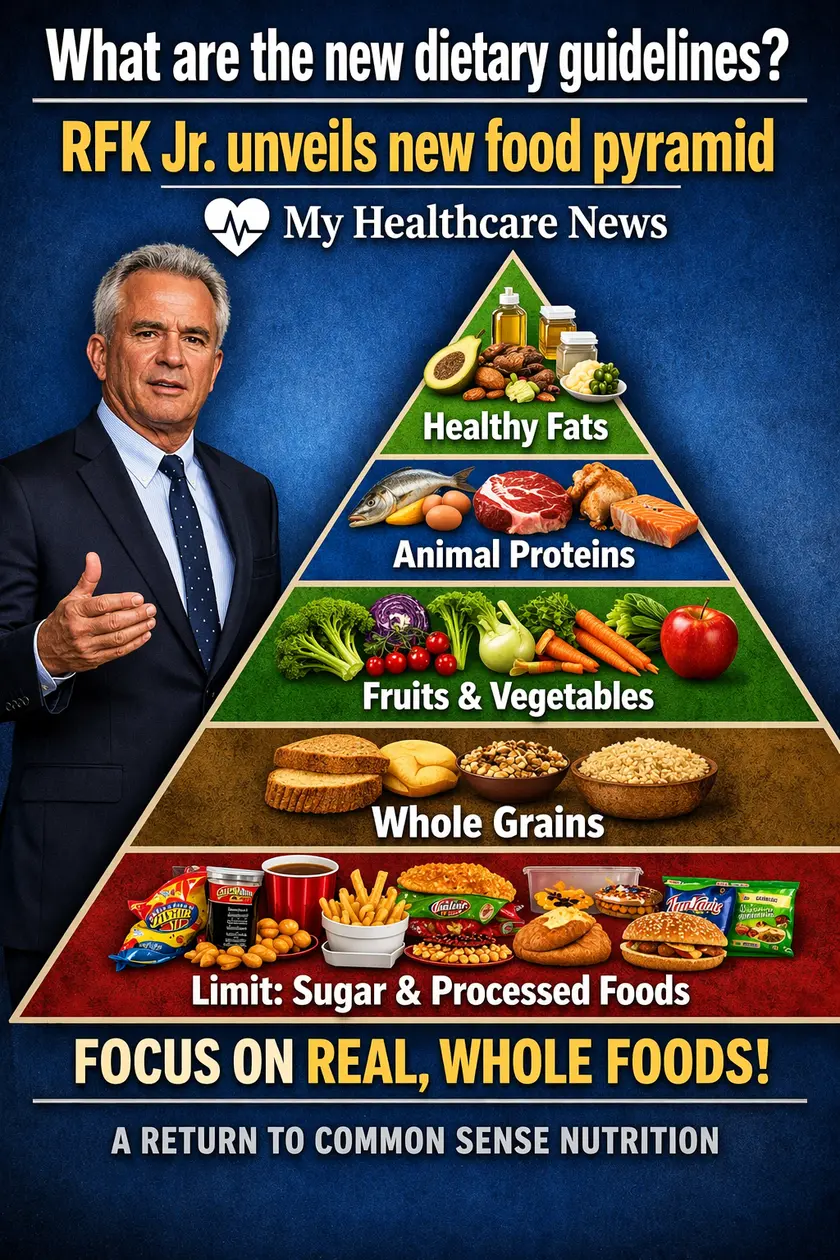
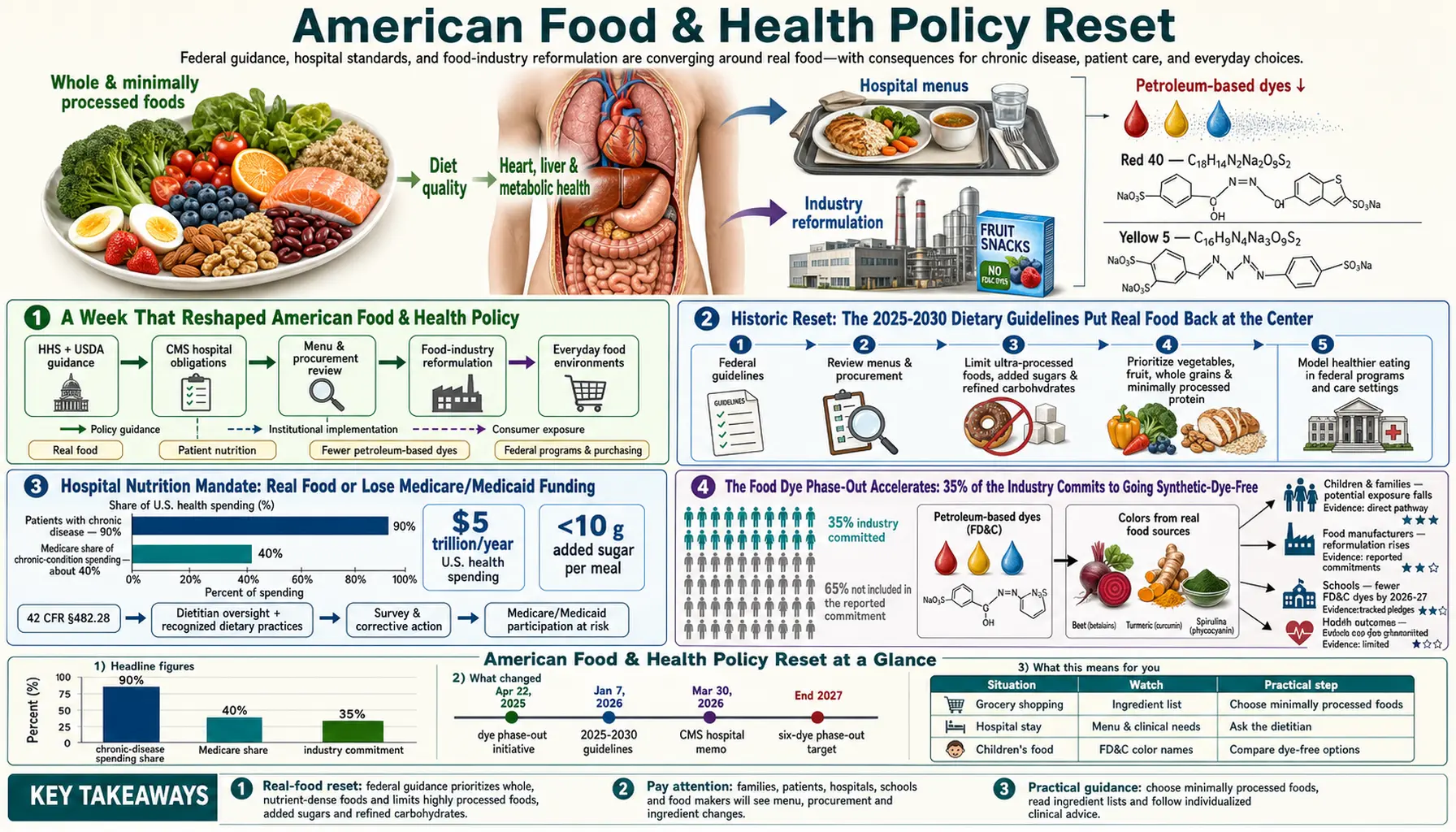
Table of Contents
- A Week That Reshaped American Food & Health Policy
- Historic Reset: The 2025–2030 Dietary Guidelines Put Real Food Back at the Center
- Hospital Food: What the Federal Record Shows
- The Food Dye Phase-Out: Voluntary Industry Pledges
- The State MAHA Wave: 140+ Food Additive Bills Reshape American Food Policy
- FY27 Budget Reorganization: A New “Administration for a Healthy America”
- MAHA ELEVATE: $100 Million for Lifestyle Medicine in Traditional Medicare
- Key Points
- Key Research Papers
- Related Articles on MyHealthcare.com
- Featured Videos
A Week That Reshaped American Food & Health Policy
Early April 2026 brought several federal and state food and health policy developments tied to the Make America Healthy Again agenda. On April 3 the White House released a fiscal year 2027 budget request that proposes reorganizing parts of the Department of Health and Human Services into an Administration for a Healthy America; the Centers for Medicare & Medicaid Services was taking applications for MAHA ELEVATE, a model that will provide approximately $100 million for lifestyle-medicine programs in Original Medicare (letters of intent were due April 10); the voluntary phase-out of petroleum-based food dyes announced in April 2025 continued; and a January 2026 MultiState review counted more than 140 food additive bills introduced across 38 states in 2025. The backdrop is the 2025–2030 Dietary Guidelines for Americans, released on January 7, 2026.
This edition pulls these threads together. Supporters describe them as a shift in federal and state policy away from highly processed food and toward whole foods, lifestyle intervention and ingredient transparency; reviewers quoted below question parts of that picture. Florida’s food testing initiative was covered in an earlier edition; this one looks at the national picture.
Historic Reset: The 2025-2030 Dietary Guidelines Put Real Food Back at the Center
On January 7, 2026, U.S. Health and Human Services Secretary Robert F. Kennedy Jr. and Agriculture Secretary Brooke Rollins released the Dietary Guidelines for Americans, 2025-2030. The departments’ joint press release described the edition as “the most significant reset of federal nutrition policy in decades,” and the Secretaries’ message inside the document calls it the most significant reset “in our nation’s history.” Both sum up its message in three words: “eat real food.”
“These Guidelines return us to the basics,” Kennedy said in the release. “American households must prioritize whole, nutrient-dense foods—protein, dairy, vegetables, fruits, healthy fats, and whole grains—and dramatically reduce highly processed foods.” Rollins said: “At long last, we are realigning our food system to support American farmers, ranchers, and companies that grow and produce real food.” (Background on whole foods is in the Food section.)
Among the changes the document itself sets out:
- Protein at every meal. The guidelines set a goal of 1.2 to 1.6 grams of protein per kilogram of body weight per day, from both animal and plant sources; Harvard’s Nutrition Source describes this as 50–100% more than the previously recommended minimum intake. The accompanying graphic, which the government calls the “New Pyramid,” replaces MyPlate; Harvard’s review describes it as a pyramid-like graphic “flipped on its head.”
- Full-fat dairy. “When consuming dairy, include full-fat dairy with no added sugars,” with a goal of 3 servings a day on a 2,000-calorie pattern; the 2020–2025 edition listed “fat-free or low-fat milk, yogurt, and cheese.” For cooking fats the document says to “prioritize oils with essential fatty acids, such as olive oil,” adding that “other options can include butter or beef tallow.” Saturated fat “should not exceed 10% of total daily calories,” the same ceiling as before.
- Highly processed foods. The document tells readers to “avoid highly processed packaged, prepared, ready-to-eat, or other foods that are salty or sweet, such as chips, cookies, and candy,” to “avoid sugar-sweetened beverages,” and to “limit foods and beverages that include artificial flavors, petroleum-based dyes, artificial preservatives, and low-calorie non-nutritive sweeteners” (see food additives). It does not define “highly processed” and does not use the NOVA classification; the government’s realfood.gov site says it is “not making a legal definition.”
- Added sugars and young children. “No amount of added sugars or non-nutritive sweeteners is recommended or considered part of a healthy or nutritious diet,” and one meal “should contain no more than 10 grams of added sugars.” For infancy and early childhood (birth to 4 years) the document says to “avoid added sugars.” Its examples of non-nutritive sweeteners are aspartame, sucralose, saccharin, xylitol and acesulfame K.
- Foods named. Animal protein sources listed include eggs, poultry, seafood and red meat; plant sources include beans, peas, lentils, legumes, nuts, seeds and soy. A gut-health section names fermented foods (sauerkraut, kimchi, kefir, miso) and high-fiber foods as supporting a diverse microbiome. Background on vitamins, minerals and the rest of the health library is in the site’s other sections.
The guidelines inform federal nutrition programs. The realfood.gov site says the administration is updating federal procurement guidelines so that schools and the military serve “more delicious, real food”; the guideline document itself sets no deadlines for school menus or WIC food packages.
Reaction was divided. Harvard’s Nutrition Source quoted the chair of its Department of Nutrition saying the guidelines “move in the right direction by reinforcing the importance of reducing added sugars and cutting back on refined grains and other highly processed foods,” while calling the pyramid graphic “particularly puzzling, given the visual emphasis on animal products high in saturated fat.” Coverage in The New York Times ran under headlines including “Kennedy Flips Food Pyramid to Emphasize Red Meat and Whole Milk,” and The Wall Street Journal’s health section published explainers on what the guidelines mean for meals. A fuller summary of the reviews is in the February 3, 2026 edition.
Hospital Food: What the Federal Record Shows
The MAHA Commission’s Make Our Children Healthy Again Strategy, released September 9, 2025, lists “improving food served in schools, hospitals, and to veterans” among its planned executive actions, and the Secretaries’ message in the 2025–2030 dietary guidelines calls on “health care professionals” among others to join the effort. Food service in hospitals that take part in Medicare is already governed by a condition of participation for food and dietetic services (42 CFR 482.28), which requires “organized dietary services that are directed and staffed by adequate qualified personnel.”
An earlier version of this edition described a January 22, 2026 announcement in Miami of a mandatory CMS “Condition of Participation on Therapeutic Nutrition” with compliance dates, a Florida farm-to-hospital supply program, an HHS “Real Food Hospital Pledge” with named hospital-system signatories, statements from industry groups, cost estimates and quotations from officials. None of these could be found in HHS, CMS or Florida government releases checked in October 2026, and they have been removed. One quotation was attributed to an “HHS Deputy Secretary Dr. Casey Means”; HHS’s September 9, 2025 release names Jim O’Neill as HHS Deputy Secretary.
The Food Dye Phase-Out: Voluntary Industry Pledges
On April 22, 2025, HHS and the FDA announced measures to phase out petroleum-based synthetic dyes from the nation’s food supply. The release said the FDA would work with industry to eliminate six remaining synthetic dyes—FD&C Green No. 3, Red No. 40, Yellow No. 5, Yellow No. 6, Blue No. 1 and Blue No. 2—“by the end of next year,” that is, by the end of 2026, and listed among its steps “establishing a national standard and timeline for the food industry to transition from petrochemical-based dyes to natural alternatives.” The phase-out rests on voluntary commitments, not on a rule. On July 14, 2025, the FDA said “about 40 percent of the food industry has committed to a voluntary phase-out of such dyes.” The FDA’s pledge tracker lists the commitments of individual manufacturers, retailers and trade associations; in its September 2026 version it gives the target for the six dyes as “by the end of 2027.”
In the April 2025 release, Secretary Kennedy said the dyes “offer no nutritional benefit and pose real, measurable dangers to our children’s health and development,” and FDA Commissioner Marty Makary said the FDA was “asking food companies to substitute petrochemical dyes with natural ingredients for American children as they already do in Europe and Canada.” An earlier version of this edition reported an April 2026 White House announcement that 35% of the food industry had committed, naming eight companies; no such announcement was found, and company names have been removed.
The six dyes are certified colors listed in 21 CFR Part 74. A seventh, FD&C Red No. 3 (erythrosine), lost its authorization for food and ingested drugs in January 2025. The FDA acted under the Delaney Clause after a 2022 petition from a coalition of advocacy and consumer organizations and scientists showed that the dye caused cancer (thyroid tumors) in male rats at high exposure; the FDA states that the effect arises from a hormonal mechanism in male rats and that “there is no evidence showing FD&C Red No. 3 causes cancer in humans.” Food makers have until January 15, 2027 to stop using it. Its use in cosmetics and externally applied drugs had ended in 1990.
Several large manufacturers announced removal timelines in mid-2025. The FDA tracker records target dates ranging from 2025 to December 2028, many covering school foods first and full retail product lines later. On July 11, 2025, according to the FDA, a national trade association for makers of consumer packaged goods announced a voluntary commitment to encourage removal of certified colors from products served in schools by the start of the 2026–2027 school year.
The health concerns cited most often come from studies of children’s behavior. A 2007 randomized, double-blinded, placebo-controlled trial from the University of Southampton, published in The Lancet, gave 153 three-year-olds and 144 eight- and nine-year-olds drinks containing sodium benzoate and one of two artificial color mixes; the authors concluded that “artificial colours or a sodium benzoate preservative (or both) in the diet result in increased hyperactivity” in both age groups. Since July 20, 2010, the European Union’s food additives regulation (Regulation (EC) No 1333/2008) has required foods containing any of six colors—sunset yellow (E110, Yellow 6 in the U.S.), quinoline yellow (E104), carmoisine (E122), allura red (E129, Red 40), tartrazine (E102, Yellow 5) and ponceau 4R (E124)—to carry the statement “may have an adverse effect on activity and attention in children.” California’s Office of Environmental Health Hazard Assessment (OEHHA) reviewed the evidence; a 2022 peer-reviewed paper by its scientists reported that 16 of 25 challenge studies found some evidence of an association (13 statistically significant) and that the basis of the FDA’s acceptable daily intakes “may not be adequate to protect neurobehavior in susceptible children.” A 2012 review of dye toxicology reported that Red 3 causes cancer in animals and that Red 40, Yellow 5 and Yellow 6 “have been found to be contaminated with benzidine or other carcinogens.”
Reporting on the April 2025 announcement, Reuters quoted Makary: “For the last 50 years, we have been running one of the largest uncontrolled scientific experiments in the world on our nation’s children without their consent.” The same report said it was not clear which studies Makary was referencing, noting that he held up a study he identified as being from The Lancet, which in 2007 had published a study linking food dyes and hyperactivity.
On May 9, 2025, the FDA approved three color additive petitions for colors from natural sources—galdieria extract blue (from a red microalga), calcium phosphate (white) and an expanded use of butterfly pea flower extract (blue)—and on July 14, 2025 a fourth, gardenia (genipin) blue. Background on the individual dyes is on the synthetic food dyes page, and the regulatory comparison in US vs. EU Food Safety.
The State MAHA Wave: 140+ Food Additive Bills Reshape American Food Policy
According to MultiState’s January 14, 2026 review of state food policy, lawmakers introduced more than 140 food additive bills across 38 states in 2025, up from 27 bills in 13 states in 2024 and four bills in three states in 2023. Of 70 bills restricting additives in schools, 11 were enacted in eight states—Arizona, Delaware, Louisiana, Tennessee, Texas, Utah, Virginia and West Virginia.
MultiState calls the most common target list the “standard 11”: Blue 1, Blue 2, Brominated Vegetable Oil (BVO), Green 3, Potassium Bromate, Propylparaben, Red 3, Red 40, Titanium Dioxide, Yellow 5 and Yellow 6; the seven dyes on the list are petroleum-derived. At the federal level, the FDA revoked the authorization for BVO in food in July 2024 (effective August 2, 2024) and for Red 3 in January 2025. The food additives reference covers the toxicology of each in more detail.
California’s AB 418, the California Food Safety Act, signed October 7, 2023, prohibits from January 1, 2027 the manufacture or sale of food containing brominated vegetable oil, potassium bromate, propylparaben or Red dye 3. AB 2316, the California School Food Safety Act, signed September 28, 2024, bars Blue 1, Blue 2, Green 3, Red 40, Yellow 5 and Yellow 6 from school meals and from foods sold to pupils at public schools beginning December 31, 2027. Assemblymember Jesse Gabriel authored both bills. West Virginia’s HB 2354, approved by the Governor on March 24, 2025, bans seven dyes (Red 3, Red 40, Yellow 5, Yellow 6, Blue 1, Blue 2 and Green 3) and the preservatives propylparaben and BHA; according to Salon, the dyes were barred from school nutrition program meals from August 1, 2025, and the dyes and two preservatives from foods and drugs sold in the state from January 1, 2028. MultiState describes it as the first law restricting additives in both retail and school settings.
Advocates argue that slow federal action pushed the states to act. In an April 11, 2026 Salon report, a vice president of the Environmental Working Group (EWG) called Red 3 “the poster child of federal government inaction” and noted that the federal dye phase-out has “no regulation attached to it.” HHS itself used the phrase “GRAS loophole”: its March 10, 2025 release said that industry “can self-affirm that the use of a substance is GRAS without notifying the FDA” and directed the FDA to explore ending that pathway. KFF Health News (January 13, 2026) quoted a regulatory counsel at the Center for Science in the Public Interest: “The state laws are really what’s motivating companies to get rid of dyes.”
For 2026, MultiState expected food additive bills to remain a top priority, citing prefiled bills in Missouri and New Hampshire. Its review also reports that Arizona became the first state to enact a definition of ultra-processed foods (HB 2164, built on the “standard 11”), that California enacted its own definition (AB 1264), and that USDA approved SNAP food-restriction waivers—limits on buying items such as soft drinks with SNAP benefits—for Nebraska (the first, in May 2025) and an additional 17 states. EWG’s interactive map listed 28 states with active legislation regulating food chemicals at the time of the Salon report.
Trade groups have taken positions as well. KFF Health News reported that a national trade group for food manufacturers called on its members in summer 2025 to voluntarily eliminate federally certified artificial dyes by the end of 2027, and quoted its senior vice president of state affairs: “We anticipate that the momentum we saw in 2025 will continue into 2026, with a particular focus on ingredient safety and transparency.” Which additives are restricted where is covered in the US vs. EU food safety comparison and the broader Toxins index.
FY27 Budget Reorganization: A New “Administration for a Healthy America”
On April 3, 2026, the White House released President Trump’s fiscal year 2027 discretionary budget request. According to an April 7 summary by the Association of State and Territorial Health Officials (ASTHO), it proposes $111.1 billion in discretionary budget authority for the Department of Health and Human Services, “a $15.8 billion or 12.5% decrease from the 2026 enacted level,” and proposes establishing an Administration for a Healthy America (AHA), “similar to the FY26 budget proposal.”
The request would eliminate the Prevention and Public Health Fund, which ASTHO says provided $1.4 billion for various CDC programs in FY26. ASTHO’s list of CDC programs the budget eliminates includes Tobacco and Prevention Control; Nutrition, Physical Activity, and Obesity; Heart Disease and Stroke; Diabetes; the National Diabetes Prevention Program; and Million Hearts.
Drawing on the budget documents posted at HHS.gov, ASTHO reports that AHA would consolidate programs from the Office of the Assistant Secretary for Health, the Health Resources and Services Administration (HRSA), the Substance Abuse and Mental Health Services Administration (SAMHSA) and several CDC centers, including the National Center for Chronic Disease Prevention and Health Promotion, the National Center for Injury Prevention and Control and the National Center on Birth Defects and Developmental Disabilities; the request proposes $17.5 billion for AHA. The Agency for Toxic Substances and Disease Registry would move instead into a proposed National Center for Chemicals and Toxins within CDC, together with the National Institute for Occupational Safety and Health, the National Center for Environmental Health, the National Institute of Environmental Health Sciences and the FDA’s National Center for Toxicological Research.
ASTHO notes that because many programs are eliminated, consolidated or moved, it “cannot make a comprehensive comparison” between FY26 enacted levels and the request, and that Congress can “approve, reject, or modify” the budget recommendations. Its legislative alerts are collected on ASTHO’s federal government affairs page. An earlier version of this edition quoted a joint statement by public health organizations, a newspaper report and signals from appropriators, and listed concerns and a briefing request attributed to ASTHO; none could be found in the sources cited, and they have been removed.
How Congress will treat the topline and the reorganization was not settled when this edition was written. Background on whole foods, medicinal herbs and other topics is in the site’s sections.
MAHA ELEVATE: $100 Million for Lifestyle Medicine in Traditional Medicare
The CMS Innovation Center’s MAHA ELEVATE model—formally, “Make America Healthy Again: Enhancing Lifestyle and Evaluating Value-based Approaches Through Evidence”—appears on the CMS Innovation Center models page. Its page was online by December 2025, and by March 19, 2026 the notice of funding opportunity had been posted. CMS says the model will provide approximately $100 million to fund three-year cooperative agreements for up to 30 proposals that use evidence-based, whole-person care approaches—“including functional or lifestyle medicine interventions”—not currently covered by Original (fee-for-service) Medicare, and that these approaches are “intended to support, not replace” beneficiaries’ medical care.
A mandatory letter of intent was due April 10, 2026, and applications by May 15, 2026. CMS later said selected applicants would receive a notice of award in fall 2026 and that the first cohort would launch in October 2026; a second cohort is planned for 2027.
CMS lists the model’s “critical areas of focus” as nutrition, physical activity, sleep, stress management, harmful substance avoidance and social connection. Every proposal must include nutrition or physical activity, three awards are reserved for interventions that address dementia, and awardees work with CMS on a plan for data collection, quality measurement, recruitment and cost containment. Model funds cannot be used to cover food. CMS calls it “the first Innovation Center model to focus on proactive, holistic, patient-centered functional or lifestyle medicine approaches to support conventional care,” and its background section states that in 2022 approximately 45% of people with Medicare had four or more chronic conditions and that people with chronic conditions accounted for nearly 90% of total health care spending.
The model follows two MAHA Commission reports: the Make Our Children Healthy Again Assessment (May 22, 2025), which identified poor diet, accumulation of environmental toxins, insufficient physical activity, chronic stress and overmedicalization as drivers of childhood chronic disease, and the Make Our Children Healthy Again Strategy (September 9, 2025), with more than 120 initiatives. An earlier version of this edition described a MAHA “chronic disease assessment” released in February 2026 that focused on Medicare spending, along with a quotation from Secretary Kennedy about the model; neither could be found.
Earlier Medicare prevention programs show the difficulty of reaching scale. A 2020 analysis of CMS supplier data found the Medicare Diabetes Prevention Program offered at 601 sites, “equating to only 1 site per 100,000 Medicare beneficiaries,” and suggested that insufficient reimbursement relative to costs “may largely account for limited availability”; a 2025 interview study of program coordinators described obstacles including obtaining Medicare designation, the logistics of claims and reimbursement, and insufficient payment.
CMS lists the organizations that may be eligible to apply:
- Private medical practices
- Health systems and accountable care organizations (ACOs)
- Academic organizations
- Functional, lifestyle, preventive and integrative medicine centers
- Federally Qualified Health Centers and Rural Health Clinics
- Community-based organizations, state or local governments, Indian Health Service, Tribal and Urban Indian programs, and senior living communities
Related topics are covered in the Food section, along with natural remedies, medicinal herbs and the lab tests used in monitoring metabolic health. Whether MAHA ELEVATE produces durable savings will depend on enrollment, provider participation and funding beyond the initial three-year period—the questions the model is designed to test.
Key Points
The policies above change institutions, programs and labels more than individual diets. In brief:
The Dietary Guidelines
- The protein goal is 1.2–1.6 g per kilogram of body weight per day; animal sources listed include eggs, poultry, seafood and red meat, and plant sources include beans, lentils, nuts, seeds and soy.
- The guidelines recommend full-fat dairy with no added sugars, name olive oil first among cooking fats with butter or beef tallow as “other options,” and keep the ceiling of 10% of daily calories from saturated fat. A 2016 comparison of USDA nutrient data found more sugar in low-fat and non-fat versions of foods than in their regular versions.
- For infancy and early childhood (birth to 4 years) the document says to “avoid added sugars”; for ages 5–10 it states that “no amount of added sugars is recommended.”
- “Highly processed” is not defined in the document.
- The guidelines do not name statins, metformin or blood-pressure medicines. For people with chronic disease they say that following the guidelines “can help prevent the onset or slow the rate of progression of chronic disease” and that some “may experience improved health outcomes when following a lower carbohydrate diet,” to be worked out with a health care professional.
Food Dyes
- Red 40, Yellow 5, Yellow 6, Blue 1, Blue 2 and Green 3 remain authorized in U.S. food; their removal rests on voluntary industry pledges. Red 3’s legal deadline in food is January 15, 2027. Ingredient lists name these dyes (for example “Red 40”); regulation in the EU is covered on the Food Dyes page.
- Titanium dioxide is not one of the FDA’s six dyes but is on the “standard 11” list, the group most commonly targeted in 2025 state bills; by the end of 2025, 11 school additive laws had been enacted in eight states.
- Since February 5, 2026, the FDA has said it will not object to “no artificial colors” claims on foods that contain no certified colors, even when they contain colors from natural sources.
Hospitals and Medicare
- No federal hospital “real food” mandate or hospital pledge program was found in HHS or CMS documents; hospital food service is governed by the existing condition of participation in 42 CFR 482.28.
- MAHA ELEVATE pays awardees for whole-person functional or lifestyle services not already covered by Original Medicare, for beneficiaries enrolled in their programs; awards were expected in fall 2026.
Decisions about diet and medicines for a particular person belong with a clinician.
Editor’s note (October 2026): this edition was checked against the primary documents in October 2026. Claims that could not be traced to a primary source—including the hospital mandate and pledge, an April 2026 “35% of industry” announcement, a February 2026 MAHA chronic-disease assessment, a consumer-group estimate of program reach, stock-market figures and several quotations—were removed; figures were corrected to the documents (for example, California’s school law covers six dyes and takes effect December 31, 2027); and company and brand names were replaced with general descriptions.
Key Research Papers
Policy sources first, then peer-reviewed papers checked against PubMed while fact-checking this edition (entries 13–18).
- HHS Press Room — Dietary Guidelines for Americans 2025–2030 launch coverage
- Make America Healthy Again (HHS) — MAHA agenda and actions
- USDA MAHA Actions — Agency-level MAHA implementation
- CMS MAHA ELEVATE Model — Full notice of funding opportunity and model design
- ASTHO FY27 Budget Analysis — State and territorial health officials’ review of the proposal
- FDA Phase-Out of Petroleum-Based Synthetic Food Dyes — HHS/FDA news release, April 22, 2025
- MultiState — State Food Additive Legislation Surged in 2025
- KFF Health News — MAHA in the Statehouses
- Salon — Federal Inaction Pushes States to Act
- EWG — Interactive Map Tracking State Food Chemical Regulation
- IARC Monographs on the Evaluation of Carcinogenic Risks
- Reuters Healthcare & Pharmaceuticals — Ongoing MAHA and food policy coverage
- McCann D, Barrett A, Cooper A, Crumpler D, Dalen L, Grimshaw K, Kitchin E, Lok K, Porteous L, Prince E, Sonuga-Barke E, Warner JO, Stevenson J (2007). Food additives and hyperactive behaviour in 3-year-old and 8/9-year-old children in the community: a randomised, double-blinded, placebo-controlled trial. Lancet 370(9598):1560-1567. — PubMed PMID: 17825405
- Miller MD, Steinmaus C, Golub MS, Castorina R, Thilakartne R, Bradman A, Marty MA (2022). Potential impacts of synthetic food dyes on activity and attention in children: a review of the human and animal evidence. Environmental Health 21(1):45. — PubMed PMID: 35484553
- Kobylewski S, Jacobson MF (2012). Toxicology of food dyes. International Journal of Occupational and Environmental Health 18(3):220-246. — PubMed PMID: 23026007
- Nguyen PK, Lin S, Heidenreich P (2016). A systematic comparison of sugar content in low-fat vs regular versions of food. Nutrition & Diabetes 6(1):e193. — PubMed PMID: 26807511
- Ritchie ND, Sauder KA, Gritz RM (2020). Medicare Diabetes Prevention Program: where are the suppliers? American Journal of Managed Care 26(6):e198-e201. — PubMed PMID: 32549070
- Turk MT, Ritchie ND, Norton B, Gallucci A (2025). Opportunities and obstacles associated with the Medicare Diabetes Prevention Program. American Journal of Managed Care 31(10):578-582. — PubMed PMID: 41143663
Related Articles on MyHealthcare.com
- April 3, 2026 — Florida’s Food Testing Initiative Exposes Hidden Toxins
- Food Dyes and Artificial Colors
- Food Additives and Their Health Impact
- US vs. EU Food Safety Standards
- Glyphosate (Roundup): Health Risks and Exposure
- Heavy Metals: Comprehensive Guide
- Food Category
- Vitamins
- Minerals
- Medicinal Herbs
- Lab Tests