 — March 14, 2026
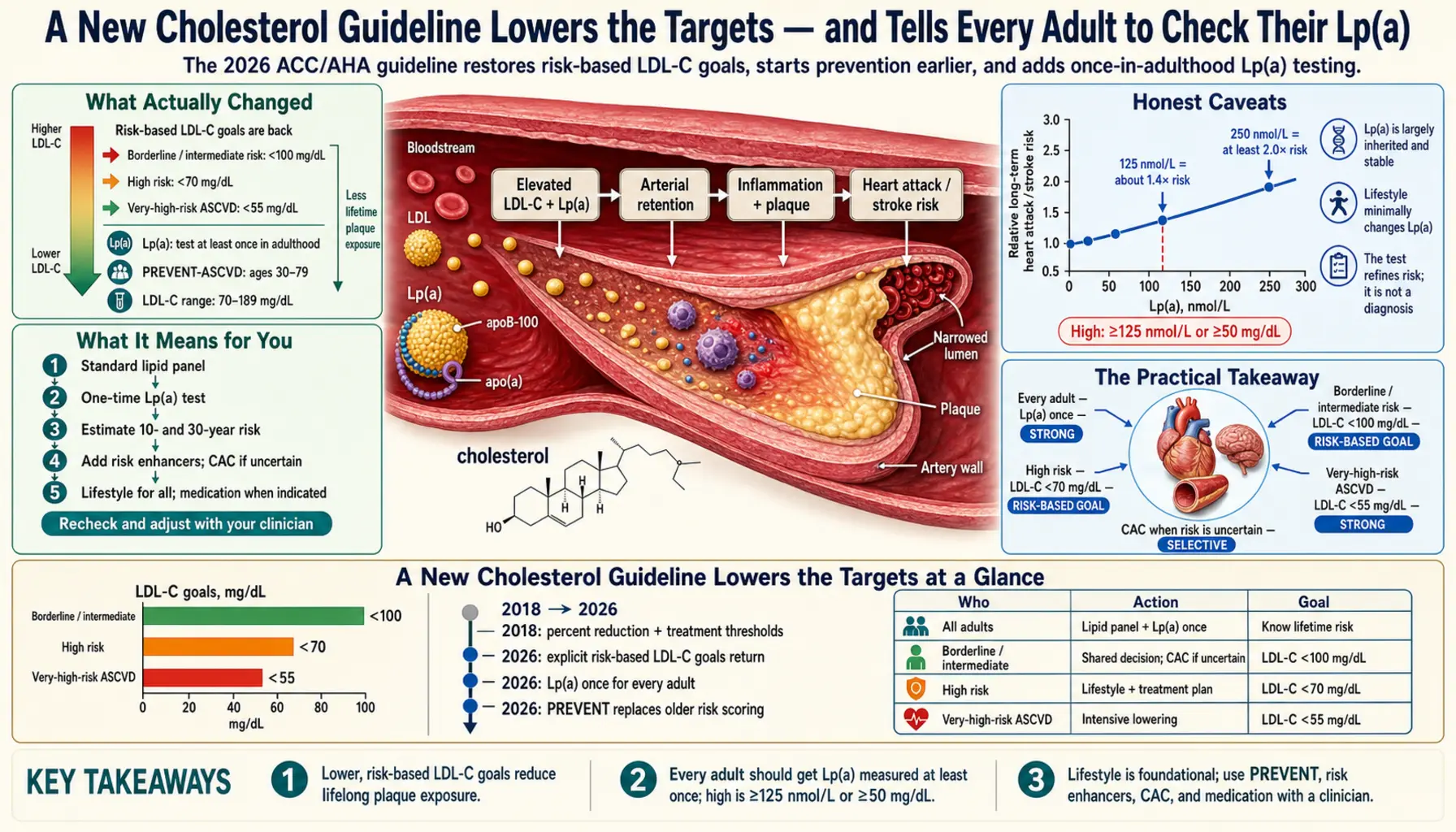
A New Cholesterol Guideline Lowers the Targets and Recommends an Lp(a) Test for Every Adult
On March 13, 2026, the American College of Cardiology and the American Heart Association — joined by nine other professional organizations, eleven in all — published a new guideline on the management of dyslipidemia, the medical umbrella term for unhealthy blood lipids: high cholesterol, high triglycerides, and elevated lipoprotein(a). It appeared the same day in each organization’s flagship journal, Circulation (AHA) and the Journal of the American College of Cardiology (ACC). In its own words it “retires and replaces” the 2018 cholesterol guideline, which had shaped how American doctors treated cholesterol since November 2018.
A guideline is not a single study. It is a panel of experts reviewing the existing evidence — for this one, a literature search run from October to December 2024 — and writing down graded recommendations. Because doctors across the United States work from these documents, a new one can change the care that tens of millions of people receive. This one makes three notable moves.
What Actually Changed
1. Numeric LDL cholesterol goals return. The 2018 guideline was organized mainly around statin intensity and used the LDL number as a threshold for deciding when to add a second drug. The AHA’s announcement of the 2026 guideline puts the change plainly: “LDL-C cholesterol and non-HDL-C goals are back in the new guideline.” LDL-C is the cholesterol carried by low-density lipoprotein particles, the particles that build artery plaque. The goals, as the announcement states them:
- Under 55 mg/dL for people with atherosclerotic cardiovascular disease (ASCVD: heart attack, stroke and other disease caused by artery plaque) who are at very high risk of further events.
- Under 70 mg/dL for people at high risk of a first heart attack or stroke.
- Under 100 mg/dL for people at borderline or intermediate risk of a first heart attack or stroke.
The publishers’ summaries used for this report give the goal for people with ASCVD at very high risk; they do not spell out a separate goal for people with ASCVD outside that group.
The writing committee’s chair, Roger Blumenthal, described the idea behind the goals in the AHA’s announcement: “Lower LDL cholesterol for longer, just like lower blood pressure for longer, results in much greater protection against future heart attack and stroke risk.” The announcement adds that people who keep LDL cholesterol and triglycerides low at earlier ages are much less likely to develop atherosclerotic disease — artery plaque — decades later.
2. A new risk calculator. The guideline replaces the older Pooled Cohort Equations with the AHA’s newer PREVENT equations, which estimate the 10- and 30-year risk of heart attack or stroke for adults aged 30 to 79 without known ASCVD. The AHA’s announcement states that the Pooled Cohort Equations “overestimated the 10-year risk of a heart attack and stroke by 40%-50%.” PREVENT adds kidney function (estimated glomerular filtration rate) and drops race as an input. The new 10-year risk bands are: low (under 3%), borderline (3 to under 5%), intermediate (5 to under 10%), and high (10% or more). These cut points are lower than the 2018 ones; an analysis in JAMA describes them as chosen so that each category holds roughly the same groups of people the older calculator placed there.
3. Lp(a) measurement for every adult. The guideline recommends measuring lipoprotein(a), or “Lp(a),” at least once in adulthood. Lp(a) is not picked up by a standard cholesterol panel. Its level is largely genetically determined and stays relatively stable over a lifetime, which is why the guideline describes a repeat test as generally not needed. Lp(a) raises heart-attack and stroke risk independently of ordinary LDL: a 2022 European Atherosclerosis Society consensus statement describes elevated Lp(a) as a risk factor “even at very low levels of low-density lipoprotein cholesterol.” In the guideline’s thresholds, as the AHA reports them, a level of 125 nmol/L or higher (or 50 mg/dL or higher) is associated with about a 1.4-fold increase in long-term risk of heart attack or stroke, and a level of 250 nmol/L with at least a two-fold increase.
What the Guideline Recommends
Statin therapy, in the AHA’s summary, “remains the foundation of lipid-lowering and risk reduction.” When healthy lifestyle habits and a statin do not lower LDL-C enough, the guideline recommends adding a non-statin therapy: oral ezetimibe and/or bempedoic acid, or a PCSK9 monoclonal antibody given by injection. The announcement adds that inclisiran, an injectable given less often, “is still being studied in clinical trials.” Risk estimation now starts at age 30 and runs to 79, where the 2018 guideline covered ages 40 to 75. For children, the guideline recommends cholesterol screening for all those aged 9 to 11 who have not been screened before.
The new calculator gives lower risk estimates, but the guideline widens who is eligible for treatment. An analysis of national survey data in JAMA estimated that 87.5 million US adults aged 30 to 79 without known ASCVD (56.6%) are eligible for a statin under the 2026 guideline, including 21.5 million who were newly eligible. The newly eligible were “largely younger and lower risk” than those eligible before (mean estimated 10-year risk 3.1%, against 6.1%). The authors write that it “may be surprising” that tools giving lower risk estimates lead to more statin recommendations, and trace it to the lower risk thresholds and to new reasons for a statin beyond 10-year risk. A second analysis, in the Journal of Clinical Lipidology, estimated that 102.9 million US adults aged 20 and older (46.8%) are eligible for lipid-lowering therapy under the 2026 guideline, against 65.3 million (29.7%) under the 2018 guideline.
Questions the Research Leaves Open
Several limits apply to the guideline and its reach:
- Lower targets and lower risk thresholds mean more people on more medication. The largest increases in statin eligibility are among younger, lower-risk adults, and the JAMA analysis notes that no new primary-prevention statin trials in low-risk groups were published between the 2018 and 2026 guidelines. The same authors report that the guideline set its 3% low-risk cut point where a moderate-intensity statin is estimated to be as likely to prevent a heart attack or stroke as to cause a case of diabetes; for high-intensity statins the guideline puts that point at 7% 10-year risk. The under-55 mg/dL goal applies to people who already have ASCVD and are at very high risk, not to every high-risk adult.
- No drug designed to lower Lp(a) had been approved when the guideline was published, and none had yet been shown to prevent heart attacks. At least three such drugs were in phase 3 outcome trials, with completion dates listed on ClinicalTrials.gov from 2026 to 2029 (NCT04023552, NCT05581303, NCT06292013). Because Lp(a)-lowering therapies are still investigational, UT Southwestern’s summary reports, the guideline recommends more intensive cholesterol lowering for people with a high Lp(a). The 2022 European consensus statement likewise recommends early, intensive management of all cardiovascular risk factors in the absence of specific Lp(a)-lowering therapies.
- A guideline reflects expert consensus on existing evidence, not a brand-new discovery. Its recommendations are graded by strength, and not every number carries the same weight of proof.
Key Points
Two of the guideline’s changes reach the most adults. It recommends a single Lp(a) test in adulthood, because the level is largely inherited and stable and is not part of a standard cholesterol panel. And it restores numeric goals for the LDL number measured on a lipid panel: under 55, 70 or 100 mg/dL depending on the risk group. The publishers present the 2026 guideline as a shift toward earlier and lower: risk estimation from age 30, numeric goals, and, in Blumenthal’s words, lipid-lowering medication considered “earlier than we would have considered 10 years ago.” Decisions about cholesterol testing and treatment belong with a clinician.
Sources
- Blumenthal RS, Morris PB, et al. (Writing Committee). 2026 ACC/AHA/AACVPR/ABC/ACPM/ADA/AGS/APhA/ASPC/NLA/PCNA Guideline on the Management of Dyslipidemia. Circulation 153(17):e1154–e1276. Published online March 13, 2026. doi:10.1161/CIR.0000000000001423 · PMID 41824552
- The same guideline, published simultaneously in the Journal of the American College of Cardiology 87(19):2624–2757. Search PubMed · PMID 41824590
- American Heart Association Newsroom. “ACC/AHA Issue Updated Guideline for Managing Lipids, Cholesterol.” March 2026. newsroom.heart.org
- National Lipid Association. “2026 ACC/AHA/Multisociety Dyslipidemia Guideline Released.” lipid.org
- UT Southwestern Medical Center Newsroom. “Updated Cholesterol Guideline Shifts Focus to Earlier Prevention.” March 2026. utsouthwestern.edu
Key Research Papers
The guideline itself and the papers used to check this report, each verified against PubMed and Crossref.
- Blumenthal RS, Morris PB, Gaudino M, Johnson HM, Anderson TS, Bittner VA, et al. (2026). 2026 ACC/AHA/AACVPR/ABC/ACPM/ADA/AGS/APhA/ASPC/NLA/PCNA Guideline on the Management of Dyslipidemia: A Report of the American College of Cardiology/American Heart Association Joint Committee on Clinical Practice Guidelines. Circulation 153(17):e1154-e1276. — PubMed PMID: 41824552
- Blumenthal RS, Morris PB, Gaudino M, Johnson HM, Anderson TS, Bittner VA, et al. (2026). 2026 ACC/AHA/AACVPR/ABC/ACPM/ADA/AGS/APhA/ASPC/NLA/PCNA Guideline on the Management of Dyslipidemia: A Report of the American College of Cardiology/American Heart Association Joint Committee on Clinical Practice Guidelines. Journal of the American College of Cardiology 87(19):2624-2757 (simultaneous publication of the same guideline). — PubMed PMID: 41824590
- Anderson TS, Wilson LM, Sussman JB (2026). Implications of the 2026 Dyslipidemia Guideline for Primary Prevention Statin Therapy. JAMA 336(7):557-564. — PubMed PMID: 42475062
- Sidiq SA, Zhang GY, Abramov D, Razavi AC, Nambi V, Jia X, et al. (2026). Projected impact of 2026 ACC/AHA/Multisociety Dyslipidemia Guideline on lipid-lowering therapy eligibility based on Class 1 and 2a recommendations. Journal of Clinical Lipidology 20(9):2046-2050. — PubMed PMID: 42493325
- Kronenberg F, Mora S, Stroes ESG, Ference BA, Arsenault BJ, Berglund L, et al. (2022). Lipoprotein(a) in atherosclerotic cardiovascular disease and aortic stenosis: a European Atherosclerosis Society consensus statement. European Heart Journal 43(39):3925-3946. — PubMed PMID: 36036785
PubMed Topic Searches
Connections
- ApoB Test
- Familial Hypercholesterolemia — inherited high LDL cholesterol from birth
- Cardiology