— March 13, 2026
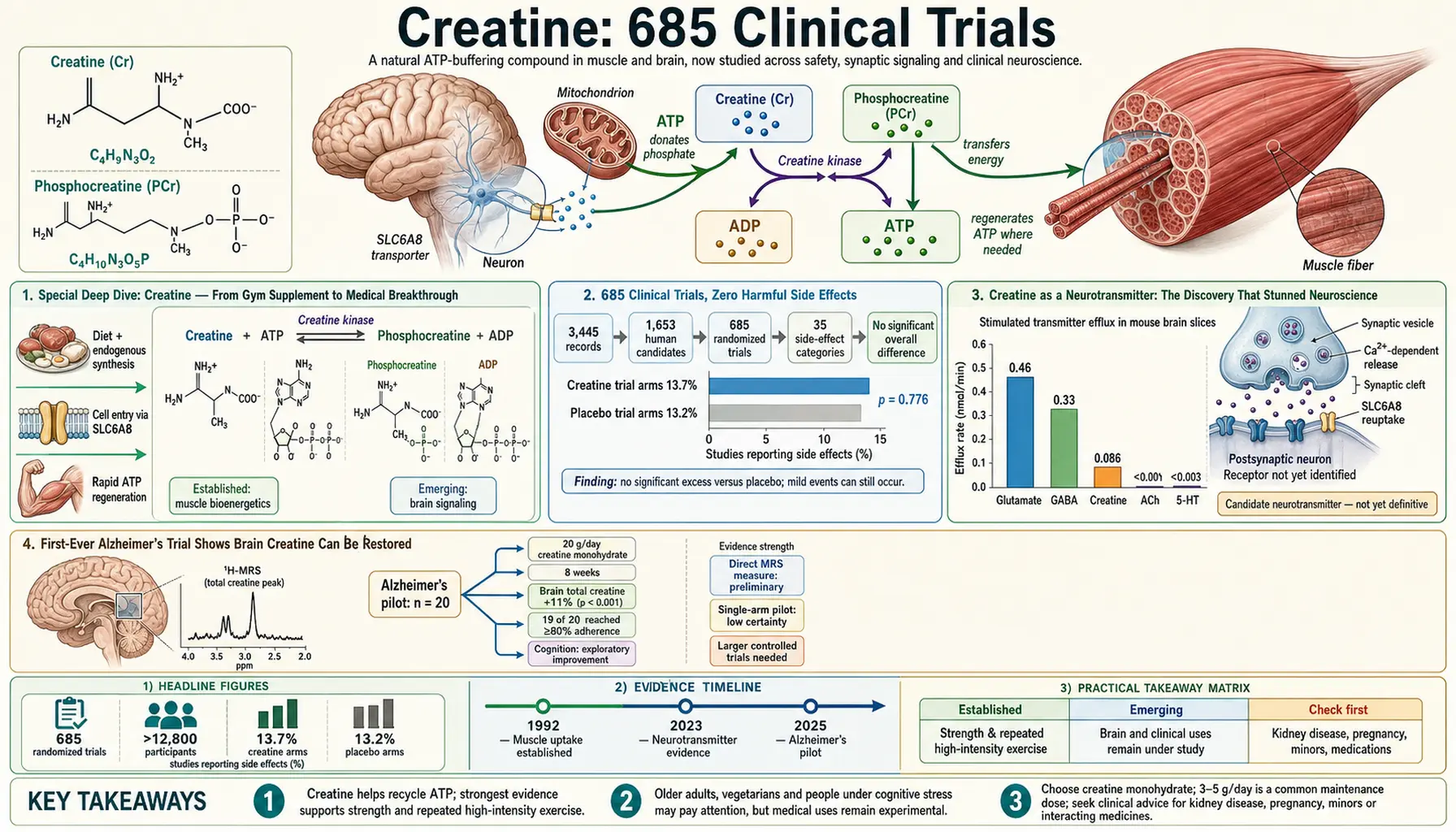
· Creatine: 685 Clinical Trials


Special Deep Dive: Creatine — From Gym Supplement to Clinical Research
Creatine monohydrate is best known as a sports supplement. Studies have also tested it in the brain, in depression, in brain injury, in type 2 diabetes, around menopause and in aging, and laboratory work has examined it in cancer immunology in mice. This deep dive reports what those studies found, how large they were, and what they did not show.
Table of Contents
- 685 Clinical Trials: Side Effects Reported on Creatine and Placebo
- Creatine as a Candidate Neurotransmitter: A 2023 Study in Mice
- Alzheimer's Disease: A 20-Patient Pilot Trial of Creatine
- Creatine and Sleep Deprivation: Loading Studies and a Single-Dose Study
- Creatine Added to an Antidepressant: A Trial in Women With Depression
- Creatine and Traumatic Brain Injury: Pilot Studies and Animal Data
- Creatine and Anti-Tumor Immunity: Findings in Mice
- Creatine in Type 2 Diabetes: HbA1c in a 12-Week Trial
- Creatine in Perimenopause and Menopause: The CONCRET-MENOPA Trial
- Creatine and Aging: Muscle, Bone and Cellular Senescence Research
- Creatine and Kidney Function: What the Studies Measured
- Groups Studied Separately: Vegetarians, Women and Older Adults
- Key Research Papers
- Connections
- Featured Videos
685 Clinical Trials: Side Effects Reported on Creatine and Placebo
In 2025, Dr. Richard B. Kreider and colleagues (Texas A&M University) published an analysis of side effects reported in 685 human clinical trials of creatine in the Journal of the International Society of Sports Nutrition. The trials gave creatine to 12,839 participants and placebo to 13,452; nearly all used creatine monohydrate, at an average of about 12.5 g a day for 64.7 days, in studies lasting up to 14 years. Side effects were reported in 13.7% of the studies' creatine groups and 13.2% of their placebo groups (p = 0.776). A slightly higher share of studies reported gastrointestinal issues (4.9% vs 4.3%) and muscle cramping or pain (2.9% vs 0.9%) with creatine, but these differences were not significant when the participants in those studies were counted. The authors found no significant differences in side effects that included markers of kidney function, and concluded that creatine "does not increase the prevalence or frequency of side effects when compared to participants ingesting" placebo. The paper's lead author discloses that he chairs the scientific advisory board of a creatine manufacturer.
Kreider was a co-author of the International Society of Sports Nutrition (ISSN) position stand on creatine in 2007 and lead author of its 2017 update, which states that studies show "short and long-term supplementation (up to 30 g/day for 5 years) is safe and well-tolerated in healthy individuals and in a number of patient populations ranging from infants to the elderly."
The 2025 paper describes its trials as covering "healthy and medically managed populations ranging from infants to older adults." One hormone finding is often raised in safety discussions: a 2009 crossover trial in 20 college-aged rugby players found that serum DHT rose 56% after 7 days of loading (25 g/day) and stayed 40% above baseline after 14 days at 5 g/day, while testosterone did not change. That trial measured hormones, not hair. A 2025 12-week randomized trial in resistance-trained men (45 randomized, 38 completed; 5 g/day) found no differences between creatine and placebo in DHT, the DHT-to-testosterone ratio, or hair density, follicle counts and hair thickness.
Creatine as a Candidate Neurotransmitter: A 2023 Study in Mice
In 2023, a team led by Dr. Yi Rao at Peking University published a paper in eLife that used chemical analysis, biochemistry, genetics and electrophysiology, mainly in mouse brain tissue, to ask whether creatine acts as a neurotransmitter as well as an energy substrate.
The team detected creatine in synaptic vesicles — the membrane-bound packets that store neurotransmitters at nerve terminals — at a level higher than acetylcholine and serotonin, though lower than glutamate and GABA. Vesicle creatine was reduced in mice lacking the creatine-making enzyme AGAT or the creatine transporter SLC6A8, creatine was released in a calcium-dependent way from stimulated brain slices, and creatine inhibited a fraction of pyramidal neurons in the neocortex, which the authors describe as consistent with an inhibitory neurotransmitter.
The authors write that they "do not have a molecularly defined receptor" for creatine, and that their results are "consistent with the possibility of Cr as a neurotransmitter, though not yet reaching the level of proof for the now classic transmitters." The paper did not study creatine supplements. A separate 2025 review in Frontiers in Nutrition proposed a "muscle-brain axis" — signals from muscle such as the growth factor BDNF — as a possible route for creatine's cognitive effects, and called for research to verify the hypothesis.
Alzheimer's Disease: A 20-Patient Pilot Trial of Creatine
The CABA trial, conducted at the University of Kansas Medical Center and published in Alzheimer's & Dementia: Translational Research & Clinical Interventions (2025), represents a milestone in both creatine and Alzheimer's disease research. It was a single-arm pilot (no placebo group), which its authors describe as "the first trial to investigate CrM supplementation as a potential adjuvant therapy in humans with AD."
Twenty patients took 20 g/day of creatine monohydrate for 8 weeks. The paper reports:
- Brain total creatine rose 11% (p < .001) on magnetic resonance spectroscopy; the authors note earlier studies had shown this in healthy people and call theirs the first to show it in Alzheimer's disease.
- Cognitive scores improved on the NIH Toolbox global (p = .02) and fluid (p = .004) composites and on the List Sorting (p = .001), Oral Reading (p < .001) and Flanker (p = .05) tests. Without a control group, the authors write that the design prevents "conclusions of efficacy."
- Adherence and tolerability: 19 of 20 participants took at least 80% of doses. Study partners reported 13 adverse events, all mild, including cramping or muscle pain, diarrhea, constipation, nausea, facial flushing and sleep disturbance.
The authors started from the idea that impaired brain energy metabolism, including the creatine system, "may contribute to the development and progression" of Alzheimer's disease. They describe the results as preliminary evidence that justifies investigating creatine in Alzheimer's disease "with larger efficacy trials."
Creatine and Sleep Deprivation: Loading Studies and a Single-Dose Study
Dr. Terry McMorris and colleagues at the University of Chichester tested creatine loading (5 g four times a day for 7 days) before sleep deprivation with exercise. In the 2006 study (Psychopharmacology; 10 on creatine, 9 on placebo), the creatine group showed significantly less decline after 24 hours without sleep in random movement generation, choice reaction time, balance and mood. In the 2007 study (Physiology & Behavior), which ran to 36 hours, the creatine group did better only on a complex central executive task at 36 hours, with no differences on the other measures.
Gordji-Nejad et al. (2024), in Scientific Reports, tested a single high dose of creatine monohydrate (0.35 g/kg) against placebo during about 21 hours of sleep deprivation; the authors note that earlier work had studied only repeated dosing over weeks. Phosphorus-31 and proton magnetic resonance spectroscopy scans and cognitive tests were repeated at 3, 5.5 and 7.5 hours. Creatine changed brain PCr/Pi, ATP and tCr/tNAA, prevented a drop in pH, and improved cognitive performance and processing speed.
The authors describe creatine as "a suitable candidate for reducing the negative effects of sleep deprivation" and conclude that a high single dose "can partially reverse metabolic alterations and fatigue-related cognitive deterioration." None of these studies compared creatine with caffeine.
Creatine Added to an Antidepressant: A Trial in Women With Depression
Antidepressants that target monoamine systems "usually require several weeks of administration to achieve clinical efficacy," as the authors of a 2012 trial led by Dr. In Kyoon Lyoo at Seoul National University note. Their trial tested whether adding creatine shortens that delay.
Published in the American Journal of Psychiatry, the double-blind study randomized 52 women with major depressive disorder to the SSRI escitalopram plus either creatine (5 g/day, 25 women) or placebo (27 women) for 8 weeks. The creatine group improved significantly more on the Hamilton Depression Rating Scale from week 2, and the difference held at weeks 4 and 8. Response rates (a fall of 50% or more) were 32.0% vs 3.7% at week 2 and 68.0% vs 29.6% at week 4, but 64.0% vs 63.0% at week 8, a difference that was not significant. Remission at week 8 was 52.0% vs 25.9% (odds ratio 6.92). Discontinuation (32.0% vs 18.5%) and adverse events (36 vs 45) did not differ significantly between groups.
The trial did not scan the brain. Its authors cite earlier phosphorus-31 MRS studies suggesting that people with depression have abnormal brain bioenergetics, propose enlarging the brain's phosphocreatine energy pool as a possible mechanism, and write that future 31P-MRS studies would be needed to test it. A 2017 open-label pilot in 15 women whose depression had not responded to an SSRI or SNRI added creatine (5 g/day) and 5-HTP for 8 weeks; mean Hamilton scores fell from 18.9 to 7.5, with no serious treatment-related adverse events, and the authors call for randomized, placebo-controlled trials.
Creatine and Traumatic Brain Injury: Pilot Studies and Animal Data
Traumatic brain injury (TBI) disrupts the brain's energy supply, and mitochondrial dysfunction and oxidative stress follow. The phosphocreatine system buffers the brain's ATP supply, which is why creatine has been studied after brain injury.
Dr. Georgios Sakellaris and colleagues at the University Hospital of Heraklion, Greece, ran an open-label randomized pilot study, published in the Journal of Trauma in 2006, in 39 children and adolescents aged 1-18 with TBI, giving creatine 0.4 g/kg/day for 6 months. The creatine group showed significant improvements in cognition (p < 0.001), personality and behavior (p < 0.001), self-care (p = 0.029) and communication (p = 0.018), and no side effects were seen. A 2008 report in Acta Paediatrica, describing the same 39-patient design, recorded significant improvement in headache (p < 0.001), dizziness (p = 0.005) and fatigue (p < 0.001). Both studies were open-label pilots, and the 2008 authors call for double-blind studies.
In a 2000 animal study, chronic dietary creatine given before an experimental brain injury reduced cortical damage by as much as 36% in mice and 50% in rats; the protection seemed related to maintained mitochondrial energy production. The human studies above gave creatine after the injury. A randomized pilot trial in mild TBI at the University of Southern Denmark (NCT06644131; 34 participants; creatine 5 g/day for seven weeks against placebo or no treatment) is listed on ClinicalTrials.gov as completed.
Creatine and Anti-Tumor Immunity: Findings in Mice
In 2019, a team led by Dr. Lili Yang at UCLA reported in the Journal of Experimental Medicine that, in mice, creatine acts as a "molecular battery" that conserves energy for CD8 T cells, immune cells that can kill tumor cells.
Tumor-infiltrating immune cells in mice sharply increased expression of the creatine transporter gene (CrT/Slc6a8), and mice lacking that gene had severely impaired anti-tumor T cell immunity. Creatine given to normal mice, by injection or in the diet at a dose the authors describe as comparable to the loading dose recommended for athletes, suppressed tumor growth in mouse melanoma and colon cancer models. Combined with PD-1/PD-L1 checkpoint blockade, creatine showed synergistic tumor suppression in mice.
A 2023 mouse study in Frontiers in Immunology extended this to macrophages: creatine supplementation suppressed B16-F10 tumor growth, shifted tumor macrophages toward the M1 type, raised their ATP production through the phosphocreatine system, and increased tumor antigen-specific CD8 T cells. In people, a 2025 analysis of NHANES 2007-2018 survey data (25,879 adults) in Frontiers in Nutrition found that each standard-deviation increase in dietary creatine intake was associated with 5% lower odds of cancer (adjusted odds ratio 0.95); the authors call for prospective studies to clarify the relationship.
The tumor results above come from mice. The protocol for a double-blind randomized trial (CREATINE-52), published in BMC Cancer in 2024, describes 52 weeks of creatine plus home-based resistance training versus placebo plus resistance training in 200 men with metastatic castration-sensitive prostate cancer receiving androgen deprivation therapy, measuring muscle mass, other health outcomes and markers of cancer progression.
Creatine in Type 2 Diabetes: HbA1c in a 12-Week Trial
Dr. Bruno Gualano and colleagues at the University of São Paulo, Brazil, tested creatine in type 2 diabetes in a 12-week randomized, double-blind, placebo-controlled trial published in Medicine & Science in Sports & Exercise (2011). Twenty-five patients were analysed (13 creatine, 12 placebo), and all took part in an exercise training program.
In the creatine group (5 g/day with exercise training), HbA1c fell from 7.4% to 6.4%, compared with 7.5% to 7.6% on placebo (p = 0.004; the paper reports a between-group difference of -1.1%, 95% CI -1.9% to -0.4%). The creatine group also had lower blood glucose during a meal tolerance test and increased GLUT-4 translocation, the movement of the glucose transporter to the muscle cell surface. Insulin and C-peptide, insulin-sensitivity measures, physical capacity, lipids and adverse effects were comparable between groups. For comparison only: in the UK Prospective Diabetes Study (UKPDS 35), an observational analysis, each 1% lower updated mean HbA1c was associated with 37% lower risk of microvascular complications and 21% lower risk of diabetes-related death. The 12-week creatine trial measured HbA1c, not complications.
The authors attribute the effect mainly to increased GLUT-4 recruitment to the muscle membrane. A follow-up analysis of 10 patients from the trial found that AMPK-alpha protein content tended to be higher after creatine (p = 0.06), and that its changes correlated with GLUT-4 translocation and HbA1c, "suggesting that AMPK signaling may be implicated." The trial was small and short, and its conclusion applies to creatine combined with an exercise program.
Creatine in Perimenopause and Menopause: The CONCRET-MENOPA Trial
Cognitive complaints during perimenopause and menopause are often described as "brain fog." The CONCRET-MENOPA trial (2026), published in the Journal of the American Nutrition Association, tested low-dose creatine formulations "as a targeted intervention for menopause-related neurocognitive and metabolic changes."
Thirty-six perimenopausal and menopausal women were randomized to low-dose creatine HCl (750 mg/day), medium-dose creatine HCl (1,500 mg/day), a combination of creatine HCl and creatine ethyl ester (800 mg/day), or placebo for 8 weeks in a double-blind design. The abstract reports:
- Medium-dose creatine HCl was superior to placebo for reaction time (reported as 1.2% vs 6.6%, p < 0.01) and for frontal brain creatine (reported as 0.9% vs 16.4%, p < 0.01)
- The medium dose also favorably changed serum lipid profiles (p < 0.05), and showed a possible advantage for mood-swing severity that did not reach significance (p = 0.06)
- All interventions were well tolerated, with no severe adverse effects reported
- The abstract reports no separate results for the low-dose or combination groups
The doses tested (750-1,500 mg/day) are lower than the 3-5 g/day that the 2017 ISSN position stand describes for maintaining muscle creatine stores once they are saturated. The authors call the protocol "promising"; the trial enrolled 36 women across four groups for 8 weeks.
Creatine and Aging: Muscle, Bone and Cellular Senescence Research
Researchers describe aging in terms of interconnected cellular processes, including mitochondrial dysfunction, oxidative stress, telomere attrition, genomic instability, chronic low-grade inflammation and cellular senescence (the permanent arrest of cell division). Reviews have asked whether creatine affects some of these processes.
A 2025 narrative review in the Journal of the International Society of Sports Nutrition (Candow and colleagues) concluded that creatine, "primarily when combined with exercise training," has beneficial effects in older adults on lean body mass, muscle size and strength, bone area and thickness, functional ability, glucose kinetics, cognition and memory, and "may have application" for sarcopenia, osteoporosis and frailty. The same year, a review in Experimental Gerontology titled "Creatine and cellular senescence: from molecular pathways to populational health" proposed that creatine may modulate cellular senescence through energy homeostasis, oxidative stress and aging-related signaling pathways, and highlighted gaps in the mechanistic understanding.
The meta-analysis by Chilibeck, Kaviani, Candow, and Zello (2017) in the Open Access Journal of Sports Medicine pooled 22 randomized trials (721 participants, mean age 57-70) of creatine or placebo during resistance training for 7-52 weeks. Creatine produced greater gains in lean tissue mass (1.37 kg), chest press strength and leg press strength; the authors write that the mechanisms "have yet to be evaluated extensively."
Creatine and Kidney Function: What the Studies Measured
Concern about creatine and the kidneys persists, a 2025 meta-analysis notes, "largely due to elevated serum creatinine levels associated with creatine intake."
Creatine is naturally broken down in the body to creatinine, which is excreted by the kidneys. Serum creatinine is used in clinical medicine as a surrogate marker for kidney function — when the kidneys fail, creatinine accumulates in the blood. Taking supplemental creatine can raise serum creatinine, so a higher value in someone taking creatine does not by itself show whether kidney filtration has changed.
Dr. Jacques Poortmans and colleagues at the Free University of Brussels studied kidney function in creatine users. In 1999 they compared athletes who had taken creatine for 10 months to 5 years with controls and found no differences in plasma levels, urine excretion or clearance of creatinine, urea and albumin. In 2005, 20 young men took 21 g/day for 14 days: urinary albumin did not rise, but urinary excretion of methylamine and formaldehyde rose 9.2-fold and 4.5-fold, which the authors describe as "potential cytotoxic compounds," while finding no detrimental effect on kidney permeability. A 2025 systematic review and meta-analysis in BMC Nephrology found a small but statistically significant rise in serum creatinine, which its authors attribute "likely" to metabolic turnover rather than renal impairment, and no significant change in GFR (glomerular filtration rate).
The 2017 ISSN position stand states: "There is no compelling scientific evidence that the short- or long-term use of creatine monohydrate (up to 30 g/day for 5 years) has any detrimental effects on otherwise healthy individuals or among clinical populations who may benefit from creatine supplementation." It also notes that a few case studies described people "purportedly taking creatine with or without other supplements" who presented with high creatinine levels and/or renal dysfunction, and that some have suggested people with pre-existing kidney disease consult a physician before taking creatine "in an abundance of caution." The 2025 analysis of 685 trials found no significant difference between creatine and placebo in side effects that included markers of kidney function.
Groups Studied Separately: Vegetarians, Women and Older Adults
Research has looked separately at three groups:
Vegetarians and Vegans
Dietary creatine comes mainly from meat, fish and other animal products. In a 2003 biopsy study, baseline muscle total creatine was lower in vegetarians than in non-vegetarians (117 vs 130 mmol/kg), and vegetarians who took creatine during resistance training gained more muscle creatine, lean tissue and work performance than non-vegetarians who took it. Brain creatine is a different matter: a 2014 spectroscopy study found comparable brain creatine in vegetarians and omnivores, and its authors concluded the brain depends on its own creatine synthesis. In Benton and Donohoe (2011), a British Journal of Nutrition trial in 128 young women, creatine did not affect verbal fluency or vigilance, but memory improved in vegetarians rather than in meat-eaters. Caroline Rae's 2003 crossover trial in 45 young adult vegetarians (5 g/day for six weeks) found significant improvements in working memory (backward digit span) and Raven's Advanced Progressive Matrices.
Women
Smith-Ryan et al. (2021), a review in Nutrients, states that females have "70-80% lower endogenous creatine stores compared to males". It reports that creatine appears effective for strength and exercise performance before menopause, that post-menopausal women may gain muscle size and function at high doses (0.3 g/kg/day) and bone benefits when creatine is combined with resistance training, and that pre-clinical and clinical evidence indicates positive effects on mood and cognition. A 2022 meta-analysis of 35 trials (1,192 participants) found lean body mass rose 1.46 kg in men on creatine, against a non-significant 0.29 kg in women. In the CONCRET-MENOPA trial, the dose the abstract reports as superior to placebo was 1,500 mg/day. In NHANES 2017-2020 survey data on 4,522 women and girls aged 12 and over (Ostojic et al., 2024), a dietary creatine intake of at least 13 mg per kg body mass a day was associated with lower odds of irregular periods (odds ratio 0.75), and lower intakes with higher odds of pelvic infection, hysterectomy and oophorectomy; the authors say further studies are needed. In a 2011 spiny-mouse study from the Monash Institute of Medical Research, a creatine-supplemented maternal diet from mid-pregnancy almost completely prevented markers of lipid peroxidation and cell death in the brains of newborns exposed to birth hypoxia.
Older Adults
Aging is typically associated with declines in muscle quantity and strength, bone mass, function and cognition, as the 2025 ISSN review notes, which is why older adults are studied. The Chilibeck meta-analysis (2017) found gains in lean mass and strength during resistance training. A 2024 meta-analysis of 16 trials (492 adults aged 20.8-76.4) found improvements in memory, attention time and processing-speed time but not in overall cognition or executive function; in subgroup analyses the benefit was larger in people with diseases, in those aged 18-60 and in women. A 2-year trial by Chilibeck, Candow and colleagues randomized 237 postmenopausal women to creatine (0.14 g/kg/day) or placebo during resistance training and walking: creatine had no effect on bone mineral density, the primary outcome, or on muscular strength, but maintained two femoral-neck geometry measures linked to bone strength and shortened 80-meter walking time; lean tissue mass rose only in a sub-analysis of valid completers.
Key Research Papers
Foundational Studies
- Harris RC, Söderlund K, Hultman E. Elevation of creatine in resting and exercised muscle of normal subjects by creatine supplementation. Clinical Science. 1992;83(3):367-374. — PubMed PMID: 1327657
- Hultman E, Söderlund K, Timmons JA, Cederblad G, Greenhaff PL. Muscle creatine loading in men. Journal of Applied Physiology. 1996;81(1):232-237. — PubMed PMID: 8828669
- Volek JS, et al. Performance and muscle fiber adaptations to creatine supplementation and heavy resistance training. Medicine & Science in Sports & Exercise. 1999;31(8):1147-1156. — PubMed PMID: 10449017
Safety and Position Stands
- Poortmans JR, Francaux M. Long-term oral creatine supplementation does not impair renal function in healthy athletes. Medicine & Science in Sports & Exercise. 1999;31(8):1108-1110. — PubMed PMID: 10449011
- Kreider RB, et al. Long-term creatine supplementation does not significantly affect clinical markers of health in athletes. Molecular and Cellular Biochemistry. 2003;244(1-2):95-104. — PubMed PMID: 12701816
- Kreider RB, Kalman DS, Antonio J, et al. International Society of Sports Nutrition position stand: safety and efficacy of creatine supplementation in exercise, sport, and medicine. JISSN. 2017;14:18. — PubMed PMID: 28615996
- Kreider RB, Gonzalez DE, Hines K, Gil A, Bonilla DA. Safety of creatine supplementation: analysis of the prevalence of reported side effects in clinical trials and adverse event reports. JISSN. 2025;22(sup1):2488937. Full text: PMC11983583 — PubMed PMID: 40198156
- Naeini EK, Eskandari M, Mortazavi M, Gholaminejad A, Karevan N. Effect of creatine supplementation on kidney function: a systematic review and meta-analysis. BMC Nephrology. 2025;26(1):622. Full text: PMC12590749 — PubMed PMID: 41199218
Brain and Cognition
- Rae C, Digney AL, McEwan SR, Bates TC. Oral creatine monohydrate supplementation improves brain performance: a double-blind, placebo-controlled, cross-over trial. Proceedings of the Royal Society B. 2003;270(1529):2147-2150. — PubMed PMID: 14561278
- Watanabe A, Kato N, Kato T. Effects of creatine on mental fatigue and cerebral hemoglobin oxygenation. Neuroscience Research. 2002;42(4):279-285. — PubMed PMID: 11985880
- McMorris T, Harris RC, Swain J, et al. Effect of creatine supplementation and sleep deprivation, with mild exercise, on cognitive and psychomotor performance, mood state, and plasma concentrations of catecholamines and cortisol. Psychopharmacology. 2006;185(1):93-103. — PubMed PMID: 16416332
- McMorris T, Harris RC, Howard AN, Langridge G, Hall B, Corbett J, Dicks M, Hodgson C. Creatine supplementation, sleep deprivation, cortisol, melatonin and behavior. Physiology & Behavior. 2007;90(1):21-28. — PubMed PMID: 17046034
- Bian X, Zhu J, Jia X, Liang W, Yu S, Li Z, Zhang W, Rao Y. Suggestion of creatine as a new neurotransmitter by approaches ranging from chemical analysis and biochemistry to electrophysiology. eLife. 2023;12:RP89317. Publisher page: eLife — PubMed PMID: 38126335
- Gordji-Nejad A, Matusch A, Kleedörfer S, et al. Single dose creatine improves cognitive performance and induces changes in cerebral high energy phosphates during sleep deprivation. Scientific Reports. 2024;14:4937. Publisher page: Nature — PubMed PMID: 38418482
- Xu C, Bi S, Zhang W, Luo L. The effects of creatine supplementation on cognitive function in adults: a systematic review and meta-analysis. Frontiers in Nutrition. 2024;11:1424972 (corrigendum 2025). Publisher page: Frontiers — PubMed PMID: 39070254
- Smith AN, Choi IY, Lee P, Sullivan DK, Burns JM, Swerdlow RH, Kelly E, Taylor MK. Creatine monohydrate pilot in Alzheimer's: feasibility, brain creatine, and cognition. Alzheimer's & Dementia: TRC&I. 2025;11(2):e70101. Publisher page: Wiley — PubMed PMID: 40395689
Depression and Mental Health
- Lyoo IK, Yoon S, Kim TS, et al. A randomized, double-blind placebo-controlled trial of oral creatine monohydrate augmentation for enhanced response to a selective serotonin reuptake inhibitor in women with major depressive disorder. American Journal of Psychiatry. 2012;169(9):937-945. Full text: PMC4624319 — PubMed PMID: 22864465
Traumatic Brain Injury
- Sakellaris G, et al. Prevention of complications related to traumatic brain injury in children and adolescents with creatine administration: an open label randomized pilot study. Journal of Trauma. 2006;61(2):322-329. — PubMed PMID: 16917445
- Sakellaris G, Nasis G, Kotsiou M, Tamiolaki M, Charissis G, Evangeliou A. Prevention of traumatic headache, dizziness and fatigue with creatine administration. A pilot study. Acta Paediatrica. 2008;97(1):31-34. — PubMed PMID: 18053002
Cancer and Immunology
- Di Biase S, Ma X, Wang X, et al. (senior author Yang L). Creatine uptake regulates CD8 T cell antitumor immunity. Journal of Experimental Medicine. 2019;216(12):2869-2882. Publisher page: JEM — PubMed PMID: 31628186
- Peng Z, Saito S. Creatine supplementation enhances anti-tumor immunity by promoting adenosine triphosphate production in macrophages. Frontiers in Immunology. 2023;14:1176956. Publisher page: Frontiers — PubMed PMID: 37662917
- Jiang J, Zhao H, Chen J, Du J, Ni W, Zheng B, Wu J, Xiao C. The association between dietary creatine intake and cancer in U.S. adults: insights from NHANES 2007-2018. Frontiers in Nutrition. 2025;11:1460057. Publisher page: Frontiers — PubMed PMID: 39867555
- Coletta AM, Simon LH, Maslana K, et al. Creatine supplementation and resistance training to preserve muscle mass and attenuate cancer progression (CREATINE-52): a protocol for a double-blind randomized controlled trial. BMC Cancer. 2024;24(1):493. Publisher page: Springer — PubMed PMID: 38637770
Diabetes
- Gualano B, et al. Creatine in type 2 diabetes: a randomized, double-blind, placebo-controlled trial. Medicine & Science in Sports & Exercise. 2011;43(5):770-778. — PubMed PMID: 20881878
Women's Health and Menopause
- Smith-Ryan AE, Cabre HE, Eckerson JM, Candow DG. Creatine supplementation in women's health: a lifespan perspective. Nutrients. 2021;13(3):877. Publisher page: MDPI — PubMed PMID: 33800439
- Ostojic SM, Stea TH, Ellery SJ, Smith-Ryan AE. Association between dietary intake of creatine and female reproductive health: evidence from NHANES 2017-2020. Food Science & Nutrition. 2024;12(7):4893-4898. Publisher page: Wiley — PubMed PMID: 39055234
- Korovljev D, Ostojic J, Panic J, et al. The effects of 8-week creatine hydrochloride and creatine ethyl ester supplementation on cognition, clinical outcomes, and brain creatine levels in perimenopausal and menopausal women (CONCRET-MENOPA): a randomized controlled trial. Journal of the American Nutrition Association. 2026;45(3):199-210. — PubMed PMID: 40854087
Aging and Sarcopenia
- Chilibeck PD, Kaviani M, Candow DG, Zello GA. Effect of creatine supplementation during resistance training on lean tissue mass and muscular strength in older adults: a meta-analysis. Open Access Journal of Sports Medicine. 2017;8:213-226. Full text: PMC5679696 — PubMed PMID: 29138605
- Rawson ES, Volek JS. Effects of creatine supplementation and resistance training on muscle strength and weightlifting performance. JSCR. 2003;17(4):822-831. — PubMed PMID: 14636102
- Delpino FM, Figueiredo LM, Forbes SC, Candow DG, Santos HO. Influence of age, sex, and type of exercise on the efficacy of creatine supplementation on lean body mass: a systematic review and meta-analysis of randomized clinical trials. Nutrition. 2022;103-104:111791. — PubMed PMID: 35986981
Bone Health
- Chilibeck PD, Candow DG, Gordon JJ, et al. A 2-yr randomized controlled trial on creatine supplementation during exercise for postmenopausal bone health. Medicine & Science in Sports & Exercise. 2023;55(10):1750-1760. Full text: PMC10487398 — PubMed PMID: 37144634
Cardiovascular
- Gordon A, Hultman E, Kaijser L, et al. Creatine supplementation in chronic heart failure increases skeletal muscle creatine phosphate and muscle performance. Cardiovascular Research. 1995;30(3):413-418. — PubMed PMID: 7585833
- Andrews R, Greenhaff P, Curtis S, Perry A, Cowley AJ. The effect of dietary creatine supplementation on skeletal muscle metabolism in congestive heart failure. European Heart Journal. 1998;19(4):617-622. Publisher page: OUP — PubMed PMID: 9597411
Vegetarians
- Benton D, Donohoe R. The influence of creatine supplementation on the cognitive functioning of vegetarians and omnivores. British Journal of Nutrition. 2011;105(7):1100-1105. Publisher page: Cambridge — PubMed PMID: 21118604
Creatine Deficiency Syndromes
- Stockler-Ipsiroglu S, van Karnebeek C, Longo N, et al. Guanidinoacetate methyltransferase (GAMT) deficiency: outcomes in 48 individuals and recommendations for diagnosis, treatment and monitoring. Molecular Genetics and Metabolism. 2014;111(1):16-25. Related overview: GeneReviews: Creatine Deficiency Disorders — PubMed PMID: 24268530
Further Papers Cited in the Text
- Buford TW, Kreider RB, Stout JR, et al. International Society of Sports Nutrition position stand: creatine supplementation and exercise. JISSN. 2007;4:6. — PubMed PMID: 17908288
- van der Merwe J, Brooks NE, Myburgh KH. Three weeks of creatine monohydrate supplementation affects dihydrotestosterone to testosterone ratio in college-aged rugby players. Clinical Journal of Sport Medicine. 2009;19(5):399-404. — PubMed PMID: 19741313
- Lak M, Forbes SC, Ashtary-Larky D, et al. Does creatine cause hair loss? A 12-week randomized controlled trial. JISSN. 2025;22(sup1):2495229. — PubMed PMID: 40265319
- Ribeiro F, Forbes SC, Candow DG, et al. Creatine supplementation and muscle-brain axis: a new possible mechanism? Frontiers in Nutrition. 2025;12:1579204. — PubMed PMID: 40771202
- Kious BM, Sabic H, Sung YH, Kondo DG, Renshaw P. An open-label pilot study of combined augmentation with creatine monohydrate and 5-hydroxytryptophan for selective serotonin reuptake inhibitor- or serotonin-norepinephrine reuptake inhibitor-resistant depression in adult women. Journal of Clinical Psychopharmacology. 2017;37(5):578-583. — PubMed PMID: 28787372
- Sullivan PG, Geiger JD, Mattson MP, Scheff SW. Dietary supplement creatine protects against traumatic brain injury. Annals of Neurology. 2000;48(5):723-729. — PubMed PMID: 11079535
- Alves CR, Ferreira JC, de Siqueira-Filho MA, et al. Creatine-induced glucose uptake in type 2 diabetes: a role for AMPK-α? Amino Acids. 2012;43(4):1803-1807. — PubMed PMID: 22349765
- Stratton IM, Adler AI, Neil HA, et al. Association of glycaemia with macrovascular and microvascular complications of type 2 diabetes (UKPDS 35): prospective observational study. BMJ. 2000;321(7258):405-412. — PubMed PMID: 10938048
- Candow DG, Ostojic SM, Chilibeck PD, et al. Creatine monohydrate supplementation for older adults and clinical populations. JISSN. 2025;22(sup1):2534130. — PubMed PMID: 40673730
- Ostojic SM, Prémusz V, Ács P. Creatine and cellular senescence: from molecular pathways to populational health. Experimental Gerontology. 2025;207:112798. — PubMed PMID: 40456458
- Poortmans JR, Kumps A, Duez P, et al. Effect of oral creatine supplementation on urinary methylamine, formaldehyde, and formate. Medicine & Science in Sports & Exercise. 2005;37(10):1717-1720. — PubMed PMID: 16260971
- Burke DG, Chilibeck PD, Parise G, et al. Effect of creatine and weight training on muscle creatine and performance in vegetarians. Medicine & Science in Sports & Exercise. 2003;35(11):1946-1955. — PubMed PMID: 14600563
- Yazigi Solis M, de Salles Painelli V, Giannini Artioli G, et al. Brain creatine depletion in vegetarians? A cross-sectional ¹H-magnetic resonance spectroscopy (¹H-MRS) study. British Journal of Nutrition. 2014;111(7):1272-1274. — PubMed PMID: 24290771
- Ireland Z, Castillo-Melendez M, Dickinson H, Snow R, Walker DW. A maternal diet supplemented with creatine from mid-pregnancy protects the newborn spiny mouse brain from birth hypoxia. Neuroscience. 2011;194:372-379. — PubMed PMID: 21640166
PubMed Topic Searches
- Clinical trials on creatine supplementation safety — PubMed search
- Clinical trials on creatine and Alzheimer's disease — PubMed search
- Clinical trials on creatine and depression — PubMed search
- Clinical trials on creatine and traumatic brain injury — PubMed search
- Clinical trials on creatine and T cell immunity — PubMed search
- Clinical trials on creatine and type 2 diabetes — PubMed search
- Clinical trials on creatine in menopause cognition — PubMed search
- Clinical trials on creatine and aging/sarcopenia — PubMed search
- Hultman 1996 muscle creatine loading (author search) — PubMed search
Connections
Featured Videos