Iodine Deficiency: Pregnancy and Brain Development
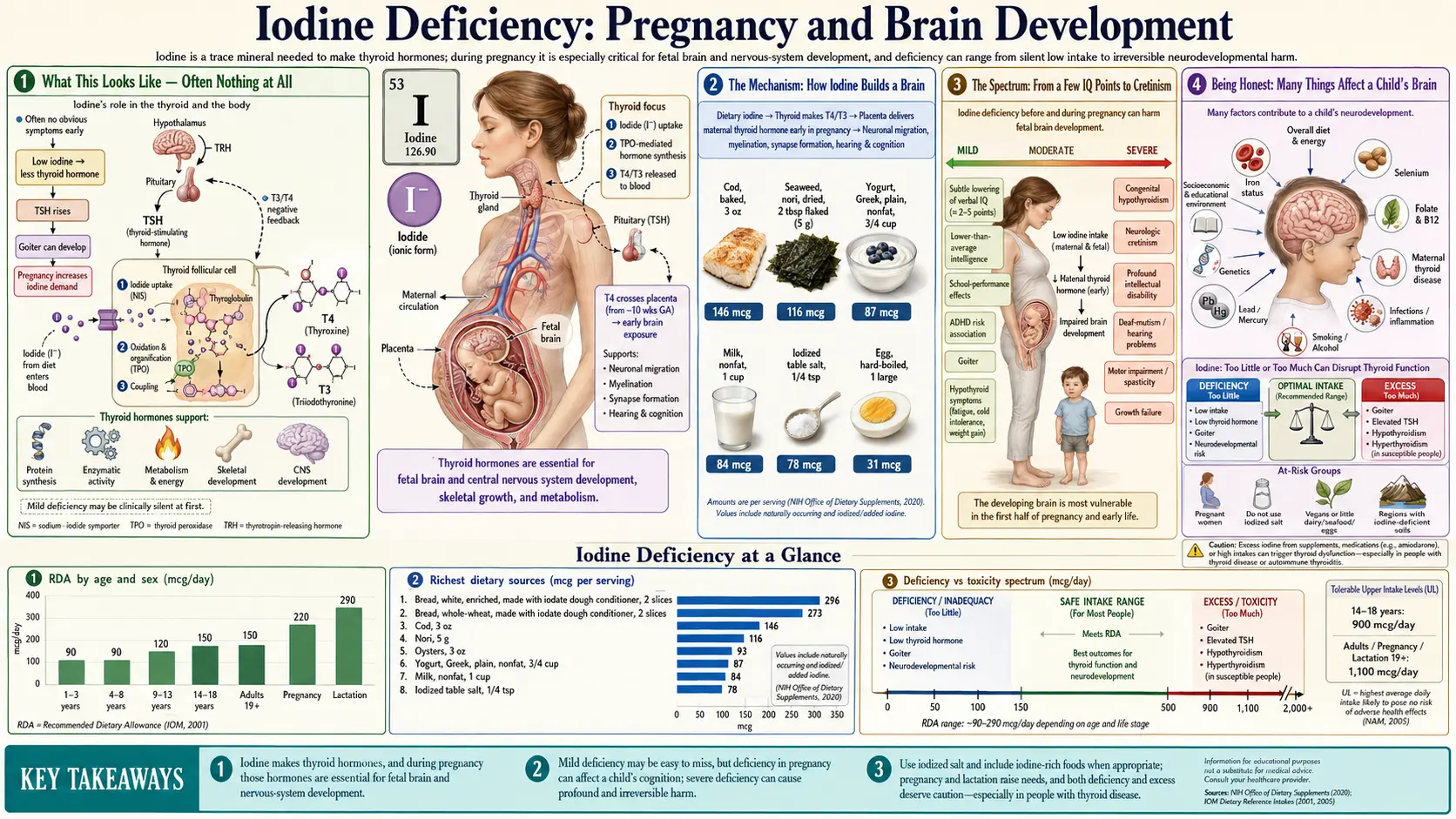
Iodine is the raw material for thyroid hormone, and thyroid hormone guides the wiring of the developing brain. The American Thyroid Association's 2006 statement describes the fetus as totally dependent in early pregnancy on the mother's thyroxine (T4) for normal brain development, and states that if iodine insufficiency leads to hypothyroidism in pregnancy, irreversible fetal brain damage can result (ATA Public Health Committee 2006). At the severe end, maternal iodine deficiency produces cretinism: profound intellectual disability. Zimmermann and colleagues describe iodine deficiency as the most common cause of preventable mental impairment worldwide (Zimmermann 2008), and Delange estimated a global loss of 10–15 IQ points at the population level (Delange 2001). For mild deficiency the picture is less settled: observational cohorts link low maternal iodine status in early pregnancy to children more often scoring in the lowest quarter for verbal IQ and reading (Bath 2013), while randomized trials of supplementing mildly deficient pregnant women have not shown a benefit for child neurodevelopment (Gowachirapant 2017; Dineva 2020).
Table of Contents
- What This Looks Like — Often Nothing at All
- The Mechanism: How Iodine Builds a Brain
- The Spectrum: From a Few IQ Points to Cretinism
- Being Honest: Many Things Affect a Child's Brain
- Circumstances Linked to Low Iodine in Pregnancy
- Why Pregnant Women Run Low
- Testing: Why Iodine Status Is Hard to Measure
- Iodine Sources and What Guidelines Report
- Situations Guidelines and Studies Flag
- Key Research Papers
- Connections
- Featured Videos
What This Looks Like — Often Nothing at All
Unlike most deficiency symptom pages, this one describes a deficiency that usually has no symptom the mother can feel. Mild iodine deficiency in pregnancy can be clinically silent: there may be no pain, no unusual tiredness, and nothing in the pregnancy that signals it. Zimmermann's 2009 review notes that assessing iodine status in pregnancy is difficult and that it remains unclear whether iodine intakes in pregnancy are sufficient in several industrialized countries (Zimmermann 2009, Endocrine Reviews).
What a mother might notice are the more general signs of low thyroid function that can accompany deficiency: a swelling at the front of the neck (a goiter), fatigue, feeling cold, or sluggishness (see hypothyroidism and fatigue and weight gain and cold sensitivity). Many women with mild-to-moderate deficiency have none of these. Glinoer describes pregnancy as a “revelator” of underlying iodine restriction: with an adequate intake the thyroid adapts to the higher demand, while a deficient intake leads to low maternal thyroxine (hypothyroxinemia), sustained stimulation of the gland and, finally, goiter (Glinoer 2007).
In the child, the associations reported in the mild range are modest and measured across groups rather than visible in any one child: more children scoring in the lowest quarter for verbal IQ and reading (Bath 2013), lower spelling scores at age 9 (Hynes 2013), and more language delay, behavior problems and poorer fine-motor skills at age 3 (Abel 2017). These are findings from cohorts of mother-child pairs, and supplementation trials have not confirmed a benefit (see the spectrum below). At the severe end, the harm is far more visible.
The Mechanism: How Iodine Builds a Brain
The chain is short. Iodine's known role in the human body is as the essential ingredient of thyroid hormone. The thyroid gland traps iodine from the blood and attaches it to a protein scaffold to make two hormones — thyroxine (T4), which carries four iodine atoms, and triiodothyronine (T3), which carries three. The numbers in the names are the iodine atoms. No iodine, no hormone. (For the full biochemistry, see iodine and thyroid function.)
Thyroid hormone, in turn, is one of the regulators of brain development. In the growing fetal brain it is involved in the multiplication of nerve cells, their migration to the right places, the growth of the branches (axons and dendrites) that let neurons connect, the formation of synapses, and myelination — the wrapping of nerve fibers in fatty insulation. Morreale de Escobar and colleagues report that experiments in rats strongly support the conclusion that thyroid hormone is already required for normal development of the cerebral cortex very early in pregnancy (Morreale de Escobar 2004; an animal finding).
An analogy. Think of building the brain as constructing a vast highway network on a fixed deadline. Thyroid hormone is the supervisor radioing instructions to every crew — lay this road now, connect that junction, insulate these wires. Iodine is the battery in the supervisor's radio. With a full battery, every crew hears every instruction. With a weak battery, the instructions come through faint; some roads end up narrower, some junctions never quite connect, and some wiring is left poorly insulated. The highway still opens, but the construction deadline has passed. The ATA's 2006 statement describes fetal brain damage from iodine-related hypothyroidism in pregnancy as irreversible (ATA Public Health Committee 2006).
The timing is what makes pregnancy distinctive. Skeaff's review describes thyroid-hormone-dependent neurodevelopment as beginning in the second half of the first trimester, with the fetal thyroid starting to produce hormone around the beginning of the second trimester; because the fetal gland's reserves are low, maternal thyroid hormone contributes to fetal levels until birth (Skeaff 2011). Morreale de Escobar and colleagues describe the mother as the only source of T4 for the developing brain before mid-gestation: small amounts of maternal T4 are present in the fetal compartment by 4 weeks after conception, and the fetal cerebral cortex converts T4 locally into the active hormone T3 (Morreale de Escobar 2004). They propose that women unable to raise their T4 production early in pregnancy form a population at risk for neurological disabilities in their children, and name mild-to-moderate iodine deficiency as the most widespread cause of low maternal T4 in Western societies. Zimmermann's 2012 review states that iodine requirements increase by 50% or more during pregnancy (Zimmermann 2012).
The Spectrum: From a Few IQ Points to Cretinism
The damage from iodine deficiency in pregnancy is not all-or-nothing. Delange describes all degrees of deficiency — mild, moderate and severe — as affecting thyroid function in the mother and newborn and the mental development of the child, with the damage increasing with the degree of deficiency (Delange 2001). The evidence, however, is much stronger at the severe end than at the mild end.
Severe deficiency — cretinism. At the extreme end, when a mother is severely iodine-deficient in pregnancy (historically in remote, mountainous, iodine-poor regions far from the sea), the result can be endemic cretinism, the most severe consequence of iodine deficiency (Delange 2001; Zimmermann 2012). Two forms are described. Neurological cretinism is characterized most commonly by intellectual disability, deaf-mutism and spastic diplegia (a stiff, spastic gait) (Hetzel 1983); Delange identifies low maternal thyroxine in early pregnancy as a key factor in the neurological damage (Delange 2001). Myxedematous cretinism is the hypothyroid form, marked by severe hypothyroidism in the child; Delange reports that selenium deficiency combined with iodine deficiency partly prevents the neurological damage but precipitates severe hypothyroidism in cretins (Delange 2001). In moderately-to-severely deficient areas, controlled studies found that iodine supplementation before or during early pregnancy eliminated new cases of cretinism (Zimmermann 2012).
Population IQ estimates. Delange estimated a global loss of 10–15 IQ points at the population level (Delange 2001), and Zimmermann's 2012 review cites two meta-analyses estimating a mean reduction of 12–13.5 IQ points in iodine-deficient populations (Zimmermann 2012). In a meta-analysis of 37 Chinese studies (12,291 children), children in severely iodine-deficient areas without supplementation scored 12.45 IQ points lower than children in iodine-sufficient areas, and children whose mothers received iodine during pregnancy scored 8.7 points higher than children whose mothers remained deficient (Qian 2005). A systematic review of children 5 years old and under translated its effect sizes into 6.9–10.2 IQ points lower in iodine-deficient children, while flagging weak study designs, omitted confounders and small samples (Bougma 2013).
Mild-to-moderate deficiency — observational studies. Pearce and colleagues describe public-health concern as having shifted from severe to mild-to-moderate deficiency, which remains prevalent in many regions, especially among pregnant women (Pearce 2016). In the UK ALSPAC cohort (Bath and colleagues, 2013), 1,040 first-trimester pregnant women had a median urinary iodine of 91.1 µg/L, classed as mild-to-moderate deficiency; children of women with an iodine-to-creatinine ratio below 150 µg/g were more likely to score in the lowest quartile for verbal IQ at age 8 (odds ratio 1.58), reading accuracy (1.69) and reading comprehension (1.54) at age 9, after adjustment for 21 confounders. In a Tasmanian cohort, children whose mothers had urinary iodine below 150 µg/L in pregnancy had lower spelling, grammar and English-literacy scores at age 9; only the spelling difference remained significant after adjustment for socioeconomic factors (Hynes 2013). In Norway's MoBa cohort (33,047 mother-child pairs, excluding supplement users), lower maternal iodine intake from food was associated with child language delay, behavior problems and poorer fine-motor skills at 3 years, but not with gross-motor skills (Abel and colleagues, 2017). An individual-participant meta-analysis of 6,180 mother-child pairs from three European cohorts found an association of maternal iodine status with verbal IQ only, present only up to 14 weeks of gestation; an iodine-to-creatinine ratio below 150 µg/g was not significantly associated with lower verbal or nonverbal IQ (Levie 2019).
Mild-to-moderate deficiency — supplementation trials. The trial evidence does not point the same way. In a randomized, double-blind, placebo-controlled trial in Bangalore and Bangkok, 832 mildly iodine-deficient pregnant women received 200 µg of iodine daily or placebo until delivery; at age 5–6 years, verbal IQ, performance IQ and executive-function scores did not differ between the groups (Gowachirapant 2017). In MoBa, iodine supplement use in pregnancy showed no protective effect on child neurodevelopment (Abel 2017). A 2020 systematic review found that a meta-analysis of two randomized trials showed no effect of supplementation on child cognitive, language or motor scores, and concluded that there is insufficient good-quality evidence to support current recommendations for iodine supplementation in pregnancy in areas of mild-to-moderate deficiency (Dineva 2020). An earlier non-randomized Spanish study reported higher infant psychomotor scores in the children of 133 women given 300 µg of potassium iodide in the first trimester than in the children of 61 unsupplemented women, a finding its authors called preliminary because of possible uncontrolled confounding (Velasco 2009).
Findings like these describe an average shift across many children rather than an effect that can be seen in any single child, which is why iodine status is tracked with population surveys that report a median urinary iodine (Zimmermann and Andersson 2021).
Being Honest: Many Things Affect a Child's Brain
A child's intelligence, language and school performance do not come down to a single nutrient. Cognitive development is shaped by a long list of factors, and iodine is one thread in a large weave:
- Genetics — inherited factors are among the strongest influences on measured cognitive ability.
- Other nutrients — iron deficiency impairs early cognitive development; folate around conception, vitamin B12, choline, zinc, and omega-3 fatty acids (DHA) are also studied for their roles in the developing brain.
- The mother's own thyroid health — overt or subclinical maternal hypothyroidism, or thyroid autoimmunity such as Hashimoto's thyroiditis, can lower the hormone signal to the fetus independently of iodine. In a randomized trial of antenatal thyroid screening in which 21,846 women gave blood samples, treating women with abnormal results with levothyroxine (started at a median of about 13 weeks of gestation) did not improve child IQ at age 3 (Lazarus 2012).
- Exposures in pregnancy — alcohol, smoking, lead, and certain other toxins are established causes of impaired neurodevelopment.
- Prematurity and birth weight, infections, and complications of pregnancy.
- The early environment after birth — nutrition, stimulation, language exposure, schooling, and socioeconomic circumstances shape measured ability, and these are easy to confuse with the effect of any one prenatal factor.
Because many of these travel together, untangling the specific contribution of iodine is hard. Zimmermann's 2009 review notes that cross-sectional studies have, with few exceptions, reported impaired intellectual function and motor skills in children from iodine-deficient areas, but that many were likely confounded by other factors that affect child development (Zimmermann 2009, Am J Clin Nutr). A slightly delayed talker or a child who struggles with reading is not evidence that the mother was iodine-deficient. What the cohort evidence shows is an association across populations, and the trial evidence in mild deficiency has not shown that supplementation changes child outcomes (Dineva 2020).
Circumstances Linked to Low Iodine in Pregnancy
Because the effect on a child is invisible and non-specific, iodine deficiency in pregnancy is not identified by spotting a symptom in the baby. The research instead links it to the mother's circumstances, including:
- A diet low in iodine's main sources. Leung and Braverman list salt, dairy products and bread fortified with iodine, and naturally iodine-rich seafood, as the primary dietary sources (Leung and Braverman 2014); in U.S. women of childbearing age, dairy consumption was positively associated with urinary iodine (Caldwell 2013). Diets with little or no dairy and seafood, including strict vegan diets, leave out these main sources unless iodine comes from elsewhere.
- Not using iodized salt. Much of the salt people eat comes from processed and restaurant food, which is often not made with iodized salt, and many specialty salts (sea salt, Himalayan pink salt, kosher salt) are not iodized.
- Pregnancy or breastfeeding itself — iodine requirements increase by 50% or more in pregnancy (Zimmermann 2012), so an intake that was borderline-adequate before pregnancy can fall short.
- Living in an iodine-poor region — inland and mountainous areas with iodine-depleted soils, where iodized salt programs are weak. In 2020, 21 countries remained iodine-deficient (Zimmermann and Andersson 2021).
- Signs of low thyroid function in the mother — a new goiter, or symptoms of hypothyroidism, can be a clue, though deficiency frequently exists without them.
The studies describe the window that matters as early. The Levie 2019 association with verbal IQ was present only up to 14 weeks of gestation (Levie 2019), and Zimmermann's 2009 review states that, to prevent fetal damage in areas of severe deficiency, iodine is to be given before or early in pregnancy (Zimmermann 2009, Am J Clin Nutr).
Why Pregnant Women Run Low
Iodine deficiency in pregnancy is a mismatch between an increased need and, in some places, a shrinking supply:
- The demand rises. Iodine requirements increase by 50% or more in pregnancy (Zimmermann 2012). WHO raised its recommended iodine intake in pregnancy from 200 to 250 µg per day (Zimmermann 2009, Am J Clin Nutr; Glinoer 2007), compared with a recommended 150 µg per day for adults who are not pregnant or lactating (Leung and Braverman 2014).
- The supply has fallen in some places. Zimmermann's 2009 review reports that about half of Europe remained mildly iodine-deficient and that intakes in other industrialized countries, including the United States and Australia, had fallen in recent years (Zimmermann 2009, Endocrine Reviews). In the United States, the national median urinary iodine fell by more than 50% between 1971–1974 and 1988–1994 while still indicating adequate intake for the population as a whole (Hollowell 1998); in NHANES 2005–2010 the median for all pregnant women was 129 µg/L, below the adequate range, with women in the first and second trimesters below adequacy and those in the third trimester adequate (Caldwell 2013). The ALSPAC authors describe the UK, long considered iodine-replete, as possibly now mildly iodine-deficient (Bath 2013).
- Specialty salts and processed food. As noted above, non-iodized specialty salts and the salt in processed foods do not supply the iodine that iodized table salt does.
- Restrictive diets. Vegan, dairy-free, and some low-salt eating patterns leave out major iodine sources.
- Goitrogens, in context. Certain foods (raw cruciferous vegetables, soy, cassava) contain compounds that can interfere with thyroid iodine use. A review of soy isoflavones reports that iodine deficiency greatly increases soy's antithyroid effects, whereas iodine supplementation is protective (Doerge and Sheehan 2002) — the effect matters mainly when iodine intake is already low.
The pattern described in the research is habitual low intake meeting the added demand of pregnancy, not a single missed meal. Dineva and colleagues note that maternal thyroid iodine stores, built up by iodine intake before conception, are a factor future trials need to measure (Dineva 2020).
Testing: Why Iodine Status Is Hard to Measure
Iodine status is difficult to measure in one person. Zimmermann's 2009 review describes the assessment of iodine status in pregnancy as difficult (Zimmermann 2009, Endocrine Reviews), and there is no simple, reliable test that tells one pregnant woman whether her iodine intake is adequate.
- Urinary iodine is the standard measure — most iodine eaten is excreted in the urine, so urinary iodine concentration reflects recent intake, but it varies from day to day with recent meals. For population surveys it is measured and expressed as the median, in µg/L (Zimmermann and Andersson 2021), and WHO treats a median of 150–249 µg/L as adequate in pregnant women (Zimmermann 2009, Am J Clin Nutr). A single sample says much less about one individual.
- Thyroid function tests — TSH, free T4, and sometimes thyroglobulin — do not measure iodine directly, but they assess how well the thyroid is keeping up. A thyroid panel is used in pregnancy to detect overt or subclinical hypothyroidism, and thyroid antibodies can identify autoimmune thyroid disease such as Hashimoto's. (A routine comprehensive metabolic panel does not include thyroid or iodine measures.)
Because individual testing is impractical, the American Thyroid Association's approach is a universal one: its 2006 statement recommends that women receive 150 µg of iodine as a daily supplement during pregnancy and lactation, and that all prenatal vitamin/mineral preparations contain 150 µg of iodine (ATA Public Health Committee 2006). The ATA's 2017 pregnancy guideline covers iodine nutrition, the interpretation of thyroid function tests in pregnancy, and screening for thyroid dysfunction (Alexander 2017).
Iodine Sources and What Guidelines Report
The guidance in this area concerns the time before conception as well as pregnancy and breastfeeding: a CDC analysis describes the ATA recommendation as a supplement containing 150 µg of iodine beginning 3 months before conception and continuing through pregnancy and lactation (Gupta 2018).
Food sources. Foods that supply iodine include:
- Dairy — milk and yogurt; dairy products are among the primary dietary iodine sources (Leung and Braverman 2014), and dairy intake tracked urinary iodine in U.S. women (Caldwell 2013).
- Eggs — eggs contain a smaller amount.
- Seafood — ocean fish such as cod and other white fish, and shellfish, are naturally iodine-rich (Leung and Braverman 2014). (See also the broader list on salmon and other fish pages.)
- Iodized salt — universal salt iodization is described as the first-line strategy for eliminating severe iodine deficiency (Pearce 2016), and 88% of the global population used iodized salt in 2020 (Zimmermann and Andersson 2021). Specialty salts are often not iodized.
- Seaweed — highly variable. In 12 seaweed species, iodine content ranged from 16 µg/g in nori to over 8,165 µg/g in one sample of processed kelp granules, and varied with harvest and storage conditions; the authors note that some seaweed dishes may exceed the tolerable upper intake level of 1,100 µg/day (Teas 2004). Leung and Braverman list fetuses and neonates among the groups more susceptible to iodine-induced thyroid dysfunction (Leung and Braverman 2014).
Supplements — what guidelines and surveys report. The ATA recommends 150 µg of iodine daily as a supplement during pregnancy and lactation, and that all prenatal vitamin/mineral preparations contain 150 µg (ATA Public Health Committee 2006). In NHANES 2011–2014, 72.2% of U.S. pregnant women used a dietary supplement but only 17.8% used one containing iodine (Gupta 2018). Glinoer's 2007 review argued for giving iodine supplements systematically to pregnant and breastfeeding mothers (Glinoer 2007). On the other side, the Dineva 2020 review concluded that good-quality evidence is insufficient to support supplementation recommendations in areas of mild-to-moderate deficiency, and the largest trial found no effect on child neurodevelopment (Dineva 2020; Gowachirapant 2017). On excess, in 7,190 women at 4–8 weeks of pregnancy in an iodine-sufficient region of China, urinary iodine of 250 µg/L or more was associated with a higher risk of maternal subclinical hypothyroidism, and 500 µg/L or more with a higher risk of isolated hypothyroxinemia (Shi 2015); Pearce and colleagues note that safe upper limits for iodine intake in pregnancy have not been well defined (Pearce 2016). Leung and Braverman list pre-existing thyroid disease among the risk factors for iodine-induced thyroid dysfunction (Leung and Braverman 2014).
Prevention, not repair. The ATA describes fetal brain damage from iodine-related hypothyroidism in pregnancy as irreversible (ATA Public Health Committee 2006), and in severely deficient areas the IQ difference was smaller in children whose mothers received iodine during pregnancy (Qian 2005). For more on iodine's role in the developing brain, see iodine for brain development.
Situations Guidelines and Studies Flag
The situations below are the ones the guidelines and studies on this page single out; decisions about iodine and thyroid care in pregnancy belong with a clinician.
- Pregnancy, breastfeeding, or planning a pregnancy — the ATA's 150 µg iodine supplement recommendation covers these stages (ATA Public Health Committee 2006; Gupta 2018), and most U.S. pregnant women who used a supplement in NHANES 2011–2014 used one without iodine (Gupta 2018).
- Vegan, dairy-free, or seafood-free diets, or no iodized salt — these leave out the main dietary iodine sources (Leung and Braverman 2014).
- A known thyroid condition — including hypothyroidism, Hashimoto's thyroiditis, Graves' disease, a goiter, or past thyroid surgery. Leung and Braverman list pre-existing thyroid disease among the risk factors for iodine-induced thyroid dysfunction (Leung and Braverman 2014), and the ATA's 2017 guideline covers the management of thyroid disease in pregnancy (Alexander 2017).
- New neck swelling, marked fatigue, or other signs of an underactive thyroid in pregnancy — a thyroid panel is the test used to detect maternal hypothyroidism, which has causes beyond iodine.
- High-dose iodine or kelp/seaweed supplements — kelp iodine content varies widely (Teas 2004), and urinary iodine of 250 µg/L or more in early pregnancy was associated with more maternal subclinical hypothyroidism (Shi 2015); the WHO pregnancy figure is 250 µg/day (Zimmermann 2009, Am J Clin Nutr), and the ATA supplement figure is 150 µg/day (ATA Public Health Committee 2006).
The common thread in this research is timing: the cohort associations and the guideline recommendations both center on iodine status before and early in pregnancy (Levie 2019; ATA Public Health Committee 2006).
Key Research Papers
- Zimmermann MB, Jooste PL, Pandav CS (2008). Iodine-deficiency disorders. The Lancet;372(9645):1251-1262. — DOI: 10.1016/S0140-6736(08)61005-3. — doi:10.1016/S0140-6736(08)61005-3
- Zimmermann MB (2009). Iodine Deficiency. Endocrine Reviews;30(4):376-408. — DOI: 10.1210/er.2009-0011. — doi:10.1210/er.2009-0011
- Zimmermann MB (2012). The Effects of Iodine Deficiency in Pregnancy and Infancy. Paediatric and Perinatal Epidemiology;26(Suppl 1):108-117. — DOI: 10.1111/j.1365-3016.2012.01275.x. — doi:10.1111/j.1365-3016.2012.01275.x
- Bath SC, Steer CD, Golding J, Emmett P, Rayman MP (2013). Effect of inadequate iodine status in UK pregnant women on cognitive outcomes in their children: results from the Avon Longitudinal Study of Parents and Children (ALSPAC). The Lancet;382(9889):331-337. — DOI: 10.1016/S0140-6736(13)60436-5. — doi:10.1016/S0140-6736(13)60436-5
- Lazarus JH, Bestwick JP, Channon S, et al. (2012). Antenatal Thyroid Screening and Childhood Cognitive Function. New England Journal of Medicine;366(6):493-501. — DOI: 10.1056/NEJMoa1106104. — doi:10.1056/NEJMoa1106104
- Velasco I, Carreira M, Santiago P, et al. (2009). Effect of Iodine Prophylaxis during Pregnancy on Neurocognitive Development of Children during the First Two Years of Life. The Journal of Clinical Endocrinology & Metabolism;94(9):3234-3241. — DOI: 10.1210/jc.2008-2652. — doi:10.1210/jc.2008-2652
- Bougma K, Aboud FE, Harding KB, Marquis GS (2013). Iodine and Mental Development of Children 5 Years Old and Under: A Systematic Review and Meta-Analysis. Nutrients;5(4):1384-1416. — DOI: 10.3390/nu5041384. — doi:10.3390/nu5041384
- Skeaff SA (2011). Iodine Deficiency in Pregnancy: The Effect on Neurodevelopment in the Child. Nutrients;3(2):265-273. — DOI: 10.3390/nu3020265. — doi:10.3390/nu3020265
- Abel MH, Caspersen IH, Meltzer HM, et al. (2017). Suboptimal Maternal Iodine Intake Is Associated with Impaired Child Neurodevelopment at 3 Years of Age in the Norwegian Mother and Child Cohort Study. The Journal of Nutrition;147(7):1314-1324. — DOI: 10.3945/jn.117.250456. — doi:10.3945/jn.117.250456
- Pearce EN, Lazarus JH, Moreno-Reyes R, Zimmermann MB (2016). Consequences of iodine deficiency and excess in pregnant women: an overview of current knowns and unknowns. The American Journal of Clinical Nutrition;104(Suppl 3):918S-923S. — DOI: 10.3945/ajcn.115.110429. — doi:10.3945/ajcn.115.110429
- Glinoer D (2007). Clinical and Biological Consequences of Iodine Deficiency during Pregnancy. Endocrine Development;10:62-85. — DOI: 10.1159/000106820. — doi:10.1159/000106820
- Alexander EK, Pearce EN, Brent GA, et al. (2017). 2017 Guidelines of the American Thyroid Association for the Diagnosis and Management of Thyroid Disease During Pregnancy and the Postpartum. Thyroid;27(3):315-389. — DOI: 10.1089/thy.2016.0457. — doi:10.1089/thy.2016.0457
- Public Health Committee of the American Thyroid Association; Becker DV, Braverman LE, Delange F, et al. (2006). Iodine supplementation for pregnancy and lactation — United States and Canada: recommendations of the American Thyroid Association. Thyroid;16(10):949-951. — PubMed PMID: 17042677
- Delange F (2001). Iodine deficiency as a cause of brain damage. Postgraduate Medical Journal;77(906):217-220. — PubMed PMID: 11264481
- Hetzel BS (1983). Iodine deficiency disorders (IDD) and their eradication. The Lancet;2(8359):1126-1129. — PubMed PMID: 6138653
- Qian M, Wang D, Watkins WE, et al. (2005). The effects of iodine on intelligence in children: a meta-analysis of studies conducted in China. Asia Pacific Journal of Clinical Nutrition;14(1):32-42. — PubMed PMID: 15734706
- Morreale de Escobar G, Obregon MJ, Escobar del Rey F (2004). Role of thyroid hormone during early brain development. European Journal of Endocrinology;151(Suppl 3):U25-U37. — PubMed PMID: 15554884
- Zimmermann MB (2009). Iodine deficiency in pregnancy and the effects of maternal iodine supplementation on the offspring: a review. The American Journal of Clinical Nutrition;89(2):668S-672S. — PubMed PMID: 19088150
- Hynes KL, Otahal P, Hay I, Burgess JR (2013). Mild iodine deficiency during pregnancy is associated with reduced educational outcomes in the offspring: 9-year follow-up of the gestational iodine cohort. The Journal of Clinical Endocrinology & Metabolism;98(5):1954-1962. — PubMed PMID: 23633204
- Levie D, Korevaar TIM, Bath SC, et al. (2019). Association of maternal iodine status with child IQ: a meta-analysis of individual participant data. The Journal of Clinical Endocrinology & Metabolism;104(12):5957-5967. — PubMed PMID: 30920622
- Gowachirapant S, Jaiswal N, Melse-Boonstra A, et al. (2017). Effect of iodine supplementation in pregnant women on child neurodevelopment: a randomised, double-blind, placebo-controlled trial. The Lancet Diabetes & Endocrinology;5(11):853-863. — PubMed PMID: 29030199
- Dineva M, Fishpool H, Rayman MP, Mendis J, Bath SC (2020). Systematic review and meta-analysis of the effects of iodine supplementation on thyroid function and child neurodevelopment in mildly-to-moderately iodine-deficient pregnant women. The American Journal of Clinical Nutrition;112(2):389-412. — PubMed PMID: 32320029
- Hollowell JG, Staehling NW, Hannon WH, et al. (1998). Iodine nutrition in the United States. Trends and public health implications: iodine excretion data from National Health and Nutrition Examination Surveys I and III (1971-1974 and 1988-1994). The Journal of Clinical Endocrinology & Metabolism;83(10):3401-3408. — PubMed PMID: 9768638
- Caldwell KL, Pan Y, Mortensen ME, et al. (2013). Iodine status in pregnant women in the National Children's Study and in U.S. women (15-44 years), National Health and Nutrition Examination Survey 2005-2010. Thyroid;23(8):927-937. — PubMed PMID: 23488982
- Gupta PM, Gahche JJ, Herrick KA, et al. (2018). Use of iodine-containing dietary supplements remains low among women of reproductive age in the United States: NHANES 2011-2014. Nutrients;10(4):422. — PubMed PMID: 29596306
- Zimmermann MB, Andersson M (2021). Global perspectives in endocrinology: coverage of iodized salt programs and iodine status in 2020. European Journal of Endocrinology;185(1):R13-R21. — PubMed PMID: 33989173
- Leung AM, Braverman LE (2014). Consequences of excess iodine. Nature Reviews Endocrinology;10(3):136-142. — PubMed PMID: 24342882
- Shi X, Han C, Li C, et al. (2015). Optimal and safe upper limits of iodine intake for early pregnancy in iodine-sufficient regions: a cross-sectional study of 7190 pregnant women in China. The Journal of Clinical Endocrinology & Metabolism;100(4):1630-1638. — PubMed PMID: 25629356
- Teas J, Pino S, Critchley A, Braverman LE (2004). Variability of iodine content in common commercially available edible seaweeds. Thyroid;14(10):836-841. — PubMed PMID: 15588380
- Doerge DR, Sheehan DM (2002). Goitrogenic and estrogenic activity of soy isoflavones. Environmental Health Perspectives;110(Suppl 3):349-353. — PubMed PMID: 12060828
PubMed Topic Searches
Connections
- All Minerals
- Iodine Deficiency Symptom Hub
- Iodine Deficiency and Goiter
- Iodine Deficiency: Hypothyroidism & Fatigue
- Iodine Deficiency: Weight Gain & Cold
- Iodine Overview
- Iodine for Brain Development
- Iodine and Thyroid Function
- Hashimoto's Thyroiditis
- Thyroid Panel
- Comprehensive Metabolic Panel
- Selenium
- Iron
- Milk
- Yogurt
- Eggs
- Cod