IGF-1 Test
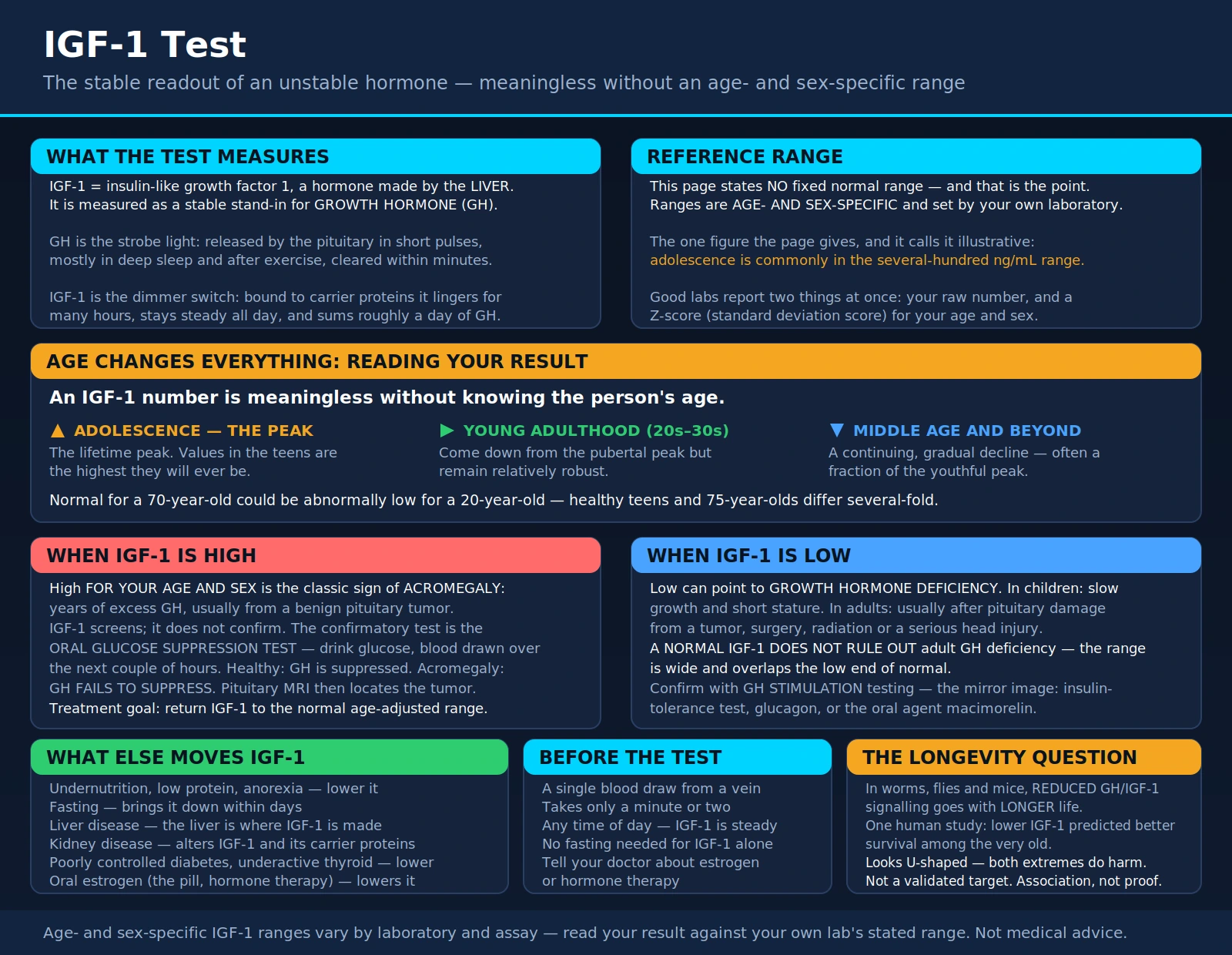
The IGF-1 test measures a hormone in your blood called insulin-like growth factor 1. Despite the name, this test is really a window into a different hormone entirely: growth hormone. Because growth hormone itself is notoriously hard to measure directly — it comes out in short bursts and vanishes within minutes — doctors lean on IGF-1 as a steady, reliable stand-in for how much growth hormone your body is actually producing. The test is ordered most often to investigate two opposite problems: too much growth hormone (a condition called acromegaly) and too little (growth hormone deficiency). One number, read against the right age chart, tells an endocrinologist a great deal. This page explains what IGF-1 is, why it might be ordered for you, how to make sense of a result that changes dramatically with age, and the honest state of the science on IGF-1 and longevity — a topic where the marketing and the research point in genuinely different directions.
Table of Contents
- What IGF-1 Is
- Why the Test Is Ordered
- When IGF-1 Is High (Acromegaly)
- When IGF-1 Is Low (GH Deficiency)
- Age Changes Everything: Reading Your Result
- The Longevity Question
- What Else Moves IGF-1
- Preparing for the Test
- Research Papers
- Connections
- Featured Videos
What IGF-1 Is
IGF-1 stands for insulin-like growth factor 1. It is a hormone your liver makes and releases into the bloodstream, and it is one of the main messengers that carries out the instructions of growth hormone (GH). When you were a child, this partnership is largely what made you grow taller; in adulthood it continues to help maintain muscle, bone, and the ongoing repair of tissues throughout the body. It is called "insulin-like" because its molecular structure resembles insulin, and it has some overlapping, blood-sugar-related effects.
To understand why doctors measure IGF-1 rather than growth hormone itself, picture the difference between a strobe light and a dimmer switch. Growth hormone is the strobe. The pituitary gland, a pea-sized structure at the base of the brain, releases GH in short pulses — brief bursts, concentrated mostly during deep sleep and after exercise — and each pulse is cleared from the blood within minutes. If you drew blood at a random moment, the GH level could be high, low, or nearly undetectable purely by chance, telling you almost nothing about the overall picture.
IGF-1 is the dimmer switch. Every GH pulse prompts the liver to make IGF-1, and IGF-1 lingers in the blood for many hours because it travels bound to carrier proteins that protect it from being broken down. The result is a level that stays remarkably steady across the day and reflects the sum of growth-hormone activity over roughly the previous day. That stability is the whole reason IGF-1 is so useful: a single, ordinary blood draw — taken at any time, no special timing required — captures what would otherwise take repeated sampling to see. In short, IGF-1 is the stable readout of an unstable hormone.
Why the Test Is Ordered
Because IGF-1 mirrors growth-hormone activity, it is the go-to first test whenever a doctor suspects that the GH system is running too fast or too slow. The most common reasons your clinician might order it include:
- Suspected acromegaly — when signs point to too much growth hormone in an adult: gradually enlarging hands and feet (rings and shoes no longer fit), coarsening facial features, a protruding jaw, deepening voice, excessive sweating, headaches, joint pain, or newly diagnosed diabetes and high blood pressure together.
- Suspected growth hormone deficiency — in children who are growing too slowly or are unusually short for their age, and in adults after pituitary damage (from a tumor, surgery, radiation, or head injury).
- Monitoring known pituitary disease — to track how well treatment for acromegaly (surgery, medication, or radiation) is working, or to check hormone replacement in someone with a deficiency.
- Evaluating pituitary tumors — when a growth on the pituitary is found on a brain scan, IGF-1 helps determine whether that tumor is secreting excess growth hormone.
It helps to hold on to one key idea before we look at high and low results: IGF-1 is a screening and monitoring test, not usually the final word by itself. An abnormal IGF-1 tells your doctor which direction to investigate, but a second, dynamic test is almost always used to confirm the diagnosis. Those confirmatory tests are described in the next two sections.
When IGF-1 Is High (Acromegaly)
A high IGF-1 result — specifically, one that is elevated for your age and sex — is the classic sign of acromegaly, a condition in which the body produces too much growth hormone over many years. The usual cause is a small, benign (non-cancerous) tumor of the pituitary gland that keeps churning out GH. The liver responds to that excess GH by making excess IGF-1, and IGF-1 in turn drives the slow overgrowth of tissues that gives the condition its name (from Greek roots meaning "enlarged extremities").
Because the changes happen so gradually — often over a decade or more — they are easy to miss. People and even their doctors may not notice until old photographs are compared side by side. If the excess growth hormone begins in childhood, before the growth plates in the bones have closed, the result is gigantism (unusual tall stature) rather than acromegaly.
Here is the important part about how the diagnosis is actually made. IGF-1 is the excellent screening test: if it comes back high for your age, acromegaly is likely and the workup continues. But the confirmatory test is a clever one called the oral glucose suppression test. You drink a standard sugary glucose solution, and blood is drawn over the next couple of hours. In a healthy person, a surge of blood sugar naturally suppresses growth-hormone release — GH levels drop low. In someone with acromegaly, the tumor ignores that signal and keeps secreting GH, so the level fails to suppress. That failure to switch off, combined with a high IGF-1, confirms the diagnosis. A pituitary MRI is then done to locate the tumor. After treatment, IGF-1 becomes the main number used to judge whether the disease is controlled — the goal is to bring it back into the normal age-adjusted range.
When IGF-1 Is Low (GH Deficiency)
A low IGF-1 can point to the opposite problem: growth hormone deficiency, in which the pituitary does not make enough GH. In children, this can cause slow growth and short stature, and it is one of the reasons a pediatric endocrinologist investigates a child who is falling off their growth curve. In adults, GH deficiency usually follows damage to the pituitary — from a tumor, from surgery or radiation to treat one, or from a serious head injury — and can contribute to fatigue, reduced muscle mass, increased body fat, and lower quality of life.
There is an important honesty caveat here that patients deserve to know: a normal IGF-1 does not rule out adult growth hormone deficiency. Many adults with genuine GH deficiency still have an IGF-1 that falls within the normal range, because the range is wide and overlaps with the low end of normal. So while a clearly low IGF-1 (especially in someone with known pituitary damage) strongly supports the diagnosis, a normal value cannot exclude it.
For that reason, diagnosing GH deficiency does not rest on IGF-1 alone. It is confirmed with GH stimulation testing — the mirror image of the suppression test used for acromegaly. Instead of trying to switch growth hormone off, these tests try to switch it on: a medication or controlled stimulus (such as an insulin-tolerance test, glucagon, or the oral agent macimorelin) is given to provoke the pituitary, and blood is drawn to see whether GH rises as it should. A pituitary that cannot mount an adequate response confirms deficiency. IGF-1, again, is the screening and monitoring tool that frames the question rather than settling it.
Age Changes Everything: Reading Your Result
If you take away one practical lesson from this page, let it be this: an IGF-1 number is meaningless without knowing the person's age. IGF-1 levels are among the most strongly age-dependent of all common blood tests. They are relatively modest in early childhood, peak dramatically during puberty — the adolescent growth spurt is largely IGF-1 in action — and then decline steadily, decade by decade, for the rest of life. A perfectly healthy 15-year-old and a perfectly healthy 75-year-old can have IGF-1 values that differ several-fold, with the teenager far higher. Sex matters too, which is why lab reports use age- and sex-specific reference ranges.
To give a sense of the scale (these are illustrative figures — always compare against your own lab's stated range, because exact numbers vary by the assay used):
- Adolescence — the lifetime peak. Values in the teens are the highest they will ever be, commonly in the several-hundred ng/mL range and sometimes higher.
- Young adulthood (20s–30s) — levels have come down from the pubertal peak but remain relatively robust.
- Middle age and beyond — a continuing, gradual decline, so that healthy older adults often sit at a fraction of their youthful peak.
This is exactly why a result must be interpreted against the right chart. A value that is entirely normal for a 70-year-old could be abnormally low for a 20-year-old, and a value that looks unremarkable at a glance could be abnormally high once matched to an older person's expected range. Good labs report IGF-1 in two ways at once: your raw number, and where that number falls relative to others of your age and sex (sometimes expressed as a "standard deviation score" or Z-score). Reputable clinical assays are increasingly standardized to shared international reference material so that results are more comparable between labs — but the age adjustment is what turns the number into a diagnosis.
The Longevity Question
IGF-1 has become a fixture in anti-aging conversations, and this is a place where it is worth being especially careful and even-handed, because the popular story and the scientific story do not fully agree.
The anti-aging marketing usually runs in one direction: growth hormone and IGF-1 decline with age, therefore raising them — with GH injections, "GH-boosting" supplements, or intense protocols — should restore youth, muscle, and vitality. It is an intuitive pitch, and the decline is real.
The laboratory research, however, points the other way. Across a striking range of species — from microscopic worms and fruit flies to mice — animals with reduced growth-hormone and IGF-1 signaling tend to live longer, not shorter. Mice bred to be dwarfs because they lack GH signaling are among the longest-lived mice known. In humans, the picture is murkier but leans the same way: one study of people with exceptional longevity found that lower IGF-1 levels predicted better survival among the very old, and other work has found that the offspring of centenarians carry genetic variations that dampen IGF-1 signaling. This has led many researchers to view a somewhat lower IGF-1, at least later in life, as potentially protective — the near-opposite of the "boost it" message.
So how should a reader hold these two ideas at once? A few honest points:
- Both extremes carry problems. Clearly high IGF-1 (as in acromegaly) shortens life and raises the risk of several diseases, while clearly low IGF-1 (as in untreated deficiency) causes real harm too. The relationship between IGF-1 and health is not a simple "lower is always better" line; if anything it resembles a U-shape, with a middle zone that appears healthiest.
- Human longevity data are associations, not proof. Finding that lower IGF-1 travels with longer survival does not prove that lowering IGF-1 causes longer life. Many other factors differ between people with high and low levels.
- IGF-1 is not a validated treatment target for longevity. There is currently no established, evidence-based way — and no medical recommendation — to deliberately push your IGF-1 up or down in the name of living longer. This remains an active area of research, genuinely interesting and unsettled, not a finished answer.
The balanced takeaway: the science that links lower IGF-1 to longevity in animals and some human data is real and should make anyone skeptical of "boost your growth hormone to stay young" marketing. But it is not license to chase a low IGF-1 either. For now, IGF-1 is best understood as a diagnostic tool for specific pituitary conditions — not a dial to turn for anti-aging.
What Else Moves IGF-1
Growth hormone is the biggest driver of IGF-1, but it is not the only one. Several everyday and medical factors can raise or lower the level, and knowing them helps explain a result that does not match expectations — and prevents a normal variation from being mistaken for disease.
- Nutrition and protein intake. IGF-1 is exquisitely sensitive to nourishment. Adequate calories and, especially, adequate protein are needed to keep IGF-1 up. Undernutrition, low-protein diets, and eating disorders such as anorexia can lower it substantially — even when growth hormone is normal or high. This is why IGF-1 partly reflects nutritional status, not just the pituitary.
- Fasting. Going without food lowers IGF-1; a sustained fast can bring it down within days. This is one of the biological threads connecting fasting and calorie restriction to the longevity research discussed above.
- Liver disease. Because the liver manufactures IGF-1, significant liver disease can reduce production and lower the blood level regardless of how much growth hormone is present.
- Kidney disease. Impaired kidney function alters IGF-1 and its carrier proteins and can affect the reading.
- Other hormones and conditions. Poorly controlled diabetes and an underactive thyroid tend to lower IGF-1. Estrogen taken by mouth (as in some oral contraceptives or hormone therapy) can lower IGF-1 as well, by changing how the liver responds to growth hormone.
- Age. Worth repeating: the single largest ordinary influence on your IGF-1 is simply how old you are (see the age section).
The practical message is that IGF-1 does not float free of the rest of your health. A low value in someone who is severely undernourished, acutely ill, or has liver disease may reflect that situation rather than a pituitary problem — and a good clinician interprets the number in the context of the whole person.
Preparing for the Test
The IGF-1 test itself is refreshingly simple. It is a single blood draw from a vein in your arm, the same as any routine blood test, and it takes only a minute or two.
- Timing. Because IGF-1 stays steady throughout the day, the blood can usually be drawn at any time — morning or afternoon — without the strict timing that many hormone tests require.
- Fasting. IGF-1 on its own generally does not require fasting, since a single meal has little short-term effect on the level. That said, always follow your own lab's or doctor's instructions, and note that IGF-1 is often ordered alongside other tests (or before the glucose-suppression confirmatory test) that do require fasting — so you may be told not to eat.
- Medications and hormones. Tell your doctor about any medications and supplements, and in particular about estrogen or hormone therapy, which can lower the result. Do not stop any prescribed medication without medical advice.
- Recent illness or nutrition. Let your clinician know if you have been seriously ill, undernourished, or fasting recently, since these can temporarily lower IGF-1 and change how the result should be read.
When your result comes back, resist the urge to judge the raw number on its own. Look at where it falls within the age- and sex-specific range printed on the report, and discuss it with the doctor who ordered it in the context of your symptoms and history. A single IGF-1 is a signpost pointing toward the next step — reassurance, a confirmatory dynamic test, or imaging — not a verdict by itself.
Research Papers
- Katznelson L, Laws ER, Melmed S, et al. Acromegaly: an Endocrine Society clinical practice guideline. Journal of Clinical Endocrinology & Metabolism. 2014;99(11):3933–3951. doi:10.1210/jc.2014-2700 — The authoritative guideline establishing an age-adjusted IGF-1 as the primary screening test for acromegaly, confirmed by failure of growth hormone to suppress during an oral glucose load.
- Molitch ME, Clemmons DR, Malozowski S, et al. Evaluation and treatment of adult growth hormone deficiency: an Endocrine Society clinical practice guideline. Journal of Clinical Endocrinology & Metabolism. 2011;96(6):1587–1609. doi:10.1210/jc.2011-0179 — Explains why a normal IGF-1 cannot exclude adult GH deficiency and why stimulation testing is required to confirm it.
- Bidlingmaier M, Friedrich N, Emeny RT, et al. Reference intervals for insulin-like growth factor-1 (IGF-I) from birth to senescence: results from a multicenter study using a new automated chemiluminescence IGF-I immunoassay conforming to recent international recommendations. Journal of Clinical Endocrinology & Metabolism. 2014;99(5):1712–1721. doi:10.1210/jc.2013-3059 — A large study documenting the strong age dependence of IGF-1 and the age- and sex-specific reference ranges needed to interpret it.
- Clemmons DR. Consensus statement on the standardization and evaluation of growth hormone and insulin-like growth factor assays. Clinical Chemistry. 2011;57(4):555–559. doi:10.1373/clinchem.2010.150631 — The consensus behind standardizing IGF-1 assays so results are comparable across laboratories.
- Giustina A, Chanson P, Bronstein MD, et al. A consensus on criteria for cure of acromegaly. Journal of Clinical Endocrinology & Metabolism. 2010;95(7):3141–3148. doi:10.1210/jc.2009-2670 — Defines a normal age-adjusted IGF-1 as a central target for judging control after acromegaly treatment.
- Milman S, Atzmon G, Huffman DM, et al. Low insulin-like growth factor-1 level predicts survival in humans with exceptional longevity. Aging Cell. 2014;13(4):769–771. doi:10.1111/acel.12213 — Human evidence that, among the very old, lower IGF-1 was associated with better survival — a cornerstone of the longevity discussion.
- Suh Y, Atzmon G, Cho MO, et al. Functionally significant insulin-like growth factor I receptor mutations in centenarians. Proceedings of the National Academy of Sciences. 2008;105(9):3438–3442. doi:10.1073/pnas.0705467105 — Found that offspring of centenarians carry IGF-1 receptor variants that dampen IGF-1 signaling, linking reduced signaling to human longevity.
- Junnila RK, List EO, Berryman DE, Murrey JW, Kopchick JJ. The GH/IGF-1 axis in ageing and longevity. Nature Reviews Endocrinology. 2013;9(6):366–376. doi:10.1038/nrendo.2013.67 — A review laying out why reduced GH/IGF-1 signaling extends lifespan in animal models and the tension this creates with anti-aging GH marketing.
- Fontana L, Weiss EP, Villareal DT, Klein S, Holloszy JO. Long-term effects of calorie or protein restriction on serum IGF-1 and IGFBP-3 concentration in humans. Aging Cell. 2008;7(5):681–687. doi:10.1111/j.1474-9726.2008.00417.x — Shows that in humans it is dietary protein, more than calories alone, that governs IGF-1 — underpinning the nutrition and fasting influences on the test.
- Thissen JP, Ketelslegers JM, Underwood LE. Nutritional regulation of the insulin-like growth factors. Endocrine Reviews. 1994;15(1):80–101. doi:10.1210/edrv-15-1-80 — The foundational review of how undernutrition, fasting, and protein intake lower IGF-1, explaining why the test reflects nutritional status as well as pituitary function.