D-Dimer Test: Fibrin Degradation and Clot Detection
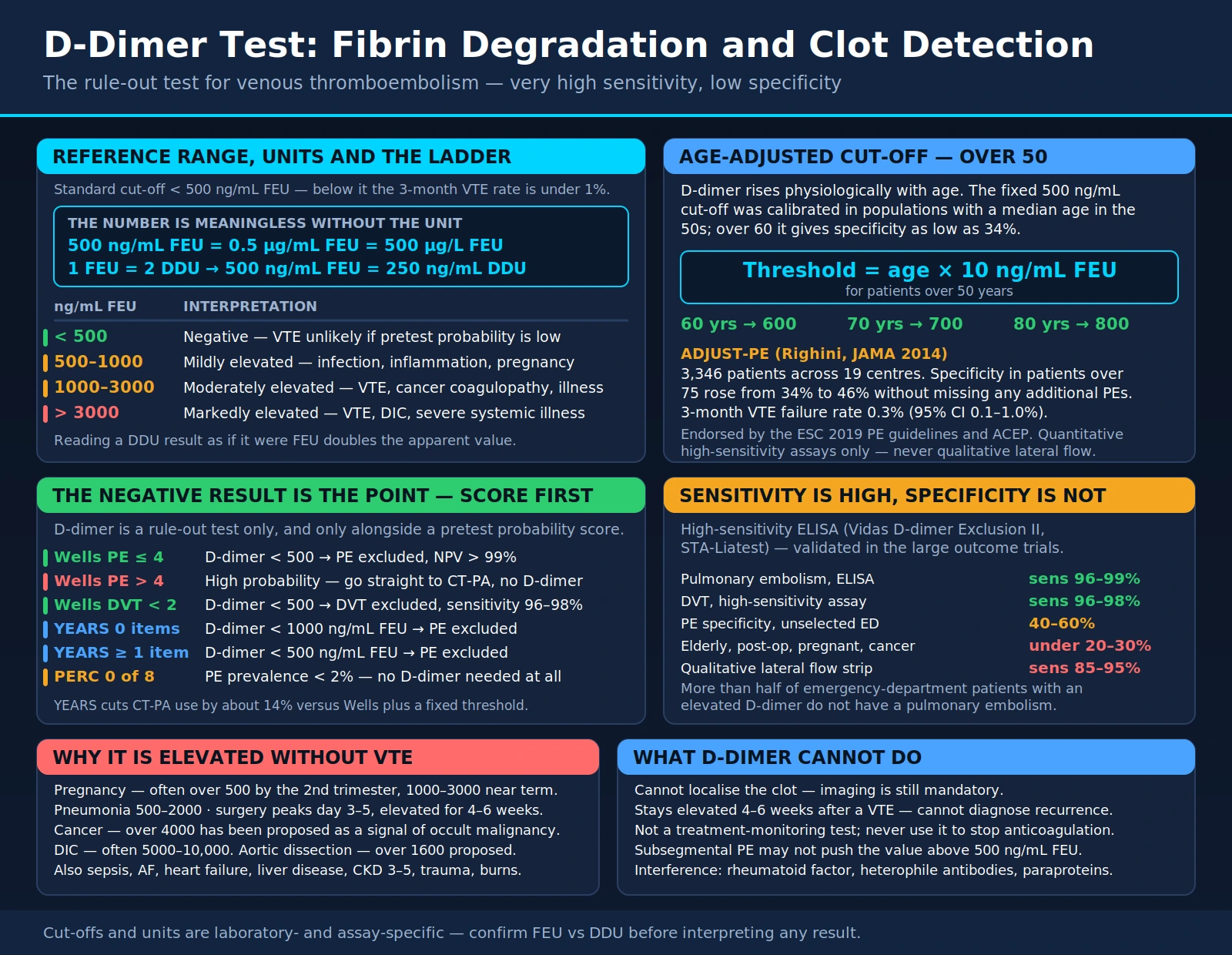
D-dimer is a fibrin degradation product released when cross-linked fibrin clots are broken down by plasmin. It is the most widely used biomarker for ruling out venous thromboembolism (VTE), including deep vein thrombosis (DVT) and pulmonary embolism (PE). Its clinical value lies in its very high sensitivity — a negative result effectively excludes significant clot activity — but it has low specificity because many conditions elevate it.
Table of Contents
- Overview — What Is D-Dimer?
- Biochemistry — How D-Dimer Is Formed
- How the Test Works
- Reference Ranges and Units
- Wells Score and Clinical Decision Rules
- Age-Adjusted D-Dimer Threshold
- Causes of Elevated D-Dimer
- D-Dimer in DIC and Critical Illness
- Pregnancy and Other Special Populations
- COVID-19 and D-Dimer
- Quantitative vs. Qualitative Assays
- Limitations and False Positives
- Anticoagulation Duration and the HERDOO2 Rule
- Key Research and Citations
- Connections
- Featured Videos
Overview — What Is D-Dimer?
D-dimer is a small protein fragment produced when a blood clot (thrombus) dissolves. The name refers to a specific structural feature of fibrin: after thrombin converts soluble fibrinogen into insoluble fibrin monomers, Factor XIIIa (a transglutaminase activated by thrombin) cross-links adjacent fibrin D domains together, forming a stable, reinforced clot. When the body's fibrinolytic system — driven primarily by plasmin — eventually degrades this cross-linked fibrin network, it releases fragments called D-dimer, named for the two D domains that remain covalently joined after plasmin cleaves the fibrin polymer.
Because D-dimer reflects both clot formation and clot dissolution, it is a marker of active clotting activity anywhere in the body, not just in a specific vascular territory. A detectable D-dimer tells you that fibrin has been laid down and is being broken down somewhere — it does not tell you where, and it does not tell you how much. This is the fundamental reason for its high sensitivity and low specificity: any process that activates coagulation will eventually produce D-dimer, from a tiny wound to a massive pulmonary embolism.
Clinically, D-dimer entered widespread use in the 1990s as a rule-out test for venous thromboembolism. A negative D-dimer result — below the established threshold — in a patient with low or intermediate pre-test probability effectively excludes clinically significant VTE, sparing patients from unnecessary radiation exposure during CT pulmonary angiography or the cost and discomfort of lower-extremity compression ultrasound. This negative predictive value, approaching 99% in validated algorithms, is the test's greatest clinical asset.
The coagulation cascade responsible for D-dimer production has two pathways: the intrinsic pathway (contact activation via Factor XII, XI, IX, VIII) and the extrinsic pathway (tissue factor plus Factor VII). Both converge on a common pathway involving Factor X, Factor V, prothrombin (Factor II), thrombin, and finally fibrinogen. D-dimer appears at the very end of this process — after the clot has already formed and after plasmin has acted. Understanding this timing is important: D-dimer may be normal early in clot formation and may remain elevated for weeks after a clot has been treated.
Biochemistry — How D-Dimer Is Formed
D-dimer is the end product of a precise two-stage sequence: a clot must first be built and chemically reinforced, and then it must be enzymatically taken apart. Neither step alone produces D-dimer. This is why the molecule is such a specific marker of completed clot turnover rather than of coagulation activity in the abstract.
Step 1: Cross-Linked Fibrin Clot Formation
When coagulation is triggered — by tissue factor exposure, endothelial injury, or contact activation — thrombin cleaves fibrinopeptides A and B from circulating fibrinogen, converting it into soluble fibrin monomers. These monomers polymerize spontaneously into fibrin protofibrils, which associate laterally into fibers. Thrombin simultaneously activates Factor XIII into Factor XIIIa, a transglutaminase that forms covalent bonds between the gamma chains of adjacent fibrin monomers and, more slowly, between their alpha chains. The resulting cross-linked polymer is mechanically stronger and far more resistant to enzymatic digestion than uncross-linked fibrin.
Step 2: Plasmin-Mediated Fibrinolysis
Tissue plasminogen activator (t-PA), released from endothelial cells, converts fibrin-bound plasminogen into plasmin, the principal fibrinolytic enzyme. Plasmin cleaves fibrin at specific lysine and arginine residues throughout the clot. Because Factor XIIIa has already welded the gamma chains together, plasmin cannot fully disassemble the polymer into its original subunits; instead it liberates a characteristic set of fragments. The smallest stable fragment released from the cross-linked D-domain interface is D-dimer — two D fragments from neighboring fibrin monomers still joined through their gamma-chain bond, with a molecular weight of roughly 180 kDa.
Why the Cross-Link Matters Analytically
D-dimer cannot be generated from fibrinogen, and it cannot be generated from soluble, uncross-linked fibrin. That biochemical constraint is what allows monoclonal antibody assays to distinguish true D-dimer from the large pool of circulating fibrinogen and from generic fibrin(ogen) degradation products. It also explains the interpretive rule that follows from it: a raised D-dimer means a clot was built and is being dismantled — whether that clot is a deep vein thrombus, a pulmonary embolus, a surgical wound, a resolving hematoma, or the diffuse microthrombi of disseminated intravascular coagulation.
How the Test Works
D-dimer is measured from a plasma sample collected in a citrate (blue-top) tube. The citrate anticoagulant chelates calcium, preventing the sample from clotting further ex vivo. The plasma is then separated by centrifugation and analyzed by immunoassay. The key analytical principle is that modern D-dimer assays use monoclonal antibodies that recognize a specific epitope present only on cross-linked fibrin degradation products — not on fibrinogen, not on soluble fibrin monomers, and not on non-cross-linked fibrin degradation products. This specificity for the cross-linked D-dimer epitope is what makes the test clinically meaningful.
Three main assay formats are in common use:
- Enzyme-linked immunosorbent assay (ELISA): Considered the gold standard for analytical sensitivity. The Vidas D-dimer Exclusion II (bioMerieux) and STA-Liatest (Stago) are the two assays most extensively validated in large clinical trials. ELISA-based assays achieve sensitivities of 96–99% for pulmonary embolism and are the only assays definitively validated for use with age-adjusted thresholds and the YEARS algorithm. Turnaround time is typically 2–4 hours in a central laboratory.
- Latex agglutination / immunoturbidimetric assays: Automated analyzers use latex particles coated with anti-D-dimer antibodies. When D-dimer is present, particle agglutination increases turbidity, which is measured photometrically. These assays are faster (20–30 minutes) and suitable for batch processing on high-throughput hematology analyzers. Sensitivity is slightly lower than ELISA but adequate for most clinical algorithms when performed on validated platforms.
- Whole-blood rapid lateral flow assays: Point-of-care tests such as the SimpliRED allow testing without centrifugation. A drop of whole blood is applied to a test strip; visible agglutination indicates a positive result. These qualitative tests have lower sensitivity (approximately 85–90%) and should be used only in patients with low pre-test probability where a quantitative assay is unavailable. They cannot be used with age-adjusted thresholds.
Sample stability is important: D-dimer is relatively stable in citrated plasma for 8 hours at room temperature and up to 24 hours refrigerated. Hemolyzed or lipemic samples may interfere with turbidimetric assays. Rheumatoid factor and heterophile antibodies can occasionally cause false-positive results, though this is uncommon.
Reference Ranges and Units
The standard D-dimer threshold used across most major guidelines is < 500 ng/mL FEU (fibrinogen equivalent units). This cutoff was established through large prospective outcome studies demonstrating that patients with D-dimer below this value and low-to-intermediate clinical probability have a 3-month VTE rate below 1%, which is the accepted threshold for "safely excluded" in thromboembolism medicine.
Units are a common source of confusion because different laboratories and different countries use different reporting conventions:
- FEU (fibrinogen equivalent units): The most common unit in North American and most European laboratories. Standard cutoff: 500 ng/mL FEU. Some labs report in µg/mL FEU (same values, different denomination: 500 ng/mL = 0.5 µg/mL).
- DDU (D-dimer units): Used by some European laboratories and some point-of-care devices. The conversion factor is: 1 FEU = 2 DDU. Therefore, 500 ng/mL FEU equals 250 ng/mL DDU. A lab reporting 250 ng/mL DDU is equivalent to 500 ng/mL FEU — a result that falls exactly at the cutoff. Misinterpreting DDU as FEU would double the apparent result.
- µg/L: Numerically identical to ng/mL; 500 ng/mL = 500 µg/L FEU.
Always confirm the reporting units before interpreting a D-dimer result. A value of 450 is normal in FEU but elevated in DDU-equivalent FEU terms — the number alone is meaningless without the unit. Laboratory reports should state both the value and the unit; if the unit is absent, call the laboratory.
Approximate interpretation ranges (FEU):
- Normal / Negative: < 500 ng/mL FEU — significant VTE unlikely in low/intermediate pre-test probability patients
- Mildly elevated: 500–1000 ng/mL FEU — requires clinical correlation; often seen in infection, inflammation, pregnancy
- Moderately elevated: 1000–3000 ng/mL FEU — raises concern for VTE, cancer-associated coagulopathy, or systemic illness
- Markedly elevated: > 3000 ng/mL FEU — strongly associated with VTE, DIC, or severe systemic illness; markedly elevated in COVID-19 with thrombotic complications
Wells Score and Clinical Decision Rules
D-dimer is validated as a rule-out test when combined with structured clinical pre-test probability scoring. Using D-dimer in isolation — without a pre-test probability assessment — is a common clinical error that leads to unnecessary imaging in large numbers of patients with non-specific D-dimer elevations. The major validated clinical decision algorithms are:
Wells PE Score (Pulmonary Embolism)
The Wells PE score assigns points for clinical findings:
- Clinical signs/symptoms of DVT: 3 points
- PE is the #1 diagnosis or equally likely: 3 points
- Heart rate > 100 bpm: 1.5 points
- Immobilization for 3 or more days, or surgery in prior 4 weeks: 1.5 points
- Previous DVT or PE: 1.5 points
- Hemoptysis: 1 point
- Malignancy (active or treated within 6 months): 1 point
Score interpretation: ≤4 = low/intermediate probability. In this group, if D-dimer is < 500 ng/mL FEU, PE is excluded with a negative predictive value >99%. Score >4 = high probability — proceed directly to CT pulmonary angiography without D-dimer testing.
Wells DVT Score (Deep Vein Thrombosis)
The Wells DVT score uses a different, leg-focused set of criteria. Each of the following adds 1 point:
- Active cancer — treatment ongoing, or within the previous 6 months, or palliative
- Paralysis, paresis, or recent plaster immobilization of the leg
- Recently bedridden more than 3 days, or major surgery within the previous 12 weeks
- Localized tenderness along the distribution of the deep venous system
- Entire leg swollen
- Calf swelling more than 3 cm greater than the asymptomatic side
- Pitting edema confined to the symptomatic leg
- Collateral superficial veins that are not varicose
One criterion subtracts points: if an alternative diagnosis is at least as likely as DVT, subtract 2 points.
Score interpretation: <2 points = DVT unlikely (low probability) → order D-dimer; a result < 500 ng/mL FEU excludes DVT with sensitivity approximately 96–98%, avoiding the need for compression ultrasound. Score ≥2 points = DVT likely → proceed directly to compression ultrasound.
YEARS Algorithm
The YEARS algorithm (van der Hulle et al., Lancet 2017) uses three clinical items plus D-dimer with a variable threshold:
- Clinical signs of DVT
- Hemoptysis
- PE most likely diagnosis
If 0 YEARS items present and D-dimer < 1000 ng/mL FEU → PE excluded. If 1 or more YEARS items present and D-dimer < 500 ng/mL FEU → PE excluded. This algorithm reduces CT pulmonary angiography use by approximately 14% compared to standard Wells + fixed-threshold D-dimer, primarily by allowing a higher D-dimer threshold in patients with 0 YEARS criteria.
PERC Rule (Pulmonary Embolism Rule-Out Criteria)
In patients with a prevalence of PE below approximately 2%, the PERC rule can exclude PE without any testing at all. If all eight criteria are absent (age <50, pulse <100, O2 sat ≥95%, no unilateral leg swelling, no hemoptysis, no recent surgery/trauma within 4 weeks, no prior DVT/PE, no exogenous estrogen), D-dimer is not needed. The PERC rule avoids the trap of ordering a D-dimer in a very-low-probability patient whose slightly elevated non-specific result would then trigger imaging.
PERC is intended for patients in whom the clinician's unstructured (gestalt) estimate of PE probability is already below roughly 15% — it is a tool for stopping a workup that should arguably never have started, not for stratifying patients who genuinely look like they might have PE. The criteria were derived and prospectively validated by Kline et al. (J Thromb Haemost 2004, PMID 15304025), where a PERC-negative assessment carried a false-negative rate of approximately 1.7% — below the threshold at which the harms of further testing (radiation, contrast nephropathy, incidental findings) outweigh the benefit of pursuing the diagnosis.
Age-Adjusted D-Dimer Threshold
The traditional 500 ng/mL FEU cutoff was calibrated in study populations with a median age in the 50s. In older patients, D-dimer rises physiologically with age — reflecting increased background fibrinolytic activity, subclinical vascular disease, and reduced renal clearance. Using the 500 ng/mL fixed threshold in patients over 60 yields specificity as low as 34%, meaning up to two-thirds of elderly patients with elevated D-dimer will undergo CT pulmonary angiography that reveals no PE. This exposes older patients to contrast nephropathy risk and cumulative radiation unnecessarily.
The age-adjusted D-dimer threshold, validated in the landmark ADJUST-PE trial (Righini et al., JAMA 2014, PMID 24643601), addresses this problem:
- Formula: For patients over 50 years old → threshold = age × 10 ng/mL FEU
- Examples: 60-year-old → 600 ng/mL FEU; 70-year-old → 700 ng/mL FEU; 80-year-old → 800 ng/mL FEU
- ADJUST-PE results: In 3,346 patients with suspected PE across 19 centers, the 3-month failure rate among those with a D-dimer above 500 µg/L but below their age-adjusted cutoff was 1 of 331 patients — 0.3% (95% CI 0.1–1.7%), within the accepted safety margin. Among the 673 patients aged 75 or older with a non-high clinical probability, the age-adjusted cutoff raised the proportion in whom PE could be excluded on D-dimer alone from 6.4% to 29.7%, with no additional false-negative findings in that group.
- Imaging avoided: ADJUST-PE enrolled patients across Europe and the United States who had a Wells score of 4 or less. Among those aged 75 and over, the proportion in whom PE could be excluded on clinical probability plus D-dimer alone — with no imaging at all — rose from 6.4% under the fixed 500 ng/mL FEU cutoff to 29.7% under the age-adjusted cutoff. That is the practical payoff: roughly one in three very elderly patients avoids the scanner instead of roughly one in sixteen.
- Independent confirmation: Schouten et al. (BMJ 2013, PMID 23645857) reached the same conclusion in a systematic review and meta-analysis of older patients with suspected VTE, finding that age-adjusted cut-off values substantially improved specificity without a meaningful loss of sensitivity.
The age-adjusted threshold is now endorsed by the European Society of Cardiology (ESC) 2019 PE Guidelines and the American College of Emergency Physicians (ACEP) as a safe alternative to the fixed threshold in patients over 50 with low-to-intermediate pre-test probability. It applies only to high-sensitivity quantitative assays (ELISA or validated turbidimetric) — not to qualitative lateral flow assays.
An important practical note: the age-adjusted threshold applies only when D-dimer is being used to exclude PE in a patient where the pre-test probability is low or intermediate. In patients with high pre-test probability (Wells score >4), no D-dimer threshold excludes PE — CT-PA is required regardless of the D-dimer result. Similarly, in patients with 1 or more YEARS criteria, the 500 ng/mL threshold applies, not the age-adjusted threshold.
When Not to Use the Age-Adjusted Threshold
The age-adjusted cutoff has never been validated in three specific groups, and should not be applied to them:
- Pregnancy. The formula was derived in non-pregnant populations, and pregnancy raises D-dimer through a mechanism unrelated to age.
- Active malignancy. Cancer produces a chronic baseline elevation that the age term does not model.
- Moderate-sensitivity or qualitative assays. The threshold assumes a high-sensitivity quantitative platform; applying it to a point-of-care lateral flow test is not supported by any trial.
In each of these groups, use the standard threshold or go directly to imaging.
Causes of Elevated D-Dimer
Because D-dimer reflects clot formation and dissolution anywhere in the body, any condition that activates coagulation or triggers inflammation with fibrin deposition can elevate it. The list is extensive, which is precisely why D-dimer is a poor rule-in test despite being an excellent rule-out test.
Thrombotic Conditions (Primary Indications)
- Deep vein thrombosis (DVT): The primary clinical indication. D-dimer sensitivity for DVT is 96–98% using high-sensitivity assays. Clot burden matters: proximal DVT of the popliteal, femoral, or iliac veins produces substantially higher values than isolated distal (calf) DVT, and bilateral or extensive iliofemoral thrombosis can push results into the thousands.
- Pulmonary embolism (PE): Sensitivity 96–99% for high-sensitivity ELISA assays. Specificity only 40–60% in ED populations. Even a small PE usually clears the 500 ng/mL FEU threshold, while a large central or saddle embolus may reach 2,000–10,000 ng/mL FEU.
- Arterial thrombosis: Myocardial infarction and acute peripheral arterial occlusion also activate coagulation and fibrinolysis and raise D-dimer. The rule-out algorithms described on this page were built for venous thromboembolism and do not transfer to arterial events — a normal D-dimer does not exclude an acute coronary syndrome.
- Cerebral venous sinus thrombosis: D-dimer is elevated in most cases and can serve as a triage marker for MRI venography.
- Aortic dissection: Markedly elevated D-dimer (>1600 ng/mL FEU) has been proposed as a rule-out marker for aortic dissection in some algorithms, though it is not yet standard of care.
- Mesenteric vein thrombosis: Usually associated with markedly elevated D-dimer.
Physiological Elevation
- Pregnancy: D-dimer rises progressively through pregnancy, often exceeding 500 ng/mL FEU by the second trimester and reaching 1000–3000 ng/mL FEU near term, even without VTE. Trimester-specific thresholds have been proposed but are not universally adopted. Clinical VTE workup in pregnant patients typically requires compression ultrasound as the primary tool.
- Older age: As discussed above, physiological rise with age is well-documented and addressed by age-adjusted thresholds.
- Neonates: D-dimer is physiologically elevated in the first weeks of life due to fibrinolytic remodeling.
Inflammatory and Infectious Conditions
- Sepsis and ARDS: One of the most common causes of markedly elevated D-dimer in the ICU. Bacterial toxins and inflammatory cytokines drive tissue factor expression on monocytes and endothelial cells, activating the coagulation cascade broadly; acute respiratory distress syndrome adds intra-alveolar and microvascular fibrin deposition on top of that. Values in the 1,000–5,000 ng/mL FEU range are routine in septic patients without any demonstrable DVT or PE. D-dimer elevation in sepsis correlates with the development of disseminated intravascular coagulation (DIC).
- Pneumonia: Pulmonary infection causes local fibrin deposition, elevating D-dimer to 500–2000 ng/mL FEU range, frequently mimicking PE clinically and biochemically.
- Inflammatory bowel disease: Active Crohn's disease or ulcerative colitis is associated with a hypercoagulable state and D-dimer elevation.
- Autoimmune diseases: Lupus, antiphospholipid syndrome, and rheumatoid arthritis are associated with elevated D-dimer due to vascular inflammation.
Malignancy
- Cancer-associated coagulopathy: Many tumors constitutively express tissue factor and other procoagulant molecules, creating a chronic low-grade hypercoagulable state (Trousseau syndrome). Pancreatic, lung, colorectal, and ovarian cancers are particularly associated with high D-dimer. D-dimer >4000 ng/mL FEU has been proposed as a screening signal for occult malignancy.
- Magnitude by disease burden: Elevation ranges from mild — a localized solid tumor with no active thrombosis — to marked, in hematologic malignancies and widely metastatic disease. A D-dimer that stays persistently elevated with no other explanation is a reasonable prompt for age-appropriate cancer screening, though it is not by itself a cancer test.
Post-Procedural and Traumatic
- Surgery: Major surgery causes fibrin deposition at wound sites; D-dimer peaks 3–5 days postoperatively and may remain elevated for 4–6 weeks, making VTE rule-out biochemically unreliable in this period. Imaging is preferred in post-operative patients with VTE suspicion.
- Trauma: Any significant traumatic injury activates coagulation both at wound sites and systemically.
- Burns: Extensive burns trigger systemic inflammatory and coagulation activation.
Cardiovascular
- Atrial fibrillation: Stasis within the left atrial appendage promotes intracardiac thrombus formation and D-dimer elevation, even in anticoagulated patients.
- Heart failure: Venous stasis, endothelial dysfunction, and reduced hepatic clearance all contribute to D-dimer elevation.
- Aortic aneurysm: Mural thrombus within an aneurysm continuously produces D-dimer.
Hematologic
- Disseminated intravascular coagulation (DIC): The most extreme cause of D-dimer elevation — values often exceed 5000–10,000 ng/mL FEU. DIC involves simultaneous widespread clot formation and fibrinolysis, consuming platelets and clotting factors. D-dimer is part of the DIC scoring system (ISTH score).
- Sickle cell disease: Chronic vaso-occlusion and vascular inflammation maintain elevated baseline D-dimer, complicating VTE workup in this population.
- Hemolytic anemia: Intravascular hemolysis releases hemoglobin, which can activate coagulation and elevate D-dimer.
Organ Dysfunction
- Liver disease: The liver is responsible for clearing fibrin degradation products. In cirrhosis or acute liver failure, impaired clearance leads to D-dimer accumulation independent of active clot formation. The liver also synthesizes most coagulation factors and inhibitors, including plasminogen activator inhibitor-1 (PAI-1), so hepatic failure produces a complex mixed coagulopathy rather than a simple clearance defect.
- Kidney disease: CKD stages 3–5 are associated with elevated baseline D-dimer due to reduced renal clearance and increased vascular inflammation.
- Stroke: Ischemic stroke triggers local and sometimes systemic coagulation activation.
D-Dimer in DIC and Critical Illness
Disseminated intravascular coagulation is the condition in which D-dimer reaches its most extreme values, and it is also the condition in which the test earns a formal, scored diagnostic role rather than a rule-out role. DIC is simultaneous, widespread coagulation activation and fibrinolysis: microthrombi form throughout the circulation while platelets and clotting factors are consumed, so the patient can be thrombosing and bleeding at the same time.
The ISTH DIC Score
The International Society on Thrombosis and Haemostasis scoring system (Taylor et al., Thromb Haemost 2001, PMID 11816725) gives D-dimer — or any fibrin-related marker — a central weighting:
- No increase: 0 points
- Moderate increase: 2 points
- Strong increase (roughly 10-fold or more above normal): 3 points
Three other parameters complete the score: platelet count, prolongation of the prothrombin time, and fibrinogen level. A total score of 5 or more is compatible with overt DIC and should trigger immediate treatment of the underlying cause. The characteristic laboratory signature is a markedly high D-dimer combined with prolonged PT and aPTT, falling platelet count, and a low or rapidly falling fibrinogen — a pattern that separates DIC from the isolated D-dimer rise seen in ordinary VTE, where PT, aPTT, platelets, and fibrinogen are typically normal.
DIC Always Has a Trigger
DIC is never a primary diagnosis. It is a downstream consequence, and finding the precipitant is the treatment. The common triggers are:
- Sepsis — the single most common cause, accounting for roughly a third of cases
- Major trauma with massive tissue injury, crush injury, or fat embolism
- Obstetric emergencies — placental abruption, amniotic fluid embolism, HELLP syndrome, retained products of conception
- Acute leukemia, especially acute promyelocytic leukemia, whose blasts release large amounts of tissue factor and cause severe DIC that can worsen transiently at the start of treatment
- Acute hemolytic transfusion reactions
- Snake envenomation, particularly by viperid species whose venom contains procoagulant enzymes
In the intensive care unit, a rising D-dimer in a patient with any of these conditions is a signal to complete the full DIC panel rather than to order a CT pulmonary angiogram. The reverse error — attributing a very high D-dimer to DIC and skipping imaging in a patient who actually has a large PE — is equally possible, which is why the score, not the single number, drives the decision.
Pregnancy and Other Special Populations
Some populations have a physiologically shifted D-dimer baseline that invalidates the standard cutoff. In each case the problem is the same: the patients whose baseline is highest are often the patients at greatest thrombotic risk, so the test loses discriminating power exactly where it would be most useful.
Pregnancy: Physiology
Pregnancy is a deliberate hypercoagulable state — an evolutionary hedge against hemorrhage at delivery. Fibrinogen concentration roughly doubles. Factors VII, VIII, X, and XII rise. Protein S, a natural anticoagulant, falls. Overall fibrinolytic activity decreases. The net effect is more fibrin turnover and therefore more D-dimer, with no thrombus anywhere.
Pregnancy: The Trimester Pattern
- First trimester: mild elevation; many healthy patients are still below 500 ng/mL FEU.
- Second trimester: moderate elevation; the standard cutoff is frequently exceeded in entirely normal pregnancies.
- Third trimester: marked elevation, in the range described in the pregnancy entry above.
- Post-partum: remains elevated for approximately 4–6 weeks after delivery before returning to baseline.
Pregnancy: What to Do Instead
There are no universally adopted trimester-specific reference ranges, and the age-adjusted formula has not been validated in pregnancy. Guidance from ACOG and the ESC is to still apply the Wells score, and to recognize that a D-dimer below the standard 500 ng/mL FEU threshold retains its rule-out value in a first-trimester patient with low pre-test probability. By the second and third trimesters, a negative result becomes uncommon enough that the test rarely changes management: bilateral compression ultrasound is the preferred first study for suspected DVT, and CT pulmonary angiography with abdominal shielding — or ventilation-perfusion scanning — is preferred for suspected PE.
Active Malignancy
Patients with active cancer carry a chronically elevated D-dimer, so the standard exclusion algorithm is unreliable in both directions. A result below 500 ng/mL FEU is still somewhat reassuring, but an elevated result has such poor specificity in this group that it adds almost nothing to the pre-test probability. Current guidance is to proceed directly to compression ultrasound or CT pulmonary angiography in a cancer patient with symptoms suggestive of VTE, rather than routing the decision through a D-dimer.
COVID-19 and D-Dimer
The COVID-19 pandemic brought D-dimer into mainstream clinical awareness, as SARS-CoV-2 infection was rapidly recognized to cause a distinctive hypercoagulable state now termed COVID-19-associated coagulopathy (CAC). Unlike classical DIC — which features consumption of clotting factors and bleeding — CAC is characterized by markedly elevated D-dimer and fibrinogen with relatively preserved platelet counts and coagulation times, pointing to a prothrombotic rather than consumptive process.
Mechanisms of COVID-19 Hypercoagulability
- Direct endothelial injury: SARS-CoV-2 enters cells via ACE2 receptors, which are expressed on endothelial cells throughout the pulmonary vasculature. Viral infection of endothelium exposes subendothelial tissue factor, triggering the extrinsic coagulation pathway.
- Cytokine storm: Elevated IL-6, IL-1β, and TNF-α suppress natural anticoagulants (Protein C, Protein S, antithrombin) while upregulating plasminogen activator inhibitor-1 (PAI-1), which suppresses fibrinolysis. This dual effect — increased clot formation + decreased clot dissolution — amplifies D-dimer elevation.
- Complement activation: SARS-CoV-2 activates the complement system, particularly via the lectin pathway, leading to platelet activation and microthrombi formation.
- Neutrophil extracellular traps (NETs): COVID-19 triggers extensive NETosis; DNA-histone complexes released by neutrophils act as a scaffold for fibrin deposition and activate Factor XII, further amplifying the thrombotic response.
D-Dimer as a COVID-19 Severity and Mortality Predictor
Across numerous observational cohorts published during 2020–2022, elevated D-dimer on hospital admission consistently predicted worse outcomes:
- D-dimer > 1000 ng/mL FEU on admission predicts ICU admission, mechanical ventilation, and in-hospital death in multiple cohort studies.
- In the analysis by Tang et al. (J Thromb Haemost 2020, PMID 32220112), D-dimer > 3000 ng/mL FEU was associated with significantly increased mortality; anticoagulation in patients with elevated D-dimer reduced mortality by 63% in those meeting DIC criteria.
- D-dimer > 6× the upper limit of normal (approximately 3000 ng/mL FEU) was associated with a 5–10-fold increase in mortality risk in pooled meta-analyses.
- In a separate earlier report from the same group — Tang et al., J Thromb Haemost 2020, PMID 32073213 — non-survivors of COVID-19 pneumonia had admission D-dimer levels roughly 4-fold higher than survivors, alongside prolonged prothrombin time and elevated fibrin degradation products. This was one of the first signals that the illness carried a coagulopathic component rather than being purely a pneumonia.
COVID-Associated Pulmonary Embolism
The incidence of pulmonary embolism in hospitalized COVID-19 patients was strikingly high in early pandemic series:
- Klok et al. (Thromb Res 2020, PMID 32291094) reported thrombotic complications in 31% of 184 ICU patients, including PE in 27%, despite standard thromboprophylaxis.
- Many of these PEs were in the distal segmental and subsegmental vessels — consistent with in-situ immunothrombosis rather than classic embolic PE.
- Serial daily D-dimer monitoring in COVID-19 ICU patients guided decisions about escalation to intermediate-dose or therapeutic anticoagulation.
Long COVID and D-Dimer
In some patients with Long COVID (post-acute sequelae of SARS-CoV-2 infection), persistent symptoms including fatigue, dyspnea, and brain fog have been linked to ongoing microclot formation. Fibrin amyloid microclots — identified by fluorescent microscopy — have been reported in blood samples from Long COVID patients, and some studies have found modestly elevated D-dimer persisting months after acute infection, though this remains an area of active research rather than established clinical practice.
Quantitative vs. Qualitative Assays
The distinction between quantitative and qualitative D-dimer assays has significant implications for which clinical algorithms can be applied and how results should be interpreted.
Quantitative Assays
Quantitative assays provide a numeric result in ng/mL FEU (or DDU). Their advantages include:
- Enable use of age-adjusted thresholds (age × 10 ng/mL FEU for patients over 50)
- Enable use of YEARS algorithm (variable threshold of 1000 vs. 500 ng/mL FEU based on criteria present)
- Allow severity risk stratification — the degree of D-dimer elevation carries prognostic information
- Can be used to monitor trends in conditions such as DIC or COVID-19 coagulopathy
- High-sensitivity ELISA platforms (Vidas D-dimer Exclusion II, STA-Liatest D-dimer, IL-Test D-dimer) are validated in the largest outcome trials and achieve sensitivities of 96–99% for PE
Qualitative Assays
Qualitative assays produce a binary positive/negative result based on a fixed cutoff. They are appropriate only for:
- Point-of-care settings where laboratory analysis is unavailable or delayed
- Low-pretest-probability patients only — cannot be used with age-adjusted or YEARS thresholds
- Rapid triage decisions pending quantitative confirmation
Qualitative lateral flow assays fall short of the 96% sensitivity generally required for safe VTE exclusion (see the figure under How the Test Works). A negative qualitative result should be interpreted cautiously in moderate-probability patients.
High-Sensitivity vs. Standard Assays
Not all quantitative assays are equivalent. The major clinical trials (Christopher Study, ADJUST-PE, YEARS) were conducted using specific high-sensitivity ELISA assays. When a clinical decision rule specifies "sensitive assay required," this means a platform with documented sensitivity ≥96% for PE in prospective studies — not simply any automated turbidimetric analyzer. Before applying algorithmic D-dimer thresholds, confirm that your laboratory's specific assay has been validated in this way. The assay's manufacturer documentation and institutional validation studies should be consulted. The major guideline bodies — the ESC, ACEP, and the AHA — all specify that only high-sensitivity assays may be substituted into the validated Wells-plus-D-dimer algorithm.
Limitations and False Positives
Understanding the limitations of D-dimer testing is as important as understanding its strengths. Overreliance on D-dimer — particularly in populations where specificity is low — leads to high rates of unnecessary imaging, contrast exposure, and radiation risk.
Low Specificity in General Populations
The fundamental limitation of D-dimer is that it is elevated by dozens of conditions other than VTE. In unselected emergency department populations, specificity for PE is approximately 40–60%, meaning that more than half of patients with elevated D-dimer do not have PE. In elderly patients (over 75), hospitalized patients, post-operative patients, pregnant women, and cancer patients, specificity can fall below 20–30%. Using D-dimer alone, without clinical probability assessment, leads to vast overtesting.
Cannot Localize the Clot
D-dimer elevation tells you that clot has formed and is being dissolved somewhere in the body. It cannot tell you whether the source is a leg vein, pulmonary artery, portal vein, cerebral sinus, or coronary artery. Imaging remains mandatory to confirm the diagnosis and guide site-specific therapy.
Cannot Distinguish Old from New Clot Activity
D-dimer may remain elevated for 4–6 weeks after an acute VTE event, even while the patient is being successfully treated with anticoagulation. This makes D-dimer unreliable for diagnosing recurrent VTE in patients with recent prior VTE — a new elevation cannot be distinguished from persistent elevation from the prior event.
Not Useful for Treatment Monitoring
D-dimer is not a reliable marker of anticoagulation response. Levels typically fall with successful treatment but the kinetics are variable and affected by the underlying condition, not just the anticoagulant. D-dimer should not be used to decide when to stop anticoagulation or to dose-adjust therapy.
Post-Surgical and Post-Trauma Populations
Major surgery virtually guarantees D-dimer elevation for several weeks postoperatively due to wound healing and fibrinolysis at surgical sites. In this population, a negative D-dimer is less reliable for VTE exclusion, and imaging (particularly compression ultrasound) is preferred as the primary evaluation tool.
Analytical Interference
Rheumatoid factor (at high titers) and heterophile antibodies can cause false-positive results in immunoassays using certain antibody pairs. Severely hemolyzed or lipemic samples may interfere with turbidimetric assays. Paraproteins (as in multiple myeloma) occasionally interfere. If a D-dimer result seems discordant with the clinical picture, repeat testing on a different platform or assay format may be informative.
Subsegmental PE Controversy
Some subsegmental PEs (distal, small clots in peripheral pulmonary arteries) may not generate D-dimer levels above 500 ng/mL FEU, particularly in ambulatory patients. The clinical significance of these incidental subsegmental PEs — increasingly detected on high-resolution CT — is debated, and their management remains controversial.
Anticoagulation Duration and the HERDOO2 Rule
The caution above — that D-dimer should not be used to titrate or monitor anticoagulation — holds for day-to-day management. There is one narrowly validated exception, and it is worth knowing precisely because it is so easy to over-generalize.
After a first unprovoked venous thromboembolism, the central question is how long to anticoagulate. Stopping exposes the patient to recurrence; continuing indefinitely exposes them to bleeding. The HERDOO2 rule (Rodger et al., BMJ 2017, PMID 28314711) identifies women whose recurrence risk is low enough that anticoagulation can be stopped after the standard initial course. The acronym enumerates four risk markers, each worth one point:
- Hyperpigmentation, Edema, or Redness in either leg — post-thrombotic signs
- D-dimer of 250 µg/L or higher, measured while the patient is still taking anticoagulation
- Obesity, defined as BMI of 30 or above
- Older age, defined as 65 years or above
Women with 0 or 1 of these four markers are classified as low risk and may discontinue anticoagulation after completing initial treatment; in the prospective validation cohort their recurrence rate was approximately 3% per year. Women with 2 or more markers, and men — for whom the rule was not validated and in whom recurrence risk after unprovoked VTE is consistently higher — should continue anticoagulation.
Two constraints deserve emphasis. First, HERDOO2 applies only to unprovoked events; a VTE that followed surgery, immobilization, or another transient trigger is managed on different grounds entirely. Second, the D-dimer in this rule is drawn on treatment and interpreted against a 250 µg/L threshold, not the 500 ng/mL FEU diagnostic cutoff used everywhere else on this page — the two numbers answer completely different questions and are not interchangeable.
Key Research and Citations
- Righini M et al. (2014). Age-adjusted D-dimer cutoff levels to rule out pulmonary embolism: the ADJUST-PE study. JAMA 311(11):1117–1124. PMID: 24643601
- Wells PS et al. (2003). Evaluation of D-dimer in the diagnosis of suspected deep-vein thrombosis. N Engl J Med 349(13):1227–1235. PMID: 14507948
- van Belle A et al. (2006). Effectiveness of managing suspected pulmonary embolism using an algorithm combining clinical probability, D-dimer testing, and computed tomography. JAMA 295(2):172–179. PMID: 16403929
- Tang N et al. (2020). Anticoagulant treatment is associated with decreased mortality in severe coronavirus disease 2019 patients with coagulopathy. J Thromb Haemost 18(5):1094–1099. PMID: 32220112
- Klok FA et al. (2020). Incidence of thrombotic complications in critically ill ICU patients with COVID-19. Thromb Res. PMID: 32291094
- Schouten HJ et al. (2013). Diagnostic accuracy of conventional or age adjusted D-dimer cut-off values in older patients with suspected venous thromboembolism: systematic review and meta-analysis. BMJ 346:f2492. PMID: 23645857
- Kline JA et al. (2008). Emergency clinician-performed compression ultrasonography for deep venous thrombosis of the lower extremity. Ann Emerg Med. — Search PubMed
- Le Gal G et al. (2006). Prediction of pulmonary embolism in the emergency department: the revised Geneva score. Ann Intern Med. PMID: 16461960
- Freund Y et al. (2018). Effect of the Pulmonary Embolism Rule-Out Criteria on subsequent thromboembolic events among low-risk emergency department patients. JAMA. — Search PubMed
- Di Nisio M et al. (2016). Deep vein thrombosis and pulmonary embolism. Lancet. — Search PubMed
- Tritschler T et al. (2018). Venous thromboembolism: advances in diagnosis and treatment. JAMA 320(15):1583–1594. PMID: 30326130
- Weitz JI et al. (2021). Thrombosis and inflammation as multicellular processes: significance of cell-cell interactions. Semin Thromb Hemost. — Search PubMed
- Kline JA et al. (2004). Clinical criteria to prevent unnecessary diagnostic testing in emergency department patients with suspected pulmonary embolism (derivation and validation of the PERC rule). J Thromb Haemost 2(8):1247–1255. PMID: 15304025
- Stein PD et al. (2004). D-dimer for the exclusion of acute venous thrombosis and pulmonary embolism: a systematic review. Ann Intern Med 140(8):589–602. PMID: 15096330
- Taylor FB Jr et al. (2001). Towards definition, clinical and laboratory criteria, and a scoring system for disseminated intravascular coagulation. Thromb Haemost 86(5):1327–1330. PMID: 11816725
- Tang N et al. (2020). Abnormal coagulation parameters are associated with poor prognosis in patients with novel coronavirus pneumonia. J Thromb Haemost 18(4):844–847. PMID: 32073213
- Linkins LA, Takach Lapner S (2017). Review of D-dimer testing: good, bad, and ugly. Int J Lab Hematol 39(Suppl 1):98–103. PMID: 28447414
- Rodger MA et al. (2017). Validating the HERDOO2 rule to guide treatment duration for women with unprovoked venous thrombosis: multinational prospective cohort management study. BMJ 356:j1065. PMID: 28314711
Connections
- All Lab Tests
- Coagulation Panel
- PT/INR
- aPTT
- Cardiovascular Disease
- Complete Blood Count
- Inflammatory Markers
- BNP / NT-proBNP
- Cardiac Troponin
- High-Sensitivity CRP (hs-CRP)
- Kidney Function Tests
- Pulmonary Embolism — the diagnosis this test is used to rule out.
- Fibrinogen