CAC Scan Cost, Insurance Coverage, and Access in the US
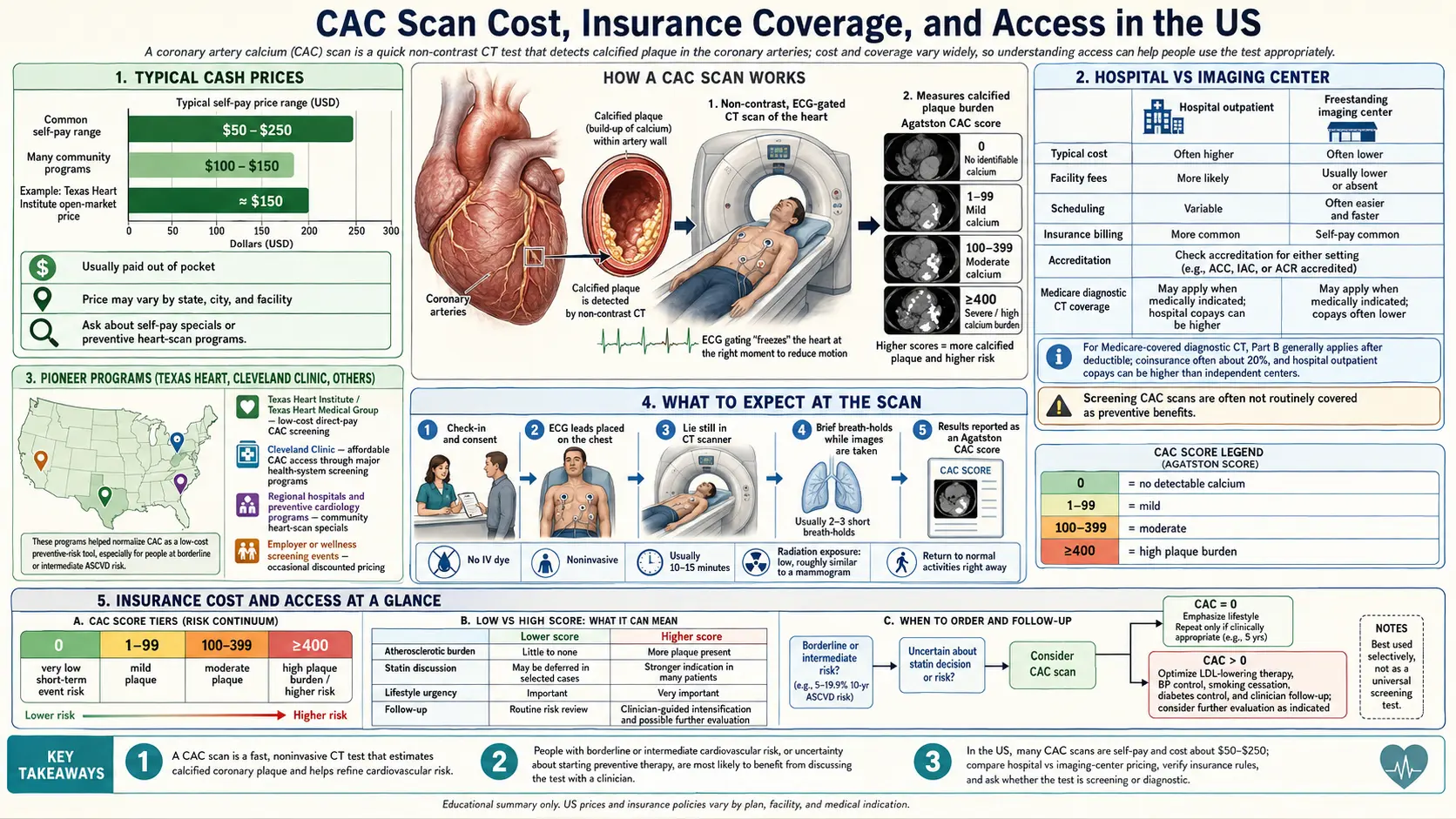
The coronary artery calcium (CAC) scan is a non-contrast CT scan of the heart that people in the United States often pay for themselves: a 2026 statement by a group of cardiologists and radiologists says most payers do not cover it, "requiring patients to pay out of pocket," and published papers put its cost at "less than $200" (2019) and "about $200 out-of-pocket" (2022). Medicare contractors' coverage policies treat calcium scoring on its own as a non-covered screening service, while a 2009 Texas law requires certain health plans in that state to cover up to $200 toward this test or a carotid ultrasound every five years for some adults. This page sets out what published studies and agency documents report on prices, private insurance, Medicare and Medicaid, tax-advantaged health accounts, self-referral, and the scan itself.
Table of Contents
- Cash Prices in Published Sources
- Insurance Coverage Landscape
- HSA, FSA, and Tax Considerations
- Price Differences Between Facilities
- Self-Referral
- The Texas Coverage Law (HB 1290, 2009)
- Medicare and CAC
- Outside the United States
- What to Expect at the Scan
- Key Research Papers
- Connections
- Featured Videos
Cash Prices in Published Sources
Published papers state the following price figures for the scan; none of them is a national price survey:
- "Less than $200" — a 2019 commentary calling for universal insurance coverage of CAC testing (Naghavi 2019)
- "About $200 out-of-pocket" — a 2022 study of hospitals in the Chicago area (Ikram and Williams 2022)
- $86 vs $487 — in the same Chicago study, hospitals in the highest-income quintile of areas tended to charge less for the scan than those in the lowest-income quintile (p < 0.08)
Insurance Coverage Landscape
What published studies and agency documents say about who pays:
- Private insurance: coverage varies by plan. RadiologyInfo, the patient site of the American College of Radiology and the Radiological Society of North America, notes: "Not all health insurance plans cover cardiac CT for calcium scoring." A 2024 Wisconsin study states that the scan "is considered investigational by some US insurance carriers and requires out-of-pocket expenses" (Marzlin 2024), and the 2026 statement says most payers do not cover it (Naghavi 2026). No national survey of private-plan policies was found.
- The USPSTF rating: the US Preventive Services Task Force concluded in 2018 that "the current evidence is insufficient to assess the balance of benefits and harms of adding the ABI, hsCRP level, or CAC score to traditional risk assessment for CVD in asymptomatic adults to prevent CVD events" (an I statement). Under the Affordable Care Act, group health plans and health insurers offering group or individual coverage must cover, without cost sharing, services rated A or B by the Task Force (42 U.S.C. §300gg-13); an I statement carries no such requirement. A Task Force update on coronary artery calcium scoring is in progress (topic page last updated September 19, 2024).
- Original Medicare: there is no national coverage determination, and contractors' local policies list calcium scoring as non-covered (see Medicare and CAC below).
- Medicaid: "Federal law requires states to provide certain mandatory benefits and allows states the choice of covering other optional benefits" (Medicaid.gov). No published survey of state Medicaid coverage of calcium scoring was found.
- Texas: a 2009 state law requires certain health plans to cover up to $200 toward the scan for some adults (see The Texas Coverage Law below).
The ACC/AHA guidelines describe a targeted use. The 2019 ACC/AHA primary-prevention guideline states that in adults at intermediate risk (≥7.5% to <20% 10-year ASCVD risk) or selected adults at borderline risk (5% to <7.5%), "if risk-based decisions for preventive interventions (eg, statin therapy) remain uncertain, it is reasonable to measure a coronary artery calcium score to guide clinician–patient risk discussion" (Class IIa). The 2018 AHA/ACC cholesterol guideline's take-home messages say that for adults 40 to 75 years of age without diabetes, with LDL-C of 70 to 189 mg/dL and a 10-year ASCVD risk of 7.5% to 19.9%, "if a decision about statin therapy is uncertain, consider measuring CAC." The 2026 statement in JACC: Cardiovascular Imaging calls on payers and policymakers to follow these guidelines and cover CAC imaging as a diagnostic test (Naghavi 2026). Cost-effectiveness models give different answers depending on their assumptions: a 2014 model built on MESA data found CAC testing in intermediate-risk patients cost-effective "only if statins are costly or significantly affect quality of life" (Pletcher 2014), and a 2021 model of people with a family history of premature coronary disease estimated $15,014 per quality-adjusted life-year, while scanning people at low risk (10-year risk under 5%) or aged 40 to 50 was not cost-effective (Venkataraman 2021).
HSA, FSA, and Tax Considerations
The IRS does not name the calcium scan; its general rules on medical expenses decide what counts:
- Medical expenses — IRS Publication 502 (2025) defines them as "the costs of diagnosis, cure, mitigation, treatment, or prevention of disease," and lists as includible "the cost of an electronic body scan," X-rays "for medical reasons," and "an annual physical examination and diagnostic tests by a physician," adding: "You don't have to be ill at the time of the examination."
- HSA (Health Savings Account) — distributions are tax-free when they pay qualified medical expenses, defined as amounts paid for "medical care" under Internal Revenue Code section 213(d) that insurance has not compensated (IRS Publication 969, 2025)
- FSA (Flexible Spending Arrangement) — qualified medical expenses are "those specified in the plan that would generally qualify for the medical and dental expenses deduction" (Publication 969)
- HRA (Health Reimbursement Arrangement) — the same "specified in the plan" rule applies, so eligibility depends on the plan's terms (Publication 969)
- Medical expense tax deduction — on Schedule A (Form 1040), only the part of medical and dental expenses that is more than 7.5% of adjusted gross income is deductible (Publication 502)
Price Differences Between Facilities
- Hospital prices vary. In a survey of the 40 hospitals in the Chicago area (Ikram and Williams 2022), 30 offered the scan; the 10 that did not were smaller hospitals in zip codes with higher poverty rates (22% vs 13%). Among the hospitals that offered it there was "wide price variation, with higher prices in poorer areas" (r = 0.57).
- Hospital price posting. Since January 1, 2021, CMS has required each hospital operating in the United States to post its prices online, both as a comprehensive machine-readable file of all items and services and as a consumer-friendly display of shoppable services.
- Hospitals vs freestanding imaging centers. No published comparison of hospital and freestanding imaging-center cash prices for this scan was found.
Self-Referral
Some imaging providers perform the scan at a patient's own request, without a physician's order. In records of 19,726 CAC scans at multiple Wisconsin sites from March 2019 to June 2021 (Marzlin 2024), 29.9% were self-referred. Self-referred patients were more likely to be women (55.1% vs 48.9%), to live in higher-income areas, and to have a score of zero (41.2% vs 38.1%); physician-referred patients had a higher prevalence of cardiovascular risk factors. Patients from low-income areas were the smallest share in both groups (7.5%), and the authors concluded that patients who obtain out-of-pocket scans "live predominantly in medium- and high-income areas."
RadiologyInfo describes calcium scoring as "a screening study that may be recommended by a physician for patients with risk factors for CAD but no clinical symptoms." The guideline recommendations above apply to adults at intermediate or selected borderline 10-year risk whose statin decision is uncertain.
The Texas Coverage Law (HB 1290, 2009)
Texas House Bill 1290 of the 81st Legislature, called "the Texas Heart Attack Prevention Bill" in a 2009 Journal of Nuclear Cardiology editorial (Beller 2009), added Chapter 1376, "Certain Tests for Early Detection of Cardiovascular Disease," to the Texas Insurance Code. The enrolled bill provides the following; the coverage section, §1376.003, has not been amended since its 2009 enactment:
- Plans: a health benefit plan "that provides coverage for screening medical procedures" must provide the minimum coverage. The chapter does not apply to, among others, limited-benefit plans, standard health benefit plans issued under Chapter 1507, workers' compensation policies, or medical payment coverage under a motor vehicle policy.
- People: men older than 45 and younger than 76, and women older than 55 and younger than 76, who are diabetic or whose risk of coronary heart disease, scored with the Framingham Heart Study coronary prediction algorithm, is intermediate or higher.
- Tests and amount: coverage of up to $200 for one of two tests every five years — CT scanning measuring coronary artery calcification, or ultrasonography measuring carotid intima-media thickness and plaque — performed by a laboratory certified by a national organization that the Texas commissioner of insurance recognizes by rule.
- Dates: the act took effect September 1, 2009, and applies to plans delivered, issued for delivery, or renewed on or after January 1, 2010.
A 2019 commentary calling for universal coverage of CAC testing pointed to the Texas law and urged other states to act (Naghavi 2019).
Medicare and CAC
CMS documents (checked October 2026) show the following:
- No national coverage determination. No Medicare national coverage determination addresses coronary calcium scoring. In the 2026 Physician Fee Schedule relative value file, CPT 75571 (CT of the heart without contrast, with quantitative calcium scoring) carries status code A, which CMS says "does not mean that Medicare has made a national coverage determination regarding the service"; its contractors "remain responsible for coverage decisions in the absence of a national Medicare policy."
- Local coverage determinations. The four local coverage determinations titled for cardiac CT or coronary CT angiography in the CMS Medicare Coverage Database (L33423, L33559, L33947, L35121) all exclude it. Three state that quantitative calcium scoring "is not a covered service and will be denied as not medically necessary" and that "calcium scoring reported in isolation is considered a screening service"; the fourth states that "Medicare does not cover a screening CCTA for asymptomatic patients, for risk stratification or for quantitative evaluation of coronary calcium." Three companion billing articles (A56451, A56737, A57552) list CPT 75571 as non-covered.
- Preventive services in general. The national coverage determination for lung-cancer screening (NCD 210.14) states that "preventive services are non-covered by Medicare unless specifically covered in this NCD, any other NCD, or in statute or regulations."
- Lung-cancer screening CT. Under NCD 210.14 (effective February 10, 2022), Medicare covers annual low-dose CT lung-cancer screening for beneficiaries aged 50 to 77 who have no signs or symptoms of lung cancer, have a smoking history of at least 20 pack-years, and currently smoke or quit within the last 15 years, with a counseling and shared decision-making visit before the first screening. A 2016 guideline of the Society of Cardiovascular Computed Tomography and the Society of Thoracic Radiology covers coronary artery calcium scoring of non-contrast, non-cardiac chest CT scans (Hecht 2017).
- Billing the beneficiary. When Medicare payment is expected to be denied, providers give Original Medicare beneficiaries an Advance Beneficiary Notice of Noncoverage (ABN, Form CMS-R-131), which CMS says is issued "to transfer potential financial liability to the Medicare beneficiary in certain instances."
Outside the United States
No verified source for current cash prices outside the United States was found, so none are listed here. Cost-effectiveness studies from other health systems use local costs: an Australian model of people with a family history of premature coronary artery disease found CAC-guided statin selection (CAC ≥100) cost-effective for people with a 5-year absolute cardiovascular risk of at least 5% (Venkataraman 2023), and a Thai model found a CAC screening strategy cost-effective for statin-naïve adults aged 40 to 75 at intermediate risk, at 16,308 baht per quality-adjusted life-year gained against Thailand's threshold of 160,000 baht (Wongyikul 2025).
What to Expect at the Scan
RadiologyInfo, the patient site of the American College of Radiology and the Radiological Society of North America, describes the exam as follows:
- Preparation — patients are instructed not to eat or drink anything, and to go without caffeine and smoking, for four hours before the exam
- No IV contrast — the exam "does not require injection of contrast material"
- Clothing — jewelry is left at home and loose, comfortable clothing worn; a gown may be provided
- ECG electrodes — small sticky discs on the chest connect to an ECG machine that records the heart's electrical activity
- Position — flat on the back on the CT table, arms raised over the head
- Breath-holds — the technologist gives instructions on how and when to hold the breath
- Total time — "less than 20 minutes"; normal activities can resume immediately afterward
- Radiation dose — a 2023 worldwide study of 19,302 patients at 742 centers in 101 countries found a median effective dose of 1.2 mSv (interquartile range 0.7–2.2) for calcium scoring (Einstein 2026); in MESA, the mean was 1.05 mSv (median 0.95) across four modern scanner models (Messenger 2016). RadiologyInfo's dose table lists 1.7 mSv for calcium scoring, comparable to 6 months of natural background radiation, against 0.28 mSv for screening digital mammography, and puts natural background exposure in the US at about 3 mSv per year.
- Results — a radiologist interprets the images and sends an official report to the doctor who ordered the exam; findings are expressed as a calcium score
The 2018 cholesterol guideline adds that "if CAC is recommended, it should be performed in facilities that have current technology that delivers the lowest radiation possible," and the 2019 guideline frames the score as a guide to the "clinician–patient risk discussion."
Key Research Papers
- US Preventive Services Task Force; Curry SJ, Krist AH, Owens DK, et al. (2018). Risk Assessment for Cardiovascular Disease With Nontraditional Risk Factors: US Preventive Services Task Force Recommendation Statement. JAMA — PubMed PMID: 29998297
- Grundy SM, Stone NJ, Bailey AL, et al. (2019). 2018 AHA/ACC/AACVPR/AAPA/ABC/ACPM/ADA/AGS/APhA/ASPC/NLA/PCNA Guideline on the Management of Blood Cholesterol: A Report of the American College of Cardiology/American Heart Association Task Force on Clinical Practice Guidelines. Circulation — PubMed PMID: 30586774
- Arnett DK, Blumenthal RS, Albert MA, et al. (2019). 2019 ACC/AHA Guideline on the Primary Prevention of Cardiovascular Disease: A Report of the American College of Cardiology/American Heart Association Task Force on Clinical Practice Guidelines. Circulation — PubMed PMID: 30879355
- Naghavi M, Wong ND, McConnell MV, et al. (2026). Coronary Artery Calcium (CAC) Imaging as a Diagnostic Test: Insurance Coverage Implications. JACC: Cardiovascular Imaging — PubMed PMID: 41379038
- Naghavi M, Maron DJ, Kloner RA, et al. (2019). Coronary artery calcium testing: A call for universal coverage. Preventive Medicine Reports — PubMed PMID: 31193256
- Ikram M, Williams KA Sr (2022). Socioeconomics of coronary artery calcium: Is it scored or ignored? Journal of Cardiovascular Computed Tomography — PubMed PMID: 34657819
- Marzlin N, Chapel A, Adefisoye J, et al. (2024). Differences and Disparities Among Self-Referred and Physician-Referred Populations Undergoing Coronary Artery Calcium Scanning. Circulation: Cardiovascular Imaging — PubMed PMID: 38377241
- Beller GA (2009). The Texas Heart Attack Prevention Bill mandating coverage for CAD screening tests. Journal of Nuclear Cardiology — PubMed PMID: 19697091
- Pletcher MJ, Pignone M, Earnshaw S, et al. (2014). Using the coronary artery calcium score to guide statin therapy: a cost-effectiveness analysis. Circulation: Cardiovascular Quality and Outcomes — PubMed PMID: 24619318
- Venkataraman P, Kawakami H, Huynh Q, et al. (2021). Cost-Effectiveness of Coronary Artery Calcium Scoring in People With a Family History of Coronary Disease. JACC: Cardiovascular Imaging — PubMed PMID: 33454262
- Venkataraman P, Neil AL, Mitchell GK, et al. (2023). The cost-effectiveness of coronary calcium score-guided statin therapy initiation for Australians with family histories of premature coronary artery disease. Medical Journal of Australia — PubMed PMID: 36841547
- Wongyikul P, Phinyo P, Suwannasom P, et al. (2025). Cost-utility analysis of Coronary Artery Calcium screening to guide statin prescription among intermediate-risk patients in Thailand. PLoS One — PubMed PMID: 40839608
- Einstein AJ, Williams MC, Weir-McCall JR, et al.; INCAPS 4 Investigators Group (2026). Worldwide Radiation Dose in Coronary Artery Disease Diagnostic Imaging. JAMA — PubMed PMID: 41739468
- Messenger B, Li D, Nasir K, et al. (2016). Coronary calcium scans and radiation exposure in the multi-ethnic study of atherosclerosis. International Journal of Cardiovascular Imaging — PubMed PMID: 26515964
- Hecht HS, Cronin P, Blaha MJ, et al. (2017). 2016 SCCT/STR guidelines for coronary artery calcium scoring of noncontrast noncardiac chest CT scans: A report of the Society of Cardiovascular Computed Tomography and Society of Thoracic Radiology. Journal of Cardiovascular Computed Tomography — PubMed PMID: 27916431
PubMed Topic Searches
- CAC cost-effectiveness analyses — PubMed search
- CAC insurance coverage — PubMed search
- CAC on lung-cancer screening LDCT — PubMed search
External Authoritative Resources
- American Heart Association
- American College of Cardiology
- USPSTF — Cardiovascular Disease: Risk Assessment With Nontraditional Risk Factors (2018)
- USPSTF — Update in Progress: Enhanced Risk Assessment for Cardiovascular Disease: Coronary Artery Calcium Scoring
- 42 U.S.C. §300gg-13 — Coverage of preventive health services
- Texas Legislature — H.B. 1290 (81st Legislature, 2009), enrolled version
- Texas Insurance Code Chapter 1376 — Certain Tests for Early Detection of Cardiovascular Disease
- CMS — Physician Fee Schedule Relative Value Files (status code definitions)
- CMS Medicare Coverage Database — local coverage determinations L33423, L33559, L33947, L35121
- CMS — NCD 210.14, Lung Cancer Screening with Low Dose Computed Tomography (LDCT)
- CMS — Advance Beneficiary Notice of Noncoverage (ABN)
- CMS — Hospital Price Transparency
- Medicaid.gov — Benefits
- IRS Publication 502 (2025), Medical and Dental Expenses
- IRS Publication 969 (2025), Health Savings Accounts and Other Tax-Favored Health Plans
- RadiologyInfo — Cardiac CT for Calcium Scoring
- RadiologyInfo — Cardiac (Heart) Screening
- RadiologyInfo — Radiation Dose
Connections
- All Lab Tests
- Coronary Calcium Score
- Agatston Score Calculation and Interpretation
- MESA Risk Calculator and Age Percentiles
- CAC Zero and the Power of Negative Result
- Statin Threshold and CAC
- CAC in Women and Younger Adults
- CAC vs Other Cardiac Tests
- Soft Plaque and CAC Limitations
- Reversal Plaque Stabilization and Lifestyle
- ApoB
- Lipoprotein(a)
- Lipid Panel
- Cancer