Stinging Nettle
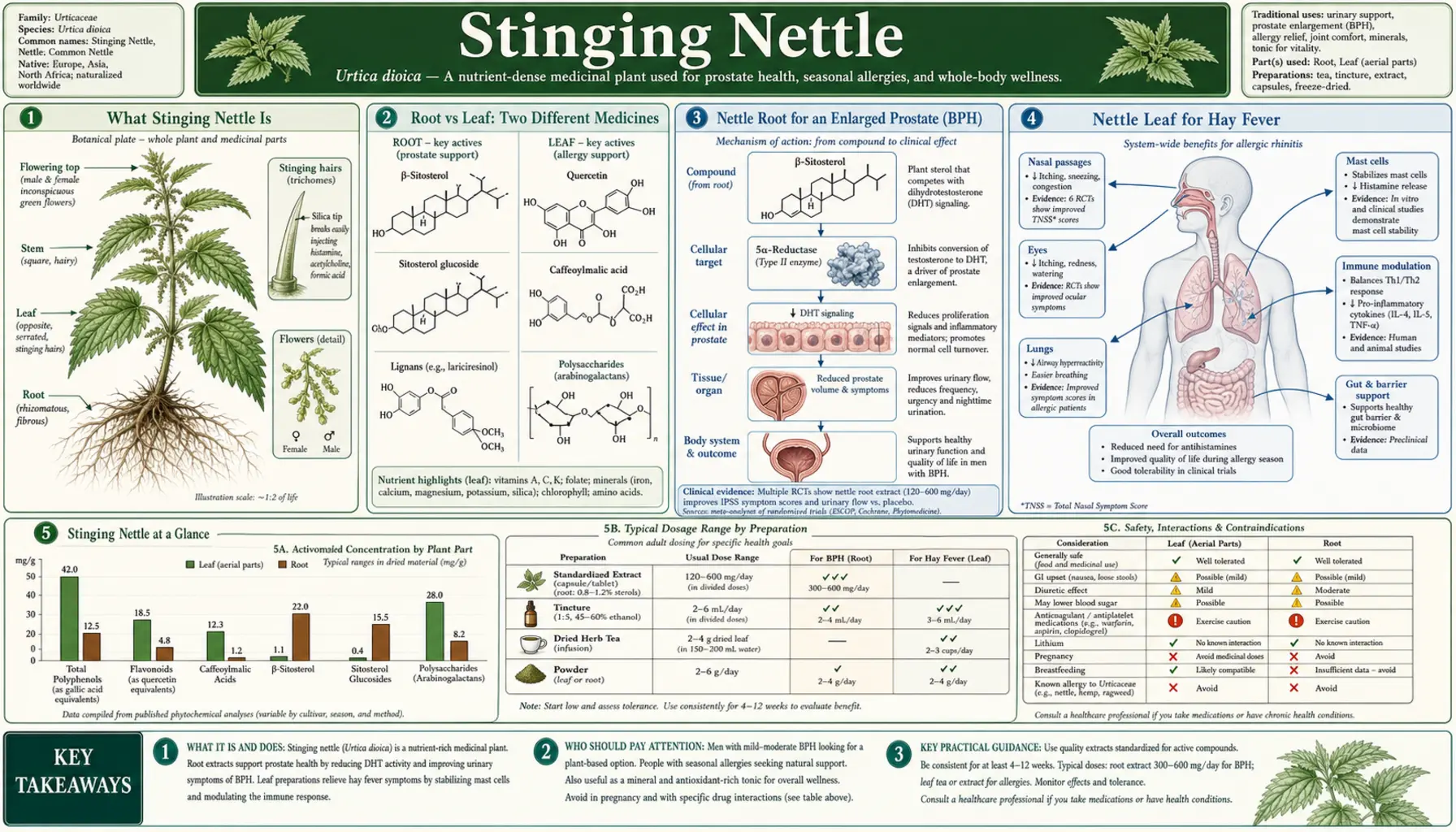
Stinging nettle (Urtica dioica) is one of those plants almost everyone recognizes by feel before they ever learn its name — brush against it and the tiny hairs on its leaves and stems deliver a burning, itchy sting. Yet this same weed, dismissed as a nuisance in gardens across Europe, North America, and Asia, has been used as food and medicine for thousands of years. Once it is cooked, dried, or crushed, the sting disappears completely and what remains is a genuinely nutritious leafy green and a well-studied herbal remedy. The most important thing to understand about nettle is that it is really two different medicines in one plant: the root is used for an enlarged prostate, while the leaf (the green above-ground part) is used for hay fever, joint aches, and nutrition. They contain different active compounds and are not interchangeable. This page walks through what nettle is, which uses the evidence actually supports, and how to use it safely.
Interactive Visualization Histamine, Mast Cells & Allergy — trigger a mast cell yourself Arm a mast cell with IgE, let the allergen cross-link it, and watch histamine burst out to raise a wheal — then block the H1 receptor and see symptoms fall while histamine still pours out. Launch →
Table of Contents
- What Stinging Nettle Is
- Root vs Leaf: Two Different Medicines
- Nettle Root for an Enlarged Prostate (BPH)
- Nettle Leaf for Hay Fever
- Joint Pain & Osteoarthritis
- Nutrition: A Nutrient-Dense Wild Green
- Other Traditional Uses
- Forms, Preparation & Dosing
- Safety, Side Effects & Interactions
- Research Papers
- Connections
- Featured Videos
What Stinging Nettle Is
Stinging nettle is a tall, leafy perennial in the family Urticaceae, native to Europe, Asia, and northern Africa and now naturalized across North America and much of the world. It grows in moist, rich soil — roadsides, riverbanks, woodland edges, and neglected corners of gardens — often in dense stands two to six feet tall. Its scientific name, Urtica dioica, comes from the Latin urere, "to burn," and dioica ("two houses"), because male and female flowers usually grow on separate plants.
People have used nettle for an unusually long list of purposes: as a spring vegetable and soup green, as a fiber for cloth and cordage (nettle textile predates cotton in parts of Europe), as animal fodder, and as a folk medicine for everything from arthritis to anemia. Much of that history is tradition rather than tested science, but a handful of its uses have now been examined in modern clinical trials, and those are the ones this page focuses on.
The Sting: What's Actually in Those Hairs
The plant's defining feature is its sting. The leaves and stems are covered with thousands of tiny hollow hairs called trichomes that behave like miniature hypodermic needles. Each one has a brittle, glass-like silica tip; when you brush against it, the tip snaps off and the sharp remainder pierces the skin and injects a cocktail of irritant chemicals. The classic ingredients are:
- Histamine — the same compound your body releases in allergic reactions, producing the immediate redness and itch.
- Acetylcholine — a nerve-signaling chemical that contributes to the burning sensation.
- Serotonin (5-HT) — adds to the irritation and pain.
- Formic acid — the same acid found in ant stings; long blamed for the burn, though it is now thought to play a smaller role than the histamine and acetylcholine.
Together these cause the familiar stinging, itching, and small raised welts (a form of contact urticaria) that can last from minutes to a few hours. Here is the reassuring and practical point: the sting is completely destroyed by heat, drying, crushing, or blanching. Cooking nettle for even a minute, steeping dried leaf in hot water for tea, or blending it thoroughly denatures these compounds and collapses the hairs. That is why cooked nettle greens, dried-leaf tea, and commercial nettle capsules do not sting at all — only the fresh, raw plant does.
Root vs Leaf: Two Different Medicines
This is the single most important thing to get right about nettle, and it is where many buyers go wrong. The root and the above-ground parts (leaf, stem, and flowering tops — collectively the "aerial parts" or "herb") have different chemistry and are used for different problems. Buying "stinging nettle" without checking which part is in the bottle is like buying "orange" when you needed either the peel or the juice.
Nettle root (Urticae radix) contains plant sterols (notably beta-sitosterol), lignans, a distinctive protein called Urtica dioica agglutinin (a lectin), and polysaccharides. These compounds interact with hormone metabolism and inflammation in the prostate, which is why the root is the part studied and sold for benign prostatic hyperplasia (BPH) — an enlarged prostate. The leaf does essentially nothing for the prostate.
Nettle leaf and aerial parts (Urticae folium/herba) are rich in flavonoids (such as quercetin and rutin), chlorophyll, carotenoids, vitamins, and a dense load of minerals. This is the part used for allergies (hay fever), joint and muscle aches, as a diuretic, and as food and nutrition. The root has none of the nutritional value and is not used for allergy.
So when you read the rest of this page, keep the two straight: prostate → root; hay fever, joints, and nutrition → leaf. Reputable products always state which part they contain. If a label just says "stinging nettle" with no plant part named, treat that as a red flag for quality. A pair of thorough scientific reviews by Chrubasik and colleagues examined the leaf/herb and the root separately for exactly this reason — the evidence base for each part is distinct (see Research Papers).
Nettle Root for an Enlarged Prostate (BPH)
This is nettle's best-evidenced medical use. Benign prostatic hyperplasia (BPH) is a very common, non-cancerous enlargement of the prostate gland that affects a majority of men as they age. As the prostate grows it squeezes the urethra, producing the frustrating cluster of lower urinary tract symptoms (LUTS): a weak or interrupted stream, difficulty starting, dribbling, a feeling of incomplete emptying, urgency, and — the one that wakes men up — frequent nighttime urination (nocturia).
What nettle root does — and does not do. Nettle root is used to ease these urinary symptoms. It is important to be clear-eyed here: it treats the symptoms of a benign condition. It does not meaningfully shrink the prostate the way the drug finasteride can, and it has nothing to do with preventing or treating prostate cancer. Any man with new or worsening urinary symptoms, blood in the urine, or a rising PSA needs a proper medical evaluation first — herbs are not a substitute for ruling out serious disease.
How it might work. Several plausible mechanisms have been proposed from laboratory work: nettle-root compounds appear to bind to sex-hormone-binding globulin, weakly inhibit the enzymes aromatase and 5-alpha-reductase (which regulate the hormones that drive prostate growth), and reduce inflammation and the multiplication of prostate cells. Beta-sitosterol, one of its sterols, is itself studied for BPH. No single mechanism is proven to be the reason it helps; the effect is probably a combination of mild actions.
What the trials show. A large, well-designed randomized, double-blind, placebo-controlled crossover trial by Safarinejad enrolled 620 men and found that nettle-root extract improved International Prostate Symptom Score (IPSS) and urinary flow significantly more than placebo, with few side effects. A separate randomized double-blind study by Ghorbanibirgani and colleagues in 100 men likewise reported symptom improvement over placebo. Much of the strongest evidence, though, comes from a combination product pairing nettle root with saw palmetto (a well-known prostate herb) — sold in Europe as "PRO 160/120." In a placebo-controlled multicenter trial, Lopatkin and colleagues found this sabal-plus-urtica combination improved IPSS and maintained the benefit over long-term use. In a comparison by Sökeland, the same combination produced IPSS improvements comparable to finasteride over 48 weeks — but with notably fewer sexual side effects (finasteride can reduce libido and erectile function). Crucially, finasteride shrank prostate volume while the herbal combination did not, underscoring that nettle relieves symptoms rather than reversing the enlargement.
The honest bottom line. The evidence that nettle root (especially combined with saw palmetto) modestly eases mild-to-moderate BPH urinary symptoms is reasonably good and generally consistent. The caveats: effect sizes are moderate, not dramatic; several trials are older, European, and connected to the manufacturers of the products tested; and long-term, independent data are thinner than for prescription drugs. It is a reasonable option to discuss with a doctor for bothersome-but-mild symptoms, ideally after a proper prostate evaluation — not a replacement for medical care when symptoms are severe.
Nettle Leaf for Hay Fever
Switch parts now: for allergic rhinitis — hay fever, the sneezing, runny nose, itchy watery eyes, and congestion triggered by pollen and other allergens — it is the leaf, not the root, that is used. There is a certain irony here: the fresh plant injects histamine to sting you, yet the dried leaf is taken to calm the histamine-driven symptoms of allergy.
How it might work. Laboratory research offers a plausible mechanism. In a detailed in-vitro study, Roschek and colleagues showed that nettle-leaf extract can interfere with several key drivers of allergic rhinitis at once: it partially blocked the histamine-1 (H1) receptor (the same target as common antihistamine drugs), inhibited mast-cell tryptase (an enzyme that releases inflammatory mediators), and dampened enzymes in the prostaglandin pathway that fuel inflammation. In other words, nettle leaf appears to nudge several allergy switches gently toward "off." The flavonoid quercetin, present in the leaf, is independently studied as a mast-cell stabilizer.
What the clinical evidence shows. This is where honesty matters: the human evidence is preliminary and thin. The most-cited clinical trial, by Mittman in 1990, was a small randomized, double-blind study of freeze-dried nettle leaf in about 98 people with allergic rhinitis. Slightly more participants rated freeze-dried nettle as effective compared with placebo, but the difference was modest and the study was small and short. Beyond that single older trial, most support is mechanistic (test-tube and receptor studies) and anecdotal. There has not been a large, high-quality modern trial confirming a meaningful benefit.
The honest bottom line. Nettle leaf is a popular, low-risk natural option for hay fever, with a believable mechanism and one small positive trial behind it — but it is not proven, and it should not replace effective treatments (antihistamines, nasal steroids, or allergen avoidance) for anyone with significant, life-disrupting allergies. Many people try it as a gentle add-on; expectations should be realistic.
Joint Pain & Osteoarthritis
Nettle has a long folk reputation for easing the aches of arthritis and rheumatism, and it is used two very different ways.
Taken by mouth (leaf). Cooked or extracted nettle leaf is used as a gentle anti-inflammatory. Its flavonoids and other compounds appear to modestly dampen inflammatory signaling. Some small studies have explored stewed nettle leaf alongside a low dose of an anti-inflammatory drug to see whether nettle lets people get by on less medication, with suggestive but far-from-definitive results.
Applied to the skin — "urtication." This is the striking one: some people deliberately sting the painful joint with fresh nettle. The centuries-old practice, called urtication, sounds like folk nonsense but has actually been tested. Randall and colleagues ran a series of small trials: an early exploratory study of nettle sting for joint pain, then a randomized controlled trial in which people with base-of-thumb (carpometacarpal) osteoarthritis applied stinging nettle versus a non-stinging "dead-nettle" placebo — and reported significantly less pain and disability with the real nettle. A later pilot study of nettle sting for chronic knee pain, however, did not find a clear benefit. The proposed idea is a counter-irritant effect: the sting may distract or modulate the pain-signaling nerves, similar in spirit to capsaicin creams.
The honest bottom line. The joint-pain evidence is genuinely intriguing but limited — a few small trials, some positive and some not. Oral nettle leaf is a plausible mild anti-inflammatory adjunct; topical urtication has a couple of small supportive studies (thumb pain) and a negative one (knee pain). Neither is a proven treatment for osteoarthritis, and neither should replace established care.
Nutrition: A Nutrient-Dense Wild Green
Long before it was a supplement, nettle was simply food — a free, wild spring green foraged across Europe for soups, purees, teas, and pies once the year's first tender tops appeared. Cooked nettle leaf is legitimately nutritious, comparable to spinach or other dark leafy greens, and is one of the more mineral-dense wild plants you can eat.
Cooked or dried nettle leaf is a notable source of:
- Iron — part of nettle's traditional reputation as a "blood builder" and spring tonic.
- Calcium and magnesium — useful minerals for bone and muscle.
- Potassium — abundant, in keeping with its mild diuretic reputation.
- Vitamin K — important for blood clotting and bone health (and the source of a real drug interaction — see below).
- Vitamin A (as beta-carotene) and vitamin C, plus a respectable amount of plant protein for a leafy green.
Two practical caveats. First, you must cook it — a quick blanch or simmer — to neutralize the sting before eating; raw nettle will sting the mouth and throat. Second, like spinach and chard, nettle contains oxalates, so people prone to calcium-oxalate kidney stones may want to moderate large amounts. Eaten as an occasional cooked green, nettle is a wholesome, mineral-rich addition to the diet.
Other Traditional Uses
Nettle appears in folk medicine for many other complaints. Most of these have little rigorous evidence, and it is worth being candid about which is which:
- Diuretic / "irrigation therapy." Nettle leaf is a traditional mild diuretic, used in Europe to increase urine flow for minor urinary complaints and as part of "flushing" the urinary tract. This is plausible given its potassium content, but the clinical evidence is limited.
- Blood sugar. A few small randomized trials, such as one by Kianbakht and colleagues in people with advanced type 2 diabetes, reported that nettle-leaf extract modestly improved blood-glucose control as an add-on. The findings are preliminary — but they matter mainly as a safety signal: nettle may add to the glucose-lowering effect of diabetes medication (see interactions).
- Skin, hair, and scalp. Nettle is a popular ingredient in shampoos and topical preparations for dandruff, eczema, and hair loss. Evidence for any real benefit is essentially anecdotal.
- General "tonic" and detox claims. Nettle tea is widely sold as a cleansing spring tonic. There is no scientific meaning to "detox" here beyond its mild diuretic effect and genuine mineral content.
None of these traditional uses is well proven. They are reasonable to know about, but they should be held loosely.
Forms, Preparation & Dosing
Because root and leaf are different medicines, match the form to the goal — and always confirm the plant part on the label.
- Root extract (for BPH). Trials typically used standardized nettle-root extract around 120 mg twice daily, or roughly 300–600 mg of dried root per day, often as part of a combination with saw palmetto. Give it several weeks — prostate-symptom benefits, if they come, build gradually.
- Dried-leaf tea (for nutrition, mild diuresis, general use). About 2–3 grams of dried leaf steeped in hot water, up to a few times daily. The heat removes any sting.
- Freeze-dried leaf capsules (for hay fever). Roughly 300 mg taken as needed during allergy season, mirroring the Mittman study's approach.
- Tincture (liquid extract). A concentrated alcohol or glycerin extract of leaf or root, dosed per the manufacturer's directions.
- Cooked greens. Fresh young tops, blanched or simmered like spinach, for eating — the traditional food use.
Product quality varies widely, and herbal supplements are not tightly regulated. Look for reputable brands that state the plant part, the extract strength, and ideally independent quality testing. If you are treating a specific condition like BPH, tell your doctor what you are taking so it can be tracked alongside proper monitoring.
Safety, Side Effects & Interactions
Cooked, dried, and properly prepared nettle is generally well tolerated by most adults. It is not a high-risk herb, but it is not free of concerns, and a few interactions are genuinely worth knowing.
Common, mild side effects:
- Stomach upset — occasional nausea, mild diarrhea, or cramping, usually at higher doses.
- Increased urination and sweating — expected from its mild diuretic action; drink enough fluids.
- Skin reaction to the fresh plant — the sting itself, a transient contact rash, in anyone who handles raw nettle without gloves.
Who should be cautious:
- Pregnancy and breastfeeding. Avoid medicinal doses of nettle in pregnancy. In folk tradition nettle has been used to stimulate the uterus, and safety data are inadequate, so caution is warranted. (Small amounts of cooked nettle as food are a lower concern, but check with your provider.)
- People on blood thinners (warfarin and similar). This is the most important interaction. Nettle leaf is high in vitamin K, which promotes clotting and can counteract warfarin, making the drug less effective. Anyone on an anticoagulant should keep vitamin-K intake steady and talk to their prescriber before adding nettle.
- People on blood-pressure medication. Because nettle can act as a mild diuretic and may lower blood pressure, it could add to the effect of antihypertensive drugs and, combined with fluid loss, contribute to lightheadedness. Monitor if you combine them.
- People on diabetes medication. Given nettle's possible blood-sugar-lowering effect, combining it with insulin or oral diabetes drugs could push glucose too low (hypoglycemia). Watch your levels and coordinate with your doctor.
- People taking lithium or strong sedatives. A diuretic effect can theoretically alter lithium levels; use caution and medical guidance.
Finally, the recurring theme for the prostate use: nettle is not a substitute for evaluation. Urinary symptoms in men can stem from BPH, but also from infection, bladder problems, or prostate cancer. See a clinician to get the right diagnosis before self-treating — nettle can ease mild symptoms, but only after you know what you are actually dealing with.
Research Papers
- Safarinejad MR. Urtica dioica for treatment of benign prostatic hyperplasia: a prospective, randomized, double-blind, placebo-controlled, crossover study. Journal of Herbal Pharmacotherapy. 2005;5(4):1–11. doi:10.1080/J157v05n04_01 — A large (620-man) randomized crossover trial finding nettle-root extract improved prostate symptom scores and urinary flow versus placebo. Nettle's best single piece of BPH evidence.
- Ghorbanibirgani A, Khalili A, Zamani L. The efficacy of stinging nettle (Urtica dioica) in patients with benign prostatic hyperplasia: a randomized double-blind study in 100 patients. Iranian Red Crescent Medical Journal. 2013;15(1):9–10. doi:10.5812/ircmj.2386 — A randomized double-blind trial reporting improved urinary symptoms with nettle over placebo, supporting the root's use for BPH.
- Lopatkin N, Sivkov A, Walther C, Schläfke S, et al. Long-term efficacy and safety of a combination of sabal and urtica extract for lower urinary tract symptoms — a placebo-controlled, double-blind, multicenter trial. World Journal of Urology. 2005;23(2):139–146. doi:10.1007/s00345-005-0501-9 — Shows the saw-palmetto-plus-nettle-root combination improved and maintained symptom relief over long-term use.
- Sökeland J. Combined sabal and urtica extract compared with finasteride in men with benign prostatic hyperplasia: analysis of prostate volume and therapeutic outcome. BJU International. 2000;86(4):439–442. doi:10.1046/j.1464-410x.2000.00776.x — The nettle-root/saw-palmetto combination gave symptom improvement comparable to finasteride with fewer sexual side effects, but did not shrink the prostate as the drug did.
- Mittman P. Randomized, double-blind study of freeze-dried Urtica dioica in the treatment of allergic rhinitis. Planta Medica. 1990;56(1):44–47. doi:10.1055/s-2006-960881 — The most-cited (and small, older) clinical trial suggesting freeze-dried nettle leaf modestly outperformed placebo for hay-fever symptoms.
- Roschek B, Fink RC, McMichael M, Alberte RS. Nettle extract (Urtica dioica) affects key receptors and enzymes associated with allergic rhinitis. Phytotherapy Research. 2009;23(7):920–926. doi:10.1002/ptr.2763 — A laboratory study showing nettle-leaf extract blocks the histamine H1 receptor, mast-cell tryptase, and prostaglandin-forming enzymes — a plausible mechanism for its use in allergy.
- Chrubasik JE, Roufogalis BD, Wagner H, Chrubasik S. A comprehensive review on nettle effect and efficacy profiles, Part I: Herba urticae. Phytomedicine. 2007;14(6):423–435. doi:10.1016/j.phymed.2007.03.004 — A thorough review of the leaf/aerial parts (allergy, joint, diuretic uses), documenting why leaf and root must be evaluated separately.
- Chrubasik JE, Roufogalis BD, Wagner H, Chrubasik S. A comprehensive review on the stinging nettle effect and efficacy profiles. Part II: Urticae radix. Phytomedicine. 2007;14(7–8):568–579. doi:10.1016/j.phymed.2007.03.014 — The companion review of the root, summarizing the BPH evidence and proposed hormone- and inflammation-related mechanisms.
- Randall C, Meethan K, Randall H, Dobbs F. Nettle sting of Urtica dioica for joint pain — an exploratory study of this complementary therapy. Complementary Therapies in Medicine. 1999;7(3):126–131. doi:10.1016/S0965-2299(99)80119-8 — An early exploratory study of the folk practice of applying nettle sting to painful joints.
- Randall C, Randall H, Dobbs F, Hutton C, Sanders H. Randomized controlled trial of nettle sting for treatment of base-of-thumb pain. Journal of the Royal Society of Medicine. 2000;93(6):305–309. doi:10.1177/014107680009300607 — A controlled trial finding topical nettle sting reduced base-of-thumb osteoarthritis pain more than a non-stinging placebo plant.
- Randall C, Dickens A, White A, Sanders H, et al. Nettle sting for chronic knee pain: a randomised controlled pilot study. Complementary Therapies in Medicine. 2008;16(2):66–72. doi:10.1016/j.ctim.2007.01.012 — A pilot trial that did not find clear benefit for knee pain, illustrating the mixed, preliminary nature of the joint-pain evidence.
- Kianbakht S, Khalighi-Sigaroodi F, Dabaghian FH. Improved glycemic control in patients with advanced type 2 diabetes mellitus taking Urtica dioica leaf extract: a randomized double-blind placebo-controlled clinical trial. Clinical Laboratory. 2013;59(9–10):1071–1076. doi:10.7754/Clin.Lab.2012.121019 — A randomized trial reporting modest blood-glucose improvement with nettle leaf — relevant chiefly as a safety signal for people on diabetes medication.
Connections
- Fluoride Chelation — mineral-rich infusion used during a fluoride flush
- All Herbs
- Histamine, Mast Cells & Allergy — interactive animation
- Benign Prostatic Hyperplasia (BPH)
- Saw Palmetto
- Allergic Rhinitis (Hay Fever)
- Conditions on this site that reference this page: Allergies · Urology