Bhringraj / False Daisy (Eclipta prostrata)
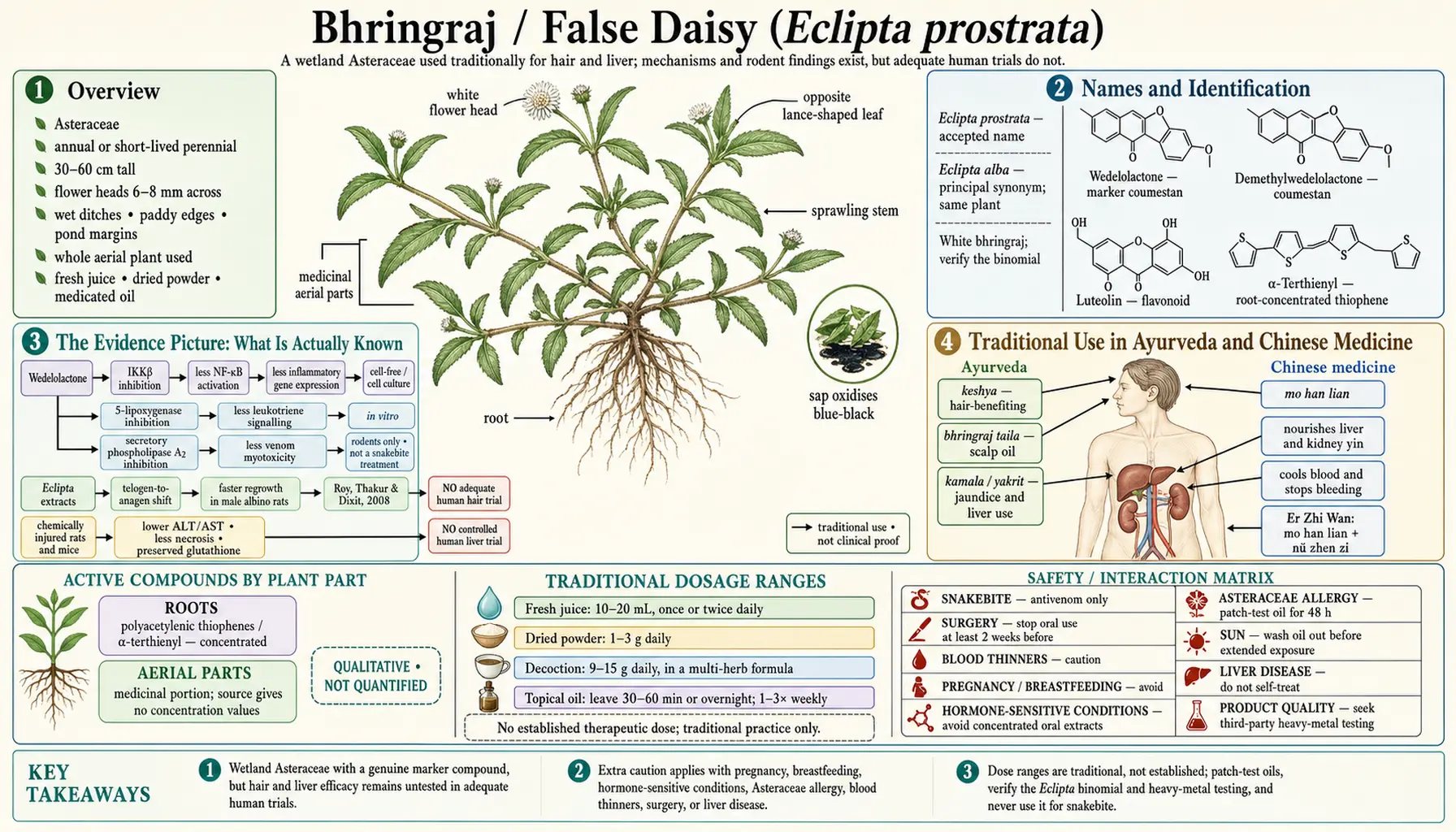
Bhringraj is a small weed of wet ditches and rice-paddy edges that is widely sold as a hair oil. The short version of the evidence is that no adequate human trial of the plant on its own has shown that it grows hair. The hair-growth claims rest on studies in rats and mice, and those studies are real, but a rodent's back skin is not a human scalp with androgenetic alopecia.
The plant has a long place in two separate medical traditions — Ayurveda uses it for hair and the liver, and Chinese medicine uses the same species for bleeding and for what it calls liver and kidney deficiency. Its marker compound, wedelolactone, has well-described biochemistry in cell and enzyme studies. Human testing is very thin: one small placebo-controlled pilot on blood pressure, and one trial of a multi-herb hair oil. This page describes the plant, what its chemistry has been shown to do, and where the evidence stops.
Table of Contents
- Overview
- Names and Identification
- The Evidence Picture: What Is Actually Known
- Traditional Use in Ayurveda and Chinese Medicine
- Active Compounds
- Hair and Scalp: The Central Claim
- Liver: Traditional Use and Animal Studies
- Bleeding, Blood, and the Yin-Tonic Role
- Wedelolactone and Snake Venom
- Culinary Use
- Forms and Preparations
- Doses Reported in Traditional Use and Trials
- Cautions and Contraindications
- Key Research Papers
- Connections
- Featured Videos
Overview
Eclipta prostrata is a low, sprawling annual or short-lived perennial in the daisy family (Asteraceae), with opposite lance-shaped leaves and small white flower heads — a tiny daisy, which is where the English name false daisy comes from.
It grows where the ground stays wet: paddy-field bunds, irrigation ditches, riverbanks and the muddy margins of ponds. It is now found across warm regions of Asia, Africa and the Americas, and in many of those places it is regarded as a weed. A 2019 review describes its traditional use in Asia and South America (Feng 2019).
The part used is the whole aerial plant — stems, leaves and flower heads — either fresh (juiced) or dried. In Ayurveda both the fresh juice (svarasa) and the dried powder are used, and the herb is also cooked into a base oil such as sesame or coconut oil to make the classical hair oil.
The most distinctive thing about the plant is its sap, which darkens to blue-black when the plant is crushed. Several of its regional names refer to this: the Chinese name means "ink drought-lotus" and one Vietnamese name means "ink grass". The darkening sap is commonly linked to the plant's reputation for darkening greying hair.
Names and Identification
Binomial: Eclipta prostrata (L.) L.
Family: Asteraceae (Compositae), tribe Heliantheae.
Principal synonym: Eclipta alba (L.) Hassk.
The two names refer to the same species, and botanical databases differ on which one they treat as accepted: the GBIF taxonomic backbone lists Eclipta alba (L.) Hassk. as accepted, with Eclipta erecta L. among its synonyms, while much of the recent pharmacology literature uses E. prostrata (Feng 2019). The Indian pharmacology literature mostly uses E. alba. A literature search on only one of the two names misses a large part of the research.
Regional names
- Sanskrit: bhringaraja (भृङ्गराज), also kesharaja, markava, angaraka
- Hindi: bhringraj, bhangra, babri
- Tamil: karisalankanni (கரிசலாங்கண்ணி) — the name under which it is known in the Tamil Siddha tradition
- Bengali: keshuti, kesharaj
- Telugu: guntagalagara; Malayalam: kayyonni; Kannada: garagadasoppu
- Chinese: 墨旱蓮 mo han lian — literally "ink drought-lotus." The drug name in Chinese pharmacopoeial usage is Ecliptae Herba.
- Vietnamese: cỏ mực ("ink grass") or nhọ nồi ("soot from the cooking pot") — both names describe the black stain
- English: false daisy, yerba de tago, trailing eclipta
One name, more than one plant: Eclipta and Wedelia ("yellow bhringraj")
A 1991 review of the nomenclature found that Indian medical literature applies the names bhringaraja and karisalankanni to more than one plant, and concluded that the names belong only to Eclipta prostrata (Balu & Rao 1991). The plant most often involved in the confusion is Wedelia calendulacea (now also placed as Sphagneticola calendulacea), a yellow-flowered creeping Asteraceae of wet ground, which is why it is sometimes called "yellow bhringraj":
- White-flowered bhringraj = Eclipta prostrata / alba, the plant this page is about.
- Yellow-flowered "bhringraj" = Wedelia calendulacea. The two leaves were compared pharmacognostically as early as 1992 (Gopalakrishnan 1992), and a 2016 study developed DNA markers specifically to detect Wedelia calendulacea as an adulterant in Eclipta alba material (Pendkar 2016).
The two are not the same plant, although both contain coumestans: a 1986 paper described coumestans as the main active principles of both "liver drugs", Eclipta alba and Wedelia calendulacea (Wagner 1986). The compound wedelolactone is in fact named after Wedelia. A product name such as "bhringraj" therefore does not by itself establish which species it contains; only the binomial does.
The Evidence Picture: What Is Actually Known
Most writing about bhringraj leads with the traditional claims and puts the evidence last. In brief:
- Hair growth in humans: no trial of Eclipta on its own was found. The one randomised, double-blind hair trial found (Patel 2026) tested a classical multi-herb Ayurvedic oil, alone and with 5% minoxidil, against 5% minoxidil alone, with no placebo arm (details in the Hair section).
- Hair growth in rodents: several studies. Extracts applied to the skin of rats (Roy 2008) and mice (Datta 2009; Begum 2015) or given by mouth to mice (Lee 2019) shortened regrowth time or moved more follicles into the growth (anagen) phase compared with controls. These are animal results.
- Liver protection: animal studies only. Protection against chemically induced liver injury in rats and mice, reported by several research groups. No controlled human trial was found.
- Wedelolactone biochemistry: cell and enzyme studies. Inhibition of the IKK complex that activates NF-κB (Kobori 2004), of 5-lipoxygenase (Wagner & Fessler 1986), and of venom phospholipase A2 (Melo 1994). In breast cancer cells it also acted on oestrogen receptors (Nehybova 2015).
- Snake-venom neutralisation: mouse and isolated-muscle studies only — see the section below.
- Blood pressure and cholesterol: one small human pilot. A placebo-controlled pilot in 60 mildly hypertensive men gave 3 g a day of dried Eclipta alba leaf powder for 60 days (Rangineni 2007). No larger trial was found.
So the summary is: an interesting molecule, plausible mechanisms, a large traditional following, and very little human testing.
Traditional Use in Ayurveda and Chinese Medicine
Two large medical traditions adopted the same weed and built different theories around it.
Ayurveda: a hair and liver herb
In Ayurveda bhringaraja is classed as keshya — a hair-benefiting drug — and as a rasayana, a rejuvenative. The most familiar preparation is bhringraj taila, a medicated oil made by cooking the fresh plant juice (or a decoction and paste of the herb) in sesame or coconut oil until the water has evaporated. The oil is massaged into the scalp and later washed out.
Bhringaraja is also a traditional liver herb. A 1986 paper described Eclipta alba and Wedelia calendulacea as "liver drugs" (Wagner 1986), and a 2016 study opens by noting that Eclipta has been used for liver disease for centuries (Lu 2016).
Chinese medicine: a yin tonic and a haemostatic
Under the name mo han lian (墨旱蓮), the same aerial parts are used in Chinese medicine for a different set of indications. It is classified as a herb that nourishes liver and kidney yin and that cools the blood and stops bleeding. A 2019 review lists its traditional uses as bleeding disorders (coughing or vomiting blood, blood in the urine, nosebleeds and uterine bleeding), skin diseases, hair loss, vitiligo, snakebite, and conditions attributed to deficiency of the liver and kidney (Feng 2019).
Its best-known appearance is in Er Zhi Wan (二至丸, "Two Solstices Pill"), a classical two-herb formula pairing mo han lian with nü zhen zi (the fruit of Ligustrum lucidum), used in Chinese medicine for menopausal complaints (Xu 2012).
The two traditions converge on a couple of points — both associate the plant with hair and with the liver — but the reasoning is different, and the convergence is a curiosity rather than corroboration. Traditional use records what people did; it does not show whether it worked.
Active Compounds
Coumestans: wedelolactone and demethylwedelolactone
Wedelolactone is the marker compound of Eclipta and the best-studied molecule in it. Chemically it is a coumestan — a fused coumarin-benzofuran ring system. Its close relative demethylwedelolactone occurs alongside it; in a rat and mouse study, a fraction with these two coumestans as its major components, plus apigenin and luteolin, was the most active liver-protective fraction of the leaf extract (Singh 2001).
What wedelolactone does in cell-free and cell-culture systems:
- Inhibits the IKK complex, the kinase that switches on NF-κB, the main transcriptional switch for inflammatory genes. In cultured cells this suppressed LPS-induced expression of caspase-11 (Kobori 2004).
- Inhibits 5-lipoxygenase, the enzyme that makes leukotrienes, in vitro (Wagner & Fessler 1986).
- Inhibits venom phospholipase A2 and venom protease activity, the basis of the snake-venom work discussed below (Melo 1994).
- Acts as an oestrogen-receptor agonist at nanomolar doses: in a 2015 cell study it activated oestrogen receptors α and β and stimulated the growth of oestrogen-receptor-positive breast cancer cells, an effect blocked by an oestrogen-receptor antagonist (Nehybova 2015). A 2012 study found that an Er Zhi Wan extract activated an oestrogen-response reporter in breast cancer cells without changing their proliferation (Xu 2012). These are cell results; no human data on the oestrogenic effect were found.
Triterpene saponins
Ecliptasaponins and eclalbasaponins are oleanane-type triterpene glycosides. A 2019 review lists triterpenes, flavonoids, thiophenes, coumestans and steroids as the plant's main chemical classes, with coumestans the most commonly reported (Feng 2019).
Flavonoids and sterols
Luteolin and apigenin are among the flavonoids reported (Singh 2001). The sterols stigmasterol and β-sitosterol were isolated from the plant in the Brazilian venom work (Mors 1989).
Thiophenes
Like many Asteraceae, Eclipta contains thiophenes: a 2015 study isolated five terthiophenes from the plant, including α-terthienylmethanol, which was cytotoxic to endometrial cancer cells in culture (Lee 2015). The parent compound α-terthienyl is a photosensitiser: when activated by light it damaged human cells in culture (Huang 2010). Whether this matters at the concentrations in a diluted hair oil is unknown.
Hair and Scalp: The Central Claim
This is the reason most people look the plant up, so the studies are set out in detail.
What the rodent studies showed
- Rats (Roy 2008). Petroleum-ether and ethanol extracts of Eclipta alba, in a cream base, were applied to shaved skin of male albino rats, with 2% minoxidil solution as the positive control. The extracts halved the time to the start of hair growth compared with control animals and shortened the time to complete regrowth. The 5% petroleum-ether extract gave more follicles in the anagen phase (69 ± 4) than control (47 ± 13), and the 2% and 5% petroleum-ether extracts did better than 2% minoxidil.
- Mice (Datta 2009). A methanol extract applied to C57BL/6 mice preselected in the resting (telogen) phase produced a dose-dependent shift into the growth phase compared with vehicle control, with FGF-7 and Shh present in anagen skin.
- Nude mice (Begum 2015). A topical petroleum-ether extract increased follicular keratinocyte proliferation and lowered TGF-β1 expression.
- Mice and human cells (Lee 2019). Oral Eclipta prostrata for 14 days, compared with saline and with 3% topical minoxidil in depilated C57BL/6N mice (4 per group), enhanced anagen induction; in cultured human dermal papilla cells it increased FGF-7 and activated mTOR signalling.
The proposed mechanism — a shift of follicles from the resting telogen phase into anagen — is the same phase the rat and mouse models measure, and it is biologically coherent.
Why animal results do not settle it
These models use animals whose back-skin follicles are brought into the same phase together, by preselecting them in telogen or by depilation (Datta 2009; Lee 2019). Human scalp follicles cycle independently, and the most common form of hair loss — androgenetic alopecia — is driven by androgen-mediated miniaturisation of the follicle, which these regrowth models do not reproduce. A result in these models therefore does not show an effect on human hair loss.
What human data exists
One randomised, double-blind trial was found (Patel 2026). It enrolled 78 people aged 18–55 with androgenetic alopecia, hair fall and greying, and compared a classical multi-herb Ayurvedic oil (Neeli Bhringadi taila) alone, the oil with 5% minoxidil, and 5% minoxidil alone for 120 days; 75 completed (25 per arm). The abstract reports improvements from baseline in all three groups. There was no placebo arm, the oil contains several herbs, and the abstract reports within-group changes from baseline, so the trial cannot show what Eclipta itself contributes. No trial of Eclipta prostrata as a single agent for hair growth was found.
What the carrier oil and the pigment are known to do
- The base oil has its own effect. In laboratory tests on hair fibres, coconut oil reduced protein loss from both undamaged and damaged hair, while sunflower and mineral oils did not (Rele & Mohile 2003). This is an effect of the carrier oil, not of the Eclipta.
- The plant darkens. The sap turns blue-black and stains. No study was found that tested whether Eclipta changes hair greying in people.
Liver: Traditional Use and Animal Studies
Both traditions use the plant for liver complaints, and this is the second-largest body of preclinical research on it.
The proposed mechanism runs through NF-κB. In mice with carbon tetrachloride liver injury, wedelolactone lowered serum ALT and AST, improved liver histology, increased the antioxidant enzymes SOD and GSH-Px, lowered TNF-α, IL-1β and IL-6, and reduced movement of NF-κB p65 into the nucleus (Lu 2016).
The evidence is from rats and mice. A 1978 study reported a protective effect of Eclipta alba against carbon tetrachloride-induced acute liver damage (Ma-Ma 1978; no abstract is indexed), a 1993 rat study found protection at the level of liver enzymes (Saxena 1993), and a coumestan-rich fraction of the leaf extract was the most protective fraction in rats and mice, with a high safety margin in acute toxicity tests (Singh 2001). These studies come from groups in India and China as well as the 1978 report, but all are animal studies.
No human trial was found. A PubMed search found no randomised controlled trial of Eclipta prostrata for any liver condition — hepatitis, fatty liver disease or drug-induced liver injury. The animal findings therefore do not show whether the plant helps any human liver disease, and liver disease is often silent until it is advanced.
Liver injury reports. The NIH's LiverTox database has no entry for Eclipta (NCBI Bookshelf search, October 2026). One published case describes severe liver injury in a 64-year-old woman who had taken several Ayurvedic products for 9 months; on a structured causality scale the main suspect was a Psoralea corylifolia product, and a tablet containing Eclipta alba or Bacopa monnieri scored lower, among other possible contributors (Teschke 2009).
Bleeding, Blood, and the Yin-Tonic Role
The Chinese use of mo han lian to "cool blood and stop bleeding" is one of the less studied parts of the traditional profile.
Coumestans are structurally related to coumarins, and the coumarin skeleton is the parent structure of warfarin. But the relationship is not what most people assume. Simple coumarin itself is not an anticoagulant; anticoagulant activity requires the 4-hydroxycoumarin structure found in dicoumarol and warfarin, and wedelolactone does not have it.
The one animal study found on bleeding points towards a haemostatic (bleeding-stopping) effect. In rabbits, the higher doses of an ethanolic leaf extract (600 and 800 mg/kg) shortened bleeding time and clotting time, and reduced the prolongation of bleeding time caused by aspirin and of clotting time caused by heparin; prothrombin time, APTT and platelet count did not change (Mahar 2014). No human study of Eclipta with anticoagulant or antiplatelet drugs was found, so whether it interacts with them in people is unknown.
Wedelolactone and Snake Venom
This is the most striking result in the Eclipta literature and also the one most easily misread.
Eclipta prostrata has a folk reputation against snakebite (Feng 2019), and researchers at the Federal University of Rio de Janeiro investigated why. An ethanolic extract neutralised the lethal effect of South American rattlesnake venom in mice when the two were mixed before injection, and wedelolactone, sitosterol and stigmasterol isolated from the plant each neutralised three lethal doses (Mors 1989). Later work showed that the extract and wedelolactone blocked muscle damage and haemorrhage caused by several pit-viper venoms and their myotoxins, and inhibited venom phospholipase A2 and protease activity (Melo 1994). Wedelolactone also reduced muscle damage in mice caused by two North American pit-viper venoms and their phospholipase A2 myotoxins (Melo & Ownby 1999). A 2000 review surveys this work alongside other plant compounds tested against snake venoms (Mors 2000).
That is a real piece of natural-product pharmacology, and it is a clue about a molecule. It is also limited in specific ways:
- The experiments were done in mice and on isolated rat or mouse muscle, mostly with the plant material and the venom mixed before injection; in one series the extract was given intravenously before the venom (Melo 1994). None resembles treatment after a real bite.
- The outcomes measured were lethality, muscle damage (plasma creatine kinase) and haemorrhage in animals. No human study was found.
- According to the World Health Organization, high-quality antivenoms are the most effective treatment to prevent or reverse most of the effects of snakebite envenoming, and antivenom is on the WHO List of Essential Medicines (WHO fact sheet).
The WHO estimates that around 81,410 to 137,880 people die each year from snakebite, with agricultural workers and children most affected, and the burden concentrated in Africa, Asia and Latin America — which includes much of the range where this plant grows and is used.
Culinary Use
Eclipta prostrata is not a common food plant, and this check found no study of it as a food. Long traditional use of the herb is weak reassurance about acute toxicity; an acute toxicity test in rodents reported a high safety margin for a leaf-extract fraction (Singh 2001). Neither says anything about the safety of concentrated extracts taken daily for months.
Forms and Preparations
- Bhringraj oil (bhringraj taila). The main commercial form: the herb or its juice cooked into a base oil such as sesame or coconut oil.
- Fresh juice (svarasa). The classical Ayurvedic internal form — the fresh plant is pounded and the juice strained, traditionally taken with honey. Practical only where the plant grows.
- Dried herb powder (churna). The whole dried aerial part milled; used internally and made into scalp pastes.
- Decoction. The usual Chinese form for mo han lian — the dried herb simmered in water, usually within a multi-herb formula rather than alone.
- Er Zhi Wan. The classical mo han lian + nü zhen zi formula.
- Capsules and extracts. Dried-herb capsules and extracts are sold; the one human pilot found used capsules of dried leaf powder (Rangineni 2007).
What labels may or may not state
- The word "bhringraj" alone does not establish the species: the name is applied to more than one plant, and Wedelia calendulacea has been found as an adulterant (Balu & Rao 1991; Pendkar 2016).
- A claim of Good Manufacturing Practices does not establish freedom from heavy metals: 75% of the metal-containing Ayurvedic products in a 2008 survey claimed it (Saper 2008; see Cautions).
Doses Reported in Traditional Use and Trials
There is no established therapeutic dose, because there are no dose-finding human trials. Traditional Ayurvedic and Chinese sources give their own customary amounts for the juice, the powder and the decoction; those figures come from practice, not from pharmacokinetic studies, and they were not verified for this page.
- The one placebo-controlled human pilot gave 3 g a day of dried Eclipta alba leaf powder, as six 500 mg capsules in three doses, for 60 days (Rangineni 2007).
- The one hair trial tested a multi-herb oil, so it gives no dose of Eclipta itself (Patel 2026).
- The rodent studies used topical creams of 2% and 5% extract (Roy 2008) or oral doses in mice (Lee 2019); animal doses do not translate directly into human doses.
Cautions and Contraindications
Overall risk profile: there is no formal toxicology programme behind this plant. Acute toxicity testing in rodents reported a high safety margin (Singh 2001), but that is not a long-term safety study, and the only placebo-controlled human study lasted 60 days (Rangineni 2007). Decisions about medicines and supplements belong with a clinician.
Snakebite
Snakebite is a medical emergency, and the WHO describes high-quality antivenom as the most effective treatment. The wedelolactone research is laboratory and animal work, mostly with plant material and venom mixed before injection. No study has tested the plant as a treatment after a bite in people.
Bleeding, surgery and anticoagulants
The traditional use is to stop bleeding, and the one animal study found that an extract shortened bleeding and clotting times in rabbits, including when those times had been prolonged by aspirin or heparin (Mahar 2014). No human interaction study was found. The research therefore raises an open question for people taking warfarin, a direct oral anticoagulant, clopidogrel or daily aspirin, and for people approaching surgery; commonly cited pre-surgical guidance for herbal products is to stop them about two weeks beforehand.
Hormone-sensitive conditions
Wedelolactone acted as an oestrogen-receptor agonist and stimulated the growth of oestrogen-receptor-positive breast cancer cells in culture (Nehybova 2015). No human data were found. The research raises a concern for people with oestrogen-receptor-positive breast cancer, endometrial cancer, endometriosis or uterine fibroids, for whom concentrated oral extracts are an unknown.
Pregnancy and breastfeeding
No safety data in pregnancy or breastfeeding were found, and the oestrogen-receptor finding above is unresolved. There is no data on transfer into breast milk.
Allergy — it is an Asteraceae plant
The daisy family is a well-known source of contact allergens, and scalp oils are applied repeatedly over long periods, the exposure pattern that can produce contact sensitisation. Specific evidence on Eclipta is limited: in a 1986 patch-test study of 46 patients with suspected airborne contact dermatitis in Varanasi, India, an Eclipta alba antigen was among the plant antigens tested and produced no reactions (Singh 1986).
Sun exposure after topical use
The plant contains terthiophenes (Lee 2015), and the related compound α-terthienyl is phototoxic to human cells in culture when exposed to light (Huang 2010). Whether this is clinically relevant at the concentrations in a diluted hair oil is unknown; no human report was found.
Staining
Not a medical risk, but real: the plant stains towels, pillowcases and light-coloured hair.
Heavy metals in Ayurvedic products
This is a documented problem and it is not specific to bhringraj. In a 2004 JAMA study, 14 of 70 Ayurvedic herbal medicine products (20%) made in South Asia and bought in Boston-area stores contained lead, mercury and/or arsenic, and each of the 14, taken as the manufacturer recommended, could give heavy-metal intakes above published regulatory standards (Saper 2004). In a 2008 JAMA study of 193 Ayurvedic medicines bought online, 20.7% contained detectable lead, mercury or arsenic — 21.7% of US-made and 19.5% of Indian-made products. Metals were more common in rasa shastra medicines, which deliberately combine herbs with metals and minerals (40.6% vs 17.1%); 75% of the metal-containing products claimed Good Manufacturing Practices, and all of them exceeded one or more standards for acceptable daily intake (Saper 2008).
Liver disease
The liver-protection data are from rats and mice, and no human trial was found. For people with an existing liver condition the research gives no evidence of benefit, and liver disease is often silent until it is advanced.
Key Research Papers
- Roy RK, Thakur M, Dixit VK (2008). Hair growth promoting activity of Eclipta alba in male albino rats. Archives of Dermatological Research 300(7):357–364. A rat study, with 2% minoxidil as the positive control — PubMed PMID: 18478241
- Wagner H, Geyer B, Kiso Y, Hikino H, Rao GS (1986). Coumestans as the main active principles of the liver drugs Eclipta alba and Wedelia calendulacea. Planta Medica (5):370–374 — PubMed PMID: 3797500
- Mors WB, Nascimento MC, Pereira BM, Pereira NA (2000). Plant natural products active against snake bite — the molecular approach. Phytochemistry 55(6):627–642. A review — PubMed PMID: 11130675
- Melo PA, Ownby CL (1999). Ability of wedelolactone, heparin, and para-bromophenacyl bromide to antagonize the myotoxic effects of two crotaline venoms and their PLA2 myotoxins. Toxicon 37(1):199–215. A mouse study — PubMed PMID: 9920492
- Kobori M, Yang Z, Gong D, et al. (2004). Wedelolactone suppresses LPS-induced caspase-11 expression by directly inhibiting the IKK complex. Cell Death and Differentiation 11(1):123–130. Cultured-cell study — PubMed PMID: 14526390
- Saper RB, Kales SN, Paquin J, et al. (2004). Heavy metal content of ayurvedic herbal medicine products. JAMA 292(23):2868–2873 — PubMed PMID: 15598918
- Saper RB, Phillips RS, Sehgal A, et al. (2008). Lead, mercury, and arsenic in US- and Indian-manufactured Ayurvedic medicines sold via the Internet. JAMA 300(8):915–923. An erratum was published in JAMA 300(14):1652 — PubMed PMID: 18728265
- Feng L, Zhai YY, Xu J, et al. (2019). A review on traditional uses, phytochemistry and pharmacology of Eclipta prostrata (L.) L. Journal of Ethnopharmacology 245:112109. Replaces an earlier entry ("Rehman S, Iqbal Z, Qureshi R, et al., Phytochemistry and pharmacological evaluation of Eclipta alba: a review"), which could not be found in PubMed or Crossref — PubMed PMID: 31395303
- Datta K, Singh AT, Mukherjee A, et al. (2009). Eclipta alba extract with potential for hair growth promoting activity. Journal of Ethnopharmacology 124(3):450–456. A mouse study — PubMed PMID: 19481595
- Begum S, Lee MR, Gu LJ, et al. (2015). Exogenous stimulation with Eclipta alba promotes hair matrix keratinocyte proliferation and downregulates TGF-β1 expression in nude mice. International Journal of Molecular Medicine 35(2):496–502 — PubMed PMID: 25484129
- Lee KH, Choi D, Jeong SI, et al. (2019). Eclipta prostrata promotes the induction of anagen, sustains the anagen phase through regulation of FGF-7 and FGF-5. Pharmaceutical Biology 57(1):105–111. Mice and cultured human dermal papilla cells — PubMed PMID: 30757935
- Patel MN, Patel N, Merja A, et al. (2026). An integrative approach of Neeli Bhringraj polyherbal hair oil in clinical evaluation of androgenetic alopecia (Khalitya) and premature hair graying (Pālitya): a randomized, double-blind clinical study. Cureus 18(7):e111988. A multi-herb oil; no placebo arm — PubMed PMID: 42544231
- Rangineni V, Sharada D, Saxena S (2007). Diuretic, hypotensive, and hypocholesterolemic effects of Eclipta alba in mild hypertensive subjects: a pilot study. Journal of Medicinal Food 10(1):143–148 — PubMed PMID: 17472478
- Wagner H, Fessler B (1986). In vitro 5-lipoxygenase inhibition by Eclipta alba extracts and the coumestan derivative wedelolactone [in German]. Planta Medica (5):374–377 — PubMed PMID: 3797501
- Mors WB, do Nascimento MC, Parente JP, et al. (1989). Neutralization of lethal and myotoxic activities of South American rattlesnake venom by extracts and constituents of the plant Eclipta prostrata (Asteraceae). Toxicon 27(9):1003–1009. A mouse study — PubMed PMID: 2799833
- Melo PA, do Nascimento MC, Mors WB, Suarez-Kurtz G (1994). Inhibition of the myotoxic and hemorrhagic activities of crotalid venoms by Eclipta prostrata (Asteraceae) extracts and constituents. Toxicon 32(5):595–603 — PubMed PMID: 8079371
- Nehybova T, Smarda J, Daniel L, et al. (2015). Wedelolactone induces growth of breast cancer cells by stimulation of estrogen receptor signalling. Journal of Steroid Biochemistry and Molecular Biology 152:76–83. Cultured-cell study — PubMed PMID: 25934092
- Xu H, Su ZR, Huang W, et al. (2012). Er Zhi Wan, an ancient herbal decoction for woman menopausal syndrome, activates the estrogenic response in cultured MCF-7 cells: an evaluation of compatibility in defining the optimized preparation method. Journal of Ethnopharmacology 143(1):109–115 — PubMed PMID: 22710293
- Ma-Ma K, Nyunt N, Tin KM (1978). The protective effect of Eclipta alba on carbon tetrachloride-induced acute liver damage. Toxicology and Applied Pharmacology 45(3):723–728 — PubMed PMID: 725927
- Saxena AK, Singh B, Anand KK (1993). Hepatoprotective effects of Eclipta alba on subcellular levels in rats. Journal of Ethnopharmacology 40(3):155–161 — PubMed PMID: 8145570
- Singh B, Saxena AK, Chandan BK, et al. (2001). In vivo hepatoprotective activity of active fraction from ethanolic extract of Eclipta alba leaves. Indian Journal of Physiology and Pharmacology 45(4):435–441 — PubMed PMID: 11883149
- Lu Y, Hu D, Ma S, et al. (2016). Protective effect of wedelolactone against CCl4-induced acute liver injury in mice. International Immunopharmacology 34:44–52 — PubMed PMID: 26921731
- Teschke R, Bahre R (2009). Severe hepatotoxicity by Indian Ayurvedic herbal products: a structured causality assessment. Annals of Hepatology 8(3):258–266. A case report — PubMed PMID: 19841509
- Mahar S, Prasad A, Datta PP, Jena J (2014). Haemostatic effect of Eclipta alba on albino rabbits. Mymensingh Medical Journal 23(2):352–360 — PubMed PMID: 24858166
- Balu S, Rao GR (1991). Nomenclatural confusion on Eclipta prostrata (L.) L. Ancient Science of Life 11(1–2):70–73 — PubMed PMID: 22556566
- Gopalakrishnan S, Solomon MJ (1992). Comparative pharmacognostic studies on the leaves of Eclipta alba and Wedelia calendulacea. International Journal of Pharmacognosy 30(1):33–38 — doi:10.3109/13880209209054627
- Pendkar S, Hegde S, Nayak S, et al. (2016). Detection of adulteration by Wedelia calendulacea in Eclipta alba through ISSR and RAPD markers. Planta Medica International Open 3(2):e43–e46 — doi:10.1055/s-0042-108742
- Rele AS, Mohile RB (2003). Effect of mineral oil, sunflower oil, and coconut oil on prevention of hair damage. Journal of Cosmetic Science 54(2):175–192. Laboratory tests on hair fibres — PubMed PMID: 12715094
- Lee JS, Ahn JH, Cho YJ, et al. (2015). α-Terthienylmethanol, isolated from Eclipta prostrata, induces apoptosis by generating reactive oxygen species via NADPH oxidase in human endometrial cancer cells. Journal of Ethnopharmacology 169:426–434 — PubMed PMID: 25940205
- Huang Q, Liu Y, Zhan T, et al. (2010). Comparable susceptibilities of human 293 cells and insect Tn-5B1-4 cells to photoactivated alpha-terthienyl. Journal of Agricultural and Food Chemistry 58(5):2637–2642 — PubMed PMID: 20014764
- Singh KK, Singh G (1986). Air-borne contact dermatitis in Varanasi. Indian Journal of Dermatology, Venereology and Leprology 52(3):140–142 — PubMed PMID: 28150592
PubMed Topic Searches
- Eclipta prostrata OR Eclipta alba — search both names
- Eclipta hair growth alopecia
- Wedelolactone
- Wedelolactone NF-κB IKK
- Eclipta hepatoprotective
- Ecliptae herba / mo han lian
- Er Zhi Wan (Ligustrum + Eclipta)
- Eclalbasaponins and ecliptasaponins
- Plant phospholipase A2 inhibitors and snakebite
- Asteraceae contact dermatitis
Connections
- All Herbs
- Neem — the other great Ayurvedic skin-and-scalp plant, and one with a considerably larger evidence base
- Amla — the classic partner in Ayurvedic hair formulations; the two are combined far more often than either is used alone
- Ashwagandha — another Ayurvedic rasayana, and a useful contrast: it does have human trial data
- Milk Thistle — the liver herb with the largest human evidence base, for comparison with Eclipta's rodent-only picture
- Turmeric — another NF-κB-modulating Ayurvedic plant with the same bioavailability problem
- Alopecia — what actually causes hair loss, and what actually has evidence for treating it
- Contact Dermatitis — relevant to any repeatedly applied Asteraceae oil
- Non-Alcoholic Fatty Liver Disease — the condition most often self-treated with liver herbs
- Cirrhosis — why silent liver disease is a bad thing to self-treat
- Liver Function Tests — how liver injury is actually measured
- Toxins — background on heavy-metal exposure from supplements
- Conditions on this site that reference this page: Seborrheic Dermatitis · Hypothyroidism