Self-Heal — Benefits Deep Dive
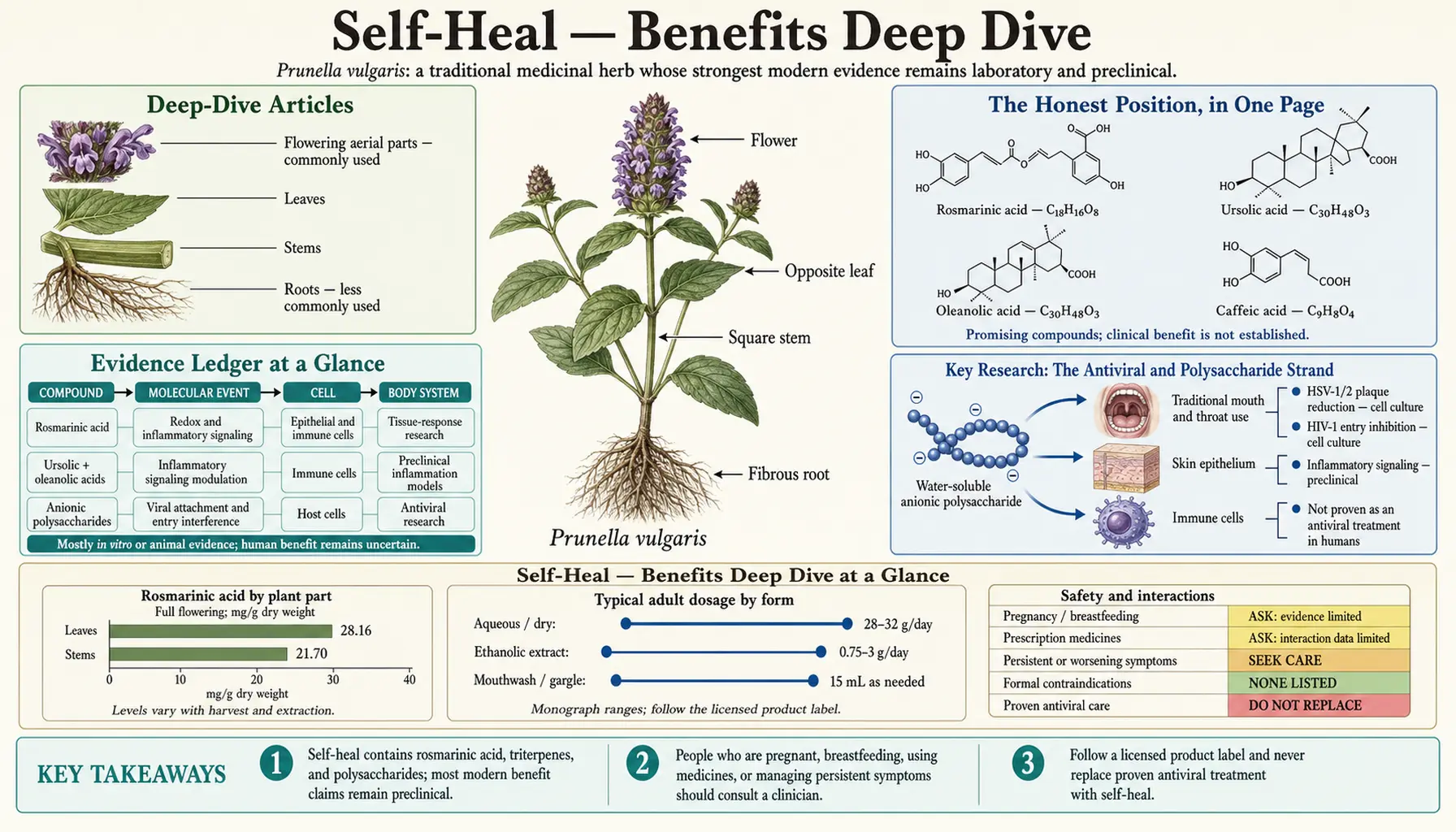
Prunella vulgaris arrives carrying two of the boldest promises in the whole herbal vocabulary. Self-heal. Heal-all. Those names were not earned by any comparison of treated and untreated patients; they are Renaissance-era labels produced by the doctrine of signatures, a way of reasoning about plants that has been obsolete for two hundred years. The plant deserves better than its own marketing, in both directions — it is more interesting than the hype suggests, and far less proven.
These four pages set out what is actually established. In short: an unusually clean safety record built on centuries of food and tea use; one strand of genuinely reproducible modern laboratory research on herpes simplex virus; a traditional core of throat, mouth and skin uses that the plant's chemistry supports better than the oral supplements built on it; and essentially no adequate human clinical trial for any of it. Not a record of failed trials — an absence of trials, which is a materially different and much less damning position, and one worth stating precisely rather than blurring.
Along the way we do something you will rarely see on a herb page: we follow the antiviral mechanism to the place where it was tested properly in humans, at proper doses, by the right route, in randomised trials with thousands of participants — and report that it failed. We also clear the plant of nine specific hazards it does not have, because refusing to invent a danger is as much a part of accuracy as refusing to invent a benefit.
Deep-Dive Articles
The Name and What It Promises
"Self-heal" and "heal-all" are among the most over-promising names in herbal medicine, and they came from the doctrine of signatures rather than from evidence. How the names were generated, why "woundwort" belongs to half a dozen unrelated plants, what the Chinese name xia ku cao says instead, and an evidence ledger that puts the plant's three best-established facts — all safety facts — above its most famous claim.
Antiviral and Herpes Research
The one genuinely interesting modern strand: water extracts and the polysaccharide "prunellin" block herpes simplex virus in cell culture, reproducibly, across independent groups. Also why that is a finding about an entire chemical class rather than about this plant, why the aciclovir-resistance claim is less impressive than it sounds, and what happened when the same mechanism went into large human trials.
Sore Throat and Topical Use
The traditional core across both European and Chinese practice, reported at traditional-use tier. What a warm gargle physically does with no herb in it at all, which constituents a water infusion actually extracts and which it leaves in the strainer, why rosmarinic acid is a plant-kingdom compound rather than a self-heal result, and when a sore throat stops being a herb question.
Rosmarinic Acid, Safety and Unknowns
Where the honest answer is mostly reassuring, and where saying so is part of accuracy. Nine hazards this plant does not have; why "it is just a mint" is a bad argument even when its conclusion is right; the coumarin fallacy that props up the blood-thinning warning; the potassium arithmetic that kills the blood-pressure mechanism; and ten numbered things nobody knows.
Table of Contents
- Deep-Dive Articles
- The Honest Position, in One Page
- Evidence Ledger at a Glance
- Key Research: The Antiviral and Polysaccharide Strand
- Key Research: Where the Mechanism Was Tested in Humans
- Key Research: Rosmarinic Acid and the Triterpenes
- Key Research: Tradition, Food Use and Safety
- Key Research: Comparators With Real Human Trials
- External Resources
- Connections
The Honest Position, in One Page
If you read nothing else in this section, read this.
What is solid
- It is a food. Young leaves are eaten raw and cooked across Europe, Turkey, Korea, Japan and China; the dried flower spike is drunk as a cooling tea, including casually and commercially. That is a very large, very long, cross-cultural exposure record.
- No toxicity signal has emerged from it. No recognised poisoning syndrome, no cluster of liver or kidney injury, no regulatory action of the kind that hit comfrey, germander, kava or aristolochia. This is absence of a signal rather than a completed safety programme — but it is real, and it is more than most medicinal herbs can show.
- The chemistry is well described. Rosmarinic acid and other phenolic acids, flavonoid glycosides, the triterpene acids ursolic and oleanolic, and water-soluble sulfated polysaccharides.
- The herpes cell-culture finding is real and reproducible. Independent groups, consistent direction, a coherent mechanism.
What is not
- There is no adequate human trial of this plant for anything. Not for wounds, not for sore throat, not for mouth ulcers, not for cold sores, not for genital herpes, not for eye inflammation, not for goitre, not for blood pressure, not for cancer.
- Nobody has measured what happens to it in a person. No pharmacokinetics, no dose-finding, no interaction studies. "No known interactions" here means nobody has looked, which is absent data rather than reassurance.
- The antiviral fraction cannot work by the oral route. Large sulfated polysaccharides are not absorbed from the gut — measured directly in humans for the best-studied member of the class. A swallowed extract cannot deliver a contact-dependent entry blocker to a virus.
- A water infusion leaves the triterpenes behind. Ursolic and oleanolic acid are poorly water-soluble, so the plant's best anti-inflammatory laboratory finding does not transfer to a tea.
- Rosmarinic acid results are not self-heal results. The compound is abundant in rosemary, lemon balm, perilla, sage and spearmint. A finding about the molecule belongs to all of them jointly and to none exclusively.
The one conclusion that surprised us
Taking the chemistry seriously ends up supporting the old-fashioned topical uses over the modern oral supplement. The antiviral polysaccharides act only on contact and are not absorbed; rosmarinic acid's oral bioavailability is low; antibacterial concentrations achievable in a strong infusion are plausible at a mucosal surface and impossible in the bloodstream. Capsules sold on the strength of the herpes research are sold on a mechanism that cannot operate the way they are taken. The gargle is the preparation with the coherent rationale — and it is the one nobody has bothered to trial.
The only real hazard
Not the plant. The delay. A herb called "self-heal" implies that no clinician is needed, and its flagship Chinese indication is dissipating neck lumps. A persistent, hard, painless or enlarging neck lump in an adult is investigated, not steeped. The same goes for a severe or one-sided sore throat, a spreading skin infection, or anything at all in someone immunosuppressed.
Evidence Ledger at a Glance
Ranked by how well established each item is, not by how often it is repeated. Note where the list starts, and note that negative and absent are logged separately because they are different verdicts.
- Established, human: edible leaf, palatable tea, long cross-cultural food record.
- Established by absence of signal, human: no notable toxicity from centuries of casual use.
- Established, chemical: the constituent profile.
- Reproducible, laboratory: inhibition of HSV-1 and HSV-2 in cell culture by aqueous extracts and purified polysaccharide.
- Reproducible, laboratory: antioxidant activity, reduced inflammatory signalling in cells and some animal models, protection of human keratinocytes against oxidative and ultraviolet stress.
- Reproducible, laboratory: inhibition of assorted bacteria and fungi in broth or agar.
- Traditional, two independent traditions: throat, mouth, minor wounds. Convergent, specific, plausible — and untrialled.
- Traditional, one tradition: eyes, neck nodules, goitre. Untrialled, and the nodule indication carries a delayed-diagnosis risk.
- Traditional with a mechanism that fails arithmetic: blood pressure via potassium salts. At a generous ceiling, a cup of tea carries about a seventh of a banana's potassium and a full traditional decoction about one banana. Whatever the herb may do, potassium is not how.
- Preclinical only, and heavily overstated online: anticancer activity. Cell lines and tumour-bearing mice. This is the claim most likely to cause real harm by displacing treatment.
- Negative, human, borrowed but directly relevant: oral bioavailability of the active antiviral class — measured and poor. And topical polyanion antivirals for preventing viral infection — large randomised trials, failed.
- Absent: every clinical endpoint, all pharmacokinetics, all dose-finding, all interaction studies, all pregnancy data, all product standardisation.
Key Research: The Antiviral and Polysaccharide Strand
All citations on this page are live PubMed title or topic searches rather than fixed identifiers, so the links keep working and you see the current literature rather than a snapshot. Where we could not verify a paper's details we describe the finding and link the topic instead.
- Tabba HD, Chang RS, Smith KM. "Isolation, purification, and partial characterization of prunellin, an anti-HIV component from aqueous extracts of Prunella vulgaris." Antiviral Research, 1989. The origin of the name that supplement labels now use as though it denoted a characterised drug. Read the words "partial characterization" in the founding paper's own title. — PubMed search
- Xu HX, Lee SHS, Lee SF, White RL, Blay J. "Isolation and characterization of an anti-HSV polysaccharide from Prunella vulgaris." Antiviral Research, 1999. The purification tying antiviral activity to the polysaccharide fraction, and the source of the aciclovir-resistant-strain report. — PubMed search
- Chiu LCM, Zhu W, Ooi VEC. "A polysaccharide fraction from medicinal herb Prunella vulgaris downregulates the expression of herpes simplex virus antigen in Vero cells." Journal of Ethnopharmacology, 2004. Independent confirmation with a downstream readout, in a monkey kidney cell line. — PubMed search
- Psotová J, Kolář M, Soušek J, et al. "Biological activities of Prunella vulgaris extract." Phytotherapy Research, 2003. Antioxidant and anti-HSV activity in a single characterised extract. — PubMed search
- Sulfated polysaccharides as antiviral entry inhibitors — class reviews. Essential context: carrageenan, dextran sulfate, fucoidan, heparin and pentosan polysulfate all do this, for the same physical-chemical reason. The finding belongs to the class. — PubMed search
- Aciclovir resistance mechanisms in herpes simplex virus. Resistance arises mainly in viral thymidine kinase — which an entry blocker never touches, making "active against resistant strains" predictable rather than remarkable. — PubMed search
Key Research: Where the Mechanism Was Tested in Humans
This block is the most important on the page, and the rarest thing on a herb site: the proposed mechanism, tested properly in people, in randomised trials, by the right route.
- Lorentsen KJ, Hendrix CW, Collins JM, et al. "Dextran sulfate is poorly absorbed after oral administration." Annals of Internal Medicine, 1989. Human pharmacokinetics for the class of molecule credited with self-heal's antiviral activity, measured directly, with an unambiguous answer. This is why an oral antiviral claim for this plant is not merely unstudied but implausible. — PubMed search
- Oral dextran sulfate in AIDS and AIDS-related complex, Annals of Internal Medicine, 1989. The clinical arm of the same story. The class did not deliver, and was effectively abandoned as an oral antiviral. — PubMed search
- Skoler-Karpoff S, et al. "Efficacy of Carraguard for prevention of HIV infection in women in South Africa: a randomised, double-blind, placebo-controlled trial." The Lancet, 2008. A carrageenan gel — a sulfated polysaccharide entry blocker — applied topically at the site of exposure, at drug concentrations, in thousands of women. It did not prevent infection. — PubMed search
- Van Damme L, et al. "Lack of effectiveness of cellulose sulfate gel for the prevention of vaginal HIV transmission." New England Journal of Medicine, 2008. Trials stopped early after an interim signal, with a clear negative efficacy result. Read the paper rather than the headlines on what the safety signal did and did not establish. — PubMed search
- PRO 2000 vaginal gel HIV prevention trials. The other major polyanion candidate: a suggestive smaller result, a null larger one. — PubMed search
- Eccles R, et al. Iota-carrageenan nasal spray versus placebo in early treatment of the common cold. Respiratory Research, 2010. The honest counterweight: the same mechanism, applied continuously to the exposed surface, with a positive result. The class is not dead — it just cannot be swallowed. — PubMed search
Key Research: Rosmarinic Acid and the Triterpenes
- Petersen M, Simmonds MSJ. "Rosmarinic acid." Phytochemistry, 2003. The standard review, including the compound's wide distribution across the mint and borage families — the reason a rosmarinic acid result is never a self-heal result. — PubMed search
- Ryu SY, Oak MH, Yoon SK, et al. "Anti-allergic and anti-inflammatory triterpenes from the herb of Prunella vulgaris." Planta Medica, 2000. The paper behind the ursolic and oleanolic acid claims — and, given their poor water solubility, the paper least applicable to a tea. — PubMed search
- Psotová J, Svobodová A, Kolářová H, Walterová D. "Photoprotective properties of Prunella vulgaris and rosmarinic acid on human keratinocytes." Journal of Photochemistry and Photobiology B: Biology, 2006. The most route-appropriate laboratory evidence the plant has: human skin cells, the tissue the tradition actually treated. — PubMed search
- Rosmarinic acid pharmacokinetics, metabolism and bioavailability in humans. Low oral bioavailability, extensive conjugation, rapid clearance — and therefore a large gap between cell-culture concentrations and anything achievable by drinking a herb. — PubMed search
- Ursolic acid: aqueous solubility, formulation and bioavailability. The chemistry behind the solvent argument — why a water infusion leaves the triterpenes in the strainer. — PubMed search
- Hwang SM, et al. Prunella vulgaris and vascular inflammation via the Nrf2 and HO-1 pathway. International Journal of Molecular Sciences, 2012. A representative anti-inflammatory mechanism study, in cells, and a good example of how far such work sits from a clinical claim. — PubMed search
Key Research: Tradition, Food Use and Safety
- Bai Y, Xia B, Xie W, et al. "Phytochemistry and pharmacological activities of the genus Prunella." Food Chemistry, 2016. The most complete compositional map, and the reference against which we checked which hazards the plant does not carry. — PubMed search
- Wang SJ, Wang XH, Dai YY, et al. "Prunella vulgaris: a comprehensive review of chemical constituents, pharmacological effects and clinical applications." Current Pharmaceutical Design, 2019. Read the clinical section for how little is there. That thinness is the finding. — PubMed search
- Prunella vulgaris in ethnobotanical wild-food and beverage surveys. The documentary basis for the food-history safety argument, from Europe, Turkey, Korea, Japan and China. — PubMed search
- Xia ku cao in traditional Chinese medicine and multi-herb formulas. Most clinical literature attaches to formulas rather than to the single herb. The search makes the pattern obvious. — PubMed search
- Germander (Teucrium chamaedrys) hepatotoxicity. The Lamiaceae counterexample that destroys the "it is just a mint, so it is safe" argument — even though the conclusion happens to be right for self-heal. — PubMed search
- Herbal product adulteration and species substitution, including DNA barcoding surveys. Why "woundwort" is a job description rather than an identification, and why the safety record belongs to the species you meant. — PubMed search
- Live search for toxicology and safety studies of Prunella vulgaris. Please run it. We could not verify a coherent toxicology programme; if that changes, this link will show it first. — PubMed search
Key Research: Comparators With Real Human Trials
These exist to answer the standing defence that traditional remedies cannot be trialled. Every item is a traditional or over-the-counter remedy that was tested anyway — often cheaply, often by small groups, and in one case on a mint-family herb for exactly the condition self-heal is claimed to treat.
- Koytchev R, Alken RG, Dundarov S. "Balm mint extract (Lo-701) for topical treatment of recurring herpes labialis." Phytomedicine, 1999. A lemon balm cream, randomised and placebo-controlled, for cold sores. A Lamiaceae herb with a similar rosmarinic acid profile and a similar traditional reputation was trialled properly. Self-heal could have been. — PubMed search
- Hubbert M, et al. Efficacy and tolerability of a spray with Salvia officinalis in the treatment of acute pharyngitis. European Journal of Medical Research, 2006. A sage throat spray against placebo. — PubMed search
- Schapowal A, Berger D, Klein P, Suter A. "Echinacea/sage or chlorhexidine/lidocaine for treating acute sore throats: a randomized double-blind trial." European Journal of Medical Research, 2009. A herbal spray taken head-to-head against a conventional one, which is the design a self-heal gargle deserves and has never received. — PubMed search
- Honey for acute cough in children — Cochrane systematic review. How much evidence a cheap traditional remedy can genuinely accumulate when someone bothers. — PubMed search
- Pelargonium sidoides for acute respiratory tract infections — Cochrane systematic review. Another traditional preparation with a real evidence base. — PubMed search
- Sacks SL, et al. Clinical efficacy of docosanol 10% cream for herpes simplex labialis: a multicentre randomised placebo-controlled trial. Journal of the American Academy of Dermatology, 2001. Calibration: a real, statistically solid effect in this condition is roughly half a day of healing time. Far smaller than herbal marketing implies. — PubMed search
- Herbal mouthwashes for oral mucositis — chamomile, calendula and others. A validated, inexpensive, ready-made trial design with a genuine unmet need, sitting in the literature next to a herb that has never been put through it. — PubMed search
- Live search for any human trial of Prunella vulgaris. The link that would falsify this whole section. As of writing, it does not. — PubMed search
External Resources
- PubMed — the biomedical literature database behind every citation on these pages.
- ClinicalTrials.gov — the trials registry. Search the species yourself to check our claim that no trial is registered.
- National Center for Complementary and Integrative Health — plain-language, evidence-graded summaries of herbs and supplements.
- LiverTox — the National Library of Medicine's reference on drug- and herb-induced liver injury. Useful for checking which herbs genuinely have a hepatotoxicity record.
- European Medicines Agency — herbal monographs, and the place to read what a "traditional use registration" actually certifies, which is documented long use plus plausibility and explicitly not efficacy trials.
- Plants of the World Online (Kew) — authoritative botanical names and distributions, for settling which species a folk name refers to.
- Cochrane Library — systematic reviews, including the honey and Pelargonium reviews cited above.
Connections
- All Herbs
- Self-Heal (Prunella vulgaris) — the main topic page for the plant
- The Name and What It Promises — the doctrine of signatures, and an evidence ledger
- Antiviral and Herpes Research — prunellin, and where the mechanism was tested
- Sore Throat and Topical Use — the traditional core, and the red flags
- Rosmarinic Acid, Safety and Unknowns — nine hazards it does not have
- Lemon Balm: Antiviral and HSV — the mint-family comparator that was trialled
- Lemon Balm — rosmarinic acid, with more human data behind it
- Rosemary: Benefits — the herb the compound is named after
- Perilla: Benefits — where this site makes the same rosmarinic-acid argument
- Yarrow: Benefits — the other great woundwort, under the same scrutiny
- Calendula: Benefits — a wound and mouth herb with real trial data
- Sage: Benefits — the Lamiaceae throat remedy that got tested
- Agrimony: Sore Throat and Topical Use — a closely parallel astringent tradition
- Plantain — the everyday poultice herb
- Comfrey — a wound herb with a genuine internal hazard
- Chrysanthemum: Cooling, Fever and Sore Throat — the cooling herb paired with xia ku cao
- Herpes Simplex — the infection, and the treatments with evidence
- Lysine: Herpes Simplex and Cold Sores — a claim that was tested, with mixed results
- Sore Throat — the symptom, its causes and its red flags