Boswellia — Benefits Deep Dive
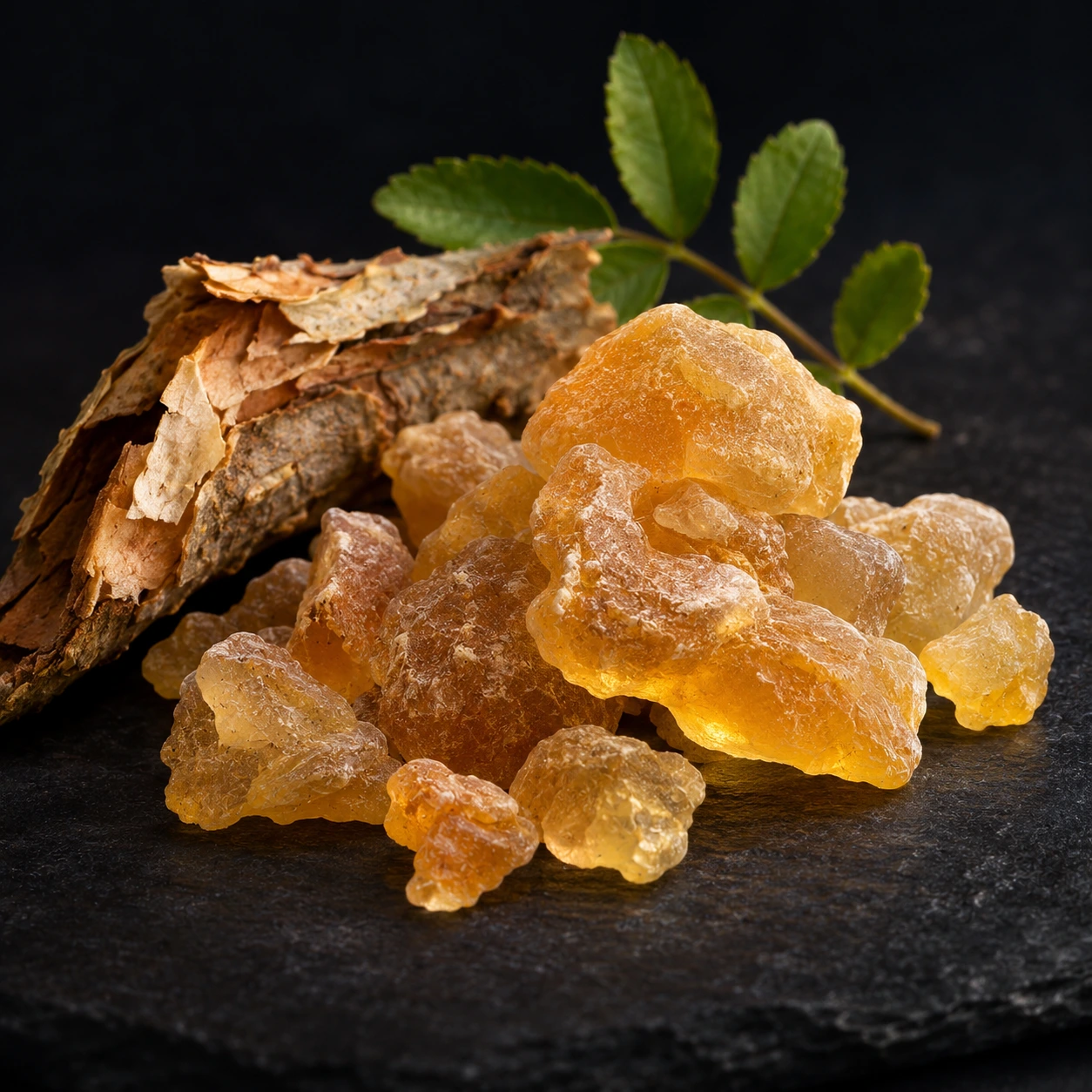
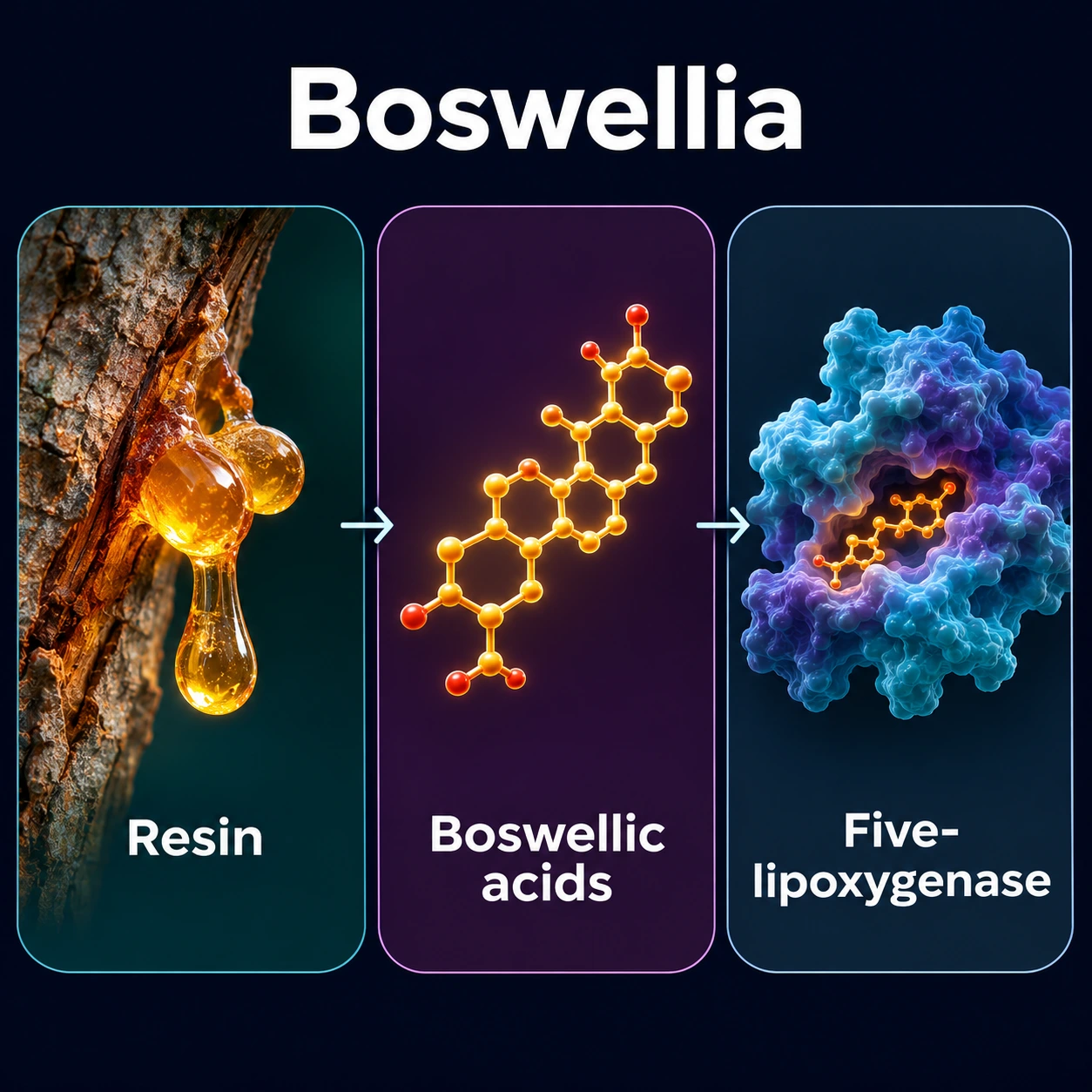

Boswellia serrata — Indian frankincense, known in Ayurveda as Shallaki or Salai guggul — is a traditional anti-inflammatory resin whose molecular target has been studied for decades and is still debated. Its oleo-gum-resin contains boswellic acids, a family of pentacyclic triterpenes whose most studied member, acetyl-11-keto-β-boswellic acid (AKBA), inhibits 5-lipoxygenase (5-LOX), the enzyme that manufactures leukotrienes, in laboratory tests; a 2011 review calls that mode of action questionable in people, because AKBA stays at very low levels in the blood. Because leukotrienes drive inflammation in joints, the gut lining, and the airways, Boswellia has been tested across all three. The evidence is not uniform: it is strongest for knee osteoarthritis, though pooled analyses disagree, mechanistically attractive but genuinely mixed for inflammatory bowel disease, and dated and preliminary for asthma. The four pages below walk through each area honestly — naming the trials, the doses, the standardized extracts, and the places where the science does not yet support the marketing.
Deep-Dive Articles
Joint & Osteoarthritis
Boswellia's strongest evidence base. Multiple randomized controlled trials in knee osteoarthritis — Kimmatkar 2003, the trials of an extract enriched to 30% AKBA, a faster-acting extract combining AKBA with the resin's non-volatile oil, and a 2020 meta-analysis of seven trials in 545 patients — showing reduced pain and stiffness and improved function, sometimes within a week. Includes standardized extracts, doses, and how the effect size compares to nonsteroidal anti-inflammatory drugs (NSAIDs).
Read the deep dive →Inflammatory Bowel Disease
A mechanistically compelling but honestly mixed story. Early ulcerative-colitis and Crohn's trials were positive, and a collagenous-colitis trial reached remission — but the best-designed Crohn's maintenance trial (Holtmeier 2011), which included 108 outpatients and was stopped early with 82 randomized, was negative. Why leukotriene B4 makes the gut a logical target, what the trials actually showed, and why Boswellia is not a replacement for standard inflammatory bowel disease (IBD) therapy.
Read the deep dive →Anti-Inflammatory Mechanism
How boswellic acids actually work. AKBA as a specific, non-redox, non-competitive inhibitor of 5-lipoxygenase (Safayhi 1992), plus the broader multi-target picture — microsomal prostaglandin E synthase-1, cathepsin G, human leukocyte elastase, nuclear factor kappa B, tumor necrosis factor-α, and matrix metalloproteinases. Also the bioavailability problem: why AKBA plasma levels may fall short of the concentrations that inhibit 5-lipoxygenase in a test tube, and how modern extracts try to fix it.
Read the deep dive →Respiratory & Asthma
The most preliminary application. Cysteinyl leukotrienes are potent bronchoconstrictors — the same pathway targeted by montelukast and zileuton — which is why a natural 5-lipoxygenase inhibitor was tested in asthma. But the human evidence rests largely on a single small 1998 trial. What that study found, why it has not been replicated at scale, and why no trial supports replacing prescribed asthma controllers with a supplement.
Read the deep dive →Table of Contents
- Deep-Dive Articles
- Boswellia and Boswellic Acids: What They Are
- Where the Evidence Is Strong, Mixed, and Preliminary
- Standardized Extracts, Forms, and Dosing
- Safety, Side Effects, and Interactions
- Boswellia and Swelling in the Brain After Radiation
- Boswellia and Blood Sugar
- Research Papers: Joint & Osteoarthritis
- Research Papers: Inflammatory Bowel Disease
- Research Papers: Mechanism & Pharmacology
- Research Papers: Respiratory & Asthma
- Research Papers: Brain Radiation & Blood Sugar
- External Authoritative Resources
- Connections
- Featured Videos
Boswellia and Boswellic Acids: What They Are
Boswellia serrata is a branching tree native to the dry hill forests of India, and a close relative of the trees that produce the frankincense of the Arabian Peninsula and the Horn of Africa. When the bark is incised, the tree exudes a fragrant oleo-gum-resin that hardens into the material used medicinally. In Ayurvedic tradition this resin has been used for centuries under the names Shallaki and Salai guggul, primarily for painful, swollen joints — the same indication for which the modern evidence is strongest.
The pharmacologically important fraction of the resin is a group of boswellic acids — pentacyclic triterpenic acids. At least a dozen have been characterized, but four dominate the literature: β-boswellic acid (BA), acetyl-β-boswellic acid (ABA), 11-keto-β-boswellic acid (KBA), and acetyl-11-keto-β-boswellic acid (AKBA). AKBA is generally regarded as the most potent in the test tube, because in early laboratory work it was the strongest of the group at inhibiting 5-lipoxygenase, the enzyme that converts arachidonic acid into leukotrienes. As first described, this is a different mechanism from that of conventional nonsteroidal anti-inflammatory drugs such as ibuprofen, which block the cyclooxygenase (COX) enzymes and the prostaglandins they produce: the 1992 laboratory study found boswellic acids did not impair cyclooxygenase in isolated human platelets. Later reviews complicate the picture. A 2016 review lists inhibition of leukotriene synthesis and, to a lesser extent, prostaglandin synthesis, and a 2011 review reports that β-boswellic acid inhibits microsomal prostaglandin E synthase-1 and the enzyme cathepsin G.
The difficulty in plain words is that the most active compound in the test tube is not the one that reaches the blood well. AKBA is poorly absorbed. The 2011 review reports that boswellic acids failed to inhibit leukotriene formation in human whole blood, that AKBA and 11-keto-β-boswellic acid stay far below the levels active in the laboratory, and that the 5-lipoxygenase mode of action is therefore questionable. β-Boswellic acid reaches plasma levels about 100-fold higher, which is why that review names its two enzyme targets as reasonable candidates instead.
That distinction is the reason clinicians and researchers find Boswellia interesting: it offers a route to dampening inflammation that does not carry the classic nonsteroidal anti-inflammatory drug (NSAID) risks of gastric ulceration and kidney stress driven by cyclooxygenase-1 (COX-1) inhibition. Whether the herb fully delivers on that promise in the body — rather than in a test tube — is a real and unsettled question, explored in depth on the mechanism page.
Where the Evidence Is Strong, Mixed, and Preliminary
One of the most useful things a reader can take from these pages is a clear map of how good the evidence actually is for each use. It varies enormously, and honest supplement information means saying so plainly.
- Knee osteoarthritis — the strongest evidence. Several randomized, placebo-controlled trials, three of those listed below led from extract makers' own research departments, plus a 2020 systematic review and meta-analysis of seven trials in 545 patients, report a reduction in pain and stiffness and an improvement in function; that review rates the trials' quality as generally medium to low. A larger 2024 meta-analysis of 13 knee osteoarthritis studies (850 patients scored on the Western Ontario and McMaster Universities Osteoarthritis Index, 1,185 on a visual pain scale) found no significant overall effect against all control types together (p=0.0865 and p=0.3966), which the authors attribute to high differences between studies. Compared with placebo alone, the extracts did lower scores on that index, and the authors state that further high-quality studies are needed. This is where a patient is most likely to notice a genuine effect. See Joint & Osteoarthritis.
- Inflammatory bowel disease — mixed and unresolved. The rationale is strong (leukotriene B4 is elevated in inflamed gut mucosa), and several small early trials in ulcerative colitis, chronic colitis, and collagenous colitis were positive. But the most rigorous trial — a placebo-controlled Crohn's maintenance study that included 108 outpatients, was stopped early with 82 randomized, and analysed 66 — found no benefit over placebo (remission 59.9% versus 55.3%, P=0.85). See Inflammatory Bowel Disease. What the positive trials compared:
- Ulcerative colitis, 1997 — against the drug sulfasalazine, not placebo: remission in 82% on the resin and 75% on sulfasalazine.
- Chronic colitis, 2001 — against sulfasalazine, not placebo: remission in 14 of 20 on the resin and 4 of 10 on sulfasalazine.
- Active Crohn's disease, 2001 — 102 people randomized, tested for non-inferiority to the drug mesalazine, not against placebo: the extract was not inferior, and no significant advantage over mesalazine was proven.
- Collagenous colitis, 2007 — against placebo, 31 randomized: remission in 63.6% versus 26.7% among those who completed the protocol (p=0.04), but 43.8% versus 26.7% counting everyone randomized (p=0.25), with no effect on tissue findings or quality of life.
- Asthma and respiratory inflammation — preliminary and dated. A small 1998 trial reported symptomatic improvement, and the leukotriene mechanism parallels the prescription drugs zileuton and montelukast — but there has been no large modern replication. A 2018 double-blind, placebo-controlled trial (18 versus 18 people, 56 days), with an author from an extract maker's research center, tested 200 mg a day of a Boswellia plus Aegle marmelos fruit combination in mild to moderate asthma; asthma symptom scores improved compared with placebo as early as day 14 (p=.0002). It is small and a combination, so it does not isolate Boswellia. See Respiratory & Asthma.
A recurring theme across all three areas is that many of the positive trials are small, some are older, and several were funded by manufacturers of standardized extracts. None of this means the results are wrong — but it does mean that the confidence intervals are wide and that independent replication matters. Where the science is thin, these pages say so rather than filling the gap with confident-sounding claims.
Standardized Extracts, Forms, and Dosing
Because whole resin varies in boswellic-acid content — and because AKBA in particular is poorly absorbed — most of the good clinical trials used standardized extracts rather than raw gum resin. Understanding the common forms helps make sense of the dosing:
- Standardized Boswellia serrata extract — typically standardized to 30–65% total boswellic acids. Older trials used roughly 300–400 mg of extract taken two to three times daily.
- An extract enriched to 30% AKBA — studied in knee osteoarthritis at 100 mg and 250 mg once daily. The higher dose showed benefit as early as seven days.
- AKBA combined with the non-volatile oil of Boswellia — made to improve absorption; studied at 100 mg daily, with some trials reporting benefit within five to seven days.
- A standardized extract of AKBA with β-boswellic acid — used in a 2019 osteoarthritis trial at 169.33 mg twice daily over 120 days.
What the trials used: on the order of 100–250 mg of an AKBA-enriched extract daily, or 300–400 mg of a broadly standardized extract two to three times daily. Absorption improves when taken with a fat-containing meal, because boswellic acids are lipophilic; a 2016 review reports absorption of 11-keto-β-boswellic acid and AKBA more than doubled with a high-fat meal. Onset in the osteoarthritis trials ranged from about one to four weeks, so these trials measured effects over several weeks, not several days. The 2020 meta-analysis specifically suggested at least four weeks of use at 100–250 mg. Its authors add that this duration and dose should be interpreted with caution, because results between week 1 and week 4 and doses outside 100–250 mg were not reported.
Safety, Side Effects, and Interactions
Across the clinical trials, Boswellia has generally been well tolerated, which is one of the reasons it is attractive as a long-term option for chronic joint pain. Still, the research and the traditional texts raise several cautions:
- Gastrointestinal effects — the most commonly reported side effects are mild: nausea, acid reflux, epigastric discomfort, and occasionally diarrhea. These are usually less frequent than with nonsteroidal anti-inflammatory drugs, but they are not zero.
- Pregnancy and breastfeeding — there is not enough safety data, and traditional texts historically regarded some frankincense preparations as potentially emmenagogic, meaning able to bring on menstrual bleeding.
- Drug interactions — boswellic acids can influence drug-metabolizing enzymes and transporters in laboratory studies, so the concern is greatest with medications that have narrow therapeutic windows. A 2025 review lists uncertain interactions with other drugs as a current drawback. Because Boswellia acts on inflammatory pathways, the same question arises with anti-inflammatory, immunosuppressive, and anticoagulant drugs.
- Not a replacement for prescribed therapy — this is the single most important caution. The trials here do not establish Boswellia as a substitute for disease-modifying inflammatory bowel disease medication, inhaled asthma controllers, or any prescribed treatment. These pages describe it as a possible adjunct.
- Product quality varies — supplements are not tightly regulated, and actual boswellic-acid content can differ from the label. A label that states the AKBA percentage gives a figure that can be compared with the extracts used in the trials.
Boswellia and Swelling in the Brain After Radiation
Radiation to the brain can cause swelling and dead tissue (cerebral edema and radiation necrosis), and steroids such as dexamethasone are the usual first treatment. A 2025 review found 6 reports covering 130 people given boswellic acids during or after brain radiation. Roughly half benefited on scans or clinically, and about a third could taper dexamethasone or avoid taking it long term. Mild stomach discomfort was the most common complaint.
The review lists what is not known: the best formulation, timing and dose, along with a large number of capsules a day and uncertain interactions with other drugs. Its authors call the clinical evidence lacking and ask for well-designed prospective trials. Separately, the European Medicines Agency classified Boswellia serrata gum resin extract as an orphan drug for swelling around brain tumours in 2002.
Boswellia and Blood Sugar
A 2024 meta-analysis of 5 studies with 287 people with type 2 diabetes reported lower hemoglobin A1c (standardized mean difference −1.01), total cholesterol, triglycerides and low-density lipoprotein cholesterol with Boswellia compared with placebo or control. The fall in fasting blood glucose did not reach significance (P=0.05), and high-density lipoprotein cholesterol did not change. A standardized mean difference has no units, so it cannot be read as a number of percentage points. The authors say Boswellia may help alongside a controlled diet and other treatments.
Research Papers: Joint & Osteoarthritis
- Kimmatkar N, Thawani V, Hingorani L, Khiyani R (2003). Efficacy and tolerability of Boswellia serrata extract in treatment of osteoarthritis of knee — a randomized double blind placebo controlled trial. Phytomedicine — PubMed PMID: 12622457
- Sengupta K, et al. (2008). A double blind, randomized, placebo controlled study of the efficacy and safety of 5-Loxin for treatment of osteoarthritis of the knee. Arthritis Research & Therapy — PubMed PMID: 18667054
- Sengupta K, et al. (2010). Comparative efficacy and tolerability of 5-Loxin and Aflapin against osteoarthritis of the knee. International Journal of Medical Sciences — PubMed PMID: 21060724
- Vishal AA, Mishra A, Raychaudhuri SP (2011). A double blind, randomized, placebo controlled clinical study evaluates the early efficacy of aflapin in subjects with osteoarthritis of knee. International Journal of Medical Sciences 8(7):615-622 — PubMed PMID: 22022214
- Majeed M, Majeed S, Narayanan NK, Nagabhushanam K (2019). A pilot, randomized, double-blind, placebo-controlled trial to assess the safety and efficacy of a novel Boswellia serrata extract in the management of osteoarthritis of the knee. Phytotherapy Research — PubMed PMID: 30838706
- Yu G, et al. (2020). Effectiveness of Boswellia and Boswellia extract for osteoarthritis patients: a systematic review and meta-analysis. BMC Complementary Medicine and Therapies — PubMed PMID: 32680575
- Dalmonte T, Andreani G, Rudelli C, Isani G (2024). Efficacy of extracts of oleogum resin of Boswellia in the treatment of knee osteoarthritis: a systematic review and meta-analysis. Phytotherapy Research 38(12):5672-5689 — PubMed PMID: 39314013
Research Papers: Inflammatory Bowel Disease
- Gupta I, Parihar A, Malhotra P, et al. (1997). Effects of Boswellia serrata gum resin in patients with ulcerative colitis. European Journal of Medical Research — PubMed PMID: 9049593
- Gupta I, et al. (2001). Effects of gum resin of Boswellia serrata in patients with chronic colitis. Planta Medica — PubMed PMID: 11488449
- Gerhardt H, Seifert F, Buvari P, Vogelsang H, Repges R (2001). Therapy of active Crohn disease with Boswellia serrata extract H 15. Zeitschrift für Gastroenterologie — PubMed PMID: 11215357
- Holtmeier W, et al. (2011). Randomized, placebo-controlled, double-blind trial of Boswellia serrata in maintaining remission of Crohn's disease: good safety profile but lack of efficacy. Inflammatory Bowel Diseases — PubMed PMID: 20848527
- Madisch A, Miehlke S, Eichele O, et al. (2007). Boswellia serrata extract for the treatment of collagenous colitis: a double-blind, randomized, placebo-controlled, multicenter trial. International Journal of Colorectal Disease — PubMed PMID: 17764013
Research Papers: Mechanism & Pharmacology
- Safayhi H, Mack T, Sabieraj J, Anazodo MI, Subramanian LR, Ammon HP (1992). Boswellic acids: novel, specific, nonredox inhibitors of 5-lipoxygenase. Journal of Pharmacology and Experimental Therapeutics 261(3):1143-1146. — PubMed PMID: 1602379
- Ammon HP (2006). Boswellic acids in chronic inflammatory diseases. Planta Medica. — PubMed PMID: 17024588
- Ammon HP (2016). Boswellic acids and their role in chronic inflammatory diseases. Advances in Experimental Medicine and Biology. — PubMed PMID: 27671822
- Abdel-Tawab M, Werz O, Schubert-Zsilavecz M (2011). Boswellia serrata: an overall assessment of in vitro, preclinical, pharmacokinetic and clinical data. Clinical Pharmacokinetics. — PubMed PMID: 21553931
Research Papers: Respiratory & Asthma
- Gupta I, Gupta V, Parihar A, et al. (1998). Effects of Boswellia serrata gum resin in patients with bronchial asthma: results of a double-blind, placebo-controlled, 6-week clinical study. European Journal of Medical Research. — PubMed PMID: 9810030
- Ammon HP (2002). Boswellic acids (components of frankincense) as the active principle in treatment of chronic inflammatory diseases. Wiener Medizinische Wochenschrift. — PubMed PMID: 12244881
- Yugandhar P, Rao KM, Sengupta K (2018). A novel herbal composition containing extracts of Boswellia serrata gum resin and Aegle marmelos fruit alleviates symptoms of asthma in a placebo controlled double-blind clinical study. Phytotherapy Research 32(1):140-150. — PubMed PMID: 29210124
Research Papers: Brain Radiation & Blood Sugar
- Dejonckheere CS, Scafa D, Kasmann L, Zeyen T, Potthoff AL, Schafer N, Weller J, Herrlinger U, Schneider M, Vatter H, Grosu AL, Brehmer S, Giordano FA, Sarria GR, Gkika E, Layer JP (2025). Boswellia serrata for the management of radiation-induced cerebral edema and necrosis: a systematic meta-narrative review of clinical evidence. Advances in Radiation Oncology 10(4):101732. — PubMed PMID: 40092573
- Karimi M, Vakili K, Rashidian P, Razavi-Amoli SK, Akhbari M, Kazemi K (2024). Effect of boswellia (Boswellia serrata L.) supplementation on glycemic markers and lipid profile in type 2 diabetic patients: a systematic review and meta-analysis. Frontiers in Clinical Diabetes and Healthcare 5:1466408. — PubMed PMID: 39449720
External Authoritative Resources
- LiverTox (U.S. National Institutes of Health, NIH) — Boswellia serrata — concise, authoritative safety and pharmacology summary
- U.S. National Institutes of Health National Center for Complementary and Integrative Health — Herbs at a Glance
- U.S. National Center for Complementary and Integrative Health (NCCIH) — Boswellia
- PubMed — All research on Boswellia serrata / boswellic acids
Connections
- All Herbs
- Boswellia (Main Page)
- Boswellia for Joint & Osteoarthritis
- Boswellia for Inflammatory Bowel Disease
- Boswellia Anti-Inflammatory Mechanism
- Boswellia for Respiratory & Asthma
- Turmeric
- Curcumin
- Ginger
- Omega-3 Fatty Acids
- Osteoarthritis
- Rheumatoid Arthritis
- Ulcerative Colitis
- Crohn's Disease
- Asthma
- Immune Boosting