Cholesterol and Cardiovascular
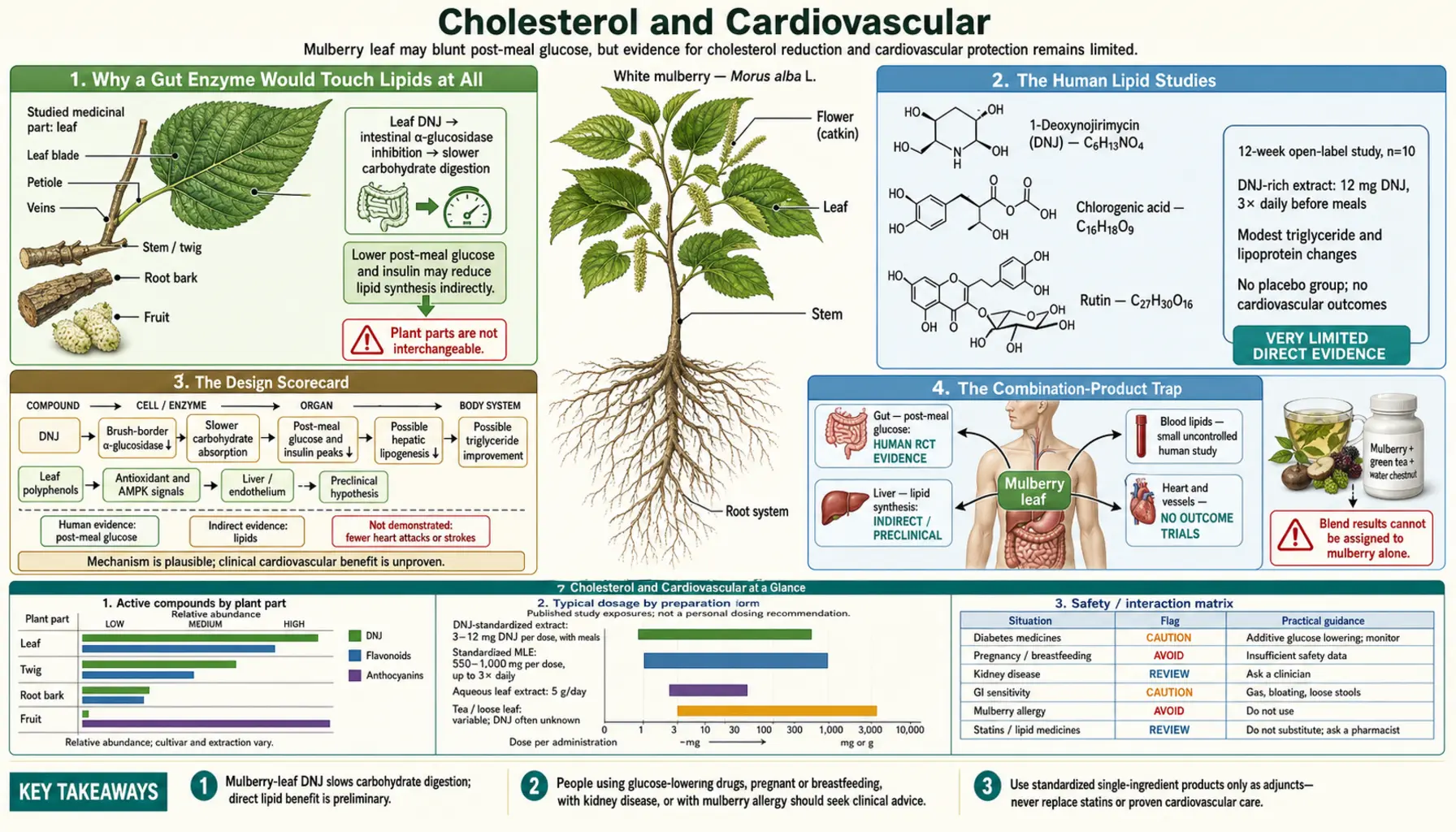
Search for mulberry leaf and you will find cholesterol claims everywhere. This article works out how much of that is real.
The short answer, stated up front so nothing here misleads: there is a modest, plausible signal for triglycerides and HDL, resting on studies so small and so weakly designed that no confident claim can be built on them — and there is no evidence at all that mulberry leaf prevents heart attacks or strokes. That second half is not merely an absence of data. The pharmaceutical version of the same mechanism was put through a proper cardiovascular outcome trial in 6,522 people and did not reduce cardiovascular events. That result deserves a full section, because it is the most informative thing anyone knows about this mechanism and the heart.
Table of Contents
- Why a Gut Enzyme Would Touch Lipids at All
- The Human Lipid Studies
- The Design Scorecard
- The Combination-Product Trap
- Spikes, Arteries and Stiffness
- Cell and Animal Work: Interesting, Not Evidence
- The Acarbose Lesson: A Class That Was Properly Tested
- What That Means for Mulberry Leaf
- If Your Goal Is Cholesterol, What Actually Works
- Cautions for Cardiovascular Use
- Key Research Papers
- Connections
Why a Gut Enzyme Would Touch Lipids at All
It is a fair first question. DNJ blocks the enzymes that cut sugars. Cholesterol is not a sugar. So why would anyone expect an effect on the lipid panel?
There are four routes, and they differ enormously in plausibility.
- Triglycerides are downstream of carbohydrate. This is the strongest argument. Fasting triglycerides are heavily driven by carbohydrate intake, because the liver converts surplus carbohydrate into fat through de novo lipogenesis, packages it into VLDL particles and exports it. High-carbohydrate diets reliably raise triglycerides; reducing refined carbohydrate reliably lowers them. Anything that reduces the sharp glucose-and-insulin pulses following meals could plausibly reduce hepatic fat production. This is the route with the clearest physiology, and it predicts triglycerides should move first, and further, than LDL.
- Lower insulin exposure. Insulin is the master switch for fat storage and it activates the enzymes of lipogenesis. Mulberry leaf lowers post-meal insulin in several trials. Less insulin over the day is a reasonable route to a lipid effect — but it is indirect and slow.
- Colonic fermentation and short-chain fatty acids. Carbohydrate that escapes the small intestine reaches the colon, where bacteria ferment it into acetate, propionate and butyrate. Propionate reaching the liver has been proposed to inhibit cholesterol synthesis. This is genuinely interesting and genuinely unproven in humans at the doses involved. It is also, note, the same process that produces the gas and bloating.
- The flavonoid fraction, independent of DNJ. Mulberry leaf contains rutin, isoquercitrin, astragalin, chlorogenic acid and related polyphenols — in far larger amounts than DNJ. Polyphenols are perennially credited with cardiovascular benefits. They are also present in essentially every edible leaf ever assayed, and that literature has a poor record of translating into clinical outcomes.
Note that route 1 predicts something specific and testable: triglycerides down, HDL possibly up (HDL and triglycerides tend to move in opposite directions), LDL relatively unmoved. Keep that prediction in mind while reading the trials, because it is roughly what they found — which is mildly reassuring about the direction, even where the studies themselves are weak.
The Human Lipid Studies
There are three studies of mulberry leaf alone with lipid endpoints, plus one combination product that is usually miscited as a fourth.
Thailand, 2011 — mulberry leaf tablets in mild dyslipidaemia
Twenty-three non-diabetic outpatients meeting NCEP ATP III criteria for dyslipidaemia, who had already failed four weeks of diet therapy, took three 280 mg mulberry leaf tablets three times daily before meals for 12 weeks — that is 2.52 g of leaf per day. Bloods every four weeks.
At 12 weeks, from their own baseline:
- Total cholesterol down 4.9 percent
- Triglycerides down 14.1 percent
- LDL down 5.6 percent
- HDL up 19.7 percent
All statistically significant. Side effects: mild diarrhoea in 26 percent, dizziness in 8.7 percent, constipation or bloating in 4.3 percent.
The critical caveat is in the methods section, not the results. This was a within-subjects design — everyone got mulberry leaf, and each person was compared against their own earlier numbers. There was no control group and no placebo. In a study like this, regression to the mean, seasonal variation, and the well-documented tendency of people to eat better while enrolled in a trial all push results in the same favourable direction. The HDL rise of nearly 20 percent is larger than most drugs achieve, which should increase your scepticism rather than your enthusiasm.
Japan, 2010 — DNJ-rich extract in high triglycerides
Ten subjects with baseline triglycerides at or above 200 mg/dL took capsules delivering 12 mg DNJ three times daily before meals for 12 weeks. Result: a modest fall in triglycerides and favourable shifts in the lipoprotein profile. No significant changes in haematology or biochemistry, no adverse events attributed to the extract.
The authors described the effect as modest, and the design was open-label, single-group — ten people, everyone knowing what they took, no comparator. It is a pilot. It should be read as a reason to run a proper trial, not as a result.
Iran, 2022 — the one with a placebo group
This is the only properly controlled lipid dataset: a randomised, double-blind, placebo-controlled trial in 60 patients with type 2 diabetes, taking 300 mg Morus alba extract twice daily for 12 weeks versus matched placebo.
Against placebo:
- HDL cholesterol rose (p = 0.001)
- Insulin fell (p = 0.026)
- Malondialdehyde fell — an oxidative stress marker (p < 0.001)
- Other metabolic markers did not change. That includes total cholesterol, LDL and triglycerides.
So the single controlled study found one lipid change: HDL up. Total cholesterol, LDL and triglycerides — the numbers most people care about, and the ones the uncontrolled Thai study reported improving — did not move when there was a placebo group to compare against.
That contrast is the most useful information on this page. It is exactly the pattern you expect when uncontrolled results are partly artefact.
Two design notes: a twice-daily schedule cannot cover three meals, which is a mismatch with a mechanism that only works at the meal; and 300 mg of an unspecified extract without a stated DNJ content cannot be compared to the DNJ-dosed studies.
The Design Scorecard
| Study | n | Control | Duration | Lipid result | How much weight it carries |
|---|---|---|---|---|---|
| Thailand 2011, leaf tablets | 23 | None (within-subject) | 12 weeks | TC −4.9%, TG −14.1%, LDL −5.6%, HDL +19.7% | Low — no placebo, no randomisation |
| Japan 2010, DNJ extract | 10 | None (open-label, single group) | 12 weeks | Modest TG fall, lipoprotein shift | Very low — pilot |
| Iran 2022, Morus alba extract | 60 | Placebo, double-blind | 12 weeks | HDL up only; TC, LDL, TG unchanged | Moderate — the only controlled result |
| Italy 2015, combination nutraceutical | — | Crossover vs another combination | 4 + 4 weeks | LDL down — but with red yeast rice and berberine in the capsule | None for mulberry — cannot attribute |
The Combination-Product Trap
An Italian crossover trial is frequently cited as evidence that mulberry leaf lowers LDL. It compared two nutraceutical combinations in people with high cholesterol not taking statins. Combination B contained red yeast rice standardised to 3.3 mg monacolin K, 531 mg berberine, and Morus alba leaf extract. Combination A contained policosanol, red yeast rice, berberine, astaxanthin, folic acid and coenzyme Q10. Combination B got 56.5 percent of patients below an LDL of 130 mg/dL against 21.7 percent for Combination A, and also improved HbA1c, fasting glucose, insulin and HOMA index.
Impressive numbers — and uninterpretable as evidence about mulberry. Three things differed between the arms: more berberine, more monacolin K, and the addition of mulberry. You cannot assign the benefit to any one of them.
Worse, the two other ingredients are not inert bystanders. Monacolin K is chemically identical to lovastatin — red yeast rice is, pharmacologically, a low-dose statin in a capsule, which is precisely why several European regulators restrict monacolin content in supplements. Berberine has its own substantial lipid and glucose literature. Between a statin molecule and berberine, the mulberry leaf is the least likely explanation for the LDL result.
The general rule: when a trial tests a blend, it produces evidence about the blend. Any claim about one ingredient requires a study of that ingredient. This is one of the commonest ways supplement marketing borrows credibility from other people’s pharmacology.
Spikes, Arteries and Stiffness
There is a more direct question than cholesterol: does blunting the spike protect blood vessels in the short term?
Postprandial hyperglycaemia causes measurable, transient arterial stiffening — arteries become less elastic for an hour or two after a big sugar load. Repeated thousands of times over years, the argument goes, that might matter.
A 2025 Japanese pilot tested it. Twelve healthy young men, randomised crossover, took powdered Morus australis leaves or nothing before 75 g of sucrose. Brachial-ankle pulse wave velocity — a standard index of systemic arterial stiffness — was measured at baseline and at 30, 60 and 120 minutes.
Result: glucose rose in both arms but was significantly lower at 30 minutes with the mulberry powder, and arterial stiffness rose significantly at 60 minutes in the control arm but not in the mulberry arm.
This is a genuinely elegant demonstration of the chain: less spike, less acute stiffening. But read the fine print. Twelve healthy young men. A single meal. A surrogate measure. And critically, Morus australis, not Morus alba — a related mulberry from the Ryukyu Islands, and not the species in the products you can buy. It is a proof of concept, not a reason to expect cardiovascular protection.
Cell and Animal Work: Interesting, Not Evidence
Mulberry leaf has a respectable laboratory literature on vascular biology. One representative example: aqueous fractions of mulberry leaf inhibited TNF-α-induced activation of NF-κB and expression of LOX-1 in cultured vascular endothelial cells. LOX-1 is the receptor through which oxidised LDL is taken up by endothelium, a step in early atherosclerosis, so this is a mechanistically sensible target.
Similar findings exist for antioxidant capacity, and rodent studies report improved glucose handling and altered gut microbiota with isolated DNJ. Mulberry leaf polyphenol content varies substantially with growing region, which complicates comparisons between such studies.
Treat all of it as hypothesis generation. Cultured endothelial cells are exposed to concentrations that oral dosing may never reach; a mouse given DNJ by gavage is not a person taking a capsule with dinner. The reason this section is short is not that the work is bad — it is that laboratory activity is the cheapest and least predictive kind of evidence, and this page already has human trials to weigh.
The Acarbose Lesson: A Class That Was Properly Tested
Here is where mulberry leaf gets something almost no herb has — a proper answer, borrowed from its pharmaceutical twin.
Because acarbose, miglitol and voglibose inhibit the same enzyme, and because they have been licensed drugs for decades, the question “does flattening post-meal glucose with an α-glucosidase inhibitor prevent cardiovascular disease?” has been asked with real money, real sample sizes and real endpoints. The answer arrived in three acts.
Act one: STOP-NIDDM, 2002 — fewer people developed diabetes
An international, multicentre, double-blind, placebo-controlled trial randomised 1,429 people with impaired glucose tolerance to 100 mg acarbose three times daily or placebo, following them for a mean of 3.3 years with yearly oral glucose tolerance tests.
Diabetes developed in 32 percent of the acarbose group versus 42 percent of the placebo group — a relative hazard of 0.75 (95% CI 0.63–0.90; p = 0.0015). Acarbose also increased reversion to normal glucose tolerance.
Two details are usually left out of the summary and both matter. First, 211 of 682 patients (31 percent) on acarbose stopped treatment early, versus 19 percent on placebo — overwhelmingly because of flatulence and diarrhoea. Nearly a third of people could not stay on the drug. Second, when placebo was substituted at the end of the study, conversion to diabetes went back up — suggesting the drug was masking progression as much as preventing it.
Act two: the 2003 cardiovascular analysis — a headline that did not hold
A secondary analysis of the same trial reported that acarbose reduced major cardiovascular events and new hypertension. For a while this was cited as proof that treating post-meal glucose protects the heart.
It should be read with care. It was a secondary endpoint of a trial designed to measure diabetes conversion, the absolute number of cardiovascular events was small, and the analysis attracted sustained methodological criticism at the time. A dramatic relative risk reduction computed from a handful of events in a trial not powered for them is exactly the kind of finding that later fails to replicate.
Act three: the ACE trial, 2017 — the properly powered answer
The Acarbose Cardiovascular Evaluation trial was built to settle it. A randomised, double-blind, placebo-controlled phase 4 trial recruited 6,522 Chinese patients with established coronary heart disease and impaired glucose tolerance from 176 hospital clinics, randomised to 50 mg acarbose three times daily or placebo on top of standard cardiovascular secondary prevention, and followed them for a median of about five years. The primary outcome was a five-point composite: cardiovascular death, non-fatal myocardial infarction, non-fatal stroke, hospitalisation for unstable angina, and hospitalisation for heart failure.
Acarbose did not reduce cardiovascular events. It did significantly reduce the incidence of new type 2 diabetes.
Large. Long. Double-blind. In precisely the population where a benefit should have been easiest to see — people who already had coronary disease and impaired glucose tolerance. And the answer was no.
The Cochrane reviews of the class reach a compatible conclusion. Across 41 trials and 8,130 participants, α-glucosidase inhibitors improved glycaemic control; the reviewers noted that evidence on mortality and morbidity — the outcomes that actually matter — was what the literature had never properly established.
What That Means for Mulberry Leaf
Three conclusions follow, and they are worth stating bluntly.
- Flattening post-meal glucose is a real physiological effect that did not translate into fewer heart attacks when it was properly tested. This is the single most important fact on this page. A mechanism can be correct, reproducible, and still not deliver the outcome you wanted. Surrogate endpoints have misled cardiology repeatedly — and here the surrogate moved while the outcome did not.
- Mulberry leaf delivers a weaker version of that same mechanism. A standardised extract at 12 mg DNJ produces less α-glucosidase inhibition than 50 mg of acarbose three times daily. If the stronger, licensed, thoroughly tested version did not reduce cardiovascular events over five years, it is not reasonable to expect the weaker botanical version to do so.
- The lipid signal, such as it is, is small and mostly uncontrolled. The one placebo-controlled trial found HDL up and nothing else.
None of this makes mulberry leaf useless. It makes it what it is: a reasonable, low-risk way to blunt post-meal glucose excursions, with a possible small effect on triglycerides and HDL. It is not a cardiovascular intervention, and anyone selling it as one is going well past the evidence.
If Your Goal Is Cholesterol, What Actually Works
Worth stating plainly, because it is the honest context for everything above. If you are reading this page because your lipid panel came back badly, the interventions with real outcome evidence are these:
- Statins — the only lipid drugs with decades of hard-outcome trials showing fewer heart attacks and strokes. If one has been offered and you are hesitating because of something you read, that conversation belongs with your doctor rather than with a supplement.
- Ezetimibe and PCSK9 inhibitors — added when statins are insufficient or not tolerated, with their own outcome data.
- Reducing refined carbohydrate and alcohol — by far the most effective lever on high triglycerides, and it works within weeks.
- Soluble fibre — oats, barley, legumes, psyllium. Modest LDL reduction, excellent safety, cheap.
- Regular activity and weight reduction — move triglycerides and HDL more reliably than any supplement.
- Stopping smoking — changes cardiovascular risk more than any lipid number will.
Mulberry leaf can sit alongside those. It cannot replace them, and treating it as a statin alternative would be a serious mistake.
Cautions for Cardiovascular Use
- ⚠ Do not substitute it for prescribed cardiovascular or diabetes medication. Nothing on this page supports that, and the ACE trial actively argues against it.
- ⚠ If you take insulin, a sulfonylurea or a glinide, mulberry leaf lowers the glucose curve your doses were set against. Monitor closely and tell your prescriber — doses may need adjusting.
- ⚠ Hypoglycaemia on an α-glucosidase inhibitor must be treated with pure glucose — dextrose tablets or gel — not juice, sweets, milk or table sugar, because sucrose breakdown is exactly what is being blocked. Carry glucose tablets. See How to Take It.
- ⚠ Never stack it with acarbose, miglitol or voglibose without your prescriber’s involvement. Same enzyme, additive effect, additive gastrointestinal misery.
- Gastrointestinal effects are the main reason people stop — 26 percent reported mild diarrhoea in the Thai lipid study, and 31 percent discontinued acarbose in STOP-NIDDM. Start low.
- Kidney function. One small pilot found a 15 percent rise in serum creatinine. Unreplicated, but relevant if your kidney function is already reduced — and reduced kidney function is common in people with cardiovascular disease.
- Watch for hidden ingredients. Mulberry leaf is often sold inside “cholesterol support” blends that also contain red yeast rice. Red yeast rice contains monacolin K, which is lovastatin. Taking that alongside a prescribed statin means doubling up on a statin without knowing it. Read the full ingredient list.
- Pregnancy, breastfeeding, children, inflammatory bowel disease, bowel obstruction: avoid concentrated extracts. Stop two weeks before surgery.
Key Research Papers
Every identifier below was verified live against NCBI E-utilities — title, first author, journal and year all had to match. Study type is labelled, and negative results are reported as such.
Mulberry leaf and human lipids
- Aramwit P, Petcharat K, Supasyndh O. Efficacy of mulberry leaf tablets in patients with mild dyslipidemia. Phytotherapy Research. 2011;25(3):365–369. Human, n = 23, within-subject, no control group. TG −14.1%, HDL +19.7% from baseline; mild diarrhoea in 26%.
- Kojima Y, Kimura T, Nakagawa K, Asai A, et al. Effects of mulberry leaf extract rich in 1-deoxynojirimycin on blood lipid profiles in humans. Journal of Clinical Biochemistry and Nutrition. 2010;47(2):155–161. Human, n = 10, open-label, single group. Modest triglyceride fall.
- Taghizadeh M, Mohammad Zadeh A, Asemi Z, Farrokhnezhad AH, et al. Morus alba leaf extract affects metabolic profiles, biomarkers of inflammation and oxidative stress in patients with type 2 diabetes mellitus: a double-blind clinical trial. Clinical Nutrition ESPEN. 2022;49:68–73. Human, n = 60, randomised, placebo-controlled. HDL up, insulin down, MDA down; other metabolic profiles unchanged.
- Trimarco V, Izzo R, Stabile E, Rozza F, et al. Effects of a new combination of nutraceuticals with Morus alba on lipid profile, insulin sensitivity and endothelial function in dyslipidemic subjects. A cross-over, randomized, double-blind trial. High Blood Pressure & Cardiovascular Prevention. 2015;22(2):149–154. Human — combination product containing red yeast rice and berberine. Cannot be attributed to mulberry.
Vascular effects
- Kume D, Nishiwaki M, Ito M. Effect of powdered Morus australis leaves on arterial stiffness response after sucrose ingestion in healthy young men: a pilot study. Journal of Nutritional Science and Vitaminology (Tokyo). 2025;71(1):63–69. Human pilot, n = 12 — note the species is M. australis, not M. alba.
- Shibata Y, Kume N, Arai H, Hayashida K, et al. Mulberry leaf aqueous fractions inhibit TNF-alpha-induced nuclear factor kappaB (NF-kappaB) activation and lectin-like oxidized LDL receptor-1 (LOX-1) expression in vascular endothelial cells. Atherosclerosis. 2007;193(1):20–27. Cell culture.
- Kim DS, Kang YM, Jin WY, Sung YY, et al. Antioxidant activities and polyphenol content of Morus alba leaf extracts collected from varying regions. Biomedical Reports. 2014;2(5):675–680. Analytical / in vitro.
The α-glucosidase inhibitor class and cardiovascular outcomes
- Holman RR, Coleman RL, Chan JCN, Chiasson JL, et al. Effects of acarbose on cardiovascular and diabetes outcomes in patients with coronary heart disease and impaired glucose tolerance (ACE): a randomised, double-blind, placebo-controlled trial. The Lancet Diabetes & Endocrinology. 2017;5(11):877–886. Human, n = 6,522, ~5 years. No reduction in cardiovascular events; fewer new cases of diabetes.
- Chiasson JL, Josse RG, Gomis R, Hanefeld M, et al. Acarbose for prevention of type 2 diabetes mellitus: the STOP-NIDDM randomised trial. The Lancet. 2002;359(9323):2072–2077. Human, n = 1,429. 31% of the acarbose arm discontinued early.
- Chiasson JL, Josse RG, Gomis R, Hanefeld M, et al. Acarbose treatment and the risk of cardiovascular disease and hypertension in patients with impaired glucose tolerance: the STOP-NIDDM trial. JAMA. 2003;290(4):486–494. Human, secondary analysis — the encouraging result that the larger ACE trial did not confirm.
- Van de Laar FA, Lucassen PL, Akkermans RP, Van de Lisdonk EH, et al. Alpha-glucosidase inhibitors for type 2 diabetes mellitus. Cochrane Database of Systematic Reviews. 2005;(2):CD003639. Systematic review, 41 trials, 8,130 participants.
- Van de Laar FA, Lucassen PL, Akkermans RP, Van de Lisdonk EH, et al. Alpha-glucosidase inhibitors for people with impaired glucose tolerance or impaired fasting blood glucose. Cochrane Database of Systematic Reviews. 2006;(4):CD005061. Systematic review.
Background and safety
- Cui W, Luo K, Xiao Q, Sun Z, et al. Effect of mulberry leaf or mulberry leaf extract on glycemic traits: a systematic review and meta-analysis. Food & Function. 2023;14(3):1277–1289. Meta-analysis, 12 trials, 615 participants.
- Chan EW, Lye PY, Wong SK. Phytochemistry, pharmacology, and clinical trials of Morus alba. Chinese Journal of Natural Medicines. 2016;14(1):17–30. Review.
- Murbach TS, Glávits R, Endres JR, Hirka G, et al. A 90-day preclinical toxicological evaluation in rats of a highly purified and concentrated mulberry leaf extract. Journal of Applied Toxicology. 2024;44(10):1504–1517. Animal toxicology.
Live PubMed Searches
- Mulberry leaf and human lipids
- Morus alba and triglycerides
- Acarbose and cardiovascular outcomes
- Postprandial hyperglycaemia and endothelial function
- Carbohydrate, lipogenesis and triglycerides
- Short-chain fatty acids and cholesterol synthesis
- Red yeast rice and monacolin K
- Postprandial arterial stiffness
Connections
- All Herbs
- White Mulberry Leaf Benefits — the hub, with the full evidence map.
- Blood Sugar and Post-Meal Spikes — the mechanism and the trials it rests on.
- How to Take It: Timing and Side Effects — dosing, interactions and the hypo rescue rule.
- Traditional Use and the Silk Road — where the plant and the molecule come from.
- White Mulberry Leaf (Morus alba) — the main herb page.
- Berberine — the ingredient most often sharing a capsule with mulberry leaf, with its own lipid evidence.
- Type 2 Diabetes — where cardiovascular risk and glucose control meet.
- Gymnema — another blood-sugar herb, different mechanism.
- Bitter Melon — widely used in Asia for metabolic complaints.