Lungwort — Benefits Deep Dive
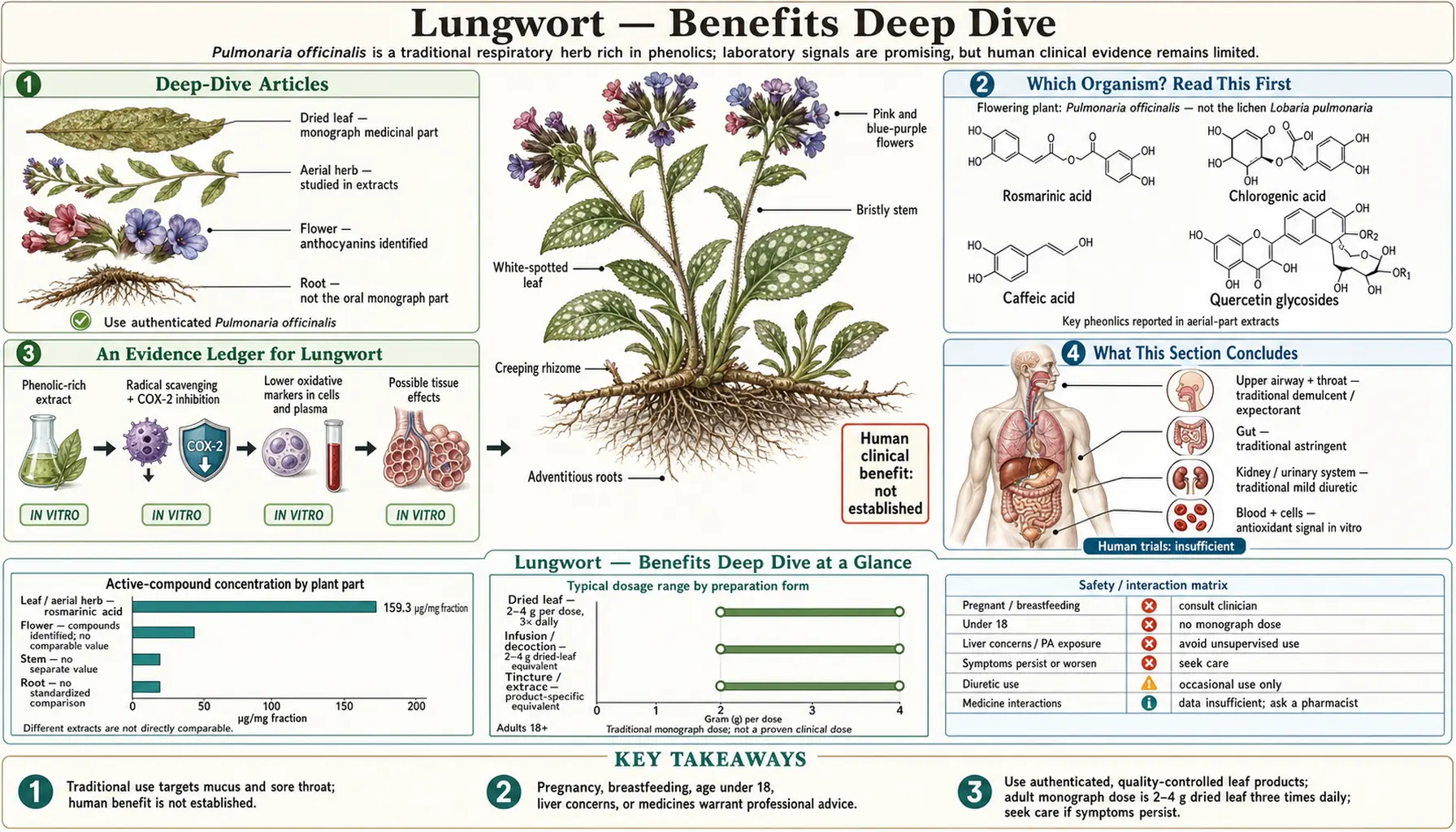
Before anything else: “lungwort” is not one organism. It is a resemblance, and at least two completely unrelated living things have been named for it. Pulmonaria officinalis is a flowering plant in the borage family, whose pale-spotted leaves were read as diseased lung tissue. Lobaria pulmonaria is a lichen — a fungus living in permanent partnership with a green alga and a nitrogen-fixing cyanobacterium, so not a plant at all — whose ridged, pitted surface was read as the inside of a lung. They share a name, a visual analogy and nothing else: no compound class, no habitat, no safety profile and no supply chain. Both are sold today as “lungwort.”
The site's main Lungwort page treats Pulmonaria officinalis, and so do these four pages unless a sentence names the lichen. That labelling is not fussiness. It is the only way to keep the evidence honest, because the commonest error in writing about this herb is quoting a study of one organism as though it described the other.
What follows is an unusual Benefits section, and it is worth saying why up front. For most herbs the interesting question is how strong the evidence is. For lungwort there is essentially no evidence to grade: no adequate controlled human trial exists for either organism, for any respiratory indication. So these pages are about something else — about how a plant acquires a medical reputation from its appearance, about what a serious cough trial would actually measure and why nobody has run one, and about a family-level liver question that is real, unresolved, and routinely reported with a confidence the published measurements do not support. Lungwort turns out to be the clearest case on this site of a name manufacturing an indication, which makes it more instructive than many herbs with better data.
Table of Contents
- Deep-Dive Articles
- Which Organism? Read This First
- An Evidence Ledger for Lungwort
- What This Section Concludes
- Key Research
- External Resources
- Connections
Deep-Dive Articles
Which Lungwort? A Flowering Plant and a Lichen Share the Name
Two organisms from different kingdoms, sold under one name. What each actually is, how to tell dried fragments apart in five checks, why their chemistries do not overlap by a single compound class, and why the lichen carries a conservation problem the plant does not.
Lungwort and the Doctrine of Signatures
The theory that a plant's appearance advertises its use, taken seriously rather than mocked. How the same reasoning assigned a borage relative and a lichen to the same organ from two different visual features — and where signature reasoning led when it landed on Chelidonium and Aristolochia.
Lungwort for Coughs and Chest Complaints
The demulcent rationale at its fairest, then the two places it breaks: a swallowed demulcent cannot reach the bronchi, and alcohol precipitates the mucilage a tincture is supposed to deliver. Ten missing pieces of human evidence, and the seven validated instruments a real cough trial would use.
Lungwort Safety and What Is Genuinely Unknown
The borage-family alkaloid question reported without invented numbers; why co-harvested weeds may matter more than the species; allantoin's real evidence and its wrong route; the lichen's separate profile, including one hazard we refuse to borrow; and twelve unknowns written as findings.
Which Organism? Read This First
A short reference, because everything else depends on it.
- Pulmonaria officinalis — common lungwort. A low woodland perennial of Europe, Boraginaceae. Bristly leaves splashed with pale spots; buds open pink and age to blue. Dried aerial parts appear in herbal texts as Pulmonariae herba. Reported constituents: mucilage, rosmarinic acid and related caffeic-acid oligomers, flavonoids, tannins, silicic acid, allantoin, vitamin C, and trace pyrrolizidine alkaloids of the lycopsamine type. This is the organism the site's Lungwort page treats.
- Lobaria pulmonaria — tree lungwort, lung lichen. A large foliose lichen on the bark of old broadleaf trees; a fungus plus a green alga of the Symbiochloris group plus Nostoc cyanobacteria in internal cephalodia. Reported constituents: the stictic-acid group of depsidones and related lichen depsides. No mucilage, no alkaloids. Slow-growing, dispersal-limited, sensitive to air pollution, and on numerous European red lists.
The practical consequence is one sentence long: buy nothing labelled only “lungwort.” Require the binomial, because without it you cannot apply either safety profile, and no page on this site describes unidentified material.
An Evidence Ledger for Lungwort
This site ranks a herb's evidence against the popular narrative rather than with it. For lungwort that means the famous claim — that it is good for the lungs — sits at the bottom, and the things we actually know sit at the top. Note also the distinction between absent and negative: almost nothing here was tested and failed, which is a different verdict from never tested, and conflating the two would be unfair in both directions.
- Established, and the firmest fact on the page: two unrelated organisms carry this name, and they are separated by more than any two plants could be. Verifiable from taxonomy alone.
- Established, human-independent: the leaf chemistry of Pulmonaria officinalis. Modern profiling shows a phenolic fraction dominated by rosmarinic acid and its oligomers, and that the profile shifts between spring and autumn material.
- Established at family level, unresolved for the species: Boraginaceae members contain pyrrolizidine alkaloids, and 1,2-unsaturated members of that class are hepatotoxic and genotoxic by a well-characterised mechanism. Alkaloids of the lower-potency lycopsamine type have been reported in the genus. How much is in a commercial lungwort tea has never been measured with modern methods.
- Chemically plausible, unquantified: the demulcent action of the leaf's mucilage on the throat. Real mechanism, no measurement of content, no clinical test, and no route by which it could reach the lower airway.
- Demonstrated in vitro only: antioxidant capacity, reduction of peroxynitrite-induced damage in isolated human plasma, COX-2 inhibition, acetylcholinesterase and tyrosinase inhibition. Respectable chemistry, no in-vivo model of any kind.
- Traditional, and pointing at diseases it could not treat: coughs, bronchitis, hoarseness, sore throat — and historically consumption, that is, tuberculosis.
- Inherited without a mechanism: the expectorant label. The traditional reflex-expectorant story depends on saponins, and Pulmonaria is not a saponin plant.
- Absent, not negative: every human endpoint. No trial, no dose-finding, no pharmacokinetics, no interaction study, no toxicology, no surveillance — for either organism.
- Checked and clear: no coumarin-based anticoagulant mechanism, no thiaminase, no stimulant-laxative action, no photosensitisation, no hydroquinone-style duration cap, and no safety implication smuggled into the name. Naming what a herb is not guilty of is part of accuracy.
Read down that list and notice the shape of it: the three best-established facts about lungwort are a fact about names, a fact about chemistry, and a fact about a family-level hazard. Not one of them is a benefit.
What This Section Concludes
Pulmonaria officinalis is a mild, pleasant, historically rich woodland herb whose entire medical reputation was generated by the appearance of its leaves. A warm infusion soothes a sore throat in the modest way that any warm mucilaginous sweetened drink does. Beyond that, there is nothing to report in its favour, and there is one open question — a borage-family alkaloid question — that justifies short and occasional use rather than a daily habit, and firm avoidance in pregnancy, breastfeeding, childhood and liver disease. The asymmetry does the work: unquantified harm on one side, unquantified nothing on the other.
Lobaria pulmonaria we cannot recommend at all. It has no toxicology, no clinical evidence, a chemistry with no demulcent mechanism to appeal to, a documented tendency to accumulate airborne metals and radionuclides because of how lichens absorb water, and a conservation status that makes wild harvesting a poor trade for a tea that does nothing measurable.
If what you want is a soothing traditional respiratory herb, marshmallow root, ribwort plantain, mullein, thyme and honey all deliver the same or better with characterised material and, in several cases, actual trials. If what you want is to understand how herbal medicine acquired its indications, lungwort is one of the most illuminating pages on this site. Those are two different reasons to be here, and only the second one is well served.
Key Research
Grouped by theme, and labelled with the organism, compound or subject actually studied — because for this herb the labelling is the point. Links are PubMed topic and title searches rather than fixed record numbers, so they remain valid as the index grows. Where a body of work is real but poorly indexed, that is stated rather than hidden.
1. Pulmonaria officinalis: Chemistry and In-Vitro Pharmacology
- Krzyżanowska-Kowalczyk and colleagues, “Novel Phenolic Constituents of Pulmonaria officinalis L. LC-MS/MS Comparison of Spring and Autumn Metabolite Profiles,” Molecules, 2018 — PubMed. The best chemical map of the leaf that exists.
- Krzyżanowska-Kowalczyk and colleagues, “Pulmonaria obscura and Pulmonaria officinalis Extracts as Mitigators of Peroxynitrite-Induced Oxidative Stress and Cyclooxygenase-2 Inhibitors,” Molecules, 2021 — PubMed. Two species side by side, in isolated plasma.
- Neagu and colleagues, “Antioxidant activity, acetylcholinesterase and tyrosinase inhibitory potential of Pulmonaria officinalis and Centarium umbellatum extracts,” Saudi Journal of Biological Sciences, 2018 — PubMed. Screening assays; tyrosinase inhibition is a depigmenting property, not a respiratory one.
- A 2025 Pharmaceutics paper on the antioxidant activity and dose-dependent genotoxicity or antigenotoxicity of a Pulmonaria officinalis ethanolic extract — PubMed. Relevant to concentrated extracts; a dose-dependent switch is a caution, not a benefit.
- Rosmarinic acid at compound level — Amoah and colleagues, “Rosmarinic Acid — Pharmaceutical and Clinical Aspects,” Planta Medica, 2016 — PubMed — plus its human pharmacokinetics. A molecule shared with sage, rosemary, lemon balm and self-heal; findings about it are not findings about lungwort.
2. Pyrrolizidine Alkaloids, the Borage Family and the Liver
- Lüthy and colleagues, “Pyrrolizidine alkaloids in medicinal plants of Boraginaceae: Borago officinalis and Pulmonaria officinalis,” Pharmaceutica Acta Helvetiae, 1984 — PubMed. The only direct measurement on the right species; four decades old.
- Haberer and colleagues, “Pyrrolizidine alkaloids in Pulmonaria obscura,” Planta Medica, 2002 — PubMed. A different species, and the true source of the widely repeated “mostly in the roots” claim.
- Moreira and colleagues, “Pyrrolizidine Alkaloids: Chemistry, Pharmacology, Toxicology and Food Safety,” International Journal of Molecular Sciences, 2018 — PubMed. Where the 1,2-unsaturated distinction and the potency ranking come from.
- Yan and colleagues, “Identification of Toxic Pyrrolizidine Alkaloids and Their Common Hepatotoxicity Mechanism,” International Journal of Molecular Sciences, 2016 — PubMed. Cytochrome-P450 bioactivation and sinusoidal injury.
- Zan and colleagues, “Pyrrolizidine alkaloids and health risk of three Boraginaceae used in traditional medicine,” Frontiers in Pharmacology, 2023 — PubMed.
- Herbal-tea contamination and the co-harvested-weed source — PubMed topic search. The finding that shifts the quality question from the species to the supplier.
- Human injury from alkaloid-containing herbal products, including the comfrey veno-occlusive-disease literature — PubMed topic search. Labelled comfrey and relatives, not lungwort.
3. Lobaria pulmonaria: A Lichen, Its Chemistry and Its Conservation
- Lichen chemistry of tree lungwort — stictic-acid-group depsidones, tenuiorin and related depsides — PubMed topic search.
- Photobiont identity, including the reassignment of the Dictyochloropsis group to Symbiochloris — PubMed topic search.
- Dispersal limitation, population genetics and conservation of Lobaria pulmonaria — PubMed topic search. Why it does not return quickly after logging or pollution.
- Lichens as biomonitors of airborne metals, and radiocaesium accumulation after Chernobyl — PubMed topic search. The reason wild-harvested lichen is an uncontrolled exposure as well as an uncontrolled dose.
- Usnic acid hepatotoxicity — the Annals of Internal Medicine (2002), American Journal of Gastroenterology (2004) and Mayo Clinic Proceedings (2006) reports — PubMed topic search. Cited as proof that lichen metabolites can be potently hepatotoxic, and explicitly not as evidence about tree lungwort, which is not documented to contain usnic acid.
- Lichen-substance contact dermatitis — PubMed topic search.
- Toxicology or safety data for tree lungwort — PubMed topic search. Returns nothing usable. The empty result is the finding.
4. Cough: How It Is Measured, and the Remedies That Have Trials
- Eccles, “The powerful placebo in cough studies?”, Pulmonary Pharmacology & Therapeutics, 2002 — PubMed. Why uncontrolled experience of a cough remedy is close to uninformative.
- Eccles, “Mechanisms of the placebo effect of sweet cough syrups,” Respiratory Physiology & Neurobiology, 2006 — PubMed. Sweetness is an active ingredient, which makes a demulcent trial genuinely hard to design.
- Birring and colleagues on the Leicester Cough Questionnaire (Thorax, 2003) and the Leicester Cough Monitor (European Respiratory Journal, 2008) — PubMed.
- European Respiratory Society guidelines on the assessment of cough — PubMed. Capsaicin and citric-acid challenge methodology among them.
- Cochrane review of honey for acute cough in children — PubMed.
- Cochrane review of Pelargonium sidoides for acute respiratory tract infections — PubMed.
- Standardised ivy-leaf extract in acute bronchitis — PubMed topic search — and the thyme-and-primrose fixed combination trialled by Kemmerich and colleagues in Arzneimittelforschung, 2007 — PubMed. Saponin-based reflex expectorants: the mechanism lungwort's chemistry cannot supply.
- Human trials of either lungwort — Pulmonaria and Lobaria — nothing usable for either.
5. Naming, Signatures, and Where Signature Reasoning Led
- Bradley Bennett, “Doctrine of Signatures: An Explanation of Medicinal Plant Discovery or Dissemination of Knowledge?”, Economic Botany, 2007 — PubMed topic search. The strongest modern defence: signatures as a memory system rather than a discovery method. Economic Botany is patchily indexed in PubMed, so a title search may not resolve.
- “Acute hepatitis induced by greater celandine (Chelidonium majus),” Gastroenterology, 1999, and the wider celandine liver-injury literature — PubMed topic search. Yellow sap read as a sign for the liver; the plant reaches the liver as a toxin.
- Aristolochic acid nephropathy and urothelial carcinoma — PubMed topic search. Birthwort was named for a resemblance to the womb and used in childbirth; the genus contains a recognised human carcinogen.
- Eyebright (Euphrasia) for ophthalmic use — PubMed topic search. A useful control case: named for the eye, and nothing followed.
- Lithospermic and salvianolic acids in Boraginaceae and relatives — PubMed topic search. A compound class whose name descends from Lithospermum, “stone seed,” itself a signature name — and which turns up in lungwort's leaf.
External Resources
- Plants of the World Online (Kew) — authoritative nomenclature for Pulmonaria species, synonyms and distribution.
- Royal Botanic Gardens, Kew — botanical and fungal science, including lichen collections.
- GBIF — occurrence records for both organisms, useful for seeing how differently they are distributed.
- British Lichen Society — identification and conservation guidance for Lobaria pulmonaria and other lichens.
- European Food Safety Authority — the pyrrolizidine-alkaloid risk assessments referred to on the safety page.
- European Medicines Agency — herbal monographs and traditional-use registrations; check for yourself that lungwort has none.
- LiverTox (NIH) — clinical reference on drug- and herb-induced liver injury, including the pyrrolizidine-alkaloid class.
- NCCIH — US National Center for Complementary and Integrative Health, for herb overviews written to a similar evidence standard.
- Cochrane Library — the systematic reviews behind the honey and Pelargonium comparators.
- PubMed — run the searches on this page yourself; the empty ones are the informative ones.
- Biodiversity Heritage Library — scanned herbals, where the doctrine-of-signatures sources can be read in the original.
Connections
- All Herbs
- Lungwort — the main topic page, treating Pulmonaria officinalis.
- Which Lungwort? — two organisms, one name.
- Doctrine of Signatures — where the indication came from.
- Lungwort for Coughs — the demulcent case and the missing trials.
- Lungwort Safety — the alkaloid question and twelve unknowns.
- Self-Heal: The Name and What It Promises — the same naming argument for “heal-all.”
- Self-Heal Benefits — a herb whose name is a promise, examined.
- Comfrey Benefits — the borage-family relative with documented human liver injury.
- Comfrey: Wound Healing and Allantoin — allantoin at its proper route.
- Coltsfoot Benefits — another alkaloid-bearing traditional cough herb.
- Coltsfoot: Alkaloids and Liver Risk — the fullest mechanism treatment on the site.
- Mullein Benefits — the other “lung herb,” with a real evidence base.
- Marshmallow Root Benefits — the properly characterised demulcent.
- Plantain Benefits — demulcent versus expectorant, worked through.
- Thyme — a trialled respiratory herb.
- Horehound — a cough herb whose regulatory position needs reading rather than quoting.
- Elecampane — the traditional expectorant root.
- Bronchitis — the condition most often claimed.
- Chronic Cough — when a cough needs investigating.
- Liver Disease — the organ behind the safety caution.